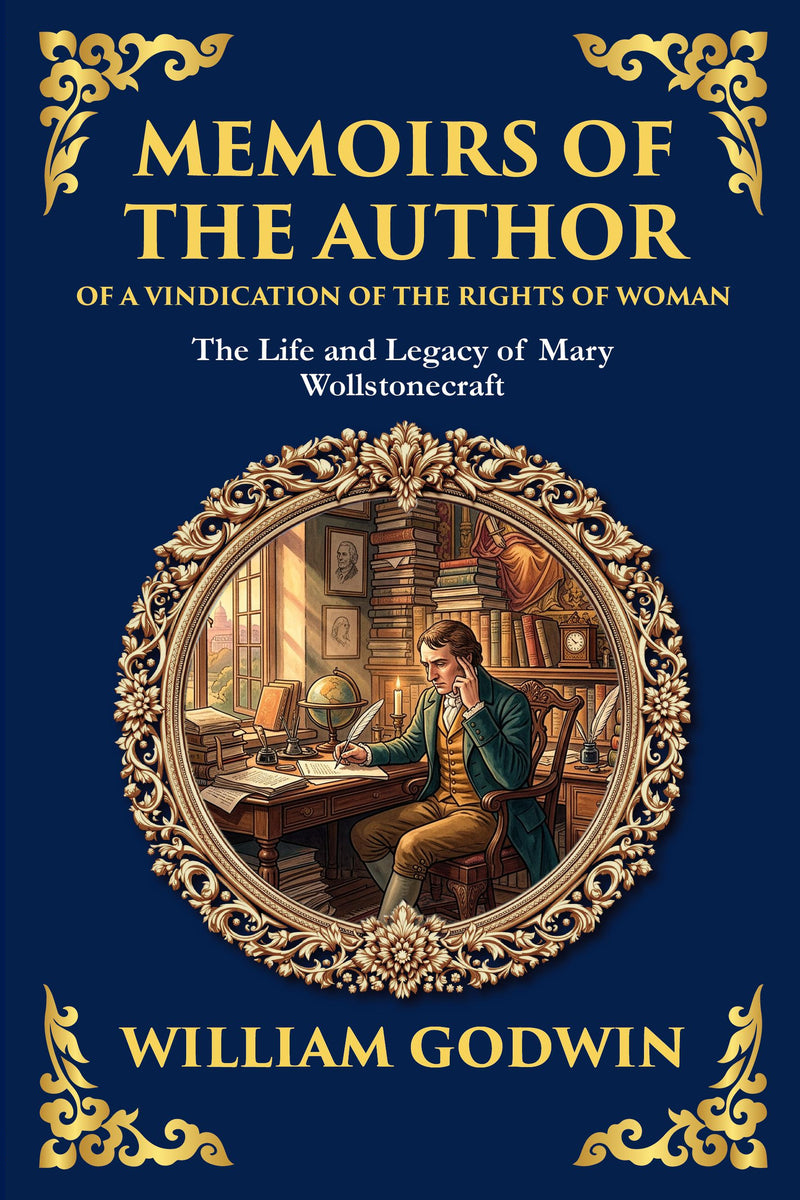
Memoirs of the Author of A Vindication of the Rights of Woman
In this heartfelt and unflinching portrait, philosopher William Godwin memorializes the life of his late wife, Mary Wollstonecraft—one of history’s most groundbreaking thinkers and the author of A Vindication of the Rights of Woman.
or free app
10,000+ hrs library
30-day guarantee
The complete Memoirs of the Author of a Vindication of the Rights of Woman appears in modern English through Library of Alexandria Press, available online with audiobook narration included for members.
What if telling the truth about the woman you love puts her reputation at risk?
In Memoirs of the Author of A Vindication of the Rights of Woman, William Godwin traces Mary Wollstonecraft’s life from a violent childhood to her work as a teacher, translator and political writer. Her search for independence takes her beyond the narrow choices open to a woman without money.
Godwin writes as her husband, grieving her death and caring for their children. He follows her to revolutionary Paris, recounts her relationship with Gilbert Imlay and speaks openly about her despair. He believes honesty honours her genius. Yet his account reveals how a loving tribute can expose its subject to lasting harm.
What you'll discover
- The woman behind the ideas – Meet Wollstonecraft as a worker, writer and mother, not only as a name in history.
- Independence earned through work – Follow her search for a living through the few jobs available to women without money.
- Paris amid the Revolution – Enter a turbulent chapter where political upheaval and her relationship with Gilbert Imlay meet.
- Love without a polished portrait – Discover a husband’s willingness to describe vulnerability alongside the brilliance he wants to honour.
- The cost of candor – Consider how truth told in grief can wound the reputation it seeks to preserve.
Perfect for readers of biography, women’s rights history and the French Revolution, and anyone curious about Godwin’s family.
Open the first page and meet Mary Wollstonecraft through the candid, grieving eyes of William Godwin.
| Formats | eBook (EPUB + PDF) · Audiobook · Paperback · Hardcover · Large Print |
| Language | English |
| Trim size (print) | 6 × 9 in |
| Binding | Paperback — perfect-bound · Hardcover — casewrap |
| Large Print edition | Same text in a larger, easy-read type — a larger font, not a larger trim |
| Print pricing | Every physical book at our true cost — at-cost, no profit (members) |
| Library | 873 restored titles, always growing |
| Length | 24,988 words · ~1 hr 40 min reading |
| Reading level | Grade 11 · a confident, adult read (this modern-English edition) |
| Edition | Modern English translation · 2026 |
Member reviews for this edition are collected as readers finish it — be the first. Across the library: 12,000+ books shipped, every plan covered by a 365-day print guarantee.
About this edition
A faithful, unabridged modern-English edition by The Library of Alexandria — carefully rendered for today's reader and verified paragraph-by-paragraph against the public-domain source. Available as eBook, audiobook, paperback, hardcover, and large print.
- Complete & unabridgedVerified paragraph by paragraph against the source — never a scan, never abridged.
- Modern English, faithfulReadable today, with the author’s meaning kept intact. Readable — not simplified.
- Every format, one membershipRead in your browser or the free app, or listen to the full audiobook.
Included free with your membership
Cancel anytime, one click · 30-day money-back guarantee
Edition last updated July 2026
What’s inside
Memoirs of the Author of A Vindication of the Rights of Woman — complete and unabridged: all 11 sections included with membership, plus the full audiobook.
Begin reading Memoirs of the Author of A Vindication of the Rights of Woman
In clear modern English — the complete text is included with membership.
Introduction
When William Godwin sat down to write the life of his late wife, he believed he was performing an act of love and homage. He had buried Mary Wollstonecraft only weeks before, in September of 1797, after she died from complications following the birth of their daughter—a daughter who would one day write Frankenstein and become Mary Shelley. Grief-stricken but resolute, Godwin felt that the world owed a debt to the woman he had married, and that the best way to honor her was to tell the truth about her, plainly and without ornament. He could not have anticipated that his tribute would ignite one of the most ferocious controversies of the age, that it would damage his wife’s reputation for nearly a century, or that it would eventually be recognized as a pioneering work in the history of biography. The book you are about to read is at once a confession, a defense, a philosophical statement, and an extraordinary portrait of one of the most remarkable women who ever lived.
This modern translation has been prepared to make Godwin’s eighteenth-century prose accessible to the contemporary reader without sacrificing the dignity, intelligence, and emotional honesty of the original. Godwin wrote in the elaborate, sometimes circuitous style of the late Enlightenment, with long periodic sentences and a vocabulary that has shifted considerably over two centuries. What follows in these pages preserves his meaning, his arguments, and the warmth of his attachment to his subject, while smoothing the path for readers who might otherwise stumble over archaic constructions. The aim has been to let Mary Wollstonecraft’s life shine through as vividly as Godwin first intended it to, and to allow his own voice—reasoned, devoted, occasionally blind to the dangers of his own candor—to come through clearly.
A Marriage of Minds and the Origins of the Memoir
To understand this book, it helps to understand the two extraordinary people at its center. Mary Wollstonecraft was, by the time of her death at thirty-eight, already a figure of international significance. Her A Vindication of the Rights of Woman, published in 1792, had argued with unprecedented force that women were not naturally inferior to men but only appeared so because they were denied the education that would allow them to develop their reason. She insisted that women were rational creatures deserving of the same intellectual cultivation as men, and that the happiness of both sexes—indeed, the moral progress of the entire human race—depended on treating women as full participants in the life of the mind. These ideas, commonplace now, were genuinely radical then, and they made Wollstonecraft both celebrated and notorious.
But she was far more than the author of a single influential book. She had been a teacher, a governess, a translator, a literary critic, and a writer of novels and travel literature. She had thrown herself into the political ferment surrounding the French Revolution, traveling to Paris during its most dangerous years and witnessing firsthand the collapse of the hopes that the Revolution had once inspired in liberal minds across Europe. She had loved passionately and suffered profoundly, enduring betrayals and disappointments that drove her, at her lowest points, to attempt to end her own life. She had borne a child outside of marriage, defying the conventions of her time, and she had supported herself by her pen at a moment when independent women writers were rare and frequently scorned. Her life was, in short, a sequence of struggles against the limitations imposed on her by birth, by poverty, and by the expectations placed upon her sex.
William Godwin, her husband for the final months of her life, was himself one of the most prominent thinkers of the period. A former dissenting minister who had abandoned organized religion, Godwin had achieved fame with his Enquiry Concerning Political Justice, a sweeping philosophical work that championed reason, individual judgment, and the perfectibility of mankind, while expressing deep skepticism about institutions including government, property, and—notoriously—marriage. He believed that human beings should be governed by reason rather than by custom or law, and that institutions which constrained individual freedom should be examined critically and, where unjustifiable, dismantled. When he and Wollstonecraft fell in love, they were two intellectual equals who shared a profound commitment to honesty and a suspicion of social convention. They lived, at first, in separate residences even after they became attached, an arrangement designed to preserve their independence. They married only when Wollstonecraft became pregnant, and they did so partly to protect their child, even though both had publicly expressed reservations about the institution of marriage.
Godwin’s decision to write the Memoirs flowed directly from the philosophy he had spent his life developing. He believed that truth was always preferable to concealment, that the honest examination of a human life was both instructive and morally elevating, and that to hide or prettify the facts of his wife’s experience would be a betrayal of everything she had stood for. He resolved, therefore, to tell everything: her love affairs, her child born out of wedlock, her suicide attempts, her emotional turbulence, and the unconventional nature of their own relationship. He believed that by presenting Wollstonecraft as she truly was—flawed, passionate, courageous, and human—he would offer the world a more valuable and more honest tribute than any sanitized hagiography could provide.
He was, in a sense, terribly wrong about how this would be received, and at the same time profoundly right about what he had achieved. The candor that scandalized his contemporaries is precisely what makes the Memoirs so valuable to us today. Godwin did not yet know that he was inventing a new kind of biography—one that treated its subject as a complete human being rather than as a marble statue of virtue. He simply did what his principles required, and in doing so he produced a document of startling intimacy and emotional power.
The writing itself was an act of mourning. Godwin composed the Memoirs in the months immediately following Wollstonecraft’s death, working through his grief by reconstructing her life. He drew on her own letters, on her published and unpublished writings, on the recollections of her friends, and on his own memories of their time together. The book is therefore not a dispassionate scholarly exercise but a deeply personal work, written by a man still raw with loss. There is a tenderness in his account, even when he is describing her failings, that reveals how completely he had come to admire and love her. He does not flinch from her mistakes, but he never condemns her for them; instead, he tries to understand the circumstances that shaped her, the pressures she faced, and the strength she showed in confronting them.
The Scandal, the Suppression, and the Slow Vindication
The publication of the Memoirs in early 1798 produced an explosion of outrage. Godwin had anticipated some criticism, but he was unprepared for the savagery of the response. Conservative reviewers, already hostile to Wollstonecraft’s feminist ideas and to Godwin’s radical philosophy, seized upon the revelations in the book as proof that her advocacy of women’s rights was nothing more than a cover for immorality. They portrayed her as a fallen woman whose private life discredited her public arguments. One particularly vicious index to a periodical of the time listed her under the heading “Prostitution,” a slander made possible only because Godwin had so honestly described her relationships. The Memoirs became, in the hands of her enemies, a weapon to be used against her and against the cause she had championed.
The damage was severe and long-lasting. For much of the nineteenth century, Wollstonecraft’s name was associated less with her ideas than with the supposed scandal of her life. Respectable women hesitated to be seen reading her work, and her reputation as a serious thinker was eclipsed by gossip about her conduct. Godwin, who had meant to honor her, found that he had instead given her detractors all the ammunition they needed. The political climate did not help: in the reactionary atmosphere following the excesses of the French Revolution, anything that smacked of radicalism, free thought, or challenges to traditional morality was viewed with suspicion and alarm. Wollstonecraft and Godwin, as standard-bearers of revolutionary ideals, became convenient targets.
It is worth pausing to consider the cruelty of this reception, because it illuminates one of the central themes of Wollstonecraft’s own thought. She had argued that women were judged by a different and harsher standard than men, that their entire worth was reduced to their sexual reputation, and that this double standard was both unjust and destructive. The fate of the Memoirs proved her point with terrible exactness. The very behavior that would have been overlooked or even admired in a man—the pursuit of love, the willingness to take emotional risks, the refusal to be bound by stifling convention—was used to destroy a woman’s standing. Godwin, by telling the truth, had inadvertently demonstrated the injustice his wife had spent her life fighting against.
Yet the story does not end in defeat. Over the course of the nineteenth and especially the twentieth centuries, Wollstonecraft’s reputation underwent a profound revival. As the movement for women’s rights gained momentum, later generations rediscovered her Vindication and recognized her as a foundational figure—a prophet who had articulated, decades before her time, the principles that would animate the struggle for women’s equality. And as attitudes toward biography and toward private morality evolved, Godwin’s Memoirs came to be appreciated not as a scandalous betrayal but as a brave and innovative work. Modern scholars now regard it as one of the first modern biographies, a pioneering attempt to portray a human life with full honesty rather than to construct a flattering legend. The candor that had once seemed shocking now appears as integrity; the willingness to show a great woman as a complete and complicated person now seems not a betrayal but a gift.
There is a particular poignancy in the fact that the woman whose reputation the Memoirs once threatened to bury is now more celebrated than ever, while the book itself has been rehabilitated as a landmark of literary and intellectual history. Time has reversed the verdict of Wollstonecraft’s contemporaries. The qualities that her detractors condemned—her independence, her passion, her refusal to live by other people’s rules—are precisely the qualities that make her so compelling to readers today. And Godwin’s refusal to hide those qualities, far from diminishing her, has allowed her to come down to us as a living, breathing woman rather than a remote icon.
As you read, you will encounter a Mary Wollstonecraft who is sometimes difficult, sometimes wrong, frequently in turmoil, and always extraordinary. You will see her caring for her siblings at great cost to herself, throwing herself into friendships and love affairs with an intensity that sometimes consumed her, struggling to earn a living in a world that offered women almost no respectable means of doing so, and forging a literary career through sheer determination and talent. You will see her in moments of deep despair and in moments of triumph. And you will see her, finally, finding a measure of happiness in her relationship with Godwin himself—a relationship between equals, founded on mutual respect and genuine affection, that represented in miniature the kind of union she had argued the whole world should aspire to.
How to Read This Book and What to Carry with You
It is useful, before beginning, to set aside certain modern expectations about what a biography should be. Godwin was not writing in our tradition, and his book does not always conform to contemporary conventions. He sometimes pauses to reflect on his own philosophical principles, to draw moral lessons, or to defend his subject against anticipated criticism. He organizes his account chronologically but with frequent digressions, and he interweaves his own opinions with his narration of events. He does not always provide the kind of documentary precision that a modern biographer would consider essential; some of his dates and details have been corrected by later scholarship. What he offers instead is something perhaps more valuable: a portrait drawn from intimate personal knowledge, suffused with the perspective of a man who knew and loved his subject, and shaped by a coherent philosophy of human nature.
Cancel anytime, one click · 30-day money-back guarantee
Founding annual rate available now — your price locks for life when you join.
Not ready? Get this free chapter by email — read it anytime.
✓ Sent — check your inbox for Memoirs of the Author of A Vindication of the Rights of Woman.
Questions about Memoirs of the Author of A Vindication of the Rights of Woman
What is Memoirs of the Author of A Vindication of the Rights of Woman about?
It is a short biography of Mary Wollstonecraft, written by her husband William Godwin soon after her death. It follows her childhood, her work as a teacher and writer, her time in Paris, her relationships and her marriage.
Why did Godwin's memoir of Mary Wollstonecraft cause a scandal?
Godwin told the truth about her private life, including her relationship with Gilbert Imlay, a child born outside marriage and two suicide attempts. Many readers of the 1790s were shocked, and her reputation suffered for a long time.
Who was Mary Wollstonecraft?
She was an English writer and thinker of the late eighteenth century. She is best known for A Vindication of the Rights of Woman, which argued that women should receive the same education as men and be treated as rational beings.
When was Godwin's Memoirs of Mary Wollstonecraft published?
It was published in January 1798, a few months after Wollstonecraft died in September 1797. Godwin wrote it quickly, and it is a true account by a husband who knew her well.
Shipping & returns
Billing & membership
More from the library


Explore Biography & Letters
- The Confessions of St. Augustine · Saint Augustine of Hippo
- Autobiography of a Yogi — Large Print · Paramahansa Yogananda
- The Confessions of Jean Jacques Rousseau — Complete · Jean-Jacques Rousseau
- Ecce Homo · Friedrich Wilhelm Nietzsche
- De Profundis · Oscar Wilde
- Memoirs of Joseph Grimaldi — Large Print · Joseph Grimaldi
- Anabasis — Large Print · Xenophon
- Anabasis · Xenophon
- English Eccentrics and Eccentricities — Large Print · John Timbs
- The Confessions of St. Augustine — Large Print · Saint Augustine of Hippo
- Memoirs of the Author of A Vindication of the Rights of Woman — Large Print · William Godwin
- You Can't Win — Large Print · Jack Black
- The Love Letters of Mary Wollstonecraft to Gilbert Imlay — Large Print · Mary Wollstonecraft
- Eighty Years and More; Reminiscences 1815–1897 — Large Print · Elizabeth Cady Stanton
- Random Reminiscences of Men and Events — Large Print · John D. Rockefeller
- De Profundis — Large Print · Oscar Wilde
- Walden, and On The Duty Of Civil Disobedience — Large Print · Henry David Thoreau
- Elizabeth, Empress of Austria and Queen of Hungary — Large Print · Carl Küchler
- The Confessions of Jean Jacques Rousseau — Complete — Large Print · Jean-Jacques Rousseau
- Society as I Have Found It — Large Print · Ward McAllister
- The Germany and the Agricola of Tacitus — Large Print · Cornelius Tacitus
- The Memorabilia — Large Print · Xenophon
- The Germany and the Agricola of Tacitus · Cornelius Tacitus
- The Memorabilia · Xenophon
- The Way to the West, and the Lives of Three Early Americans — Large Print · Emerson Hough
- Sailing Alone Around the World — Large Print · Joshua Slocum
- The Way to the West, and the Lives of Three Early Americans · Emerson Hough
- The Oregon Trail: Sketches of Prairie and Rocky-Mountain Life — Large Print · Francis Parkman
- Sailing Alone Around the World · Joshua Slocum
- The Wanderings of a Spiritualist — Large Print · Arthur Conan Doyle
Memoirs of the Author of A Vindication of the Rights of Woman
Memoirs of the Author of A Vindication of the Rights of Woman
The Life and Legacy of Mary Wollstonecraft
William Godwin
Contents
- Introduction
- Chapter 1
- Chapter 2
- Chapter 3
- Chapter 4
- Chapter 5
- Chapter 6
- Chapter 7
- Chapter 8
- Chapter 9
- Chapter 10
Introduction
When William Godwin sat down to write the life of his late wife, he believed he was performing an act of love and homage. He had buried Mary Wollstonecraft only weeks before, in September of 1797, after she died from complications following the birth of their daughter—a daughter who would one day write Frankenstein and become Mary Shelley. Grief-stricken but resolute, Godwin felt that the world owed a debt to the woman he had married, and that the best way to honor her was to tell the truth about her, plainly and without ornament. He could not have anticipated that his tribute would ignite one of the most ferocious controversies of the age, that it would damage his wife’s reputation for nearly a century, or that it would eventually be recognized as a pioneering work in the history of biography. The book you are about to read is at once a confession, a defense, a philosophical statement, and an extraordinary portrait of one of the most remarkable women who ever lived.
This modern translation has been prepared to make Godwin’s eighteenth-century prose accessible to the contemporary reader without sacrificing the dignity, intelligence, and emotional honesty of the original. Godwin wrote in the elaborate, sometimes circuitous style of the late Enlightenment, with long periodic sentences and a vocabulary that has shifted considerably over two centuries. What follows in these pages preserves his meaning, his arguments, and the warmth of his attachment to his subject, while smoothing the path for readers who might otherwise stumble over archaic constructions. The aim has been to let Mary Wollstonecraft’s life shine through as vividly as Godwin first intended it to, and to allow his own voice—reasoned, devoted, occasionally blind to the dangers of his own candor—to come through clearly.
A Marriage of Minds and the Origins of the Memoir
To understand this book, it helps to understand the two extraordinary people at its center. Mary Wollstonecraft was, by the time of her death at thirty-eight, already a figure of international significance. Her A Vindication of the Rights of Woman, published in 1792, had argued with unprecedented force that women were not naturally inferior to men but only appeared so because they were denied the education that would allow them to develop their reason. She insisted that women were rational creatures deserving of the same intellectual cultivation as men, and that the happiness of both sexes—indeed, the moral progress of the entire human race—depended on treating women as full participants in the life of the mind. These ideas, commonplace now, were genuinely radical then, and they made Wollstonecraft both celebrated and notorious.
But she was far more than the author of a single influential book. She had been a teacher, a governess, a translator, a literary critic, and a writer of novels and travel literature. She had thrown herself into the political ferment surrounding the French Revolution, traveling to Paris during its most dangerous years and witnessing firsthand the collapse of the hopes that the Revolution had once inspired in liberal minds across Europe. She had loved passionately and suffered profoundly, enduring betrayals and disappointments that drove her, at her lowest points, to attempt to end her own life. She had borne a child outside of marriage, defying the conventions of her time, and she had supported herself by her pen at a moment when independent women writers were rare and frequently scorned. Her life was, in short, a sequence of struggles against the limitations imposed on her by birth, by poverty, and by the expectations placed upon her sex.
William Godwin, her husband for the final months of her life, was himself one of the most prominent thinkers of the period. A former dissenting minister who had abandoned organized religion, Godwin had achieved fame with his Enquiry Concerning Political Justice, a sweeping philosophical work that championed reason, individual judgment, and the perfectibility of mankind, while expressing deep skepticism about institutions including government, property, and—notoriously—marriage. He believed that human beings should be governed by reason rather than by custom or law, and that institutions which constrained individual freedom should be examined critically and, where unjustifiable, dismantled. When he and Wollstonecraft fell in love, they were two intellectual equals who shared a profound commitment to honesty and a suspicion of social convention. They lived, at first, in separate residences even after they became attached, an arrangement designed to preserve their independence. They married only when Wollstonecraft became pregnant, and they did so partly to protect their child, even though both had publicly expressed reservations about the institution of marriage.
Godwin’s decision to write the Memoirs flowed directly from the philosophy he had spent his life developing. He believed that truth was always preferable to concealment, that the honest examination of a human life was both instructive and morally elevating, and that to hide or prettify the facts of his wife’s experience would be a betrayal of everything she had stood for. He resolved, therefore, to tell everything: her love affairs, her child born out of wedlock, her suicide attempts, her emotional turbulence, and the unconventional nature of their own relationship. He believed that by presenting Wollstonecraft as she truly was—flawed, passionate, courageous, and human—he would offer the world a more valuable and more honest tribute than any sanitized hagiography could provide.
He was, in a sense, terribly wrong about how this would be received, and at the same time profoundly right about what he had achieved. The candor that scandalized his contemporaries is precisely what makes the Memoirs so valuable to us today. Godwin did not yet know that he was inventing a new kind of biography—one that treated its subject as a complete human being rather than as a marble statue of virtue. He simply did what his principles required, and in doing so he produced a document of startling intimacy and emotional power.
The writing itself was an act of mourning. Godwin composed the Memoirs in the months immediately following Wollstonecraft’s death, working through his grief by reconstructing her life. He drew on her own letters, on her published and unpublished writings, on the recollections of her friends, and on his own memories of their time together. The book is therefore not a dispassionate scholarly exercise but a deeply personal work, written by a man still raw with loss. There is a tenderness in his account, even when he is describing her failings, that reveals how completely he had come to admire and love her. He does not flinch from her mistakes, but he never condemns her for them; instead, he tries to understand the circumstances that shaped her, the pressures she faced, and the strength she showed in confronting them.
The Scandal, the Suppression, and the Slow Vindication
The publication of the Memoirs in early 1798 produced an explosion of outrage. Godwin had anticipated some criticism, but he was unprepared for the savagery of the response. Conservative reviewers, already hostile to Wollstonecraft’s feminist ideas and to Godwin’s radical philosophy, seized upon the revelations in the book as proof that her advocacy of women’s rights was nothing more than a cover for immorality. They portrayed her as a fallen woman whose private life discredited her public arguments. One particularly vicious index to a periodical of the time listed her under the heading “Prostitution,” a slander made possible only because Godwin had so honestly described her relationships. The Memoirs became, in the hands of her enemies, a weapon to be used against her and against the cause she had championed.
The damage was severe and long-lasting. For much of the nineteenth century, Wollstonecraft’s name was associated less with her ideas than with the supposed scandal of her life. Respectable women hesitated to be seen reading her work, and her reputation as a serious thinker was eclipsed by gossip about her conduct. Godwin, who had meant to honor her, found that he had instead given her detractors all the ammunition they needed. The political climate did not help: in the reactionary atmosphere following the excesses of the French Revolution, anything that smacked of radicalism, free thought, or challenges to traditional morality was viewed with suspicion and alarm. Wollstonecraft and Godwin, as standard-bearers of revolutionary ideals, became convenient targets.
It is worth pausing to consider the cruelty of this reception, because it illuminates one of the central themes of Wollstonecraft’s own thought. She had argued that women were judged by a different and harsher standard than men, that their entire worth was reduced to their sexual reputation, and that this double standard was both unjust and destructive. The fate of the Memoirs proved her point with terrible exactness. The very behavior that would have been overlooked or even admired in a man—the pursuit of love, the willingness to take emotional risks, the refusal to be bound by stifling convention—was used to destroy a woman’s standing. Godwin, by telling the truth, had inadvertently demonstrated the injustice his wife had spent her life fighting against.
Yet the story does not end in defeat. Over the course of the nineteenth and especially the twentieth centuries, Wollstonecraft’s reputation underwent a profound revival. As the movement for women’s rights gained momentum, later generations rediscovered her Vindication and recognized her as a foundational figure—a prophet who had articulated, decades before her time, the principles that would animate the struggle for women’s equality. And as attitudes toward biography and toward private morality evolved, Godwin’s Memoirs came to be appreciated not as a scandalous betrayal but as a brave and innovative work. Modern scholars now regard it as one of the first modern biographies, a pioneering attempt to portray a human life with full honesty rather than to construct a flattering legend. The candor that had once seemed shocking now appears as integrity; the willingness to show a great woman as a complete and complicated person now seems not a betrayal but a gift.
There is a particular poignancy in the fact that the woman whose reputation the Memoirs once threatened to bury is now more celebrated than ever, while the book itself has been rehabilitated as a landmark of literary and intellectual history. Time has reversed the verdict of Wollstonecraft’s contemporaries. The qualities that her detractors condemned—her independence, her passion, her refusal to live by other people’s rules—are precisely the qualities that make her so compelling to readers today. And Godwin’s refusal to hide those qualities, far from diminishing her, has allowed her to come down to us as a living, breathing woman rather than a remote icon.
As you read, you will encounter a Mary Wollstonecraft who is sometimes difficult, sometimes wrong, frequently in turmoil, and always extraordinary. You will see her caring for her siblings at great cost to herself, throwing herself into friendships and love affairs with an intensity that sometimes consumed her, struggling to earn a living in a world that offered women almost no respectable means of doing so, and forging a literary career through sheer determination and talent. You will see her in moments of deep despair and in moments of triumph. And you will see her, finally, finding a measure of happiness in her relationship with Godwin himself—a relationship between equals, founded on mutual respect and genuine affection, that represented in miniature the kind of union she had argued the whole world should aspire to.
How to Read This Book and What to Carry with You
It is useful, before beginning, to set aside certain modern expectations about what a biography should be. Godwin was not writing in our tradition, and his book does not always conform to contemporary conventions. He sometimes pauses to reflect on his own philosophical principles, to draw moral lessons, or to defend his subject against anticipated criticism. He organizes his account chronologically but with frequent digressions, and he interweaves his own opinions with his narration of events. He does not always provide the kind of documentary precision that a modern biographer would consider essential; some of his dates and details have been corrected by later scholarship. What he offers instead is something perhaps more valuable: a portrait drawn from intimate personal knowledge, suffused with the perspective of a man who knew and loved his subject, and shaped by a coherent philosophy of human nature.
I have always believed that it is the duty of those left behind to provide the public with an account of the life of a deceased person of great merit. It is rare for such a person to live their life without facing careless insults or malicious lies. The general public cannot possibly have the same perspective as those who knew them intimately, nor can they witness the virtues that are mostly revealed through personal interaction. Every person who helps humanity is driven, to some extent, by a natural desire for recognition; therefore, those who survive them only pay their debt to these benefactors when they help uphold and establish the honor that the deceased cherished. By doing justice to these famous figures, we create a beautiful source of inspiration and encouragement for those who wish to follow in their footsteps. All of humanity benefits from this fairness, as it teaches us to respect and love the qualities that most deserve such admiration. I am convinced that the more complete the portrait and story of a person like the subject of this narrative, the more we will feel a connection to their life and a kinship with their greatness. There are few people whose character is more closely tied to the welfare and progress of the public than the author of A Vindication of the Rights of Woman.
The details in the following pages come mostly from the person they are about. Anyone who knew her likely has no doubt about her honesty and sincerity. Whenever the author of this account met people who truly interested him or whom he grew fond of, he always felt a curiosity to learn about the places they had lived and the events that shaped their minds and characters. Driven by this feeling, he often steered his conversations with Mary toward these topics. Once or twice, he took notes while she was present on a few specific dates to help him organize the timeline of her life. To the information gathered this way, he added a thorough investigation by interviewing the people who knew her best during the different stages of her life.
End of the free sample
Keep reading, free
Members read and listen to the complete book — and the entire library. Cancel anytime, one click · 30-day money-back guarantee.