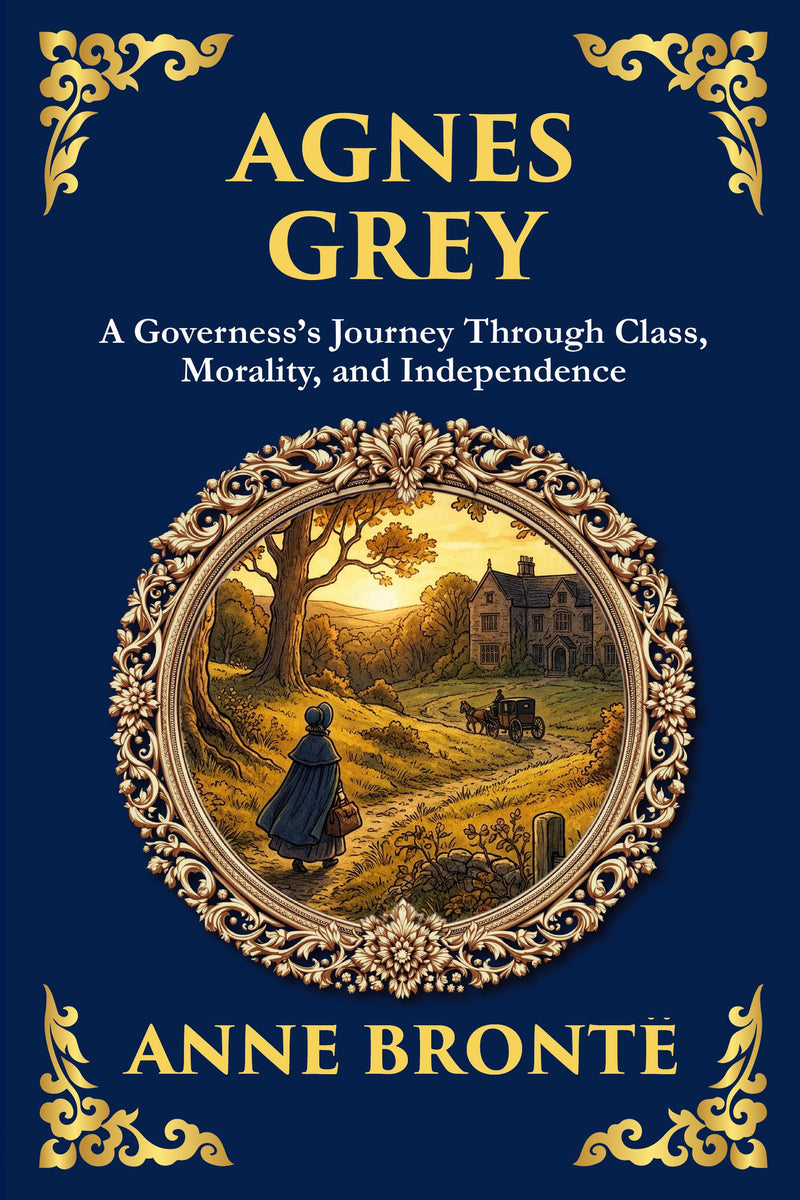
Agnes Grey
Anne Brontë’s Agnes Grey is a quietly powerful tale of perseverance, dignity, and moral strength. Following the life of a young governess navigating the harsh realities of Victorian England, the story reveals how one woman’s courage and principles can withstand a society obsessed with wealth and status.
or free app
10,000+ hrs library
30-day guarantee
The complete Agnes Grey appears in modern English through Library of Alexandria Press, available online with audiobook narration included for members.
Have you ever wondered why morality, class, and quiet resistance still resonate through the centuries? In Agnes Grey, Anne Brontë paints an unflinching portrait of the challenges faced by a governess in 19th-century England—exposing the injustices of class, the complexities of family, and the quiet strength found in moral conviction. Told through the eyes of Agnes herself, the novel chronicles her attempts to maintain dignity while working within households that view her as invisible.
Yet through adversity, she finds an inner resilience that not only challenges societal norms but redefines what it means to live a life of integrity. This modern edition brings Brontë’s eloquent prose and social insight to contemporary readers, inviting them to reflect on timeless issues of gender, power, and identity.
What you’ll discover in this modern edition
- A Groundbreaking Perspective on Female Independence Step into the shoes of Agnes Grey and witness the quiet strength required to maintain dignity in a dismissive world.
| Formats | eBook (EPUB + PDF) · Audiobook · Paperback · Hardcover · Large Print |
| Language | English |
| Trim size (print) | 6 × 9 in |
| Binding | Paperback — perfect-bound · Hardcover — casewrap |
| Large Print edition | Same text in a larger, easy-read type — a larger font, not a larger trim |
| Print pricing | Every physical book at our true cost — at-cost, no profit (members) |
| Library | 873 restored titles, always growing |
| Length | 66,910 words · ~4 hr 28 min reading |
| Reading level | Grade 8 · an easy, flowing read (this modern-English edition) |
| Edition | Modern English translation · 2026 |
Member reviews for this edition are collected as readers finish it — be the first. Across the library: 12,000+ books shipped, every plan covered by a 365-day print guarantee.
About this edition
A faithful, unabridged modern-English edition by The Library of Alexandria — carefully rendered for today's reader and verified paragraph-by-paragraph against the public-domain source. Available as eBook, audiobook, paperback, hardcover, and large print.
- Complete & unabridgedVerified paragraph by paragraph against the source — never a scan, never abridged.
- Modern English, faithfulReadable today, with the author’s meaning kept intact. Readable — not simplified.
- Every format, one membershipRead in your browser or the free app, or listen to the full audiobook.
Included free with your membership
Cancel anytime, one click · 30-day money-back guarantee
Edition last updated July 2026
What’s inside
Agnes Grey — complete and unabridged: all 26 sections included with membership, plus the full audiobook.
Begin reading Agnes Grey
In clear modern English — the complete text is included with membership.
Introduction
There is a particular kind of courage that does not announce itself. It does not raise its voice or storm the gates; it simply endures, observes, and refuses to be erased. This quiet steadfastness lies at the very heart of the slim, unassuming novel you are about to read, and it is precisely what has allowed this book to outlast the fashionable sensations of its own era and speak so directly to readers nearly two centuries later. First published in 1847, the same extraordinary year that produced Jane Eyre and Wuthering Heights, this work has too often been overshadowed by the more flamboyant achievements of the author’s sisters. Yet to read it on its own terms is to discover a novel of remarkable restraint, moral seriousness, and emotional honesty—a book that trusts the truth of ordinary experience to carry its own dramatic weight.
Anne Brontë was the youngest of the three literary sisters who, writing from a remote parsonage on the Yorkshire moors, would change the course of English fiction. Where Charlotte reached for grandeur and Emily for the sublime and elemental, Anne pursued something quieter and, in its way, more radical: the unvarnished reality of a young woman’s working life. The result is a novel that refuses to flatter, refuses to exaggerate, and refuses to let its heroine off the hook of difficult moral choices. It is a book that grew directly out of lived experience—Anne herself worked as a governess for several years, and she poured the frustrations, humiliations, and small triumphs of that experience into these pages with an unsentimental clarity that startled some of her first readers. She was, in her own words, determined “to tell the truth,” and that determination gives the narrative a bracing freshness even today.
This edition has been prepared as a modern translation, carefully adapted for the contemporary reader. That phrase deserves a moment of explanation, because it is easy to misunderstand. The intention behind this adaptation is not to rewrite the author or to flatten the distinctive texture of her prose, but rather to gently smooth the obstacles that nineteenth-century language can place between a modern reader and the genuine pleasures of the story. Certain archaic constructions, obscure idioms, and conventions of punctuation and phrasing that might cause a present-day reader to stumble have been thoughtfully clarified, so that the emotional and intellectual current of the book can flow without unnecessary interruption. What remains intact is the voice—the wry, observant, morally attentive voice of a narrator who notices everything and judges fairly. The goal throughout has been to honor the original while ensuring that nothing stands between you and the experience the author intended you to have. You should come away feeling that you have met the real book, only with the dust of two centuries gently brushed away.
A Young Woman's World, Rendered Without Illusion
To understand why this novel matters, it helps to understand the peculiar position of the governess in the society it depicts. In early Victorian England, a governess occupied one of the strangest and most uncomfortable social locations imaginable. She was, by birth and education, a lady—often the daughter of a clergyman or a family fallen on hard times—and yet she was also, undeniably, a paid employee. This made her something of a social paradox. She was too refined to eat with the servants and too dependent to be treated as an equal by the family that employed her. She lived in a kind of perpetual limbo, present in the most intimate spaces of a household yet belonging to none of them, expected to mold the characters of children over whom she had been given responsibility but almost no real authority. She was, in effect, expected to perform miracles of moral education while being systematically undermined by the very parents who had hired her.
For thousands of educated but impoverished young women, this was not an abstract dilemma but a daily reality, and it is one that the author knew firsthand. The governess was one of the few respectable employments available to a woman of her class who needed to earn a living, and the demand for such positions vastly outstripped the supply, leaving governesses poorly paid, easily replaced, and frequently exploited. Our narrator enters this world with all the hopeful confidence of youth, eager to prove herself useful, eager to contribute to her family’s strained finances, and eager—perhaps most poignantly—to experience something of the wider world beyond the loving but confined circle of her home. What she encounters is an education of a different kind: an education in how the comfortable classes regard those who serve them, in the casual cruelties that wealth permits itself, and in the resilience required to keep one’s sense of self intact when every external circumstance seems designed to wear it down.
What makes the novel so compelling is not melodrama but accumulation. The author understood something that many novelists miss: that real suffering and real moral testing rarely come in the form of grand catastrophes. They come, instead, in the form of countless small indignities, daily frustrations, and the slow grinding-down of expectations. The misbehavior of spoiled children, the indifference or hostility of their parents, the loneliness of a young woman cut off from companionship and sympathy—these are the materials from which the narrative builds its quiet power. And yet, crucially, the book is never merely an exercise in grievance. Its narrator is too intelligent, too self-aware, and too genuinely good to descend into self-pity. She observes the failings of those around her with a sharp eye, but she also holds herself to the same exacting standards. She is constantly examining her own conduct, her own motives, her own reactions, asking whether she has behaved well, whether she has been fair, whether she has lived up to the principles she professes.
This self-scrutiny is one of the novel’s great strengths and one of the reasons it feels so modern. We live in an age that is, in its own way, deeply concerned with questions of authenticity, integrity, and the relationship between one’s private values and one’s public conduct. The narrator’s relentless honesty with herself, her refusal to take the easy comforts of self-justification, gives her a moral seriousness that commands respect. She is not a passive sufferer waiting to be rescued; she is an active moral agent, continually choosing how to respond to the difficulties life places before her. And because the author renders her interior life with such precision and such honesty, we come to know her not as a type or a symbol but as a fully realized human being—someone whose company we genuinely value, whose judgments we come to trust, and whose well-being we come to care about deeply.
It is worth pausing on the question of class, which the subtitle rightly identifies as one of the book’s central concerns. The novel offers an unflinching portrait of how social hierarchy shapes every human interaction within its world. We see how the wealthy families regard their governess as a kind of useful furniture, a service to be purchased rather than a person to be respected. We see how the children, observing the contempt with which their parents treat the help, learn to replicate that contempt themselves, absorbing a sense of their own superiority almost before they can speak in full sentences. We see, too, how money distorts everything it touches—how it shapes marriages, friendships, ambitions, and even moral judgments. The author is particularly acute on the way that wealth permits a kind of moral laziness, allowing those who possess it to indulge their worst impulses without consequence. The spoiled, the vain, the cruel, and the selfish faces that populate these pages are not exaggerated caricatures; they are recognizable portraits of what privilege can do to character when it is never checked by hardship or accountability.
And yet—and this is essential—the book is not a simple polemic against the rich. The author is far too honest a writer for that. She recognizes that virtue and vice are distributed across all social classes, that poverty does not automatically confer nobility any more than wealth automatically confers corruption. What she insists upon is something subtler and more enduring: that true worth is a matter of character, not of circumstance, and that the genuine aristocracy is one of moral quality rather than of birth or fortune. This conviction runs through the entire narrative like a steel thread, giving it both its critical edge and its underlying hopefulness. For all the disappointments and injustices the narrator endures, the novel ultimately affirms that goodness matters, that integrity has its own rewards, and that a life lived according to one’s principles—however modest and unrewarded it may appear by worldly standards—possesses a dignity that no amount of wealth or status can purchase.
It is one of the curiosities of literary history that the youngest and most modest of the three sisters has been the most consistently underestimated. For a long time, this novel was treated as a kind of apprentice work, a pale precursor to the more dazzling productions of Charlotte and Emily. Even within the family, there was a tendency to regard Anne as the gentle, retiring one, less fierce in her imagination, less bold in her ambitions. But this assessment, which has only recently begun to be seriously revised, fundamentally misreads both the writer and her achievement. What looks at first glance like gentleness is in fact a deliberate and principled artistic choice. Anne Brontë was not incapable of melodrama; she chose to avoid it. She was not blind to the appeal of romantic excess; she rejected it on grounds of truth.
In an age when fiction was often expected to entertain through extravagant incident and heightened emotion, she committed herself instead to a kind of disciplined realism that anticipated the great novelists of the later nineteenth century. She believed that the everyday struggles of an ordinary young woman were worthy of serious literary attention, and she had the artistic confidence to render them without inflating them into something they were not. This restraint is harder to achieve than spectacle. It requires a writer to trust the inherent interest of human experience, to resist the temptation to manufacture excitement, and to find drama in the subtle shifts of feeling and judgment that constitute most of real life. The author succeeds in this difficult task brilliantly. Her prose is clear, controlled, and quietly precise; she has an unerring ear for the rhythms of social hypocrisy and an unerring eye for the small revealing detail that exposes a character’s true nature.
Consider, too, the moral seriousness that informs every page. Anne Brontë was the daughter of a clergyman, and her work is suffused with a deep, sincere, and unsentimental religious faith. But this faith is never preachy or dogmatic; rather, it provides the framework within which her characters’ choices acquire weight and meaning. For her, the central question of human life was not how to be happy but how to be good—and she understood, with great psychological subtlety, how difficult, how complicated, and how unglamorous the pursuit of goodness can be. Her heroine’s faith is not a source of easy comfort but a discipline that demands constant effort, self-examination, and the suppression of natural resentments. This gives the novel a moral texture quite different from the romantic intensity of her sisters’ work. Where Emily’s vision is wild and elemental and Charlotte’s is passionate and assertive, Anne’s is patient, principled, and grounded in a clear-eyed understanding of how people actually behave.
This patience extends to the novel’s pacing and structure, which reward the kind of attentive reading that our hurried age too rarely affords. The book does not rush to provide its satisfactions. It builds its effects gradually, layer upon layer, allowing us to absorb the full weight of the narrator’s situation before any resolution begins to emerge. This is a novel that asks us to slow down, to attend to nuance, to notice the things its heroine notices—the telling gesture, the casually wounding remark, the small kindness that shines all the brighter against a background of indifference. In return for this attention, it offers pleasures that flashier books cannot: the deep satisfaction of genuine character development, the quiet thrill of moral courage tested and proven, and the profound emotional reward of seeing integrity ultimately vindicated.
Cancel anytime, one click · 30-day money-back guarantee
Founding annual rate available now — your price locks for life when you join.
Not ready? Get this free chapter by email — read it anytime.
✓ Sent — check your inbox for Agnes Grey.
Questions about Agnes Grey
What is Agnes Grey about?
Anne Brontë’s Agnes Grey is a quietly powerful tale of perseverance, dignity, and moral strength. Following the life of a young governess navigating the harsh realities of Victorian England, the story reveals how one woman’s courage and principles can withstand a society obsessed with wealth and status. In a world where women are expected to be silent, Agnes Grey finds her voice.
Who wrote Agnes Grey?
Agnes Grey was written by Anne Brontë. This edition presents the complete work in clear modern English, faithfully rendered from the public-domain original by Library of Alexandria Press.
Is Agnes Grey free to read?
The opening chapter is free to read on this page. Members read and listen to the complete work — and the entire library — free, and can order any physical book at our true print cost.
How long is Agnes Grey?
26 chapters (~66,910 words) — about 4 hr 28 min of reading in this modern-English edition.
Is this an abridged version of Agnes Grey?
No. This is the complete, unabridged Agnes Grey, carefully rendered into clear modern English and verified paragraph-by-paragraph against the public-domain source — nothing is cut or summarised.
What formats does Agnes Grey come in?
Agnes Grey is available as eBook, paperback, hardcover and large print. eBook and audiobook are included with membership; printed editions ship at our true print cost.
Shipping & returns
Billing & membership
More from the library


Explore Biography & Letters
- Meditations · Marcus Aurelius
- The Confessions of St. Augustine · Saint Augustine
- The Confessions of Jean-Jacques Rousseau — Complete · Jean-Jacques Rousseau
- Ecce Homo · Friedrich Wilhelm Nietzsche
- De Profundis · Oscar Wilde
- Memoirs of Joseph Grimaldi · Joseph Grimaldi
- English Eccentrics and Eccentricities · John Timbs
- You Can’t Win · Jack Black
- Wild Animals I Have Known · Ernest Thompson Seton
- The Diary of Samuel Pepys — Complete 1665 N.S. · Samuel Pepys
- Random Reminiscences of Men and Events · John D. Rockefeller
- The Story of My Life · Helen Keller
- Elizabeth, Empress of Austria and Queen of Hungary · Carl Küchler
- Society as I Have Found It · Ward McAllister
- Autobiography of a Yogi · Paramahansa Yogananda
- Christopher Columbus and How He Received and Imparted the Spirit of Discovery
- A Portrait of the Artist as a Young Man · James Joyce
- Memoirs of the Author of a Vindication of the Rights of Woman · William Godwin
- Mary: A Fiction · Mary Wollstonecraft
- The Romance of Biography (Vol. 1 of 2) · Mrs. Jameson
- The Love Letters of Mary Wollstonecraft to Gilbert Imlay · Mary Wollstonecraft
- Selected Works of Voltairine de Cleyre · Voltairine de Cleyre
- Eighty Years and More; Reminiscences 1815–1897 · Elizabeth Cady Stanton
- Anarchism and Other Essays · Emma Goldman
- Daddy-Long-Legs · Jean Webster
- Reminiscences of a Stock Operator · Edwin Lefèvre
- Martin Eden · Jack London
- Matthew Calbraith Perry: A Typical American Naval Officer · William Elliot Griffis
- Walden, and On the Duty of Civil Disobedience · Henry David Thoreau
- Little Women · Louisa May Alcott
Agnes Grey
Agnes Grey
A Governess’s Journey Through Class, Morality, and Independence
Anne Brontë
Contents
- Introduction
- Chapter 1
- Chapter 2
- Chapter 3
- Chapter 4
- Chapter 5
- Chapter 6
- Chapter 7
- Chapter 8
- Chapter 9
- Chapter 10
- Chapter 11
- Chapter 12
- Chapter 13
- Chapter 14
- Chapter 15
- Chapter 16
- Chapter 17
- Chapter 18
- Chapter 19
- Chapter 20
- Chapter 21
- Chapter 22
- Chapter 23
- Chapter 24
- Chapter 25
Introduction
There is a particular kind of courage that does not announce itself. It does not raise its voice or storm the gates; it simply endures, observes, and refuses to be erased. This quiet steadfastness lies at the very heart of the slim, unassuming novel you are about to read, and it is precisely what has allowed this book to outlast the fashionable sensations of its own era and speak so directly to readers nearly two centuries later. First published in 1847, the same extraordinary year that produced Jane Eyre and Wuthering Heights, this work has too often been overshadowed by the more flamboyant achievements of the author’s sisters. Yet to read it on its own terms is to discover a novel of remarkable restraint, moral seriousness, and emotional honesty—a book that trusts the truth of ordinary experience to carry its own dramatic weight.
Anne Brontë was the youngest of the three literary sisters who, writing from a remote parsonage on the Yorkshire moors, would change the course of English fiction. Where Charlotte reached for grandeur and Emily for the sublime and elemental, Anne pursued something quieter and, in its way, more radical: the unvarnished reality of a young woman’s working life. The result is a novel that refuses to flatter, refuses to exaggerate, and refuses to let its heroine off the hook of difficult moral choices. It is a book that grew directly out of lived experience—Anne herself worked as a governess for several years, and she poured the frustrations, humiliations, and small triumphs of that experience into these pages with an unsentimental clarity that startled some of her first readers. She was, in her own words, determined “to tell the truth,” and that determination gives the narrative a bracing freshness even today.
This edition has been prepared as a modern translation, carefully adapted for the contemporary reader. That phrase deserves a moment of explanation, because it is easy to misunderstand. The intention behind this adaptation is not to rewrite the author or to flatten the distinctive texture of her prose, but rather to gently smooth the obstacles that nineteenth-century language can place between a modern reader and the genuine pleasures of the story. Certain archaic constructions, obscure idioms, and conventions of punctuation and phrasing that might cause a present-day reader to stumble have been thoughtfully clarified, so that the emotional and intellectual current of the book can flow without unnecessary interruption. What remains intact is the voice—the wry, observant, morally attentive voice of a narrator who notices everything and judges fairly. The goal throughout has been to honor the original while ensuring that nothing stands between you and the experience the author intended you to have. You should come away feeling that you have met the real book, only with the dust of two centuries gently brushed away.
A Young Woman's World, Rendered Without Illusion
To understand why this novel matters, it helps to understand the peculiar position of the governess in the society it depicts. In early Victorian England, a governess occupied one of the strangest and most uncomfortable social locations imaginable. She was, by birth and education, a lady—often the daughter of a clergyman or a family fallen on hard times—and yet she was also, undeniably, a paid employee. This made her something of a social paradox. She was too refined to eat with the servants and too dependent to be treated as an equal by the family that employed her. She lived in a kind of perpetual limbo, present in the most intimate spaces of a household yet belonging to none of them, expected to mold the characters of children over whom she had been given responsibility but almost no real authority. She was, in effect, expected to perform miracles of moral education while being systematically undermined by the very parents who had hired her.
For thousands of educated but impoverished young women, this was not an abstract dilemma but a daily reality, and it is one that the author knew firsthand. The governess was one of the few respectable employments available to a woman of her class who needed to earn a living, and the demand for such positions vastly outstripped the supply, leaving governesses poorly paid, easily replaced, and frequently exploited. Our narrator enters this world with all the hopeful confidence of youth, eager to prove herself useful, eager to contribute to her family’s strained finances, and eager—perhaps most poignantly—to experience something of the wider world beyond the loving but confined circle of her home. What she encounters is an education of a different kind: an education in how the comfortable classes regard those who serve them, in the casual cruelties that wealth permits itself, and in the resilience required to keep one’s sense of self intact when every external circumstance seems designed to wear it down.
What makes the novel so compelling is not melodrama but accumulation. The author understood something that many novelists miss: that real suffering and real moral testing rarely come in the form of grand catastrophes. They come, instead, in the form of countless small indignities, daily frustrations, and the slow grinding-down of expectations. The misbehavior of spoiled children, the indifference or hostility of their parents, the loneliness of a young woman cut off from companionship and sympathy—these are the materials from which the narrative builds its quiet power. And yet, crucially, the book is never merely an exercise in grievance. Its narrator is too intelligent, too self-aware, and too genuinely good to descend into self-pity. She observes the failings of those around her with a sharp eye, but she also holds herself to the same exacting standards. She is constantly examining her own conduct, her own motives, her own reactions, asking whether she has behaved well, whether she has been fair, whether she has lived up to the principles she professes.
This self-scrutiny is one of the novel’s great strengths and one of the reasons it feels so modern. We live in an age that is, in its own way, deeply concerned with questions of authenticity, integrity, and the relationship between one’s private values and one’s public conduct. The narrator’s relentless honesty with herself, her refusal to take the easy comforts of self-justification, gives her a moral seriousness that commands respect. She is not a passive sufferer waiting to be rescued; she is an active moral agent, continually choosing how to respond to the difficulties life places before her. And because the author renders her interior life with such precision and such honesty, we come to know her not as a type or a symbol but as a fully realized human being—someone whose company we genuinely value, whose judgments we come to trust, and whose well-being we come to care about deeply.
It is worth pausing on the question of class, which the subtitle rightly identifies as one of the book’s central concerns. The novel offers an unflinching portrait of how social hierarchy shapes every human interaction within its world. We see how the wealthy families regard their governess as a kind of useful furniture, a service to be purchased rather than a person to be respected. We see how the children, observing the contempt with which their parents treat the help, learn to replicate that contempt themselves, absorbing a sense of their own superiority almost before they can speak in full sentences. We see, too, how money distorts everything it touches—how it shapes marriages, friendships, ambitions, and even moral judgments. The author is particularly acute on the way that wealth permits a kind of moral laziness, allowing those who possess it to indulge their worst impulses without consequence. The spoiled, the vain, the cruel, and the selfish faces that populate these pages are not exaggerated caricatures; they are recognizable portraits of what privilege can do to character when it is never checked by hardship or accountability.
And yet—and this is essential—the book is not a simple polemic against the rich. The author is far too honest a writer for that. She recognizes that virtue and vice are distributed across all social classes, that poverty does not automatically confer nobility any more than wealth automatically confers corruption. What she insists upon is something subtler and more enduring: that true worth is a matter of character, not of circumstance, and that the genuine aristocracy is one of moral quality rather than of birth or fortune. This conviction runs through the entire narrative like a steel thread, giving it both its critical edge and its underlying hopefulness. For all the disappointments and injustices the narrator endures, the novel ultimately affirms that goodness matters, that integrity has its own rewards, and that a life lived according to one’s principles—however modest and unrewarded it may appear by worldly standards—possesses a dignity that no amount of wealth or status can purchase.
It is one of the curiosities of literary history that the youngest and most modest of the three sisters has been the most consistently underestimated. For a long time, this novel was treated as a kind of apprentice work, a pale precursor to the more dazzling productions of Charlotte and Emily. Even within the family, there was a tendency to regard Anne as the gentle, retiring one, less fierce in her imagination, less bold in her ambitions. But this assessment, which has only recently begun to be seriously revised, fundamentally misreads both the writer and her achievement. What looks at first glance like gentleness is in fact a deliberate and principled artistic choice. Anne Brontë was not incapable of melodrama; she chose to avoid it. She was not blind to the appeal of romantic excess; she rejected it on grounds of truth.
In an age when fiction was often expected to entertain through extravagant incident and heightened emotion, she committed herself instead to a kind of disciplined realism that anticipated the great novelists of the later nineteenth century. She believed that the everyday struggles of an ordinary young woman were worthy of serious literary attention, and she had the artistic confidence to render them without inflating them into something they were not. This restraint is harder to achieve than spectacle. It requires a writer to trust the inherent interest of human experience, to resist the temptation to manufacture excitement, and to find drama in the subtle shifts of feeling and judgment that constitute most of real life. The author succeeds in this difficult task brilliantly. Her prose is clear, controlled, and quietly precise; she has an unerring ear for the rhythms of social hypocrisy and an unerring eye for the small revealing detail that exposes a character’s true nature.
Consider, too, the moral seriousness that informs every page. Anne Brontë was the daughter of a clergyman, and her work is suffused with a deep, sincere, and unsentimental religious faith. But this faith is never preachy or dogmatic; rather, it provides the framework within which her characters’ choices acquire weight and meaning. For her, the central question of human life was not how to be happy but how to be good—and she understood, with great psychological subtlety, how difficult, how complicated, and how unglamorous the pursuit of goodness can be. Her heroine’s faith is not a source of easy comfort but a discipline that demands constant effort, self-examination, and the suppression of natural resentments. This gives the novel a moral texture quite different from the romantic intensity of her sisters’ work. Where Emily’s vision is wild and elemental and Charlotte’s is passionate and assertive, Anne’s is patient, principled, and grounded in a clear-eyed understanding of how people actually behave.
This patience extends to the novel’s pacing and structure, which reward the kind of attentive reading that our hurried age too rarely affords. The book does not rush to provide its satisfactions. It builds its effects gradually, layer upon layer, allowing us to absorb the full weight of the narrator’s situation before any resolution begins to emerge. This is a novel that asks us to slow down, to attend to nuance, to notice the things its heroine notices—the telling gesture, the casually wounding remark, the small kindness that shines all the brighter against a background of indifference. In return for this attention, it offers pleasures that flashier books cannot: the deep satisfaction of genuine character development, the quiet thrill of moral courage tested and proven, and the profound emotional reward of seeing integrity ultimately vindicated.
Every true story has a lesson to teach. In some, however, the lesson is hard to find, or so small that the effort of digging it out is hardly worth the trouble. I am not the best person to judge whether that is the case with my own story. I sometimes think it might be useful to some and entertaining to others, but I will let the world decide for itself. Because I am unknown, because so many years have passed, and because I have used a few fake names, I feel safe sharing things here that I would not even tell my closest friend.
My father was a clergyman in northern England, respected by everyone who knew him. In his younger years, he lived quite comfortably using the combined income from his small parish and a cozy little property he owned. My mother, who married him against her friends’ wishes, was a squire’s daughter and a spirited woman. People tried to warn her that marrying a poor parson meant giving up her carriage, her lady’s maid, and all the luxuries of a wealthy life—things she considered basic necessities. While a carriage and a maid are convenient, thank goodness she had feet to walk and hands to take care of herself. An elegant house and large grounds are nice, but she would rather live in a cottage with Richard Grey than in a palace with any other man in the world.
When arguments failed, her father finally told the couple they could marry if they wanted, but if they did, his daughter would lose every penny of her inheritance. He expected this would discourage them, but he was wrong. My father knew my mother’s true worth and realized she was a treasure in her own right; he would have been happy to take her on any terms just to have her in his humble home. For her part, she would rather work with her own hands than be separated from the man she loved—the man she wanted to make happy, and who was already her soulmate. So, her inheritance went to a “wiser” sister who had married a wealthy nabob. To the shock and pity of everyone who knew her, my mother went to live in a simple village parsonage among the hills of ——. Yet, despite all this, and despite my mother’s strong will and my father’s quirks, I believe you could search all of England and never find a happier couple.
End of the free sample
Keep reading, free
Members read and listen to the complete book — and the entire library. Cancel anytime, one click · 30-day money-back guarantee.