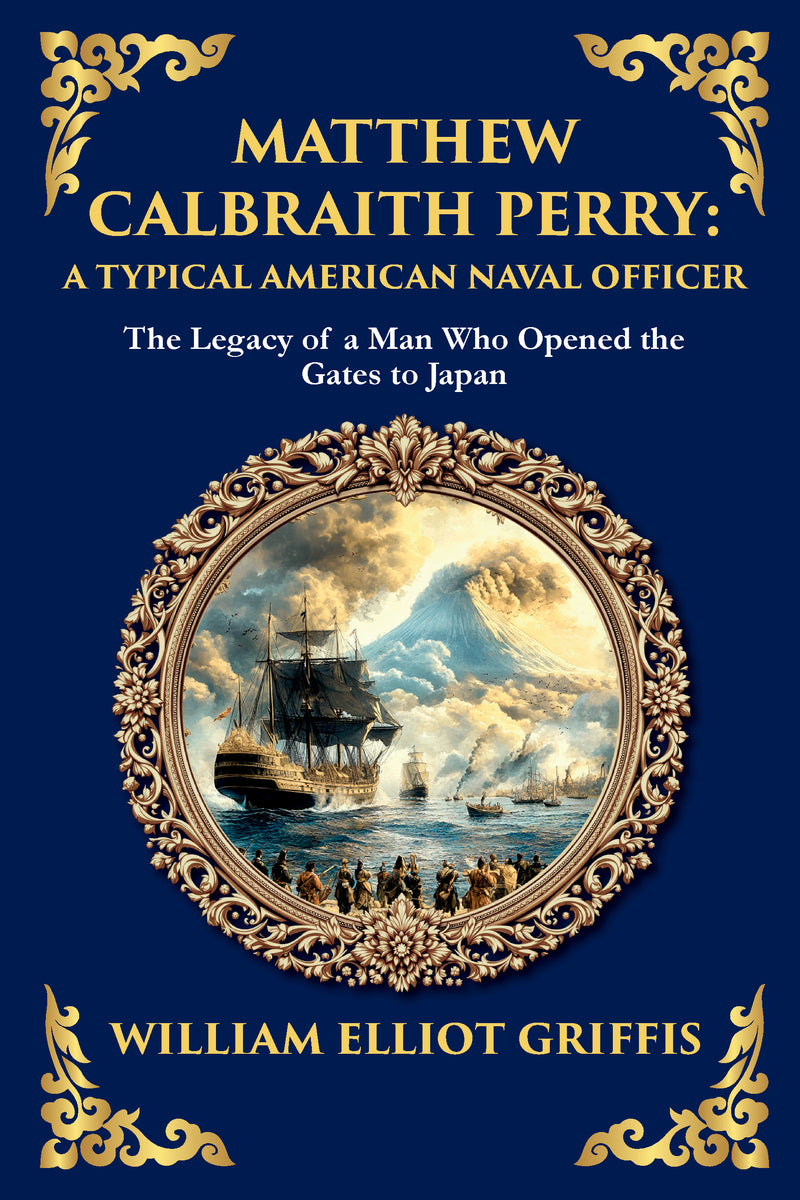
Matthew Calbraith Perry: A Typical American Naval Officer
In Matthew Calbraith Perry: A Typical American Naval Officer, historian William Elliot Griffis paints a rich and detailed portrait of one of the most pivotal figures in 19th-century American naval history.
or free app
10,000+ hrs library
30-day guarantee
The complete Matthew Calbraith Perry: A Typical appears in modern English through Library of Alexandria Press, available online with audiobook narration included for members.
Have you ever wondered why one man’s voyage could alter the course of world history? Matthew Calbraith Perry: A Typical American Naval Officer by William Elliot Griffis delivers a powerful and insightful examination of the man who helped launch the United States onto the global stage. Known best for his 1853 expedition to Japan, Commodore Perry’s life and career embody the values, complexities, and ambitions of 19th-century America.
In this definitive biography, Griffis chronicles Perry’s development from a disciplined naval officer to a strategic diplomat whose mission to Japan forged the Treaty of Kanagawa—opening trade and ushering Japan into the modern world. With vivid historical detail, Griffis explores the intersections of power, culture, and conviction.
What you’ll discover in this modern edition
- A Hero of Naval Tradition – Trace Perry’s early training, leadership style, and contributions to the evolution of U.S. naval capabilities.
- The Japan Expedition in Full Detail – Witness the historic journey to Edo Bay, the technological spectacle of the “Black Ships,” and the diplomatic finesse that led to peaceful negotiation.
- The Global Consequences of One Voyage – Understand how Perry’s mission redefined East-West relations and laid foundations for international diplomacy.
- Personal Insights Into Perry’s Character – Explore his letters, beliefs, and leadership principles that made him a revered figure in both the U.S. and Japan.
- A Visionary American Figure – See how Perry’s actions reflected broader themes of Manifest Destiny, technological innovation, and rising national identity.
| Formats | eBook (EPUB + PDF) · Audiobook · Paperback · Hardcover · Large Print |
| Language | English |
| Trim size (print) | 6 × 9 in |
| Binding | Paperback — perfect-bound · Hardcover — casewrap |
| Large Print edition | Same text in a larger, easy-read type — a larger font, not a larger trim |
| Print pricing | Every physical book at our true cost — at-cost, no profit (members) |
| Library | 873 restored titles, always growing |
| Length | 96,834 words · ~6 hr 27 min reading |
| Reading level | Grade 11 · a confident, adult read (this modern-English edition) |
| Edition | Modern English translation · 2026 |
Member reviews for this edition are collected as readers finish it — be the first. Across the library: 12,000+ books shipped, every plan covered by a 365-day print guarantee.
About this edition
A faithful, unabridged modern-English edition by The Library of Alexandria — carefully rendered for today's reader and verified paragraph-by-paragraph against the public-domain source. Available as eBook, audiobook, paperback, hardcover, and large print.
- Complete & unabridgedVerified paragraph by paragraph against the source — never a scan, never abridged.
- Modern English, faithfulReadable today, with the author’s meaning kept intact. Readable — not simplified.
- Every format, one membershipRead in your browser or the free app, or listen to the full audiobook.
Included free with your membership
Cancel anytime, one click · 30-day money-back guarantee
Edition last updated July 2026
What’s inside
Matthew Calbraith Perry: A Typical American Naval Officer — complete and unabridged: all 38 sections included with membership, plus the full audiobook.
Begin reading Matthew Calbraith Perry: A Typical American Naval Officer
In clear modern English — the complete text is included with membership.
Introduction
There are certain figures in history whose names become permanently attached to a single, monumental event—so much so that the rich complexity of their lives risks being flattened into a single image, a single moment frozen in the amber of textbooks and commemorations. Matthew Calbraith Perry is one such figure. For most readers, the name conjures one indelible picture: a stern American commodore arriving in the harbor of Edo with a fleet of black-hulled ships, demanding that an isolated and ancient nation open its doors to the wider world. The Japanese themselves immortalized the moment in woodblock prints and folk verses, calling the vessels the “Black Ships,” and treating their arrival as a thunderclap that shattered more than two centuries of self-imposed seclusion. It is a moment that genuinely altered the course of two civilizations and, by extension, the destiny of the modern Pacific world.
Yet the man who stood on the deck of that flagship was so much more than the sum of that single dramatic encounter. He was the product of a young, ambitious, and often improvisational American republic that was still defining itself, still building the institutions that would carry it onto the world stage. He was a sailor in an age when the United States Navy was barely older than he was, when the very profession of the naval officer in America had to be invented, defended, and dignified through the labor and example of individual men. Perry spent the greater part of his life not in the celebrated waters off Japan but in the everyday and frequently thankless work of building a navy worthy of a great nation—fighting pirates, suppressing the slave trade, advancing the cause of steam power, founding systems of naval education, and serving with distinction in the Mexican War. The expedition to Japan, which crowns his career and secures his place in world memory, was in many ways the natural culmination of a lifetime of disciplined preparation, patient diplomacy, and quiet conviction.
This is the deeper truth that William Elliot Griffis sets out to illuminate in the pages that follow. His title is deliberately chosen and worth pausing over: A Typical American Naval Officer. At first glance, the word “typical” might seem an odd, even diminishing, choice for a man of such singular achievement. Why describe an extraordinary figure as “typical”? But Griffis intends the word in its highest sense. To him, Perry is typical not because he was ordinary, but because he embodied the finest qualities of the institution and the country he served. He was representative in the way that a perfect specimen represents its kind—a man in whom the ideals of duty, professionalism, patriotism, courage, foresight, and integrity were so fully realized that to study his life is to understand what the American naval officer, at his best, could and should be. In writing Perry’s biography, Griffis was also writing a kind of portrait of the early American navy itself, with all its struggles, its growing pains, and its eventual triumphs.
This dual purpose gives the book a texture and ambition that lift it well above the simple recounting of one man’s deeds. Readers who come to these pages expecting only the story of the Japan expedition will find that story here, told with care and authority—but they will also discover a panoramic view of an entire era of American maritime history, narrated through the experiences of a single, exemplary life. The result is a work that functions simultaneously as biography, as institutional history, and as a meditation on character and national purpose.
To appreciate why this particular biography carries such weight, it helps to understand something of the man who wrote it. William Elliot Griffis was uniquely suited—perhaps singularly so among Americans of his generation—to tell the story of the man who opened Japan. Griffis was not a distant scholar working solely from documents in a comfortable library; he was someone who had lived inside the very transformation that Perry’s expedition set in motion. In the years following the opening of Japan, when the country was undergoing the astonishing convulsion of modernization known to history as the Meiji period, Griffis traveled to Japan and lived there as an educator. He taught science and helped establish modern schooling at a time when Japan, having decided to embrace rather than resist the wider world, was eagerly importing Western knowledge and Western teachers to remake itself into a modern power.
This experience gave Griffis something that no purely American observer could possess: an intimate, lived understanding of Japan from the inside, at the very moment when the seeds Perry had planted were bearing their most dramatic fruit. He came to know the Japanese people, their language, their customs, their history, and their own perspective on the momentous events that had drawn their nation out of isolation. He could see, in a way few Westerners of his time could, both sides of the encounter between Perry’s fleet and the Japanese authorities—the American ambitions and anxieties on one hand, and the Japanese fears, calculations, and divided counsels on the other. When Griffis writes about how the Japanese received Perry, he is not guessing; he is drawing upon a depth of cultural knowledge that lends his account a balance and humanity often missing from triumphalist Western narratives of the period.
Griffis went on to become one of the most prolific and influential interpreters of Japan to the English-speaking world. Through his many books, he did more than perhaps any other writer of his era to shape how Americans understood Japan, its history, and its sudden emergence as a modern nation. He was, in effect, a bridge between two civilizations—and that role makes him the ideal biographer for the man whose mission first built that bridge. There is a fitting symmetry in the fact that the person who labored to explain Japan to America should be the one to chronicle the life of the American who first opened the way.
But Griffis brought more than cultural insight to this project. He was a careful researcher with access to family papers, official documents, personal correspondence, and the recollections of those who had known Perry and served alongside him. He took pains to assemble an accurate and richly detailed record of a life that spanned some of the most consequential decades in American history. The Perry who emerges from these pages is not a marble statue but a living human being—a man with strengths and limitations, with deep convictions and personal loyalties, with a family he loved and a profession he revered. Griffis allows us to see Perry not only at the dramatic climaxes of his career but in the long stretches of patient, often obscure service that prepared him for greatness.
It is worth saying a word here about the nature of this edition. The book you hold has been thoughtfully adapted as a modern translation for the contemporary reader. Griffis wrote in the polished, expansive prose of the late nineteenth century, a style that, however elegant, can feel dense and circuitous to readers accustomed to the rhythms of modern English. Sentences in that era often ran to great length, freighted with subordinate clauses and the formal courtesies of Victorian rhetoric. References that would have been instantly familiar to readers of Griffis’s day may now require a moment’s pause. This adaptation aims to preserve the substance, the spirit, and the dignity of the original while rendering it in language that flows naturally for today’s reader. The goal is to remove the barriers of antiquated phrasing without sacrificing the depth, the texture, or the historical authenticity of Griffis’s account. What remains is the story itself—vivid, authoritative, and as compelling now as when it was first told—made accessible to a new generation.
To read this biography is to travel through one of the most formative periods in the history of the United States and of the modern world. Perry’s life unfolded against a backdrop of extraordinary change. He came of age in the early decades of the nineteenth century, when the American republic was still young, fragile, and uncertain of its place among nations. The navy he joined was small and improvised, its traditions barely formed, its ships and methods often borrowed or hastily adapted. By the time of his death, the United States had become a continental power with growing interests across the seas, and the navy had been transformed from a ragged collection of sailing vessels into a far more professional and technologically advanced force. Perry was not merely a witness to this transformation; he was one of its principal architects.
Consider the world into which he was born and the world he helped to make. When Perry first went to sea, ships were powered by wind and canvas, and the very idea of steam-driven warships was regarded by many old salts as a dangerous novelty—noisy, dirty, unreliable, and somehow ungentlemanly. Perry, however, grasped early and clearly that steam would revolutionize naval warfare and commerce, and he became one of its most determined champions in the American service. His advocacy earned him a lasting association with the rise of the modern steam navy, and it is no accident that the fleet he led to Japan included steam-powered vessels whose smoking funnels astonished and intimidated the Japanese, who had never seen ships that could move against the wind and the tide as if by some supernatural force. In championing this new technology, Perry was helping to drag a tradition-bound institution into the industrial age—an effort that required not only technical vision but the courage to challenge entrenched habits and skeptical superiors.
His career touched nearly every important theater of early American naval activity. He served in the Mediterranean during the campaigns against the Barbary corsairs, in the waters of the West Indies and along the coasts of Africa and South America, and in the bitter fighting of the Mexican War, where he commanded naval operations with skill and determination. He was deeply involved in the suppression of the transatlantic slave trade, a cause that engaged his sense of justice as well as his professional duty. He worked tirelessly to improve the education and training of naval officers, helping to lay foundations for the kind of professional development that would later be institutionalized in formal naval academies. He concerned himself with the practical details of seamanship, gunnery, discipline, and the welfare of sailors. In all of this, Griffis shows us a man for whom the navy was not merely a job but a calling—an institution to be nurtured, dignified, and perfected for the service of the nation.
This breadth of experience is one of the great pleasures of the book. Through Perry’s eyes we encounter the texture of nineteenth-century maritime life in remarkable detail: the long, dangerous voyages; the encounters with foreign peoples and distant shores; the diplomatic delicacy required of officers who often served as the only representatives of their country in remote corners of the globe; the technical challenges of operating ships in an age of rapid change; and the constant interplay of personal ambition, institutional politics, and national interest. Griffis does not shy away from the difficulties and frustrations Perry faced—the bureaucratic obstacles, the rivalries, the slow grinding work of reform—and this honesty makes the eventual triumphs all the more satisfying.
It is important, too, to set the great expedition to Japan within this larger context, for only then can its true significance be understood. When readers encounter the story of the Black Ships, they will see that it was not the product of mere chance or sudden ambition, but the logical outcome of decades of American expansion across the continent and growing American interest in the commerce of the Pacific. The United States, having reached its western shores, now looked across the ocean toward the markets and resources of Asia. American whaling ships ranged the northern Pacific, and the new steam vessels needed coaling stations and safe harbors. Japan, lying athwart the routes between America and the riches of the East, could no longer remain a closed and forbidding mystery. The mission entrusted to Perry was thus a matter of high national policy, and its success depended on a rare combination of qualities—firmness without provocation, patience without weakness, dignity without arrogance, and an instinctive understanding of how to deal with a proud and ancient people on their own terms.
Cancel anytime, one click · 30-day money-back guarantee
Founding annual rate available now — your price locks for life when you join.
Not ready? Get this free chapter by email — read it anytime.
✓ Sent — check your inbox for Matthew Calbraith Perry: A Typical American Naval Officer.
Questions about Matthew Calbraith Perry: A Typical American Naval Officer
What is Matthew Calbraith Perry: A Typical about?
In Matthew Calbraith Perry: A Typical American Naval Officer, historian William Elliot Griffis paints a rich and detailed portrait of one of the most pivotal figures in 19th-century American naval history. Through diplomacy backed by strength, Commodore Perry led the mission that ended Japan’s centuries of isolation and reshaped global relations forever. More than a biography, this work explores the rise of American naval power, the challenges of intercultural diplomacy, and the personal discipline and vision that
Who wrote Matthew Calbraith Perry: A Typical?
Matthew Calbraith Perry: A Typical was written by William Elliot Griffis. This edition presents the complete work in clear modern English, faithfully rendered from the public-domain original by Library of Alexandria Press.
Is Matthew Calbraith Perry: A Typical free to read?
The opening chapter is free to read on this page. Members read and listen to the complete work — and the entire library — free, and can order any physical book at our true print cost.
How long is Matthew Calbraith Perry: A Typical?
38 chapters (~96,834 words) — about 6 hr 27 min of reading in this modern-English edition.
Is this an abridged version of Matthew Calbraith Perry: A Typical?
No. This is the complete, unabridged Matthew Calbraith Perry: A Typical, carefully rendered into clear modern English and verified paragraph-by-paragraph against the public-domain source — nothing is cut or summarised.
What formats does Matthew Calbraith Perry: A Typical come in?
Matthew Calbraith Perry: A Typical is available as eBook, paperback, hardcover and large print. eBook and audiobook are included with membership; printed editions ship at our true print cost.
Shipping & returns
Billing & membership
More from the library


Explore Biography & Letters
- The Confessions of St. Augustine · Saint Augustine of Hippo
- Autobiography of a Yogi — Large Print · Paramahansa Yogananda
- The Confessions of Jean Jacques Rousseau — Complete · Jean-Jacques Rousseau
- Ecce Homo · Friedrich Wilhelm Nietzsche
- De Profundis · Oscar Wilde
- Memoirs of Joseph Grimaldi — Large Print · Joseph Grimaldi
- Anabasis — Large Print · Xenophon
- Anabasis · Xenophon
- English Eccentrics and Eccentricities — Large Print · John Timbs
- The Confessions of St. Augustine — Large Print · Saint Augustine of Hippo
- Memoirs of the Author of A Vindication of the Rights of Woman — Large Print · William Godwin
- You Can't Win — Large Print · Jack Black
- The Love Letters of Mary Wollstonecraft to Gilbert Imlay — Large Print · Mary Wollstonecraft
- Eighty Years and More; Reminiscences 1815–1897 — Large Print · Elizabeth Cady Stanton
- Random Reminiscences of Men and Events — Large Print · John D. Rockefeller
- De Profundis — Large Print · Oscar Wilde
- Walden, and On The Duty Of Civil Disobedience — Large Print · Henry David Thoreau
- Elizabeth, Empress of Austria and Queen of Hungary — Large Print · Carl Küchler
- The Confessions of Jean Jacques Rousseau — Complete — Large Print · Jean-Jacques Rousseau
- Society as I Have Found It — Large Print · Ward McAllister
- The Germany and the Agricola of Tacitus — Large Print · Cornelius Tacitus
- The Memorabilia — Large Print · Xenophon
- The Germany and the Agricola of Tacitus · Cornelius Tacitus
- The Memorabilia · Xenophon
- The Way to the West, and the Lives of Three Early Americans — Large Print · Emerson Hough
- Sailing Alone Around the World — Large Print · Joshua Slocum
- The Way to the West, and the Lives of Three Early Americans · Emerson Hough
- The Oregon Trail: Sketches of Prairie and Rocky-Mountain Life — Large Print · Francis Parkman
- Sailing Alone Around the World · Joshua Slocum
- The Wanderings of a Spiritualist — Large Print · Arthur Conan Doyle
Matthew Calbraith Perry: A Typical American Naval Officer
Matthew Calbraith Perry: A Typical American Naval Officer
The Legacy of the Man Who Opened Japan
William Elliot Griffis
Contents
- Introduction
- Preface by the Author
- Chapter 1
- Chapter 2
- Chapter 3
- Chapter 4
- Chapter 5
- Chapter 6
- Chapter 7
- Chapter 8
- Chapter 9
- Chapter 10
- Chapter 11
- Chapter 12
- Chapter 13
- Chapter 14
- Chapter 15
- Chapter 16
- Chapter 17
- Chapter 18
- Chapter 19
- Chapter 20
- Chapter 21
- Chapter 22
- Chapter 23
- Chapter 24
- Chapter 25
- Chapter 26
- Chapter 27
- Chapter 28
- Chapter 29
- Chapter 30
- Chapter 31
- Chapter 32
- Chapter 33
- Chapter 34
- Chapter 35
- Chapter 36
Introduction
There are certain figures in history whose names become permanently attached to a single, monumental event—so much so that the rich complexity of their lives risks being flattened into a single image, a single moment frozen in the amber of textbooks and commemorations. Matthew Calbraith Perry is one such figure. For most readers, the name conjures one indelible picture: a stern American commodore arriving in the harbor of Edo with a fleet of black-hulled ships, demanding that an isolated and ancient nation open its doors to the wider world. The Japanese themselves immortalized the moment in woodblock prints and folk verses, calling the vessels the “Black Ships,” and treating their arrival as a thunderclap that shattered more than two centuries of self-imposed seclusion. It is a moment that genuinely altered the course of two civilizations and, by extension, the destiny of the modern Pacific world.
Yet the man who stood on the deck of that flagship was so much more than the sum of that single dramatic encounter. He was the product of a young, ambitious, and often improvisational American republic that was still defining itself, still building the institutions that would carry it onto the world stage. He was a sailor in an age when the United States Navy was barely older than he was, when the very profession of the naval officer in America had to be invented, defended, and dignified through the labor and example of individual men. Perry spent the greater part of his life not in the celebrated waters off Japan but in the everyday and frequently thankless work of building a navy worthy of a great nation—fighting pirates, suppressing the slave trade, advancing the cause of steam power, founding systems of naval education, and serving with distinction in the Mexican War. The expedition to Japan, which crowns his career and secures his place in world memory, was in many ways the natural culmination of a lifetime of disciplined preparation, patient diplomacy, and quiet conviction.
This is the deeper truth that William Elliot Griffis sets out to illuminate in the pages that follow. His title is deliberately chosen and worth pausing over: A Typical American Naval Officer. At first glance, the word “typical” might seem an odd, even diminishing, choice for a man of such singular achievement. Why describe an extraordinary figure as “typical”? But Griffis intends the word in its highest sense. To him, Perry is typical not because he was ordinary, but because he embodied the finest qualities of the institution and the country he served. He was representative in the way that a perfect specimen represents its kind—a man in whom the ideals of duty, professionalism, patriotism, courage, foresight, and integrity were so fully realized that to study his life is to understand what the American naval officer, at his best, could and should be. In writing Perry’s biography, Griffis was also writing a kind of portrait of the early American navy itself, with all its struggles, its growing pains, and its eventual triumphs.
This dual purpose gives the book a texture and ambition that lift it well above the simple recounting of one man’s deeds. Readers who come to these pages expecting only the story of the Japan expedition will find that story here, told with care and authority—but they will also discover a panoramic view of an entire era of American maritime history, narrated through the experiences of a single, exemplary life. The result is a work that functions simultaneously as biography, as institutional history, and as a meditation on character and national purpose.
To appreciate why this particular biography carries such weight, it helps to understand something of the man who wrote it. William Elliot Griffis was uniquely suited—perhaps singularly so among Americans of his generation—to tell the story of the man who opened Japan. Griffis was not a distant scholar working solely from documents in a comfortable library; he was someone who had lived inside the very transformation that Perry’s expedition set in motion. In the years following the opening of Japan, when the country was undergoing the astonishing convulsion of modernization known to history as the Meiji period, Griffis traveled to Japan and lived there as an educator. He taught science and helped establish modern schooling at a time when Japan, having decided to embrace rather than resist the wider world, was eagerly importing Western knowledge and Western teachers to remake itself into a modern power.
This experience gave Griffis something that no purely American observer could possess: an intimate, lived understanding of Japan from the inside, at the very moment when the seeds Perry had planted were bearing their most dramatic fruit. He came to know the Japanese people, their language, their customs, their history, and their own perspective on the momentous events that had drawn their nation out of isolation. He could see, in a way few Westerners of his time could, both sides of the encounter between Perry’s fleet and the Japanese authorities—the American ambitions and anxieties on one hand, and the Japanese fears, calculations, and divided counsels on the other. When Griffis writes about how the Japanese received Perry, he is not guessing; he is drawing upon a depth of cultural knowledge that lends his account a balance and humanity often missing from triumphalist Western narratives of the period.
Griffis went on to become one of the most prolific and influential interpreters of Japan to the English-speaking world. Through his many books, he did more than perhaps any other writer of his era to shape how Americans understood Japan, its history, and its sudden emergence as a modern nation. He was, in effect, a bridge between two civilizations—and that role makes him the ideal biographer for the man whose mission first built that bridge. There is a fitting symmetry in the fact that the person who labored to explain Japan to America should be the one to chronicle the life of the American who first opened the way.
But Griffis brought more than cultural insight to this project. He was a careful researcher with access to family papers, official documents, personal correspondence, and the recollections of those who had known Perry and served alongside him. He took pains to assemble an accurate and richly detailed record of a life that spanned some of the most consequential decades in American history. The Perry who emerges from these pages is not a marble statue but a living human being—a man with strengths and limitations, with deep convictions and personal loyalties, with a family he loved and a profession he revered. Griffis allows us to see Perry not only at the dramatic climaxes of his career but in the long stretches of patient, often obscure service that prepared him for greatness.
It is worth saying a word here about the nature of this edition. The book you hold has been thoughtfully adapted as a modern translation for the contemporary reader. Griffis wrote in the polished, expansive prose of the late nineteenth century, a style that, however elegant, can feel dense and circuitous to readers accustomed to the rhythms of modern English. Sentences in that era often ran to great length, freighted with subordinate clauses and the formal courtesies of Victorian rhetoric. References that would have been instantly familiar to readers of Griffis’s day may now require a moment’s pause. This adaptation aims to preserve the substance, the spirit, and the dignity of the original while rendering it in language that flows naturally for today’s reader. The goal is to remove the barriers of antiquated phrasing without sacrificing the depth, the texture, or the historical authenticity of Griffis’s account. What remains is the story itself—vivid, authoritative, and as compelling now as when it was first told—made accessible to a new generation.
To read this biography is to travel through one of the most formative periods in the history of the United States and of the modern world. Perry’s life unfolded against a backdrop of extraordinary change. He came of age in the early decades of the nineteenth century, when the American republic was still young, fragile, and uncertain of its place among nations. The navy he joined was small and improvised, its traditions barely formed, its ships and methods often borrowed or hastily adapted. By the time of his death, the United States had become a continental power with growing interests across the seas, and the navy had been transformed from a ragged collection of sailing vessels into a far more professional and technologically advanced force. Perry was not merely a witness to this transformation; he was one of its principal architects.
Consider the world into which he was born and the world he helped to make. When Perry first went to sea, ships were powered by wind and canvas, and the very idea of steam-driven warships was regarded by many old salts as a dangerous novelty—noisy, dirty, unreliable, and somehow ungentlemanly. Perry, however, grasped early and clearly that steam would revolutionize naval warfare and commerce, and he became one of its most determined champions in the American service. His advocacy earned him a lasting association with the rise of the modern steam navy, and it is no accident that the fleet he led to Japan included steam-powered vessels whose smoking funnels astonished and intimidated the Japanese, who had never seen ships that could move against the wind and the tide as if by some supernatural force. In championing this new technology, Perry was helping to drag a tradition-bound institution into the industrial age—an effort that required not only technical vision but the courage to challenge entrenched habits and skeptical superiors.
His career touched nearly every important theater of early American naval activity. He served in the Mediterranean during the campaigns against the Barbary corsairs, in the waters of the West Indies and along the coasts of Africa and South America, and in the bitter fighting of the Mexican War, where he commanded naval operations with skill and determination. He was deeply involved in the suppression of the transatlantic slave trade, a cause that engaged his sense of justice as well as his professional duty. He worked tirelessly to improve the education and training of naval officers, helping to lay foundations for the kind of professional development that would later be institutionalized in formal naval academies. He concerned himself with the practical details of seamanship, gunnery, discipline, and the welfare of sailors. In all of this, Griffis shows us a man for whom the navy was not merely a job but a calling—an institution to be nurtured, dignified, and perfected for the service of the nation.
This breadth of experience is one of the great pleasures of the book. Through Perry’s eyes we encounter the texture of nineteenth-century maritime life in remarkable detail: the long, dangerous voyages; the encounters with foreign peoples and distant shores; the diplomatic delicacy required of officers who often served as the only representatives of their country in remote corners of the globe; the technical challenges of operating ships in an age of rapid change; and the constant interplay of personal ambition, institutional politics, and national interest. Griffis does not shy away from the difficulties and frustrations Perry faced—the bureaucratic obstacles, the rivalries, the slow grinding work of reform—and this honesty makes the eventual triumphs all the more satisfying.
It is important, too, to set the great expedition to Japan within this larger context, for only then can its true significance be understood. When readers encounter the story of the Black Ships, they will see that it was not the product of mere chance or sudden ambition, but the logical outcome of decades of American expansion across the continent and growing American interest in the commerce of the Pacific. The United States, having reached its western shores, now looked across the ocean toward the markets and resources of Asia. American whaling ships ranged the northern Pacific, and the new steam vessels needed coaling stations and safe harbors. Japan, lying athwart the routes between America and the riches of the East, could no longer remain a closed and forbidding mystery. The mission entrusted to Perry was thus a matter of high national policy, and its success depended on a rare combination of qualities—firmness without provocation, patience without weakness, dignity without arrogance, and an instinctive understanding of how to deal with a proud and ancient people on their own terms.
In 1854, the entire Christian world was thrilled by the news that Japan was opening up to the rest of the world, and Commodore Matthew Perry’s name was known everywhere. In Europe, people recognized that this victory had been achieved by no ordinary naval officer. His complete mastery of detail, combined with his strong diplomatic skills, marked Matthew Calbraith Perry as a man whose life story was worth knowing. That is the history we intend to outline.
There are many excellent reasons why our subject’s life is interesting, including the following:
1. As a young man, he served as a naval officer during the War of 1812.
2. He chose the site for the first free Black settlement in Liberia.
3. Throughout his life, he remained one of the most influential educators in the United States Navy.
4. He was the pioneer of our steam-powered navy.
5. He was the first to prove that the ram was an effective offensive weapon in naval combat.
6. He established the naval apprenticeship system.
7. He played a key role in helping to eliminate the foreign slave trade along the west coast of Africa.
8. His methods helped remove dueling, alcohol rations, and flogging from the American navy.
9. In 1847, he commanded the largest squadron ever assembled under the American flag up to that time in the Gulf of Mexico. The naval battery, manned by his gunnery students, decided the outcome of the battle at Vera Cruz, and his fleet’s presence allowed General Scott’s army to reach the capital.
10. His final achievement was opening Japan to the rest of the world. This is one of only three events in American history—alongside the Declaration of Independence and the arbitration of the Alabama claims—that have had a profound global impact.
End of the free sample
Keep reading, free
Members read and listen to the complete book — and the entire library. Cancel anytime, one click · 30-day money-back guarantee.