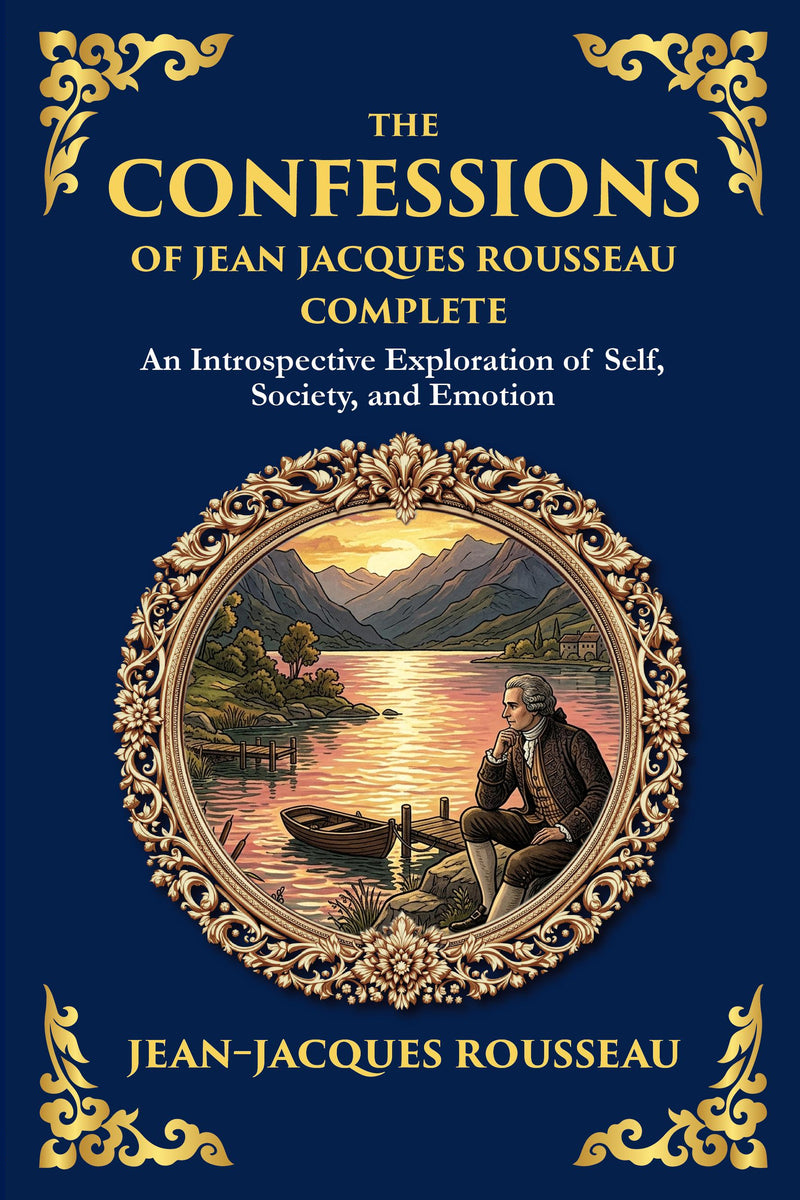
The Confessions of Jean-Jacques Rousseau — Complete — Large Print
The Confessions is Rousseau’s fearless and unflinching journey into the soul of a man shaped by passions, contradictions, genius, and guilt.
or free app
10,000+ hrs library
30-day guarantee
The complete The Confessions of Jean Jacques appears in modern English through Library of Alexandria Press, available online with audiobook narration included for members.
Have you ever wondered why the truth of the self is often the most radical revelation of all? The Confessions of Jean Jacques Rousseau — Complete is a profound work of introspection and bold self-analysis that forever changed the landscape of autobiographical writing. In this groundbreaking literary and philosophical memoir, Enlightenment thinker Jean-Jacques Rousseau recounts his life—not to glorify his achievements, but to expose the intricate and sometimes painful truths of the human condition.
Rousseau’s confessional narrative spans from his early childhood through his artistic and political ascent, marked by scandal, self-imposed exile, intellectual rivalry, and a lifelong struggle with identity and emotion. With remarkable transparency, he confronts his fears, desires, mistakes, and insights, inviting readers into a mind that influenced revolutions in both thought and society.
What you’ll discover in this modern edition
- The Birth of Modern Autobiography – Explore how Rousseau’s radical honesty and literary courage helped invent the confessional memoir.
- The Emotional Life of a Philosopher – Witness Rousseau’s inner struggles with alienation, vanity, shame, and love.
- An Enlightenment Thinker at Odds With Society – Understand the contradictions of a man who championed liberty yet quarreled with nearly all his contemporaries.
- A Vision of Nature, Morality, and Human Freedom – Delve into the philosophical musings that fueled works like The Social Contract and Emile.
| Formats | eBook (EPUB + PDF) · Audiobook · Paperback · Hardcover · Large Print |
| Language | English |
| Trim size (print) | 6 × 9 in |
| Binding | Paperback — perfect-bound · Hardcover — casewrap |
| Large Print edition | Same text in a larger, easy-read type — a larger font, not a larger trim |
| Print pricing | Every physical book at our true cost — at-cost, no profit (members) |
| Library | 873 restored titles, always growing |
| Length | 255,141 words · ~17 hr 1 min reading |
| Reading level | Grade 3 · an easy, flowing read (this modern-English edition) |
| Edition | Modern English translation · 2026 |
Member reviews for this edition are collected as readers finish it — be the first. Across the library: 12,000+ books shipped, every plan covered by a 365-day print guarantee.
About this edition
A faithful, unabridged modern-English edition by The Library of Alexandria — carefully rendered for today's reader and verified paragraph-by-paragraph against the public-domain source. Available as eBook, audiobook, paperback, hardcover, and large print.
- Complete & unabridgedVerified paragraph by paragraph against the source — never a scan, never abridged.
- Modern English, faithfulReadable today, with the author’s meaning kept intact. Readable — not simplified.
- Every format, one membershipRead in your browser or the free app, or listen to the full audiobook.
Included free with your membership
Cancel anytime, one click · 30-day money-back guarantee
Edition last updated July 2026
What’s inside
The Confessions of Jean-Jacques Rousseau — Complete — Large Print — complete and unabridged: all 13 sections included with membership, plus the full audiobook.
Begin reading The Confessions of Jean-Jacques Rousseau — Complete — Large Print
In clear modern English — the complete text is included with membership.
Introduction
There are books that tell us about the world, and there are books that tell us about a single human being—so completely, so nakedly, that in reading them we somehow learn about ourselves. The work you are about to encounter belongs unmistakably to the second category. When Jean-Jacques Rousseau set out to write the story of his own life, he was attempting something that, in his own estimation, had never been done before. He did not merely intend to record the events of a remarkable existence; he intended to lay bare the entirety of a soul, to expose its contradictions and its tenderness, its meanness and its generosity, its triumphs and its humiliations, with a frankness so total that no reader could ever again doubt what one human being truly was. The result is one of the most influential and enduring documents in the history of Western literature—a book that effectively invented the modern autobiography and, in doing so, changed forever the way we think about the self.
This modern translation has been prepared with the contemporary reader firmly in mind. Rousseau wrote in the elegant, sometimes labyrinthine French of the eighteenth century, and earlier English versions often preserved a stiffness and formality that can stand between us and the urgent, beating heart of his confession. The aim here has been to honor the spirit, the intelligence, and the emotional force of the original while rendering it in language that flows naturally for readers today. Nothing essential has been sacrificed; rather, the goal has been to remove the barriers of antiquated phrasing and obscure reference so that the voice—and what a voice it is—comes through with all its original immediacy. You will find here the same restless, passionate, self-justifying, self-accusing man who first picked up his pen more than two and a half centuries ago, speaking to you across the gulf of time as though he were seated across the table, determined that you should understand him at last.
To appreciate the audacity of what Rousseau attempted, it helps to understand something of the moment in which he wrote. The eighteenth century was the age of the Enlightenment, an era that prized reason, public reputation, and the polished surfaces of civilized life. Memoirs existed, of course, but they tended to be the dignified retrospectives of statesmen and soldiers, concerned with great events and the burnishing of legacies. They were performances of public selves. What no one had done before was to turn the lamp inward and describe, with merciless honesty, the private interior of a single ordinary-extraordinary individual: not the man as he wished to appear, but the man as he believed he truly was.
Rousseau announced his intention with characteristic grandeur. He declared that he was undertaking a project without precedent and one that would have no imitator. He would present a portrait of himself that was completely true to nature, and that portrait would be himself entire. He promised to conceal nothing—not the actions of which he was ashamed, not the desires he could scarcely admit even to his own conscience, not the petty resentments and the absurd vanities that we all carry but rarely confess. He understood that to be fully believed, he had to be fully exposed, and so he resolved to set down the good and the bad with equal candor, allowing the reader to assemble the complete human being from the evidence he laid out.
It is worth pausing on how genuinely revolutionary this was. We live now in a culture saturated with confession—memoirs, personal essays, the endless self-disclosure of social media—and so it can be difficult to grasp how startling, even scandalous, it once seemed for a man to write at length about the embarrassing accidents of his childhood, the confused stirrings of his adolescent desire, the small thefts and lies of his youth, the failures of nerve and the lapses of loyalty that marked his adult life. Rousseau did not flinch from any of it. He recorded moments of cruelty he had inflicted and injustices he had suffered, episodes that cast him in a ridiculous light and episodes in which a single false word had shaped the rest of his existence. In one famous passage, he confesses to an act of cowardice committed in his youth—an accusation he leveled against an innocent servant to save himself from blame—and the shame of it, he tells us, haunted him for the rest of his days. He sets it before us not to be forgiven, exactly, but to be known.
This commitment to total disclosure is what gives the work its peculiar and undying power. We trust Rousseau because he tells us things no one would invent to flatter himself. And because we trust him, we follow him into territory that most writers would never dare to enter: the murky, contradictory, often irrational landscape of the inner life. He understood, long before modern psychology gave us the vocabulary, that human beings are not coherent, that we are bundles of competing impulses, that we deceive ourselves constantly, and that the truth of a person lies not in any single noble or shameful act but in the whole tangled fabric of a life lived from the inside. To read him is to be reminded that you, too, are such a fabric—that the gap between who you appear to be and who you privately are is not a personal failing but the universal condition of being human.
The reader should know going in that Rousseau is not always reliable in the ordinary sense, and he would be the first to admit it. Memory distorts; the heart edits; the wounded ego reconstructs events to its own advantage. There are moments in this book where his account of a quarrel or a betrayal is plainly colored by his own sense of grievance, where he casts himself as the persecuted innocent surrounded by conspiring enemies. In his later years, Rousseau suffered acutely from feelings of paranoia, and the shadow of that suffering falls across the final portions of his story. Yet this, too, is part of the extraordinary honesty of the work. He gives us not an objective record but a subjective truth—the truth of how the world looked and felt from behind his own eyes. And in capturing that, he captures something more valuable than mere fact: he captures the texture of a consciousness, the way a particular sensitive, brilliant, deeply flawed man experienced his own existence. The proper way to read these passages is not to fact-check them against history but to receive them as testimony, to ask not “did it really happen this way?” but “what does it mean that he remembered and felt it this way?”
You will find, as you read, that Rousseau possessed a genius for the small, telling detail. He can devote pages to a single afternoon, to the precise quality of light over a lake, to the taste of a meal eaten in the company of someone he loved, to the agony of a social blunder. These passages are not digressions; they are the very substance of the book. Rousseau believed that the truth of a life resides in its sensations and emotions far more than in its outward events, and so he wrote with an attentiveness to feeling that was almost without precedent in the literature of his time. He gave us the inner weather of a human being—the sudden squalls of jealousy, the long warm afternoons of contentment, the cold gray fogs of melancholy and self-doubt. In doing so, he opened a door through which countless writers would follow. The entire tradition of introspective literature that flows down to our own day owes an immense debt to the man whose voice fills these pages.
Although it would spoil your experience to reveal the particular turns of Rousseau’s life, it is fair and helpful to say a few words about the shape of the journey you are about to undertake, and about the man at its center, so that you may read with the fullest understanding.
Rousseau came into the world in circumstances that marked him deeply from the very beginning, and the loss and instability of his earliest years left an imprint on his character that he traces with great care. He was a man largely self-educated, who devoured books with an almost feverish hunger and constructed his vast intellect out of solitary reading rather than formal schooling. This origin gave him both his strength and his vulnerability: he was an outsider to the cultured world he would eventually conquer, never fully at ease among the brilliant and the powerful, always conscious of the distance between his humble beginnings and the salons of the great. Much of the drama of his story arises from this tension—between the country boy and the celebrated philosopher, between the man who longed for simple peace and the man who could not stop himself from courting controversy and fame.
His life carried him across much of Europe, through a remarkable variety of occupations and roles, and through encounters with some of the most fascinating figures of his age. He worked at humble trades and ascended to the heights of intellectual celebrity. He knew poverty and dependence; he knew patronage and adulation. He formed intense friendships and watched them dissolve into bitter enmity. He loved deeply, and his accounts of those loves—particularly his attachment to the older woman who became, in his telling, the great formative relationship of his early life—are among the most tender and psychologically acute passages in the entire book. He was a wanderer by temperament, never quite settled, always seeking some lost paradise of peace and belonging that seemed forever to recede before him.
Through it all, what emerges is the portrait of a man for whom feeling was the supreme reality. Rousseau lived through his emotions with an intensity that could be both his glory and his torment. He felt everything more strongly than those around him—joy and grief, love and resentment, gratitude and humiliation—and he believed that this capacity for feeling was the truest part of himself. Indeed, one of the great themes that runs beneath the surface of this work is the value of the natural, the spontaneous, and the heartfelt against the artificial, the calculated, and the merely conventional. Rousseau distrusted the polished hypocrisies of society; he believed that civilization had a way of corrupting the natural goodness of the human heart, of teaching people to mask their true feelings behind a screen of manners and ambition. His own life, as he presents it, becomes a kind of case study in this conflict—the story of a sincere and feeling man trying to remain true to himself in a world that constantly demanded he be something other than what he was.
This is what makes the book so much more than a record of one man’s days. It is a sustained meditation on what it means to be authentic in an inauthentic world, on the difficulty of knowing oneself, on the way our childhoods shape us, on the nature of love and friendship and betrayal, on the costs of fame and the consolations of solitude. Rousseau was one of the most important thinkers of his century—his ideas about nature, education, society, and the individual would help to reshape the modern world—and although this is a personal narrative rather than a work of philosophy, his great themes are woven through it everywhere. You will encounter, in the form of lived experience rather than abstract argument, the very questions that occupied his more famous theoretical works. You will see his ideas about the goodness of nature and the corruption of society take flesh in the events of his own life. The result is a book that engages the heart and the mind in equal measure.
It would be misleading, though, to suggest that Rousseau is always sympathetic or always right. Part of what makes this such a rich and rewarding reading experience is precisely that he is so often exasperating. He can be self-pitying, self-righteous, contradictory, and breathtakingly unfair to those who crossed him. He will justify behavior that strikes us as indefensible and then, a few pages later, confess to some minor fault with agonized intensity. He sees conspiracies where there were probably only ordinary human misunderstandings. He is, in short, a complicated and difficult man, and the experience of reading him is not unlike the experience of coming to know such a person in real life: there are moments when you will admire him, moments when you will pity him, moments when you will want to argue with him, and moments when his honesty and vulnerability will move you almost to tears. This is not a flaw in the book; it is the book’s deepest achievement. Rousseau wanted to give us a real human being in all his complexity, and he succeeded so completely that we react to him exactly as we would to a living person.
Cancel anytime, one click · 30-day money-back guarantee
Founding annual rate available now — your price locks for life when you join.
Not ready? Get this free chapter by email — read it anytime.
✓ Sent — check your inbox for The Confessions of Jean-Jacques Rousseau — Complete — Large Print.
Questions about The Confessions of Jean-Jacques Rousseau — Complete — Large Print
What is The Confessions of Jean Jacques about?
The Confessions is Rousseau’s fearless and unflinching journey into the soul of a man shaped by passions, contradictions, genius, and guilt. In this complete edition of one of literature’s earliest autobiographies, the philosopher lays bare his triumphs and transgressions, his loves and losses, with startling honesty and literary brilliance. Rousseau’s daring act of self-exposure blazed a new trail in personal writing—one that continues to inspire thinkers, writers, and dreamers.
Who wrote The Confessions of Jean Jacques?
The Confessions of Jean Jacques was written by Jean-Jacques Rousseau. This edition presents the complete work in clear modern English, faithfully rendered from the public-domain original by Library of Alexandria Press.
Is The Confessions of Jean Jacques free to read?
The opening chapter is free to read on this page. Members read and listen to the complete work — and the entire library — free, and can order any physical book at our true print cost.
How long is The Confessions of Jean Jacques?
13 chapters (~255,141 words) — about 17 hr 1 min of reading in this modern-English edition.
Is this an abridged version of The Confessions of Jean Jacques?
No. This is the complete, unabridged The Confessions of Jean Jacques, carefully rendered into clear modern English and verified paragraph-by-paragraph against the public-domain source — nothing is cut or summarised.
What formats does The Confessions of Jean Jacques come in?
The Confessions of Jean Jacques is available as eBook, paperback and hardcover. eBook and audiobook are included with membership; printed editions ship at our true print cost.
Shipping & returns
Billing & membership
More from the library


Explore Biography & Letters
- Meditations · Marcus Aurelius
- The Confessions of St. Augustine · Saint Augustine
- The Confessions of Jean-Jacques Rousseau — Complete · Jean-Jacques Rousseau
- Ecce Homo · Friedrich Wilhelm Nietzsche
- De Profundis · Oscar Wilde
- Memoirs of Joseph Grimaldi · Joseph Grimaldi
- English Eccentrics and Eccentricities · John Timbs
- You Can’t Win · Jack Black
- Wild Animals I Have Known · Ernest Thompson Seton
- The Diary of Samuel Pepys — Complete 1665 N.S. · Samuel Pepys
- Random Reminiscences of Men and Events · John D. Rockefeller
- The Story of My Life · Helen Keller
- Elizabeth, Empress of Austria and Queen of Hungary · Carl Küchler
- Society as I Have Found It · Ward McAllister
- Autobiography of a Yogi · Paramahansa Yogananda
- Christopher Columbus and How He Received and Imparted the Spirit of Discovery
- A Portrait of the Artist as a Young Man · James Joyce
- Memoirs of the Author of a Vindication of the Rights of Woman · William Godwin
- Mary: A Fiction · Mary Wollstonecraft
- The Romance of Biography (Vol. 1 of 2) · Mrs. Jameson
- The Love Letters of Mary Wollstonecraft to Gilbert Imlay · Mary Wollstonecraft
- Selected Works of Voltairine de Cleyre · Voltairine de Cleyre
- Eighty Years and More; Reminiscences 1815–1897 · Elizabeth Cady Stanton
- Anarchism and Other Essays · Emma Goldman
- Agnes Grey · Anne Brontë
- Daddy-Long-Legs · Jean Webster
- Reminiscences of a Stock Operator · Edwin Lefèvre
- Martin Eden · Jack London
- Matthew Calbraith Perry: A Typical American Naval Officer · William Elliot Griffis
- Walden, and On the Duty of Civil Disobedience · Henry David Thoreau
The Confessions of Jean-Jacques Rousseau — Complete — Large Print
The Confessions of Jean-Jacques Rousseau — Complete — Large Print
An Introspective Exploration of Self, Society, and Emotion
Jean-Jacques Rousseau
Contents
- Introduction
- Book 1
- Book 2
- Book 3
- Book 4
- Book 5
- Book 6
- Book 7
- Book 8
- Book 9
- Book 10
- Book 11
- Book 12
Introduction
There are books that tell us about the world, and there are books that tell us about a single human being—so completely, so nakedly, that in reading them we somehow learn about ourselves. The work you are about to encounter belongs unmistakably to the second category. When Jean-Jacques Rousseau set out to write the story of his own life, he was attempting something that, in his own estimation, had never been done before. He did not merely intend to record the events of a remarkable existence; he intended to lay bare the entirety of a soul, to expose its contradictions and its tenderness, its meanness and its generosity, its triumphs and its humiliations, with a frankness so total that no reader could ever again doubt what one human being truly was. The result is one of the most influential and enduring documents in the history of Western literature—a book that effectively invented the modern autobiography and, in doing so, changed forever the way we think about the self.
This modern translation has been prepared with the contemporary reader firmly in mind. Rousseau wrote in the elegant, sometimes labyrinthine French of the eighteenth century, and earlier English versions often preserved a stiffness and formality that can stand between us and the urgent, beating heart of his confession. The aim here has been to honor the spirit, the intelligence, and the emotional force of the original while rendering it in language that flows naturally for readers today. Nothing essential has been sacrificed; rather, the goal has been to remove the barriers of antiquated phrasing and obscure reference so that the voice—and what a voice it is—comes through with all its original immediacy. You will find here the same restless, passionate, self-justifying, self-accusing man who first picked up his pen more than two and a half centuries ago, speaking to you across the gulf of time as though he were seated across the table, determined that you should understand him at last.
To appreciate the audacity of what Rousseau attempted, it helps to understand something of the moment in which he wrote. The eighteenth century was the age of the Enlightenment, an era that prized reason, public reputation, and the polished surfaces of civilized life. Memoirs existed, of course, but they tended to be the dignified retrospectives of statesmen and soldiers, concerned with great events and the burnishing of legacies. They were performances of public selves. What no one had done before was to turn the lamp inward and describe, with merciless honesty, the private interior of a single ordinary-extraordinary individual: not the man as he wished to appear, but the man as he believed he truly was.
Rousseau announced his intention with characteristic grandeur. He declared that he was undertaking a project without precedent and one that would have no imitator. He would present a portrait of himself that was completely true to nature, and that portrait would be himself entire. He promised to conceal nothing—not the actions of which he was ashamed, not the desires he could scarcely admit even to his own conscience, not the petty resentments and the absurd vanities that we all carry but rarely confess. He understood that to be fully believed, he had to be fully exposed, and so he resolved to set down the good and the bad with equal candor, allowing the reader to assemble the complete human being from the evidence he laid out.
It is worth pausing on how genuinely revolutionary this was. We live now in a culture saturated with confession—memoirs, personal essays, the endless self-disclosure of social media—and so it can be difficult to grasp how startling, even scandalous, it once seemed for a man to write at length about the embarrassing accidents of his childhood, the confused stirrings of his adolescent desire, the small thefts and lies of his youth, the failures of nerve and the lapses of loyalty that marked his adult life. Rousseau did not flinch from any of it. He recorded moments of cruelty he had inflicted and injustices he had suffered, episodes that cast him in a ridiculous light and episodes in which a single false word had shaped the rest of his existence. In one famous passage, he confesses to an act of cowardice committed in his youth—an accusation he leveled against an innocent servant to save himself from blame—and the shame of it, he tells us, haunted him for the rest of his days. He sets it before us not to be forgiven, exactly, but to be known.
This commitment to total disclosure is what gives the work its peculiar and undying power. We trust Rousseau because he tells us things no one would invent to flatter himself. And because we trust him, we follow him into territory that most writers would never dare to enter: the murky, contradictory, often irrational landscape of the inner life. He understood, long before modern psychology gave us the vocabulary, that human beings are not coherent, that we are bundles of competing impulses, that we deceive ourselves constantly, and that the truth of a person lies not in any single noble or shameful act but in the whole tangled fabric of a life lived from the inside. To read him is to be reminded that you, too, are such a fabric—that the gap between who you appear to be and who you privately are is not a personal failing but the universal condition of being human.
The reader should know going in that Rousseau is not always reliable in the ordinary sense, and he would be the first to admit it. Memory distorts; the heart edits; the wounded ego reconstructs events to its own advantage. There are moments in this book where his account of a quarrel or a betrayal is plainly colored by his own sense of grievance, where he casts himself as the persecuted innocent surrounded by conspiring enemies. In his later years, Rousseau suffered acutely from feelings of paranoia, and the shadow of that suffering falls across the final portions of his story. Yet this, too, is part of the extraordinary honesty of the work. He gives us not an objective record but a subjective truth—the truth of how the world looked and felt from behind his own eyes. And in capturing that, he captures something more valuable than mere fact: he captures the texture of a consciousness, the way a particular sensitive, brilliant, deeply flawed man experienced his own existence. The proper way to read these passages is not to fact-check them against history but to receive them as testimony, to ask not “did it really happen this way?” but “what does it mean that he remembered and felt it this way?”
You will find, as you read, that Rousseau possessed a genius for the small, telling detail. He can devote pages to a single afternoon, to the precise quality of light over a lake, to the taste of a meal eaten in the company of someone he loved, to the agony of a social blunder. These passages are not digressions; they are the very substance of the book. Rousseau believed that the truth of a life resides in its sensations and emotions far more than in its outward events, and so he wrote with an attentiveness to feeling that was almost without precedent in the literature of his time. He gave us the inner weather of a human being—the sudden squalls of jealousy, the long warm afternoons of contentment, the cold gray fogs of melancholy and self-doubt. In doing so, he opened a door through which countless writers would follow. The entire tradition of introspective literature that flows down to our own day owes an immense debt to the man whose voice fills these pages.
Although it would spoil your experience to reveal the particular turns of Rousseau’s life, it is fair and helpful to say a few words about the shape of the journey you are about to undertake, and about the man at its center, so that you may read with the fullest understanding.
Rousseau came into the world in circumstances that marked him deeply from the very beginning, and the loss and instability of his earliest years left an imprint on his character that he traces with great care. He was a man largely self-educated, who devoured books with an almost feverish hunger and constructed his vast intellect out of solitary reading rather than formal schooling. This origin gave him both his strength and his vulnerability: he was an outsider to the cultured world he would eventually conquer, never fully at ease among the brilliant and the powerful, always conscious of the distance between his humble beginnings and the salons of the great. Much of the drama of his story arises from this tension—between the country boy and the celebrated philosopher, between the man who longed for simple peace and the man who could not stop himself from courting controversy and fame.
His life carried him across much of Europe, through a remarkable variety of occupations and roles, and through encounters with some of the most fascinating figures of his age. He worked at humble trades and ascended to the heights of intellectual celebrity. He knew poverty and dependence; he knew patronage and adulation. He formed intense friendships and watched them dissolve into bitter enmity. He loved deeply, and his accounts of those loves—particularly his attachment to the older woman who became, in his telling, the great formative relationship of his early life—are among the most tender and psychologically acute passages in the entire book. He was a wanderer by temperament, never quite settled, always seeking some lost paradise of peace and belonging that seemed forever to recede before him.
Through it all, what emerges is the portrait of a man for whom feeling was the supreme reality. Rousseau lived through his emotions with an intensity that could be both his glory and his torment. He felt everything more strongly than those around him—joy and grief, love and resentment, gratitude and humiliation—and he believed that this capacity for feeling was the truest part of himself. Indeed, one of the great themes that runs beneath the surface of this work is the value of the natural, the spontaneous, and the heartfelt against the artificial, the calculated, and the merely conventional. Rousseau distrusted the polished hypocrisies of society; he believed that civilization had a way of corrupting the natural goodness of the human heart, of teaching people to mask their true feelings behind a screen of manners and ambition. His own life, as he presents it, becomes a kind of case study in this conflict—the story of a sincere and feeling man trying to remain true to himself in a world that constantly demanded he be something other than what he was.
This is what makes the book so much more than a record of one man’s days. It is a sustained meditation on what it means to be authentic in an inauthentic world, on the difficulty of knowing oneself, on the way our childhoods shape us, on the nature of love and friendship and betrayal, on the costs of fame and the consolations of solitude. Rousseau was one of the most important thinkers of his century—his ideas about nature, education, society, and the individual would help to reshape the modern world—and although this is a personal narrative rather than a work of philosophy, his great themes are woven through it everywhere. You will encounter, in the form of lived experience rather than abstract argument, the very questions that occupied his more famous theoretical works. You will see his ideas about the goodness of nature and the corruption of society take flesh in the events of his own life. The result is a book that engages the heart and the mind in equal measure.
It would be misleading, though, to suggest that Rousseau is always sympathetic or always right. Part of what makes this such a rich and rewarding reading experience is precisely that he is so often exasperating. He can be self-pitying, self-righteous, contradictory, and breathtakingly unfair to those who crossed him. He will justify behavior that strikes us as indefensible and then, a few pages later, confess to some minor fault with agonized intensity. He sees conspiracies where there were probably only ordinary human misunderstandings. He is, in short, a complicated and difficult man, and the experience of reading him is not unlike the experience of coming to know such a person in real life: there are moments when you will admire him, moments when you will pity him, moments when you will want to argue with him, and moments when his honesty and vulnerability will move you almost to tears. This is not a flaw in the book; it is the book’s deepest achievement. Rousseau wanted to give us a real human being in all his complexity, and he succeeded so completely that we react to him exactly as we would to a living person.
I have begun a task that is without precedent, and once finished, will have no imitator. I intend to show my fellow human beings a man exactly as nature intended; and that man will be myself.
I know my own heart and have studied human nature. I am not like anyone I have ever known, and perhaps like no one who has ever existed. Even if I am not better, I can at least claim to be original. Whether Nature was wise to break the mold after forming me can only be decided after reading this work.
When the final trumpet sounds, I will stand before the sovereign judge with this book in my hand and loudly proclaim: this is how I acted; these were my thoughts; this is who I was. I have described both my virtues and my vices with equal freedom and honesty. I have hidden no crimes and added no fake virtues. If I have occasionally added unnecessary flourishes, it was only to fill gaps caused by a failing memory. I may have assumed certain things were true when I only knew they were probable, but I have never knowingly told a lie. I have revealed myself exactly as I was—sometimes vile and despicable, at other times virtuous, generous, and noble. You have read into my innermost soul. Eternal Power! Gather a countless crowd of my fellow humans around your throne. Let them listen to my confessions, let them blush at my depravity, and let them tremble at my sufferings. Then, let each person in turn sincerely expose the flaws and wanderings of their own heart, and if they dare, let them claim, “I was a better person than that man.”
I was born in Geneva in 1712, the son of Isaac Rousseau and Susannah Bernard, both of whom were citizens. My father’s portion of a modest inheritance, which was split among fifteen children, was very small. Therefore, he relied entirely on his work as a watchmaker, a trade in which he was known for being very skillful. My mother’s family was wealthier; she was the daughter of Mr. Bernard, a minister, and she possessed a great deal of modesty and beauty. In fact, my father had some trouble winning her hand in marriage.
End of the free sample
Keep reading, free
Members read and listen to the complete book — and the entire library. Cancel anytime, one click · 30-day money-back guarantee.