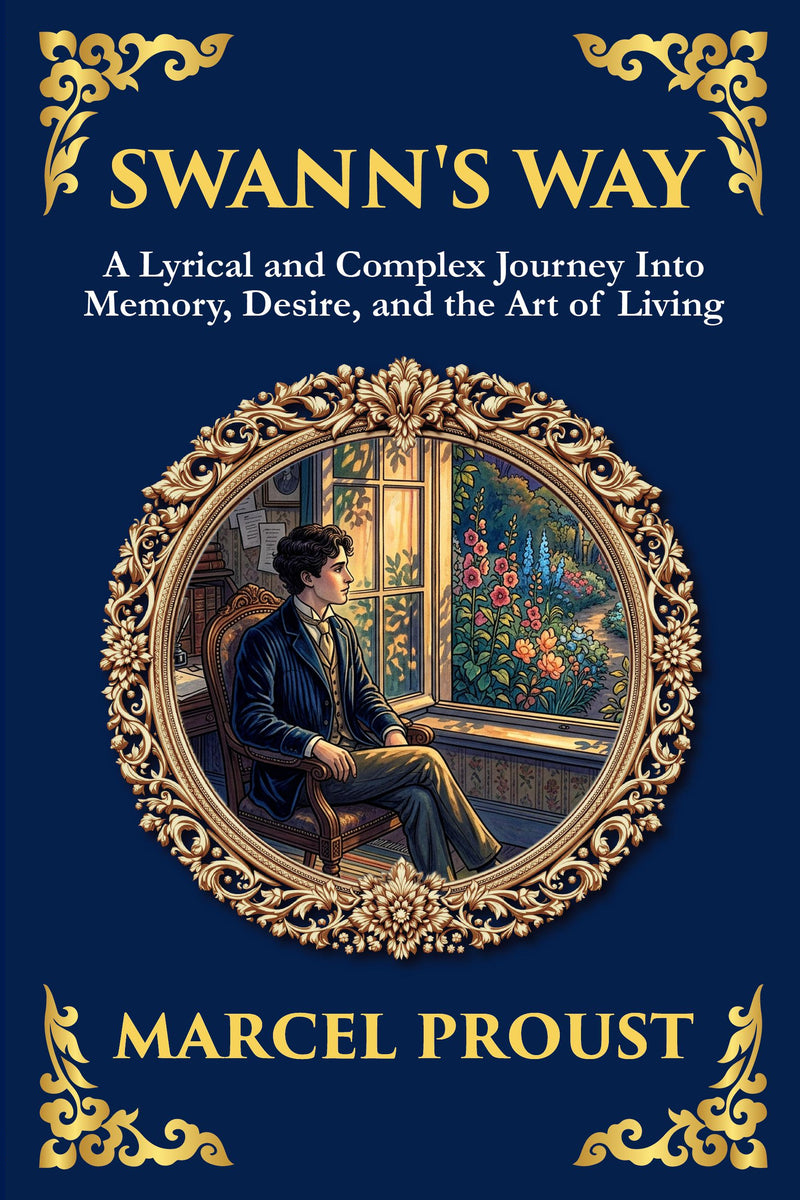
Swann’s Way
Time slips like a dream, and memory becomes the key to unlocking the mysteries of life and love. In Swann’s Way, the first volume of Marcel Proust’s monumental In Search of Lost Time, we enter a world shaped not by chronology but by consciousness—where every sensation, every glance, every taste can trigger a flood of r
or free app
10,000+ hrs library
30-day guarantee
The complete Swann's Way appears in modern English through Library of Alexandria Press, available online with audiobook narration included for members.
Have you ever wondered why a single moment can awaken an entire world of memory? Swann’s Way, the first volume in Marcel Proust’s In Search of Lost Time, is a revolutionary work of introspective fiction that transforms ordinary life into extraordinary art. Through lush, lyrical prose and breathtaking psychological insight, Proust explores how memory—especially involuntary memory—can reveal our deepest truths, shape our identities, and stir forgotten feelings we thought lost to time.
Blending childhood reminiscence, philosophical reflection, and the doomed love affair between Charles Swann and the elusive Odette de Crécy, this novel reveals how the smallest details—a sound, a gesture, a taste—can carry vast emotional weight. Far more than a story, Swann’s Way is an immersion into the mind itself, where past and present intermingle and time becomes both elusive and eternal.
What you’ll discover in this modern edition
- A Meditation on Time and Memory – Explore how life is not merely lived but relived through the lens of memory.
- The Iconic “Madeleine Scene” – Witness one of literature’s most famous moments of involuntary memory, where a simple pastry opens a floodgate of feeling.
- An Exploration of Desire and Jealousy – Delve into the obsessive and tormented romance of Swann and Odette, a love both passionate and corrosive.
- A Tapestry of Psychological Insight – Journey through the inner lives of characters with Proust’s unmatched depth and nuance.
- A Work That Changed Literature Forever – Recognized as one of the greatest literary achievements of the 20th century, Swann’s Way redefined the novel form.
| Formats | eBook (EPUB + PDF) · Audiobook · Paperback · Hardcover · Large Print |
| Language | English |
| Trim size (print) | 6 × 9 in |
| Binding | Paperback — perfect-bound · Hardcover — casewrap |
| Large Print edition | Same text in a larger, easy-read type — a larger font, not a larger trim |
| Print pricing | Every physical book at our true cost — at-cost, no profit (members) |
| Library | 873 restored titles, always growing |
| Length | 165,724 words · ~11 hr 3 min reading |
| Reading level | Grade 3 · an easy, flowing read (this modern-English edition) |
| Edition | Modern English translation · 2026 |
Member reviews for this edition are collected as readers finish it — be the first. Across the library: 12,000+ books shipped, every plan covered by a 365-day print guarantee.
About this edition
A faithful, unabridged modern-English edition by The Library of Alexandria — carefully rendered for today's reader and verified paragraph-by-paragraph against the public-domain source. Available as eBook, audiobook, paperback, hardcover, and large print.
- Complete & unabridgedVerified paragraph by paragraph against the source — never a scan, never abridged.
- Modern English, faithfulReadable today, with the author’s meaning kept intact. Readable — not simplified.
- Every format, one membershipRead in your browser or the free app, or listen to the full audiobook.
Included free with your membership
Cancel anytime, one click · 30-day money-back guarantee
Edition last updated July 2026
What’s inside
Swann’s Way — complete and unabridged: all 5 sections included with membership, plus the full audiobook.
Begin reading Swann’s Way
In clear modern English — the complete text is included with membership.
Introduction
There are books we read, and there are books that read us. Swann’s Way belongs unmistakably to the second category. To open its pages is to enter not merely a story but a way of perceiving — a heightened, almost dizzying attentiveness to the textures of experience that most of us rush past without noticing. Marcel Proust did not set out simply to tell a tale. He set out to capture the very mechanics of consciousness: how we remember, how we long, how we love, and how the most ordinary moments of a life can, in retrospect, reveal themselves to be the secret architecture of everything we are. This is the first volume of one of the most ambitious literary undertakings ever attempted, and yet it begins with something disarmingly small — a child who cannot fall asleep without a goodnight kiss from his mother.
That opening, which has become one of the most celebrated in all of literature, tells you almost everything about what kind of experience awaits. Where another writer might dispense with such a scene in a sentence, Proust lingers, expands, and excavates. The anguish of a boy waiting in the dark, the agonizing strategy of intercepting his mother on the stairs, the unbearable presence of a dinner guest who delays the longed-for moment — these become the occasion for a meditation on desire, anxiety, and the strange tyranny that love exercises over us from our earliest years. The reader who slows down to match the rhythm of this prose will discover that nothing here is trivial. Every detail is doing work; every digression is, in fact, an arrival.
This modern translation has been prepared with the contemporary reader firmly in mind. Proust’s sentences are famous — and sometimes feared — for their length and their labyrinthine construction. A single sentence can unfurl across an entire page, branching into clause after clause, gathering qualifications and reversals and sudden flashes of insight as it goes. This is not a flaw to be corrected but a feature to be understood: the long sentence is the natural shape of a mind in the act of thinking, of feeling, of remembering. The architecture of these sentences mirrors the architecture of consciousness itself, which never proceeds in tidy, isolated units but flows, doubles back, and accumulates. What this edition offers is a rendering that honors that flow while clearing away the obstacles that can make older translations feel forbidding. The goal has been to let the music and the meaning come through with maximum clarity, so that the modern reader can experience the genuine pleasure of the prose rather than struggling against its surface.
The central preoccupation of this book — and indeed of the entire vast work it inaugurates — is memory. Not memory as a filing cabinet of facts we can retrieve at will, but memory as something far more elusive and more powerful: the sudden, involuntary resurrection of an entire vanished world through the agency of a sensation. The most famous instance of this, the scene that has entered the common cultural vocabulary even among people who have never read a page of Proust, involves a small cake dipped in tea. The narrator, an adult, tastes this combination and is overwhelmed by an inexplicable joy whose source he cannot at first identify. As he probes the sensation, the past comes flooding back — not as a list of remembered events, but as a living, breathing totality, complete with its colors and sounds and the very feel of the air.
This phenomenon, which Proust explores with extraordinary subtlety, lies at the heart of why this book has endured and why it continues to feel so urgent. He is drawing a distinction between two kinds of memory. There is the voluntary memory, the kind we summon deliberately when we try to recall what happened on a particular day, which Proust regarded as relatively lifeless — a mere intellectual reconstruction. And then there is involuntary memory, the kind that ambushes us, triggered by a taste, a smell, an unexpected sound, a physical posture. This second kind of memory, he believed, restores the past to us in its full sensory and emotional truth, momentarily abolishing the distance of years. It is a fleeting form of resurrection, and the great project of the book is to understand it, to honor it, and ultimately to transform it into art.
For the contemporary reader, this exploration carries a particular resonance. We live in an age saturated with documentation — photographs, videos, endless digital records of our lives. And yet how often do these external records fail to give us back what we have actually lost? A scent of woodsmoke, a few bars of a half-forgotten song, the particular slant of light on an autumn afternoon can transport us more completely than any photograph. Proust understood this more than a century ago, before any of our modern technologies existed, and his insights into the secret workings of recollection remain not only accurate but profound. To read him is to become more aware of one’s own inner life, to start noticing the small triggers and resonances that connect the present to the buried strata of the past.
The world that memory restores in these pages is centered on a place: a village called Combray, where the narrator spent his childhood summers. This is one of the great achievements of the book — the creation of an entire world so vivid and complete that it lodges permanently in the reader’s imagination. The two paths one could take on a walk from the family’s house — one leading past Swann’s estate, the other toward the property of the aristocratic Guermantes family — give the work its structure and its symbolism. These two “ways,” which seem in childhood to be utterly separate and even opposed, come to represent two different visions of life, two different worlds, two different possibilities of what existence might hold. The narrator’s sense that they could never meet, that one had to choose between them, becomes one of the book’s quiet, recurring meditations.
Within Combray, Proust populates his pages with a gallery of unforgettable figures. There is the formidable, devoted family servant; the eccentric and ailing aunt who has retreated entirely into the rituals of her bedroom; the priest, the neighbors, the whole social fabric of provincial French life rendered with a precision that is sometimes affectionate, sometimes gently satirical, and always deeply observant. Proust possessed an extraordinary gift for capturing the comedy of human behavior — the small vanities, the self-deceptions, the social maneuverings by which people assert their importance or protect their fragile sense of themselves. This comic sensibility is one of the great pleasures of the book, and one that is sometimes overlooked by readers who approach Proust expecting only solemnity. He is, in fact, frequently very funny, and his humor is never cruel; it springs from an immense, almost loving understanding of human frailty.
If the first part of the book gives us the world of childhood and the mysteries of memory, the long central section turns to a different and equally profound subject: the nature of love. Here Proust steps back from his narrator’s own experience to tell the story of Charles Swann, a cultivated, charming, sophisticated man — a friend of the narrator’s family and a fixture of fashionable society — and his consuming, tormented passion for a woman who is, by the standards of his world, entirely unsuitable for him. This section, which can almost be read as a self-contained novel, is one of the most penetrating studies of romantic obsession ever written.
What makes Proust’s treatment of love so remarkable is his refusal of sentiment and his almost clinical honesty about what desire actually does to us. He shows how love so often has very little to do with the actual qualities of the beloved, and a great deal to do with the lover’s own imagination, insecurity, and need. He traces, with merciless precision, how jealousy works — how it feeds on uncertainty, how it transforms the most innocent details into evidence of betrayal, how it can become a form of suffering more vivid and more consuming than any pleasure. He understands that we often love most intensely not the people who give us happiness but the ones who withhold it, the ones who keep us in a state of doubt and longing. And he shows, with a kind of wise melancholy, how the very intensity of a passion can blind us to the truth of the person we believe we love.
This is not a cynical portrait, though it is unsparing. Proust is too compassionate, too aware of his own susceptibilities, to condemn his characters for their follies. Instead, he invites us to recognize ourselves in them. Who has not, at some point, felt the disproportion between the reality of another person and the towering edifice of feeling we have constructed around them? Who has not experienced the way absence inflames desire, the way a casual word can poison an entire day, the way we sometimes love an idea of someone more than the someone themselves? In dissecting Swann’s passion, Proust is really dissecting something universal in the human heart, and the reader emerges from these pages with a deepened, if somewhat chastened, understanding of their own emotional life.
Woven through the story of Swann’s love is a vivid portrait of a particular social world — the salon culture of late nineteenth-century Paris, with its hostesses and their circles, its pretensions and its codes, its hierarchies of taste and fashion. Proust was himself a keen observer of this world, having moved through its various strata, and he renders it with a satirist’s sharp eye and a sociologist’s precision. The rituals of the salon, the maneuvering for status, the way art and music and conversation become tokens in a game of social positioning — all of this is captured with a wit and an exactness that makes the reader feel they have been admitted into a vanished but vividly living society. And running beneath the comedy is a serious inquiry into the relationship between art and life, between genuine feeling and social performance, between what we truly value and what we merely pretend to value in order to belong.
Art, indeed, is one of the recurring themes that binds the entire book together. Music plays a particularly important role: a certain musical phrase becomes, for Swann, intimately bound up with his love, a kind of emotional shorthand for everything he feels. Through this device, Proust explores the mysterious power of art to capture and preserve emotions that language alone cannot express, to give form to the formless flux of our inner lives. Painting, literature, and architecture all appear throughout the book not as mere decoration but as essential to Proust’s vision of what gives life its meaning. For Proust, art is not a luxury or an escape; it is the highest form of attention, the means by which the fleeting impressions of experience can be rescued from oblivion and given permanent shape. This conviction — that art redeems time, that it allows us to recover and to keep what life perpetually takes away — is the spiritual core of the entire work, and though it reaches its full expression only in the later volumes, its seeds are planted here.
A few words of guidance may help the reader make the most of what lies ahead, for Swann’s Way asks to be read in a particular way — and rewards that reading more richly than almost any book one can name. The first and most important counsel is this: do not hurry. This is not a book to be consumed quickly, raced through in pursuit of plot. In fact, readers who come to it expecting the propulsive momentum of a conventional novel — a clear central conflict, rising action, a race toward resolution — may at first feel disoriented. The pleasures of Proust are of a different order entirely. They are the pleasures of immersion, of attention, of savoring. The right pace is a slow one, a few pages or a few dozen at a sitting, allowing each passage to resonate before moving on. Read this way, the book becomes not a task but a refuge, a place to return to, a deepening companionship.
Cancel anytime, one click · 30-day money-back guarantee
Founding annual rate available now — your price locks for life when you join.
Not ready? Get this free chapter by email — read it anytime.
✓ Sent — check your inbox for Swann’s Way.
Questions about Swann’s Way
What is Swann's Way about?
Time slips like a dream, and memory becomes the key to unlocking the mysteries of life and love. In Swann’s Way, the first volume of Marcel Proust’s monumental In Search of Lost Time, we enter a world shaped not by chronology but by consciousness—where every sensation, every glance, every taste can trigger a flood of recollection and emotion. As the narrator reflects on his childhood in Combray and the enigmatic love story of Charles Swann and Odette, we are invited into an intricately woven meditation on memory, d
Who wrote Swann's Way?
Swann's Way was written by Marcel Proust. This edition presents the complete work in clear modern English, faithfully rendered from the public-domain original by Library of Alexandria Press.
Is Swann's Way free to read?
The opening chapter is free to read on this page. Members read and listen to the complete work — and the entire library — free, and can order any physical book at our true print cost.
How long is Swann's Way?
5 chapters (~165,724 words) — about 11 hr 3 min of reading in this modern-English edition.
Is this an abridged version of Swann's Way?
No. This is the complete, unabridged Swann's Way, carefully rendered into clear modern English and verified paragraph-by-paragraph against the public-domain source — nothing is cut or summarised.
What formats does Swann's Way come in?
Swann's Way is available as eBook, paperback, hardcover and large print. eBook and audiobook are included with membership; printed editions ship at our true print cost.
Shipping & returns
Billing & membership
More from the library


Explore Biography & Letters
- Meditations · Marcus Aurelius
- The Confessions of St. Augustine · Saint Augustine
- The Confessions of Jean-Jacques Rousseau — Complete · Jean-Jacques Rousseau
- Ecce Homo · Friedrich Wilhelm Nietzsche
- De Profundis · Oscar Wilde
- Memoirs of Joseph Grimaldi · Joseph Grimaldi
- English Eccentrics and Eccentricities · John Timbs
- You Can’t Win · Jack Black
- Wild Animals I Have Known · Ernest Thompson Seton
- The Diary of Samuel Pepys — Complete 1665 N.S. · Samuel Pepys
- Random Reminiscences of Men and Events · John D. Rockefeller
- The Story of My Life · Helen Keller
- Elizabeth, Empress of Austria and Queen of Hungary · Carl Küchler
- Society as I Have Found It · Ward McAllister
- Autobiography of a Yogi · Paramahansa Yogananda
- Christopher Columbus and How He Received and Imparted the Spirit of Discovery
- A Portrait of the Artist as a Young Man · James Joyce
- Memoirs of the Author of a Vindication of the Rights of Woman · William Godwin
- Mary: A Fiction · Mary Wollstonecraft
- The Romance of Biography (Vol. 1 of 2) · Mrs. Jameson
- The Love Letters of Mary Wollstonecraft to Gilbert Imlay · Mary Wollstonecraft
- Selected Works of Voltairine de Cleyre · Voltairine de Cleyre
- Eighty Years and More; Reminiscences 1815–1897 · Elizabeth Cady Stanton
- Anarchism and Other Essays · Emma Goldman
- Agnes Grey · Anne Brontë
- Daddy-Long-Legs · Jean Webster
- Reminiscences of a Stock Operator · Edwin Lefèvre
- Martin Eden · Jack London
- Matthew Calbraith Perry: A Typical American Naval Officer · William Elliot Griffis
- Walden, and On the Duty of Civil Disobedience · Henry David Thoreau
Swann’s Way
Swann’s Way
A Lyrical and Complex Journey Into Memory, Desire, and the Art of Living
Marcel Proust
Contents
- Introduction
- Chapter 1
- Chapter 2
- Chapter 3
- Chapter 4
Introduction
There are books we read, and there are books that read us. Swann’s Way belongs unmistakably to the second category. To open its pages is to enter not merely a story but a way of perceiving — a heightened, almost dizzying attentiveness to the textures of experience that most of us rush past without noticing. Marcel Proust did not set out simply to tell a tale. He set out to capture the very mechanics of consciousness: how we remember, how we long, how we love, and how the most ordinary moments of a life can, in retrospect, reveal themselves to be the secret architecture of everything we are. This is the first volume of one of the most ambitious literary undertakings ever attempted, and yet it begins with something disarmingly small — a child who cannot fall asleep without a goodnight kiss from his mother.
That opening, which has become one of the most celebrated in all of literature, tells you almost everything about what kind of experience awaits. Where another writer might dispense with such a scene in a sentence, Proust lingers, expands, and excavates. The anguish of a boy waiting in the dark, the agonizing strategy of intercepting his mother on the stairs, the unbearable presence of a dinner guest who delays the longed-for moment — these become the occasion for a meditation on desire, anxiety, and the strange tyranny that love exercises over us from our earliest years. The reader who slows down to match the rhythm of this prose will discover that nothing here is trivial. Every detail is doing work; every digression is, in fact, an arrival.
This modern translation has been prepared with the contemporary reader firmly in mind. Proust’s sentences are famous — and sometimes feared — for their length and their labyrinthine construction. A single sentence can unfurl across an entire page, branching into clause after clause, gathering qualifications and reversals and sudden flashes of insight as it goes. This is not a flaw to be corrected but a feature to be understood: the long sentence is the natural shape of a mind in the act of thinking, of feeling, of remembering. The architecture of these sentences mirrors the architecture of consciousness itself, which never proceeds in tidy, isolated units but flows, doubles back, and accumulates. What this edition offers is a rendering that honors that flow while clearing away the obstacles that can make older translations feel forbidding. The goal has been to let the music and the meaning come through with maximum clarity, so that the modern reader can experience the genuine pleasure of the prose rather than struggling against its surface.
The central preoccupation of this book — and indeed of the entire vast work it inaugurates — is memory. Not memory as a filing cabinet of facts we can retrieve at will, but memory as something far more elusive and more powerful: the sudden, involuntary resurrection of an entire vanished world through the agency of a sensation. The most famous instance of this, the scene that has entered the common cultural vocabulary even among people who have never read a page of Proust, involves a small cake dipped in tea. The narrator, an adult, tastes this combination and is overwhelmed by an inexplicable joy whose source he cannot at first identify. As he probes the sensation, the past comes flooding back — not as a list of remembered events, but as a living, breathing totality, complete with its colors and sounds and the very feel of the air.
This phenomenon, which Proust explores with extraordinary subtlety, lies at the heart of why this book has endured and why it continues to feel so urgent. He is drawing a distinction between two kinds of memory. There is the voluntary memory, the kind we summon deliberately when we try to recall what happened on a particular day, which Proust regarded as relatively lifeless — a mere intellectual reconstruction. And then there is involuntary memory, the kind that ambushes us, triggered by a taste, a smell, an unexpected sound, a physical posture. This second kind of memory, he believed, restores the past to us in its full sensory and emotional truth, momentarily abolishing the distance of years. It is a fleeting form of resurrection, and the great project of the book is to understand it, to honor it, and ultimately to transform it into art.
For the contemporary reader, this exploration carries a particular resonance. We live in an age saturated with documentation — photographs, videos, endless digital records of our lives. And yet how often do these external records fail to give us back what we have actually lost? A scent of woodsmoke, a few bars of a half-forgotten song, the particular slant of light on an autumn afternoon can transport us more completely than any photograph. Proust understood this more than a century ago, before any of our modern technologies existed, and his insights into the secret workings of recollection remain not only accurate but profound. To read him is to become more aware of one’s own inner life, to start noticing the small triggers and resonances that connect the present to the buried strata of the past.
The world that memory restores in these pages is centered on a place: a village called Combray, where the narrator spent his childhood summers. This is one of the great achievements of the book — the creation of an entire world so vivid and complete that it lodges permanently in the reader’s imagination. The two paths one could take on a walk from the family’s house — one leading past Swann’s estate, the other toward the property of the aristocratic Guermantes family — give the work its structure and its symbolism. These two “ways,” which seem in childhood to be utterly separate and even opposed, come to represent two different visions of life, two different worlds, two different possibilities of what existence might hold. The narrator’s sense that they could never meet, that one had to choose between them, becomes one of the book’s quiet, recurring meditations.
Within Combray, Proust populates his pages with a gallery of unforgettable figures. There is the formidable, devoted family servant; the eccentric and ailing aunt who has retreated entirely into the rituals of her bedroom; the priest, the neighbors, the whole social fabric of provincial French life rendered with a precision that is sometimes affectionate, sometimes gently satirical, and always deeply observant. Proust possessed an extraordinary gift for capturing the comedy of human behavior — the small vanities, the self-deceptions, the social maneuverings by which people assert their importance or protect their fragile sense of themselves. This comic sensibility is one of the great pleasures of the book, and one that is sometimes overlooked by readers who approach Proust expecting only solemnity. He is, in fact, frequently very funny, and his humor is never cruel; it springs from an immense, almost loving understanding of human frailty.
If the first part of the book gives us the world of childhood and the mysteries of memory, the long central section turns to a different and equally profound subject: the nature of love. Here Proust steps back from his narrator’s own experience to tell the story of Charles Swann, a cultivated, charming, sophisticated man — a friend of the narrator’s family and a fixture of fashionable society — and his consuming, tormented passion for a woman who is, by the standards of his world, entirely unsuitable for him. This section, which can almost be read as a self-contained novel, is one of the most penetrating studies of romantic obsession ever written.
What makes Proust’s treatment of love so remarkable is his refusal of sentiment and his almost clinical honesty about what desire actually does to us. He shows how love so often has very little to do with the actual qualities of the beloved, and a great deal to do with the lover’s own imagination, insecurity, and need. He traces, with merciless precision, how jealousy works — how it feeds on uncertainty, how it transforms the most innocent details into evidence of betrayal, how it can become a form of suffering more vivid and more consuming than any pleasure. He understands that we often love most intensely not the people who give us happiness but the ones who withhold it, the ones who keep us in a state of doubt and longing. And he shows, with a kind of wise melancholy, how the very intensity of a passion can blind us to the truth of the person we believe we love.
This is not a cynical portrait, though it is unsparing. Proust is too compassionate, too aware of his own susceptibilities, to condemn his characters for their follies. Instead, he invites us to recognize ourselves in them. Who has not, at some point, felt the disproportion between the reality of another person and the towering edifice of feeling we have constructed around them? Who has not experienced the way absence inflames desire, the way a casual word can poison an entire day, the way we sometimes love an idea of someone more than the someone themselves? In dissecting Swann’s passion, Proust is really dissecting something universal in the human heart, and the reader emerges from these pages with a deepened, if somewhat chastened, understanding of their own emotional life.
Woven through the story of Swann’s love is a vivid portrait of a particular social world — the salon culture of late nineteenth-century Paris, with its hostesses and their circles, its pretensions and its codes, its hierarchies of taste and fashion. Proust was himself a keen observer of this world, having moved through its various strata, and he renders it with a satirist’s sharp eye and a sociologist’s precision. The rituals of the salon, the maneuvering for status, the way art and music and conversation become tokens in a game of social positioning — all of this is captured with a wit and an exactness that makes the reader feel they have been admitted into a vanished but vividly living society. And running beneath the comedy is a serious inquiry into the relationship between art and life, between genuine feeling and social performance, between what we truly value and what we merely pretend to value in order to belong.
Art, indeed, is one of the recurring themes that binds the entire book together. Music plays a particularly important role: a certain musical phrase becomes, for Swann, intimately bound up with his love, a kind of emotional shorthand for everything he feels. Through this device, Proust explores the mysterious power of art to capture and preserve emotions that language alone cannot express, to give form to the formless flux of our inner lives. Painting, literature, and architecture all appear throughout the book not as mere decoration but as essential to Proust’s vision of what gives life its meaning. For Proust, art is not a luxury or an escape; it is the highest form of attention, the means by which the fleeting impressions of experience can be rescued from oblivion and given permanent shape. This conviction — that art redeems time, that it allows us to recover and to keep what life perpetually takes away — is the spiritual core of the entire work, and though it reaches its full expression only in the later volumes, its seeds are planted here.
A few words of guidance may help the reader make the most of what lies ahead, for Swann’s Way asks to be read in a particular way — and rewards that reading more richly than almost any book one can name. The first and most important counsel is this: do not hurry. This is not a book to be consumed quickly, raced through in pursuit of plot. In fact, readers who come to it expecting the propulsive momentum of a conventional novel — a clear central conflict, rising action, a race toward resolution — may at first feel disoriented. The pleasures of Proust are of a different order entirely. They are the pleasures of immersion, of attention, of savoring. The right pace is a slow one, a few pages or a few dozen at a sitting, allowing each passage to resonate before moving on. Read this way, the book becomes not a task but a refuge, a place to return to, a deepening companionship.
For a long time, I went to bed early. Sometimes, after blowing out my candle, I would fall asleep so quickly that I didn’t even have time to tell myself, “I’m going to sleep.” Then, half an hour later, the realization that it was time for bed would wake me up. I would try to put away the book I imagined was still in my hands and blow out the light. While I slept, I had been thinking about what I was reading, but my thoughts had drifted into their own rhythm until I felt I had actually become the subject of the book—whether it was a church, a string quartet, or the rivalry between François I and Charles V. This feeling would linger for a few moments after I woke up. It didn’t bother me, but it felt like a veil over my eyes, preventing me from noticing that the candle was already out. Eventually, the feeling would start to seem nonsensical, like the memories of a past life to someone who has been reincarnated. The subject of the book would detach from me, leaving me to decide if I wanted to remain part of it. At the same time, my vision would clear, and I would be surprised to find myself in the dark—a darkness that felt pleasant and restful for my eyes, and perhaps even more so for my mind, though the cause of it remained a mystery.
I would wonder what time it was. I could hear train whistles, sounding now near and now far, marking the distance like a bird’s call in a forest. They gave me a sense of the empty countryside through which a traveler was rushing toward the nearest station. That traveler’s path was etched forever in his memory by the general excitement of being in a strange place, doing unusual things, and the echoes of final conversations and farewells exchanged under an unfamiliar streetlamp—sounds that still rang in his ears in the silence of the night—along with the wonderful prospect of finally being home.
End of the free sample
Keep reading, free
Members read and listen to the complete book — and the entire library. Cancel anytime, one click · 30-day money-back guarantee.