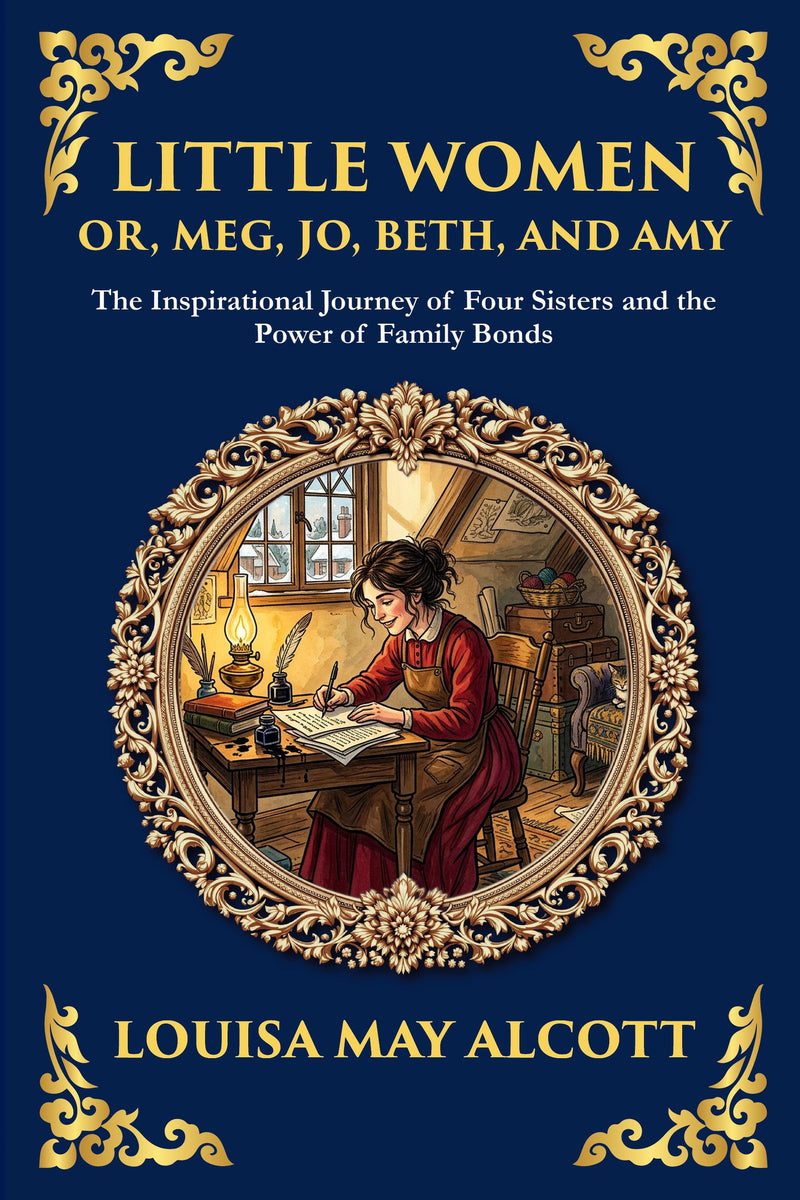
Little Women; Or, Meg, Jo, Beth, and Amy
Set in the backdrop of the American Civil War, Little Women is a timeless coming-of-age tale that captures the trials, triumphs, and tender moments of four sisters—Meg, Jo, Beth, and Amy March.
or free app
10,000+ hrs library
30-day guarantee
The complete Little Women; Or, Meg, Jo, Beth, and Amy appears in modern English through Library of Alexandria Press, available online with audiobook narration included for members.
Have you ever wondered why the simplest lives often hold the most profound truths? Little Women is more than a novel—it is a deeply human story about love, ambition, heartbreak, and resilience. Louisa May Alcott brings to life the heartwarming and sometimes heart- wrenching journey of four young women growing up in 19th-century New England.
Each sister—practical Meg, fiery Jo, gentle Beth, and artistic Amy—embodies a different struggle and aspiration, yet they are united by their powerful bond and the steady moral compass of their mother, Marmee. As they face the hardships of war, poverty, and growing pains, they also find strength in sisterhood, dreams that evolve, and the courage to define their own paths in life. This edition captures the full, unabridged text of Alcott’s masterpiece, presented in a modern layout designed for today’s reader.
Perfect for fans of character-driven fiction, inspiring women’s literature, and stories that stir the soul.
What you’ll discover in this modern edition
- The Complete Journey of the March Sisters – From childhood laughter to grown-up trials, follow Meg, Jo, Beth, and Amy through every moment.
- A Celebration of Family, Feminine Strength, and Moral Growth – Alcott’s characters are not flawless, but their flaws make them real, relatable, and deeply inspiring.
- Unforgettable Life Lessons – From humility and perseverance to forgiveness and ambition, each chapter offers timeless wisdom.
- A Groundbreaking Novel Ahead of Its Time – Addressing themes of gender roles, independence, and artistic expression, Little Women remains remarkably relevant.
- A Beautiful Reading Experience – With a modernized layout and reader-friendly design, this classic is made even more accessible. Few books offer the emotional richness, relatability, and spiritual nourishment of Little Women.
| Formats | eBook (EPUB + PDF) · Audiobook · Paperback · Hardcover · Large Print |
| Language | English |
| Trim size (print) | 6 × 9 in |
| Binding | Paperback — perfect-bound · Hardcover — casewrap |
| Large Print edition | Same text in a larger, easy-read type — a larger font, not a larger trim |
| Print pricing | Every physical book at our true cost — at-cost, no profit (members) |
| Library | 873 restored titles, always growing |
| Length | 181,975 words · ~12 hr 8 min reading |
| Reading level | Grade 6 · an easy, flowing read (this modern-English edition) |
| Edition | Modern English translation · 2026 |
Member reviews for this edition are collected as readers finish it — be the first. Across the library: 12,000+ books shipped, every plan covered by a 365-day print guarantee.
About this edition
A faithful, unabridged modern-English edition by The Library of Alexandria — carefully rendered for today's reader and verified paragraph-by-paragraph against the public-domain source. Available as eBook, audiobook, paperback, hardcover, and large print.
- Complete & unabridgedVerified paragraph by paragraph against the source — never a scan, never abridged.
- Modern English, faithfulReadable today, with the author’s meaning kept intact. Readable — not simplified.
- Every format, one membershipRead in your browser or the free app, or listen to the full audiobook.
Included free with your membership
Cancel anytime, one click · 30-day money-back guarantee
Edition last updated July 2026
What’s inside
Little Women; Or, Meg, Jo, Beth, and Amy — complete and unabridged: all 50 sections included with membership, plus the full audiobook.
Begin reading Little Women; Or, Meg, Jo, Beth, and Amy
In clear modern English — the complete text is included with membership.
Introduction
There are certain books that seem to belong less to the shelves of a library than to the lives of the people who read them. They are not simply stories we encounter once and set aside; they become companions, returned to again and again across the seasons of a single life. We meet them as children and later as adults, and we find that they have somehow grown along with us, revealing meanings we could not have understood at first. The novel you now hold in your hands is one of these rare works. Since its first appearance in the years following the American Civil War, it has been read aloud by candlelight and lamplight, passed from mother to daughter, smuggled into school desks, dog-eared in attic bedrooms, and quoted in moments of grief and joy alike. It has crossed oceans and generations, surviving every change in fashion and taste, and it remains today as warm, as funny, and as quietly profound as it was on the day it was written.
What makes a book endure for more than a century and a half? It is not spectacle, for there are no battles here, no great political intrigues, no monsters or treasures. The drama of this novel is the drama of ordinary life: the small triumphs and disappointments of a household, the slow and uneven business of growing up, the ache of wanting to be better than one is, and the comfort of being loved despite one’s faults. And yet within that ordinariness lies something extraordinary. The author understood, with a wisdom that still astonishes, that the most important events in a human life rarely announce themselves with trumpets. They happen in kitchens and gardens, in shared secrets and whispered confessions, in the quiet courage of a person who chooses kindness when cruelty would be easier. To read this book attentively is to be reminded that the work of becoming a good and whole person is the great adventure available to everyone, regardless of wealth, circumstance, or fame.
This edition has been carefully prepared as a modern translation, adapted for the contemporary reader. That phrase deserves a word of explanation, because it touches the heart of what we hope to offer you. The original text, magnificent as it is, was written in the idiom of the mid-nineteenth century. Its sentences could be long and winding, its vocabulary occasionally archaic, its references rooted in a world whose customs and assumptions have faded from common memory. For some readers, these qualities are part of the charm; for many others, they form a barrier that keeps a beloved story at arm’s length. The aim of this adaptation is to lower that barrier without lowering the story itself—to clear away the dust that time has settled over the prose so that the living warmth beneath it can shine through unobstructed. The spirit of the original has been preserved with care and reverence. The characters speak and act as they always have; their hopes, their quarrels, their laughter, and their tears remain entirely their own. What has changed is chiefly the texture of the language, smoothed and clarified so that a reader today can move through the pages with the same ease and delight that the first readers must have felt in their own time.
It is impossible to understand the peculiar tenderness of this novel without knowing something of the woman who wrote it, for few books have ever been drawn so directly from the well of their author’s own experience. Louisa May Alcott was born in 1832 into a family that was rich in ideas and poor in nearly everything else. Her father was a philosopher and educational reformer, a man of lofty principles and impractical habits who moved his family from place to place in pursuit of one idealistic scheme after another. He kept company with some of the finest minds of his age, and the household breathed an atmosphere of literature, conversation, and moral seriousness. But high thinking did not pay the grocer, and Louisa grew up intimately acquainted with the anxieties of genteel poverty—the patched dresses, the carefully stretched meals, the dignity that must be maintained in the face of constant want.
From a young age she took it upon herself to help support her family. She worked as a teacher, a seamstress, a governess, and even a domestic servant, all the while scribbling stories in stolen hours, determined to make her way as a writer in a world that offered women few such paths. She published thrilling, sensational tales under a pen name to earn money, and she nursed wounded soldiers during the Civil War until illness nearly cost her life. She was, by every account, fiercely independent, hot-tempered, generous, ambitious, and impatient with the narrow expectations placed upon women of her day. In short, she was very much like the most memorable character in the book you are about to read—the spirited, headstrong, scribbling girl whose dreams of authorship and whose struggle to tame her own fiery nature have spoken to countless readers across the years.
When a publisher first suggested that Alcott write a book for girls, she was reluctant. She did not think much of the idea, and she confessed in her journal that she did not particularly enjoy the company of girls or know many besides her own sisters. And yet it was precisely those sisters, and the family life they had shared in their modest New England home, that became the soil from which this masterpiece grew. She wrote quickly, drawing on memory and affection, transforming the people she loved into characters who would become beloved by millions. The result surprised even her. The book was an immediate and enormous success, and demand for more was so great that she soon produced a continuation. Almost overnight, the obscure and overworked writer became one of the most famous authors in the country, and the financial security her family had never known was finally within reach.
But the deepest power of the novel does not come from its success. It comes from its honesty. Because Alcott was writing about her own family, she could not bring herself to make her characters into plaster saints. They are flawed, sometimes maddeningly so. They lose their tempers, they envy one another, they make selfish choices and pay for them, they wrestle with vanity and pride and despair. They are, in a word, real. And this realism, so rare in the moralizing children’s literature of the period, is what gives the book its enduring vitality. We believe in these sisters because they are not perfect, and we love them because they keep trying to be better. Alcott gives us the gift of watching ordinary, imperfect human beings struggle toward goodness—not the dull goodness of obedience, but the hard-won goodness that is earned through failure, reflection, and the steady labor of self-improvement. In this she was far ahead of her time, and it is one of the reasons her work feels so startlingly modern even now.
It is worth knowing, too, that the book engages thoughtfully with the questions that would have pressed most heavily on a young woman of Alcott’s era. What does it mean to be useful? Is it possible to be both ambitious and loving, both independent and devoted? Must a woman choose between her own dreams and the duties expected of her by her family and society? How does one find meaningful work in a world that offers women so few opportunities? These are not abstract concerns in the novel; they are lived out, painfully and joyfully, in the daily choices of its characters. Alcott did not pretend the answers were easy. She wrote out of her own deep frustration with the limits placed upon her sex, and a careful reader will sense, beneath the domestic warmth of the story, the quiet pulse of rebellion. That tension—between the comforts of home and the call of a larger life—gives the book a depth that has allowed each generation of readers to find in it something newly relevant to their own struggles.
Without revealing the turns the story takes—for the pleasure of discovering them belongs to you alone—it is worth preparing you for the kind of experience that awaits. This is, above all, a domestic novel, which is to say that its stage is the home and its actors are a family. At its center stand four sisters, each distinct and vividly drawn, each carrying her own particular gifts and her own particular faults. One is gentle and motherly, longing for the ordinary comforts of love and a household of her own. One is bold and rebellious, bursting with literary ambition and a temper she cannot always control, chafing against the constraints that her world places upon a girl. One is shy and tender, content with the smallest pleasures and possessed of a sweetness that touches everyone around her. And one is artistic and proud, with a child’s vanity that gradually ripens into a more thoughtful understanding of herself and the world.
These four, together with their wise and loving mother, form the warm hearth around which the entire book revolves. Their father is absent for much of the story, serving away from home, and so the household is, for long stretches, a world of women—a world of shared work and shared dreams, of theatricals performed in the parlor and secret societies invented for amusement, of small economies and great loyalties. Into this circle come a handful of others: a lonely boy from the grand house next door who becomes almost a brother to the sisters; his kindly grandfather; a sharp-tongued, wealthy aunt; and various friends and suitors whose arrivals and departures stir the placid surface of family life. The cast is small, the geography modest, and yet within these narrow bounds the author finds room for the whole range of human feeling.
You will laugh often, for the book is genuinely and surprisingly funny. The mishaps of the sisters—their failed culinary experiments, their amateur dramatics, their squabbles and reconciliations—are rendered with a light comic touch that has lost none of its sparkle. You will also be moved, perhaps more deeply than you expect. There are passages of great tenderness in these pages, moments that have brought tears to the eyes of readers for a hundred and fifty years and will surely bring them to yours. The author does not shy away from sorrow, nor from the hard realities of illness, loss, and the passage of time. She knew that a story cannot be truly joyful unless it is also willing to be sad, and she trusts her readers to bear both. This willingness to hold joy and grief together, to show life in its fullness rather than in some sanitized half-portrait, is one of the marks of the book’s greatness.
You will find, as well, a quiet but persistent wisdom about the art of living. The mother of the family is one of literature’s great teachers, and her gentle counsel to her daughters—about controlling one’s temper, about the value of work, about the difference between true and false happiness, about facing hardship without bitterness—forms a kind of moral thread running through the whole. These lessons are never preachy or heavy-handed in the way that so much instruction of the period could be. They arise naturally from situations the characters find themselves in, and they are offered with such warmth and good sense that they feel less like rules imposed from above than like the accumulated wisdom of a loving family passed down through the generations. Many readers have carried these small pieces of guidance with them throughout their lives, recalling them in moments of difficulty, finding in them a steady and reassuring voice.
But perhaps the greatest thing you will find here is a feeling—the feeling of belonging to a family. The book has an almost magical power to fold the reader into its circle, to make us feel that we, too, are sitting by the fire with the sisters, sharing in their secrets and their celebrations. There is a coziness to it, a sense of refuge, that has made it for many people a kind of literary home, a place to return to when the larger world feels cold and frightening. To open these pages is to be welcomed back into a household where, for all its troubles, love is the governing law and no one is ever truly alone. In an age when so much pulls us apart, when families are scattered and screens replace conversation, this vision of close-knit warmth has only grown more precious. The book reminds us of something we are always in danger of forgetting: that the bonds we form with those closest to us are the truest riches we will ever possess.
Cancel anytime, one click · 30-day money-back guarantee
Founding annual rate available now — your price locks for life when you join.
Not ready? Get this free chapter by email — read it anytime.
✓ Sent — check your inbox for Little Women; Or, Meg, Jo, Beth, and Amy.
Questions about Little Women; Or, Meg, Jo, Beth, and Amy
What is Little Women; Or, Meg, Jo, Beth, and Amy about?
Set in the backdrop of the American Civil War, Little Women is a timeless coming-of-age tale that captures the trials, triumphs, and tender moments of four sisters—Meg, Jo, Beth, and Amy March. Through seasons of joy and sorrow, ambition and self-discovery, they navigate the path from girlhood to womanhood with courage, kindness, and unwavering love for one another. With richly drawn characters and heartfelt storytelling, Louisa May Alcott’s beloved novel celebrates the enduring power of family, the strength of cha
Who wrote Little Women; Or, Meg, Jo, Beth, and Amy?
Little Women; Or, Meg, Jo, Beth, and Amy was written by Louisa May Alcott. This edition presents the complete work in clear modern English, faithfully rendered from the public-domain original by Library of Alexandria Press.
Is Little Women; Or, Meg, Jo, Beth, and Amy free to read?
The opening chapter is free to read on this page. Members read and listen to the complete work — and the entire library — free, and can order any physical book at our true print cost.
How long is Little Women; Or, Meg, Jo, Beth, and Amy?
50 chapters (~181,975 words) — about 12 hr 8 min of reading in this modern-English edition.
Is this an abridged version of Little Women; Or, Meg, Jo, Beth, and Amy?
No. This is the complete, unabridged Little Women; Or, Meg, Jo, Beth, and Amy, carefully rendered into clear modern English and verified paragraph-by-paragraph against the public-domain source — nothing is cut or summarised.
What formats does Little Women; Or, Meg, Jo, Beth, and Amy come in?
Little Women; Or, Meg, Jo, Beth, and Amy is available as eBook, paperback and hardcover. eBook and audiobook are included with membership; printed editions ship at our true print cost.
Shipping & returns
Billing & membership
More from the library


Explore Biography & Letters
- Meditations · Marcus Aurelius
- The Confessions of St. Augustine · Saint Augustine
- The Confessions of Jean-Jacques Rousseau — Complete · Jean-Jacques Rousseau
- Ecce Homo · Friedrich Wilhelm Nietzsche
- De Profundis · Oscar Wilde
- Memoirs of Joseph Grimaldi · Joseph Grimaldi
- English Eccentrics and Eccentricities · John Timbs
- You Can’t Win · Jack Black
- Wild Animals I Have Known · Ernest Thompson Seton
- The Diary of Samuel Pepys — Complete 1665 N.S. · Samuel Pepys
- Random Reminiscences of Men and Events · John D. Rockefeller
- The Story of My Life · Helen Keller
- Elizabeth, Empress of Austria and Queen of Hungary · Carl Küchler
- Society as I Have Found It · Ward McAllister
- Autobiography of a Yogi · Paramahansa Yogananda
- Christopher Columbus and How He Received and Imparted the Spirit of Discovery
- A Portrait of the Artist as a Young Man · James Joyce
- Memoirs of the Author of a Vindication of the Rights of Woman · William Godwin
- Mary: A Fiction · Mary Wollstonecraft
- The Romance of Biography (Vol. 1 of 2) · Mrs. Jameson
- The Love Letters of Mary Wollstonecraft to Gilbert Imlay · Mary Wollstonecraft
- Selected Works of Voltairine de Cleyre · Voltairine de Cleyre
- Eighty Years and More; Reminiscences 1815–1897 · Elizabeth Cady Stanton
- Anarchism and Other Essays · Emma Goldman
- Agnes Grey · Anne Brontë
- Daddy-Long-Legs · Jean Webster
- Reminiscences of a Stock Operator · Edwin Lefèvre
- Martin Eden · Jack London
- Matthew Calbraith Perry: A Typical American Naval Officer · William Elliot Griffis
- Walden, and On the Duty of Civil Disobedience · Henry David Thoreau
Little Women; Or, Meg, Jo, Beth, and Amy
Little Women; Or, Meg, Jo, Beth, and Amy
The Inspirational Journey of Four Sisters and the Power of Family Bonds
Louisa May Alcott
Contents
- Introduction
- Part 1
- Chapter 1
- Chapter 2
- Chapter 3
- Chapter 4
- Chapter 5
- Chapter 6
- Chapter 7
- Chapter 8
- Chapter 9
- Chapter 10
- Chapter 11
- Chapter 12
- Chapter 13
- Chapter 14
- Chapter 15
- Chapter 16
- Chapter 17
- Chapter 18
- Chapter 19
- Chapter 20
- Chapter 21
- Chapter 22
- Chapter 23
- Part 2
- Chapter 24
- Chapter 25
- Chapter 26
- Chapter 27
- Chapter 28
- Chapter 29
- Chapter 30
- Chapter 31
- Chapter 32
- Chapter 33
- Chapter 34
- Chapter 35
- Chapter 36
- Chapter 37
- … and 10 more chapters
Introduction
There are certain books that seem to belong less to the shelves of a library than to the lives of the people who read them. They are not simply stories we encounter once and set aside; they become companions, returned to again and again across the seasons of a single life. We meet them as children and later as adults, and we find that they have somehow grown along with us, revealing meanings we could not have understood at first. The novel you now hold in your hands is one of these rare works. Since its first appearance in the years following the American Civil War, it has been read aloud by candlelight and lamplight, passed from mother to daughter, smuggled into school desks, dog-eared in attic bedrooms, and quoted in moments of grief and joy alike. It has crossed oceans and generations, surviving every change in fashion and taste, and it remains today as warm, as funny, and as quietly profound as it was on the day it was written.
What makes a book endure for more than a century and a half? It is not spectacle, for there are no battles here, no great political intrigues, no monsters or treasures. The drama of this novel is the drama of ordinary life: the small triumphs and disappointments of a household, the slow and uneven business of growing up, the ache of wanting to be better than one is, and the comfort of being loved despite one’s faults. And yet within that ordinariness lies something extraordinary. The author understood, with a wisdom that still astonishes, that the most important events in a human life rarely announce themselves with trumpets. They happen in kitchens and gardens, in shared secrets and whispered confessions, in the quiet courage of a person who chooses kindness when cruelty would be easier. To read this book attentively is to be reminded that the work of becoming a good and whole person is the great adventure available to everyone, regardless of wealth, circumstance, or fame.
This edition has been carefully prepared as a modern translation, adapted for the contemporary reader. That phrase deserves a word of explanation, because it touches the heart of what we hope to offer you. The original text, magnificent as it is, was written in the idiom of the mid-nineteenth century. Its sentences could be long and winding, its vocabulary occasionally archaic, its references rooted in a world whose customs and assumptions have faded from common memory. For some readers, these qualities are part of the charm; for many others, they form a barrier that keeps a beloved story at arm’s length. The aim of this adaptation is to lower that barrier without lowering the story itself—to clear away the dust that time has settled over the prose so that the living warmth beneath it can shine through unobstructed. The spirit of the original has been preserved with care and reverence. The characters speak and act as they always have; their hopes, their quarrels, their laughter, and their tears remain entirely their own. What has changed is chiefly the texture of the language, smoothed and clarified so that a reader today can move through the pages with the same ease and delight that the first readers must have felt in their own time.
It is impossible to understand the peculiar tenderness of this novel without knowing something of the woman who wrote it, for few books have ever been drawn so directly from the well of their author’s own experience. Louisa May Alcott was born in 1832 into a family that was rich in ideas and poor in nearly everything else. Her father was a philosopher and educational reformer, a man of lofty principles and impractical habits who moved his family from place to place in pursuit of one idealistic scheme after another. He kept company with some of the finest minds of his age, and the household breathed an atmosphere of literature, conversation, and moral seriousness. But high thinking did not pay the grocer, and Louisa grew up intimately acquainted with the anxieties of genteel poverty—the patched dresses, the carefully stretched meals, the dignity that must be maintained in the face of constant want.
From a young age she took it upon herself to help support her family. She worked as a teacher, a seamstress, a governess, and even a domestic servant, all the while scribbling stories in stolen hours, determined to make her way as a writer in a world that offered women few such paths. She published thrilling, sensational tales under a pen name to earn money, and she nursed wounded soldiers during the Civil War until illness nearly cost her life. She was, by every account, fiercely independent, hot-tempered, generous, ambitious, and impatient with the narrow expectations placed upon women of her day. In short, she was very much like the most memorable character in the book you are about to read—the spirited, headstrong, scribbling girl whose dreams of authorship and whose struggle to tame her own fiery nature have spoken to countless readers across the years.
When a publisher first suggested that Alcott write a book for girls, she was reluctant. She did not think much of the idea, and she confessed in her journal that she did not particularly enjoy the company of girls or know many besides her own sisters. And yet it was precisely those sisters, and the family life they had shared in their modest New England home, that became the soil from which this masterpiece grew. She wrote quickly, drawing on memory and affection, transforming the people she loved into characters who would become beloved by millions. The result surprised even her. The book was an immediate and enormous success, and demand for more was so great that she soon produced a continuation. Almost overnight, the obscure and overworked writer became one of the most famous authors in the country, and the financial security her family had never known was finally within reach.
But the deepest power of the novel does not come from its success. It comes from its honesty. Because Alcott was writing about her own family, she could not bring herself to make her characters into plaster saints. They are flawed, sometimes maddeningly so. They lose their tempers, they envy one another, they make selfish choices and pay for them, they wrestle with vanity and pride and despair. They are, in a word, real. And this realism, so rare in the moralizing children’s literature of the period, is what gives the book its enduring vitality. We believe in these sisters because they are not perfect, and we love them because they keep trying to be better. Alcott gives us the gift of watching ordinary, imperfect human beings struggle toward goodness—not the dull goodness of obedience, but the hard-won goodness that is earned through failure, reflection, and the steady labor of self-improvement. In this she was far ahead of her time, and it is one of the reasons her work feels so startlingly modern even now.
It is worth knowing, too, that the book engages thoughtfully with the questions that would have pressed most heavily on a young woman of Alcott’s era. What does it mean to be useful? Is it possible to be both ambitious and loving, both independent and devoted? Must a woman choose between her own dreams and the duties expected of her by her family and society? How does one find meaningful work in a world that offers women so few opportunities? These are not abstract concerns in the novel; they are lived out, painfully and joyfully, in the daily choices of its characters. Alcott did not pretend the answers were easy. She wrote out of her own deep frustration with the limits placed upon her sex, and a careful reader will sense, beneath the domestic warmth of the story, the quiet pulse of rebellion. That tension—between the comforts of home and the call of a larger life—gives the book a depth that has allowed each generation of readers to find in it something newly relevant to their own struggles.
Without revealing the turns the story takes—for the pleasure of discovering them belongs to you alone—it is worth preparing you for the kind of experience that awaits. This is, above all, a domestic novel, which is to say that its stage is the home and its actors are a family. At its center stand four sisters, each distinct and vividly drawn, each carrying her own particular gifts and her own particular faults. One is gentle and motherly, longing for the ordinary comforts of love and a household of her own. One is bold and rebellious, bursting with literary ambition and a temper she cannot always control, chafing against the constraints that her world places upon a girl. One is shy and tender, content with the smallest pleasures and possessed of a sweetness that touches everyone around her. And one is artistic and proud, with a child’s vanity that gradually ripens into a more thoughtful understanding of herself and the world.
These four, together with their wise and loving mother, form the warm hearth around which the entire book revolves. Their father is absent for much of the story, serving away from home, and so the household is, for long stretches, a world of women—a world of shared work and shared dreams, of theatricals performed in the parlor and secret societies invented for amusement, of small economies and great loyalties. Into this circle come a handful of others: a lonely boy from the grand house next door who becomes almost a brother to the sisters; his kindly grandfather; a sharp-tongued, wealthy aunt; and various friends and suitors whose arrivals and departures stir the placid surface of family life. The cast is small, the geography modest, and yet within these narrow bounds the author finds room for the whole range of human feeling.
You will laugh often, for the book is genuinely and surprisingly funny. The mishaps of the sisters—their failed culinary experiments, their amateur dramatics, their squabbles and reconciliations—are rendered with a light comic touch that has lost none of its sparkle. You will also be moved, perhaps more deeply than you expect. There are passages of great tenderness in these pages, moments that have brought tears to the eyes of readers for a hundred and fifty years and will surely bring them to yours. The author does not shy away from sorrow, nor from the hard realities of illness, loss, and the passage of time. She knew that a story cannot be truly joyful unless it is also willing to be sad, and she trusts her readers to bear both. This willingness to hold joy and grief together, to show life in its fullness rather than in some sanitized half-portrait, is one of the marks of the book’s greatness.
You will find, as well, a quiet but persistent wisdom about the art of living. The mother of the family is one of literature’s great teachers, and her gentle counsel to her daughters—about controlling one’s temper, about the value of work, about the difference between true and false happiness, about facing hardship without bitterness—forms a kind of moral thread running through the whole. These lessons are never preachy or heavy-handed in the way that so much instruction of the period could be. They arise naturally from situations the characters find themselves in, and they are offered with such warmth and good sense that they feel less like rules imposed from above than like the accumulated wisdom of a loving family passed down through the generations. Many readers have carried these small pieces of guidance with them throughout their lives, recalling them in moments of difficulty, finding in them a steady and reassuring voice.
But perhaps the greatest thing you will find here is a feeling—the feeling of belonging to a family. The book has an almost magical power to fold the reader into its circle, to make us feel that we, too, are sitting by the fire with the sisters, sharing in their secrets and their celebrations. There is a coziness to it, a sense of refuge, that has made it for many people a kind of literary home, a place to return to when the larger world feels cold and frightening. To open these pages is to be welcomed back into a household where, for all its troubles, love is the governing law and no one is ever truly alone. In an age when so much pulls us apart, when families are scattered and screens replace conversation, this vision of close-knit warmth has only grown more precious. The book reminds us of something we are always in danger of forgetting: that the bonds we form with those closest to us are the truest riches we will ever possess.
“Christmas just isn’t Christmas without any presents,” Jo grumbled, lying on the rug.
“It’s so awful to be poor!” Meg sighed, looking down at her old dress.
“I don’t think it’s fair that some girls have plenty of pretty things while others have nothing at all,” little Amy added with an offended sniff.
“We have father and mother and each other,” Beth said contentedly from her corner.
The four young faces, lit by the glow of the fire, brightened at her cheerful words, but dimmed again when Jo said sadly,
“We don’t have father, and we won’t for a long time.” She didn’t say “maybe never,” but they all silently thought it, thinking of their father far away at the war.
No one spoke for a minute; then Meg said in a different tone,
“You know why Mother suggested we not have any presents this Christmas. It’s going to be a hard winter for everyone, and she thinks we shouldn’t spend money on luxuries while our men are suffering so much in the army. We can’t do much, but we can make small sacrifices, and we should do it happily. But I’m afraid I can’t,” Meg said, shaking her head as she thought regretfully about all the pretty things she wanted.
“But I don’t think the little bit we’d spend would actually help. We only have a dollar each, and the army wouldn’t benefit much from that. I agree not to expect anything from you or Mother, but I really want to buy Undine and Sintram for myself; I’ve wanted it for so long,” said Jo, who loved to read.
“I planned to spend mine on new sheet music,” Beth said with a little sigh that no one heard except the hearth-brush and the kettle-holder.
“I’m going to get a nice set of Faber drawing pencils; I really need them,” Amy said decisively.
End of the free sample
Keep reading, free
Members read and listen to the complete book — and the entire library. Cancel anytime, one click · 30-day money-back guarantee.