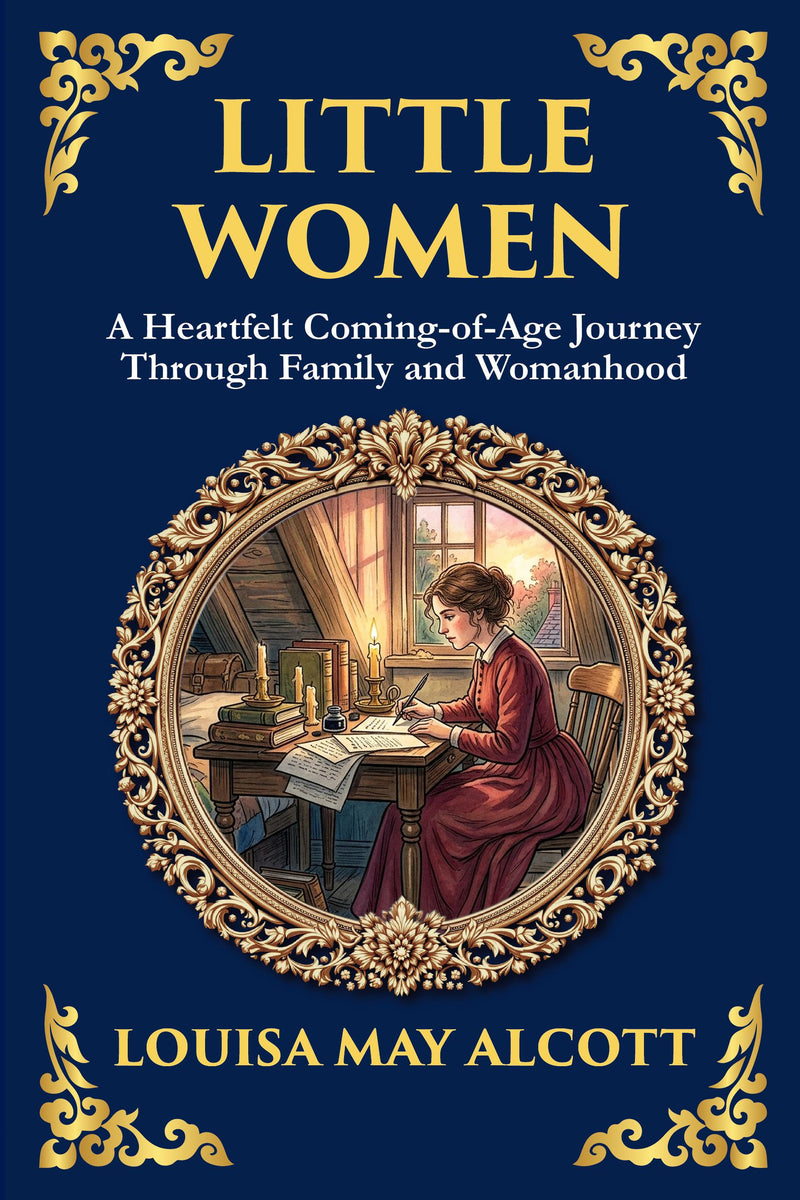
Little Women — Large Print
In a warm yet deeply moving tale of love, family, and personal growth, Little Women follows the four March sisters—Meg, Jo, Beth, and Amy—as they navigate the joys and hardships of life during the Civil War era.
or free app
10,000+ hrs library
30-day guarantee
The complete Little Women appears in modern English through Library of Alexandria Press, available online with audiobook narration included for members.
Have you ever wondered why some stories never fade, touching hearts for generations? Little Women by Louisa May Alcott is more than just a coming-of-age tale—it is a journey through love, loss, dreams, and resilience. Set against the backdrop of the American Civil War, the novel brings to life the unforgettable March family as they face poverty, societal expectations, and personal challenges while striving to stay true to themselves.
Meet the four March sisters: Meg, the eldest, who longs for a life of comfort and romance. Jo, a fiercely independent aspiring writer, determined to break free from traditional roles. Beth, the gentle soul whose kindness touches everyone around her.
Amy, the youngest, who dreams of beauty, art, and refinement. As the sisters grow, they encounter love and heartbreak, ambition and sacrifice, success and tragedy. At the heart of their story is the strength of family and the courage to follow one’s dreams, even when faced with adversity.
Whether you are reading this classic for the first time or revisiting it as an old favorite, Little Women remains a deeply inspiring reflection on womanhood, identity, and the timeless bonds of sisterhood.
What you’ll discover in this modern edition
- A heartwarming journey of the March sisters, each with unique dreams and struggles.
- Themes of resilience and self-discovery, as the sisters navigate life’s joys and sorrows.
- A historical portrait of 19th-century America, filled with timeless moral lessons.
- A celebration of family and love, showing how true bonds endure hardship.
- One of literature’s most iconic female protagonists, Jo March, who has inspired countless generations. Step into the world of the March family and experience a story that continues to resonate across the ages.
| Formats | eBook (EPUB + PDF) · Audiobook · Paperback · Hardcover · Large Print |
| Language | English |
| Trim size (print) | 6 × 9 in |
| Binding | Paperback — perfect-bound · Hardcover — casewrap |
| Large Print edition | Same text in a larger, easy-read type — a larger font, not a larger trim |
| Print pricing | Every physical book at our true cost — at-cost, no profit (members) |
| Library | 873 restored titles, always growing |
| Length | 184,263 words · ~12 hr 17 min reading |
| Reading level | Grade 6 · an easy, flowing read (this modern-English edition) |
| Edition | Modern English translation · 2026 |
Member reviews for this edition are collected as readers finish it — be the first. Across the library: 12,000+ books shipped, every plan covered by a 365-day print guarantee.
About this edition
A faithful, unabridged modern-English edition by The Library of Alexandria — carefully rendered for today's reader and verified paragraph-by-paragraph against the public-domain source. Available as eBook, audiobook, paperback, hardcover, and large print.
- Complete & unabridgedVerified paragraph by paragraph against the source — never a scan, never abridged.
- Modern English, faithfulReadable today, with the author’s meaning kept intact. Readable — not simplified.
- Every format, one membershipRead in your browser or the free app, or listen to the full audiobook.
Included free with your membership
Cancel anytime, one click · 30-day money-back guarantee
Edition last updated July 2026
What’s inside
Little Women — Large Print — complete and unabridged: all 50 sections included with membership, plus the full audiobook.
Begin reading Little Women — Large Print
In clear modern English — the complete text is included with membership.
Introduction
There are certain books that do not merely tell a story but offer a place to live for a while—a hearth to gather around, a family to belong to, a set of rooms whose every creak and corner becomes as familiar as our own homes. Little Women is one of these rare works. For more than a century and a half, readers across the world have stepped through its front door and felt, almost immediately, that they have come home. To open its pages is to be welcomed into the warmth of a household where money is scarce but love is abundant, where laughter and tears are never far apart, and where four very different young women are quietly becoming themselves in full view of anyone willing to watch with patience and tenderness.
What you hold in your hands is a modern translation of this beloved classic, carefully adapted for the contemporary reader. The intention behind this edition is not to replace the original or to diminish its character, but to clear away the small obstacles of time—the unfamiliar phrasings, the dated turns of speech, the references that have faded with the years—so that the heart of the book may beat as freshly for you as it did for its first readers. The story itself remains untouched in spirit. The March family is still here, vivid and real, and the journey they invite you to share is as moving and as relevant as it ever was. If anything, the passage of years has only deepened the resonance of what Louisa May Alcott set down, for the questions her characters wrestle with—how to be good without losing yourself, how to grow up without growing cold, how to balance ambition with affection, duty with desire—are questions we are still asking today.
It is worth pausing, before you begin, to consider why this particular book has endured when so many others of its era have slipped quietly out of memory. Little Women was first published in two volumes, in 1868 and 1869, and its success was immediate and overwhelming. Readers wrote to its author begging to know what would happen to the characters they had come to love as if they were neighbors or relations. Booksellers could scarcely keep copies on their shelves. And yet popularity alone does not explain longevity. Many bestsellers of the nineteenth century are now read only by scholars and specialists. What makes this novel different is something harder to name—a quality of truthfulness that allows it to leap across the gap of generations and speak directly to the reader, whoever and whenever they may be.
Part of this truthfulness comes from the fact that the book is rooted in lived experience. Louisa May Alcott did not invent the March family out of pure imagination; she drew them from her own. She was the second of four daughters in a family that knew genteel poverty intimately, presided over by an idealistic father whose grand intellectual ambitions rarely translated into household income, and held together by a mother of extraordinary strength and warmth. The struggles depicted in these pages—the careful counting of small sums, the turned and mended dresses, the longing for small luxuries, the necessity of work—were struggles Alcott herself had known. When she writes of a young woman scribbling stories in a garret in the hope of earning a few dollars to ease her family’s burdens, she writes from memory. This authenticity gives the book a weight and a sincerity that no amount of clever invention could supply. You sense, reading it, that the author is not merely entertaining you but confiding in you.
But truthfulness is not the same as gloom, and one of the great delights awaiting you is how genuinely warm and funny this book can be. The March household is alive with personality. There is teasing and squabbling, there are private jokes and dramatic schemes, there are theatrical performances staged in the attic with homemade costumes and outrageous plots. The sisters quarrel and reconcile, sulk and forgive, scheme and dream. Their voices are distinct and immediate; you will know within a few chapters exactly who is speaking by the rhythm and color of their words. This liveliness is essential to the book’s magic. It would be easy, given the moral seriousness of the story, for it to become preachy or heavy. Instead, the lessons—and there are lessons, gently and lovingly delivered—arrive wrapped in so much affection and humor that they never feel like sermons. We learn alongside the sisters because we have come to care about them, not because we are being instructed.
At the center of the family stands the mother the girls call Marmee, one of literature’s great portraits of maternal wisdom. She is not a saint of the dull, lifeless kind; she has a temper she has spent a lifetime learning to govern, opinions she holds firmly, and a heart capable of fierce love and quiet sorrow. Her guidance shapes the whole emotional architecture of the book. Through her, Alcott offers a vision of womanhood and motherhood that was, in its day, quietly radical—one that valued character over conformity, integrity over mere respectability, and the inner life of women as something worthy of serious attention. The conversations between Marmee and her daughters, often taking place by firelight after some small domestic crisis, are among the most tender and instructive passages in the novel. They reward slow reading. There is a great deal of accumulated wisdom in them, and it is offered without condescension, as one woman speaking to other women about how to live well.
The four sisters themselves form the beating heart of the story, and each is drawn with such care and individuality that readers have argued for generations about which they love best and which they most resemble. Without revealing the turns their lives will take, it can be said that they represent four distinct temperaments and four different answers to the question of what a woman might do with her one precious life. One is gentle and domestic, longing for a home of her own. One is fierce, ambitious, impatient with the limits placed upon her, and determined to make something of herself in a world not yet ready to give women much room. One is shy and musical, content with small joys and devoted to those she loves. One is artistic and proud, hungry for elegance and beauty, sometimes vain but never cruel. The genius of Alcott’s characterization is that none of these girls is a type or a symbol; each is a fully realized person, with virtues and faults thoroughly mixed, capable of growth and capable of failure. You will recognize yourself in all of them at different moments, and you will recognize the people you have loved.
It is the ambitious, restless sister whom readers have most often taken to their hearts, and it is not difficult to see why. In her, Alcott gave voice to longings that countless girls and women have felt but rarely seen reflected in the literature of their time: the desire for independence, for creative work, for adventure beyond the parlor and the kitchen, for a life shaped by one’s own choices rather than by the expectations of others. Through this character, the novel asks whether a young woman can be both true to herself and at peace with the world around her, whether ambition and tenderness can coexist, whether one must sacrifice the wildness of one’s nature in order to grow up. These are not small questions, and the book does not answer them glibly. It takes them seriously, as it takes its readers seriously, and that respect is one of the deepest reasons for its enduring hold on our imaginations.
The World of the March Family and the Power of Small Things
To enter this novel fully, it helps to understand a little about the world in which it is set—not to study it as history, but to feel its texture beneath the story. The events unfold in New England during and after the years of the American Civil War, a conflict that hovers at the edges of the family’s daily life like distant thunder. The father is away, serving as a chaplain to the troops, and his absence colors everything: the empty chair at the table, the anxious wait for letters, the quiet courage with which the women of the household carry on. This is a story shaped by war, though it is not a war story. The battles it depicts are the smaller, quieter ones fought within the four walls of a modest home—battles against poverty, against pride, against selfishness and despair, against the daily temptations to be less than one’s best self. Alcott understood that these inner battles, though invisible to the world, require as much courage as any waged on a field, and she chronicles them with a seriousness that elevates the ordinary into something close to the heroic.
The material poverty of the family is rendered with unsentimental honesty. There is never quite enough money. Dresses must be made to last, pleasures must be carefully chosen, and the difference between the Marches and their wealthier neighbors is felt keenly by the girls, especially the younger ones who have not yet learned to bear it gracefully. Yet the book performs a kind of quiet alchemy with this poverty. It does not romanticize hardship, nor does it suggest that being poor is somehow ennobling in itself. Rather, it shows how a family rich in love can transform scarcity into a different kind of abundance—how a humble Christmas can be made glorious by generosity, how a borrowed dress and a single good glove need not spoil an evening, how the simplest pleasures, savored together, can outshine the most lavish entertainments enjoyed alone. This is one of the book’s most consoling messages, and one that speaks with particular force in our own age of acquisition and comparison. The Marches teach us, without ever lecturing, that the things that matter most cannot be bought.
A great deal of the novel’s charm and wisdom lies in its attention to small things. Alcott had a remarkable gift for finding meaning in the ordinary furniture of daily life—a basket of mending, a pot of jam gone wrong, a kept or broken promise, a kindness offered to a poor neighbor, a moment of jealousy quickly repented. Nothing very dramatic, by the standards of grand fiction, happens for long stretches of the book. There are no great villains, no shipwrecks or duels or sudden fortunes won and lost. And yet the story never flags, because Alcott understood that the real drama of most human lives takes place in exactly these small moments—in the choice to forgive rather than to hold a grudge, to give rather than to keep, to speak gently rather than sharply, to swallow one’s pride for the sake of someone else’s happiness. She makes these tiny decisions feel as consequential as they truly are. By the end, you may find that you have been quietly persuaded to look at your own small choices with new and more careful eyes.
This is, in the deepest sense, a book about character—about how character is formed, slowly and painfully and joyfully, through the accumulated choices of ordinary days. Each of the sisters carries a particular flaw she must learn to master: a quick temper, a streak of vanity, a tendency toward shyness or selfishness or discontent. The novel follows them as they stumble against these faults, fail, repent, and try again, never quite achieving perfection but always inching toward their better selves. There is something profoundly reassuring in this. Alcott does not present us with flawless heroines to admire from a distance; she gives us imperfect young women who struggle exactly as we struggle, and who win their small victories exactly as we hope to win ours. The book’s moral vision is generous and humane. It assumes that goodness is possible but never easy, that we are all works in progress, and that the effort to be good is itself a kind of beauty, regardless of whether we ever fully succeed.
It would be a mistake, though, to leave the impression that this is a solemn book. For all its moral seriousness, Little Women is full of joy. There are picnics and parties, friendships and flirtations, performances and pranks, holidays celebrated with whatever modest means are at hand. The arrival of a lonely boy from the great house next door opens the family’s world to new companionship and new possibilities, and the friendship that grows between him and the sisters brings some of the book’s most delightful scenes. There is romance, handled with delicacy and surprising honesty about the complications of the heart. There is laughter on nearly every page. The overall effect is not of being instructed but of being embraced—of spending time in the company of people whose warmth and goodness make us want to be warmer and better ourselves. Few books leave the reader feeling so thoroughly comforted and encouraged.
Cancel anytime, one click · 30-day money-back guarantee
Founding annual rate available now — your price locks for life when you join.
Not ready? Get this free chapter by email — read it anytime.
✓ Sent — check your inbox for Little Women — Large Print.
Questions about Little Women — Large Print
What is Little Women about?
In a warm yet deeply moving tale of love, family, and personal growth, Little Women follows the four March sisters—Meg, Jo, Beth, and Amy—as they navigate the joys and hardships of life during the Civil War era. Each sister dreams of a life shaped by her own values: Meg longs for love and stability, Jo yearns to be a writer, Beth embodies quiet kindness and sacrifice, and Amy aspires to beauty and refinement. Through trials, triumphs, heartbreak, and hope, their story reveals what it means to grow into womanhood wh
Who wrote Little Women?
Little Women was written by Louisa May Alcott. This edition presents the complete work in clear modern English, faithfully rendered from the public-domain original by Library of Alexandria Press.
Is Little Women free to read?
The opening chapter is free to read on this page. Members read and listen to the complete work — and the entire library — free, and can order any physical book at our true print cost.
How long is Little Women?
50 chapters (~184,263 words) — about 12 hr 17 min of reading in this modern-English edition.
Is this an abridged version of Little Women?
No. This is the complete, unabridged Little Women, carefully rendered into clear modern English and verified paragraph-by-paragraph against the public-domain source — nothing is cut or summarised.
What formats does Little Women come in?
Little Women is available as eBook, paperback and hardcover. eBook and audiobook are included with membership; printed editions ship at our true print cost.
Shipping & returns
Billing & membership
More from the library


Explore Biography & Letters
- Meditations · Marcus Aurelius
- The Confessions of St. Augustine · Saint Augustine
- The Confessions of Jean-Jacques Rousseau — Complete · Jean-Jacques Rousseau
- Ecce Homo · Friedrich Wilhelm Nietzsche
- De Profundis · Oscar Wilde
- Memoirs of Joseph Grimaldi · Joseph Grimaldi
- English Eccentrics and Eccentricities · John Timbs
- You Can’t Win · Jack Black
- Wild Animals I Have Known · Ernest Thompson Seton
- The Diary of Samuel Pepys — Complete 1665 N.S. · Samuel Pepys
- Random Reminiscences of Men and Events · John D. Rockefeller
- The Story of My Life · Helen Keller
- Elizabeth, Empress of Austria and Queen of Hungary · Carl Küchler
- Society as I Have Found It · Ward McAllister
- Autobiography of a Yogi · Paramahansa Yogananda
- Christopher Columbus and How He Received and Imparted the Spirit of Discovery
- A Portrait of the Artist as a Young Man · James Joyce
- Memoirs of the Author of a Vindication of the Rights of Woman · William Godwin
- Mary: A Fiction · Mary Wollstonecraft
- The Romance of Biography (Vol. 1 of 2) · Mrs. Jameson
- The Love Letters of Mary Wollstonecraft to Gilbert Imlay · Mary Wollstonecraft
- Selected Works of Voltairine de Cleyre · Voltairine de Cleyre
- Eighty Years and More; Reminiscences 1815–1897 · Elizabeth Cady Stanton
- Anarchism and Other Essays · Emma Goldman
- Agnes Grey · Anne Brontë
- Daddy-Long-Legs · Jean Webster
- Reminiscences of a Stock Operator · Edwin Lefèvre
- Martin Eden · Jack London
- Matthew Calbraith Perry: A Typical American Naval Officer · William Elliot Griffis
- Walden, and On the Duty of Civil Disobedience · Henry David Thoreau
Little Women — Large Print
Little Women — Large Print
A Heartfelt Coming-of-Age Journey Through Family and Womanhood
Louisa May Alcott
Contents
- Introduction
- Part 1
- Chapter 1
- Chapter 2
- Chapter 3
- Chapter 4
- Chapter 5
- Chapter 6
- Chapter 7
- Chapter 8
- Chapter 9
- Chapter 10
- Chapter 11
- Chapter 12
- Chapter 13
- Chapter 14
- Chapter 15
- Chapter 16
- Chapter 17
- Chapter 18
- Chapter 19
- Chapter 20
- Chapter 21
- Chapter 22
- Chapter 23
- Part 2
- Chapter 24
- Chapter 25
- Chapter 26
- Chapter 27
- Chapter 28
- Chapter 29
- Chapter 30
- Chapter 31
- Chapter 32
- Chapter 33
- Chapter 34
- Chapter 35
- Chapter 36
- Chapter 37
- … and 10 more chapters
Introduction
There are certain books that do not merely tell a story but offer a place to live for a while—a hearth to gather around, a family to belong to, a set of rooms whose every creak and corner becomes as familiar as our own homes. Little Women is one of these rare works. For more than a century and a half, readers across the world have stepped through its front door and felt, almost immediately, that they have come home. To open its pages is to be welcomed into the warmth of a household where money is scarce but love is abundant, where laughter and tears are never far apart, and where four very different young women are quietly becoming themselves in full view of anyone willing to watch with patience and tenderness.
What you hold in your hands is a modern translation of this beloved classic, carefully adapted for the contemporary reader. The intention behind this edition is not to replace the original or to diminish its character, but to clear away the small obstacles of time—the unfamiliar phrasings, the dated turns of speech, the references that have faded with the years—so that the heart of the book may beat as freshly for you as it did for its first readers. The story itself remains untouched in spirit. The March family is still here, vivid and real, and the journey they invite you to share is as moving and as relevant as it ever was. If anything, the passage of years has only deepened the resonance of what Louisa May Alcott set down, for the questions her characters wrestle with—how to be good without losing yourself, how to grow up without growing cold, how to balance ambition with affection, duty with desire—are questions we are still asking today.
It is worth pausing, before you begin, to consider why this particular book has endured when so many others of its era have slipped quietly out of memory. Little Women was first published in two volumes, in 1868 and 1869, and its success was immediate and overwhelming. Readers wrote to its author begging to know what would happen to the characters they had come to love as if they were neighbors or relations. Booksellers could scarcely keep copies on their shelves. And yet popularity alone does not explain longevity. Many bestsellers of the nineteenth century are now read only by scholars and specialists. What makes this novel different is something harder to name—a quality of truthfulness that allows it to leap across the gap of generations and speak directly to the reader, whoever and whenever they may be.
Part of this truthfulness comes from the fact that the book is rooted in lived experience. Louisa May Alcott did not invent the March family out of pure imagination; she drew them from her own. She was the second of four daughters in a family that knew genteel poverty intimately, presided over by an idealistic father whose grand intellectual ambitions rarely translated into household income, and held together by a mother of extraordinary strength and warmth. The struggles depicted in these pages—the careful counting of small sums, the turned and mended dresses, the longing for small luxuries, the necessity of work—were struggles Alcott herself had known. When she writes of a young woman scribbling stories in a garret in the hope of earning a few dollars to ease her family’s burdens, she writes from memory. This authenticity gives the book a weight and a sincerity that no amount of clever invention could supply. You sense, reading it, that the author is not merely entertaining you but confiding in you.
But truthfulness is not the same as gloom, and one of the great delights awaiting you is how genuinely warm and funny this book can be. The March household is alive with personality. There is teasing and squabbling, there are private jokes and dramatic schemes, there are theatrical performances staged in the attic with homemade costumes and outrageous plots. The sisters quarrel and reconcile, sulk and forgive, scheme and dream. Their voices are distinct and immediate; you will know within a few chapters exactly who is speaking by the rhythm and color of their words. This liveliness is essential to the book’s magic. It would be easy, given the moral seriousness of the story, for it to become preachy or heavy. Instead, the lessons—and there are lessons, gently and lovingly delivered—arrive wrapped in so much affection and humor that they never feel like sermons. We learn alongside the sisters because we have come to care about them, not because we are being instructed.
At the center of the family stands the mother the girls call Marmee, one of literature’s great portraits of maternal wisdom. She is not a saint of the dull, lifeless kind; she has a temper she has spent a lifetime learning to govern, opinions she holds firmly, and a heart capable of fierce love and quiet sorrow. Her guidance shapes the whole emotional architecture of the book. Through her, Alcott offers a vision of womanhood and motherhood that was, in its day, quietly radical—one that valued character over conformity, integrity over mere respectability, and the inner life of women as something worthy of serious attention. The conversations between Marmee and her daughters, often taking place by firelight after some small domestic crisis, are among the most tender and instructive passages in the novel. They reward slow reading. There is a great deal of accumulated wisdom in them, and it is offered without condescension, as one woman speaking to other women about how to live well.
The four sisters themselves form the beating heart of the story, and each is drawn with such care and individuality that readers have argued for generations about which they love best and which they most resemble. Without revealing the turns their lives will take, it can be said that they represent four distinct temperaments and four different answers to the question of what a woman might do with her one precious life. One is gentle and domestic, longing for a home of her own. One is fierce, ambitious, impatient with the limits placed upon her, and determined to make something of herself in a world not yet ready to give women much room. One is shy and musical, content with small joys and devoted to those she loves. One is artistic and proud, hungry for elegance and beauty, sometimes vain but never cruel. The genius of Alcott’s characterization is that none of these girls is a type or a symbol; each is a fully realized person, with virtues and faults thoroughly mixed, capable of growth and capable of failure. You will recognize yourself in all of them at different moments, and you will recognize the people you have loved.
It is the ambitious, restless sister whom readers have most often taken to their hearts, and it is not difficult to see why. In her, Alcott gave voice to longings that countless girls and women have felt but rarely seen reflected in the literature of their time: the desire for independence, for creative work, for adventure beyond the parlor and the kitchen, for a life shaped by one’s own choices rather than by the expectations of others. Through this character, the novel asks whether a young woman can be both true to herself and at peace with the world around her, whether ambition and tenderness can coexist, whether one must sacrifice the wildness of one’s nature in order to grow up. These are not small questions, and the book does not answer them glibly. It takes them seriously, as it takes its readers seriously, and that respect is one of the deepest reasons for its enduring hold on our imaginations.
The World of the March Family and the Power of Small Things
To enter this novel fully, it helps to understand a little about the world in which it is set—not to study it as history, but to feel its texture beneath the story. The events unfold in New England during and after the years of the American Civil War, a conflict that hovers at the edges of the family’s daily life like distant thunder. The father is away, serving as a chaplain to the troops, and his absence colors everything: the empty chair at the table, the anxious wait for letters, the quiet courage with which the women of the household carry on. This is a story shaped by war, though it is not a war story. The battles it depicts are the smaller, quieter ones fought within the four walls of a modest home—battles against poverty, against pride, against selfishness and despair, against the daily temptations to be less than one’s best self. Alcott understood that these inner battles, though invisible to the world, require as much courage as any waged on a field, and she chronicles them with a seriousness that elevates the ordinary into something close to the heroic.
The material poverty of the family is rendered with unsentimental honesty. There is never quite enough money. Dresses must be made to last, pleasures must be carefully chosen, and the difference between the Marches and their wealthier neighbors is felt keenly by the girls, especially the younger ones who have not yet learned to bear it gracefully. Yet the book performs a kind of quiet alchemy with this poverty. It does not romanticize hardship, nor does it suggest that being poor is somehow ennobling in itself. Rather, it shows how a family rich in love can transform scarcity into a different kind of abundance—how a humble Christmas can be made glorious by generosity, how a borrowed dress and a single good glove need not spoil an evening, how the simplest pleasures, savored together, can outshine the most lavish entertainments enjoyed alone. This is one of the book’s most consoling messages, and one that speaks with particular force in our own age of acquisition and comparison. The Marches teach us, without ever lecturing, that the things that matter most cannot be bought.
A great deal of the novel’s charm and wisdom lies in its attention to small things. Alcott had a remarkable gift for finding meaning in the ordinary furniture of daily life—a basket of mending, a pot of jam gone wrong, a kept or broken promise, a kindness offered to a poor neighbor, a moment of jealousy quickly repented. Nothing very dramatic, by the standards of grand fiction, happens for long stretches of the book. There are no great villains, no shipwrecks or duels or sudden fortunes won and lost. And yet the story never flags, because Alcott understood that the real drama of most human lives takes place in exactly these small moments—in the choice to forgive rather than to hold a grudge, to give rather than to keep, to speak gently rather than sharply, to swallow one’s pride for the sake of someone else’s happiness. She makes these tiny decisions feel as consequential as they truly are. By the end, you may find that you have been quietly persuaded to look at your own small choices with new and more careful eyes.
This is, in the deepest sense, a book about character—about how character is formed, slowly and painfully and joyfully, through the accumulated choices of ordinary days. Each of the sisters carries a particular flaw she must learn to master: a quick temper, a streak of vanity, a tendency toward shyness or selfishness or discontent. The novel follows them as they stumble against these faults, fail, repent, and try again, never quite achieving perfection but always inching toward their better selves. There is something profoundly reassuring in this. Alcott does not present us with flawless heroines to admire from a distance; she gives us imperfect young women who struggle exactly as we struggle, and who win their small victories exactly as we hope to win ours. The book’s moral vision is generous and humane. It assumes that goodness is possible but never easy, that we are all works in progress, and that the effort to be good is itself a kind of beauty, regardless of whether we ever fully succeed.
It would be a mistake, though, to leave the impression that this is a solemn book. For all its moral seriousness, Little Women is full of joy. There are picnics and parties, friendships and flirtations, performances and pranks, holidays celebrated with whatever modest means are at hand. The arrival of a lonely boy from the great house next door opens the family’s world to new companionship and new possibilities, and the friendship that grows between him and the sisters brings some of the book’s most delightful scenes. There is romance, handled with delicacy and surprising honesty about the complications of the heart. There is laughter on nearly every page. The overall effect is not of being instructed but of being embraced—of spending time in the company of people whose warmth and goodness make us want to be warmer and better ourselves. Few books leave the reader feeling so thoroughly comforted and encouraged.
“Christmas won’t feel like Christmas without any presents,” Jo grumbled, lying on the rug.
“It’s so dreadful to be poor!” sighed Meg, looking down at her old dress.
“I don’t think it’s fair that some girls have so many pretty things while other girls have nothing at all,” little Amy added with an offended sniff.
“We have Dad and Mom, and we have each other,” Beth said happily from her corner.
The four young faces glowing in the firelight brightened at the cheerful words, but dimmed again when Jo said sadly, “We don’t have Father, and we won’t have him back for a long time.” She didn’t say “maybe never,” but they each thought it silently, imagining their father far away where the war was raging.
Nobody spoke for a minute. Then Meg said in a different tone, “You know why Mother suggested we not have any presents this Christmas. She knows it will be a hard winter for everyone, and she feels we shouldn’t spend money on luxuries while our soldiers are suffering so much in the army. We can’t do much, but we can make small sacrifices, and we should do it happily. But I’m afraid I can’t,” Meg added, shaking her head as she thought regretfully about all the pretty things she wanted.
“But I don’t think spending the little we have would actually help. We only have a dollar each, and that wouldn’t make much of a difference to the army. I agree that we shouldn’t expect any money from you or Mother, but I really want to buy Undine and Sintran for myself. I’ve wanted it for so long,” said Jo, who loved to read.
“I planned to spend mine learning new music,” Beth said with a soft sigh that went unnoticed by everyone except the hearth brush and the kettle-holder.
End of the free sample
Keep reading, free
Members read and listen to the complete book — and the entire library. Cancel anytime, one click · 30-day money-back guarantee.