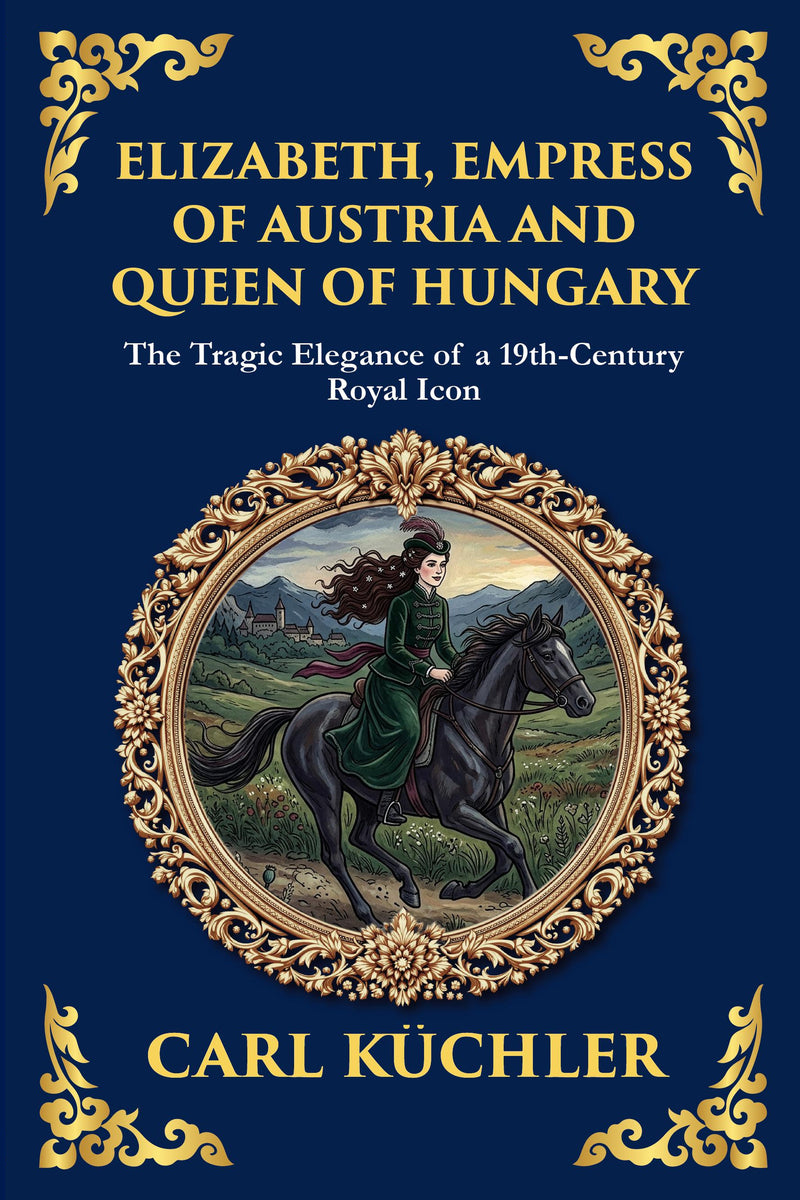
Elizabeth, Empress of Austria and Queen of Hungary — Large Print
Empress Elizabeth of Austria Known for her beauty, brilliance, and inner sorrow, Empress Elizabeth of Austria—“Sisi”— remains one of the most enigmatic and beloved royal figures of the 19th century.
or free app
10,000+ hrs library
30-day guarantee
The complete Elizabeth, Empress of Austria and Queen of Hungary appears in modern English through Library of Alexandria Press, available online with audiobook narration included for members.
Have you ever wondered why the life of Empress Elizabeth continues to captivate hearts over a century after her death? Elizabeth, Empress of Austria and Queen of Hungary is a hauntingly beautiful account of one of Europe’s most fascinating and complex monarchs. Written by court biographer Carl Küchler, this work offers a richly detailed glimpse into the life of the legendary “Sisi”—whose elegance and emotional depth defied the stiff traditions of royal life.
Unlike conventional biographies, this volume paints a deeply emotional and psychological portrait of a woman struggling beneath the weight of public adoration and personal sorrow. From the opulent court of Vienna to the pastoral freedom of Hungary, Elizabeth’s journey is one of contradictions—lavishness and loneliness, rebellion and duty, joy and tragedy.
What you’ll discover in this modern edition
- The Rise of a Reluctant Empress – Follow Elizabeth’s transformation from carefree Bavarian duchess to the most adored monarch in Europe.
- The Intimate Struggles of Royalty – Witness her battle with depression, eating disorders, and the expectations of imperial life.
- A Deep Bond with Hungary – Explore her unique relationship with the Hungarian people and her pivotal political influence in uniting the empire.
- A Tragic Personal Legacy – Learn of her heartbreaking family tragedies and the haunting events that led to her assassination.
- A Feminine Icon of the Romantic Era – Discover how Elizabeth became a symbol of freedom, poetry, and rebellion in a world that demanded silence. Küchler’s sympathetic yet candid portrayal captures both the glory and grief of one of history’
| Formats | eBook (EPUB + PDF) · Audiobook · Paperback · Hardcover · Large Print |
| Language | English |
| Trim size (print) | 6 × 9 in |
| Binding | Paperback — perfect-bound · Hardcover — casewrap |
| Large Print edition | Same text in a larger, easy-read type — a larger font, not a larger trim |
| Print pricing | Every physical book at our true cost — at-cost, no profit (members) |
| Library | 873 restored titles, always growing |
| Length | 27,625 words · ~1 hr 50 min reading |
| Reading level | Grade 12 · a confident, adult read (this modern-English edition) |
| Edition | Modern English translation · 2026 |
Member reviews for this edition are collected as readers finish it — be the first. Across the library: 12,000+ books shipped, every plan covered by a 365-day print guarantee.
About this edition
A faithful, unabridged modern-English edition by The Library of Alexandria — carefully rendered for today's reader and verified paragraph-by-paragraph against the public-domain source. Available as eBook, audiobook, paperback, hardcover, and large print.
- Complete & unabridgedVerified paragraph by paragraph against the source — never a scan, never abridged.
- Modern English, faithfulReadable today, with the author’s meaning kept intact. Readable — not simplified.
- Every format, one membershipRead in your browser or the free app, or listen to the full audiobook.
Included free with your membership
Cancel anytime, one click · 30-day money-back guarantee
Edition last updated July 2026
What’s inside
Elizabeth, Empress of Austria and Queen of Hungary — Large Print — complete and unabridged: all 21 sections included with membership, plus the full audiobook.
Begin reading Elizabeth, Empress of Austria and Queen of Hungary — Large Print
In clear modern English — the complete text is included with membership.
Introduction
There are certain figures in history whose lives seem to belong as much to legend as to fact—men and women whose names carry an aura of mystery, beauty, and sorrow long after the world that produced them has crumbled into dust. Among them stands Elizabeth, Empress of Austria and Queen of Hungary, a woman whose existence reads less like a biography and more like a tragic poem written across the second half of the nineteenth century. To open this book is to step into a world of imperial palaces and alpine retreats, of gilded carriages and lonely sea voyages, of a beauty so renowned that she became the standard against which all others were measured, and a melancholy so profound that no amount of privilege could ever lift it. Carl Küchler, writing with the reverence and attentiveness of a man genuinely captivated by his subject, set out to capture the essence of this remarkable woman, and in this modern translation his work is brought to a new generation of readers who may know her only as a name, or perhaps not at all.
The empress whom history remembers as “Sisi”—a nickname that has since become almost a brand, attached to films, museums, and tourist memorabilia across Central Europe—was in life a far more complex and elusive creature than any popular image can convey. She was a Bavarian duchess plucked from a relatively carefree girlhood and thrust, at the age of sixteen, into one of the most rigid and ceremonious courts in all of Europe. She became the consort of Emperor Franz Joseph I, the long-reigning sovereign of the Habsburg dominions, and in doing so she inherited not only a crown but a cage. The Viennese court, with its byzantine etiquette and its watchful, often hostile mother-in-law, was a world entirely unsuited to her free and restless spirit. What follows from that early collision—between the wild, poetry-loving girl from the lakes and mountains of Bavaria and the iron formality of the Hofburg—is the central tension of her entire life, and it is the engine that drives this narrative forward.
Küchler approaches his subject not as a cold chronicler of dates and treaties but as someone enchanted by the woman herself. This is important for the reader to understand from the outset, because the book you are about to read is not a dry political history of the Austro-Hungarian Empire, nor is it a scandal-hungry exposé. It is something rarer and, in many ways, more valuable: a portrait drawn with affection, written by a man of the late nineteenth and early twentieth century who lived close enough to Elizabeth’s era to feel its atmosphere directly, and who took particular care to follow the threads of her inner life—her loves, her griefs, her wanderings, and above all her poetry. For Elizabeth was herself a writer of verse, a devoted student of the German poet Heinrich Heine, and a woman who poured her sorrows and her longings into private poems that revealed a soul far deeper and stranger than the public ever guessed.
To appreciate why Elizabeth has held the imagination of so many for so long, one must first understand the curious double nature of her fame. On one hand, she was celebrated throughout Europe as a paragon of physical beauty—a tall, slender woman with an extraordinary cascade of hair that reached nearly to the floor, a tiny waist maintained through near-obsessive discipline, and a grace of bearing that seemed to belong to a different and finer order of being. Painters, photographers, and poets vied to capture her likeness. Crowds gathered wherever she appeared. She was, in the truest sense of an overused word, an icon: a living image onto which an entire continent projected its dreams of royal splendor.
Yet behind that dazzling surface lay a life marked by an almost unrelenting succession of private sorrows. Elizabeth knew the death of children, the strain of a marriage that never fully bridged the gulf between two very different temperaments, the suffocating scrutiny of court and public alike, and a deepening melancholy that modern readers would likely recognize as something close to chronic depression. She suffered too from a profound restlessness, a need to keep moving that drove her across Europe and the Mediterranean for much of her later life—from the imperial villa on the island of Corfu, which she had built as a refuge, to the spas and seaside resorts where she sought relief for both body and spirit. She came to dread the camera and the public gaze that had once adored her, hiding her face behind fans and parasols, traveling under assumed names, guarding her aging from the world with the same intensity she had once devoted to displaying her youth.
This is the great paradox that the book invites you to contemplate: a woman who possessed nearly everything the world believes capable of bringing happiness—rank, wealth, beauty, devotion—and who nonetheless lived much of her life in a state of inner exile. Her famous beauty was as much a burden as a gift, a role she was expected to perform endlessly, and one that grew heavier with every passing year. Her freedom, hard-won through her refusal to submit fully to the demands of court life, came at the cost of a kind of homelessness, a perpetual movement that brought her relief but never lasting peace.
Küchler is especially attentive to Elizabeth’s love of nature, of horses and riding, of the open sea and the high mountains. These were the elements in which her spirit found its truest expression. She was one of the finest horsewomen of her age, daring and tireless in the saddle, and she pursued the hunt across the fields of England, Ireland, and Hungary with a passion that scandalized some and thrilled others. The author traces, too, her deep and genuine attachment to Hungary—a kingdom she loved with a sincerity she never managed to feel for Austria. The Hungarian people returned that love, and Elizabeth’s role in the political reconciliation between the Habsburg crown and the Hungarian nation, culminating in her coronation as Queen of Hungary, stands as one of the few public chapters of her life in which her personal feelings and her official duties came into harmonious alignment.
There is, running beneath all of this, the unmistakable presence of fate—a sense that Elizabeth was a woman set apart, destined for both extraordinary fortune and extraordinary suffering. The reader who comes to this book already aware of how her story ends will feel that shadow throughout; the reader who does not should perhaps be allowed to discover it within these pages, as the narrative draws toward its close. It is enough to say here that few lives in royal history have ended in a manner so abrupt, so unexpected, and so charged with the cruel irony that seemed to follow Elizabeth from her youth to her grave. The tragedy of her life was not merely a single event but a long accumulation, a slow gathering of clouds that gave her existence the unmistakable shape of an elegy.
It is precisely this elegiac quality that the subtitle of this edition captures so well. The “tragic elegance” of Elizabeth is not a contradiction but a fusion—the inseparability of her grace and her grief, her splendor and her sorrow. She moved through the world like a figure from a melancholy ballad, beautiful and remote, admired and unhappy, the central jewel of an empire she could not love and a court she could not abide. To read about her is to be reminded that history’s most glittering surfaces often conceal the deepest wells of human pain, and that the lives we are tempted to envy from a distance may, examined closely, dissolve into something far more sobering and far more human.
This edition presents Küchler’s work in a modern translation, adapted with the contemporary reader firmly in mind. A word should be said about what that means, and why it matters for the experience you are about to have. The original text belongs to a particular literary moment—a time when biography was written with a lushness of feeling and a fondness for sentiment that can sometimes feel foreign to readers accustomed to the leaner, more skeptical prose of the present day. Küchler wrote in the immediate afterglow of Elizabeth’s life, when her memory was fresh and her legend still forming, and his admiration for her colors every page. He is not a detached modern historian weighing sources against one another; he is a writer who felt the romance and the tragedy of his subject keenly, and who wanted his readers to feel it too.
This modern translation seeks to preserve that warmth and that intimacy while making the language accessible and graceful for a present-day audience. The aim has been to render Küchler’s affection and his eye for telling detail into clear, flowing English, smoothing the more archaic turns of phrase without flattening the emotional texture that gives the book its distinctive character. Readers should approach the work, then, not as a definitive scholarly account—much has been written about Elizabeth in the years since, and modern biographers have access to documents and perspectives Küchler could not have possessed—but as a heartfelt and atmospheric portrait, a window into how the empress was remembered and revered by those who lived in the shadow of her legend.
There is a particular value in reading a biography written so close to its subject’s own time. Küchler shares the assumptions, the tastes, and the sensibilities of the era that produced Elizabeth, and through him we glimpse not only the woman but the world that made and mourned her. The cult of imperial beauty, the reverence for royal personages, the romantic idealization of melancholy and sensitivity—all of these were living forces in Küchler’s day, and they shape his telling in ways that are themselves historically illuminating. To read him is to read a kind of double portrait: of Elizabeth as she was understood by her contemporaries and near-contemporaries, and of the cultural moment that found in her a perfect vessel for its own dreams and anxieties about beauty, freedom, and fate.
The contemporary reader may notice, too, the ways in which Elizabeth’s story resonates with concerns very much alive in our own time. Here was a woman crushed by the weight of public expectation, scrutinized relentlessly for her appearance, defined by an image she could not control, and driven to extremes of self-discipline in the effort to preserve that image against the natural changes of age. Here was someone who struggled with what we would now call mental health, who sought meaning and relief in travel, in art, in poetry, in solitude. Here was a public figure who longed above all for privacy, who fled the very adoration that defined her. In an age that has invented new and more invasive forms of celebrity and surveillance, Elizabeth’s predicament feels startlingly modern. The empress who hid her face behind a fan a century and a half ago would surely recognize something of herself in the contemporary celebrity hounded by cameras, and the reader who recognizes that connection will find the book speaks to the present with unexpected force.
It is worth approaching these pages, then, with a willingness to enter a world both distant and near. Distant in its protocols and its pageantry, its emperors and archdukes, its rituals of court that can seem almost absurd in their elaborateness. Near in its emotional substance, in the universal human realities of love and loss, of the longing for freedom, of the search for a self beneath the roles imposed by others. Küchler’s gift is to keep these two dimensions in balance—to give us the glittering exterior of the imperial age while never losing sight of the suffering woman at its center.
Some readers will come to this book already familiar with Elizabeth through one of the many films and popular treatments that have kept her memory alive, particularly in German-speaking Europe. To those readers, this work offers an opportunity to set aside the prettified, romanticized versions and encounter a portrait that, while warm in its sympathies, is rooted in the world and the records of Elizabeth’s own century. Other readers will be meeting her for the first time, knowing nothing of her story, and to them the book offers the pleasures of discovery—the slow unfolding of a life that begins in carefree Bavarian girlhood and rises to the dizzying heights of imperial power before descending into restless wandering and final tragedy. To both kinds of reader, the same advice applies: let the narrative carry you, and resist the urge to know the ending before you reach it. Elizabeth’s life has the structure of a great tragedy, and like all great tragedies it deserves to be experienced in its proper sequence, its early joys and triumphs given their full weight before the gathering darkness.
Cancel anytime, one click · 30-day money-back guarantee
Founding annual rate available now — your price locks for life when you join.
Not ready? Get this free chapter by email — read it anytime.
✓ Sent — check your inbox for Elizabeth, Empress of Austria and Queen of Hungary — Large Print.
Questions about Elizabeth, Empress of Austria and Queen of Hungary — Large Print
What is Elizabeth, Empress of Austria and Queen of Hungary about?
Empress Elizabeth of Austria Known for her beauty, brilliance, and inner sorrow, Empress Elizabeth of Austria—“Sisi”— remains one of the most enigmatic and beloved royal figures of the 19th century. In this intimate portrait by Carl Küchler, readers are invited behind the courtly façade to witness the story of a woman torn between duty and desire, power and melancholy. From her reluctant rise to the throne as the wife of Emperor Franz Joseph I, to her deep affinity with Hungary and tragic end, Elizabeth’s life unfo
Who wrote Elizabeth, Empress of Austria and Queen of Hungary?
Elizabeth, Empress of Austria and Queen of Hungary was written by Carl Küchler. This edition presents the complete work in clear modern English, faithfully rendered from the public-domain original by Library of Alexandria Press.
Is Elizabeth, Empress of Austria and Queen of Hungary free to read?
The opening chapter is free to read on this page. Members read and listen to the complete work — and the entire library — free, and can order any physical book at our true print cost.
How long is Elizabeth, Empress of Austria and Queen of Hungary?
21 chapters (~27,625 words) — about 1 hr 50 min of reading in this modern-English edition.
Is this an abridged version of Elizabeth, Empress of Austria and Queen of Hungary?
No. This is the complete, unabridged Elizabeth, Empress of Austria and Queen of Hungary, carefully rendered into clear modern English and verified paragraph-by-paragraph against the public-domain source — nothing is cut or summarised.
What formats does Elizabeth, Empress of Austria and Queen of Hungary come in?
Elizabeth, Empress of Austria and Queen of Hungary is available as eBook, paperback, hardcover and large print. eBook and audiobook are included with membership; printed editions ship at our true print cost.
Shipping & returns
Billing & membership
More from the library


Explore Biography & Letters
- Meditations · Marcus Aurelius
- The Confessions of St. Augustine · Saint Augustine
- The Confessions of Jean-Jacques Rousseau — Complete · Jean-Jacques Rousseau
- Ecce Homo · Friedrich Wilhelm Nietzsche
- De Profundis · Oscar Wilde
- Memoirs of Joseph Grimaldi · Joseph Grimaldi
- English Eccentrics and Eccentricities · John Timbs
- You Can’t Win · Jack Black
- Wild Animals I Have Known · Ernest Thompson Seton
- The Diary of Samuel Pepys — Complete 1665 N.S. · Samuel Pepys
- Random Reminiscences of Men and Events · John D. Rockefeller
- The Story of My Life · Helen Keller
- Elizabeth, Empress of Austria and Queen of Hungary · Carl Küchler
- Society as I Have Found It · Ward McAllister
- Autobiography of a Yogi · Paramahansa Yogananda
- Christopher Columbus and How He Received and Imparted the Spirit of Discovery
- A Portrait of the Artist as a Young Man · James Joyce
- Memoirs of the Author of a Vindication of the Rights of Woman · William Godwin
- Mary: A Fiction · Mary Wollstonecraft
- The Romance of Biography (Vol. 1 of 2) · Mrs. Jameson
- The Love Letters of Mary Wollstonecraft to Gilbert Imlay · Mary Wollstonecraft
- Selected Works of Voltairine de Cleyre · Voltairine de Cleyre
- Eighty Years and More; Reminiscences 1815–1897 · Elizabeth Cady Stanton
- Anarchism and Other Essays · Emma Goldman
- Agnes Grey · Anne Brontë
- Daddy-Long-Legs · Jean Webster
- Reminiscences of a Stock Operator · Edwin Lefèvre
- Martin Eden · Jack London
- Matthew Calbraith Perry: A Typical American Naval Officer · William Elliot Griffis
- Walden, and On the Duty of Civil Disobedience · Henry David Thoreau
Elizabeth, Empress of Austria and Queen of Hungary — Large Print
Elizabeth, Empress of Austria and Queen of Hungary — Large Print
The Tragic Elegance of a 19th-Century Royal Icon
Carl Küchler
Contents
- Introduction
- Chapter 1
- Chapter 2
- Chapter 3
- Chapter 4
- Chapter 5
- Chapter 6
- Chapter 7
- Chapter 8
- Chapter 9
- Chapter 10
- Chapter 11
- Chapter 12
- Chapter 13
- Chapter 14
- Chapter 15
- Chapter 16
- Chapter 17
- Chapter 18
- Chapter 19
- Chapter 20
Introduction
There are certain figures in history whose lives seem to belong as much to legend as to fact—men and women whose names carry an aura of mystery, beauty, and sorrow long after the world that produced them has crumbled into dust. Among them stands Elizabeth, Empress of Austria and Queen of Hungary, a woman whose existence reads less like a biography and more like a tragic poem written across the second half of the nineteenth century. To open this book is to step into a world of imperial palaces and alpine retreats, of gilded carriages and lonely sea voyages, of a beauty so renowned that she became the standard against which all others were measured, and a melancholy so profound that no amount of privilege could ever lift it. Carl Küchler, writing with the reverence and attentiveness of a man genuinely captivated by his subject, set out to capture the essence of this remarkable woman, and in this modern translation his work is brought to a new generation of readers who may know her only as a name, or perhaps not at all.
The empress whom history remembers as “Sisi”—a nickname that has since become almost a brand, attached to films, museums, and tourist memorabilia across Central Europe—was in life a far more complex and elusive creature than any popular image can convey. She was a Bavarian duchess plucked from a relatively carefree girlhood and thrust, at the age of sixteen, into one of the most rigid and ceremonious courts in all of Europe. She became the consort of Emperor Franz Joseph I, the long-reigning sovereign of the Habsburg dominions, and in doing so she inherited not only a crown but a cage. The Viennese court, with its byzantine etiquette and its watchful, often hostile mother-in-law, was a world entirely unsuited to her free and restless spirit. What follows from that early collision—between the wild, poetry-loving girl from the lakes and mountains of Bavaria and the iron formality of the Hofburg—is the central tension of her entire life, and it is the engine that drives this narrative forward.
Küchler approaches his subject not as a cold chronicler of dates and treaties but as someone enchanted by the woman herself. This is important for the reader to understand from the outset, because the book you are about to read is not a dry political history of the Austro-Hungarian Empire, nor is it a scandal-hungry exposé. It is something rarer and, in many ways, more valuable: a portrait drawn with affection, written by a man of the late nineteenth and early twentieth century who lived close enough to Elizabeth’s era to feel its atmosphere directly, and who took particular care to follow the threads of her inner life—her loves, her griefs, her wanderings, and above all her poetry. For Elizabeth was herself a writer of verse, a devoted student of the German poet Heinrich Heine, and a woman who poured her sorrows and her longings into private poems that revealed a soul far deeper and stranger than the public ever guessed.
To appreciate why Elizabeth has held the imagination of so many for so long, one must first understand the curious double nature of her fame. On one hand, she was celebrated throughout Europe as a paragon of physical beauty—a tall, slender woman with an extraordinary cascade of hair that reached nearly to the floor, a tiny waist maintained through near-obsessive discipline, and a grace of bearing that seemed to belong to a different and finer order of being. Painters, photographers, and poets vied to capture her likeness. Crowds gathered wherever she appeared. She was, in the truest sense of an overused word, an icon: a living image onto which an entire continent projected its dreams of royal splendor.
Yet behind that dazzling surface lay a life marked by an almost unrelenting succession of private sorrows. Elizabeth knew the death of children, the strain of a marriage that never fully bridged the gulf between two very different temperaments, the suffocating scrutiny of court and public alike, and a deepening melancholy that modern readers would likely recognize as something close to chronic depression. She suffered too from a profound restlessness, a need to keep moving that drove her across Europe and the Mediterranean for much of her later life—from the imperial villa on the island of Corfu, which she had built as a refuge, to the spas and seaside resorts where she sought relief for both body and spirit. She came to dread the camera and the public gaze that had once adored her, hiding her face behind fans and parasols, traveling under assumed names, guarding her aging from the world with the same intensity she had once devoted to displaying her youth.
This is the great paradox that the book invites you to contemplate: a woman who possessed nearly everything the world believes capable of bringing happiness—rank, wealth, beauty, devotion—and who nonetheless lived much of her life in a state of inner exile. Her famous beauty was as much a burden as a gift, a role she was expected to perform endlessly, and one that grew heavier with every passing year. Her freedom, hard-won through her refusal to submit fully to the demands of court life, came at the cost of a kind of homelessness, a perpetual movement that brought her relief but never lasting peace.
Küchler is especially attentive to Elizabeth’s love of nature, of horses and riding, of the open sea and the high mountains. These were the elements in which her spirit found its truest expression. She was one of the finest horsewomen of her age, daring and tireless in the saddle, and she pursued the hunt across the fields of England, Ireland, and Hungary with a passion that scandalized some and thrilled others. The author traces, too, her deep and genuine attachment to Hungary—a kingdom she loved with a sincerity she never managed to feel for Austria. The Hungarian people returned that love, and Elizabeth’s role in the political reconciliation between the Habsburg crown and the Hungarian nation, culminating in her coronation as Queen of Hungary, stands as one of the few public chapters of her life in which her personal feelings and her official duties came into harmonious alignment.
There is, running beneath all of this, the unmistakable presence of fate—a sense that Elizabeth was a woman set apart, destined for both extraordinary fortune and extraordinary suffering. The reader who comes to this book already aware of how her story ends will feel that shadow throughout; the reader who does not should perhaps be allowed to discover it within these pages, as the narrative draws toward its close. It is enough to say here that few lives in royal history have ended in a manner so abrupt, so unexpected, and so charged with the cruel irony that seemed to follow Elizabeth from her youth to her grave. The tragedy of her life was not merely a single event but a long accumulation, a slow gathering of clouds that gave her existence the unmistakable shape of an elegy.
It is precisely this elegiac quality that the subtitle of this edition captures so well. The “tragic elegance” of Elizabeth is not a contradiction but a fusion—the inseparability of her grace and her grief, her splendor and her sorrow. She moved through the world like a figure from a melancholy ballad, beautiful and remote, admired and unhappy, the central jewel of an empire she could not love and a court she could not abide. To read about her is to be reminded that history’s most glittering surfaces often conceal the deepest wells of human pain, and that the lives we are tempted to envy from a distance may, examined closely, dissolve into something far more sobering and far more human.
This edition presents Küchler’s work in a modern translation, adapted with the contemporary reader firmly in mind. A word should be said about what that means, and why it matters for the experience you are about to have. The original text belongs to a particular literary moment—a time when biography was written with a lushness of feeling and a fondness for sentiment that can sometimes feel foreign to readers accustomed to the leaner, more skeptical prose of the present day. Küchler wrote in the immediate afterglow of Elizabeth’s life, when her memory was fresh and her legend still forming, and his admiration for her colors every page. He is not a detached modern historian weighing sources against one another; he is a writer who felt the romance and the tragedy of his subject keenly, and who wanted his readers to feel it too.
This modern translation seeks to preserve that warmth and that intimacy while making the language accessible and graceful for a present-day audience. The aim has been to render Küchler’s affection and his eye for telling detail into clear, flowing English, smoothing the more archaic turns of phrase without flattening the emotional texture that gives the book its distinctive character. Readers should approach the work, then, not as a definitive scholarly account—much has been written about Elizabeth in the years since, and modern biographers have access to documents and perspectives Küchler could not have possessed—but as a heartfelt and atmospheric portrait, a window into how the empress was remembered and revered by those who lived in the shadow of her legend.
There is a particular value in reading a biography written so close to its subject’s own time. Küchler shares the assumptions, the tastes, and the sensibilities of the era that produced Elizabeth, and through him we glimpse not only the woman but the world that made and mourned her. The cult of imperial beauty, the reverence for royal personages, the romantic idealization of melancholy and sensitivity—all of these were living forces in Küchler’s day, and they shape his telling in ways that are themselves historically illuminating. To read him is to read a kind of double portrait: of Elizabeth as she was understood by her contemporaries and near-contemporaries, and of the cultural moment that found in her a perfect vessel for its own dreams and anxieties about beauty, freedom, and fate.
The contemporary reader may notice, too, the ways in which Elizabeth’s story resonates with concerns very much alive in our own time. Here was a woman crushed by the weight of public expectation, scrutinized relentlessly for her appearance, defined by an image she could not control, and driven to extremes of self-discipline in the effort to preserve that image against the natural changes of age. Here was someone who struggled with what we would now call mental health, who sought meaning and relief in travel, in art, in poetry, in solitude. Here was a public figure who longed above all for privacy, who fled the very adoration that defined her. In an age that has invented new and more invasive forms of celebrity and surveillance, Elizabeth’s predicament feels startlingly modern. The empress who hid her face behind a fan a century and a half ago would surely recognize something of herself in the contemporary celebrity hounded by cameras, and the reader who recognizes that connection will find the book speaks to the present with unexpected force.
It is worth approaching these pages, then, with a willingness to enter a world both distant and near. Distant in its protocols and its pageantry, its emperors and archdukes, its rituals of court that can seem almost absurd in their elaborateness. Near in its emotional substance, in the universal human realities of love and loss, of the longing for freedom, of the search for a self beneath the roles imposed by others. Küchler’s gift is to keep these two dimensions in balance—to give us the glittering exterior of the imperial age while never losing sight of the suffering woman at its center.
Some readers will come to this book already familiar with Elizabeth through one of the many films and popular treatments that have kept her memory alive, particularly in German-speaking Europe. To those readers, this work offers an opportunity to set aside the prettified, romanticized versions and encounter a portrait that, while warm in its sympathies, is rooted in the world and the records of Elizabeth’s own century. Other readers will be meeting her for the first time, knowing nothing of her story, and to them the book offers the pleasures of discovery—the slow unfolding of a life that begins in carefree Bavarian girlhood and rises to the dizzying heights of imperial power before descending into restless wandering and final tragedy. To both kinds of reader, the same advice applies: let the narrative carry you, and resist the urge to know the ending before you reach it. Elizabeth’s life has the structure of a great tragedy, and like all great tragedies it deserves to be experienced in its proper sequence, its early joys and triumphs given their full weight before the gathering darkness.
On September 9, 1888, a special event took place in the royal house of Wittelsbach. Maximilian Joseph, the head of the ducal line of Vorpfalz-Zweibrücken-Birkenfeld, and his wife Ludovica (Louise)—the daughter of King Maximilian I of Bavaria and his second wife, Caroline of Baden—celebrated their diamond wedding anniversary. Both the bride and groom had been barely twenty years old when they first married.
Few royal couples have been as closely linked to so many of Europe’s ruling families. Their oldest son, Ludwig Wilhelm, gave up his right to the throne to marry an actress named Henrietta Mendel, who had been granted the title of Countess Wallersee. Helene, the eldest daughter, married the Hereditary Prince of Thurn and Taxis. Their daughter Louise married Frederick of Hohenzollern, creating new bonds between the Wittelsbachs and the Prussian royal house. The next daughter was Elizabeth of Austria-Hungary, whose son eventually married Stephanie, the daughter of the King of Belgium. After Elizabeth came Karl Theodore, a well-known eye specialist who became the head of the Wittelsbach ducal line after his father died. He first married his cousin Sophie, the daughter of King John of Saxony; his second and current wife is Marie Josepha, a Princess of Portugal. Two other daughters, Marie and Mathilde, married into the younger branch of the Bourbons. Marie married King Francis II of Naples, and Mathilde married his half-brother, Count Louis of Trani. The youngest daughter, Sophie, was once engaged to her cousin, King Ludwig II of Bavaria, but later married Duke Ferdinand d’Alençon, the nephew of Louis Philippe of France. Finally, the youngest son, Max Emanuel, married Amélie of Saxe-Coburg and Gotha, which linked him by marriage to Prince Ferdinand of Bulgaria.
End of the free sample
Keep reading, free
Members read and listen to the complete book — and the entire library. Cancel anytime, one click · 30-day money-back guarantee.