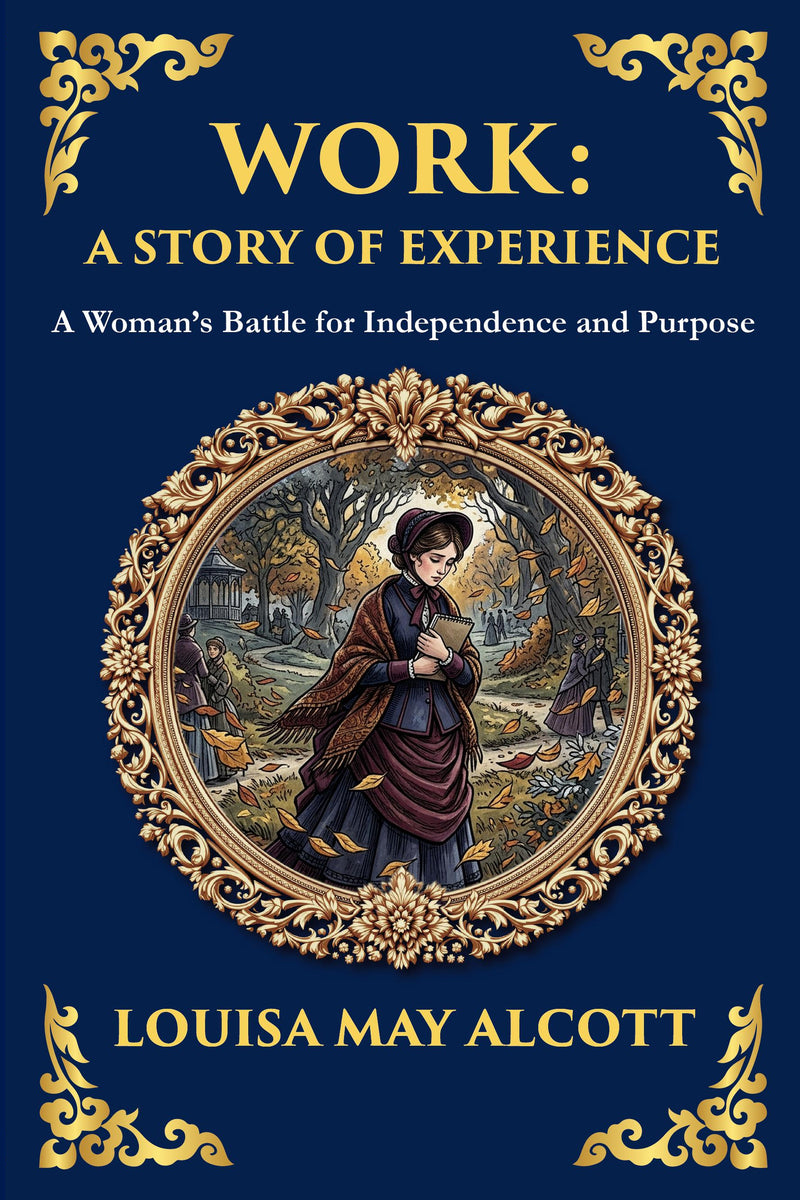
Work: A Story of Experience
Before Little Women, Louisa May Alcott wrote a revolutionary novel that explored the struggles, dreams, and dignity of working women.
or free app
10,000+ hrs library
30-day guarantee
The complete Work: A Story of Experience appears in modern English through Library of Alexandria Press, available online with audiobook narration included for members.
What does it cost a woman to earn her own bread—and choose her own life?
Christie Devon leaves a New England farm with a plain wish: honest work, her own money, and a purpose she can call hers. In Louisa May Alcott’s Work: A Story of Experience, service, the theatre, and other jobs test that wish against the narrow choices open to women.
Set in the years around the American Civil War, the novel follows Christie through friendships and hard lessons. Rachel, a woman society treats harshly, tests her compassion. Mr. Power connects faith with useful labor, while gardener David Sterling shares her respect for honest work. Each encounter deepens the question of what makes a life worthwhile.
What you'll discover
- A heroine who tries – Follow Christie as she trades the safety of home for the chance to choose.
- The cost of independence – See what service and other jobs demand of a woman determined to support herself.
- Friendship beyond social judgment – Meet Rachel, whose friendship asks Christie to put loyalty and compassion into practice.
- Work beyond a wage – Explore the restless search for purpose that makes earning a living more than a practical task.
- Warmth amid hard lessons – Find Alcott’s humor and warmth in episodes shaped by her own experience of working life.
Perfect for readers who love Alcott’s warmth, are curious about women’s independence in the 1800s, and enjoy a heroine who learns by trying.
Open the first page and join Christie as she decides to make her own way.
| Formats | eBook (EPUB + PDF) · Audiobook · Paperback · Hardcover · Large Print |
| Language | English |
| Trim size (print) | 6 × 9 in |
| Binding | Paperback — perfect-bound · Hardcover — casewrap |
| Large Print edition | Same text in a larger, easy-read type — a larger font, not a larger trim |
| Print pricing | Every physical book at our true cost — at-cost, no profit (members) |
| Library | 873 restored titles, always growing |
| Length | 119,797 words · ~7 hr 59 min reading |
| Reading level | Grade 3 · an easy, flowing read (this modern-English edition) |
| Edition | Modern English translation · 2026 |
Member reviews for this edition are collected as readers finish it — be the first. Across the library: 12,000+ books shipped, every plan covered by a 365-day print guarantee.
About this edition
A faithful, unabridged modern-English edition by The Library of Alexandria — carefully rendered for today's reader and verified paragraph-by-paragraph against the public-domain source. Available as eBook, audiobook, paperback, hardcover, and large print.
- Complete & unabridgedVerified paragraph by paragraph against the source — never a scan, never abridged.
- Modern English, faithfulReadable today, with the author’s meaning kept intact. Readable — not simplified.
- Every format, one membershipRead in your browser or the free app, or listen to the full audiobook.
Included free with your membership
Cancel anytime, one click · 30-day money-back guarantee
Edition last updated July 2026
What’s inside
Work: A Story of Experience — complete and unabridged: all 21 sections included with membership, plus the full audiobook.
Begin reading Work: A Story of Experience
In clear modern English — the complete text is included with membership.
Introduction
When Louisa May Alcott published Work: A Story of Experience in 1873, she was already a household name. Little Women had appeared five years earlier and transformed her almost overnight from a struggling writer scraping together income through pseudonymous thrillers and freelance journalism into one of the most beloved authors in America. Readers who had wept and laughed alongside the March sisters expected more of the same warmth, more domestic comfort, more of that particular Alcott magic that made ordinary family life feel luminous and significant. What they received with Work was something both familiar and surprising: a novel that took the question lingering beneath all her fiction—what is a woman to do with her one life?—and answered it head-on, without the softening frame of childhood or the safe harbor of family.
This is a book about a woman who decides to support herself. That sentence may seem unremarkable to a modern reader, but in the context of mid-nineteenth-century America, it was nothing short of radical. The novel opens with its heroine, Christie Devon, making a declaration of independence as bold as any uttered by the founding fathers her country revered. She announces that she intends to go out into the world, find work, and earn her own living—not because she has been abandoned or widowed or driven by desperation, but because she wants to. She wants to discover what she is capable of, to feel the dignity of self-reliance, to become a whole person rather than a dependent appendage to someone else’s household. In an era when respectable women were expected to remain quietly within the domestic sphere until marriage transferred their care from father to husband, Christie’s ambition was something close to scandalous.
Alcott knew this terrain intimately, because she had walked every inch of it herself. Work is, in many ways, the most autobiographical of all her novels—more so even than Little Women, which softened and prettified the realities of the Alcott family’s chronic poverty. Before she found literary fame, Louisa had supported herself and frequently her entire family through a dizzying succession of jobs. She had been a seamstress, a household servant, a teacher, a governess, and a companion to the elderly and infirm. During the Civil War she served as a nurse in a Union hospital in Washington, an experience that nearly killed her when she contracted typhoid and was treated with mercury that would compromise her health for the rest of her life. Each of these experiences finds its echo in Christie’s journey. When the heroine takes a position in domestic service, or stands behind a stage as an actress, or sits sewing until her fingers ache, Alcott is writing from the marrow of her own hard-won knowledge. There is an authenticity to these scenes that no amount of research could supply; they have the unmistakable texture of lived truth.
This particular edition has been prepared as a modern translation, carefully adapted for the contemporary reader. The aim throughout has been to preserve the integrity of Alcott’s vision, her moral seriousness, her sly humor, and the emotional power of her storytelling, while gently smoothing the linguistic obstacles that can make nineteenth-century prose feel remote to readers today. Sentence structures that once sprawled across half a page have been clarified; vocabulary that has fallen out of use or shifted meaning has been thoughtfully rendered; references to a vanished world have been made accessible without being explained into dullness. The goal is not to replace Alcott but to remove the static between her voice and your ear, so that the urgency and intelligence of her writing reach you as freshly as they reached her first readers a century and a half ago. What remains is the essential Alcott: ardent, principled, observant, and deeply humane.
What makes Christie Devon such a compelling figure is that she is not a saint, nor is she a victim. She is a woman of intelligence, energy, and considerable pride, and these qualities propel her through a series of trials that test every part of her character. Alcott structured the novel as a kind of episodic pilgrimage, with Christie moving from one form of employment to another, each chapter of her working life revealing a different stratum of society and a different challenge to her resilience. The cumulative effect is a panoramic portrait of the options—and the limitations—available to a woman who wished to make her own way in the world without the protection of inherited wealth or a husband’s income.
Through Christie’s eyes, we encounter the full range of “respectable” female labor in the nineteenth century, and Alcott does not flinch from showing how precarious and undervalued each of these positions truly was. We see the strange intimacy and humiliation of domestic service, where a woman might be treated as part of the family one moment and as invisible furniture the next. We see the glittering, hollow world of the theater, with its temptations and its peculiar camaraderie. We see the lonely vulnerability of the governess, suspended uncomfortably between the servants below and the family above, belonging fully to neither. We see the relentless grind of needlework, the lowest-paid and most exhausting of the so-called genteel occupations, where women ruined their eyesight and their health for wages that barely kept body and soul together. And we see, too, the particular dangers that lurked for any woman who had no man to vouch for her respectability—the suspicion, the unwanted advances, the constant negotiation of a world built to keep her dependent.
Alcott’s genius lies in refusing to make any of this either melodramatic or didactic, though the novel certainly has its moments of high feeling. She understood, from her own experience, that the real story of women’s work is not usually a tale of spectacular catastrophe but of slow attrition—of small indignities accumulating, of dreams gradually scaling themselves down to fit the available space, of the body and spirit wearing thin under the friction of constant struggle. There is a moment in the novel, which I will not describe in detail so as not to diminish its impact, when Christie reaches the absolute limit of her endurance. It is one of the most honest depictions of despair in nineteenth-century American fiction, all the more startling for appearing in a novel by an author the public associated with cheerful family entertainment. Alcott was willing to look directly at the abyss into which an exhausted, unsupported woman might fall, and she rendered it with a frankness that still has the power to take a reader’s breath away.
Yet Work is not, finally, a bleak book. It is a book about endurance and renewal, about the way a person can be broken down and then, through the kindness of others and the discovery of meaningful purpose, built back up into something stronger and truer than before. Christie’s journey is not merely a tour of available occupations; it is the story of a soul finding its vocation. The word “vocation” matters here, because it carries both its everyday sense of a job or trade and its deeper religious meaning of a calling—a summons to a particular kind of service in the world. Alcott was steeped in the spiritual ferment of nineteenth-century New England, and she believed profoundly that work, rightly understood, was not merely a means of survival but a path toward integrity, connection, and even a kind of salvation. The “experience” of the novel’s title is therefore both literal and transformative: it is the sum of everything Christie undergoes, and it is also the process by which raw experience is refined into wisdom.
One of the great pleasures of the book is the cast of characters Christie encounters along her way. Alcott had a gift for the swift, vivid sketch—a few sentences that bring a person fully to life—and Work is populated with memorable figures who help or hinder the heroine at various stages of her odyssey. There are employers both kind and cruel, fellow workers who become friends and rivals, and mentors who appear at crucial junctures to offer the guidance or the example Christie needs. Some of these relationships blossom into the deep, sustaining bonds that Alcott believed were the true riches of a human life. The novel takes friendship seriously as a moral and emotional force, particularly friendship between women, which Alcott depicts as a source of strength every bit as vital as romantic love. In an age that tended to treat a woman’s emotional life as beginning and ending with her relationship to a man, this insistence on the importance of female solidarity feels remarkably ahead of its time.
It would be a mistake, though, to suggest that Work dismisses or downplays the matters of the heart. Love, marriage, and partnership all have their place in Christie’s story, and Alcott handles these themes with characteristic intelligence. What distinguishes her treatment of romance from the conventional fiction of her day is her refusal to present marriage as the automatic culmination and resolution of a woman’s life. In the typical novel of the period, the heroine’s adventures end the moment she finds a husband; the wedding bells signal that her story is over, her purpose fulfilled, her future settled. Alcott was deeply skeptical of this formula. For her, the question of what a woman does with her life could not be answered simply by handing her over to a man. Marriage, in her view, ought to be a partnership of equals, a meeting of independent souls who choose each other freely—not a transaction in which a woman exchanges her autonomy for security. The relationships in Work are tested against this high standard, and the way Christie’s emotional life unfolds is one of the most thoughtful and satisfying threads in the entire novel.
To understand the passion that animates Work, it helps to know something of the extraordinary world that produced Louisa May Alcott. She was born in 1832 into a family that stood at the very center of American intellectual and reform culture. Her father, Amos Bronson Alcott, was a philosopher and educator associated with the Transcendentalist movement—a man of soaring ideals and almost no practical ability to support his family. He was a friend of Ralph Waldo Emerson and Henry David Thoreau, and the Alcott household was a place where the great questions of the age were debated as freely as the price of bread was worried over. Bronson Alcott’s idealism was both an inspiration and a burden to his daughter. From him she inherited a fierce moral seriousness and a conviction that life should be lived in service to high principles; from the consequences of his impracticality she learned, very young, that someone had to pay the rent, and that someone would have to be her.
This combination of lofty ideals and grinding economic necessity is the engine that drives all of Alcott’s best work. She was a reformer to her bones. Her family was deeply committed to the abolition of slavery, and their home in Concord, Massachusetts, served as a station on the Underground Railroad. She was an ardent supporter of women’s rights and women’s suffrage, and she would later become the first woman to register to vote in Concord. These were not abstract political positions for Alcott but lived commitments, and they suffuse Work at every level. The novel’s insistence on a woman’s right to meaningful labor, on her dignity as an independent being, on the bonds of sympathy that ought to connect human beings across the barriers of class and circumstance—all of this flows directly from Alcott’s reformist convictions.
The latter portion of the novel turns explicitly toward these broader social questions, expanding outward from Christie’s personal struggles to consider how women might work together to improve the lot of all working women. Alcott was writing in the aftermath of the Civil War, in a period of intense social reflection about the future of American society and the place of women within it. The war had thrust thousands of women into roles they had never occupied before—as nurses, as managers of farms and businesses, as breadwinners for families whose men had gone off to fight or had not come home. The question of what women would do with this hard-won competence, whether they would be allowed to keep the ground they had gained or be pushed back into the narrow confines of the prewar domestic ideal, hung heavily over the era. Work is, among other things, Alcott’s contribution to this debate, a passionate argument that women’s capabilities should not be wasted and that society as a whole would be richer for allowing women to contribute their full energies to the common good.
Cancel anytime, one click · 30-day money-back guarantee
Founding annual rate available now — your price locks for life when you join.
Not ready? Get this free chapter by email — read it anytime.
✓ Sent — check your inbox for Work: A Story of Experience.
Questions about Work: A Story of Experience
What is Work by Louisa May Alcott about?
It follows Christie Devon, a young woman who leaves her uncle's farm to earn her own living. She tries several jobs and learns what work, friendship and independence cost and give.
Is Work by Louisa May Alcott based on a true story?
It is a novel, but it draws closely on Alcott's own life. She had worked as a servant, teacher, seamstress and actress, and the book was published in 1873.
Who is Christie Devon in Work?
Christie Devon is the heroine. She is an orphan raised on a farm who decides to leave home and find honest work, a place in the world and a purpose she has chosen.
Is Work a hard book to read?
No. The language is plain and the chapters are short episodes. Some speeches and moral passages reflect the style of the 1870s, but most readers follow Christie's story easily.
Shipping & returns
Billing & membership
More from the library


Explore Classic & Literary
- Resurrection · Leo Tolstoy
- Crime and Punishment · Fyodor Dostoyevsky
- Anna Karenina · Leo Tolstoy
- Moby-Dick · Herman Melville
- Great Expectations · Charles Dickens
- The Brothers Karamazov · Fyodor Dostoyevsky
- The Great Gatsby · F. Scott Fitzgerald
- McTeague: A Story of San Francisco — Large Print · Frank Norris
- McTeague: A Story of San Francisco · Frank Norris
- The Country House — Large Print · John Galsworthy
- Ethan Frome — Large Print · Edith Wharton
- Bartleby, the Scrivener: A Story of Wall-Street · Herman Melville
- Mrs. Dalloway — Large Print · Virginia Woolf
- Resurrection — Large Print · Leo Tolstoy
- Against the Grain — Large Print · Joris-Karl Huysmans
- The Red Badge of Courage: An Episode of the American Civil War · Stephen Crane
- Bartleby, the Scrivener: A Story of Wall-Street — Large Print · Herman Melville
- The Red Badge of Courage: An Episode of the American Civil War — Large Print · Stephen Crane
- North and South · Elizabeth Gaskell
- Barry Lyndon · William Makepeace Thackeray
- Barry Lyndon — Large Print · William Makepeace Thackeray
- North and South — Large Print · Elizabeth Gaskell
- Dombey and Son — Large Print · Charles Dickens
- My Ántonia — Large Print · Willa Cather
- Jane Eyre: An Autobiography · Charlotte Brontë
- Penrod — Large Print · Booth Tarkington
- Tess of the d'Urbervilles: A Pure Woman — Large Print · Thomas Hardy
- The Belle of Bowling Green · Amelia E. Barr
- The Possessed: Or, The Devils — Large Print · Fyodor Dostoyevsky
- Penrod · Booth Tarkington
Work: A Story of Experience
Work: A Story of Experience
A Woman’s Battle for Independence and Purpose
Louisa May Alcott
Contents
- Introduction
- Chapter 1
- Chapter 2
- Chapter 3
- Chapter 4
- Chapter 5
- Chapter 6
- Chapter 7
- Chapter 8
- Chapter 9
- Chapter 10
- Chapter 11
- Chapter 12
- Chapter 13
- Chapter 14
- Chapter 15
- Chapter 16
- Chapter 17
- Chapter 18
- Chapter 19
- Chapter 20
Introduction
When Louisa May Alcott published Work: A Story of Experience in 1873, she was already a household name. Little Women had appeared five years earlier and transformed her almost overnight from a struggling writer scraping together income through pseudonymous thrillers and freelance journalism into one of the most beloved authors in America. Readers who had wept and laughed alongside the March sisters expected more of the same warmth, more domestic comfort, more of that particular Alcott magic that made ordinary family life feel luminous and significant. What they received with Work was something both familiar and surprising: a novel that took the question lingering beneath all her fiction—what is a woman to do with her one life?—and answered it head-on, without the softening frame of childhood or the safe harbor of family.
This is a book about a woman who decides to support herself. That sentence may seem unremarkable to a modern reader, but in the context of mid-nineteenth-century America, it was nothing short of radical. The novel opens with its heroine, Christie Devon, making a declaration of independence as bold as any uttered by the founding fathers her country revered. She announces that she intends to go out into the world, find work, and earn her own living—not because she has been abandoned or widowed or driven by desperation, but because she wants to. She wants to discover what she is capable of, to feel the dignity of self-reliance, to become a whole person rather than a dependent appendage to someone else’s household. In an era when respectable women were expected to remain quietly within the domestic sphere until marriage transferred their care from father to husband, Christie’s ambition was something close to scandalous.
Alcott knew this terrain intimately, because she had walked every inch of it herself. Work is, in many ways, the most autobiographical of all her novels—more so even than Little Women, which softened and prettified the realities of the Alcott family’s chronic poverty. Before she found literary fame, Louisa had supported herself and frequently her entire family through a dizzying succession of jobs. She had been a seamstress, a household servant, a teacher, a governess, and a companion to the elderly and infirm. During the Civil War she served as a nurse in a Union hospital in Washington, an experience that nearly killed her when she contracted typhoid and was treated with mercury that would compromise her health for the rest of her life. Each of these experiences finds its echo in Christie’s journey. When the heroine takes a position in domestic service, or stands behind a stage as an actress, or sits sewing until her fingers ache, Alcott is writing from the marrow of her own hard-won knowledge. There is an authenticity to these scenes that no amount of research could supply; they have the unmistakable texture of lived truth.
This particular edition has been prepared as a modern translation, carefully adapted for the contemporary reader. The aim throughout has been to preserve the integrity of Alcott’s vision, her moral seriousness, her sly humor, and the emotional power of her storytelling, while gently smoothing the linguistic obstacles that can make nineteenth-century prose feel remote to readers today. Sentence structures that once sprawled across half a page have been clarified; vocabulary that has fallen out of use or shifted meaning has been thoughtfully rendered; references to a vanished world have been made accessible without being explained into dullness. The goal is not to replace Alcott but to remove the static between her voice and your ear, so that the urgency and intelligence of her writing reach you as freshly as they reached her first readers a century and a half ago. What remains is the essential Alcott: ardent, principled, observant, and deeply humane.
What makes Christie Devon such a compelling figure is that she is not a saint, nor is she a victim. She is a woman of intelligence, energy, and considerable pride, and these qualities propel her through a series of trials that test every part of her character. Alcott structured the novel as a kind of episodic pilgrimage, with Christie moving from one form of employment to another, each chapter of her working life revealing a different stratum of society and a different challenge to her resilience. The cumulative effect is a panoramic portrait of the options—and the limitations—available to a woman who wished to make her own way in the world without the protection of inherited wealth or a husband’s income.
Through Christie’s eyes, we encounter the full range of “respectable” female labor in the nineteenth century, and Alcott does not flinch from showing how precarious and undervalued each of these positions truly was. We see the strange intimacy and humiliation of domestic service, where a woman might be treated as part of the family one moment and as invisible furniture the next. We see the glittering, hollow world of the theater, with its temptations and its peculiar camaraderie. We see the lonely vulnerability of the governess, suspended uncomfortably between the servants below and the family above, belonging fully to neither. We see the relentless grind of needlework, the lowest-paid and most exhausting of the so-called genteel occupations, where women ruined their eyesight and their health for wages that barely kept body and soul together. And we see, too, the particular dangers that lurked for any woman who had no man to vouch for her respectability—the suspicion, the unwanted advances, the constant negotiation of a world built to keep her dependent.
Alcott’s genius lies in refusing to make any of this either melodramatic or didactic, though the novel certainly has its moments of high feeling. She understood, from her own experience, that the real story of women’s work is not usually a tale of spectacular catastrophe but of slow attrition—of small indignities accumulating, of dreams gradually scaling themselves down to fit the available space, of the body and spirit wearing thin under the friction of constant struggle. There is a moment in the novel, which I will not describe in detail so as not to diminish its impact, when Christie reaches the absolute limit of her endurance. It is one of the most honest depictions of despair in nineteenth-century American fiction, all the more startling for appearing in a novel by an author the public associated with cheerful family entertainment. Alcott was willing to look directly at the abyss into which an exhausted, unsupported woman might fall, and she rendered it with a frankness that still has the power to take a reader’s breath away.
Yet Work is not, finally, a bleak book. It is a book about endurance and renewal, about the way a person can be broken down and then, through the kindness of others and the discovery of meaningful purpose, built back up into something stronger and truer than before. Christie’s journey is not merely a tour of available occupations; it is the story of a soul finding its vocation. The word “vocation” matters here, because it carries both its everyday sense of a job or trade and its deeper religious meaning of a calling—a summons to a particular kind of service in the world. Alcott was steeped in the spiritual ferment of nineteenth-century New England, and she believed profoundly that work, rightly understood, was not merely a means of survival but a path toward integrity, connection, and even a kind of salvation. The “experience” of the novel’s title is therefore both literal and transformative: it is the sum of everything Christie undergoes, and it is also the process by which raw experience is refined into wisdom.
One of the great pleasures of the book is the cast of characters Christie encounters along her way. Alcott had a gift for the swift, vivid sketch—a few sentences that bring a person fully to life—and Work is populated with memorable figures who help or hinder the heroine at various stages of her odyssey. There are employers both kind and cruel, fellow workers who become friends and rivals, and mentors who appear at crucial junctures to offer the guidance or the example Christie needs. Some of these relationships blossom into the deep, sustaining bonds that Alcott believed were the true riches of a human life. The novel takes friendship seriously as a moral and emotional force, particularly friendship between women, which Alcott depicts as a source of strength every bit as vital as romantic love. In an age that tended to treat a woman’s emotional life as beginning and ending with her relationship to a man, this insistence on the importance of female solidarity feels remarkably ahead of its time.
It would be a mistake, though, to suggest that Work dismisses or downplays the matters of the heart. Love, marriage, and partnership all have their place in Christie’s story, and Alcott handles these themes with characteristic intelligence. What distinguishes her treatment of romance from the conventional fiction of her day is her refusal to present marriage as the automatic culmination and resolution of a woman’s life. In the typical novel of the period, the heroine’s adventures end the moment she finds a husband; the wedding bells signal that her story is over, her purpose fulfilled, her future settled. Alcott was deeply skeptical of this formula. For her, the question of what a woman does with her life could not be answered simply by handing her over to a man. Marriage, in her view, ought to be a partnership of equals, a meeting of independent souls who choose each other freely—not a transaction in which a woman exchanges her autonomy for security. The relationships in Work are tested against this high standard, and the way Christie’s emotional life unfolds is one of the most thoughtful and satisfying threads in the entire novel.
To understand the passion that animates Work, it helps to know something of the extraordinary world that produced Louisa May Alcott. She was born in 1832 into a family that stood at the very center of American intellectual and reform culture. Her father, Amos Bronson Alcott, was a philosopher and educator associated with the Transcendentalist movement—a man of soaring ideals and almost no practical ability to support his family. He was a friend of Ralph Waldo Emerson and Henry David Thoreau, and the Alcott household was a place where the great questions of the age were debated as freely as the price of bread was worried over. Bronson Alcott’s idealism was both an inspiration and a burden to his daughter. From him she inherited a fierce moral seriousness and a conviction that life should be lived in service to high principles; from the consequences of his impracticality she learned, very young, that someone had to pay the rent, and that someone would have to be her.
This combination of lofty ideals and grinding economic necessity is the engine that drives all of Alcott’s best work. She was a reformer to her bones. Her family was deeply committed to the abolition of slavery, and their home in Concord, Massachusetts, served as a station on the Underground Railroad. She was an ardent supporter of women’s rights and women’s suffrage, and she would later become the first woman to register to vote in Concord. These were not abstract political positions for Alcott but lived commitments, and they suffuse Work at every level. The novel’s insistence on a woman’s right to meaningful labor, on her dignity as an independent being, on the bonds of sympathy that ought to connect human beings across the barriers of class and circumstance—all of this flows directly from Alcott’s reformist convictions.
The latter portion of the novel turns explicitly toward these broader social questions, expanding outward from Christie’s personal struggles to consider how women might work together to improve the lot of all working women. Alcott was writing in the aftermath of the Civil War, in a period of intense social reflection about the future of American society and the place of women within it. The war had thrust thousands of women into roles they had never occupied before—as nurses, as managers of farms and businesses, as breadwinners for families whose men had gone off to fight or had not come home. The question of what women would do with this hard-won competence, whether they would be allowed to keep the ground they had gained or be pushed back into the narrow confines of the prewar domestic ideal, hung heavily over the era. Work is, among other things, Alcott’s contribution to this debate, a passionate argument that women’s capabilities should not be wasted and that society as a whole would be richer for allowing women to contribute their full energies to the common good.
“Aunt Betsey, I’m about to make my own Declaration of Independence.”
“Good heavens, what do you mean, child?” Startled, the old lady hurriedly shoved a pie into the oven, nearly ruining it in her haste.
“I mean that since I’m an adult, I’m going to take care of myself instead of being a burden. Uncle wants me gone; he thinks I should leave, and sooner or later, he’ll tell me. I don’t want to wait for that. Like the people in fairy tales, I’m going to head out into the world and make my own way. I know I can do it.”
Christie emphasized her point with energetic movements in the bread trough, kneading the dough as if it were her own destiny and she was shaping it to her liking. Aunt Betsey stood listening, holding a pie fork, her usually calm face showing total astonishment. When the girl paused with a final, decisive thump, the old lady exclaimed:
“What crazy idea have you got in your head now?”
“A very sane and sensible one that I need to act on, so please listen, ma’am. I’ve felt this way for a long time, I’ve thought it through, and I’m sure it’s the right thing for me. I’m old enough to support myself; if I were a boy, I would have been told to do this years ago. I hate being dependent, and since I don’t have to be, I can’t stand it anymore. If you were poor, I would never leave you, because I’ll never forget how kind you’ve been to me. But Uncle doesn’t love or understand me; I’m a burden to him, and I have to go somewhere I can be independent. I won’t be happy until I do, because there’s nothing for me here. I’m tired of this boring town where everyone only cares about eating, drinking, and getting rich. I can’t find friends who understand me or work that I’m good at. So please let me go, Auntie, and find where I belong, wherever that may be.”
End of the free sample
Keep reading, free
Members read and listen to the complete book — and the entire library. Cancel anytime, one click · 30-day money-back guarantee.