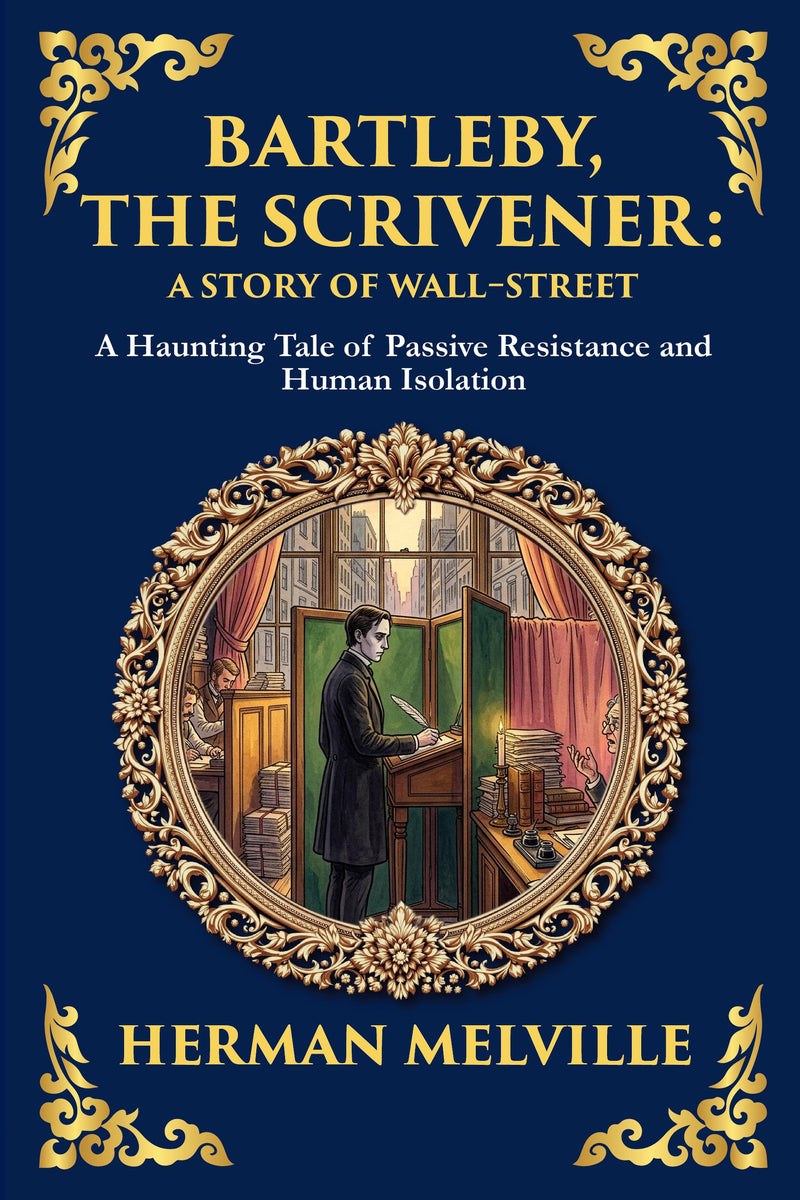
Bartleby, the Scrivener: A Story of Wall Street
In the bustling offices of Wall Street, where precision and profit rule the day, one quiet scrivener disrupts everything with his passive yet unyielding resistance.
or free app
10,000+ hrs library
30-day guarantee
The complete Bartleby, the Scrivener: A Story of Wall Street appears in modern English through Library of Alexandria Press, available online with audiobook narration included for members.
Have you ever wondered why silence can sometimes be the loudest protest of all? In Bartleby, the Scrivener: A Story of Wall-Street, Herman Melville delivers a powerful allegory of resistance, isolation, and the human struggle within an increasingly mechanized society. At the heart of the tale lies Bartleby, a law-copyist whose simple refrain, “I would prefer not to,” becomes both his shield and his undoing.
This modern presentation of Melville’s classic invites readers to explore not just the story of a solitary scrivener, but the deeper questions it raises about conformity, work, and the human soul. More than just a tale of office life, it is a timeless exploration of compassion, the limits of empathy, and the haunting specter of loneliness.
What you’ll discover in this modern edition
- A Tale of Quiet Defiance – Witness Bartleby’s passive resistance unfold within the rigid world of Wall Street.
- Themes of Isolation and Alienation – Explore Melville’s timeless meditation on loneliness and society’s inability to reach the most vulnerable.
- A Reflection on Work and Identity – Consider the meaning of labor and the way it defines—or destroys—human lives.
- A Story Both Haunting and Profound – Experience a narrative that resonates as much with today’s readers as it did in Melville’s time.
| Formats | eBook (EPUB + PDF) · Audiobook · Paperback · Hardcover · Large Print |
| Language | English |
| Trim size (print) | 6 × 9 in |
| Binding | Paperback — perfect-bound · Hardcover — casewrap |
| Large Print edition | Same text in a larger, easy-read type — a larger font, not a larger trim |
| Print pricing | Every physical book at our true cost — at-cost, no profit (members) |
| Library | 873 restored titles, always growing |
| Length | 17,126 words · ~1 hr 9 min reading |
| Reading level | Grade 3 · an easy, flowing read (this modern-English edition) |
| Edition | Modern English translation · 2026 |
Member reviews for this edition are collected as readers finish it — be the first. Across the library: 12,000+ books shipped, every plan covered by a 365-day print guarantee.
About this edition
A faithful, unabridged modern-English edition by The Library of Alexandria — carefully rendered for today's reader and verified paragraph-by-paragraph against the public-domain source. Available as eBook, audiobook, paperback, hardcover, and large print.
- Complete & unabridgedVerified paragraph by paragraph against the source — never a scan, never abridged.
- Modern English, faithfulReadable today, with the author’s meaning kept intact. Readable — not simplified.
- Every format, one membershipRead in your browser or the free app, or listen to the full audiobook.
Included free with your membership
Cancel anytime, one click · 30-day money-back guarantee
Edition last updated July 2026
What’s inside
Bartleby, the Scrivener: A Story of Wall Street — complete and unabridged, included in full with membership, plus the full audiobook.
Begin reading Bartleby, the Scrivener: A Story of Wall Street
In clear modern English — the complete text is included with membership.
Introduction
There are stories that announce themselves with thunder, and there are stories that arrive quietly, take a seat in the corner of the room, and refuse to leave your mind for the rest of your life. Herman Melville’s tale of a Wall Street copyist belongs unmistakably to the second category. It is a deceptively simple narrative—a few characters, a single office, a handful of repeated phrases—and yet it has haunted readers, philosophers, lawyers, psychologists, and ordinary working people for well over a century and a half. To open these pages is to encounter one of the most enigmatic figures in all of literature: a pale, neat, unobtrusive man who, when asked to perform the most ordinary task of his profession, replies with five words that have echoed through the corridors of modern thought ever since. Those words, which you will soon encounter for yourself, are among the most quietly devastating in the English language, and the entire emotional architecture of the story is built upon them.
This modern translation has been prepared with a single, devoted purpose in mind: to remove the barriers of nineteenth-century diction, sentence structure, and cultural reference that can stand between today’s reader and the extraordinary experience waiting within. Melville wrote in 1853, in an English that was already ornate by the standards of his own day and that has grown more distant with each passing generation. The original prose, magnificent as it is, can ask a great deal of the contemporary reader—long winding clauses, archaic legal terminology, allusions to a commercial world that has long since vanished. What has been preserved in this adaptation is everything that matters: the rhythm of the narrator’s voice, the gentle comedy of the early scenes, the slow and almost imperceptible darkening of the mood, the unbearable tenderness of the final pages. What has been adjusted is only the surface—the things that might otherwise cause a reader to stumble, to reread a sentence three times, or worse, to set the book aside. The aim is to let you meet this story the way its first readers met it: as a living, breathing, immediate encounter, rather than as a museum piece to be admired from behind glass.
To understand why this tale strikes so deep, it helps to know a little about the world from which it emerged. The setting is Wall Street in the years before the American Civil War—a narrow, canyon-like district at the southern tip of Manhattan where the young nation’s commercial energy was already beginning to concentrate itself into towers of paper, ink, and ambition. This was an age before the typewriter, before the photocopier, before any of the machines we now take for granted. Every legal document, every contract, every deed and mortgage and writ had to be copied out by hand, word for word, by men who sat at desks for ten or twelve hours a day, dipping their pens, scratching across the page, transcribing the same dry phrases over and over until their eyes burned and their fingers cramped. These men were called scriveners, and theirs was among the most monotonous occupations a literate person could hold. They were the human machinery of the law, valued precisely to the degree that they functioned without complaint, without error, and without any visible inner life of their own.
It is into this world that Melville introduces his title character—a scrivener hired by a comfortable, well-meaning lawyer who narrates the entire story for us. And here we must pause to appreciate one of the work’s most brilliant decisions, for the tale is told not by the strange copyist himself but by the man who employs him. We never gain direct access to the scrivener’s thoughts. We see him only from the outside, through the bewildered, increasingly troubled eyes of his employer, a self-described “safe” man who has spent his whole life avoiding difficulty and discomfort. This narrative choice is no mere technical flourish; it is the very engine of the story’s power. Because we cannot enter the copyist’s mind, we are left, like the narrator, to wonder, to speculate, to grasp at explanations that never quite satisfy. We become detectives of the human soul, and we discover, as the narrator does, that some mysteries refuse to be solved.
The office itself is described with extraordinary care, and you will want to pay attention to its geography as you read. It is a place of walls—walls inside and walls outside. The windows on one side look out upon a white wall; the windows on the other look upon a brick wall, so close that it seems within arm’s reach. Light filters down as if through a shaft. This is not accidental scenery. Melville, who had spent years at sea in the wide-open spaces of the Pacific, understood better than almost anyone the difference between freedom and confinement, between horizon and enclosure. The story’s setting is a kind of prison disguised as a place of business, and the wall becomes one of the most resonant images in the entire work—a barrier between people, between the self and the world, between understanding and incomprehension. Keep the walls in mind. They will mean more and more as the pages turn.
The other inhabitants of this little world deserve mention too, because they provide the texture and, in the early sections, a great deal of genuine humor. There is an elderly clerk whose temperament shifts with the time of day, productive and mild in the morning, flushed and irritable in the afternoon. There is a younger, ambitious clerk afflicted by the opposite rhythm, his nerves jangled in the morning and settling only as the day wears on. Between the two of them, the narrator jokes, he gets one good day’s work spread across two men. And there is an office boy with a comic appetite and a nickname drawn from his fondness for a particular kind of cake. These figures are drawn with a warmth and lightness of touch that may surprise readers who have heard only of the story’s reputation for bleakness. The opening movement of the tale is, in fact, quite funny—a gently ironic portrait of office life, of small vanities and daily routines, of an employer who prides himself on his easygoing nature. This comedy is essential. It establishes the ordinary, even cozy world into which something extraordinary is about to be introduced, and it makes the contrast all the more affecting when the mood begins to change.
Herman Melville himself was no stranger to the experience of being misunderstood, overlooked, and quietly defeated by the world. By the time he wrote this story, his early success as the author of thrilling sea adventures had collapsed. The ambitious, philosophically dense novel into which he had poured his greatest energies—the one we now consider his masterpiece, a vast book about a white whale—had been met with bewilderment and commercial failure. Melville had, in a sense, refused to give the reading public what it wanted; he had pursued his own deepest artistic vision and been punished for it with neglect. He knew what it was to be a man whose inner life remained invisible to those around him, whose strange and uncompromising nature made others uncomfortable. It is impossible to read this tale of a copyist who simply stops doing what is expected of him without sensing the author’s own situation pressing against the page. This is, among many other things, a story written by a man who understood resistance from the inside—who knew the strange dignity and the terrible cost of saying no.
And yet it would be a mistake to reduce the story to autobiography. What Melville created here transcends his personal circumstances entirely. He gave us a parable so open, so resistant to any single interpretation, that each generation of readers has found in it a mirror of its own anxieties. To some, the copyist is a study in depression and despair, a portrait of mental suffering rendered with uncanny accuracy long before such conditions were understood or named. To others, he is a figure of pure rebellion, a one-man revolt against the dehumanizing machinery of capitalism and the soul-crushing routines of modern work. To still others, he embodies a kind of saintly withdrawal, a refusal to participate in a world he finds spiritually intolerable. Some read him as a Christ figure, others as a philosopher of negation, others as the first existential hero in American literature, a man who confronts the absurdity of existence and responds with a quiet, immovable refusal. The remarkable thing is that the text supports all of these readings and is exhausted by none of them. The copyist remains, finally, a mystery—and it is precisely his mystery that has kept readers returning to him for generations.
At the heart of this story lies a phrase you will come to know intimately, a phrase so simple that a child could understand each of its words, and yet so profound in its cumulative effect that scholars have written entire books trying to plumb its depths. When the copyist is first asked to perform a routine duty, he does not refuse outright. He does not argue, complain, or explain. He simply states, with perfect calm and without the slightest hostility, that he would prefer not to. The narrator, accustomed to a world in which employees do as they are told, is dumbfounded. He repeats the request, certain he has been misheard. The reply comes again, unchanged, unhurried, entirely without anger. And from this small seed grows the whole magnificent, terrible flower of the story.
What makes this refusal so unsettling—and so endlessly fascinating—is its passivity. The copyist does not rage against his employer. He does not organize, protest, or demand. He offers no manifesto and makes no threats. He simply declines, gently and absolutely, to do what is asked of him, and there is nothing in the ordinary machinery of authority that knows how to respond to such a response. The narrator cannot fire the man without feeling like a monster, for the copyist is not insolent; he is perfectly polite. He cannot reason with him, for the copyist offers no reasons that can be argued against. He cannot even become properly angry, for there is nothing to push against, no resistance in the ordinary sense, only this soft, unbreachable wall of preference. The refusal is so disarming precisely because it operates outside the rules of the game everyone else is playing. It does not fight the system; it simply steps outside of it, and in doing so it reveals how fragile and arbitrary the system always was.
This is what gives the story its extraordinary modern resonance. We live in a world of relentless productivity, of constant demands upon our time and attention, of an unspoken expectation that we will always be available, always responsive, always willing to do what is required. The figure of the man who quietly says he would prefer not to has become, in our own age, something close to a folk hero—a symbol of resistance to the pressures of overwork, of the right to withdraw consent, of the dignity of the human person who refuses to be reduced to a function. You may find, as you read, that the copyist’s strange calm speaks to something you have felt yourself: the exhaustion of endless obligation, the longing simply to stop, the secret wish to step outside the machine and decline, gently, to participate any longer. The story does not endorse this wish in any simple way—it is far too honest for that, and you will see where the path of refusal ultimately leads—but it takes the wish seriously, treats it with respect, and forces us to confront the genuine difficulty of a life lived in opposition to expectation.
What is most moving, however, is not the copyist himself but the effect he has upon the narrator. For this is, in a sense, a story about the limits of human kindness and the strange ways in which one person can become responsible for another. The narrator is not a villain. He is, by his own honest account, a comfortable and conventional man, but he is not cruel, and the slow transformation of his feelings—from irritation to bewilderment to a kind of helpless compassion—forms the true emotional center of the tale. He tries, again and again, to do the right thing, though he is never quite sure what the right thing is. He bargains with himself, makes excuses, talks himself into patience and out of it again. He feels the pull of self-interest and the counterpull of conscience. In watching him struggle, we recognize ourselves: our own mixed motives, our own failures of nerve, our own awkward, fumbling attempts to be good to people we do not understand and cannot help. The relationship between these two men—the one who refuses and the one who cannot quite bring himself to abandon the refuser—is one of the most quietly profound studies of human obligation ever written.
Cancel anytime, one click · 30-day money-back guarantee
Founding annual rate available now — your price locks for life when you join.
Not ready? Get this free chapter by email — read it anytime.
✓ Sent — check your inbox for Bartleby, the Scrivener: A Story of Wall Street.
Questions about Bartleby, the Scrivener: A Story of Wall Street
What is Bartleby, the Scrivener: A Story of Wall Street about?
In the bustling offices of Wall Street, where precision and profit rule the day, one quiet scrivener disrupts everything with his passive yet unyielding resistance. Bartleby’s refusal to conform, his haunting silence, and his descent into complete isolation challenge the assumptions of work, society, and humanity itself. Melville’s haunting masterpiece is more than a tale of one man’s peculiar behavior—it is a profound meditation on alienation, compassion, and the crushing weight of modern life.
Who wrote Bartleby, the Scrivener: A Story of Wall Street?
Bartleby, the Scrivener: A Story of Wall Street was written by Herman Melville. This edition presents the complete work in clear modern English, faithfully rendered from the public-domain original by Library of Alexandria Press.
Is Bartleby, the Scrivener: A Story of Wall Street free to read?
The opening chapter is free to read on this page. Members read and listen to the complete work — and the entire library — free, and can order any physical book at our true print cost.
How long is Bartleby, the Scrivener: A Story of Wall Street?
2 chapters (~17,126 words) — about 1 hr 9 min of reading in this modern-English edition.
Is this an abridged version of Bartleby, the Scrivener: A Story of Wall Street?
No. This is the complete, unabridged Bartleby, the Scrivener: A Story of Wall Street, carefully rendered into clear modern English and verified paragraph-by-paragraph against the public-domain source — nothing is cut or summarised.
What formats does Bartleby, the Scrivener: A Story of Wall Street come in?
Bartleby, the Scrivener: A Story of Wall Street is available as eBook, paperback, hardcover and large print. eBook and audiobook are included with membership; printed editions ship at our true print cost.
Shipping & returns
Billing & membership
More from the library


Explore Short Stories
- My Man Jeeves · P. G. Wodehouse
- Men without women · Ernest Hemingway
- Four Short Stories by Emile Zola · Émile Zola
- The Wisdom of Father Brown · G. K. Chesterton
- The Cask of Amontillado · Edgar Allan Poe
- Tales of Unrest · Joseph Conrad
- The Man with Two Left Feet, and Other Stories · P. G. Wodehouse
- The Book of Dragons · E. Nesbit
- The Four Million · O. Henry
- Ghost Stories of an Antiquary · M. R. James
- Carry On, Jeeves · P. G. Wodehouse
- Wild Animals I Have Known · Ernest Thompson Seton
- The Queen of Spades and Other Stories · Aleksandr Sergeevich Pushkin
- The Man Who Would Be King · Rudyard Kipling
- The Monkey’s Paw · W. W. Jacobs
- The Adventures of Heine · Edgar Wallace
- The Life-Eater · Harold Ward
- What Men Live By, and Other Tales · graf Leo Tolstoy
- The Innocence of Father Brown · G. K. Chesterton
- The Black Kiss
- The Beasts in the Void · Paul W. Fairman
- John Jones’s Dollar · Harry Stephen Keeler
- Subversive · Mack Reynolds
- The Mississippi Saucer · Frank Belknap Long
- Man of Distinction · Michael Shaara
- The Golden Judge · Nathaniel Gordon
- The Big Fix · George O. Smith
- Time and Time Again · H. Beam Piper
- Missing Link · Frank Herbert
- We're Civilized!
Bartleby, the Scrivener: A Story of Wall Street
Bartleby, the Scrivener: A Story of Wall Street
A Haunting Tale of Passive Resistance and Human Isolation
Herman Melville
Contents
- Introduction
- Bartleby, the Scrivener: A Story of Wall Street
Introduction
There are stories that announce themselves with thunder, and there are stories that arrive quietly, take a seat in the corner of the room, and refuse to leave your mind for the rest of your life. Herman Melville’s tale of a Wall Street copyist belongs unmistakably to the second category. It is a deceptively simple narrative—a few characters, a single office, a handful of repeated phrases—and yet it has haunted readers, philosophers, lawyers, psychologists, and ordinary working people for well over a century and a half. To open these pages is to encounter one of the most enigmatic figures in all of literature: a pale, neat, unobtrusive man who, when asked to perform the most ordinary task of his profession, replies with five words that have echoed through the corridors of modern thought ever since. Those words, which you will soon encounter for yourself, are among the most quietly devastating in the English language, and the entire emotional architecture of the story is built upon them.
This modern translation has been prepared with a single, devoted purpose in mind: to remove the barriers of nineteenth-century diction, sentence structure, and cultural reference that can stand between today’s reader and the extraordinary experience waiting within. Melville wrote in 1853, in an English that was already ornate by the standards of his own day and that has grown more distant with each passing generation. The original prose, magnificent as it is, can ask a great deal of the contemporary reader—long winding clauses, archaic legal terminology, allusions to a commercial world that has long since vanished. What has been preserved in this adaptation is everything that matters: the rhythm of the narrator’s voice, the gentle comedy of the early scenes, the slow and almost imperceptible darkening of the mood, the unbearable tenderness of the final pages. What has been adjusted is only the surface—the things that might otherwise cause a reader to stumble, to reread a sentence three times, or worse, to set the book aside. The aim is to let you meet this story the way its first readers met it: as a living, breathing, immediate encounter, rather than as a museum piece to be admired from behind glass.
To understand why this tale strikes so deep, it helps to know a little about the world from which it emerged. The setting is Wall Street in the years before the American Civil War—a narrow, canyon-like district at the southern tip of Manhattan where the young nation’s commercial energy was already beginning to concentrate itself into towers of paper, ink, and ambition. This was an age before the typewriter, before the photocopier, before any of the machines we now take for granted. Every legal document, every contract, every deed and mortgage and writ had to be copied out by hand, word for word, by men who sat at desks for ten or twelve hours a day, dipping their pens, scratching across the page, transcribing the same dry phrases over and over until their eyes burned and their fingers cramped. These men were called scriveners, and theirs was among the most monotonous occupations a literate person could hold. They were the human machinery of the law, valued precisely to the degree that they functioned without complaint, without error, and without any visible inner life of their own.
It is into this world that Melville introduces his title character—a scrivener hired by a comfortable, well-meaning lawyer who narrates the entire story for us. And here we must pause to appreciate one of the work’s most brilliant decisions, for the tale is told not by the strange copyist himself but by the man who employs him. We never gain direct access to the scrivener’s thoughts. We see him only from the outside, through the bewildered, increasingly troubled eyes of his employer, a self-described “safe” man who has spent his whole life avoiding difficulty and discomfort. This narrative choice is no mere technical flourish; it is the very engine of the story’s power. Because we cannot enter the copyist’s mind, we are left, like the narrator, to wonder, to speculate, to grasp at explanations that never quite satisfy. We become detectives of the human soul, and we discover, as the narrator does, that some mysteries refuse to be solved.
The office itself is described with extraordinary care, and you will want to pay attention to its geography as you read. It is a place of walls—walls inside and walls outside. The windows on one side look out upon a white wall; the windows on the other look upon a brick wall, so close that it seems within arm’s reach. Light filters down as if through a shaft. This is not accidental scenery. Melville, who had spent years at sea in the wide-open spaces of the Pacific, understood better than almost anyone the difference between freedom and confinement, between horizon and enclosure. The story’s setting is a kind of prison disguised as a place of business, and the wall becomes one of the most resonant images in the entire work—a barrier between people, between the self and the world, between understanding and incomprehension. Keep the walls in mind. They will mean more and more as the pages turn.
The other inhabitants of this little world deserve mention too, because they provide the texture and, in the early sections, a great deal of genuine humor. There is an elderly clerk whose temperament shifts with the time of day, productive and mild in the morning, flushed and irritable in the afternoon. There is a younger, ambitious clerk afflicted by the opposite rhythm, his nerves jangled in the morning and settling only as the day wears on. Between the two of them, the narrator jokes, he gets one good day’s work spread across two men. And there is an office boy with a comic appetite and a nickname drawn from his fondness for a particular kind of cake. These figures are drawn with a warmth and lightness of touch that may surprise readers who have heard only of the story’s reputation for bleakness. The opening movement of the tale is, in fact, quite funny—a gently ironic portrait of office life, of small vanities and daily routines, of an employer who prides himself on his easygoing nature. This comedy is essential. It establishes the ordinary, even cozy world into which something extraordinary is about to be introduced, and it makes the contrast all the more affecting when the mood begins to change.
Herman Melville himself was no stranger to the experience of being misunderstood, overlooked, and quietly defeated by the world. By the time he wrote this story, his early success as the author of thrilling sea adventures had collapsed. The ambitious, philosophically dense novel into which he had poured his greatest energies—the one we now consider his masterpiece, a vast book about a white whale—had been met with bewilderment and commercial failure. Melville had, in a sense, refused to give the reading public what it wanted; he had pursued his own deepest artistic vision and been punished for it with neglect. He knew what it was to be a man whose inner life remained invisible to those around him, whose strange and uncompromising nature made others uncomfortable. It is impossible to read this tale of a copyist who simply stops doing what is expected of him without sensing the author’s own situation pressing against the page. This is, among many other things, a story written by a man who understood resistance from the inside—who knew the strange dignity and the terrible cost of saying no.
And yet it would be a mistake to reduce the story to autobiography. What Melville created here transcends his personal circumstances entirely. He gave us a parable so open, so resistant to any single interpretation, that each generation of readers has found in it a mirror of its own anxieties. To some, the copyist is a study in depression and despair, a portrait of mental suffering rendered with uncanny accuracy long before such conditions were understood or named. To others, he is a figure of pure rebellion, a one-man revolt against the dehumanizing machinery of capitalism and the soul-crushing routines of modern work. To still others, he embodies a kind of saintly withdrawal, a refusal to participate in a world he finds spiritually intolerable. Some read him as a Christ figure, others as a philosopher of negation, others as the first existential hero in American literature, a man who confronts the absurdity of existence and responds with a quiet, immovable refusal. The remarkable thing is that the text supports all of these readings and is exhausted by none of them. The copyist remains, finally, a mystery—and it is precisely his mystery that has kept readers returning to him for generations.
At the heart of this story lies a phrase you will come to know intimately, a phrase so simple that a child could understand each of its words, and yet so profound in its cumulative effect that scholars have written entire books trying to plumb its depths. When the copyist is first asked to perform a routine duty, he does not refuse outright. He does not argue, complain, or explain. He simply states, with perfect calm and without the slightest hostility, that he would prefer not to. The narrator, accustomed to a world in which employees do as they are told, is dumbfounded. He repeats the request, certain he has been misheard. The reply comes again, unchanged, unhurried, entirely without anger. And from this small seed grows the whole magnificent, terrible flower of the story.
What makes this refusal so unsettling—and so endlessly fascinating—is its passivity. The copyist does not rage against his employer. He does not organize, protest, or demand. He offers no manifesto and makes no threats. He simply declines, gently and absolutely, to do what is asked of him, and there is nothing in the ordinary machinery of authority that knows how to respond to such a response. The narrator cannot fire the man without feeling like a monster, for the copyist is not insolent; he is perfectly polite. He cannot reason with him, for the copyist offers no reasons that can be argued against. He cannot even become properly angry, for there is nothing to push against, no resistance in the ordinary sense, only this soft, unbreachable wall of preference. The refusal is so disarming precisely because it operates outside the rules of the game everyone else is playing. It does not fight the system; it simply steps outside of it, and in doing so it reveals how fragile and arbitrary the system always was.
This is what gives the story its extraordinary modern resonance. We live in a world of relentless productivity, of constant demands upon our time and attention, of an unspoken expectation that we will always be available, always responsive, always willing to do what is required. The figure of the man who quietly says he would prefer not to has become, in our own age, something close to a folk hero—a symbol of resistance to the pressures of overwork, of the right to withdraw consent, of the dignity of the human person who refuses to be reduced to a function. You may find, as you read, that the copyist’s strange calm speaks to something you have felt yourself: the exhaustion of endless obligation, the longing simply to stop, the secret wish to step outside the machine and decline, gently, to participate any longer. The story does not endorse this wish in any simple way—it is far too honest for that, and you will see where the path of refusal ultimately leads—but it takes the wish seriously, treats it with respect, and forces us to confront the genuine difficulty of a life lived in opposition to expectation.
What is most moving, however, is not the copyist himself but the effect he has upon the narrator. For this is, in a sense, a story about the limits of human kindness and the strange ways in which one person can become responsible for another. The narrator is not a villain. He is, by his own honest account, a comfortable and conventional man, but he is not cruel, and the slow transformation of his feelings—from irritation to bewilderment to a kind of helpless compassion—forms the true emotional center of the tale. He tries, again and again, to do the right thing, though he is never quite sure what the right thing is. He bargains with himself, makes excuses, talks himself into patience and out of it again. He feels the pull of self-interest and the counterpull of conscience. In watching him struggle, we recognize ourselves: our own mixed motives, our own failures of nerve, our own awkward, fumbling attempts to be good to people we do not understand and cannot help. The relationship between these two men—the one who refuses and the one who cannot quite bring himself to abandon the refuser—is one of the most quietly profound studies of human obligation ever written.
I am a fairly old man. For the last thirty years, my work has put me in contact with a fascinating and unusual group of people who, as far as I know, have never been written about: law-copyists, or scriveners. I have known many of them both professionally and personally. If I wanted to, I could tell several stories that would make a kind man smile or a sentimental person cry. However, I will skip the biographies of other scriveners to focus on a few parts of the life of Bartleby, who was the strangest scrivener I ever encountered. While I could write a full biography of other copyists, that is impossible with Bartleby. I don’t believe there is enough information available to write a complete and satisfying biography of him. It is a real loss for literature. Bartleby was one of those people about whom nothing can be known except from original sources, and in his case, those sources are very limited. All I know about him is what I saw with my own surprised eyes, except for one vague report that I will mention later.
Before I introduce the scrivener as he first appeared to me, I should describe myself, my employees, my business, my office, and my general surroundings. This description is necessary to properly understand the main character I am about to introduce.
First: since I was young, I have been deeply convinced that the easiest way to live is the best. Because of this, even though I work in a profession known for being energetic, nervous, and sometimes even turbulent, I have never let that disrupt my peace of mind. I am one of those unambitious lawyers who never addresses a jury or seeks public applause. Instead, in the quiet comfort of a cozy office, I handle a steady business involving the bonds, mortgages, and title deeds of wealthy men. Everyone who knows me considers me an exceptionally safe man. The late John Jacob Astor, who wasn’t one for poetic language, didn’t hesitate to say that my greatest strength was prudence, followed by my organized method. I don’t say this to brag, but simply to state the fact that the late John Jacob Astor employed me. I admit I love repeating that name; it has a full, rounded sound to it, like the ring of gold bullion. I will also admit that I greatly valued Mr. Astor’s high opinion of me.
End of the free sample
Keep reading, free
Members read and listen to the complete book — and the entire library. Cancel anytime, one click · 30-day money-back guarantee.