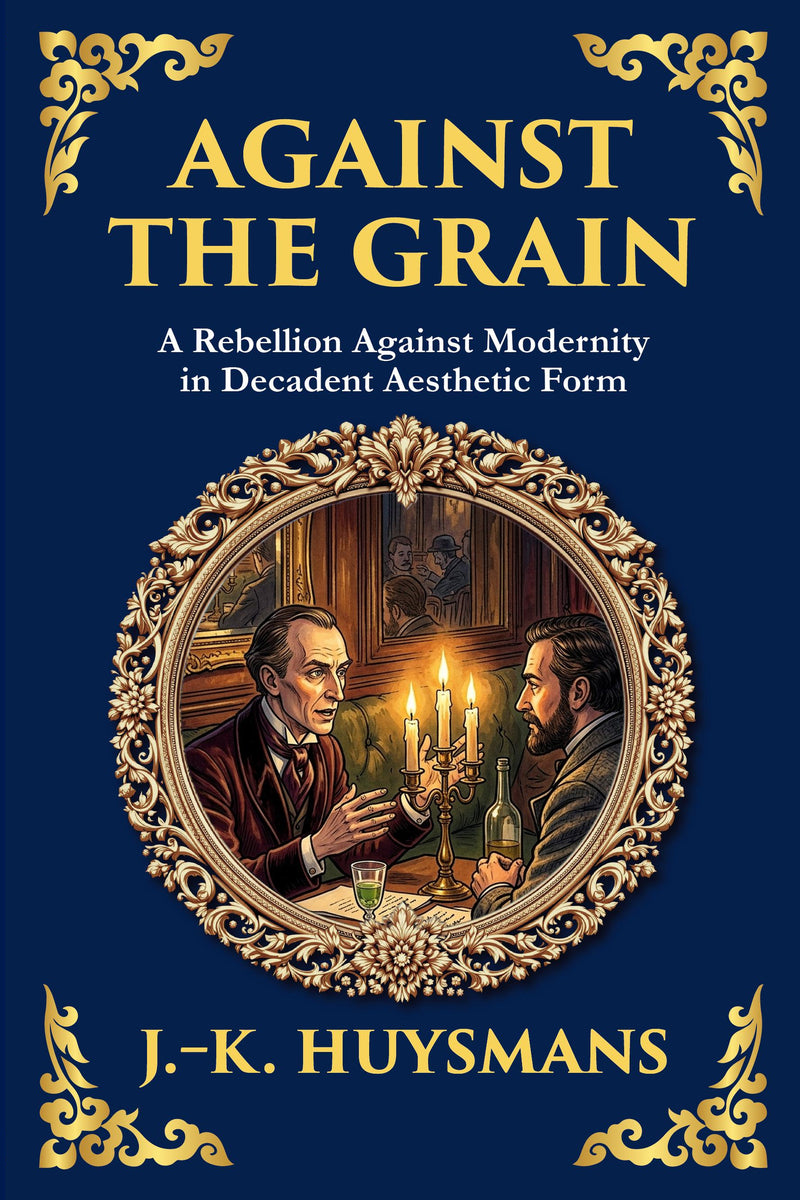
Against the Grain — Large Print
In a world obsessed with progress, Against the Grain dares to defy. Enter the opulent and insular life of Jean des Esseintes—a wealthy aristocrat who turns his back on modern society and retreats into an artificial paradise of art, literature, and elaborate sensations.
or free app
10,000+ hrs library
30-day guarantee
The complete Against the Grain appears in modern English through Library of Alexandria Press, available online with audiobook narration included for members.
Have you ever wondered why some souls rebel not through action—but through art? Against the Grain is J.-K. Huysmans’ dazzling exploration of aestheticism, alienation, and the craving for something beyond the ordinary. Originally published in 1884, this novel remains one of the most important and provocative works in European literature.
A cornerstone of the Decadent movement, it follows Jean des Esseintes, a reclusive aristocrat who withdraws from bourgeois society to construct his own world—one in which artifice triumphs over nature, and refined beauty serves as both salvation and curse. Through intoxicating descriptions and sardonic wit, Huysmans presents a scathing critique of modern life while simultaneously creating a manifesto for aesthetic autonomy. Des Esseintes’s obsessions with classical texts, bizarre rituals, synesthetic experiences, and bizarre décor reflect a mind in constant revolt—against religion, politics, materialism, and time itself.
This edition offers a modern, lyrical translation faithful to Huysmans' style and psychological nuance, drawing out the sensual excess and spiritual torment that lie beneath each decadent flourish.
What you’ll discover in this modern edition
- A Singular Exploration of the Decadent Mind Follow Jean des Esseintes’ retreat into an aesthetic utopia where beauty replaces human contact.
- The Foundational Novel of the Decadent Movement Discover how this work influenced Oscar Wilde, Marcel Proust, and generations of rebels in art and literature.
- A Rich Psychological and Symbolic Tapestry Examine the philosophical despair behind a life built entirely on taste, sensation, and illusion.
- A Modern Translation for Today’s Reader Experience Huysmans' evocative prose with clarity and depth while preserving his original intent.
- A Mirror to the Modern Crisis of Meaning Engage with a story that eerily anticipates today’s battles between substance and spectacle, isolation and stimulation.
| Formats | eBook (EPUB + PDF) · Audiobook · Paperback · Hardcover · Large Print |
| Language | English |
| Trim size (print) | 6 × 9 in |
| Binding | Paperback — perfect-bound · Hardcover — casewrap |
| Large Print edition | Same text in a larger, easy-read type — a larger font, not a larger trim |
| Print pricing | Every physical book at our true cost — at-cost, no profit (members) |
| Library | 873 restored titles, always growing |
| Length | 57,389 words · ~3 hr 50 min reading |
| Reading level | Grade 14 · a demanding, literary read (this modern-English edition) |
| Edition | Modern English translation · 2026 |
Member reviews for this edition are collected as readers finish it — be the first. Across the library: 12,000+ books shipped, every plan covered by a 365-day print guarantee.
About this edition
A faithful, unabridged modern-English edition by The Library of Alexandria — carefully rendered for today's reader and verified paragraph-by-paragraph against the public-domain source. Available as eBook, audiobook, paperback, hardcover, and large print.
- Complete & unabridgedVerified paragraph by paragraph against the source — never a scan, never abridged.
- Modern English, faithfulReadable today, with the author’s meaning kept intact. Readable — not simplified.
- Every format, one membershipRead in your browser or the free app, or listen to the full audiobook.
Included free with your membership
Cancel anytime, one click · 30-day money-back guarantee
Edition last updated July 2026
What’s inside
Against the Grain — Large Print — complete and unabridged: all 36 sections included with membership, plus the full audiobook.
Begin reading Against the Grain — Large Print
In clear modern English — the complete text is included with membership.
Introduction
There is a particular kind of novel that arrives in literary history not merely as a book but as an event — a detonation whose shockwave continues to travel outward long after the initial blast. Joris-Karl Huysmans published À rebours in Paris in 1884, and the explosion it caused has never entirely subsided. Oscar Wilde called it “the strangest book” he had ever read, and then, characteristically, read it again. It became the unnamed “yellow book” that corrupts Dorian Gray in Wilde’s own masterpiece, passed across a table like contraband, its pages capable of infecting a young man’s soul simply by being turned. Émile Zola, who had been Huysmans’s literary patron and the presiding genius of the Naturalist movement to which the younger writer nominally belonged, read the manuscript and told its author plainly that the book would be a torpedo aimed at the hull of everything they had built together. He was right, and Huysmans knew it, and published anyway. What you are holding is that torpedo — still live, still dangerous, still capable of making you question the life you have arranged for yourself and the civilization that arranged it for you.
To understand why this book matters, and why it continues to matter to readers who encounter it more than a century after its composition, it helps to understand something of the world it was written against. France in the early 1880s was a nation in the grip of a particular kind of confident, progressive, materialist optimism. The Third Republic had stabilized after the catastrophes of the Franco-Prussian War and the Commune. Industry was expanding. Science was ascendant. The great Naturalist novelists — Zola above all, but also Maupassant, Daudet, and the early Huysmans himself — were producing fiction that treated human beings as biological and social organisms shaped by heredity and environment, their fates as deterministic as the movement of planets. It was a literature of surfaces observed with clinical precision, of working-class misery and bourgeois hypocrisy catalogued with the dispassion of a laboratory report. It was, in its way, a magnificent achievement. It was also, Huysmans had come to feel, a prison.
Joris-Karl Huysmans — born in Paris in 1848 to a Dutch father and a French mother, christened Charles-Marie-Georges but adopting the more exotic Joris-Karl as a literary signature — had spent years as a dutiful civil servant in the French Ministry of the Interior while writing fiction on the side. His early novels were recognizably Naturalist in method: careful, unglamorous, attentive to the textures of ordinary Parisian life. But something was happening to him internally, some growing revulsion against the flat materialism of the age, some hunger for beauty and strangeness and intensity that the Naturalist program could not satisfy. The result, when it finally erupted, was the book you are about to read — a work so unlike anything that had preceded it that it required an entirely new critical vocabulary to describe. That vocabulary, eventually, became the vocabulary of Decadence.
The word “decadence” carries a weight of moral disapproval that tends to obscure its more precise aesthetic meaning. In the context of the literary movement that crystallized around this novel in the 1880s and 1890s, decadence referred to something specific and, in its own way, principled: a deliberate turning away from nature, from progress, from the social and the collective, toward the artificial, the refined, the individual, and the extreme. Where Naturalism looked outward at society, Decadence looked inward at sensation. Where Naturalism trusted science, Decadence trusted art. Where Naturalism sought to represent the world as it was, Decadence sought to construct worlds as they might be — or as they could only be in the imagination of a sufficiently cultivated and sufficiently desperate sensibility.
Huysmans did not invent this tendency single-handedly. The roots of what would become Decadence run deep into the nineteenth century: through Baudelaire’s Fleurs du Mal, with its celebration of artificial beauty and its frank acknowledgment of spiritual exhaustion; through Théophile Gautier’s preface to Mademoiselle de Maupin, with its defiant assertion that beauty serves no useful purpose and is therefore the only thing worth serving; through the Parnassian poets with their cult of formal perfection; through the Symbolists with their conviction that the material world is merely a system of correspondences pointing toward invisible realities. All of these currents flow into this novel, which gathers them up, concentrates them, and releases them in the form of a single extraordinary character living a single extraordinary experiment in deliberate, systematic, total aestheticism.
That character is the Duc Jean Floressas des Esseintes, and he is one of the most memorable figures in all of European fiction. He is the last scion of an ancient aristocratic family whose bloodline has been thinning for generations, each successive descendant more nervous, more refined, more physically fragile than the last, until the process of aristocratic attenuation has produced, in Jean, something almost beyond the human — a creature of pure sensibility, all nerve endings and aesthetic appetite, constitutionally incapable of tolerating the coarseness of ordinary social life. Having exhausted the pleasures available to a wealthy young Parisian — the women, the dinner parties, the literary circles, the debaucheries of various kinds — and having found all of them not merely unsatisfying but actively nauseating, he makes a decision of radical simplicity: he will withdraw from the world entirely. He will take a house in the suburbs, furnish and decorate it according to his own exacting specifications, and live there alone, surrounded by the books, paintings, music, flowers, perfumes, and objects that his taste has determined to be the finest things human civilization has produced. He will, in short, attempt to live entirely within art.
What follows is not, in any conventional sense, a plot. There are no love affairs, no villains, no dramatic confrontations, no narrative arc in the usual sense of that phrase. The book is instead a series of meditations, each chapter organized around a different domain of aesthetic experience — painting, literature, Latin prose, perfume, flowers, gemstones, music, the design of interior spaces — in which des Esseintes’s tastes and judgments are explored with an exhaustiveness that is simultaneously comic, serious, and deeply strange. He is a character who thinks about things with an intensity that most people reserve for crises, and the things he thinks about are the things that Huysmans himself cared about most passionately. The novel is, among other things, a sustained act of criticism — one of the most idiosyncratic and brilliant works of literary and artistic criticism produced in the nineteenth century, embedded in the form of a fiction.
The reader coming to this novel for the first time should be warned, gently but honestly, that it does not behave like most novels. If you approach it expecting the machinery of conventional narrative — rising action, romantic tension, plot complications resolved in a satisfying final movement — you will find yourself disoriented within the first few chapters and possibly tempted to put the book down. This would be a mistake, and the purpose of this note is partly to prevent it.
The key is to understand that the book’s apparent plotlessness is not a failure of construction but a deliberate formal choice that mirrors its thematic content. Des Esseintes has removed himself from the world of events, and the novel removes itself from the world of events along with him. What replaces plot is something richer and stranger: a sustained, intimate, often hilarious, occasionally heartbreaking exploration of one man’s inner life as expressed through his relationship to beautiful and difficult things. Each chapter is less a narrative unit than an essay in fictional form, and the pleasure of reading it is less the pleasure of finding out what happens next than the pleasure of inhabiting a sensibility so extreme, so refined, and so thoroughly worked out that it becomes a kind of alternative reality.
The best approach, this editor would suggest, is to read slowly and to allow yourself to be carried by the prose rather than pushing against it in search of story. Let the digressions happen. When des Esseintes spends several pages discussing the relative merits of Latin prose stylists of the late Roman Empire, or constructing an elaborate theory of the relationship between perfumes and musical keys, or meditating on the precise psychological effect of different colors of interior decoration, do not skim. These passages are the book. They are where Huysmans is most fully himself, and where the novel’s peculiar magic is most concentrated. The digressions are not interruptions of the experience — they are the experience.
It also helps to know that the book is, in significant ways, funny. Huysmans had a gift for deadpan comedy that is easy to miss if you approach the text with too much reverence. Des Esseintes is a figure of genuine pathos, but he is also, at moments, magnificently absurd — a man who has thought himself into a corner so elaborate and so perfectly appointed that the corner itself becomes a kind of joke. The episode involving the tortoise, to take one example that can be mentioned without spoiling anything, is one of the great comic set pieces in French literature, and it is funny precisely because Huysmans takes it completely seriously. The humor and the seriousness are not in tension; they are the same thing, which is part of what makes the book so unusual and so difficult to categorize.
Finally, do not be intimidated by the references. The novel is dense with allusions to painters, writers, composers, and historical figures, many of whom will be unfamiliar to the general reader. This is intentional — the density of reference is itself a statement about the kind of consciousness des Esseintes represents, a mind so saturated with culture that it can only think in terms of cultural comparison and allusion. But you do not need to recognize every name to follow the argument or feel the force of the prose. The footnotes in this edition are designed to provide context where it is genuinely useful without overwhelming the reading experience. Trust the text to carry you even when the specific references are unfamiliar. The emotional and intellectual logic of each passage is almost always clear from context, and the pleasure of encountering a new name and following it into the footnote and from there into your own curiosity is one of the genuine secondary pleasures this book offers.
It is worth pausing to consider what this novel actually did to European literature and culture, because the scale of its influence is difficult to overstate. When it appeared in 1884, it was received with a mixture of scandal, bewilderment, and intense excitement that is the characteristic response to genuinely new things. The Naturalists felt betrayed. The critics were largely baffled. But among younger writers and artists, the effect was electrifying. Here, suddenly, was a book that took seriously the things they had been told were trivial — decoration, style, sensation, the cultivation of private experience — and treated them with the same intellectual rigor and moral seriousness that the Naturalists had brought to social documentation. Here was a book that said, in effect, that the inner life of a single highly developed consciousness was as worthy of sustained literary attention as the working conditions of miners or the sexual hypocrisy of the bourgeoisie.
The writers who came after — Wilde, Beardsley, Dowson, Symons in England; Verlaine, Mallarmé, and the Symbolists in France; D’Annunzio in Italy — all read this book and were changed by it. The entire aesthetic movement of the 1890s, with its cult of beauty, its dandyism, its deliberate artificiality, its fascination with the relationship between art and morality, flows directly from the pages you are about to read. When Wilde created Lord Henry Wotton in Dorian Gray, he was in some sense creating a more sociable, more conversational version of des Esseintes. When Beardsley drew his elaborate, decadent illustrations, he was working in a visual idiom that this novel had helped to make possible. The book did not merely reflect a cultural moment; it created one.
Cancel anytime, one click · 30-day money-back guarantee
Founding annual rate available now — your price locks for life when you join.
Not ready? Get this free chapter by email — read it anytime.
✓ Sent — check your inbox for Against the Grain — Large Print.
Questions about Against the Grain — Large Print
What is Against the Grain about?
In a world obsessed with progress, Against the Grain dares to defy. Enter the opulent and insular life of Jean des Esseintes—a wealthy aristocrat who turns his back on modern society and retreats into an artificial paradise of art, literature, and elaborate sensations. His world is one of perfumes and gemstones, Latin poetry and exotic pets, where aesthetic indulgence replaces human connection.
Who wrote Against the Grain?
Against the Grain was written by J.-K. Huysmans. This edition presents the complete work in clear modern English, faithfully rendered from the public-domain original by Library of Alexandria Press.
Is Against the Grain free to read?
The opening chapter is free to read on this page. Members read and listen to the complete work — and the entire library — free, and can order any physical book at our true print cost.
How long is Against the Grain?
36 chapters (~57,389 words) — about 3 hr 50 min of reading in this modern-English edition.
Is this an abridged version of Against the Grain?
No. This is the complete, unabridged Against the Grain, carefully rendered into clear modern English and verified paragraph-by-paragraph against the public-domain source — nothing is cut or summarised.
What formats does Against the Grain come in?
Against the Grain is available as eBook, paperback, hardcover and large print. eBook and audiobook are included with membership; printed editions ship at our true print cost.
Shipping & returns
Billing & membership
More from the library


Explore Classic & Literary
- Dream Psychology: Psychoanalysis for Beginners · Sigmund Freud
- Great Expectations · Charles Dickens
- The Brothers Karamazov · Fyodor Dostoyevsky
- The Great Gatsby · F. Scott Fitzgerald
- Wild Flowers Worth Knowing · Neltje Blanchan
- Italian Hours · Henry James
- A Popular History of France from the Earliest Times, Volume 5 · François Guizot
- A history of English literature: A practical text-book · Edward Albert
- Italian Highways and Byways from a Motor Car · M. F. Mansfield
- The Heart-Cry of Jesus · Byron J. Rees
- Castes and Tribes of Southern India. Vol. 6 of 7 · Edgar Thurston
- Against the Grain · J.-K. Huysmans
- Dombey and Son · Charles Dickens
- How to Invest Money · George Garr Henry
- The Great Controversy Between Christ and Satan · Ellen Gould Harmon White
- One Hundred Proofs That the Earth Is Not a Globe · William Carpenter
- Southern Literature From 1579–1895 · Louise Manly
- The Renaissance: Studies in Art and Poetry · Walter Pater
- Mark Twain’s Speeches · Mark Twain
- Tacitus on Germany · Cornelius Tacitus
- The Rosary · Florence L. Barclay
- Peculiarities of American Cities · Willard W. Glazier
- Tennis for Girls · Florence A. Ballin
- The World’s Greatest Books — Volume 02 — Fiction
- Shirley · Charlotte Brontë
- Daisy Miller: A Study · Henry James
- Louis Lambert · Honoré de Balzac
- Historic Jamaica · Frank Cundall
- The Gambler · Fyodor Dostoyevsky
- The Mayor of Casterbridge · Thomas Hardy
Against the Grain — Large Print
Against the Grain — Large Print
A Modern Translation
J.-K. Huysmans
Contents
- Introduction
- Chapter 1
- Chapter 2
- Chapter 3
- Chapter 4
- Chapter 5
- Chapter 6
- Chapter 7
- Chapter 8
- Chapter 9
- Chapter 10
- Chapter 11
- Chapter 12
- Chapter 13
- Chapter 14
- Chapter 15
- Chapter 16
- Chapter 17
- Chapter 18
- Chapter 19
- Chapter 20
- Chapter 21
- Chapter 22
- Chapter 23
- Chapter 24
- Chapter 25
- Chapter 26
- Chapter 27
- Chapter 28
- Chapter 29
- Chapter 30
- Chapter 31
- Chapter 32
- Chapter 33
- Chapter 34
- Chapter 35
Introduction
There is a particular kind of novel that arrives in literary history not merely as a book but as an event — a detonation whose shockwave continues to travel outward long after the initial blast. Joris-Karl Huysmans published À rebours in Paris in 1884, and the explosion it caused has never entirely subsided. Oscar Wilde called it “the strangest book” he had ever read, and then, characteristically, read it again. It became the unnamed “yellow book” that corrupts Dorian Gray in Wilde’s own masterpiece, passed across a table like contraband, its pages capable of infecting a young man’s soul simply by being turned. Émile Zola, who had been Huysmans’s literary patron and the presiding genius of the Naturalist movement to which the younger writer nominally belonged, read the manuscript and told its author plainly that the book would be a torpedo aimed at the hull of everything they had built together. He was right, and Huysmans knew it, and published anyway. What you are holding is that torpedo — still live, still dangerous, still capable of making you question the life you have arranged for yourself and the civilization that arranged it for you.
To understand why this book matters, and why it continues to matter to readers who encounter it more than a century after its composition, it helps to understand something of the world it was written against. France in the early 1880s was a nation in the grip of a particular kind of confident, progressive, materialist optimism. The Third Republic had stabilized after the catastrophes of the Franco-Prussian War and the Commune. Industry was expanding. Science was ascendant. The great Naturalist novelists — Zola above all, but also Maupassant, Daudet, and the early Huysmans himself — were producing fiction that treated human beings as biological and social organisms shaped by heredity and environment, their fates as deterministic as the movement of planets. It was a literature of surfaces observed with clinical precision, of working-class misery and bourgeois hypocrisy catalogued with the dispassion of a laboratory report. It was, in its way, a magnificent achievement. It was also, Huysmans had come to feel, a prison.
Joris-Karl Huysmans — born in Paris in 1848 to a Dutch father and a French mother, christened Charles-Marie-Georges but adopting the more exotic Joris-Karl as a literary signature — had spent years as a dutiful civil servant in the French Ministry of the Interior while writing fiction on the side. His early novels were recognizably Naturalist in method: careful, unglamorous, attentive to the textures of ordinary Parisian life. But something was happening to him internally, some growing revulsion against the flat materialism of the age, some hunger for beauty and strangeness and intensity that the Naturalist program could not satisfy. The result, when it finally erupted, was the book you are about to read — a work so unlike anything that had preceded it that it required an entirely new critical vocabulary to describe. That vocabulary, eventually, became the vocabulary of Decadence.
The word “decadence” carries a weight of moral disapproval that tends to obscure its more precise aesthetic meaning. In the context of the literary movement that crystallized around this novel in the 1880s and 1890s, decadence referred to something specific and, in its own way, principled: a deliberate turning away from nature, from progress, from the social and the collective, toward the artificial, the refined, the individual, and the extreme. Where Naturalism looked outward at society, Decadence looked inward at sensation. Where Naturalism trusted science, Decadence trusted art. Where Naturalism sought to represent the world as it was, Decadence sought to construct worlds as they might be — or as they could only be in the imagination of a sufficiently cultivated and sufficiently desperate sensibility.
Huysmans did not invent this tendency single-handedly. The roots of what would become Decadence run deep into the nineteenth century: through Baudelaire’s Fleurs du Mal, with its celebration of artificial beauty and its frank acknowledgment of spiritual exhaustion; through Théophile Gautier’s preface to Mademoiselle de Maupin, with its defiant assertion that beauty serves no useful purpose and is therefore the only thing worth serving; through the Parnassian poets with their cult of formal perfection; through the Symbolists with their conviction that the material world is merely a system of correspondences pointing toward invisible realities. All of these currents flow into this novel, which gathers them up, concentrates them, and releases them in the form of a single extraordinary character living a single extraordinary experiment in deliberate, systematic, total aestheticism.
That character is the Duc Jean Floressas des Esseintes, and he is one of the most memorable figures in all of European fiction. He is the last scion of an ancient aristocratic family whose bloodline has been thinning for generations, each successive descendant more nervous, more refined, more physically fragile than the last, until the process of aristocratic attenuation has produced, in Jean, something almost beyond the human — a creature of pure sensibility, all nerve endings and aesthetic appetite, constitutionally incapable of tolerating the coarseness of ordinary social life. Having exhausted the pleasures available to a wealthy young Parisian — the women, the dinner parties, the literary circles, the debaucheries of various kinds — and having found all of them not merely unsatisfying but actively nauseating, he makes a decision of radical simplicity: he will withdraw from the world entirely. He will take a house in the suburbs, furnish and decorate it according to his own exacting specifications, and live there alone, surrounded by the books, paintings, music, flowers, perfumes, and objects that his taste has determined to be the finest things human civilization has produced. He will, in short, attempt to live entirely within art.
What follows is not, in any conventional sense, a plot. There are no love affairs, no villains, no dramatic confrontations, no narrative arc in the usual sense of that phrase. The book is instead a series of meditations, each chapter organized around a different domain of aesthetic experience — painting, literature, Latin prose, perfume, flowers, gemstones, music, the design of interior spaces — in which des Esseintes’s tastes and judgments are explored with an exhaustiveness that is simultaneously comic, serious, and deeply strange. He is a character who thinks about things with an intensity that most people reserve for crises, and the things he thinks about are the things that Huysmans himself cared about most passionately. The novel is, among other things, a sustained act of criticism — one of the most idiosyncratic and brilliant works of literary and artistic criticism produced in the nineteenth century, embedded in the form of a fiction.
The reader coming to this novel for the first time should be warned, gently but honestly, that it does not behave like most novels. If you approach it expecting the machinery of conventional narrative — rising action, romantic tension, plot complications resolved in a satisfying final movement — you will find yourself disoriented within the first few chapters and possibly tempted to put the book down. This would be a mistake, and the purpose of this note is partly to prevent it.
The key is to understand that the book’s apparent plotlessness is not a failure of construction but a deliberate formal choice that mirrors its thematic content. Des Esseintes has removed himself from the world of events, and the novel removes itself from the world of events along with him. What replaces plot is something richer and stranger: a sustained, intimate, often hilarious, occasionally heartbreaking exploration of one man’s inner life as expressed through his relationship to beautiful and difficult things. Each chapter is less a narrative unit than an essay in fictional form, and the pleasure of reading it is less the pleasure of finding out what happens next than the pleasure of inhabiting a sensibility so extreme, so refined, and so thoroughly worked out that it becomes a kind of alternative reality.
The best approach, this editor would suggest, is to read slowly and to allow yourself to be carried by the prose rather than pushing against it in search of story. Let the digressions happen. When des Esseintes spends several pages discussing the relative merits of Latin prose stylists of the late Roman Empire, or constructing an elaborate theory of the relationship between perfumes and musical keys, or meditating on the precise psychological effect of different colors of interior decoration, do not skim. These passages are the book. They are where Huysmans is most fully himself, and where the novel’s peculiar magic is most concentrated. The digressions are not interruptions of the experience — they are the experience.
It also helps to know that the book is, in significant ways, funny. Huysmans had a gift for deadpan comedy that is easy to miss if you approach the text with too much reverence. Des Esseintes is a figure of genuine pathos, but he is also, at moments, magnificently absurd — a man who has thought himself into a corner so elaborate and so perfectly appointed that the corner itself becomes a kind of joke. The episode involving the tortoise, to take one example that can be mentioned without spoiling anything, is one of the great comic set pieces in French literature, and it is funny precisely because Huysmans takes it completely seriously. The humor and the seriousness are not in tension; they are the same thing, which is part of what makes the book so unusual and so difficult to categorize.
Finally, do not be intimidated by the references. The novel is dense with allusions to painters, writers, composers, and historical figures, many of whom will be unfamiliar to the general reader. This is intentional — the density of reference is itself a statement about the kind of consciousness des Esseintes represents, a mind so saturated with culture that it can only think in terms of cultural comparison and allusion. But you do not need to recognize every name to follow the argument or feel the force of the prose. The footnotes in this edition are designed to provide context where it is genuinely useful without overwhelming the reading experience. Trust the text to carry you even when the specific references are unfamiliar. The emotional and intellectual logic of each passage is almost always clear from context, and the pleasure of encountering a new name and following it into the footnote and from there into your own curiosity is one of the genuine secondary pleasures this book offers.
It is worth pausing to consider what this novel actually did to European literature and culture, because the scale of its influence is difficult to overstate. When it appeared in 1884, it was received with a mixture of scandal, bewilderment, and intense excitement that is the characteristic response to genuinely new things. The Naturalists felt betrayed. The critics were largely baffled. But among younger writers and artists, the effect was electrifying. Here, suddenly, was a book that took seriously the things they had been told were trivial — decoration, style, sensation, the cultivation of private experience — and treated them with the same intellectual rigor and moral seriousness that the Naturalists had brought to social documentation. Here was a book that said, in effect, that the inner life of a single highly developed consciousness was as worthy of sustained literary attention as the working conditions of miners or the sexual hypocrisy of the bourgeoisie.
The writers who came after — Wilde, Beardsley, Dowson, Symons in England; Verlaine, Mallarmé, and the Symbolists in France; D’Annunzio in Italy — all read this book and were changed by it. The entire aesthetic movement of the 1890s, with its cult of beauty, its dandyism, its deliberate artificiality, its fascination with the relationship between art and morality, flows directly from the pages you are about to read. When Wilde created Lord Henry Wotton in Dorian Gray, he was in some sense creating a more sociable, more conversational version of des Esseintes. When Beardsley drew his elaborate, decadent illustrations, he was working in a visual idiom that this novel had helped to make possible. The book did not merely reflect a cultural moment; it created one.
Judging by the various portraits kept at the Chateau de Lourps, the Floressas Des Esseintes had originally been a family of hardy soldiers and stern cavalrymen. Packed tightly side by side in old frames that their broad shoulders filled, they startled the viewer with their fixed stares, fierce mustaches, and chests that filled the massive shells of their armor.
These were the ancestors. There were no portraits of their descendants, and a wide gap existed in the lineage of the family’s faces. Only one painting served as a link between the past and present: a cunning, mysterious head with gaunt, haggard features, cheekbones defined by a single stroke of paint, hair sprinkled with pearls, and a neck rising stiffly from a pleated ruff.
In this depiction of one of the closest friends of the Duc d’Epernon and the Marquis d’O, the effects of a sluggish and weak constitution were already apparent.
It was obvious that the family’s decline had followed a steady path. The effemination of the men had accelerated. As if to finish the work of many years, the Des Esseintes had intermarried for two centuries, draining whatever strength remained through these consanguineous unions.
There was only one living member of this family, which had once been so numerous that it owned all the territories of the Ile-de-France and La Brie. Duc Jean was a slender, nervous thirty-year-old man with hollow cheeks, cold steel-blue eyes, a straight, thin nose, and delicate hands.
Through a strange genetic throwback, the last descendant resembled the old patriarch, from whom he inherited a pointed, remarkably fair beard and an ambiguous expression that was simultaneously weary and cunning.
End of the free sample
Keep reading, free
Members read and listen to the complete book — and the entire library. Cancel anytime, one click · 30-day money-back guarantee.