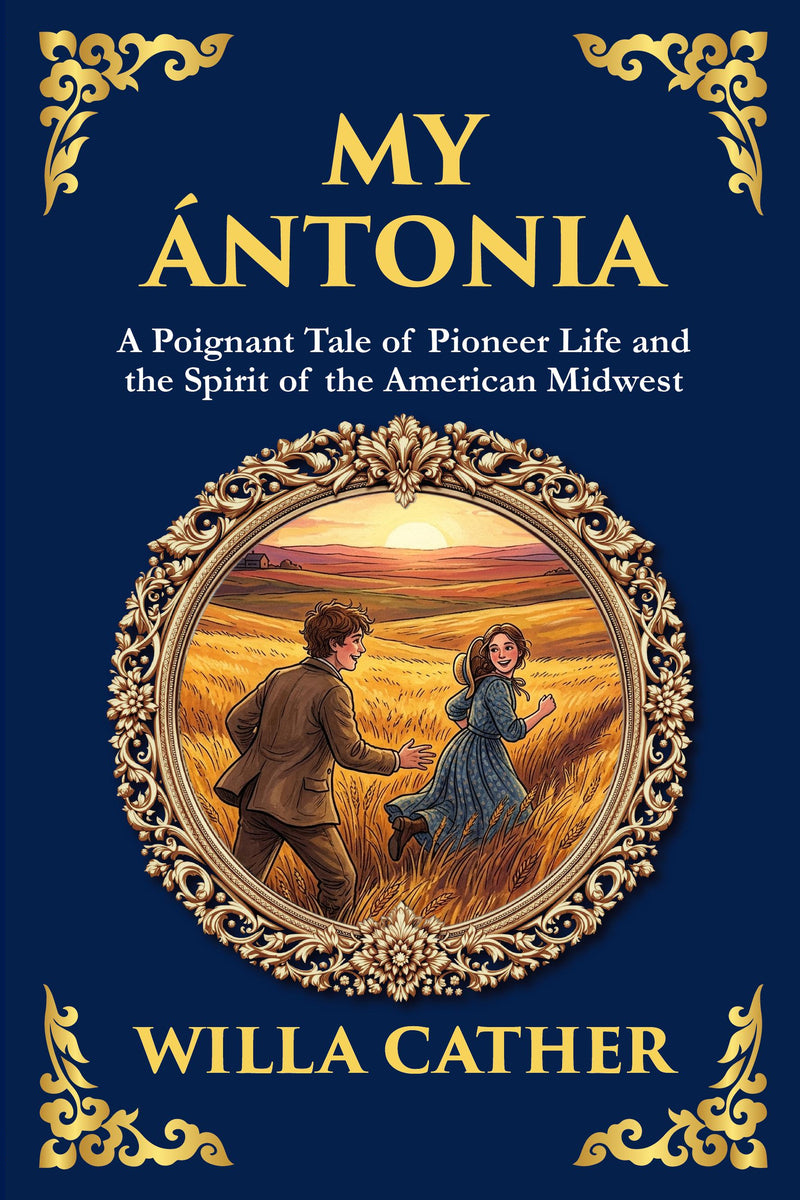
My Ántonia — Large Print
Set against the vast prairies of Nebraska, My Ántonia is Willa Cather’s timeless tribute to memory, immigration, and the rugged beauty of frontier life.
or free app
10,000+ hrs library
30-day guarantee
The complete My Ántonia appears in modern English through Library of Alexandria Press, available online with audiobook narration included for members.
Have you ever wondered why some memories linger forever—etched in the land, the soul, and the silence between words? In My Ántonia, Willa Cather crafts one of the most beloved masterpieces of American literature, weaving a deeply personal tale of love, loss, and memory. Through the narrator Jim Burden’s recollections, the story unfolds as a poignant exploration of his childhood on the windswept Nebraska plains and his enduring bond with the courageous immigrant girl, Ántonia Shimerda. Ántonia is not merely a character—she is the embodiment of the frontier spirit: passionate, determined, and shaped by the hardship of survival in a new world.
As both endure the hardships of pioneering life, their fates diverge, yet the memory of Ántonia and the landscape they once shared continue to haunt Jim’s soul and stir his deepest reflections on life, identity, and the passage of time.
What you’ll discover in this modern edition
- A Vivid Portrait of the American Prairie Experience the raw beauty, brutality, and poetry of the Midwest as seen through the eyes of a child growing up with the land.
| Formats | eBook (EPUB + PDF) · Audiobook · Paperback · Hardcover · Large Print |
| Language | English |
| Trim size (print) | 6 × 9 in |
| Binding | Paperback — perfect-bound · Hardcover — casewrap |
| Large Print edition | Same text in a larger, easy-read type — a larger font, not a larger trim |
| Print pricing | Every physical book at our true cost — at-cost, no profit (members) |
| Library | 873 restored titles, always growing |
| Length | 83,636 words · ~5 hr 35 min reading |
| Reading level | Grade 7 · an easy, flowing read (this modern-English edition) |
| Edition | Modern English translation · 2026 |
Member reviews for this edition are collected as readers finish it — be the first. Across the library: 12,000+ books shipped, every plan covered by a 365-day print guarantee.
About this edition
A faithful, unabridged modern-English edition by The Library of Alexandria — carefully rendered for today's reader and verified paragraph-by-paragraph against the public-domain source. Available as eBook, audiobook, paperback, hardcover, and large print.
- Complete & unabridgedVerified paragraph by paragraph against the source — never a scan, never abridged.
- Modern English, faithfulReadable today, with the author’s meaning kept intact. Readable — not simplified.
- Every format, one membershipRead in your browser or the free app, or listen to the full audiobook.
Included free with your membership
Cancel anytime, one click · 30-day money-back guarantee
Edition last updated July 2026
What’s inside
My Ántonia — Large Print — complete and unabridged: all 26 sections included with membership, plus the full audiobook.
Begin reading My Ántonia — Large Print
In clear modern English — the complete text is included with membership.
Introduction
There are certain books that do not so much tell a story as conjure a world — and once you have wandered through that world, some part of you never entirely leaves it. My Ántonia is one of those rare and luminous works. First published in 1918, it stands today as one of the most beloved and enduring achievements of American literature, a novel that has shaped how generations of readers imagine the prairie, the immigrant experience, and the quiet heroism of ordinary lives lived close to the land. To open these pages is to step onto the vast grasslands of Nebraska in the late nineteenth century, where the wind moves through the red grass like a living thing and the horizon stretches so far that a young heart can scarcely contain its longing. This edition presents Willa Cather’s masterwork in a modern translation, gently adapted for the contemporary reader, so that the timeless beauty of the original may flow freely into the present without the friction of dated phrasing or unfamiliar idiom. The aim is not to alter Cather’s vision but to clear the windowpane through which you view it, allowing her radiant prose and her tender, unhurried storytelling to reach you as vividly as they reached readers more than a century ago.
What you hold is far more than a regional novel or a historical curiosity. It is a meditation on memory, on the people and places that imprint themselves upon us in youth and remain with us forever, growing more precious with each passing year. It is a book about the American frontier, yes — about sod houses and homesteads, about the back-breaking labor of turning wilderness into farmland — but it is equally a book about the human spirit, about resilience and joy, about loss and the strange consolation that comes from remembering what we have loved. Cather understood, perhaps better than any American writer of her age, that the deepest dramas often unfold not in great events but in the texture of daily living, in a shared meal, a long walk through the fields, a friendship that endures across decades. Reading My Ántonia is like coming home to a place you have never been, and finding there a face you somehow already know.
To understand the singular power of this novel, it helps to know something of the remarkable woman who created it. Willa Cather was born in 1873 in Virginia, but when she was nine years old her family pulled up its roots and moved to the Nebraska Divide, that great swell of prairie between the Republican and Little Blue Rivers. For a sensitive, imaginative child accustomed to the green and settled landscapes of the East, the shock of the open plains was profound. Years later she would describe the experience of arriving in that empty country — a land without fences, without trees, without the comforting boundaries of an established civilization — as something close to annihilation, as though her very identity had been wiped clean by the immensity around her. “I would not know how much a child’s life is bound up in the woods and hills and meadows around it,” she later reflected, “if I had not been jerked away from all these and thrown out into a country as bare as a piece of sheet iron.” Yet out of that initial terror grew a lifelong love. The prairie that had at first seemed a void revealed itself, season by season, as a place of extraordinary richness — of color and light, of hardy growing things, and above all of people.
For the Cather family had landed among a vibrant patchwork of immigrant communities: Bohemians and Swedes, Germans, Norwegians, and Russians, all of them transplanted to the raw earth of the New World, all of them struggling to build lives from nothing. Young Willa was endlessly fascinated by these neighbors. She rode her pony across the countryside, visiting the homesteads of these foreign-born settlers, listening to their stories, absorbing their songs and customs, their griefs and their indomitable hopes. She befriended the immigrant girls who worked as hired help in the town of Red Cloud, where her family eventually settled, and she came to admire their vigor, their generosity of feeling, and the deep wells of experience that lay behind their broken English. Among these acquaintances was a Bohemian girl named Annie Sadilek, who would later, transformed by the alchemy of art, become the figure of Ántonia herself. Cather never forgot these women, and when at last she came to write the book that would secure her reputation, it was their courage and warmth that she chose to honor above all else.
After studying at the University of Nebraska, Cather embarked on a career in journalism and teaching, moving eastward to Pittsburgh and then to New York, where she worked as an editor at the influential McClure’s Magazine. She was by then a sophisticated woman of letters, fully immersed in the cultural currents of the modern city. But the wisest advice she ever received came from the writer Sarah Orne Jewett, who counseled her to turn away from clever imitation and toward the material she knew most intimately — the country of her childhood, the people of the plains. It was a turning point. With O Pioneers! in 1913 and The Song of the Lark in 1915, Cather began to mine the deep ore of her Nebraska memories, and with My Ántonia in 1918 she achieved her fullest and most perfect expression of that vision. The novel is, in the truest sense, a work drawn from the soil of lived experience, ripened by years of reflection and rendered with the disciplined artistry of a writer at the height of her powers.
It is worth pausing to appreciate how unusual Cather’s literary ambition was. In an era when the fashionable trend in fiction ran toward dense plotting, crowded incident, and the cataloguing of material detail, Cather chose a different path. She believed in what she called the “novel démeublé” — the unfurnished novel, stripped of clutter and excess, in which the most important things are suggested rather than stated, felt rather than described. “Whatever is felt upon the page without being specifically named there,” she wrote, “that, one might say, is created.” Her pages breathe. There is space in them, the same vast open space she found so frightening and then so beloved on the Nebraska prairie. She trusted her readers to feel the weight of what she left unsaid, to sense the emotional currents running beneath the calm surface of her prose. This restraint is itself a kind of generosity, and it is one of the reasons the novel rewards rereading so richly: each return reveals new depths, new resonances, things you had not noticed before because they were woven so subtly into the fabric of the whole.
The modern adaptation you are about to read has been undertaken with great care to preserve precisely this quality of luminous restraint. Cather’s sentences possess a clarity and a music that are central to their effect, and nothing has been done to coarsen or simplify their essential beauty. Rather, where a turn of phrase or a now-obscure reference might have caused a contemporary reader to stumble, the language has been smoothed and clarified, so that the current of the narrative carries you forward without interruption. The intent throughout has been fidelity — fidelity to Cather’s tone, her rhythm, and above all her feeling. You will encounter the same wide skies, the same unforgettable people, the same aching tenderness that have moved readers for over a hundred years. What you will not encounter, ideally, is any sense of distance between yourself and the world she made. The prairie should feel as near to you as your own breath.
At its heart, My Ántonia is a book about memory — about the way the past lives within us and shapes who we become. The story unfolds as the recollections of a man looking back across the long span of his life to the years of his boyhood and youth, when he first arrived in Nebraska and first encountered the spirited immigrant girl who would haunt his imagination ever after. This framing device — the act of remembering itself — gives the novel its peculiar emotional power. We do not experience the events of the story as they happen in some immediate, breathless present; we experience them as they are recalled, softened and burnished and made golden by the passage of time. The narrative has the quality of a long, twilit conversation, the kind two old friends might have on a summer evening, when the talk turns naturally to the people and places of their shared youth and every memory seems to glow with a light that the present cannot match.
This is fitting, because My Ántonia is fundamentally about the things we carry with us through life — the formative landscapes, the early friendships, the figures of our childhood who, for reasons we can never fully explain, become permanently lodged in our hearts. Almost everyone who reads this book recognizes in it some echo of their own past, some person or place that shaped them in ways they only later came to understand. The girl Ántonia, with her dark eyes and her irrepressible vitality, is one of the great characters of American fiction precisely because she is so vividly herself and yet so universally meaningful. She embodies a quality of life — a fullness of being, a capacity for both joy and suffering — that the narrator spends his entire existence trying to comprehend and to honor. Through his eyes, we come to love her too, and to feel the pang of all that time takes from us and all that, mysteriously, it leaves behind.
The world that the novel preserves is the world of the American frontier in its final flowering, the homesteading era of the 1880s and beyond, when families from across Europe and the eastern United States poured onto the Great Plains to claim free land and to wrest a living from the stubborn earth. It was a time of extraordinary hardship. The first settlers often lived in dugouts and sod houses, enduring brutal winters, scorching summers, prairie fires, and the crushing loneliness of distances that could not easily be bridged. Cather does not flinch from the harshness of this life. There is hunger in these pages, and bitter cold, and despair so deep that it sometimes leads to tragedy. The immigrant families in particular — arriving without money, without the language, without any understanding of frontier farming — faced obstacles that would have broken less determined people. And yet what Cather captures most powerfully is not the suffering itself but the human response to it: the stubborn dignity, the flashes of humor, the small kindnesses exchanged between neighbors, the irrepressible will to make beauty and meaning even in the midst of want.
Cather had a profound understanding of the immigrant experience, and My Ántonia remains one of the most sympathetic and richly textured portraits of immigrant life in all of American literature. She saw these newcomers not as exotic curiosities or as objects of condescension, but as bearers of ancient cultures, custodians of music and food and storytelling traditions that enriched the raw new country immeasurably. The contrast she draws between the settled, often complacent townsfolk and the vital, full-blooded immigrant families is one of the recurring motifs of the book, and it carries a quiet social criticism that feels remarkably ahead of its time. Cather understood that America was being remade, day by day, by these foreign-born settlers, that the energy and warmth and resilience they brought were the true source of the nation’s vigor. In honoring them, she was honoring something essential about the American experiment itself.
But to read My Ántonia merely as a historical document, however valuable, would be to miss the deeper enchantment of the book. For above all, this is a novel of feeling — of the particular emotions stirred by landscape and season and the turning of the years. Cather was a supreme poet of the natural world, and her descriptions of the Nebraska prairie are among the most beautiful passages in American prose. She renders the great sweep of the grasslands at sunset, the snow lying blue in the moonlight, the corn ripening gold in the late summer heat, the wildflowers bursting through the sod in spring, with a precision and a tenderness that take the breath away. Reading her, you do not merely picture these scenes; you feel them, in your skin and in your bones. The prairie becomes a presence in the book almost as vivid as any of the human characters, a vast and indifferent and yet endlessly nourishing ground against which the small human dramas play themselves out. There is a famous image near the close of the novel — a plow standing black against the red disk of the setting sun, magnified for a moment to heroic proportions — that has become one of the iconic pictures in all of American literature, a perfect emblem of the way Cather invests the humble objects of frontier life with grandeur and meaning.
Cancel anytime, one click · 30-day money-back guarantee
Founding annual rate available now — your price locks for life when you join.
Not ready? Get this free chapter by email — read it anytime.
✓ Sent — check your inbox for My Ántonia — Large Print.
Questions about My Ántonia — Large Print
What is My Ántonia about?
Set against the vast prairies of Nebraska, My Ántonia is Willa Cather’s timeless tribute to memory, immigration, and the rugged beauty of frontier life. Through the eyes of Jim Burden, a sensitive orphan boy, we witness the indomitable spirit of Ántonia Shimerda—a spirited Bohemian girl whose life is marked by hardship, endurance, and quiet heroism. A deeply nostalgic and lyrical novel, My Ántonia explores the bonds of youth, the trials of pioneering families, and the invisible threads that connect people to land,
Who wrote My Ántonia?
My Ántonia was written by Willa Cather. This edition presents the complete work in clear modern English, faithfully rendered from the public-domain original by Library of Alexandria Press.
Is My Ántonia free to read?
The opening chapter is free to read on this page. Members read and listen to the complete work — and the entire library — free, and can order any physical book at our true print cost.
How long is My Ántonia?
26 chapters (~83,636 words) — about 5 hr 35 min of reading in this modern-English edition.
Is this an abridged version of My Ántonia?
No. This is the complete, unabridged My Ántonia, carefully rendered into clear modern English and verified paragraph-by-paragraph against the public-domain source — nothing is cut or summarised.
What formats does My Ántonia come in?
My Ántonia is available as eBook, paperback, hardcover and large print. eBook and audiobook are included with membership; printed editions ship at our true print cost.
Shipping & returns
Billing & membership
More from the library


Explore Classic & Literary
- Dream Psychology: Psychoanalysis for Beginners · Sigmund Freud
- Great Expectations · Charles Dickens
- The Brothers Karamazov · Fyodor Dostoyevsky
- The Great Gatsby · F. Scott Fitzgerald
- Wild Flowers Worth Knowing · Neltje Blanchan
- Italian Hours · Henry James
- A Popular History of France from the Earliest Times, Volume 5 · François Guizot
- A history of English literature: A practical text-book · Edward Albert
- Italian Highways and Byways from a Motor Car · M. F. Mansfield
- The Heart-Cry of Jesus · Byron J. Rees
- Castes and Tribes of Southern India. Vol. 6 of 7 · Edgar Thurston
- Against the Grain · J.-K. Huysmans
- Dombey and Son · Charles Dickens
- How to Invest Money · George Garr Henry
- The Great Controversy Between Christ and Satan · Ellen Gould Harmon White
- One Hundred Proofs That the Earth Is Not a Globe · William Carpenter
- Southern Literature From 1579–1895 · Louise Manly
- The Renaissance: Studies in Art and Poetry · Walter Pater
- Mark Twain’s Speeches · Mark Twain
- Tacitus on Germany · Cornelius Tacitus
- The Rosary · Florence L. Barclay
- Peculiarities of American Cities · Willard W. Glazier
- Tennis for Girls · Florence A. Ballin
- The World’s Greatest Books — Volume 02 — Fiction
- Shirley · Charlotte Brontë
- Daisy Miller: A Study · Henry James
- Louis Lambert · Honoré de Balzac
- Historic Jamaica · Frank Cundall
- The Gambler · Fyodor Dostoyevsky
- The Mayor of Casterbridge · Thomas Hardy
My Ántonia — Large Print
My Ántonia — Large Print
A Touching Story of Pioneer Life and the Spirit of the American Midwest
Willa Cather
Contents
- Introduction
- Author's Introduction
- Book 1
- Chapter 1
- Chapter 2
- Chapter 3
- Chapter 4
- Chapter 5
- Chapter 6
- Chapter 7
- Chapter 8
- Chapter 9
- Chapter 10
- Chapter 11
- Chapter 12
- Chapter 13
- Chapter 14
- Chapter 15
- Chapter 16
- Chapter 17
- Chapter 18
- Chapter 19
- Book 2
- Book 3
- Book 4
- Book 5
Introduction
There are certain books that do not so much tell a story as conjure a world — and once you have wandered through that world, some part of you never entirely leaves it. My Ántonia is one of those rare and luminous works. First published in 1918, it stands today as one of the most beloved and enduring achievements of American literature, a novel that has shaped how generations of readers imagine the prairie, the immigrant experience, and the quiet heroism of ordinary lives lived close to the land. To open these pages is to step onto the vast grasslands of Nebraska in the late nineteenth century, where the wind moves through the red grass like a living thing and the horizon stretches so far that a young heart can scarcely contain its longing. This edition presents Willa Cather’s masterwork in a modern translation, gently adapted for the contemporary reader, so that the timeless beauty of the original may flow freely into the present without the friction of dated phrasing or unfamiliar idiom. The aim is not to alter Cather’s vision but to clear the windowpane through which you view it, allowing her radiant prose and her tender, unhurried storytelling to reach you as vividly as they reached readers more than a century ago.
What you hold is far more than a regional novel or a historical curiosity. It is a meditation on memory, on the people and places that imprint themselves upon us in youth and remain with us forever, growing more precious with each passing year. It is a book about the American frontier, yes — about sod houses and homesteads, about the back-breaking labor of turning wilderness into farmland — but it is equally a book about the human spirit, about resilience and joy, about loss and the strange consolation that comes from remembering what we have loved. Cather understood, perhaps better than any American writer of her age, that the deepest dramas often unfold not in great events but in the texture of daily living, in a shared meal, a long walk through the fields, a friendship that endures across decades. Reading My Ántonia is like coming home to a place you have never been, and finding there a face you somehow already know.
To understand the singular power of this novel, it helps to know something of the remarkable woman who created it. Willa Cather was born in 1873 in Virginia, but when she was nine years old her family pulled up its roots and moved to the Nebraska Divide, that great swell of prairie between the Republican and Little Blue Rivers. For a sensitive, imaginative child accustomed to the green and settled landscapes of the East, the shock of the open plains was profound. Years later she would describe the experience of arriving in that empty country — a land without fences, without trees, without the comforting boundaries of an established civilization — as something close to annihilation, as though her very identity had been wiped clean by the immensity around her. “I would not know how much a child’s life is bound up in the woods and hills and meadows around it,” she later reflected, “if I had not been jerked away from all these and thrown out into a country as bare as a piece of sheet iron.” Yet out of that initial terror grew a lifelong love. The prairie that had at first seemed a void revealed itself, season by season, as a place of extraordinary richness — of color and light, of hardy growing things, and above all of people.
For the Cather family had landed among a vibrant patchwork of immigrant communities: Bohemians and Swedes, Germans, Norwegians, and Russians, all of them transplanted to the raw earth of the New World, all of them struggling to build lives from nothing. Young Willa was endlessly fascinated by these neighbors. She rode her pony across the countryside, visiting the homesteads of these foreign-born settlers, listening to their stories, absorbing their songs and customs, their griefs and their indomitable hopes. She befriended the immigrant girls who worked as hired help in the town of Red Cloud, where her family eventually settled, and she came to admire their vigor, their generosity of feeling, and the deep wells of experience that lay behind their broken English. Among these acquaintances was a Bohemian girl named Annie Sadilek, who would later, transformed by the alchemy of art, become the figure of Ántonia herself. Cather never forgot these women, and when at last she came to write the book that would secure her reputation, it was their courage and warmth that she chose to honor above all else.
After studying at the University of Nebraska, Cather embarked on a career in journalism and teaching, moving eastward to Pittsburgh and then to New York, where she worked as an editor at the influential McClure’s Magazine. She was by then a sophisticated woman of letters, fully immersed in the cultural currents of the modern city. But the wisest advice she ever received came from the writer Sarah Orne Jewett, who counseled her to turn away from clever imitation and toward the material she knew most intimately — the country of her childhood, the people of the plains. It was a turning point. With O Pioneers! in 1913 and The Song of the Lark in 1915, Cather began to mine the deep ore of her Nebraska memories, and with My Ántonia in 1918 she achieved her fullest and most perfect expression of that vision. The novel is, in the truest sense, a work drawn from the soil of lived experience, ripened by years of reflection and rendered with the disciplined artistry of a writer at the height of her powers.
It is worth pausing to appreciate how unusual Cather’s literary ambition was. In an era when the fashionable trend in fiction ran toward dense plotting, crowded incident, and the cataloguing of material detail, Cather chose a different path. She believed in what she called the “novel démeublé” — the unfurnished novel, stripped of clutter and excess, in which the most important things are suggested rather than stated, felt rather than described. “Whatever is felt upon the page without being specifically named there,” she wrote, “that, one might say, is created.” Her pages breathe. There is space in them, the same vast open space she found so frightening and then so beloved on the Nebraska prairie. She trusted her readers to feel the weight of what she left unsaid, to sense the emotional currents running beneath the calm surface of her prose. This restraint is itself a kind of generosity, and it is one of the reasons the novel rewards rereading so richly: each return reveals new depths, new resonances, things you had not noticed before because they were woven so subtly into the fabric of the whole.
The modern adaptation you are about to read has been undertaken with great care to preserve precisely this quality of luminous restraint. Cather’s sentences possess a clarity and a music that are central to their effect, and nothing has been done to coarsen or simplify their essential beauty. Rather, where a turn of phrase or a now-obscure reference might have caused a contemporary reader to stumble, the language has been smoothed and clarified, so that the current of the narrative carries you forward without interruption. The intent throughout has been fidelity — fidelity to Cather’s tone, her rhythm, and above all her feeling. You will encounter the same wide skies, the same unforgettable people, the same aching tenderness that have moved readers for over a hundred years. What you will not encounter, ideally, is any sense of distance between yourself and the world she made. The prairie should feel as near to you as your own breath.
At its heart, My Ántonia is a book about memory — about the way the past lives within us and shapes who we become. The story unfolds as the recollections of a man looking back across the long span of his life to the years of his boyhood and youth, when he first arrived in Nebraska and first encountered the spirited immigrant girl who would haunt his imagination ever after. This framing device — the act of remembering itself — gives the novel its peculiar emotional power. We do not experience the events of the story as they happen in some immediate, breathless present; we experience them as they are recalled, softened and burnished and made golden by the passage of time. The narrative has the quality of a long, twilit conversation, the kind two old friends might have on a summer evening, when the talk turns naturally to the people and places of their shared youth and every memory seems to glow with a light that the present cannot match.
This is fitting, because My Ántonia is fundamentally about the things we carry with us through life — the formative landscapes, the early friendships, the figures of our childhood who, for reasons we can never fully explain, become permanently lodged in our hearts. Almost everyone who reads this book recognizes in it some echo of their own past, some person or place that shaped them in ways they only later came to understand. The girl Ántonia, with her dark eyes and her irrepressible vitality, is one of the great characters of American fiction precisely because she is so vividly herself and yet so universally meaningful. She embodies a quality of life — a fullness of being, a capacity for both joy and suffering — that the narrator spends his entire existence trying to comprehend and to honor. Through his eyes, we come to love her too, and to feel the pang of all that time takes from us and all that, mysteriously, it leaves behind.
The world that the novel preserves is the world of the American frontier in its final flowering, the homesteading era of the 1880s and beyond, when families from across Europe and the eastern United States poured onto the Great Plains to claim free land and to wrest a living from the stubborn earth. It was a time of extraordinary hardship. The first settlers often lived in dugouts and sod houses, enduring brutal winters, scorching summers, prairie fires, and the crushing loneliness of distances that could not easily be bridged. Cather does not flinch from the harshness of this life. There is hunger in these pages, and bitter cold, and despair so deep that it sometimes leads to tragedy. The immigrant families in particular — arriving without money, without the language, without any understanding of frontier farming — faced obstacles that would have broken less determined people. And yet what Cather captures most powerfully is not the suffering itself but the human response to it: the stubborn dignity, the flashes of humor, the small kindnesses exchanged between neighbors, the irrepressible will to make beauty and meaning even in the midst of want.
Cather had a profound understanding of the immigrant experience, and My Ántonia remains one of the most sympathetic and richly textured portraits of immigrant life in all of American literature. She saw these newcomers not as exotic curiosities or as objects of condescension, but as bearers of ancient cultures, custodians of music and food and storytelling traditions that enriched the raw new country immeasurably. The contrast she draws between the settled, often complacent townsfolk and the vital, full-blooded immigrant families is one of the recurring motifs of the book, and it carries a quiet social criticism that feels remarkably ahead of its time. Cather understood that America was being remade, day by day, by these foreign-born settlers, that the energy and warmth and resilience they brought were the true source of the nation’s vigor. In honoring them, she was honoring something essential about the American experiment itself.
But to read My Ántonia merely as a historical document, however valuable, would be to miss the deeper enchantment of the book. For above all, this is a novel of feeling — of the particular emotions stirred by landscape and season and the turning of the years. Cather was a supreme poet of the natural world, and her descriptions of the Nebraska prairie are among the most beautiful passages in American prose. She renders the great sweep of the grasslands at sunset, the snow lying blue in the moonlight, the corn ripening gold in the late summer heat, the wildflowers bursting through the sod in spring, with a precision and a tenderness that take the breath away. Reading her, you do not merely picture these scenes; you feel them, in your skin and in your bones. The prairie becomes a presence in the book almost as vivid as any of the human characters, a vast and indifferent and yet endlessly nourishing ground against which the small human dramas play themselves out. There is a famous image near the close of the novel — a plow standing black against the red disk of the setting sun, magnified for a moment to heroic proportions — that has become one of the iconic pictures in all of American literature, a perfect emblem of the way Cather invests the humble objects of frontier life with grandeur and meaning.
Last summer, I happened to be traveling across the plains of Iowa during a period of intense heat. I was lucky enough to have James Quayle Burden as my companion—or Jim Burden, as we still call him in the West. We are old friends who grew up together in the same small Nebraska town, and we had a lot to catch up on. As the train sped through endless miles of ripe wheat, passing by small towns, colorful pastures, and oak groves wilting in the sun, we sat in the observation car. The woodwork was hot to the touch, and a thick layer of red dust covered everything. The heat, the dust, and the scorching wind brought back many memories. We talked about what it’s like to spend your childhood in tiny towns like those, surrounded by wheat and corn and facing extreme weather. We remembered burning summers where the world looked green and wavy under a bright sky, and you felt almost suffocated by the lush vegetation and the strong smell of weeds and heavy harvests. We also recalled windy winters with very little snow, when the entire landscape looked stripped bare and gray as sheet metal. We agreed that anyone who didn’t grow up in a small prairie town could never truly understand it. We joked that it was like being part of a secret society.
Even though Jim Burden and I both live in New York and are old friends, I don’t see him very often. He is a legal advisor for one of the major Western railways, and he is sometimes away from his New York office for weeks at a time. That is one reason we rarely meet. Another reason is that I don’t like his wife.
When Jim was still an unknown young lawyer struggling to make a living in New York, his career took a sudden leap forward thanks to a brilliant marriage. Genevieve Whitney was the only daughter of a prominent man. Her marriage to young Burden caused quite a stir at the time. People said she had been brutally dumped by her cousin, Rutland Whitney, and that she married this unknown man from the West just to be rebellious. Even then, she was a restless and stubborn girl who loved to shock her friends. Later, when I got to know her, she was always doing something unexpected. She turned one of her townhouses into a women’s suffrage headquarters, produced her own play at the Princess Theater, and was even arrested for picketing during a garment workers’ strike. I find it hard to believe she actually cares deeply about the causes she supports; it seems more like a passing interest. She is beautiful, energetic, and efficient, but to me, she seems cold and incapable of real enthusiasm. I think her husband’s quiet nature irritates her, so she spends her time acting as a patron to a group of young poets and painters who have radical ideas but mediocre talent. She has her own money and lives her own life. For some reason, she chooses to remain Mrs. James Burden.
End of the free sample
Keep reading, free
Members read and listen to the complete book — and the entire library. Cancel anytime, one click · 30-day money-back guarantee.