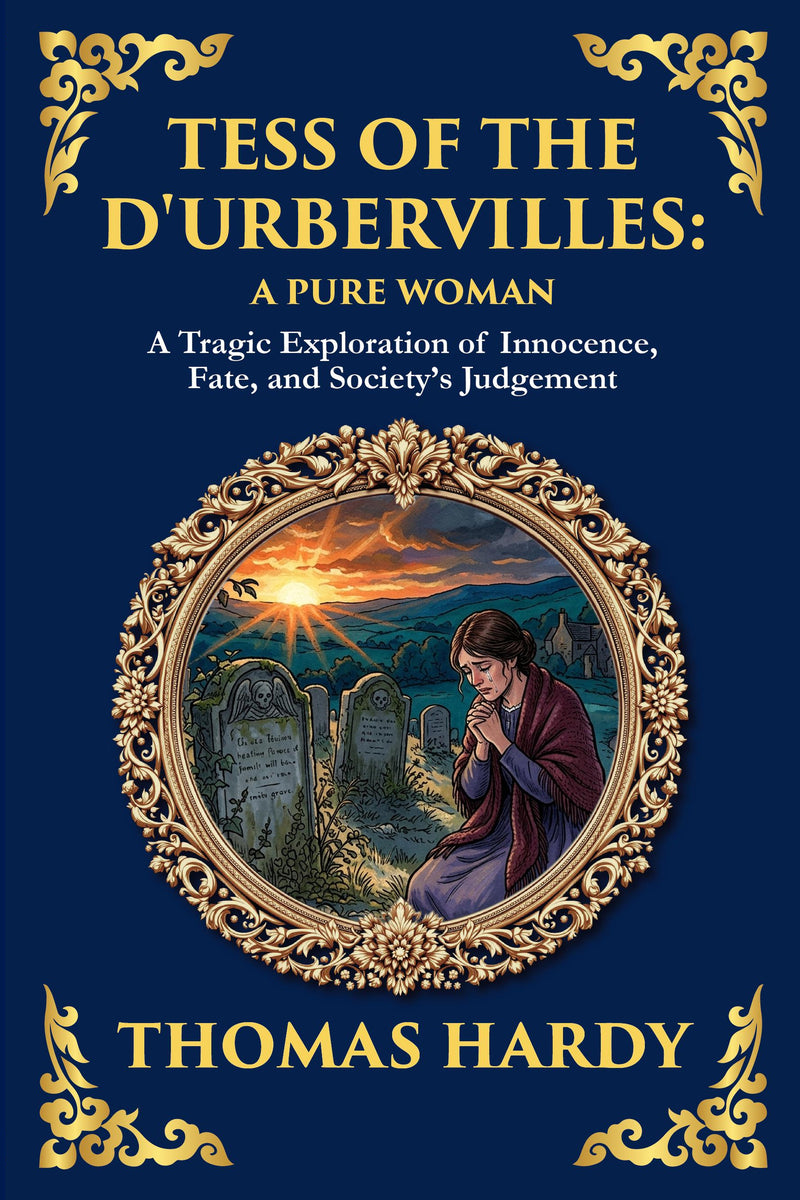
Tess of the d’Urbervilles: A Pure Woman — Large Print
Tess of the d'Urbervilles is Thomas Hardy’s haunting masterpiece of innocence betrayed and virtue condemned. Tess Durbeyfield is a poor country girl whose chance discovery of aristocratic lineage sets in motion a tragic chain of events.
or free app
10,000+ hrs library
30-day guarantee
The complete Tess of the d'Urbervilles: A Pure appears in modern English through Library of Alexandria Press, available online with audiobook narration included for members.
Have you ever wondered why society punishes the innocent more harshly than the guilty? In Tess of the d’Urbervilles, Thomas Hardy delivers one of literature’s most devastating portrayals of a woman trapped between fate and judgment. Published in 1891 to controversy and acclaim, this deeply moving novel remains as relevant today as ever—a piercing exploration of purity, injustice, and resilience.
Tess Durbeyfield is a young woman from a working-class family in rural Wessex. When her family learns of a distant noble ancestry, Tess is sent to seek favor from the wealthy d’Urbervilles—unaware that this journey will mark the beginning of her undoing. Betrayed by Alec d’Urberville, Tess faces a society that blames her for the violence she endures.
Struggling for redemption, she later finds love in Angel Clare, a man torn between idealism and tradition. But even love cannot protect her from the relentless forces of shame, fate, and the unforgiving judgments of others. Hardy’s evocative prose, rich landscapes, and compassionate insight into Tess’s interior life make this novel not just a tragedy—but a fierce plea for empathy, justice, and the recognition of true purity.
What you’ll discover in this modern edition
- A Harrowing Story of Innocence and Injustice – Follow Tess’s emotional journey from hopeful youth to tragic heroine.
| Formats | eBook (EPUB + PDF) · Audiobook · Paperback · Hardcover · Large Print |
| Language | English |
| Trim size (print) | 6 × 9 in |
| Binding | Paperback — perfect-bound · Hardcover — casewrap |
| Large Print edition | Same text in a larger, easy-read type — a larger font, not a larger trim |
| Print pricing | Every physical book at our true cost — at-cost, no profit (members) |
| Library | 873 restored titles, always growing |
| Length | 146,542 words · ~9 hr 46 min reading |
| Reading level | Grade 8 · an easy, flowing read (this modern-English edition) |
| Edition | Modern English translation · 2026 |
Member reviews for this edition are collected as readers finish it — be the first. Across the library: 12,000+ books shipped, every plan covered by a 365-day print guarantee.
About this edition
A faithful, unabridged modern-English edition by The Library of Alexandria — carefully rendered for today's reader and verified paragraph-by-paragraph against the public-domain source. Available as eBook, audiobook, paperback, hardcover, and large print.
- Complete & unabridgedVerified paragraph by paragraph against the source — never a scan, never abridged.
- Modern English, faithfulReadable today, with the author’s meaning kept intact. Readable — not simplified.
- Every format, one membershipRead in your browser or the free app, or listen to the full audiobook.
Included free with your membership
Cancel anytime, one click · 30-day money-back guarantee
Edition last updated July 2026
What’s inside
Tess of the d’Urbervilles: A Pure Woman — Large Print — complete and unabridged: all 60 sections included with membership, plus the full audiobook.
Begin reading Tess of the d’Urbervilles: A Pure Woman — Large Print
In clear modern English — the complete text is included with membership.
Introduction
There are certain novels that arrive in a reader’s life not as mere entertainment but as an experience that lingers, shapes, and occasionally haunts. They are books that, once finished, refuse to release their grip on the imagination, asking questions that have no comfortable answers and depicting human suffering with such tenderness and such fury that we cannot help but feel implicated in the world they describe. Thomas Hardy’s masterpiece, first published in 1891, belongs firmly within this rare company. It is a work of profound moral seriousness, written by a man who looked upon the rigid conventions of his age and refused to accept that they represented justice, decency, or truth. When it first appeared, it scandalized polite society and divided critics; today it stands as one of the most beloved and frequently studied novels in the English language, a story whose emotional power has not dimmed across more than a century of changing tastes and shifting values.
This edition has been prepared as a modern translation, carefully adapted for the contemporary reader. The aim of such an undertaking is not to diminish or simplify the original, nor to strip it of the qualities that have made it endure, but rather to clear away the obstacles that can sometimes stand between a modern audience and the heart of a great Victorian novel. Hardy wrote in a dense, allusive prose, full of regional dialect, classical references, and the rolling cadences of nineteenth-century English. For some readers, these features are part of the pleasure; for others, they can become barriers that obscure the immense human drama unfolding beneath. This adaptation seeks to preserve the soul of the story—its passion, its moral urgency, its aching beauty—while making its language more immediately accessible. The hope is that you will find yourself swept along by the narrative, fully present in its world, and free to give your whole attention to the fate of its unforgettable heroine.
Before you begin, it is worth pausing to consider why this particular novel has earned its place among the great works of world literature, and why its central concerns continue to resonate so powerfully in our own time. For while it is rooted firmly in the agricultural countryside of late-nineteenth-century England—a world of dairy farms and harvest fields, of country roads and village churches—the questions it raises are timeless. What does it mean to be good? Who has the right to judge another human being? How much of our lives is determined by chance, by circumstance, by the accident of where and to whom we are born? And what happens to the innocent when they collide with a society that is quick to condemn and slow to forgive? These are not antique concerns. They are as alive and pressing now as they were when Hardy first set them down, and the reader who approaches this book with an open heart will find that its tragedy speaks directly to the present moment.
To understand the full weight of this story, it helps to imagine the world from which it emerged. The England of Thomas Hardy’s youth and early manhood was a place poised between two ages. The old rural society—deeply traditional, bound by the rhythms of the agricultural year, governed by ancient custom and an almost feudal sense of place—was beginning to crumble under the pressures of industrialization, mechanization, and the great social upheavals of the Victorian century. Railways were stitching the countryside together with the cities. Steam-powered machinery was transforming the labor of the fields. Old families were declining, their names and estates passing into history, while new fortunes rose from commerce and trade. The rural poor, who for generations had lived and worked upon the same land as their ancestors, found themselves increasingly displaced, uprooted, and forced to move in search of work.
Hardy set most of his finest fiction in a semi-fictional region he called Wessex, modeled closely on the real landscape of Dorset and the surrounding counties of southwest England where he was born and spent much of his life. This was no mere backdrop. For Hardy, the land was a living presence, almost a character in its own right—indifferent to human suffering, vast and ancient, beautiful and pitiless by turns. His descriptions of the natural world are among the glories of his writing, and you will find in these pages landscapes rendered with extraordinary vividness: the lush, fertile valley where milk flows and lovers walk, the bleak and stony uplands where the soil yields little and the wind cuts to the bone. These settings are never decorative. They mirror and amplify the inner lives of the characters, and they remind us constantly that human beings are small and fragile creatures moving across an enormous and uncaring world.
Within this changing landscape, Hardy was deeply attentive to the lives of ordinary people—farm laborers, dairymaids, tradesmen, the rural working class whose struggles rarely found their way into the polished drawing-room fiction of his contemporaries. He wrote about these people not with condescension but with genuine respect and profound sympathy, granting them the full dignity of tragic heroes and heroines. In an age that reserved its serious literary attention for the educated and the wealthy, this was itself a quietly revolutionary act. The protagonist of this novel is a young woman of humble origins, and Hardy insists that her inner life—her hopes, her loves, her sufferings—is every bit as worthy of our attention and our compassion as that of any duchess or king.
It is also worth understanding something of the moral and religious atmosphere of the time. Victorian society was governed by an extraordinarily rigid code of sexual morality, particularly where women were concerned. A woman’s “purity”—a word that carried immense and often suffocating weight—was held to be her most precious possession, and its loss, however it came about, could mean permanent ruin: social exclusion, the destruction of marriage prospects, lifelong shame. The standards applied to men were vastly more lenient, a double standard that Hardy found both hypocritical and cruel. The very subtitle of his novel, which boldly proclaimed his heroine to be a “pure woman,” was a deliberate provocation, a challenge flung in the face of conventional morality. Hardy was asking his readers to reconsider their assumptions about innocence and guilt, about who deserves sympathy and who deserves blame. The controversy this caused was enormous; the book was attacked from pulpits and in newspapers, and Hardy was accused of immorality and indecency. Yet he never wavered. He believed that society’s judgments were frequently unjust, that the conventional view of “fallen” women was a moral obscenity, and that true purity was a matter of the heart and spirit rather than of circumstance.
This conviction lies at the very center of the novel, and it is one reason the book retains such power today. We may like to believe that we have moved beyond the harsh and hypocritical moralities of the Victorians, but the impulse to judge, to condemn, to assign blame to victims, to apply different standards to different people—these remain stubbornly with us. Hardy’s great achievement is to make us feel, in our very bones, the injustice of such judgments, and to extend our sympathy toward a character whom the conventional morality of her time would have cast aside without a second thought.
Beyond the social and moral concerns, there runs through the novel a darker and more philosophical current. Hardy was a man troubled by the great questions of his age—questions raised by the advance of science, the decline of traditional religious certainty, and the increasingly mechanistic view of the universe that emerged in the wake of Darwin and the new geology. He did not believe in a benevolent God watching over human affairs and ensuring that the good are rewarded and the wicked punished. Instead, he saw a universe governed by chance, by blind forces, by what he sometimes called the “President of the Immortals”—an indifferent or even malicious fate that toys with human lives. This vision gives his tragedy its particular flavor. The catastrophes that befall his characters are not always the result of their own moral failings; they are often the result of accident, coincidence, bad timing, the cruel intersection of circumstance. A letter slipped under a door but never read. A chance meeting that changes everything. A moment of weakness or misunderstanding from which there is no recovery. Again and again in this novel, we watch as small events spiral outward into enormous consequences, and we are left to contemplate how little control any of us truly has over the shape of our own lives.
This may make the book sound unbearably bleak, and it is true that Hardy does not flinch from depicting suffering. But to read him only as a prophet of despair is to miss something essential. For all the darkness of his vision, Hardy was also a writer of immense tenderness, capable of rendering moments of joy, beauty, and love with breathtaking delicacy. The sections of the novel set in the fertile dairy country, in particular, contain some of the most lyrical and sensuous writing in all of English fiction—passages so alive with the warmth of summer and the stirrings of young love that they seem to glow upon the page. Hardy understood that the depth of a tragedy depends upon the value of what is lost, and so he takes care to show us how much there is to cherish, how much happiness might have been possible, how beautiful life can be even in the shadow of its inevitable sorrows. The result is a novel that breaks the heart precisely because it has first taught us to love.
At the center of this story stands one of the most fully realized and deeply moving characters in all of literature. Hardy lavished upon his heroine an attention and a sympathy so complete that readers across generations have felt they truly knew her—have wept for her, raged on her behalf, and carried her with them long after the final page. She is a young woman of remarkable inner richness: sensitive, intelligent, capable of great love and great loyalty, possessed of a natural dignity that no misfortune can entirely extinguish. She is also, crucially, a figure of profound innocence—not in the sense of being naïve or simple, but in the deeper sense of being fundamentally good-hearted, free of malice, undeserving of the troubles that gather around her.
What makes her so compelling is the way Hardy refuses to reduce her to a symbol or a type. She is not merely a passive victim, though terrible things happen to her, nor is she an idealized saint, though she possesses great virtues. She is a living, breathing individual, full of contradictions and complexities, capable of error and self-deception as well as nobility and courage. We watch her grow and change across the course of the novel, hardened by experience yet never wholly losing her essential tenderness. We share her moments of hope and her descents into despair. We come to understand her so intimately that her fate feels like the fate of someone we love.
Around her, Hardy places a cast of characters who embody the various forces and temptations that shape her destiny. There are the men whose paths cross hers—each rendered with psychological depth, each neither wholly good nor wholly bad, each contributing in his own way to the unfolding drama. Hardy is particularly acute in his portrayal of the gap between what people believe themselves to be and how they actually behave, between their professed ideals and their real conduct under pressure. He shows us how even those who genuinely love can wound most deeply, how high principles can become instruments of cruelty, how the inability to live up to one’s own moral standards can prove as destructive as outright villainy. These are not cardboard figures but complicated human beings, and part of the novel’s enduring power lies in its refusal to offer us easy heroes and villains.
Cancel anytime, one click · 30-day money-back guarantee
Founding annual rate available now — your price locks for life when you join.
Not ready? Get this free chapter by email — read it anytime.
✓ Sent — check your inbox for Tess of the d’Urbervilles: A Pure Woman — Large Print.
Questions about Tess of the d’Urbervilles: A Pure Woman — Large Print
What is Tess of the d'Urbervilles: A Pure about?
Tess of the d'Urbervilles is Thomas Hardy’s haunting masterpiece of innocence betrayed and virtue condemned. Tess Durbeyfield is a poor country girl whose chance discovery of aristocratic lineage sets in motion a tragic chain of events. Entrapped by social expectations, manipulated by predatory men, and burdened by the weight of moral judgment, Tess becomes both a symbol of purity and a victim of hypocrisy.
Who wrote Tess of the d'Urbervilles: A Pure?
Tess of the d'Urbervilles: A Pure was written by Thomas Hardy. This edition presents the complete work in clear modern English, faithfully rendered from the public-domain original by Library of Alexandria Press.
Is Tess of the d'Urbervilles: A Pure free to read?
The opening chapter is free to read on this page. Members read and listen to the complete work — and the entire library — free, and can order any physical book at our true print cost.
How long is Tess of the d'Urbervilles: A Pure?
60 chapters (~146,542 words) — about 9 hr 46 min of reading in this modern-English edition.
Is this an abridged version of Tess of the d'Urbervilles: A Pure?
No. This is the complete, unabridged Tess of the d'Urbervilles: A Pure, carefully rendered into clear modern English and verified paragraph-by-paragraph against the public-domain source — nothing is cut or summarised.
What formats does Tess of the d'Urbervilles: A Pure come in?
Tess of the d'Urbervilles: A Pure is available as eBook, paperback, hardcover and large print. eBook and audiobook are included with membership; printed editions ship at our true print cost.
Shipping & returns
Billing & membership
More from the library


Explore Children's Classics
- Peter and Wendy · J. M. Barrie
- Jack and Jill · Louisa May Alcott
- The Wonderful Wizard of Oz · L. Frank Baum
- Anne of Green Gables · L. M. Montgomery
- The Secret Garden · Frances Hodgson Burnett
- The Tale of Peter Rabbit · Beatrix Potter
- Peter Pan · J. M. Barrie
- The Prince and the Pauper · Mark Twain
- The Red Fairy Book · Andrew Lang
- Old Christmas: from the Sketch Book of Washington Irving · Washington Irving
- A Houseful of Girls · Sarah Tytler
- In the hollow of His hand · Hesba Stretton
- Miss Primrose · Agnes Giberne
- Five Little Peppers and How They Grew · Margaret Sidney
- The Loss of the Swansea: A Story of the Florida Coast · W. L. Alden
- Sky Island · L. Frank Baum
- The Book of Dragons · E. Nesbit
- Wild Animals I Have Known · Ernest Thompson Seton
- Skinny McCord · Percy Keese Fitzhugh
- The Hunniwell Boys and the Platinum Mystery · L. P. Wyman
- Rainbow Valley · L. M. Montgomery
- "Us and Our Donkey" · Amy Le Feuvre
- Dorothy and the Wizard in Oz · L. Frank Baum
- The Home Book of Verse — Volume 4 · Burton Egbert Stevenson
- The Story of Doctor Dolittle · Hugh Lofting
- The Tale of Benjamin Bunny · Beatrix Potter
- Fifty Famous Stories Retold · James Baldwin
- Rilla of Ingleside · L. M. Montgomery
- The House at Pooh Corner · A. A. Milne
- Rich and Humble: A Story for Young People · Oliver Optic
Tess of the d’Urbervilles: A Pure Woman — Large Print
Tess of the d’Urbervilles: A Pure Woman — Large Print
A Tragic Exploration of Innocence, Fate, and Society’s Judgement
Thomas Hardy
Contents
- Introduction
- Explanatory Note to the First Edition
- Author’s Preface to the Fifth and Later Editions
- Chapter 1
- Chapter 2
- Chapter 3
- Chapter 4
- Chapter 5
- Chapter 6
- Chapter 7
- Chapter 8
- Chapter 9
- Chapter 10
- Chapter 11
- Chapter 12
- Chapter 13
- Chapter 14
- Chapter 15
- Chapter 16
- Chapter 17
- Chapter 18
- Chapter 19
- Chapter 20
- Chapter 21
- Chapter 22
- Chapter 23
- Chapter 24
- Chapter 25
- Chapter 26
- Chapter 27
- Chapter 28
- Chapter 29
- Chapter 30
- Chapter 31
- Chapter 32
- Chapter 33
- Chapter 34
- Chapter 35
- Chapter 36
- Chapter 37
- … and 20 more chapters
Introduction
There are certain novels that arrive in a reader’s life not as mere entertainment but as an experience that lingers, shapes, and occasionally haunts. They are books that, once finished, refuse to release their grip on the imagination, asking questions that have no comfortable answers and depicting human suffering with such tenderness and such fury that we cannot help but feel implicated in the world they describe. Thomas Hardy’s masterpiece, first published in 1891, belongs firmly within this rare company. It is a work of profound moral seriousness, written by a man who looked upon the rigid conventions of his age and refused to accept that they represented justice, decency, or truth. When it first appeared, it scandalized polite society and divided critics; today it stands as one of the most beloved and frequently studied novels in the English language, a story whose emotional power has not dimmed across more than a century of changing tastes and shifting values.
This edition has been prepared as a modern translation, carefully adapted for the contemporary reader. The aim of such an undertaking is not to diminish or simplify the original, nor to strip it of the qualities that have made it endure, but rather to clear away the obstacles that can sometimes stand between a modern audience and the heart of a great Victorian novel. Hardy wrote in a dense, allusive prose, full of regional dialect, classical references, and the rolling cadences of nineteenth-century English. For some readers, these features are part of the pleasure; for others, they can become barriers that obscure the immense human drama unfolding beneath. This adaptation seeks to preserve the soul of the story—its passion, its moral urgency, its aching beauty—while making its language more immediately accessible. The hope is that you will find yourself swept along by the narrative, fully present in its world, and free to give your whole attention to the fate of its unforgettable heroine.
Before you begin, it is worth pausing to consider why this particular novel has earned its place among the great works of world literature, and why its central concerns continue to resonate so powerfully in our own time. For while it is rooted firmly in the agricultural countryside of late-nineteenth-century England—a world of dairy farms and harvest fields, of country roads and village churches—the questions it raises are timeless. What does it mean to be good? Who has the right to judge another human being? How much of our lives is determined by chance, by circumstance, by the accident of where and to whom we are born? And what happens to the innocent when they collide with a society that is quick to condemn and slow to forgive? These are not antique concerns. They are as alive and pressing now as they were when Hardy first set them down, and the reader who approaches this book with an open heart will find that its tragedy speaks directly to the present moment.
To understand the full weight of this story, it helps to imagine the world from which it emerged. The England of Thomas Hardy’s youth and early manhood was a place poised between two ages. The old rural society—deeply traditional, bound by the rhythms of the agricultural year, governed by ancient custom and an almost feudal sense of place—was beginning to crumble under the pressures of industrialization, mechanization, and the great social upheavals of the Victorian century. Railways were stitching the countryside together with the cities. Steam-powered machinery was transforming the labor of the fields. Old families were declining, their names and estates passing into history, while new fortunes rose from commerce and trade. The rural poor, who for generations had lived and worked upon the same land as their ancestors, found themselves increasingly displaced, uprooted, and forced to move in search of work.
Hardy set most of his finest fiction in a semi-fictional region he called Wessex, modeled closely on the real landscape of Dorset and the surrounding counties of southwest England where he was born and spent much of his life. This was no mere backdrop. For Hardy, the land was a living presence, almost a character in its own right—indifferent to human suffering, vast and ancient, beautiful and pitiless by turns. His descriptions of the natural world are among the glories of his writing, and you will find in these pages landscapes rendered with extraordinary vividness: the lush, fertile valley where milk flows and lovers walk, the bleak and stony uplands where the soil yields little and the wind cuts to the bone. These settings are never decorative. They mirror and amplify the inner lives of the characters, and they remind us constantly that human beings are small and fragile creatures moving across an enormous and uncaring world.
Within this changing landscape, Hardy was deeply attentive to the lives of ordinary people—farm laborers, dairymaids, tradesmen, the rural working class whose struggles rarely found their way into the polished drawing-room fiction of his contemporaries. He wrote about these people not with condescension but with genuine respect and profound sympathy, granting them the full dignity of tragic heroes and heroines. In an age that reserved its serious literary attention for the educated and the wealthy, this was itself a quietly revolutionary act. The protagonist of this novel is a young woman of humble origins, and Hardy insists that her inner life—her hopes, her loves, her sufferings—is every bit as worthy of our attention and our compassion as that of any duchess or king.
It is also worth understanding something of the moral and religious atmosphere of the time. Victorian society was governed by an extraordinarily rigid code of sexual morality, particularly where women were concerned. A woman’s “purity”—a word that carried immense and often suffocating weight—was held to be her most precious possession, and its loss, however it came about, could mean permanent ruin: social exclusion, the destruction of marriage prospects, lifelong shame. The standards applied to men were vastly more lenient, a double standard that Hardy found both hypocritical and cruel. The very subtitle of his novel, which boldly proclaimed his heroine to be a “pure woman,” was a deliberate provocation, a challenge flung in the face of conventional morality. Hardy was asking his readers to reconsider their assumptions about innocence and guilt, about who deserves sympathy and who deserves blame. The controversy this caused was enormous; the book was attacked from pulpits and in newspapers, and Hardy was accused of immorality and indecency. Yet he never wavered. He believed that society’s judgments were frequently unjust, that the conventional view of “fallen” women was a moral obscenity, and that true purity was a matter of the heart and spirit rather than of circumstance.
This conviction lies at the very center of the novel, and it is one reason the book retains such power today. We may like to believe that we have moved beyond the harsh and hypocritical moralities of the Victorians, but the impulse to judge, to condemn, to assign blame to victims, to apply different standards to different people—these remain stubbornly with us. Hardy’s great achievement is to make us feel, in our very bones, the injustice of such judgments, and to extend our sympathy toward a character whom the conventional morality of her time would have cast aside without a second thought.
Beyond the social and moral concerns, there runs through the novel a darker and more philosophical current. Hardy was a man troubled by the great questions of his age—questions raised by the advance of science, the decline of traditional religious certainty, and the increasingly mechanistic view of the universe that emerged in the wake of Darwin and the new geology. He did not believe in a benevolent God watching over human affairs and ensuring that the good are rewarded and the wicked punished. Instead, he saw a universe governed by chance, by blind forces, by what he sometimes called the “President of the Immortals”—an indifferent or even malicious fate that toys with human lives. This vision gives his tragedy its particular flavor. The catastrophes that befall his characters are not always the result of their own moral failings; they are often the result of accident, coincidence, bad timing, the cruel intersection of circumstance. A letter slipped under a door but never read. A chance meeting that changes everything. A moment of weakness or misunderstanding from which there is no recovery. Again and again in this novel, we watch as small events spiral outward into enormous consequences, and we are left to contemplate how little control any of us truly has over the shape of our own lives.
This may make the book sound unbearably bleak, and it is true that Hardy does not flinch from depicting suffering. But to read him only as a prophet of despair is to miss something essential. For all the darkness of his vision, Hardy was also a writer of immense tenderness, capable of rendering moments of joy, beauty, and love with breathtaking delicacy. The sections of the novel set in the fertile dairy country, in particular, contain some of the most lyrical and sensuous writing in all of English fiction—passages so alive with the warmth of summer and the stirrings of young love that they seem to glow upon the page. Hardy understood that the depth of a tragedy depends upon the value of what is lost, and so he takes care to show us how much there is to cherish, how much happiness might have been possible, how beautiful life can be even in the shadow of its inevitable sorrows. The result is a novel that breaks the heart precisely because it has first taught us to love.
At the center of this story stands one of the most fully realized and deeply moving characters in all of literature. Hardy lavished upon his heroine an attention and a sympathy so complete that readers across generations have felt they truly knew her—have wept for her, raged on her behalf, and carried her with them long after the final page. She is a young woman of remarkable inner richness: sensitive, intelligent, capable of great love and great loyalty, possessed of a natural dignity that no misfortune can entirely extinguish. She is also, crucially, a figure of profound innocence—not in the sense of being naïve or simple, but in the deeper sense of being fundamentally good-hearted, free of malice, undeserving of the troubles that gather around her.
What makes her so compelling is the way Hardy refuses to reduce her to a symbol or a type. She is not merely a passive victim, though terrible things happen to her, nor is she an idealized saint, though she possesses great virtues. She is a living, breathing individual, full of contradictions and complexities, capable of error and self-deception as well as nobility and courage. We watch her grow and change across the course of the novel, hardened by experience yet never wholly losing her essential tenderness. We share her moments of hope and her descents into despair. We come to understand her so intimately that her fate feels like the fate of someone we love.
Around her, Hardy places a cast of characters who embody the various forces and temptations that shape her destiny. There are the men whose paths cross hers—each rendered with psychological depth, each neither wholly good nor wholly bad, each contributing in his own way to the unfolding drama. Hardy is particularly acute in his portrayal of the gap between what people believe themselves to be and how they actually behave, between their professed ideals and their real conduct under pressure. He shows us how even those who genuinely love can wound most deeply, how high principles can become instruments of cruelty, how the inability to live up to one’s own moral standards can prove as destructive as outright villainy. These are not cardboard figures but complicated human beings, and part of the novel’s enduring power lies in its refusal to offer us easy heroes and villains.
In this novel, the heroine’s main struggle begins after an event that usually would have ended her role as the lead character, or at least crushed her hopes and ambitions. According to the accepted rules of storytelling, it was unexpected that the public would welcome the book and agree with me that fiction can offer more than just a gloomy look at a well-known tragedy. However, the warm response Tess of the d’Urbervilles received from readers in England and America seems to prove that writing a story based on what people actually believe, rather than following society’s formal rules, is not a mistake—even in a work as imperfect as this one. I cannot help but express my gratitude for this response. My only regret is that in a world where people often long for friendship, and where simply not being misunderstood feels like a kindness, I will never get to meet and shake hands with these appreciative readers.
I include in this group the reviewers—the vast majority of whom so generously welcomed the story. Their comments show that they, like the readers, used their own imagination to fill in the gaps where my storytelling was lacking.
Even so, although I didn’t intend for the novel to be a lesson or an attack—wanting the scenes to be simple representations and the reflections to be based more on feelings than firm beliefs—some people have objected to both the subject matter and the way it was written.
The more strict critics disagree on what subjects are appropriate for art. They seem unable to connect the adjective in the subtitle to anything other than the artificial meaning created by the rules of civilization. They ignore how the word is used in Nature, as well as its artistic value and the spiritual meaning found in the best parts of their own Christianity. Others disagree simply because they believe the novel reflects the views of the late nineteenth century rather than those of an earlier, simpler generation—a claim I hope is true. Let me repeat: a novel is an impression, not an argument, and that is the end of it. This reminds me of a passage in Schiller’s letters to Goethe regarding these kinds of critics: “They are people who look only for their own ideas in a work of art, and value what ‘should be’ more than what ‘is.’ Therefore, the disagreement starts at the most basic level, and it is impossible to reach an understanding with them.” He also wrote: “As soon as I notice that someone, when judging poetry, considers anything more important than inner Necessity and Truth, I am done with them.”
End of the free sample
Keep reading, free
Members read and listen to the complete book — and the entire library. Cancel anytime, one click · 30-day money-back guarantee.