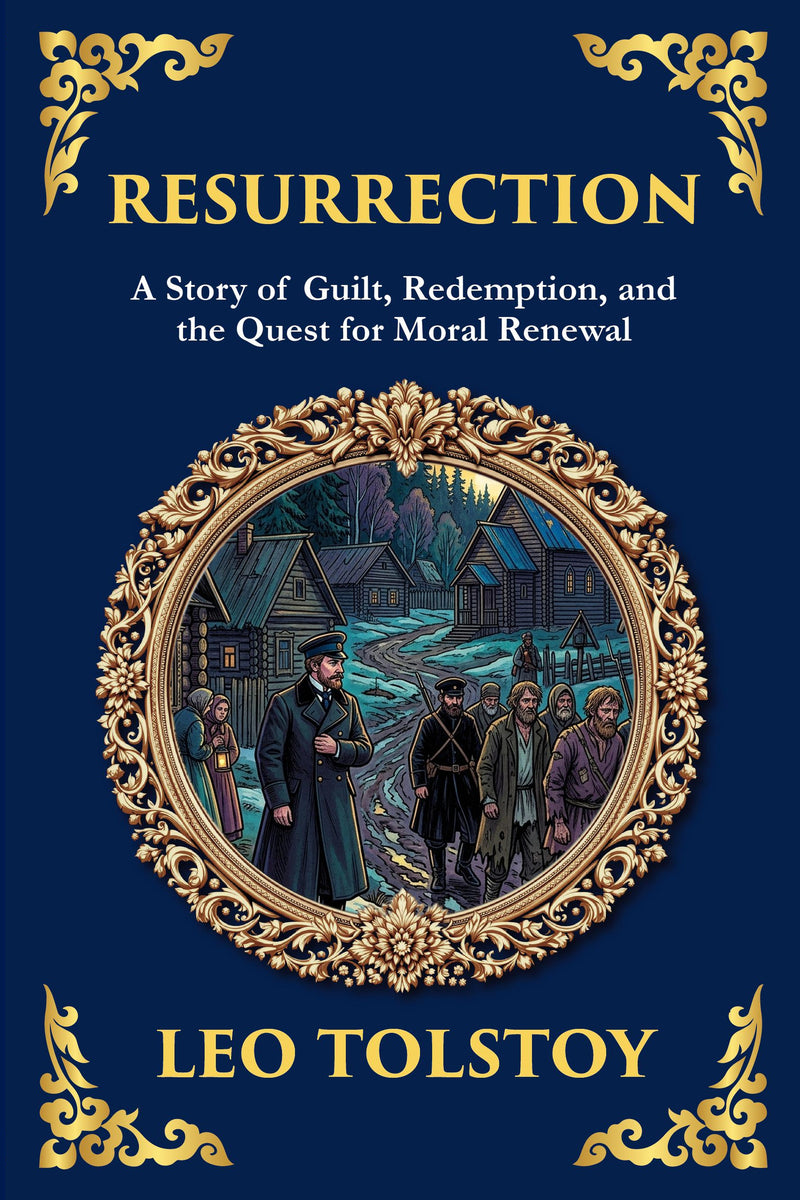
Resurrection — Large Print
A prince. A prisoner. A reckoning. When nobleman Dmitri Ivanovich Nekhlyudov is summoned for jury duty, he comes face to face with a woman he once seduced and abandoned—Katyusha Maslova, now on trial for murder.
or free app
10,000+ hrs library
30-day guarantee
The complete Resurrection appears in modern English through Library of Alexandria Press, available online with audiobook narration included for members.
Have you ever wondered why true redemption begins with confronting the truth? Resurrection, Leo Tolstoy’s last novel, is a searing exposé of injustice and spiritual decay—and one man’s attempt to redeem himself in a world that has lost its moral compass. More than a century after its publication, this powerful story of conscience and transformation remains as urgent and relevant as ever.
Dmitri Ivanovich Nekhlyudov, a Russian aristocrat, is haunted by the memory of seducing and abandoning a young servant girl, Katyusha Maslova. When he encounters her years later as a prisoner on trial, her life in ruins, he is overcome with remorse. What follows is not just a quest to help her—but a brutal examination of himself, of the legal system, and of the spiritual emptiness of the privileged class.
Through a raw, unflinching lens, Tolstoy explores themes of guilt, justice, spiritual renewal, and the stark divide between the powerful and the powerless. As Nekhlyudov’s journey takes him from courtrooms to prisons to the Siberian wilderness, he is forced to abandon comfort for truth —and illusion for compassion.
What you’ll discover in this modern edition
- A Tragic Tale of Love and Guilt – Experience the fateful reunion between a fallen nobleman and the woman he wronged.
- A Scathing Critique of Social Hypocrisy – Witness Tolstoy’s bold condemnation of the courts, the church, and class injustice.
- A Profound Spiritual Awakening – Follow Nekhlyudov’s evolution from self-centered aristocrat to morally conscious seeker.
- A Timeless Reflection on Redemption – Explore universal questions of forgiveness, personal responsibility, and human dignity.
- A Modern, Accessible Translation – Faithfully rendered for today’s readers, preserving Tolstoy’s intensity, clarity, and spiritual depth.
| Formats | eBook (EPUB + PDF) · Audiobook · Paperback · Hardcover · Large Print |
| Language | English |
| Trim size (print) | 6 × 9 in |
| Binding | Paperback — perfect-bound · Hardcover — casewrap |
| Large Print edition | Same text in a larger, easy-read type — a larger font, not a larger trim |
| Print pricing | Every physical book at our true cost — at-cost, no profit (members) |
| Library | 873 restored titles, always growing |
| Length | 162,220 words · ~10 hr 49 min reading |
| Reading level | Grade 9 · a comfortable read (this modern-English edition) |
| Edition | Modern English translation · 2026 |
Member reviews for this edition are collected as readers finish it — be the first. Across the library: 12,000+ books shipped, every plan covered by a 365-day print guarantee.
About this edition
A faithful, unabridged modern-English edition by The Library of Alexandria — carefully rendered for today's reader and verified paragraph-by-paragraph against the public-domain source. Available as eBook, audiobook, paperback, hardcover, and large print.
- Complete & unabridgedVerified paragraph by paragraph against the source — never a scan, never abridged.
- Modern English, faithfulReadable today, with the author’s meaning kept intact. Readable — not simplified.
- Every format, one membershipRead in your browser or the free app, or listen to the full audiobook.
Included free with your membership
Cancel anytime, one click · 30-day money-back guarantee
Edition last updated July 2026
What’s inside
Resurrection — Large Print — complete and unabridged: all 60 sections included with membership, plus the full audiobook.
Begin reading Resurrection — Large Print
In clear modern English — the complete text is included with membership.
Introduction
There is a moment near the beginning of this novel when a young woman named Katyusha Maslova walks out of a prison cell into a corridor that smells of typhoid and tar, steps into the thin April sunlight, and notices a pigeon. The bird flutters up from the cobblestones and fans her cheek with its wing. She smiles, then sighs, then remembers something the reader does not yet know. It is a tiny moment, almost nothing — a woman, a bird, a breath of spring air — and yet it contains the entire moral architecture of what Leo Tolstoy spent the last years of the nineteenth century building. That sigh, that half-remembered thing, that involuntary smile in the middle of misery: this is the territory the novel will inhabit for the next several hundred pages, and it is territory that no other writer of Tolstoy’s era, and very few since, has mapped with such ferocious honesty and such unexpected tenderness.
Resurrection was published in 1899, when Tolstoy was seventy-one years old. He had already written War and Peace and Anna Karenina. He had already undergone the spiritual crisis he described in A Confession, the crisis that convinced him organized religion was a fraud, private property was theft, and the Russian state was a machine for manufacturing human suffering. He had already alienated the Orthodox Church, which would formally excommunicate him two years after this novel appeared. He had already become, in the eyes of much of the world, not merely a novelist but a prophet — inconvenient, infuriating, impossible to ignore. By the time he sat down to complete this book, he had been working on it, on and off, for nearly a decade, and he brought to it everything he had learned about human beings, everything he had come to believe about God and conscience and the criminal absurdity of the social order, and everything he knew — which was considerable — about the specific textures of Russian aristocratic life, Russian peasant life, Russian prison life, and the long, frozen roads to Siberia.
The result is a novel unlike anything else in his body of work, and unlike almost anything else in the literature of its century. It is at once a love story and a legal thriller, a spiritual autobiography and a work of savage social criticism, a journey narrative and a meditation on guilt so searching that it can make the reader feel personally implicated in events that took place in a country that no longer exists. It is also, despite all of this, compulsively readable — driven by a plot that moves with the momentum of a criminal trial, a prison sentence, and a march across a continent, and animated by characters so fully realized that they seem to breathe on the page.
The novel grew from a true story, as Louise Maude notes in her translator’s preface to the original English edition. A lawyer acquaintance of Tolstoy’s described to him a case in which a juror recognized, in the dock, a woman he had seduced and abandoned years before. That seed of a story — the collision between a man’s comfortable present and his buried past, mediated by the machinery of a court of law — was exactly the kind of moral situation Tolstoy found irresistible. It gave him a structure in which the personal and the political could not be separated, in which a single act of private cruelty ramified outward into an indictment of an entire civilization.
The man at the center of the novel is Prince Dmitri Ivanovich Nekhludoff, a landowner and man of leisure in his thirties, the kind of educated, well-meaning, vaguely dissatisfied Russian aristocrat who appears throughout nineteenth-century Russian fiction as a type — the superfluous man, the man who thinks too much and does too little. When we first meet him, he is preparing to serve on a jury, a civic duty he regards with mild irritation. He is also, in a quiet way, at a crossroads: he is considering a socially advantageous marriage, he is managing his inherited estates with the comfortable inattention of a man who has never had to think seriously about where his money comes from, and he is living, in short, the life of a man who has successfully insulated himself from the consequences of his own choices.
The trial changes everything. The woman in the dock — charged with poisoning a merchant, a crime whose details emerge slowly and with considerable moral complexity — is Katyusha Maslova, and Nekhludoff knows her. He knew her, rather, a long time ago, in a different life, when she was a young ward in the household of his aunts, and he was a young man who believed himself to be in love with her, and then, later, when he was a young officer who had stopped believing in love and acted accordingly. What he did to her, and what became of her afterward, is the buried history that the novel gradually excavates, and it is a history that implicates not just Nekhludoff personally but the entire system of class and gender and legal power that made what he did possible and what happened to her inevitable.
The jury returns a verdict that is, through a procedural error partly attributable to Nekhludoff’s own distraction, unjustly severe. Maslova is sentenced to hard labor in Siberia. And Nekhludoff, sitting in the courtroom, feels something shift inside him — not immediately, not cleanly, but with the grinding, reluctant movement of a man who has been asleep for years and is beginning, against his will, to wake up. The novel that follows is the story of that waking: what it costs, what it requires, what it destroys, and what, if anything, it makes possible.
To call this a story of redemption would be both accurate and misleading. Tolstoy was too honest a writer, and too suspicious of easy consolation, to offer anything as tidy as redemption. What he offers instead is something harder and more interesting: the story of a man attempting to take genuine moral responsibility for his actions in a world that is structurally organized to make such responsibility unnecessary, and the story of a woman who must decide, on her own terms, what she makes of that attempt. Maslova is not a passive object of Nekhludoff’s conscience. She is one of the most fully realized female characters in nineteenth-century fiction — proud, damaged, funny, suspicious, capable of both cruelty and extraordinary grace — and the novel’s moral center of gravity shifts, as it progresses, increasingly toward her.
Tolstoy makes demands on his readers, and it is worth being honest about that before you begin. This is not a novel that flatters you or lets you off the hook. It is a novel that will, at various points, interrupt its own narrative momentum to deliver extended meditations on land reform, the theology of the Orthodox Church, the philosophy of criminal punishment, the economics of peasant serfdom, and the spiritual teachings of the Gospels. Some readers, encountering these passages for the first time, feel ambushed. They were following a story, and suddenly they are reading an essay. This is a reasonable reaction, and it is worth knowing in advance that it will happen, so that when it does, you can receive it as part of the experience rather than as an interruption of it.
The key is to understand what Tolstoy is doing structurally. He is not inserting his opinions into a novel that would be better without them. He is writing a novel in which the gap between how the world is described officially — by courts, by churches, by governments, by polite society — and how it actually functions is itself the subject. The essayistic passages are not digressions; they are the moments when Nekhludoff, or Tolstoy, or both simultaneously, refuses to let the narrative machinery of fiction smooth over what is actually happening. When a man is flogged in prison, Tolstoy does not just describe the flogging and move on. He stops and asks, with genuine fury, what kind of civilization produces this, and what kind of moral logic sustains it. These interruptions are, in their way, as formally radical as anything in modernist fiction — they are the novel refusing to aestheticize suffering, refusing to make horror beautiful and therefore bearable.
So the first piece of advice for reading this book is: do not resist the essays. Read them as you would read a letter from someone who is very angry and very intelligent and has thought about these things for a long time. You do not have to agree with everything Tolstoy says — he would probably be suspicious of a reader who agreed with everything — but you should engage with it, argue with it if you like, and let it complicate your experience of the story you are reading alongside it.
The second piece of advice is to pay attention to the minor characters. Tolstoy peoples this novel with an extraordinary gallery of human beings who appear briefly and then vanish: a prison warden who is neither villain nor hero but simply a man doing a job; a senator who is charming at dinner and monstrous in his official capacity; a revolutionary who has thought more carefully about justice than almost anyone else in the book and whose conclusions are not Tolstoy’s own. These figures are not merely background. They are the novel’s argument made flesh — the argument that the system Tolstoy is attacking is not maintained by monsters but by ordinary people, people who are kind to their families and cruel in their offices, people who have simply never been forced to look directly at what they are part of. Nekhludoff’s journey forces him to look. The minor characters are the people who have not yet been forced, or who have been forced and looked away.
The third piece of advice is to read slowly enough to notice the prose. Even in translation, and this Library of Alexandria Press edition has been prepared with scrupulous attention to rendering Tolstoy’s rhythms in contemporary English that neither archaizes nor modernizes, there is a quality to the writing that rewards attention. The famous opening pages, in which spring asserts itself over the stones and smoke of a city, and the narrator observes that the plants and birds and insects are all glad while the grown men and women continue to torment themselves and each other, establish in a few paragraphs the novel’s entire moral and aesthetic program. Nature, in this book, is not backdrop. It is a standard against which human behavior is measured and found wanting, and it recurs throughout — in the smell of fresh air that reaches even into prison corridors, in the pigeons on the cobblestones, in the vast Siberian landscape through which the convict columns march — as a reminder of what human beings are capable of feeling when they are not busy organizing systems of oppression.
To read this novel well, it helps to have some sense of the Russia it describes, though Tolstoy is a generous enough writer that ignorance of the historical context is never a fatal handicap. The Russia of the 1890s was a country under enormous pressure. The emancipation of the serfs in 1861 had transformed the legal status of the peasantry without transforming the economic realities that kept them poor and dependent. The industrialization of the cities was creating new forms of misery to replace the old ones. The tsarist state maintained its authority through a combination of bureaucratic inertia, official religion, and the systematic use of exile and imprisonment against anyone who questioned the arrangement too loudly. The revolutionary movements that would eventually produce 1917 were already active, and the novel’s third book, set largely among political prisoners being marched to Siberia, gives Tolstoy the opportunity to examine the various strands of radical thought with the same unflinching honesty he brings to everything else — admiring the courage of the revolutionaries while remaining skeptical of their programs, and reserving his deepest sympathy for the people who have been ground up by the system regardless of their political opinions.
The legal system that opens the novel is depicted with a precision that suggests Tolstoy had studied it carefully and found it, at every level, a mechanism for producing injustice while maintaining the appearance of procedure. The judges are distracted, the advocates are cynical, the jury is confused, and the whole apparatus moves forward with the terrible momentum of a machine that has been running so long that no one remembers why it was built or what it was supposed to accomplish. This is not caricature. Tolstoy is too good a novelist for caricature. The judges are not evil men; they are tired men, men with domestic concerns and professional ambitions and the mild moral numbness that comes from spending years in a system that rewards the smooth processing of human beings over the careful consideration of their individual cases. The horror is not that the system is run by monsters. The horror is that it is run by people very much like us.
Cancel anytime, one click · 30-day money-back guarantee
Founding annual rate available now — your price locks for life when you join.
Not ready? Get this free chapter by email — read it anytime.
✓ Sent — check your inbox for Resurrection — Large Print.
Questions about Resurrection — Large Print
Who wrote Resurrection?
Resurrection was written by Leo Tolstoy. This edition presents the complete work in clear modern English, faithfully rendered from the public-domain original by Library of Alexandria Press.
Is Resurrection free to read?
The opening chapter is free to read on this page. Members read and listen to the complete work — and the entire library — free, and can order any physical book at our true print cost.
How long is Resurrection?
60 chapters (~162,220 words) — about 10 hr 49 min of reading in this modern-English edition.
Is this an abridged version of Resurrection?
No. This is the complete, unabridged Resurrection, carefully rendered into clear modern English and verified paragraph-by-paragraph against the public-domain source — nothing is cut or summarised.
What formats does Resurrection come in?
Resurrection is available as eBook, paperback and hardcover. eBook and audiobook are included with membership; printed editions ship at our true print cost.
Shipping & returns
Billing & membership
More from the library


Explore Mystery & Crime
- Resurrection · Leo Tolstoy
- Crime and Punishment · Fyodor Dostoyevsky
- The Strange Case of Dr. Jekyll and Mr. Hyde · Robert Louis Stevenson
- The Riddle of the Sands · Erskine Childers
- The Wisdom of Father Brown · G. K. Chesterton
- The Cask of Amontillado · Edgar Allan Poe
- The Tomb of Ts’in · Edgar Wallace
- Ghost Stories of an Antiquary · M. R. James
- The Hunniwell Boys and the Platinum Mystery · L. P. Wyman
- The Seven Dials Mystery · Agatha Christie
- The Thirty-Nine Steps · John Buchan
- The Hand in the Dark · Arthur J. Rees
- Lady Audley’s Secret · M. E. Braddon
- The Mystery of the Blue Train · Agatha Christie
- The Secret Adversary · Agatha Christie
- The Call of Cthulhu · H. P. Lovecraft
- The Adventures of Heine · Edgar Wallace
- The Valley of Fear · Arthur Conan Doyle
- The Innocence of Father Brown · G. K. Chesterton
- McTeague: A Story of San Francisco · Frank Norris
- Tess of the d’Urbervilles: A Pure Woman · Thomas Hardy
- The Big Fix · George O. Smith
- The Ambulance Made Two Trips · Murray Leinster
- Time Crime · H. Beam Piper
- The Misplaced Battleship · Harry Harrison
- Supermind · Randall Garrett and Laurence M....
- Lone Star Planet · H. Beam Piper and John J. McGuire
- Dracula · Bram Stoker
- The Murder on the Links · Agatha Christie
- The Hound of the Baskervilles · Arthur Conan Doyle
Resurrection — Large Print
Resurrection — Large Print
A Modern Translation
Leo Tolstoy
Contents
- Introduction
- Chapter 1
- Chapter 2
- Chapter 3
- Chapter 4
- Chapter 5
- Chapter 6
- Chapter 7
- Chapter 8
- Chapter 9
- Chapter 10
- Chapter 11
- Chapter 12
- Chapter 13
- Chapter 14
- Chapter 15
- Chapter 16
- Chapter 17
- Chapter 18
- Chapter 19
- Chapter 20
- Chapter 21
- Chapter 22
- Chapter 23
- Chapter 24
- Chapter 25
- Chapter 26
- Chapter 27
- Chapter 28
- Chapter 29
- Chapter 30
- Chapter 31
- Chapter 32
- Chapter 33
- Chapter 34
- Chapter 35
- Chapter 36
- Chapter 37
- Chapter 38
- Chapter 39
- … and 20 more chapters
Introduction
There is a moment near the beginning of this novel when a young woman named Katyusha Maslova walks out of a prison cell into a corridor that smells of typhoid and tar, steps into the thin April sunlight, and notices a pigeon. The bird flutters up from the cobblestones and fans her cheek with its wing. She smiles, then sighs, then remembers something the reader does not yet know. It is a tiny moment, almost nothing — a woman, a bird, a breath of spring air — and yet it contains the entire moral architecture of what Leo Tolstoy spent the last years of the nineteenth century building. That sigh, that half-remembered thing, that involuntary smile in the middle of misery: this is the territory the novel will inhabit for the next several hundred pages, and it is territory that no other writer of Tolstoy’s era, and very few since, has mapped with such ferocious honesty and such unexpected tenderness.
Resurrection was published in 1899, when Tolstoy was seventy-one years old. He had already written War and Peace and Anna Karenina. He had already undergone the spiritual crisis he described in A Confession, the crisis that convinced him organized religion was a fraud, private property was theft, and the Russian state was a machine for manufacturing human suffering. He had already alienated the Orthodox Church, which would formally excommunicate him two years after this novel appeared. He had already become, in the eyes of much of the world, not merely a novelist but a prophet — inconvenient, infuriating, impossible to ignore. By the time he sat down to complete this book, he had been working on it, on and off, for nearly a decade, and he brought to it everything he had learned about human beings, everything he had come to believe about God and conscience and the criminal absurdity of the social order, and everything he knew — which was considerable — about the specific textures of Russian aristocratic life, Russian peasant life, Russian prison life, and the long, frozen roads to Siberia.
The result is a novel unlike anything else in his body of work, and unlike almost anything else in the literature of its century. It is at once a love story and a legal thriller, a spiritual autobiography and a work of savage social criticism, a journey narrative and a meditation on guilt so searching that it can make the reader feel personally implicated in events that took place in a country that no longer exists. It is also, despite all of this, compulsively readable — driven by a plot that moves with the momentum of a criminal trial, a prison sentence, and a march across a continent, and animated by characters so fully realized that they seem to breathe on the page.
The novel grew from a true story, as Louise Maude notes in her translator’s preface to the original English edition. A lawyer acquaintance of Tolstoy’s described to him a case in which a juror recognized, in the dock, a woman he had seduced and abandoned years before. That seed of a story — the collision between a man’s comfortable present and his buried past, mediated by the machinery of a court of law — was exactly the kind of moral situation Tolstoy found irresistible. It gave him a structure in which the personal and the political could not be separated, in which a single act of private cruelty ramified outward into an indictment of an entire civilization.
The man at the center of the novel is Prince Dmitri Ivanovich Nekhludoff, a landowner and man of leisure in his thirties, the kind of educated, well-meaning, vaguely dissatisfied Russian aristocrat who appears throughout nineteenth-century Russian fiction as a type — the superfluous man, the man who thinks too much and does too little. When we first meet him, he is preparing to serve on a jury, a civic duty he regards with mild irritation. He is also, in a quiet way, at a crossroads: he is considering a socially advantageous marriage, he is managing his inherited estates with the comfortable inattention of a man who has never had to think seriously about where his money comes from, and he is living, in short, the life of a man who has successfully insulated himself from the consequences of his own choices.
The trial changes everything. The woman in the dock — charged with poisoning a merchant, a crime whose details emerge slowly and with considerable moral complexity — is Katyusha Maslova, and Nekhludoff knows her. He knew her, rather, a long time ago, in a different life, when she was a young ward in the household of his aunts, and he was a young man who believed himself to be in love with her, and then, later, when he was a young officer who had stopped believing in love and acted accordingly. What he did to her, and what became of her afterward, is the buried history that the novel gradually excavates, and it is a history that implicates not just Nekhludoff personally but the entire system of class and gender and legal power that made what he did possible and what happened to her inevitable.
The jury returns a verdict that is, through a procedural error partly attributable to Nekhludoff’s own distraction, unjustly severe. Maslova is sentenced to hard labor in Siberia. And Nekhludoff, sitting in the courtroom, feels something shift inside him — not immediately, not cleanly, but with the grinding, reluctant movement of a man who has been asleep for years and is beginning, against his will, to wake up. The novel that follows is the story of that waking: what it costs, what it requires, what it destroys, and what, if anything, it makes possible.
To call this a story of redemption would be both accurate and misleading. Tolstoy was too honest a writer, and too suspicious of easy consolation, to offer anything as tidy as redemption. What he offers instead is something harder and more interesting: the story of a man attempting to take genuine moral responsibility for his actions in a world that is structurally organized to make such responsibility unnecessary, and the story of a woman who must decide, on her own terms, what she makes of that attempt. Maslova is not a passive object of Nekhludoff’s conscience. She is one of the most fully realized female characters in nineteenth-century fiction — proud, damaged, funny, suspicious, capable of both cruelty and extraordinary grace — and the novel’s moral center of gravity shifts, as it progresses, increasingly toward her.
Tolstoy makes demands on his readers, and it is worth being honest about that before you begin. This is not a novel that flatters you or lets you off the hook. It is a novel that will, at various points, interrupt its own narrative momentum to deliver extended meditations on land reform, the theology of the Orthodox Church, the philosophy of criminal punishment, the economics of peasant serfdom, and the spiritual teachings of the Gospels. Some readers, encountering these passages for the first time, feel ambushed. They were following a story, and suddenly they are reading an essay. This is a reasonable reaction, and it is worth knowing in advance that it will happen, so that when it does, you can receive it as part of the experience rather than as an interruption of it.
The key is to understand what Tolstoy is doing structurally. He is not inserting his opinions into a novel that would be better without them. He is writing a novel in which the gap between how the world is described officially — by courts, by churches, by governments, by polite society — and how it actually functions is itself the subject. The essayistic passages are not digressions; they are the moments when Nekhludoff, or Tolstoy, or both simultaneously, refuses to let the narrative machinery of fiction smooth over what is actually happening. When a man is flogged in prison, Tolstoy does not just describe the flogging and move on. He stops and asks, with genuine fury, what kind of civilization produces this, and what kind of moral logic sustains it. These interruptions are, in their way, as formally radical as anything in modernist fiction — they are the novel refusing to aestheticize suffering, refusing to make horror beautiful and therefore bearable.
So the first piece of advice for reading this book is: do not resist the essays. Read them as you would read a letter from someone who is very angry and very intelligent and has thought about these things for a long time. You do not have to agree with everything Tolstoy says — he would probably be suspicious of a reader who agreed with everything — but you should engage with it, argue with it if you like, and let it complicate your experience of the story you are reading alongside it.
The second piece of advice is to pay attention to the minor characters. Tolstoy peoples this novel with an extraordinary gallery of human beings who appear briefly and then vanish: a prison warden who is neither villain nor hero but simply a man doing a job; a senator who is charming at dinner and monstrous in his official capacity; a revolutionary who has thought more carefully about justice than almost anyone else in the book and whose conclusions are not Tolstoy’s own. These figures are not merely background. They are the novel’s argument made flesh — the argument that the system Tolstoy is attacking is not maintained by monsters but by ordinary people, people who are kind to their families and cruel in their offices, people who have simply never been forced to look directly at what they are part of. Nekhludoff’s journey forces him to look. The minor characters are the people who have not yet been forced, or who have been forced and looked away.
The third piece of advice is to read slowly enough to notice the prose. Even in translation, and this Library of Alexandria Press edition has been prepared with scrupulous attention to rendering Tolstoy’s rhythms in contemporary English that neither archaizes nor modernizes, there is a quality to the writing that rewards attention. The famous opening pages, in which spring asserts itself over the stones and smoke of a city, and the narrator observes that the plants and birds and insects are all glad while the grown men and women continue to torment themselves and each other, establish in a few paragraphs the novel’s entire moral and aesthetic program. Nature, in this book, is not backdrop. It is a standard against which human behavior is measured and found wanting, and it recurs throughout — in the smell of fresh air that reaches even into prison corridors, in the pigeons on the cobblestones, in the vast Siberian landscape through which the convict columns march — as a reminder of what human beings are capable of feeling when they are not busy organizing systems of oppression.
To read this novel well, it helps to have some sense of the Russia it describes, though Tolstoy is a generous enough writer that ignorance of the historical context is never a fatal handicap. The Russia of the 1890s was a country under enormous pressure. The emancipation of the serfs in 1861 had transformed the legal status of the peasantry without transforming the economic realities that kept them poor and dependent. The industrialization of the cities was creating new forms of misery to replace the old ones. The tsarist state maintained its authority through a combination of bureaucratic inertia, official religion, and the systematic use of exile and imprisonment against anyone who questioned the arrangement too loudly. The revolutionary movements that would eventually produce 1917 were already active, and the novel’s third book, set largely among political prisoners being marched to Siberia, gives Tolstoy the opportunity to examine the various strands of radical thought with the same unflinching honesty he brings to everything else — admiring the courage of the revolutionaries while remaining skeptical of their programs, and reserving his deepest sympathy for the people who have been ground up by the system regardless of their political opinions.
The legal system that opens the novel is depicted with a precision that suggests Tolstoy had studied it carefully and found it, at every level, a mechanism for producing injustice while maintaining the appearance of procedure. The judges are distracted, the advocates are cynical, the jury is confused, and the whole apparatus moves forward with the terrible momentum of a machine that has been running so long that no one remembers why it was built or what it was supposed to accomplish. This is not caricature. Tolstoy is too good a novelist for caricature. The judges are not evil men; they are tired men, men with domestic concerns and professional ambitions and the mild moral numbness that comes from spending years in a system that rewards the smooth processing of human beings over the careful consideration of their individual cases. The horror is not that the system is run by monsters. The horror is that it is run by people very much like us.
Even in the city, spring was still spring, despite the efforts of hundreds of thousands of people to ruin the small patch of land they crowded upon by paving the ground with stone, erasing every trace of greenery, chopping down trees, driving away animals and birds, and filling the air with coal and naphtha smoke.
The sun was warm and the air was mild. Everywhere the grass revived—wherever it hadn’t been scraped away—springing up between the paving stones and on the narrow strips of lawn along the boulevards. Birches, poplars, and wild cherries unfolded their fragrant, sticky leaves, and the lime trees’ buds were opening. Crows, sparrows, and pigeons, filled with springtime joy, were preparing their nests, while flies buzzed along the walls, warmed by the sun. Everything was happy: the plants, the birds, the insects, and the children. But adults—men and women—did not stop cheating and tormenting themselves and others. On this spring morning, people didn’t consider the beauty of God’s world, created for the joy of all creatures and designed to lead the heart toward peace, harmony, and love, to be sacred or worthy of their attention; they cared only for their own schemes to enslave one another.
Consequently, in the government town’s prison office, the sacred and important thing was not that humans and animals had received the grace and joy of spring, but that a numbered, titled notice had arrived the previous day. It ordered that on this 28th day of April, at 9 a.m., three prisoners currently held in the jail—one man and two women (one of whom, as the primary criminal, was to be escorted separately)—must appear in court. So, on April 28th at 8 o’clock, a jailer entered the corridor, followed shortly by a woman warder with curly grey hair. She wore a jacket with gold-trimmed sleeves and a blue-edged belt around her waist, and her face looked strained and suffering.
End of the free sample
Keep reading, free
Members read and listen to the complete book — and the entire library. Cancel anytime, one click · 30-day money-back guarantee.