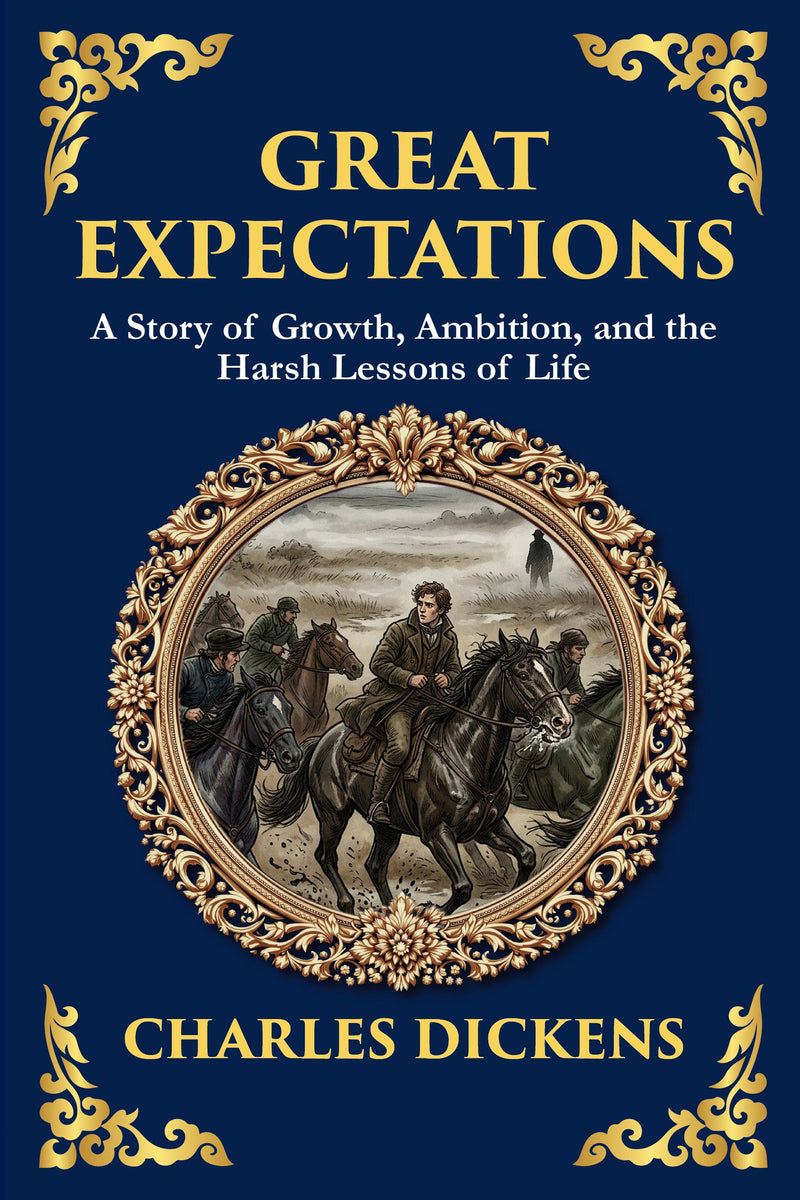
Great Expectations
A tale of mystery, ambition, and transformation, Great Expectations is one of Charles Dickens’ most enduring masterpieces.
or free app
10,000+ hrs library
30-day guarantee
The complete Great Expectations appears in modern English through Library of Alexandria Press, available online with audiobook narration included for members.
What if becoming a gentleman means turning away from the people who love you?
On the bleak Kent marshes, the orphan Pip meets an escaped convict who frightens him into helping. At home, gentle blacksmith Joe Gargery offers kindness against his sister’s harsh rule. Then Pip enters Miss Havisham’s decaying house, meets the proud Estella, and begins to feel ashamed of everything he comes from.
When Mr Jaggers brings news of a fortune from an unknown benefactor, Pip sees a chance to become a gentleman. London promises fine clothes, new manners, and distance from the forge. In Charles Dickens’s Great Expectations, ambition puts friendship and loyalty at risk, while secrets unsettle Pip’s hopes for the life he wants.
What you'll discover
- A boy divided – Follow Pip as his hunger to rise strains his bond with the kindhearted Joe.
- The house of stopped clocks – Enter Miss Havisham’s shuttered world, where an old wedding dress keeps bitterness close.
- Secrets behind the fortune – Watch a guarded lawyer manage Pip’s affairs while the source of his wealth remains hidden.
- The price of gentility – Explore the gap between fine manners and kindness through Pip’s uneasy pursuit of status.
- Humor beside the hurt – Find sharp comedy and warmth among the strange houses, wounded hopes, and difficult choices.
Perfect for readers who love rich characters, secrets, and moral stories with humor and heart, especially anyone who feels ashamed of where they come from.
Open the first page now, and meet Pip on the marsh as a stranger rises from the grass.
| Formats | eBook (EPUB + PDF) · Audiobook · Paperback · Hardcover · Large Print |
| Language | English |
| Trim size (print) | 6 × 9 in |
| Binding | Paperback — perfect-bound · Hardcover — casewrap |
| Large Print edition | Same text in a larger, easy-read type — a larger font, not a larger trim |
| Print pricing | Every physical book at our true cost — at-cost, no profit (members) |
| Library | 873 restored titles, always growing |
| Length | 173,263 words · ~11 hr 33 min reading |
| Reading level | Grade 7 · an easy, flowing read (this modern-English edition) |
| Edition | Modern English translation · 2026 |
Member reviews for this edition are collected as readers finish it — be the first. Across the library: 12,000+ books shipped, every plan covered by a 365-day print guarantee.
About this edition
A faithful, unabridged modern-English edition by The Library of Alexandria — carefully rendered for today's reader and verified paragraph-by-paragraph against the public-domain source. Available as eBook, audiobook, paperback, hardcover, and large print.
- Complete & unabridgedVerified paragraph by paragraph against the source — never a scan, never abridged.
- Modern English, faithfulReadable today, with the author’s meaning kept intact. Readable — not simplified.
- Every format, one membershipRead in your browser or the free app, or listen to the full audiobook.
Included free with your membership
Cancel anytime, one click · 30-day money-back guarantee
Edition last updated July 2026
What’s inside
Great Expectations — complete and unabridged: all 60 sections included with membership, plus the full audiobook.
Begin reading Great Expectations
In clear modern English — the complete text is included with membership.
Introduction
There are certain stories that seem to grow alongside us, revealing new dimensions each time we return to them. Great Expectations is precisely such a story. First published in serial form between 1860 and 1861, this novel has endured not because it captures a particular moment in Victorian England, but because it captures something timeless about what it means to be human, to want more than we have, and to discover that the things we long for are rarely the things we truly need. This modern translation has been carefully prepared to bring the full emotional and intellectual richness of the original to readers who live in a very different world, while preserving everything that has made it one of the most beloved works of fiction ever written.
The story you are about to read follows the life of a young man from his earliest childhood through to maturity, tracing his hopes, his failures, his loves, and his gradual, often painful, education in the ways of the world. It is told in the first person, which means that you will experience events as he experienced them—filtered through his perceptions, his self-deceptions, and his moments of dazzling clarity. This intimacy is one of the great pleasures of the book. You are not merely watching a life unfold; you are living inside it, sharing in its embarrassments and its triumphs, wincing at its mistakes and yearning for its redemption.
What makes this particular edition special is its commitment to accessibility without compromise. The language of the original, brilliant though it is, can present obstacles to contemporary readers. Sentence structures that flowed naturally to Victorian audiences can feel dense or convoluted today. References to customs, institutions, and everyday objects that needed no explanation in 1860 can now obscure meaning rather than illuminate it. This translation gently smooths those difficulties, rendering the prose in language that feels natural to the modern ear, while taking great care never to flatten the wit, the warmth, or the profound moral seriousness that animate every page. The goal has been to let you encounter this masterpiece as its first readers did: as a gripping, moving, sometimes hilarious, sometimes heartbreaking story that you cannot put down.
To appreciate what this book accomplishes, it helps to understand a little about the man who wrote it and the circumstances under which it came into being. By the time he began this novel, its author was already the most famous writer in the English-speaking world. He had created an extraordinary gallery of characters who had become household names, and his public readings drew enormous crowds. Yet he was not content to rest on his reputation. He was a restless, driven man, perpetually reinventing his craft, always pushing himself toward deeper truths and more sophisticated forms.
This novel represents one of his most mature achievements. Unlike some of his earlier works, which sprawled across vast canvases and overflowed with subplots and minor characters, this one is tightly constructed, focused with almost laser-like precision on the inner development of a single protagonist. There is not a wasted scene, not a superfluous chapter. Every encounter, every conversation, every seemingly minor incident contributes to the larger pattern of the whole. When you reach the final pages and look back over everything that has happened, you will discover how carefully the entire structure has been engineered, how every thread connects to every other thread, how images and themes introduced in the opening pages return, transformed, near the close.
The author drew deeply on his own experiences in creating this story. He had known poverty and humiliation as a child, and he never forgot what it felt like to be small, powerless, and at the mercy of adults who did not always have his best interests at heart. He understood the secret shame that can attach itself to one’s origins, and the desperate desire to escape them, to become something better, finer, more respectable. He also understood—and this is crucial—the moral dangers that come with such ambitions. The pursuit of status and refinement can hollow a person out, can make them ashamed of the very people who loved them most and sacrificed the most for them. These are not abstract concerns. They are lived realities, and the author renders them with a psychological acuity that feels startlingly modern.
This is one reason the novel translates so well into contemporary language. Its concerns are our concerns. We still live in a world obsessed with self-improvement, with rising above our circumstances, with becoming the polished, successful versions of ourselves that we imagine we ought to be. We still struggle with the gap between who we are and who we wish to appear. We still wrestle with gratitude and ingratitude, with loyalty and betrayal, with the question of what we owe to the people who shaped us. The Victorian trappings may be unfamiliar, but the human heart at the center of this story beats exactly like our own.
The modernization undertaken in this edition operates on several levels. At the most basic, archaic vocabulary has been updated. Words that have fallen out of use, or that have shifted their meaning over the past century and a half, have been replaced with their contemporary equivalents. This prevents the jarring experience of stumbling over a term and having to pause to puzzle out its meaning, which breaks the spell of immersion that good fiction creates. At a slightly higher level, sentence construction has been streamlined. The author was fond of long, elaborately subordinated sentences, full of qualifications and digressions. These can be magnificent, but they can also tax the patience of readers accustomed to a brisker pace. Where such sentences threatened to impede understanding, they have been broken up and clarified, always with an eye to preserving rhythm and emphasis.
Yet it would be a mistake to imagine that this translation has reduced the original to bland, generic prose. Far from it. The author’s distinctive voice survives intact: the sly humor, the gift for caricature, the sudden eruptions of poetry, the capacity to move from comedy to tragedy and back again within the space of a single page. His characters still speak in voices uniquely their own. The eccentrics are still eccentric, the villains still chilling, the comic figures still uproariously funny. What has changed is merely the surface texture of the language, smoothed just enough to let the modern reader pass through it without friction and arrive at the living substance beneath.
This balance—accessibility on one hand, fidelity on the other—is the central challenge of any modernization, and it has guided every editorial decision in this volume. The aim throughout has been to serve the reader, to remove obstacles without removing riches, to ensure that nothing essential is lost while everything inessential that might stand between you and the story is quietly cleared away. You should be able to read this book the way you would read a contemporary novel: smoothly, eagerly, carried along by the momentum of the narrative, never stopping to wonder what something means. And yet you should also feel, beneath the modern surface, the unmistakable presence of a great artist at the height of his powers.
The Heart of the Story and Why It Endures
At its core, this is a novel about expectations—about the things we expect from life, the things life expects from us, and the vast, often comical, often tragic distance between the two. The title itself is a kind of irony that you will come to appreciate more and more as the story unfolds. To have “great expectations” sounds wonderful, like a promise of glittering rewards to come. But the author understood that expectations can be a curse as well as a blessing. They can blind us to the value of what we already possess. They can corrupt our judgment, distort our relationships, and lead us to chase phantoms while ignoring the real treasures right in front of us. The novel is, among many other things, a profound meditation on the difference between the life we dream of and the life we actually have, and on the difficult wisdom required to tell the two apart.
The protagonist’s journey takes him from humble beginnings into a wider, more dazzling world, and then—well, I will not say where it takes him after that, for to do so would be to rob you of the pleasure of discovery. But I can tell you that his journey is not a simple one. It does not follow the comfortable arc of so many stories about ambitious young people who rise, succeed, and live happily ever after. The truth this novel tells is more complicated, more honest, and ultimately more satisfying. It is a story about education in the deepest sense—not the education of schools and books, but the education of the heart, the slow and painful process by which a person learns what really matters.
Along the way, you will meet some of the most memorable characters in all of literature. There is a figure of haunting strangeness, frozen in time, surrounded by the decaying relics of a long-ago disappointment, who exercises a powerful and not entirely wholesome influence over the protagonist’s imagination. There is a young person of striking beauty and cold cruelty, who teaches the protagonist to be ashamed of himself and sets him on a course that will shape his entire life. There is a humble, good-hearted laborer whose simple decency stands as a kind of moral touchstone throughout the book, a reminder of what genuine love and loyalty look like. There is a brisk, cynical man of the law, whose hands are always smelling of soap, who knows far more than he ever lets on. And there are mysteries—secrets buried in the past that will gradually, thrillingly, come to light, connecting characters and events in ways no reader could have predicted.
The plot, indeed, is one of the novel’s great glories. The author was a master of suspense, of the carefully planted clue and the long-delayed revelation. Reading this book is partly like solving an elaborate puzzle, watching as pieces that seemed unrelated suddenly snap into place, as coincidences that seemed merely convenient turn out to be the workings of a hidden design. There is a moment—I will not spoil it—at the very heart of the book when a revelation arrives that overturns everything the protagonist (and the reader) believed to be true. It is one of the most powerful turning points in all of fiction, and experiencing it for the first time is an unforgettable pleasure. If you already know this story, you will find fresh delight in seeing how skillfully it was prepared. If you do not, I envy you the surprise.
But it would be wrong to suggest that this is merely a clever entertainment, a well-made machine for generating suspense. It is far more than that. It is a deeply moral book, concerned with the great questions of how we ought to live and treat one another. It asks what we owe to those who have helped us, and whether we can ever truly repay such debts. It asks whether people can change, whether the wrongs of the past can be redeemed, whether love can survive disappointment and betrayal. It asks what it means to be a gentleman—not in the narrow social sense of having money and refined manners, but in the deeper sense of having a good and generous heart. The author had little patience for the snobbery of his age, the assumption that worth could be measured by birth and wealth. Again and again, this novel insists that true nobility is a matter of character, not class, and that the humblest, least polished people are often the finest in the ways that count.
This is part of what gives the book its enduring relevance. We may no longer live in a rigidly stratified society of the kind the author knew, but we are hardly free of our own forms of snobbery and status anxiety. We still judge people by their wealth, their education, their accents, their connections. We still feel the pull of social ambition and the shame of social inferiority. The protagonist’s struggle to reconcile his desire for advancement with his loyalty to the people who loved him in his obscurity is a struggle that anyone who has ever climbed a social ladder—or watched someone else climb one—will recognize at once. The novel’s insight into the corrosive effects of money and status on the soul is as sharp today as it was when it was written, perhaps sharper.
Cancel anytime, one click · 30-day money-back guarantee
Founding annual rate available now — your price locks for life when you join.
Not ready? Get this free chapter by email — read it anytime.
✓ Sent — check your inbox for Great Expectations.
Questions about Great Expectations
What is Great Expectations about?
It tells the life of Pip, an orphan raised by his sister and her blacksmith husband in Kent. A sudden offer of wealth takes him to London, where he learns what ambition, shame and loyalty really mean.
Who is Miss Havisham in Great Expectations?
Miss Havisham is a rich, reclusive woman who lives in Satis House, wearing her old wedding dress with every clock stopped. She raises Estella and invites Pip to visit, and she shapes much of his life.
What does the title Great Expectations mean?
It refers to Pip's hopes of becoming a gentleman and gaining a fine future, and also to what others expect of him. The novel questions whether such hopes lead to happiness or to harm.
When was Great Expectations written and is it a true story?
Dickens wrote it as a weekly serial in his magazine All the Year Round in 1860 and 1861. It is a work of fiction, though it draws on his own feelings about class and ambition.
Shipping & returns
Billing & membership
More from the library


Explore Classic & Literary
- Crime and Punishment · Fyodor Dostoyevsky
- Oliver Twist · Charles Dickens
- Pride and Prejudice · Jane Austen
- War and Peace · Leo Tolstoy
- David Copperfield · Charles Dickens
- The Brothers Karamazov · Fyodor Dostoyevsky
- The Sorrows of Young Werther · Johann Wolfgang von Goethe
- The Great Gatsby · F. Scott Fitzgerald
- Uncle Tom’s Cabin · Harriet Beecher Stowe
- Madame Bovary · Gustave Flaubert
- The Betrothed · Alessandro Manzoni
- The Scarlet Letter · Nathaniel Hawthorne
- A Tale of Two Cities · Charles Dickens
- The Ladies' Paradise · Émile Zola
- Anna Karenina · Leo Tolstoy
- Les Misérables · Victor Hugo
- Moby-Dick · Herman Melville
- The Idiot · Fyodor Dostoyevsky
- Heart of Darkness · Joseph Conrad
- Fathers and Sons · Ivan Turgenev
- Ethan Frome · Edith Wharton
- Adventures of Huckleberry Finn · Mark Twain
- The Age of Innocence · Edith Wharton
- Bartleby, the Scrivener: A Story of Wall-Street · Herman Melville
- The Trial · Franz Kafka
- Notes from the Underground · Fyodor Dostoyevsky
- Northanger Abbey · Jane Austen
- Mrs. Dalloway · Virginia Woolf
- Bleak House · Charles Dickens
- Father Goriot · Honoré de Balzac
Great Expectations
Great Expectations
A Story of Growth, Ambition, and the Harsh Lessons of Life
Charles Dickens
Contents
- Introduction
- Chapter 1
- Chapter 2
- Chapter 3
- Chapter 4
- Chapter 5
- Chapter 6
- Chapter 7
- Chapter 8
- Chapter 9
- Chapter 10
- Chapter 11
- Chapter 12
- Chapter 13
- Chapter 14
- Chapter 15
- Chapter 16
- Chapter 17
- Chapter 18
- Chapter 19
- Chapter 20
- Chapter 21
- Chapter 22
- Chapter 23
- Chapter 24
- Chapter 25
- Chapter 26
- Chapter 27
- Chapter 28
- Chapter 29
- Chapter 30
- Chapter 31
- Chapter 32
- Chapter 33
- Chapter 34
- Chapter 35
- Chapter 36
- Chapter 37
- Chapter 38
- Chapter 39
- … and 20 more chapters
Introduction
There are certain stories that seem to grow alongside us, revealing new dimensions each time we return to them. Great Expectations is precisely such a story. First published in serial form between 1860 and 1861, this novel has endured not because it captures a particular moment in Victorian England, but because it captures something timeless about what it means to be human, to want more than we have, and to discover that the things we long for are rarely the things we truly need. This modern translation has been carefully prepared to bring the full emotional and intellectual richness of the original to readers who live in a very different world, while preserving everything that has made it one of the most beloved works of fiction ever written.
The story you are about to read follows the life of a young man from his earliest childhood through to maturity, tracing his hopes, his failures, his loves, and his gradual, often painful, education in the ways of the world. It is told in the first person, which means that you will experience events as he experienced them—filtered through his perceptions, his self-deceptions, and his moments of dazzling clarity. This intimacy is one of the great pleasures of the book. You are not merely watching a life unfold; you are living inside it, sharing in its embarrassments and its triumphs, wincing at its mistakes and yearning for its redemption.
What makes this particular edition special is its commitment to accessibility without compromise. The language of the original, brilliant though it is, can present obstacles to contemporary readers. Sentence structures that flowed naturally to Victorian audiences can feel dense or convoluted today. References to customs, institutions, and everyday objects that needed no explanation in 1860 can now obscure meaning rather than illuminate it. This translation gently smooths those difficulties, rendering the prose in language that feels natural to the modern ear, while taking great care never to flatten the wit, the warmth, or the profound moral seriousness that animate every page. The goal has been to let you encounter this masterpiece as its first readers did: as a gripping, moving, sometimes hilarious, sometimes heartbreaking story that you cannot put down.
To appreciate what this book accomplishes, it helps to understand a little about the man who wrote it and the circumstances under which it came into being. By the time he began this novel, its author was already the most famous writer in the English-speaking world. He had created an extraordinary gallery of characters who had become household names, and his public readings drew enormous crowds. Yet he was not content to rest on his reputation. He was a restless, driven man, perpetually reinventing his craft, always pushing himself toward deeper truths and more sophisticated forms.
This novel represents one of his most mature achievements. Unlike some of his earlier works, which sprawled across vast canvases and overflowed with subplots and minor characters, this one is tightly constructed, focused with almost laser-like precision on the inner development of a single protagonist. There is not a wasted scene, not a superfluous chapter. Every encounter, every conversation, every seemingly minor incident contributes to the larger pattern of the whole. When you reach the final pages and look back over everything that has happened, you will discover how carefully the entire structure has been engineered, how every thread connects to every other thread, how images and themes introduced in the opening pages return, transformed, near the close.
The author drew deeply on his own experiences in creating this story. He had known poverty and humiliation as a child, and he never forgot what it felt like to be small, powerless, and at the mercy of adults who did not always have his best interests at heart. He understood the secret shame that can attach itself to one’s origins, and the desperate desire to escape them, to become something better, finer, more respectable. He also understood—and this is crucial—the moral dangers that come with such ambitions. The pursuit of status and refinement can hollow a person out, can make them ashamed of the very people who loved them most and sacrificed the most for them. These are not abstract concerns. They are lived realities, and the author renders them with a psychological acuity that feels startlingly modern.
This is one reason the novel translates so well into contemporary language. Its concerns are our concerns. We still live in a world obsessed with self-improvement, with rising above our circumstances, with becoming the polished, successful versions of ourselves that we imagine we ought to be. We still struggle with the gap between who we are and who we wish to appear. We still wrestle with gratitude and ingratitude, with loyalty and betrayal, with the question of what we owe to the people who shaped us. The Victorian trappings may be unfamiliar, but the human heart at the center of this story beats exactly like our own.
The modernization undertaken in this edition operates on several levels. At the most basic, archaic vocabulary has been updated. Words that have fallen out of use, or that have shifted their meaning over the past century and a half, have been replaced with their contemporary equivalents. This prevents the jarring experience of stumbling over a term and having to pause to puzzle out its meaning, which breaks the spell of immersion that good fiction creates. At a slightly higher level, sentence construction has been streamlined. The author was fond of long, elaborately subordinated sentences, full of qualifications and digressions. These can be magnificent, but they can also tax the patience of readers accustomed to a brisker pace. Where such sentences threatened to impede understanding, they have been broken up and clarified, always with an eye to preserving rhythm and emphasis.
Yet it would be a mistake to imagine that this translation has reduced the original to bland, generic prose. Far from it. The author’s distinctive voice survives intact: the sly humor, the gift for caricature, the sudden eruptions of poetry, the capacity to move from comedy to tragedy and back again within the space of a single page. His characters still speak in voices uniquely their own. The eccentrics are still eccentric, the villains still chilling, the comic figures still uproariously funny. What has changed is merely the surface texture of the language, smoothed just enough to let the modern reader pass through it without friction and arrive at the living substance beneath.
This balance—accessibility on one hand, fidelity on the other—is the central challenge of any modernization, and it has guided every editorial decision in this volume. The aim throughout has been to serve the reader, to remove obstacles without removing riches, to ensure that nothing essential is lost while everything inessential that might stand between you and the story is quietly cleared away. You should be able to read this book the way you would read a contemporary novel: smoothly, eagerly, carried along by the momentum of the narrative, never stopping to wonder what something means. And yet you should also feel, beneath the modern surface, the unmistakable presence of a great artist at the height of his powers.
The Heart of the Story and Why It Endures
At its core, this is a novel about expectations—about the things we expect from life, the things life expects from us, and the vast, often comical, often tragic distance between the two. The title itself is a kind of irony that you will come to appreciate more and more as the story unfolds. To have “great expectations” sounds wonderful, like a promise of glittering rewards to come. But the author understood that expectations can be a curse as well as a blessing. They can blind us to the value of what we already possess. They can corrupt our judgment, distort our relationships, and lead us to chase phantoms while ignoring the real treasures right in front of us. The novel is, among many other things, a profound meditation on the difference between the life we dream of and the life we actually have, and on the difficult wisdom required to tell the two apart.
The protagonist’s journey takes him from humble beginnings into a wider, more dazzling world, and then—well, I will not say where it takes him after that, for to do so would be to rob you of the pleasure of discovery. But I can tell you that his journey is not a simple one. It does not follow the comfortable arc of so many stories about ambitious young people who rise, succeed, and live happily ever after. The truth this novel tells is more complicated, more honest, and ultimately more satisfying. It is a story about education in the deepest sense—not the education of schools and books, but the education of the heart, the slow and painful process by which a person learns what really matters.
Along the way, you will meet some of the most memorable characters in all of literature. There is a figure of haunting strangeness, frozen in time, surrounded by the decaying relics of a long-ago disappointment, who exercises a powerful and not entirely wholesome influence over the protagonist’s imagination. There is a young person of striking beauty and cold cruelty, who teaches the protagonist to be ashamed of himself and sets him on a course that will shape his entire life. There is a humble, good-hearted laborer whose simple decency stands as a kind of moral touchstone throughout the book, a reminder of what genuine love and loyalty look like. There is a brisk, cynical man of the law, whose hands are always smelling of soap, who knows far more than he ever lets on. And there are mysteries—secrets buried in the past that will gradually, thrillingly, come to light, connecting characters and events in ways no reader could have predicted.
The plot, indeed, is one of the novel’s great glories. The author was a master of suspense, of the carefully planted clue and the long-delayed revelation. Reading this book is partly like solving an elaborate puzzle, watching as pieces that seemed unrelated suddenly snap into place, as coincidences that seemed merely convenient turn out to be the workings of a hidden design. There is a moment—I will not spoil it—at the very heart of the book when a revelation arrives that overturns everything the protagonist (and the reader) believed to be true. It is one of the most powerful turning points in all of fiction, and experiencing it for the first time is an unforgettable pleasure. If you already know this story, you will find fresh delight in seeing how skillfully it was prepared. If you do not, I envy you the surprise.
But it would be wrong to suggest that this is merely a clever entertainment, a well-made machine for generating suspense. It is far more than that. It is a deeply moral book, concerned with the great questions of how we ought to live and treat one another. It asks what we owe to those who have helped us, and whether we can ever truly repay such debts. It asks whether people can change, whether the wrongs of the past can be redeemed, whether love can survive disappointment and betrayal. It asks what it means to be a gentleman—not in the narrow social sense of having money and refined manners, but in the deeper sense of having a good and generous heart. The author had little patience for the snobbery of his age, the assumption that worth could be measured by birth and wealth. Again and again, this novel insists that true nobility is a matter of character, not class, and that the humblest, least polished people are often the finest in the ways that count.
This is part of what gives the book its enduring relevance. We may no longer live in a rigidly stratified society of the kind the author knew, but we are hardly free of our own forms of snobbery and status anxiety. We still judge people by their wealth, their education, their accents, their connections. We still feel the pull of social ambition and the shame of social inferiority. The protagonist’s struggle to reconcile his desire for advancement with his loyalty to the people who loved him in his obscurity is a struggle that anyone who has ever climbed a social ladder—or watched someone else climb one—will recognize at once. The novel’s insight into the corrosive effects of money and status on the soul is as sharp today as it was when it was written, perhaps sharper.
My father’s last name was Pirrip and my first name was Philip, but as a small child, I couldn’t pronounce either clearly. I could only manage “Pip,” so I called myself Pip, and that is what everyone called me.
I know Pirrip was my father’s name because it’s on his tombstone and because of my sister, Mrs. Joe Gargery, who married the local blacksmith. Since I never knew my parents and never saw a picture of them—they lived long before photography existed—I imagined what they looked like based solely on their gravestones. The style of the lettering on my father’s stone gave me the strange impression that he was a square, stocky, dark man with curly black hair. From the phrasing of the inscription, “Also Georgiana, Wife of the Above,” I childishly concluded that my mother was sickly and had freckles. Beside their grave were five small stone markers, each about eighteen inches long, arranged in a neat row. These were for my five little brothers, who had died very young in the struggle for survival. Because of those stones, I firmly believed that my brothers had all been born on their backs with their hands in their pockets, and had never taken them out during their short lives.
We lived in the marsh country by the river, about twenty miles from the sea. My first clear understanding of the world happened on a cold, raw afternoon toward evening. In that moment, I realized for certain that this bleak place overgrown with nettles was the churchyard; that Philip Pirrip, formerly of this parish, and his wife Georgiana, were dead and buried; that Alexander, Bartholomew, Abraham, Tobias, and Roger, their infant children, were also dead and buried; that the dark, flat wasteland beyond the churchyard, divided by ditches, mounds, and gates and dotted with grazing cattle, was the marshes; that the low, gray line in the distance was the river; that the wild, distant place where the wind roared from was the sea; and that the small, shivering bundle of a boy, terrified by it all and starting to cry, was Pip.
End of the free sample
Keep reading, free
Members read and listen to the complete book — and the entire library. Cancel anytime, one click · 30-day money-back guarantee.