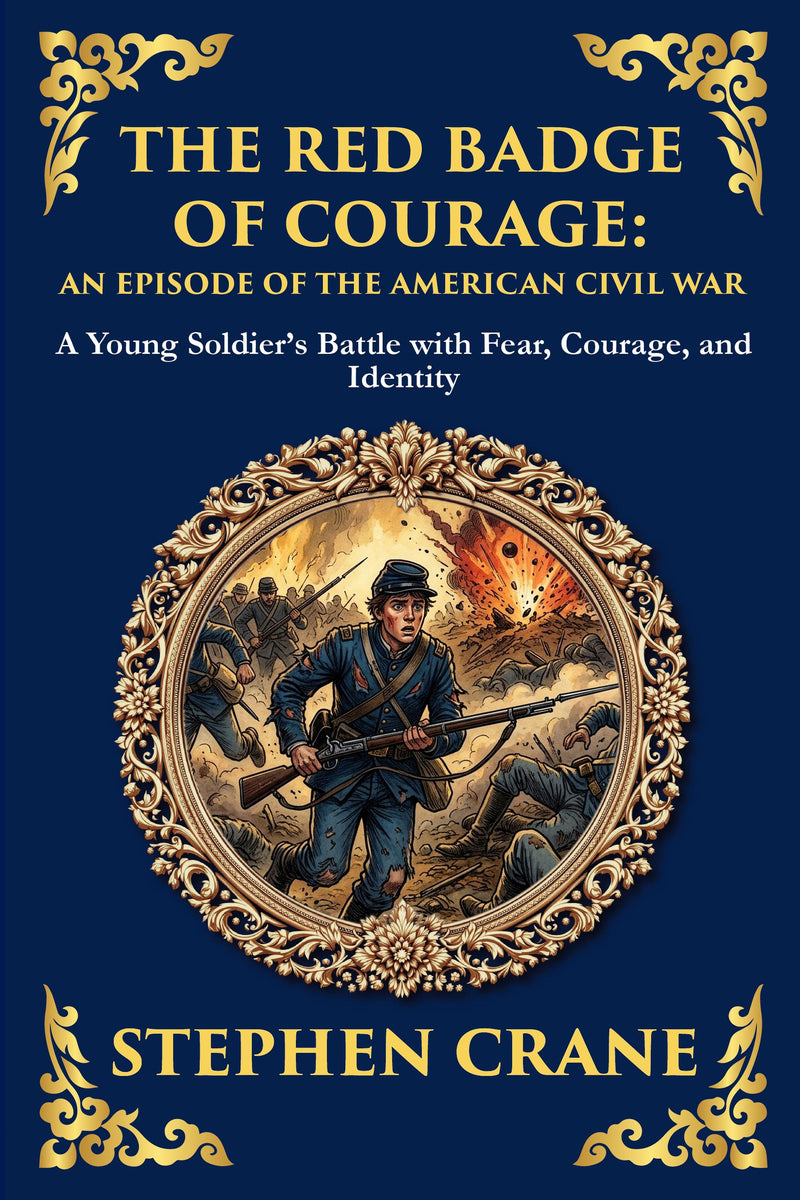
The Red Badge of Courage: An Episode of the American Civil War
A timeless masterpiece of American literature, The Red Badge of Courage follows the journey of Henry Fleming, a young Union soldier who grapples with fear, shame, and the search for honor on the battlefield.
or free app
10,000+ hrs library
30-day guarantee
The complete The Red Badge of Courage: An Episode of the American Civil War appears in modern English through Library of Alexandria Press, available online with audiobook narration included for members.
What if the enemy you fear most is your own urge to run?
Henry Fleming leaves farm life for a Union regiment, carrying dreams of glory into the American Civil War. In camp, he waits and wonders whether he will stand when the fighting starts. Around him, soldiers talk, rumors spread, and the distance between imagined heroism and real danger begins to close.
In The Red Badge of Courage, Stephen Crane keeps you close to Henry’s frightened mind. Jim Conklin offers a calm presence, while Wilson blusters as the army marches toward battle. Smoke, noise, and confusion narrow Henry’s world. What matters is not a general’s plan, but how a young soldier faces fear—and judges himself.
What you'll discover
- Glory meets doubt – Follow a farm boy whose dreams of grand deeds collide with questions he cannot answer.
- Battle from the ground – Enter the smoke and noise of war as Henry sees it, in bewildering pieces.
- A mind under pressure – Feel how fear and pride pull Henry toward competing versions of himself.
- Courage without easy answers – Explore a story where bravery and cowardice belong to the same troubled person.
- Color sharpens the chaos – Discover Crane’s bright images and close attention to a soldier’s shifting thoughts.
Perfect for readers who want a short, intense war novel at a soldier’s level, and anyone curious about fear and pride.
Open the first page and join Henry in camp, where dreams of glory meet the fear of battle.
| Formats | eBook (EPUB + PDF) · Audiobook · Paperback · Hardcover · Large Print |
| Language | English |
| Trim size (print) | 6 × 9 in |
| Binding | Paperback — perfect-bound · Hardcover — casewrap |
| Large Print edition | Same text in a larger, easy-read type — a larger font, not a larger trim |
| Print pricing | Every physical book at our true cost — at-cost, no profit (members) |
| Library | 873 restored titles, always growing |
| Length | 47,639 words · ~3 hr 11 min reading |
| Reading level | Grade 7 · an easy, flowing read (this modern-English edition) |
| Edition | Modern English translation · 2026 |
Member reviews for this edition are collected as readers finish it — be the first. Across the library: 12,000+ books shipped, every plan covered by a 365-day print guarantee.
About this edition
A faithful, unabridged modern-English edition by The Library of Alexandria — carefully rendered for today's reader and verified paragraph-by-paragraph against the public-domain source. Available as eBook, audiobook, paperback, hardcover, and large print.
- Complete & unabridgedVerified paragraph by paragraph against the source — never a scan, never abridged.
- Modern English, faithfulReadable today, with the author’s meaning kept intact. Readable — not simplified.
- Every format, one membershipRead in your browser or the free app, or listen to the full audiobook.
Included free with your membership
Cancel anytime, one click · 30-day money-back guarantee
Edition last updated July 2026
What’s inside
The Red Badge of Courage: An Episode of the American Civil War — complete and unabridged: all 25 sections included with membership, plus the full audiobook.
Begin reading The Red Badge of Courage: An Episode of the American Civil War
In clear modern English — the complete text is included with membership.
Introduction
When Stephen Crane sat down to write The Red Badge of Courage, he had never seen a battle. He had not yet been born when the cannon fell silent at Appomattox, and the men who fought the American Civil War were, to him, aging veterans and faded photographs. Yet he produced what many readers and critics regard as the most psychologically truthful account of combat ever written in the English language—a book so convincing in its sensory detail and emotional honesty that veterans of the war wrote to congratulate him, certain that he must have stood beside them in the smoke. That a young man in his early twenties, working largely from his imagination and from the accumulated memory of a nation, could conjure the inner life of a soldier with such unflinching accuracy remains one of the great wonders of American literature.
This edition presents Crane’s masterpiece in a modern translation, carefully adapted for the contemporary reader. The aim has been to preserve everything that makes the original extraordinary—its hallucinatory imagery, its rhythmic intensity, its psychological precision—while gently smoothing the obstacles that nineteenth-century prose can place between a modern reader and a deeply rewarding experience. The dense dialect, the dated turns of phrase, and the occasionally tangled syntax of the 1895 text have been clarified so that the emotional current of the story can flow without interruption. What you hold is not a simplification but a clearing of the path: the goal is to let Crane’s astonishing vision strike you as freshly and forcefully as it struck its first readers more than a century ago.
Before you begin, it is worth pausing to consider what kind of book this is, where it came from, and why it has endured. This is not a war story in the conventional sense. There are no grand strategies explained, no generals delivering speeches, no sweeping panoramas of armies clashing across history’s stage. There is, instead, a single young man, and the swirling chaos of his own mind as he confronts the most ancient and intimate of human questions: When the moment comes, what will I do? Will I stand, or will I run? And perhaps even more unsettling—when I learn the answer, who will I discover myself to be?
Stephen Crane was born in Newark, New Jersey, in 1871, the youngest of fourteen children in a deeply religious Methodist household. His father was a minister, his mother a devout and socially active woman who wrote for religious publications. Crane rebelled against this background almost from the start, drawn instead to the rough, unvarnished textures of life—to the slums, the saloons, the streets, and the people who lived hard and spoke plainly. He was a restless student who left college after a single semester, far more interested in baseball and in the burgeoning art of writing than in formal academics. He turned to journalism young, reporting from the impoverished neighborhoods of New York City, and his first novel, Maggie: A Girl of the Streets, published privately in 1893 when he was only twenty-one, was a stark and unsentimental portrait of urban poverty that few publishers dared touch. It sold almost nothing during his lifetime, but it announced the arrival of a startlingly original voice.
It was in this period of poverty and obscurity that Crane began to think seriously about the Civil War. The conflict had ended only six years before his birth, and it still loomed over American life like a recent and unhealed wound. Veterans were everywhere; the memorials were being raised; the magazines were full of reminiscences. Crane reportedly grew impatient with these accounts, complaining that the men who wrote them told you everything about where the troops moved and nothing about how the men felt. “I wonder that some of those fellows don’t tell how they felt in those scrapes,” he is said to have remarked. “They spout enough of what they did, but they’re as emotionless as rocks.” That gap—between the documented facts of war and the unrecorded inner experience of the men who endured it—became the territory Crane set out to map.
To prepare, he read what he could, including the popular Battles and Leaders of the Civil War series, and he listened to the stories of veterans. But his true method was not historical research; it was imaginative immersion of an almost feverish intensity. He seems to have lived inside the consciousness of his protagonist until the experience became, for the purposes of art, entirely real. The result was a book that captured not the geography of a battle but its psychology—the terror, the confusion, the strange exhilaration, the shame, the self-deception, and the hard-won knowledge that war forces upon the soul.
When The Red Badge of Courage was first published—appearing in a shortened newspaper version in late 1894 and as a full book in 1895—it made Crane internationally famous almost overnight. In England, where it was received with particular enthusiasm, established writers hailed it as a work of genius. The praise was tinged with disbelief: how could a man so young, who had never heard a shot fired in anger, have written something so true? Crane himself would later get his chance to see real war, working as a correspondent in Greece and Cuba, and his reaction upon witnessing actual combat was telling. He found that he had gotten it right. The imagined had matched the real.
Crane’s triumph was brief in the way that the lives of so many brilliant young artists are brief. His health, never robust, gave way to tuberculosis, and he died in a sanatorium in Germany in 1900, just twenty-eight years old. In his short life he produced poetry, short stories, journalism, and several books, including the masterful short story “The Open Boat,” drawn from his own experience surviving a shipwreck. But it is The Red Badge of Courage that secured his place among the immortals of American letters—a single, perfect distillation of his genius for finding the universal truth inside the particular human moment.
To understand the originality of what Crane accomplished, it helps to remember the literary climate into which his book arrived. Much of the popular fiction of his era was sentimental, romantic, and morally tidy. Heroes were heroic; villains were villainous; courage was a simple virtue that good men possessed and cowards lacked. War, in particular, was frequently rendered as a theater of glory, where noble men proved their worth and earned their honor in clean, decisive contests. Crane swept all of this away. His war is muddy, smoky, deafening, and senseless. His hero is not noble but ordinary, frightened, self-absorbed, and prone to grand delusions about himself. Courage, in Crane’s hands, is not a fixed quality but a shifting, unreliable thing—something that comes and goes, that can be faked, that can be discovered by accident, and that is forever entangled with vanity, fear, and luck. This was a radically modern way of seeing, and it helped to inaugurate a new era in literature.
The Mind at War: What This Book Is Really About
It is important to say plainly what The Red Badge of Courage is and is not, so that you can read it with the right expectations and reap its full reward. This is not a novel of plot in the traditional sense. Very little “happens” in terms of external events that could be summarized in a paragraph. There is no mystery to solve, no romance to resolve, no fortune to be won or lost. The story follows a young soldier, identified for much of the book simply as “the youth,” through a brief span of time during a single campaign of the Civil War. We are never told precisely which battle, though scholars have long associated it with Chancellorsville. We are never even told what the war is fundamentally about, in the sense of slavery, union, and the great moral questions of the era. Crane deliberately strips all of this away.
What remains is the only thing he cared about: the interior experience of a human being pushed to the edge of himself. The entire drama of the book takes place inside the protagonist’s head. The battles, the marches, the camp life, the other soldiers—all of these exist primarily as stimuli that provoke and reveal the youth’s churning thoughts and feelings. We watch him imagine the coming fight before it arrives, building it up into something epic and testing himself against fantasies of glory. We watch him grow sick with dread and uncertainty. We watch him observe his fellow soldiers, searching their faces for some sign of how he should feel, desperate to know whether they too are afraid, whether anyone else shares his secret terror that he might fail. And we watch him in the moment of truth, when imagination collides with reality and he must finally learn what he is made of.
This relentless focus on inner life is what makes the book feel so startlingly modern, even today. Crane was anticipating the literary revolution that would soon transform fiction—the turn inward, toward consciousness, toward the unreliable and self-justifying narratives we tell ourselves about our own behavior. The youth is forever interpreting and reinterpreting his own actions, casting himself now as a hero, now as a victim, now as a martyr to forces beyond his control. He rationalizes; he deceives himself; he constructs flattering explanations for things he is secretly ashamed of. Crane renders this process with a cool, almost clinical precision that never lets us fully trust the youth’s view of himself, even as we are locked inside his perspective. This tension—between what the protagonist believes about himself and what we suspect is actually true—is one of the great pleasures and challenges of the reading experience.
The central question that drives the entire book is the question of courage, and what Crane does with this theme is profoundly unsettling and profoundly honest. The youth wants, more than anything, to know whether he is brave. He has enlisted dreaming of heroism, but as the battle approaches he is consumed by the fear that he will run. The dread is not simply of death or injury; it is of being seen to be afraid, of failing the test in front of others, of discovering that he is a coward. Crane understood, with extraordinary insight, that what we call courage is often inseparable from this fear of shame, this desperate concern with how we appear in the eyes of the group. He understood, too, that courage and cowardice are not stable categories—that a man might be a coward one moment and a hero the next, and that the difference between them might come down to chance, exhaustion, herd instinct, or a sudden surge of animal rage. The book refuses to give us the comforting moral arithmetic of conventional war stories. It insists instead on the messy, contradictory truth.
The title itself points to one of the book’s most piercing ideas, and it rewards careful attention. A “red badge of courage” is a wound—the visible mark on a soldier’s body that proves he has stood and fought and bled. The youth comes to long for such a badge, not because he wants to be hurt but because he wants the proof, the credential, the outward sign that will testify to his inner worth and silence his private doubts. There is something deeply human and deeply troubling in this longing. It speaks to the way we crave external validation, the way we want our virtue to be certified by visible evidence, the way the appearance of courage can become more important than courage itself. Crane explores this idea with an irony so subtle and so devastating that it has kept readers and critics arguing for over a century. I will say no more about how this theme unfolds, because to do so would rob you of the experience of watching it develop. But keep the title in your mind as you read, and let its meaning deepen and darken as the youth’s journey progresses.
Alongside its psychological depth, the book is celebrated for its extraordinary style, and this is something this modern edition has worked hard to preserve. Crane was a poet as much as a novelist, and his prose is dense with vivid, often shocking imagery. He had a particular genius for color—the famous “red” of the title is only one example of the way hues blaze and bleed across his pages. The sun is a “red and ferocious” presence; the campfires glow; the enemy appears as gray shapes in the smoke; and blood, of course, marks the landscape of battle. He also relied heavily on personification and metaphor, rendering the impersonal machinery of war as a living, breathing monster. Cannons become beasts; the army becomes a serpent or a dragon winding across the land; nature itself seems alternately indifferent and malevolent. This technique, sometimes called impressionism, captures the way a frightened, overwhelmed mind perceives the world—not as a series of clear facts but as a swirl of sensations, fragments, and half-understood shapes looming out of the chaos.
Cancel anytime, one click · 30-day money-back guarantee
Founding annual rate available now — your price locks for life when you join.
Not ready? Get this free chapter by email — read it anytime.
✓ Sent — check your inbox for The Red Badge of Courage: An Episode of the American Civil War.
Questions about The Red Badge of Courage: An Episode of the American Civil War
What is The Red Badge of Courage about?
It follows Henry Fleming, a young Union soldier in the American Civil War, as he faces his first battles. The book is about fear, shame, courage and how a young man's idea of himself changes under fire.
Is The Red Badge of Courage a true story?
No. It is a novel, published in 1895. Crane was born after the war ended and had not seen combat. He drew on veterans' accounts, histories and his imagination, and he did not name the battle.
What does the red badge of courage mean?
The red badge is a wound, the visible proof that a soldier has been in the fight. Henry envies it because courage is judged by marks others can see, while his fear stays hidden.
Is The Red Badge of Courage hard to read?
Not very. It is short, with brief chapters and a fast pace. The prose is vivid and sometimes odd, with unusual images and colors, and some of the period language may take a few pages to adjust to.
Shipping & returns
Billing & membership
More from the library


Explore Classic & Literary
- Resurrection · Leo Tolstoy
- Crime and Punishment · Fyodor Dostoyevsky
- Anna Karenina · Leo Tolstoy
- Moby-Dick · Herman Melville
- Great Expectations · Charles Dickens
- The Brothers Karamazov · Fyodor Dostoyevsky
- The Great Gatsby · F. Scott Fitzgerald
- McTeague: A Story of San Francisco — Large Print · Frank Norris
- McTeague: A Story of San Francisco · Frank Norris
- The Country House — Large Print · John Galsworthy
- Ethan Frome — Large Print · Edith Wharton
- Bartleby, the Scrivener: A Story of Wall-Street · Herman Melville
- Mrs. Dalloway — Large Print · Virginia Woolf
- Resurrection — Large Print · Leo Tolstoy
- Against the Grain — Large Print · Joris-Karl Huysmans
- Bartleby, the Scrivener: A Story of Wall-Street — Large Print · Herman Melville
- The Red Badge of Courage: An Episode of the American Civil War — Large Print · Stephen Crane
- North and South · Elizabeth Gaskell
- Barry Lyndon · William Makepeace Thackeray
- Barry Lyndon — Large Print · William Makepeace Thackeray
- North and South — Large Print · Elizabeth Gaskell
- Dombey and Son — Large Print · Charles Dickens
- My Ántonia — Large Print · Willa Cather
- Jane Eyre: An Autobiography · Charlotte Brontë
- Penrod — Large Print · Booth Tarkington
- Tess of the d'Urbervilles: A Pure Woman — Large Print · Thomas Hardy
- The Belle of Bowling Green · Amelia E. Barr
- The Possessed: Or, The Devils — Large Print · Fyodor Dostoyevsky
- Penrod · Booth Tarkington
- Jane Eyre: An Autobiography — Large Print · Charlotte Brontë
The Red Badge of Courage: An Episode of the American Civil War
The Red Badge of Courage: An Episode of the American Civil War
A Young Soldier’s Battle with Fear, Courage, and Identity
Stephen Crane
Contents
- Introduction
- Chapter 1
- Chapter 2
- Chapter 3
- Chapter 4
- Chapter 5
- Chapter 6
- Chapter 7
- Chapter 8
- Chapter 9
- Chapter 10
- Chapter 11
- Chapter 12
- Chapter 13
- Chapter 14
- Chapter 15
- Chapter 16
- Chapter 17
- Chapter 18
- Chapter 19
- Chapter 20
- Chapter 21
- Chapter 22
- Chapter 23
- Chapter 24
Introduction
When Stephen Crane sat down to write The Red Badge of Courage, he had never seen a battle. He had not yet been born when the cannon fell silent at Appomattox, and the men who fought the American Civil War were, to him, aging veterans and faded photographs. Yet he produced what many readers and critics regard as the most psychologically truthful account of combat ever written in the English language—a book so convincing in its sensory detail and emotional honesty that veterans of the war wrote to congratulate him, certain that he must have stood beside them in the smoke. That a young man in his early twenties, working largely from his imagination and from the accumulated memory of a nation, could conjure the inner life of a soldier with such unflinching accuracy remains one of the great wonders of American literature.
This edition presents Crane’s masterpiece in a modern translation, carefully adapted for the contemporary reader. The aim has been to preserve everything that makes the original extraordinary—its hallucinatory imagery, its rhythmic intensity, its psychological precision—while gently smoothing the obstacles that nineteenth-century prose can place between a modern reader and a deeply rewarding experience. The dense dialect, the dated turns of phrase, and the occasionally tangled syntax of the 1895 text have been clarified so that the emotional current of the story can flow without interruption. What you hold is not a simplification but a clearing of the path: the goal is to let Crane’s astonishing vision strike you as freshly and forcefully as it struck its first readers more than a century ago.
Before you begin, it is worth pausing to consider what kind of book this is, where it came from, and why it has endured. This is not a war story in the conventional sense. There are no grand strategies explained, no generals delivering speeches, no sweeping panoramas of armies clashing across history’s stage. There is, instead, a single young man, and the swirling chaos of his own mind as he confronts the most ancient and intimate of human questions: When the moment comes, what will I do? Will I stand, or will I run? And perhaps even more unsettling—when I learn the answer, who will I discover myself to be?
Stephen Crane was born in Newark, New Jersey, in 1871, the youngest of fourteen children in a deeply religious Methodist household. His father was a minister, his mother a devout and socially active woman who wrote for religious publications. Crane rebelled against this background almost from the start, drawn instead to the rough, unvarnished textures of life—to the slums, the saloons, the streets, and the people who lived hard and spoke plainly. He was a restless student who left college after a single semester, far more interested in baseball and in the burgeoning art of writing than in formal academics. He turned to journalism young, reporting from the impoverished neighborhoods of New York City, and his first novel, Maggie: A Girl of the Streets, published privately in 1893 when he was only twenty-one, was a stark and unsentimental portrait of urban poverty that few publishers dared touch. It sold almost nothing during his lifetime, but it announced the arrival of a startlingly original voice.
It was in this period of poverty and obscurity that Crane began to think seriously about the Civil War. The conflict had ended only six years before his birth, and it still loomed over American life like a recent and unhealed wound. Veterans were everywhere; the memorials were being raised; the magazines were full of reminiscences. Crane reportedly grew impatient with these accounts, complaining that the men who wrote them told you everything about where the troops moved and nothing about how the men felt. “I wonder that some of those fellows don’t tell how they felt in those scrapes,” he is said to have remarked. “They spout enough of what they did, but they’re as emotionless as rocks.” That gap—between the documented facts of war and the unrecorded inner experience of the men who endured it—became the territory Crane set out to map.
To prepare, he read what he could, including the popular Battles and Leaders of the Civil War series, and he listened to the stories of veterans. But his true method was not historical research; it was imaginative immersion of an almost feverish intensity. He seems to have lived inside the consciousness of his protagonist until the experience became, for the purposes of art, entirely real. The result was a book that captured not the geography of a battle but its psychology—the terror, the confusion, the strange exhilaration, the shame, the self-deception, and the hard-won knowledge that war forces upon the soul.
When The Red Badge of Courage was first published—appearing in a shortened newspaper version in late 1894 and as a full book in 1895—it made Crane internationally famous almost overnight. In England, where it was received with particular enthusiasm, established writers hailed it as a work of genius. The praise was tinged with disbelief: how could a man so young, who had never heard a shot fired in anger, have written something so true? Crane himself would later get his chance to see real war, working as a correspondent in Greece and Cuba, and his reaction upon witnessing actual combat was telling. He found that he had gotten it right. The imagined had matched the real.
Crane’s triumph was brief in the way that the lives of so many brilliant young artists are brief. His health, never robust, gave way to tuberculosis, and he died in a sanatorium in Germany in 1900, just twenty-eight years old. In his short life he produced poetry, short stories, journalism, and several books, including the masterful short story “The Open Boat,” drawn from his own experience surviving a shipwreck. But it is The Red Badge of Courage that secured his place among the immortals of American letters—a single, perfect distillation of his genius for finding the universal truth inside the particular human moment.
To understand the originality of what Crane accomplished, it helps to remember the literary climate into which his book arrived. Much of the popular fiction of his era was sentimental, romantic, and morally tidy. Heroes were heroic; villains were villainous; courage was a simple virtue that good men possessed and cowards lacked. War, in particular, was frequently rendered as a theater of glory, where noble men proved their worth and earned their honor in clean, decisive contests. Crane swept all of this away. His war is muddy, smoky, deafening, and senseless. His hero is not noble but ordinary, frightened, self-absorbed, and prone to grand delusions about himself. Courage, in Crane’s hands, is not a fixed quality but a shifting, unreliable thing—something that comes and goes, that can be faked, that can be discovered by accident, and that is forever entangled with vanity, fear, and luck. This was a radically modern way of seeing, and it helped to inaugurate a new era in literature.
The Mind at War: What This Book Is Really About
It is important to say plainly what The Red Badge of Courage is and is not, so that you can read it with the right expectations and reap its full reward. This is not a novel of plot in the traditional sense. Very little “happens” in terms of external events that could be summarized in a paragraph. There is no mystery to solve, no romance to resolve, no fortune to be won or lost. The story follows a young soldier, identified for much of the book simply as “the youth,” through a brief span of time during a single campaign of the Civil War. We are never told precisely which battle, though scholars have long associated it with Chancellorsville. We are never even told what the war is fundamentally about, in the sense of slavery, union, and the great moral questions of the era. Crane deliberately strips all of this away.
What remains is the only thing he cared about: the interior experience of a human being pushed to the edge of himself. The entire drama of the book takes place inside the protagonist’s head. The battles, the marches, the camp life, the other soldiers—all of these exist primarily as stimuli that provoke and reveal the youth’s churning thoughts and feelings. We watch him imagine the coming fight before it arrives, building it up into something epic and testing himself against fantasies of glory. We watch him grow sick with dread and uncertainty. We watch him observe his fellow soldiers, searching their faces for some sign of how he should feel, desperate to know whether they too are afraid, whether anyone else shares his secret terror that he might fail. And we watch him in the moment of truth, when imagination collides with reality and he must finally learn what he is made of.
This relentless focus on inner life is what makes the book feel so startlingly modern, even today. Crane was anticipating the literary revolution that would soon transform fiction—the turn inward, toward consciousness, toward the unreliable and self-justifying narratives we tell ourselves about our own behavior. The youth is forever interpreting and reinterpreting his own actions, casting himself now as a hero, now as a victim, now as a martyr to forces beyond his control. He rationalizes; he deceives himself; he constructs flattering explanations for things he is secretly ashamed of. Crane renders this process with a cool, almost clinical precision that never lets us fully trust the youth’s view of himself, even as we are locked inside his perspective. This tension—between what the protagonist believes about himself and what we suspect is actually true—is one of the great pleasures and challenges of the reading experience.
The central question that drives the entire book is the question of courage, and what Crane does with this theme is profoundly unsettling and profoundly honest. The youth wants, more than anything, to know whether he is brave. He has enlisted dreaming of heroism, but as the battle approaches he is consumed by the fear that he will run. The dread is not simply of death or injury; it is of being seen to be afraid, of failing the test in front of others, of discovering that he is a coward. Crane understood, with extraordinary insight, that what we call courage is often inseparable from this fear of shame, this desperate concern with how we appear in the eyes of the group. He understood, too, that courage and cowardice are not stable categories—that a man might be a coward one moment and a hero the next, and that the difference between them might come down to chance, exhaustion, herd instinct, or a sudden surge of animal rage. The book refuses to give us the comforting moral arithmetic of conventional war stories. It insists instead on the messy, contradictory truth.
The title itself points to one of the book’s most piercing ideas, and it rewards careful attention. A “red badge of courage” is a wound—the visible mark on a soldier’s body that proves he has stood and fought and bled. The youth comes to long for such a badge, not because he wants to be hurt but because he wants the proof, the credential, the outward sign that will testify to his inner worth and silence his private doubts. There is something deeply human and deeply troubling in this longing. It speaks to the way we crave external validation, the way we want our virtue to be certified by visible evidence, the way the appearance of courage can become more important than courage itself. Crane explores this idea with an irony so subtle and so devastating that it has kept readers and critics arguing for over a century. I will say no more about how this theme unfolds, because to do so would rob you of the experience of watching it develop. But keep the title in your mind as you read, and let its meaning deepen and darken as the youth’s journey progresses.
Alongside its psychological depth, the book is celebrated for its extraordinary style, and this is something this modern edition has worked hard to preserve. Crane was a poet as much as a novelist, and his prose is dense with vivid, often shocking imagery. He had a particular genius for color—the famous “red” of the title is only one example of the way hues blaze and bleed across his pages. The sun is a “red and ferocious” presence; the campfires glow; the enemy appears as gray shapes in the smoke; and blood, of course, marks the landscape of battle. He also relied heavily on personification and metaphor, rendering the impersonal machinery of war as a living, breathing monster. Cannons become beasts; the army becomes a serpent or a dragon winding across the land; nature itself seems alternately indifferent and malevolent. This technique, sometimes called impressionism, captures the way a frightened, overwhelmed mind perceives the world—not as a series of clear facts but as a swirl of sensations, fragments, and half-understood shapes looming out of the chaos.
The cold slowly left the earth, and as the fog cleared, it revealed an army resting on the hills. As the landscape turned from brown to green, the soldiers woke up, buzzing with excitement at the latest rumors. They watched the roads, which were transforming from deep troughs of liquid mud into actual paths. A river, amber-colored in the shadow of its banks, flowed at the army’s feet; at night, when the water turned a gloomy black, one could see the red, eye-like glow of enemy campfires on the distant hills.
One tall soldier decided to be productive and went to wash a shirt. He came rushing back from a stream, waving his garment like a flag. He was bursting with a story he had heard from a reliable friend, who had heard it from a truthful cavalryman, who had heard it from his trustworthy brother—one of the orderlies at division headquarters. He took on the important air of a royal messenger.
“We’re moving tomorrow—for sure,” he told a group of men in the company street pompously. “We’re going way up the river, cutting across, and coming up behind them.”
To his attentive audience, he described a loud and detailed plan for a brilliant campaign. When he finished, the men in blue split into small, arguing groups between the rows of squat brown huts. A Black teamster, who had been dancing on a cracker box while forty soldiers cheered him on, was suddenly ignored. He sat down gloomily. Smoke drifted lazily from many odd-looking chimneys.
“That’s a lie! That’s all it is—a total lie!” another private shouted. His smooth face was flushed, and he shoved his hands sulkily into his trouser pockets. He took the claim as a personal insult. “I don’t believe this damn army is ever going to move. We’re stuck. I’ve gotten ready to move eight times in the last two weeks, and we haven’t budged yet.”
End of the free sample
Keep reading, free
Members read and listen to the complete book — and the entire library. Cancel anytime, one click · 30-day money-back guarantee.