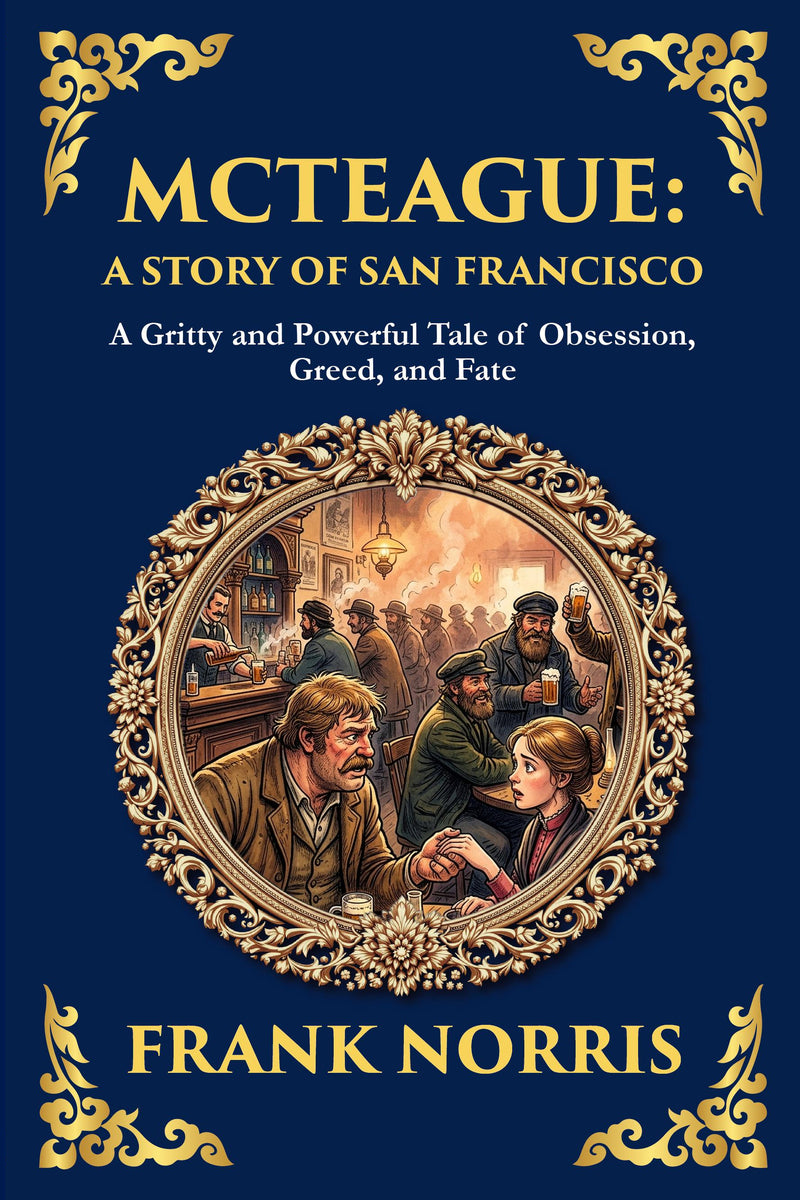
McTeague: A Story of San Francisco — Large Print
In the shadowy streets of 1890s San Francisco, a slow-witted dentist named McTeague lives a modest, unremarkable life. But when love, greed, and pride enter his world, everything changes —and not for the better.
or free app
10,000+ hrs library
30-day guarantee
The complete McTeague: A Story of San Francisco appears in modern English through Library of Alexandria Press, available online with audiobook narration included for members.
Have you ever wondered why some lives unravel the moment fortune enters the room? In McTeague: A Story of San Francisco, Frank Norris paints an unflinching portrait of American life during the turn of the century—a world where destiny tightens its grip the moment greed takes root. What begins as a slow, simple tale of a dentist and his timid bride quickly descends into a nightmare of obsession, betrayal, and brutality.
McTeague, a hulking and uneducated dentist, marries Trina, a delicate woman who wins a small fortune in a lottery. But as the money lingers untouched, its presence poisons their lives. McTeague’s brutish nature simmers under the surface, Trina’s miserliness grows grotesque, and what was once affection curdles into hatred.
As San Francisco’s gritty neighborhoods pulse around them, the pair fall into an inescapable spiral of poverty, paranoia, and violence. Frank Norris—one of the key figures of American naturalism—delivers a shocking, psychologically rich novel that exposes the savagery lurking beneath civility.
What you’ll discover in this modern edition
- A Haunting Tale of Human Decline Follow McTeague and Trina’s descent from hopeful love to desperate ruin, catalyzed by greed and circumstance.
| Formats | eBook (EPUB + PDF) · Audiobook · Paperback · Hardcover · Large Print |
| Language | English |
| Trim size (print) | 6 × 9 in |
| Binding | Paperback — perfect-bound · Hardcover — casewrap |
| Large Print edition | Same text in a larger, easy-read type — a larger font, not a larger trim |
| Print pricing | Every physical book at our true cost — at-cost, no profit (members) |
| Library | 873 restored titles, always growing |
| Length | 111,282 words · ~7 hr 25 min reading |
| Reading level | Grade 3 · an easy, flowing read (this modern-English edition) |
| Edition | Modern English translation · 2026 |
Member reviews for this edition are collected as readers finish it — be the first. Across the library: 12,000+ books shipped, every plan covered by a 365-day print guarantee.
About this edition
A faithful, unabridged modern-English edition by The Library of Alexandria — carefully rendered for today's reader and verified paragraph-by-paragraph against the public-domain source. Available as eBook, audiobook, paperback, hardcover, and large print.
- Complete & unabridgedVerified paragraph by paragraph against the source — never a scan, never abridged.
- Modern English, faithfulReadable today, with the author’s meaning kept intact. Readable — not simplified.
- Every format, one membershipRead in your browser or the free app, or listen to the full audiobook.
Included free with your membership
Cancel anytime, one click · 30-day money-back guarantee
Edition last updated July 2026
What’s inside
McTeague: A Story of San Francisco — Large Print — complete and unabridged: all 23 sections included with membership, plus the full audiobook.
Begin reading McTeague: A Story of San Francisco — Large Print
In clear modern English — the complete text is included with membership.
Introduction
When McTeague: A Story of San Francisco first appeared in 1899, American readers encountered something they had rarely seen before in their own literature: a novel that refused to look away. Here was a book that planted its feet in the dust and grime of an ordinary city street, fixed its gaze on ordinary people with ordinary appetites, and traced what happened when those appetites were given room to grow. Frank Norris, then only in his late twenties, had produced a work of startling confidence and unsettling power—a portrait of human beings shaped by forces they neither understood nor controlled. More than a century later, the novel retains its capacity to disturb, to move, and to fascinate. It remains one of the foundational texts of American literary naturalism, and it stands among the most vivid evocations of San Francisco ever committed to the page.
This edition presents the novel in a modern translation, carefully adapted for the contemporary reader. The aim throughout has been to preserve the texture and force of Norris’s original while smoothing the obstacles that can stand between a modern audience and a story written more than a hundred and twenty years ago. The dialect, the period idioms, the occasional density of nineteenth-century prose—these have been handled with a light but deliberate touch, so that the rawness of the narrative comes through cleanly. What you hold is not a simplification but a clarification: a way into a great novel that lets its strangeness and its strength register without the friction of dated language. The story itself, in all its grim momentum and its surprising tenderness, remains exactly as Norris conceived it.
Frank Norris was born Benjamin Franklin Norris Jr. in Chicago in 1870, the son of a prosperous wholesale jeweler and a mother with theatrical ambitions and a deep love of literature. When the family relocated to San Francisco during his boyhood, the young Norris found himself in the city that would define his imagination and provide the setting for his greatest book. He was, by temperament, a romantic and an adventurer, but also a keen observer with a journalist’s eye for the concrete detail and the telling gesture. He studied art in Paris for a time, harboring early dreams of becoming a painter, before turning decisively toward writing. That training in the visual arts never entirely left him; throughout this novel you will notice how he composes scenes the way a painter arranges a canvas, attending to color, light, posture, and the physical heaviness of objects.
The crucial intellectual encounter of Norris’s life came during his years at the University of California, Berkeley, and later at Harvard, where he absorbed the ideas that would shape his entire literary project. He fell under the spell of the French novelist Émile Zola, whose vast cycle of novels examined human beings as products of heredity, environment, and circumstance. Zola called his method “naturalism,” and he conceived of the novelist as a kind of scientist conducting experiments—placing characters with particular temperaments into particular conditions and observing, with cold honesty, what resulted. The naturalist did not flinch from the ugly, the animal, or the brutal aspects of life. On the contrary, he sought them out, believing that to understand human beings truthfully one had to acknowledge the powerful undercurrents of instinct, appetite, and inheritance that flowed beneath the polished surface of civilized behavior.
Norris embraced this philosophy with the fervor of a convert, but he was no mere imitator. He brought to it a distinctly American energy and an attachment to his own particular corner of the world. Where Zola anatomized the slums and salons of Paris, Norris would do the same for San Francisco—its working-class neighborhoods, its dental parlors and concertinas, its saloons and its streetcar lines, its mining country and the deadly emptiness of Death Valley. He understood that the great forces he wished to dramatize—heredity, greed, the blind tug of desire—could be found just as powerfully in the life of a dim-witted dentist and his frugal wife as in any aristocratic tragedy. This democratization of the tragic was one of his most significant achievements, and it is everywhere apparent in this novel.
Norris’s career was brief and brilliant. He worked as a journalist, reporting on the Boer War in South Africa and the Spanish-American War in Cuba, experiences that sharpened his sense of human struggle and physical hardship. He published several novels in quick succession, and he had begun an ambitious trilogy about the production, distribution, and consumption of wheat—a grand attempt to show the movement of vast economic forces through human lives—when his life was cut tragically short. He died in 1902 of complications from appendicitis, at only thirty-two years of age. He left behind a body of work remarkable for its scope and ambition, but it is McTeague, written when he was still a young man, that has proved his most enduring legacy. It was the book in which his theories and his gifts came together most completely, and it announced the arrival of a major new voice in American fiction.
To understand the novel fully, it helps to remember the literary climate into which it arrived. American fiction at the close of the nineteenth century was dominated by genteel realism and sentimental romance. Readers expected stories that affirmed moral order, that rewarded virtue and punished vice in tidy and reassuring ways, that drew a discreet veil over the cruder facts of bodily existence. Norris and his contemporaries—writers such as Stephen Crane and, slightly later, Theodore Dreiser—broke decisively with these expectations. They insisted on a harder, more unsparing kind of truth. They wrote about poverty, lust, violence, and degradation without apology. They suggested that human beings might not be the masters of their own fate, that beneath the veneer of respectability lurked something raw and instinctual that could, under the right pressure, come surging to the surface. This was deeply controversial in its day, and some readers found the new fiction crude, pessimistic, even immoral. But it was also exhilarating, and it permanently expanded the territory available to the American novel.
San Francisco itself deserves recognition as a kind of character in this book. Norris knew the city intimately, and he renders it with extraordinary specificity. Polk Street, where much of the early action unfolds, becomes a fully realized world—a busy commercial artery lined with shops and apartments, populated by a cast of immigrants and tradespeople, alive with the sounds and smells and rhythms of daily life. The dentist’s bay-windowed parlor, the photographer’s studio, the harness shop, the secondhand store, the variety theater, the streetcar that carries the noise of the city up and down the hill at all hours—these details accumulate into something almost overwhelming in their density and authenticity. Norris was writing about a place he loved and understood, and that intimate knowledge gives the novel a grounding in physical reality that few books of its era can match. When the action eventually moves beyond the city, into the gold country and finally into the terrible wastes of the desert, the contrast is all the more striking, and the landscape takes on an almost mythic significance.
At the center of this novel stands its title character, a large, slow, powerful man who has risen from humble and difficult beginnings to establish himself as a dentist in the city. He is not a clever man; he is, in fact, rather dull and limited in his understanding. But he is good-natured in his way, content with the small comforts of his routine—his work, his pipe, his beer, his concertina, the steam beer he drinks on Sundays. Norris presents him to us with a kind of unsentimental clarity, neither idealizing nor entirely condemning him. He is a creature of habit and appetite, a man whose enormous physical strength is matched by an enormous capacity for inertia. He has built himself a modest and satisfying existence, and he asks for little more.
Into this settled life comes a woman, and with her come the desires and complications that will set the entire tragic machinery in motion. I will not describe the events that follow, for to do so would be to rob you of the experience of watching them unfold. But I can speak of the great themes that the novel explores, because it is in these themes that its enduring power resides. This is a book about obsession, about greed, and about fate—the three forces named in its subtitle—and it traces with remorseless logic how these forces work upon human beings who are largely powerless to resist them.
Greed, above all, dominates the novel. Norris was fascinated by the corrupting power of money and, even more, by the corrupting power of gold itself—not merely as a medium of exchange but as a glittering, almost magical object of desire. Several characters in this story are consumed by their hunger for wealth, and Norris dramatizes this hunger as something close to a physical compulsion, a fever in the blood that overwhelms reason, affection, and decency. The imagery of gold runs throughout the book like a bright, poisonous thread. Coins are hoarded, counted, fondled, and worshipped. The pursuit of money distorts and finally destroys the relationships that ought to sustain his characters’ lives. Norris understood, with a clarity that feels remarkably modern, how the love of money could hollow people out from the inside, turning them into something less than human. In an age obsessed with wealth and acquisition, this dimension of the novel has lost none of its relevance.
Closely bound up with greed is the theme of obsession more broadly—the way a single fixed idea can take possession of a mind and crowd out everything else. Norris’s characters are not flexible, adaptable people who can adjust their desires to circumstance. They are driven by compulsions that grip them and will not let go. Once a particular appetite has been awakened, it follows its own remorseless course toward satisfaction or destruction, regardless of consequences. This is naturalism’s grim view of human psychology: that beneath our rational self-image we are ruled by drives we can neither fully understand nor reliably control. Norris dramatizes this idea with chilling effectiveness, showing how an ordinary man, under sufficient pressure, can be transformed into something terrible by forces operating within his own nature.
This brings us to the question of heredity and what Norris, following the scientific thought of his era, regarded as the animal inheritance of human beings. One of the novel’s central and most controversial preoccupations is the idea that we carry within us, in our very blood, the legacy of our ancestors—and that this legacy may include destructive tendencies that lie dormant for years before erupting under the right conditions. Norris repeatedly suggests that beneath the thin crust of civilized behavior there lurks something primitive and brutal, a “brute” or “beast” that can be roused from its sleep. The dentist, in particular, is presented as a man with such a beast within him, inherited from a violent and drunken father, slumbering for most of his life but capable of being awakened by circumstance. This deterministic view of human nature—the notion that our fates are written in our heredity and that we are not truly free—is one of the defining features of literary naturalism, and it gives the novel its tragic inevitability. We watch the catastrophe approach with a sense of dread precisely because we sense, as Norris intends us to, that the characters cannot escape what they are.
Fate, then, presides over the entire narrative. Norris constructs his story with the relentless logic of a tragedy, in which each event flows inexorably from what came before, and in which the seeds of destruction are present from the very beginning. There is a terrible momentum to the book, a sense that once certain forces have been set in motion, nothing can arrest their progress. This is not a story in which characters learn, grow, and redeem themselves through moral effort. It is a story in which they are carried along by currents far stronger than their individual wills, toward an end that seems, in retrospect, to have been written from the start. Some readers find this vision bleak, even unbearable; others find in it a kind of austere grandeur, a clear-eyed acknowledgment of the role that chance, circumstance, and inheritance play in shaping the course of a human life. Either way, it is impossible to read the novel without feeling the immense gravitational pull of its design.
Cancel anytime, one click · 30-day money-back guarantee
Founding annual rate available now — your price locks for life when you join.
Not ready? Get this free chapter by email — read it anytime.
✓ Sent — check your inbox for McTeague: A Story of San Francisco — Large Print.
Questions about McTeague: A Story of San Francisco — Large Print
What is McTeague: A Story of San Francisco about?
In the shadowy streets of 1890s San Francisco, a slow-witted dentist named McTeague lives a modest, unremarkable life. But when love, greed, and pride enter his world, everything changes —and not for the better. Frank Norris’s McTeague is a raw and riveting portrayal of how obsession and materialism can corrode the soul.
Who wrote McTeague: A Story of San Francisco?
McTeague: A Story of San Francisco was written by Frank Norris. This edition presents the complete work in clear modern English, faithfully rendered from the public-domain original by Library of Alexandria Press.
Is McTeague: A Story of San Francisco free to read?
The opening chapter is free to read on this page. Members read and listen to the complete work — and the entire library — free, and can order any physical book at our true print cost.
How long is McTeague: A Story of San Francisco?
23 chapters (~111,282 words) — about 7 hr 25 min of reading in this modern-English edition.
Is this an abridged version of McTeague: A Story of San Francisco?
No. This is the complete, unabridged McTeague: A Story of San Francisco, carefully rendered into clear modern English and verified paragraph-by-paragraph against the public-domain source — nothing is cut or summarised.
What formats does McTeague: A Story of San Francisco come in?
McTeague: A Story of San Francisco is available as eBook, paperback, hardcover and large print. eBook and audiobook are included with membership; printed editions ship at our true print cost.
Shipping & returns
Billing & membership
More from the library


Explore Mystery & Crime
- Resurrection · Leo Tolstoy
- Crime and Punishment · Fyodor Dostoyevsky
- The Strange Case of Dr. Jekyll and Mr. Hyde · Robert Louis Stevenson
- The Riddle of the Sands · Erskine Childers
- The Wisdom of Father Brown · G. K. Chesterton
- The Cask of Amontillado · Edgar Allan Poe
- The Tomb of Ts’in · Edgar Wallace
- Ghost Stories of an Antiquary · M. R. James
- The Hunniwell Boys and the Platinum Mystery · L. P. Wyman
- The Seven Dials Mystery · Agatha Christie
- The Thirty-Nine Steps · John Buchan
- The Hand in the Dark · Arthur J. Rees
- Lady Audley’s Secret · M. E. Braddon
- The Mystery of the Blue Train · Agatha Christie
- The Secret Adversary · Agatha Christie
- The Call of Cthulhu · H. P. Lovecraft
- The Adventures of Heine · Edgar Wallace
- The Valley of Fear · Arthur Conan Doyle
- The Innocence of Father Brown · G. K. Chesterton
- McTeague: A Story of San Francisco · Frank Norris
- Tess of the d’Urbervilles: A Pure Woman · Thomas Hardy
- The Big Fix · George O. Smith
- The Ambulance Made Two Trips · Murray Leinster
- Time Crime · H. Beam Piper
- The Misplaced Battleship · Harry Harrison
- Supermind · Randall Garrett and Laurence M....
- Lone Star Planet · H. Beam Piper and John J. McGuire
- Dracula · Bram Stoker
- The Murder on the Links · Agatha Christie
- The Hound of the Baskervilles · Arthur Conan Doyle
McTeague: A Story of San Francisco — Large Print
McTeague: A Story of San Francisco — Large Print
A Gritty and Powerful Tale of Obsession, Greed, and Fate
Frank Norris
Contents
- Introduction
- Chapter 1
- Chapter 2
- Chapter 3
- Chapter 4
- Chapter 5
- Chapter 6
- Chapter 7
- Chapter 8
- Chapter 9
- Chapter 10
- Chapter 11
- Chapter 12
- Chapter 13
- Chapter 14
- Chapter 15
- Chapter 16
- Chapter 17
- Chapter 18
- Chapter 19
- Chapter 20
- Chapter 21
- Chapter 22
Introduction
When McTeague: A Story of San Francisco first appeared in 1899, American readers encountered something they had rarely seen before in their own literature: a novel that refused to look away. Here was a book that planted its feet in the dust and grime of an ordinary city street, fixed its gaze on ordinary people with ordinary appetites, and traced what happened when those appetites were given room to grow. Frank Norris, then only in his late twenties, had produced a work of startling confidence and unsettling power—a portrait of human beings shaped by forces they neither understood nor controlled. More than a century later, the novel retains its capacity to disturb, to move, and to fascinate. It remains one of the foundational texts of American literary naturalism, and it stands among the most vivid evocations of San Francisco ever committed to the page.
This edition presents the novel in a modern translation, carefully adapted for the contemporary reader. The aim throughout has been to preserve the texture and force of Norris’s original while smoothing the obstacles that can stand between a modern audience and a story written more than a hundred and twenty years ago. The dialect, the period idioms, the occasional density of nineteenth-century prose—these have been handled with a light but deliberate touch, so that the rawness of the narrative comes through cleanly. What you hold is not a simplification but a clarification: a way into a great novel that lets its strangeness and its strength register without the friction of dated language. The story itself, in all its grim momentum and its surprising tenderness, remains exactly as Norris conceived it.
Frank Norris was born Benjamin Franklin Norris Jr. in Chicago in 1870, the son of a prosperous wholesale jeweler and a mother with theatrical ambitions and a deep love of literature. When the family relocated to San Francisco during his boyhood, the young Norris found himself in the city that would define his imagination and provide the setting for his greatest book. He was, by temperament, a romantic and an adventurer, but also a keen observer with a journalist’s eye for the concrete detail and the telling gesture. He studied art in Paris for a time, harboring early dreams of becoming a painter, before turning decisively toward writing. That training in the visual arts never entirely left him; throughout this novel you will notice how he composes scenes the way a painter arranges a canvas, attending to color, light, posture, and the physical heaviness of objects.
The crucial intellectual encounter of Norris’s life came during his years at the University of California, Berkeley, and later at Harvard, where he absorbed the ideas that would shape his entire literary project. He fell under the spell of the French novelist Émile Zola, whose vast cycle of novels examined human beings as products of heredity, environment, and circumstance. Zola called his method “naturalism,” and he conceived of the novelist as a kind of scientist conducting experiments—placing characters with particular temperaments into particular conditions and observing, with cold honesty, what resulted. The naturalist did not flinch from the ugly, the animal, or the brutal aspects of life. On the contrary, he sought them out, believing that to understand human beings truthfully one had to acknowledge the powerful undercurrents of instinct, appetite, and inheritance that flowed beneath the polished surface of civilized behavior.
Norris embraced this philosophy with the fervor of a convert, but he was no mere imitator. He brought to it a distinctly American energy and an attachment to his own particular corner of the world. Where Zola anatomized the slums and salons of Paris, Norris would do the same for San Francisco—its working-class neighborhoods, its dental parlors and concertinas, its saloons and its streetcar lines, its mining country and the deadly emptiness of Death Valley. He understood that the great forces he wished to dramatize—heredity, greed, the blind tug of desire—could be found just as powerfully in the life of a dim-witted dentist and his frugal wife as in any aristocratic tragedy. This democratization of the tragic was one of his most significant achievements, and it is everywhere apparent in this novel.
Norris’s career was brief and brilliant. He worked as a journalist, reporting on the Boer War in South Africa and the Spanish-American War in Cuba, experiences that sharpened his sense of human struggle and physical hardship. He published several novels in quick succession, and he had begun an ambitious trilogy about the production, distribution, and consumption of wheat—a grand attempt to show the movement of vast economic forces through human lives—when his life was cut tragically short. He died in 1902 of complications from appendicitis, at only thirty-two years of age. He left behind a body of work remarkable for its scope and ambition, but it is McTeague, written when he was still a young man, that has proved his most enduring legacy. It was the book in which his theories and his gifts came together most completely, and it announced the arrival of a major new voice in American fiction.
To understand the novel fully, it helps to remember the literary climate into which it arrived. American fiction at the close of the nineteenth century was dominated by genteel realism and sentimental romance. Readers expected stories that affirmed moral order, that rewarded virtue and punished vice in tidy and reassuring ways, that drew a discreet veil over the cruder facts of bodily existence. Norris and his contemporaries—writers such as Stephen Crane and, slightly later, Theodore Dreiser—broke decisively with these expectations. They insisted on a harder, more unsparing kind of truth. They wrote about poverty, lust, violence, and degradation without apology. They suggested that human beings might not be the masters of their own fate, that beneath the veneer of respectability lurked something raw and instinctual that could, under the right pressure, come surging to the surface. This was deeply controversial in its day, and some readers found the new fiction crude, pessimistic, even immoral. But it was also exhilarating, and it permanently expanded the territory available to the American novel.
San Francisco itself deserves recognition as a kind of character in this book. Norris knew the city intimately, and he renders it with extraordinary specificity. Polk Street, where much of the early action unfolds, becomes a fully realized world—a busy commercial artery lined with shops and apartments, populated by a cast of immigrants and tradespeople, alive with the sounds and smells and rhythms of daily life. The dentist’s bay-windowed parlor, the photographer’s studio, the harness shop, the secondhand store, the variety theater, the streetcar that carries the noise of the city up and down the hill at all hours—these details accumulate into something almost overwhelming in their density and authenticity. Norris was writing about a place he loved and understood, and that intimate knowledge gives the novel a grounding in physical reality that few books of its era can match. When the action eventually moves beyond the city, into the gold country and finally into the terrible wastes of the desert, the contrast is all the more striking, and the landscape takes on an almost mythic significance.
At the center of this novel stands its title character, a large, slow, powerful man who has risen from humble and difficult beginnings to establish himself as a dentist in the city. He is not a clever man; he is, in fact, rather dull and limited in his understanding. But he is good-natured in his way, content with the small comforts of his routine—his work, his pipe, his beer, his concertina, the steam beer he drinks on Sundays. Norris presents him to us with a kind of unsentimental clarity, neither idealizing nor entirely condemning him. He is a creature of habit and appetite, a man whose enormous physical strength is matched by an enormous capacity for inertia. He has built himself a modest and satisfying existence, and he asks for little more.
Into this settled life comes a woman, and with her come the desires and complications that will set the entire tragic machinery in motion. I will not describe the events that follow, for to do so would be to rob you of the experience of watching them unfold. But I can speak of the great themes that the novel explores, because it is in these themes that its enduring power resides. This is a book about obsession, about greed, and about fate—the three forces named in its subtitle—and it traces with remorseless logic how these forces work upon human beings who are largely powerless to resist them.
Greed, above all, dominates the novel. Norris was fascinated by the corrupting power of money and, even more, by the corrupting power of gold itself—not merely as a medium of exchange but as a glittering, almost magical object of desire. Several characters in this story are consumed by their hunger for wealth, and Norris dramatizes this hunger as something close to a physical compulsion, a fever in the blood that overwhelms reason, affection, and decency. The imagery of gold runs throughout the book like a bright, poisonous thread. Coins are hoarded, counted, fondled, and worshipped. The pursuit of money distorts and finally destroys the relationships that ought to sustain his characters’ lives. Norris understood, with a clarity that feels remarkably modern, how the love of money could hollow people out from the inside, turning them into something less than human. In an age obsessed with wealth and acquisition, this dimension of the novel has lost none of its relevance.
Closely bound up with greed is the theme of obsession more broadly—the way a single fixed idea can take possession of a mind and crowd out everything else. Norris’s characters are not flexible, adaptable people who can adjust their desires to circumstance. They are driven by compulsions that grip them and will not let go. Once a particular appetite has been awakened, it follows its own remorseless course toward satisfaction or destruction, regardless of consequences. This is naturalism’s grim view of human psychology: that beneath our rational self-image we are ruled by drives we can neither fully understand nor reliably control. Norris dramatizes this idea with chilling effectiveness, showing how an ordinary man, under sufficient pressure, can be transformed into something terrible by forces operating within his own nature.
This brings us to the question of heredity and what Norris, following the scientific thought of his era, regarded as the animal inheritance of human beings. One of the novel’s central and most controversial preoccupations is the idea that we carry within us, in our very blood, the legacy of our ancestors—and that this legacy may include destructive tendencies that lie dormant for years before erupting under the right conditions. Norris repeatedly suggests that beneath the thin crust of civilized behavior there lurks something primitive and brutal, a “brute” or “beast” that can be roused from its sleep. The dentist, in particular, is presented as a man with such a beast within him, inherited from a violent and drunken father, slumbering for most of his life but capable of being awakened by circumstance. This deterministic view of human nature—the notion that our fates are written in our heredity and that we are not truly free—is one of the defining features of literary naturalism, and it gives the novel its tragic inevitability. We watch the catastrophe approach with a sense of dread precisely because we sense, as Norris intends us to, that the characters cannot escape what they are.
Fate, then, presides over the entire narrative. Norris constructs his story with the relentless logic of a tragedy, in which each event flows inexorably from what came before, and in which the seeds of destruction are present from the very beginning. There is a terrible momentum to the book, a sense that once certain forces have been set in motion, nothing can arrest their progress. This is not a story in which characters learn, grow, and redeem themselves through moral effort. It is a story in which they are carried along by currents far stronger than their individual wills, toward an end that seems, in retrospect, to have been written from the start. Some readers find this vision bleak, even unbearable; others find in it a kind of austere grandeur, a clear-eyed acknowledgment of the role that chance, circumstance, and inheritance play in shaping the course of a human life. Either way, it is impossible to read the novel without feeling the immense gravitational pull of its design.
It was Sunday, and as he always did on that day, McTeague had his dinner at two in the afternoon at the coffee shop for streetcar conductors on Polk Street. He ate a thick gray soup, some heavy, undercooked meat served very hot on a cold plate, two types of vegetables, and a kind of suet pudding loaded with sugar and strong butter. On his way back to his office, which was one block away, he stopped at Joe Frenna’s bar and bought a pitcher of draft beer. He always made a habit of leaving the pitcher there before heading to dinner.
Once inside his office—which he called “Dental Parlors” on his sign—he took off his coat and shoes, unbuttoned his vest, and filled his small stove with coal. He leaned back in his operating chair by the bay window, reading the paper, drinking beer, and smoking a large porcelain pipe while he digested his food, feeling full, sluggish, and warm. Eventually, overwhelmed by the beer, the heat of the room, the cheap tobacco, and his heavy meal, he drifted off to sleep. Late in the afternoon, his canary began to sing in its gold-colored cage just above his head. He woke up slowly, finished the rest of his beer—which was now flat and stale—and took his concertina from the bookcase. It usually sat there during the week next to seven volumes of “Allen’s Practical Dentist.” He played about half a dozen very sad songs on it.
McTeague looked forward to these Sunday afternoons as a time for relaxation and pleasure. He always spent them in exactly the same way. These were his only joys: eating, smoking, sleeping, and playing his concertina.
The six gloomy songs he knew always reminded him of ten years ago, when he worked as a car-boy at the Big Dipper Mine in Placer County. He remembered the years spent pushing heavy ore cars in and out of the tunnel under his father’s direction. For thirteen days of every two weeks, his father was a steady, hardworking shift boss at the mine. But every other Sunday, he turned into an unstable animal—a beast and a brute, driven mad by alcohol.
End of the free sample
Keep reading, free
Members read and listen to the complete book — and the entire library. Cancel anytime, one click · 30-day money-back guarantee.