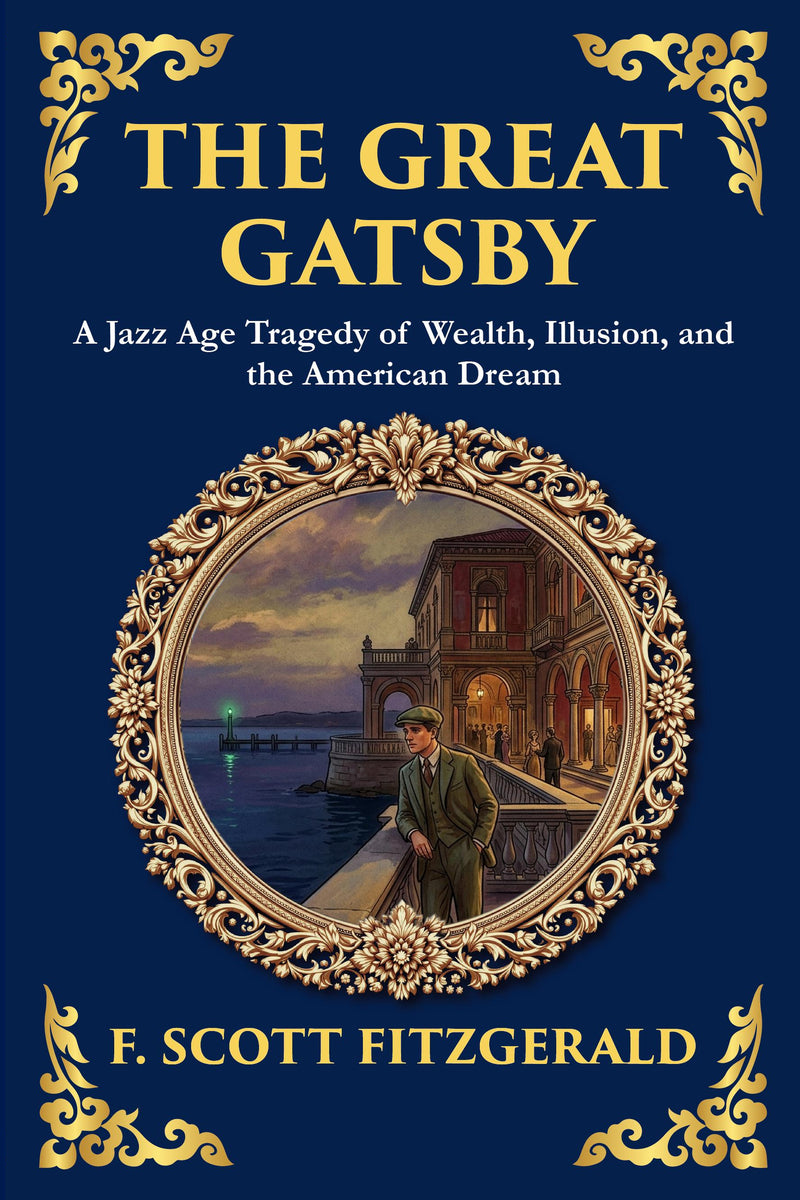
The Great Gatsby
In the glimmering world of the Roaring Twenties, where opulence masks emptiness and charm conceals longing, Jay Gatsby reigns as a mysterious millionaire with a dream that won’t die.
or free app
10,000+ hrs library
30-day guarantee
The complete The Great Gatsby appears in modern English through Library of Alexandria Press, available online with audiobook narration included for members.
Have you ever wondered why chasing a dream can leave you emptier than before? The Great Gatsby by F. Scott Fitzgerald is a haunting and lyrical portrait of a man who dares to dream too much. Set against the dazzling backdrop of the Jazz Age, this novel unravels the tragic tale of Jay Gatsby—a self-made millionaire obsessed with recreating a lost past and winning back the woman he loves.
Through the narration of Nick Carraway, a Yale graduate and neighbor to Gatsby, readers are drawn into a world of extravagant parties, gleaming mansions, and emotional ruin. Gatsby’s mansion is filled with guests, but his heart is fixated on one: Daisy Buchanan. As Gatsby attempts to rewrite history, Fitzgerald paints a sharp critique of the American Dream, exposing its illusion and emptiness.
What you’ll discover in this modern edition
- A Love Story Drenched in Tragedy – Witness Gatsby’s obsessive pursuit of Daisy, and the heartbreak that comes with it.
- A Portrait of the Roaring Twenties – Step into a world of jazz, excess, and social upheaval during America’s most decadent decade.
- A Critique of Wealth and Illusion – Explore how material success masks spiritual failure and moral decay.
- The Disintegration of the American Dream – See how dreams rooted in fantasy often lead to devastation.
- Fitzgerald’s Mastery of Language and Symbolism – From the green light at the end of Daisy’s dock to the eyes of Dr. T. J. Eckleburg, every detail matters.
| Formats | eBook (EPUB + PDF) · Audiobook · Paperback · Hardcover · Large Print |
| Language | English |
| Trim size (print) | 6 × 9 in |
| Binding | Paperback — perfect-bound · Hardcover — casewrap |
| Large Print edition | Same text in a larger, easy-read type — a larger font, not a larger trim |
| Print pricing | Every physical book at our true cost — at-cost, no profit (members) |
| Library | 873 restored titles, always growing |
| Length | 48,918 words · ~3 hr 16 min reading |
| Reading level | Grade 4 · an easy, flowing read (this modern-English edition) |
| Edition | Modern English translation · 2026 |
Member reviews for this edition are collected as readers finish it — be the first. Across the library: 12,000+ books shipped, every plan covered by a 365-day print guarantee.
About this edition
A faithful, unabridged modern-English edition by The Library of Alexandria — carefully rendered for today's reader and verified paragraph-by-paragraph against the public-domain source. Available as eBook, audiobook, paperback, hardcover, and large print.
- Complete & unabridgedVerified paragraph by paragraph against the source — never a scan, never abridged.
- Modern English, faithfulReadable today, with the author’s meaning kept intact. Readable — not simplified.
- Every format, one membershipRead in your browser or the free app, or listen to the full audiobook.
Included free with your membership
Cancel anytime, one click · 30-day money-back guarantee
Edition last updated July 2026
What’s inside
The Great Gatsby — complete and unabridged: all 10 sections included with membership, plus the full audiobook.
Begin reading The Great Gatsby
In clear modern English — the complete text is included with membership.
Introduction
There are certain books that seem to capture the entire spirit of an age within the boundaries of a few hundred pages, and there are even rarer books that, in capturing that spirit, manage to say something timeless about what it means to be human. The novel you are about to read belongs to that rarest category. Published in 1925, it arrived in a world giddy with new money, new music, and new freedoms—a world that believed, with a kind of intoxicated certainty, that the party would never end. It is a story about that belief, and about the price of clinging to it. It is a story about longing, about the gap between who we are and who we wish we could become, and about the strange, almost religious power of a dream to both elevate and destroy a person.
F. Scott Fitzgerald wrote this slender masterpiece when he was still a young man, barely into his late twenties, and yet he wrote it with the wisdom of someone who had already glimpsed the hollow center of his own glittering era. He understood that the 1920s in America were not merely a decade but a fever—a moment of feverish prosperity, reckless pleasure, and quiet desperation lurking just beneath the surface. He himself lived at the heart of that fever, dazzled by wealth and beauty, haunted by his own ambitions, and forever torn between celebrating the world of luxury and condemning it. That tension—the simultaneous attraction to and repulsion from a life of glamour—runs through every page of this book like an electric current, and it is part of what makes the reading experience so unforgettable.
This edition presents the novel in a modern translation, carefully adapted for the contemporary reader. The purpose of such an adaptation is not to diminish the original but to remove the small barriers that nearly a century of changing language can place between you and the heart of the story. Certain turns of phrase, certain references and rhythms of speech that would have been instantly familiar to a reader in 1925, can now require a footnote or a moment of puzzlement that pulls you out of the dream. By gently smoothing those edges, this version aims to give you the same immediate, immersive experience that the book’s first readers enjoyed—to let you fall into the world of summer parties and shimmering bays without stumbling over the cobblestones of a vanished vocabulary. What remains untouched is the soul of the work: the aching beauty of its emotion, the precision of its observations, and the haunting power of its conclusion.
A Portrait of an Age and the Man Who Captured It
To fully appreciate what you are holding, it helps to understand the world that produced it. The 1920s in America have come to be known as the Jazz Age, a phrase that Fitzgerald himself helped popularize. It was a decade that emerged from the shadow of a devastating world war, a conflict that had shattered old certainties and left a generation of young people determined to live as intensely as possible. The economy was booming. Fortunes were being made overnight in the stock market and in the booming new industries. Automobiles, once luxuries, were filling the roads. Skyscrapers were rising. Radio was filling living rooms with music and voices from across the country. And everywhere, there was a sense that the rules were changing—that the old, stuffy, Victorian way of life was being swept aside by something faster, louder, and more thrilling.
It was also the era of Prohibition, a time when the manufacture and sale of alcohol were illegal across the United States. Far from ending the nation’s thirst, this ban created a vast underground economy of speakeasies, smugglers, and bootleggers. Ordinary citizens broke the law nightly, sipping cocktails in hidden bars, while criminal organizations grew rich and powerful on the trade. There was a delicious hypocrisy in the air—a society that publicly preached restraint while privately indulging in excess. This contradiction is woven deeply into the fabric of the story you are about to read, where the source of wealth is not always asked about too closely, and where the line between respectability and corruption is blurrier than anyone cares to admit.
Music was the heartbeat of the decade. Jazz, born in the African American communities of New Orleans and other cities, had spread across the nation and become the soundtrack of modern life. It was improvisational, sensual, and unpredictable—everything the older generation found alarming and the younger generation found liberating. Dance halls pulsed with new rhythms, and young women known as flappers cut their hair short, raised their hemlines, and danced with an abandon that scandalized their elders. The whole culture seemed to be in motion, throwing off the past and racing toward an undefined but exhilarating future.
And yet, beneath all of this brightness, there was a profound emptiness that thoughtful observers could not ignore. The pursuit of pleasure for its own sake left many feeling hollow. The worship of money corroded older values of community, family, and meaning. The dizzying social mobility of the era—the sense that anyone could reinvent themselves and rise to the top—came with a dark underside, a sense that identity itself had become unstable, that a person could be made and unmade, that appearances might be all there was. Fitzgerald saw this with extraordinary clarity. He was not merely a chronicler of parties and pretty dresses; he was a moralist with the eye of a poet, recording both the splendor and the rot.
Fitzgerald’s own life was bound up with these themes in painful and intimate ways. Born in Minnesota in 1896 to a family of modest means with aspirations toward gentility, he grew up acutely aware of social class. He attended Princeton University but never graduated, and he spent much of his life on the outside of the privileged world he longed to enter. His great love and eventual wife, the brilliant and troubled Zelda, initially refused to marry him until he could prove that he could support her in the style she expected. That experience—of being rejected because he was not yet wealthy enough, of having to chase money in order to win love—burned itself into his imagination. The desperate striving of a man who reinvents himself to win back a woman who once seemed beyond his reach was not an abstract idea to Fitzgerald. It was the story of his own heart.
This personal dimension gives the novel its emotional authenticity. Fitzgerald understood from the inside what it feels like to gaze at the world of the wealthy from just outside its golden circle. He understood the seductive promise of money—the way it seems to offer not just comfort but transformation, the ability to become a new and better version of oneself. And he understood, too, the terrible disappointment that often waits at the end of that pursuit, when the dream that drove a person forward turns out to be either unattainable or, worse, unworthy of the longing it inspired. These insights are not delivered as lectures. They emerge organically through character and image and event, which is the mark of a true artist.
The novel was not an enormous commercial success when it first appeared. Fitzgerald, who had enjoyed early fame with his first novels, was somewhat disappointed by its reception. He died in 1940 at the age of forty-four, believing himself largely forgotten, never knowing that the book he considered his finest achievement would one day be regarded as one of the greatest American novels ever written. It was only in the decades after his death—particularly during and after the Second World War, when copies were distributed to soldiers—that the book found its true and lasting audience. Today it is read in classrooms around the world, studied by scholars, adapted for film and stage, and beloved by ordinary readers who find in it something that speaks directly to their own hopes and disappointments. There is a poignant justice in this. The story is, after all, about a man who reaches for an immortality of meaning and is denied it in his own lifetime. Its author, too, achieved his greatest recognition only after he was gone.
The Art of the Story and Its Enduring Power
What makes this novel endure is not its plot, which is in many ways simple, but the extraordinary craft with which it is told. Fitzgerald was a writer of remarkable economy. He could suggest entire worlds of feeling in a single sentence, conjure a character’s whole nature with one telling gesture, and evoke an atmosphere so vivid that you feel the warm summer air and hear the distant music of a party drifting across the water. Reading the book is a sensory experience as much as an intellectual one. You will find yourself transported to lavish mansions on the shores of a wealthy enclave, to the heat and dust of a desolate stretch of road, to the crowded glamour of city hotels and restaurants. The settings are not mere backdrops; they breathe and pulse with meaning.
One of the most brilliant choices Fitzgerald made was in how he tells the story. Rather than presenting events directly, he filters them through the eyes of a narrator who is both inside the world he describes and slightly apart from it—an observer with his own quiet judgments and growing sense of unease. This narrative approach is central to the experience of reading the book. You will not be handed easy conclusions. Instead, you will be invited to watch, to wonder, and gradually to understand. The narrator’s perspective is shaped by his own values and limitations, which means that part of the pleasure of reading lies in noticing what he notices, in sensing what he leaves unsaid, and in forming your own response to the people and events he describes. This subtlety rewards careful reading. The story unfolds in layers, and details that seem incidental on a first encounter often reveal themselves to be deeply significant.
The central figure of the novel is one of the most fascinating and mysterious characters in all of literature. He is a man surrounded by rumor and speculation, a host of legendary parties whose own past is shrouded in uncertainty. As the story progresses, the truth about him gradually emerges, and what we discover is both surprising and deeply moving. He is a dreamer of almost mythic proportions, a man who has constructed an entire life around a single, shining hope. There is something both magnificent and tragic about the intensity of his longing—magnificent because it represents the human capacity to imagine and strive for something greater than the ordinary, tragic because it sets him on a collision course with a reality that cannot possibly live up to his vision. Whether you come to admire him, pity him, or both, he will linger in your imagination long after you have finished the final page.
The themes that the novel explores are as relevant today as they were a century ago, perhaps even more so. At its heart, this is a meditation on the American Dream—the powerful and seductive idea that anyone, regardless of where they begin, can achieve wealth, status, and happiness through sheer effort and determination. The book examines this dream with unflinching honesty. It acknowledges the beauty and the necessity of dreaming, the way that aspiration gives life energy and direction. But it also exposes the dream’s darker dimensions: the way it can curdle into mere greed, the way it can blind a person to the genuine human connections in front of them, the way it can lead someone to mistake the symbols of success for success itself. In an age like our own, obsessed with wealth, image, and the endless pursuit of more, these questions feel urgent and personal.
The novel also offers a searching examination of social class and the barriers that divide people. It draws a careful distinction between those who are born into wealth and those who acquire it, between old money with its inherited confidence and casual cruelty, and new money with its eagerness and insecurity. These distinctions matter enormously to the characters, and they shape the tragedy that unfolds. Fitzgerald was acutely sensitive to the subtle codes that mark social belonging—the way one speaks, dresses, entertains, the things one knows without being taught. He shows how these invisible boundaries can be more impenetrable than any wall, and how the dream of crossing them can drive a person to extraordinary lengths.
Cancel anytime, one click · 30-day money-back guarantee
Founding annual rate available now — your price locks for life when you join.
Not ready? Get this free chapter by email — read it anytime.
✓ Sent — check your inbox for The Great Gatsby.
Questions about The Great Gatsby
What is The Great Gatsby about?
In the glimmering world of the Roaring Twenties, where opulence masks emptiness and charm conceals longing, Jay Gatsby reigns as a mysterious millionaire with a dream that won’t die. Behind the dazzling parties and shimmering lights lies a tale of obsession, illusion, and lost love. Through the eyes of Nick Carraway, The Great Gatsby reveals the seductive allure—and ultimate emptiness—of the American Dream.
Who wrote The Great Gatsby?
The Great Gatsby was written by F. Scott Fitzgerald. This edition presents the complete work in clear modern English, faithfully rendered from the public-domain original by Library of Alexandria Press.
Is The Great Gatsby free to read?
The opening chapter is free to read on this page. Members read and listen to the complete work — and the entire library — free, and can order any physical book at our true print cost.
How long is The Great Gatsby?
10 chapters (~48,918 words) — about 3 hr 16 min of reading in this modern-English edition.
Is this an abridged version of The Great Gatsby?
No. This is the complete, unabridged The Great Gatsby, carefully rendered into clear modern English and verified paragraph-by-paragraph against the public-domain source — nothing is cut or summarised.
What formats does The Great Gatsby come in?
The Great Gatsby is available as eBook, paperback, hardcover and large print. eBook and audiobook are included with membership; printed editions ship at our true print cost.
Shipping & returns
Billing & membership
More from the library


Explore Classic & Literary
- Dream Psychology: Psychoanalysis for Beginners · Sigmund Freud
- Great Expectations · Charles Dickens
- The Brothers Karamazov · Fyodor Dostoyevsky
- Wild Flowers Worth Knowing · Neltje Blanchan
- Italian Hours · Henry James
- A Popular History of France from the Earliest Times, Volume 5 · François Guizot
- A history of English literature: A practical text-book · Edward Albert
- Italian Highways and Byways from a Motor Car · M. F. Mansfield
- The Heart-Cry of Jesus · Byron J. Rees
- Castes and Tribes of Southern India. Vol. 6 of 7 · Edgar Thurston
- Against the Grain · J.-K. Huysmans
- Dombey and Son · Charles Dickens
- How to Invest Money · George Garr Henry
- The Great Controversy Between Christ and Satan · Ellen Gould Harmon White
- One Hundred Proofs That the Earth Is Not a Globe · William Carpenter
- Southern Literature From 1579–1895 · Louise Manly
- The Renaissance: Studies in Art and Poetry · Walter Pater
- Mark Twain’s Speeches · Mark Twain
- Tacitus on Germany · Cornelius Tacitus
- The Rosary · Florence L. Barclay
- Peculiarities of American Cities · Willard W. Glazier
- Tennis for Girls · Florence A. Ballin
- The World’s Greatest Books — Volume 02 — Fiction
- Shirley · Charlotte Brontë
- Daisy Miller: A Study · Henry James
- Louis Lambert · Honoré de Balzac
- Historic Jamaica · Frank Cundall
- The Gambler · Fyodor Dostoyevsky
- The Mayor of Casterbridge · Thomas Hardy
- The International Jew: The World’s Foremost Problem
The Great Gatsby
The Great Gatsby
A Jazz Age Tragedy of Wealth, Illusion, and the American Dream
F. Scott Fitzgerald
Contents
- Introduction
- Chapter 1
- Chapter 2
- Chapter 3
- Chapter 4
- Chapter 5
- Chapter 6
- Chapter 7
- Chapter 8
- Chapter 9
Introduction
There are certain books that seem to capture the entire spirit of an age within the boundaries of a few hundred pages, and there are even rarer books that, in capturing that spirit, manage to say something timeless about what it means to be human. The novel you are about to read belongs to that rarest category. Published in 1925, it arrived in a world giddy with new money, new music, and new freedoms—a world that believed, with a kind of intoxicated certainty, that the party would never end. It is a story about that belief, and about the price of clinging to it. It is a story about longing, about the gap between who we are and who we wish we could become, and about the strange, almost religious power of a dream to both elevate and destroy a person.
F. Scott Fitzgerald wrote this slender masterpiece when he was still a young man, barely into his late twenties, and yet he wrote it with the wisdom of someone who had already glimpsed the hollow center of his own glittering era. He understood that the 1920s in America were not merely a decade but a fever—a moment of feverish prosperity, reckless pleasure, and quiet desperation lurking just beneath the surface. He himself lived at the heart of that fever, dazzled by wealth and beauty, haunted by his own ambitions, and forever torn between celebrating the world of luxury and condemning it. That tension—the simultaneous attraction to and repulsion from a life of glamour—runs through every page of this book like an electric current, and it is part of what makes the reading experience so unforgettable.
This edition presents the novel in a modern translation, carefully adapted for the contemporary reader. The purpose of such an adaptation is not to diminish the original but to remove the small barriers that nearly a century of changing language can place between you and the heart of the story. Certain turns of phrase, certain references and rhythms of speech that would have been instantly familiar to a reader in 1925, can now require a footnote or a moment of puzzlement that pulls you out of the dream. By gently smoothing those edges, this version aims to give you the same immediate, immersive experience that the book’s first readers enjoyed—to let you fall into the world of summer parties and shimmering bays without stumbling over the cobblestones of a vanished vocabulary. What remains untouched is the soul of the work: the aching beauty of its emotion, the precision of its observations, and the haunting power of its conclusion.
A Portrait of an Age and the Man Who Captured It
To fully appreciate what you are holding, it helps to understand the world that produced it. The 1920s in America have come to be known as the Jazz Age, a phrase that Fitzgerald himself helped popularize. It was a decade that emerged from the shadow of a devastating world war, a conflict that had shattered old certainties and left a generation of young people determined to live as intensely as possible. The economy was booming. Fortunes were being made overnight in the stock market and in the booming new industries. Automobiles, once luxuries, were filling the roads. Skyscrapers were rising. Radio was filling living rooms with music and voices from across the country. And everywhere, there was a sense that the rules were changing—that the old, stuffy, Victorian way of life was being swept aside by something faster, louder, and more thrilling.
It was also the era of Prohibition, a time when the manufacture and sale of alcohol were illegal across the United States. Far from ending the nation’s thirst, this ban created a vast underground economy of speakeasies, smugglers, and bootleggers. Ordinary citizens broke the law nightly, sipping cocktails in hidden bars, while criminal organizations grew rich and powerful on the trade. There was a delicious hypocrisy in the air—a society that publicly preached restraint while privately indulging in excess. This contradiction is woven deeply into the fabric of the story you are about to read, where the source of wealth is not always asked about too closely, and where the line between respectability and corruption is blurrier than anyone cares to admit.
Music was the heartbeat of the decade. Jazz, born in the African American communities of New Orleans and other cities, had spread across the nation and become the soundtrack of modern life. It was improvisational, sensual, and unpredictable—everything the older generation found alarming and the younger generation found liberating. Dance halls pulsed with new rhythms, and young women known as flappers cut their hair short, raised their hemlines, and danced with an abandon that scandalized their elders. The whole culture seemed to be in motion, throwing off the past and racing toward an undefined but exhilarating future.
And yet, beneath all of this brightness, there was a profound emptiness that thoughtful observers could not ignore. The pursuit of pleasure for its own sake left many feeling hollow. The worship of money corroded older values of community, family, and meaning. The dizzying social mobility of the era—the sense that anyone could reinvent themselves and rise to the top—came with a dark underside, a sense that identity itself had become unstable, that a person could be made and unmade, that appearances might be all there was. Fitzgerald saw this with extraordinary clarity. He was not merely a chronicler of parties and pretty dresses; he was a moralist with the eye of a poet, recording both the splendor and the rot.
Fitzgerald’s own life was bound up with these themes in painful and intimate ways. Born in Minnesota in 1896 to a family of modest means with aspirations toward gentility, he grew up acutely aware of social class. He attended Princeton University but never graduated, and he spent much of his life on the outside of the privileged world he longed to enter. His great love and eventual wife, the brilliant and troubled Zelda, initially refused to marry him until he could prove that he could support her in the style she expected. That experience—of being rejected because he was not yet wealthy enough, of having to chase money in order to win love—burned itself into his imagination. The desperate striving of a man who reinvents himself to win back a woman who once seemed beyond his reach was not an abstract idea to Fitzgerald. It was the story of his own heart.
This personal dimension gives the novel its emotional authenticity. Fitzgerald understood from the inside what it feels like to gaze at the world of the wealthy from just outside its golden circle. He understood the seductive promise of money—the way it seems to offer not just comfort but transformation, the ability to become a new and better version of oneself. And he understood, too, the terrible disappointment that often waits at the end of that pursuit, when the dream that drove a person forward turns out to be either unattainable or, worse, unworthy of the longing it inspired. These insights are not delivered as lectures. They emerge organically through character and image and event, which is the mark of a true artist.
The novel was not an enormous commercial success when it first appeared. Fitzgerald, who had enjoyed early fame with his first novels, was somewhat disappointed by its reception. He died in 1940 at the age of forty-four, believing himself largely forgotten, never knowing that the book he considered his finest achievement would one day be regarded as one of the greatest American novels ever written. It was only in the decades after his death—particularly during and after the Second World War, when copies were distributed to soldiers—that the book found its true and lasting audience. Today it is read in classrooms around the world, studied by scholars, adapted for film and stage, and beloved by ordinary readers who find in it something that speaks directly to their own hopes and disappointments. There is a poignant justice in this. The story is, after all, about a man who reaches for an immortality of meaning and is denied it in his own lifetime. Its author, too, achieved his greatest recognition only after he was gone.
The Art of the Story and Its Enduring Power
What makes this novel endure is not its plot, which is in many ways simple, but the extraordinary craft with which it is told. Fitzgerald was a writer of remarkable economy. He could suggest entire worlds of feeling in a single sentence, conjure a character’s whole nature with one telling gesture, and evoke an atmosphere so vivid that you feel the warm summer air and hear the distant music of a party drifting across the water. Reading the book is a sensory experience as much as an intellectual one. You will find yourself transported to lavish mansions on the shores of a wealthy enclave, to the heat and dust of a desolate stretch of road, to the crowded glamour of city hotels and restaurants. The settings are not mere backdrops; they breathe and pulse with meaning.
One of the most brilliant choices Fitzgerald made was in how he tells the story. Rather than presenting events directly, he filters them through the eyes of a narrator who is both inside the world he describes and slightly apart from it—an observer with his own quiet judgments and growing sense of unease. This narrative approach is central to the experience of reading the book. You will not be handed easy conclusions. Instead, you will be invited to watch, to wonder, and gradually to understand. The narrator’s perspective is shaped by his own values and limitations, which means that part of the pleasure of reading lies in noticing what he notices, in sensing what he leaves unsaid, and in forming your own response to the people and events he describes. This subtlety rewards careful reading. The story unfolds in layers, and details that seem incidental on a first encounter often reveal themselves to be deeply significant.
The central figure of the novel is one of the most fascinating and mysterious characters in all of literature. He is a man surrounded by rumor and speculation, a host of legendary parties whose own past is shrouded in uncertainty. As the story progresses, the truth about him gradually emerges, and what we discover is both surprising and deeply moving. He is a dreamer of almost mythic proportions, a man who has constructed an entire life around a single, shining hope. There is something both magnificent and tragic about the intensity of his longing—magnificent because it represents the human capacity to imagine and strive for something greater than the ordinary, tragic because it sets him on a collision course with a reality that cannot possibly live up to his vision. Whether you come to admire him, pity him, or both, he will linger in your imagination long after you have finished the final page.
The themes that the novel explores are as relevant today as they were a century ago, perhaps even more so. At its heart, this is a meditation on the American Dream—the powerful and seductive idea that anyone, regardless of where they begin, can achieve wealth, status, and happiness through sheer effort and determination. The book examines this dream with unflinching honesty. It acknowledges the beauty and the necessity of dreaming, the way that aspiration gives life energy and direction. But it also exposes the dream’s darker dimensions: the way it can curdle into mere greed, the way it can blind a person to the genuine human connections in front of them, the way it can lead someone to mistake the symbols of success for success itself. In an age like our own, obsessed with wealth, image, and the endless pursuit of more, these questions feel urgent and personal.
The novel also offers a searching examination of social class and the barriers that divide people. It draws a careful distinction between those who are born into wealth and those who acquire it, between old money with its inherited confidence and casual cruelty, and new money with its eagerness and insecurity. These distinctions matter enormously to the characters, and they shape the tragedy that unfolds. Fitzgerald was acutely sensitive to the subtle codes that mark social belonging—the way one speaks, dresses, entertains, the things one knows without being taught. He shows how these invisible boundaries can be more impenetrable than any wall, and how the dream of crossing them can drive a person to extraordinary lengths.
When I was younger and more vulnerable, my father gave me some advice that I’ve been thinking about ever since.
“Whenever you feel like criticizing someone,” he told me, “just remember that not everyone in the world has had the same advantages you’ve had.”
He didn’t say anything else, but we’ve always been able to communicate a lot without saying much, and I knew he meant far more than that. Because of this, I tend to avoid judging people. This habit has led many interesting people to open up to me, though it has also made me a target for quite a few professional bores. People with unstable personalities are quick to spot and cling to this quality in a normal person. That’s why, in college, I was unfairly called a politician, simply because I knew the secret sorrows of strange, unknown men. Most of these confessions were unasked for. I often pretended to be asleep, distracted, or jokingly dismissive when I realized someone was about to share a deep secret; the “intimate revelations” of young men—or at least the way they describe them—are usually cliché and full of obvious omissions. Avoiding judgment is an act of endless hope. I’m still a little afraid of missing something if I forget that—as my father snobbishly suggested, and I snobbishly repeat—a basic sense of decency isn’t distributed equally at birth.
Even after bragging about my tolerance, I have to admit it has its limits. A person’s behavior might be based on a solid foundation or a shaky one, but after a certain point, I stop caring what that foundation is. When I returned from the East last autumn, I felt like I wanted the whole world to be in uniform and standing at moral attention forever; I didn’t want any more chaotic journeys into the depths of the human heart. Only Gatsby, the man this book is named after, was an exception—and Gatsby represented everything I usually despise. If personality is just a series of successful performances, then there was something magnificent about him, a heightened sensitivity to the possibilities of life, as if he were like one of those complex machines that can detect earthquakes from ten thousand miles away. This wasn’t the kind of flimsy emotionalism people call a “creative temperament”—it was an extraordinary capacity for hope, a romantic readiness I’ve never seen in anyone else and likely never will again. In the end, Gatsby turned out fine; it was what preyed on him, the foul dust that followed his dreams, that made me lose interest in the failed sorrows and brief joys of other men.
End of the free sample
Keep reading, free
Members read and listen to the complete book — and the entire library. Cancel anytime, one click · 30-day money-back guarantee.