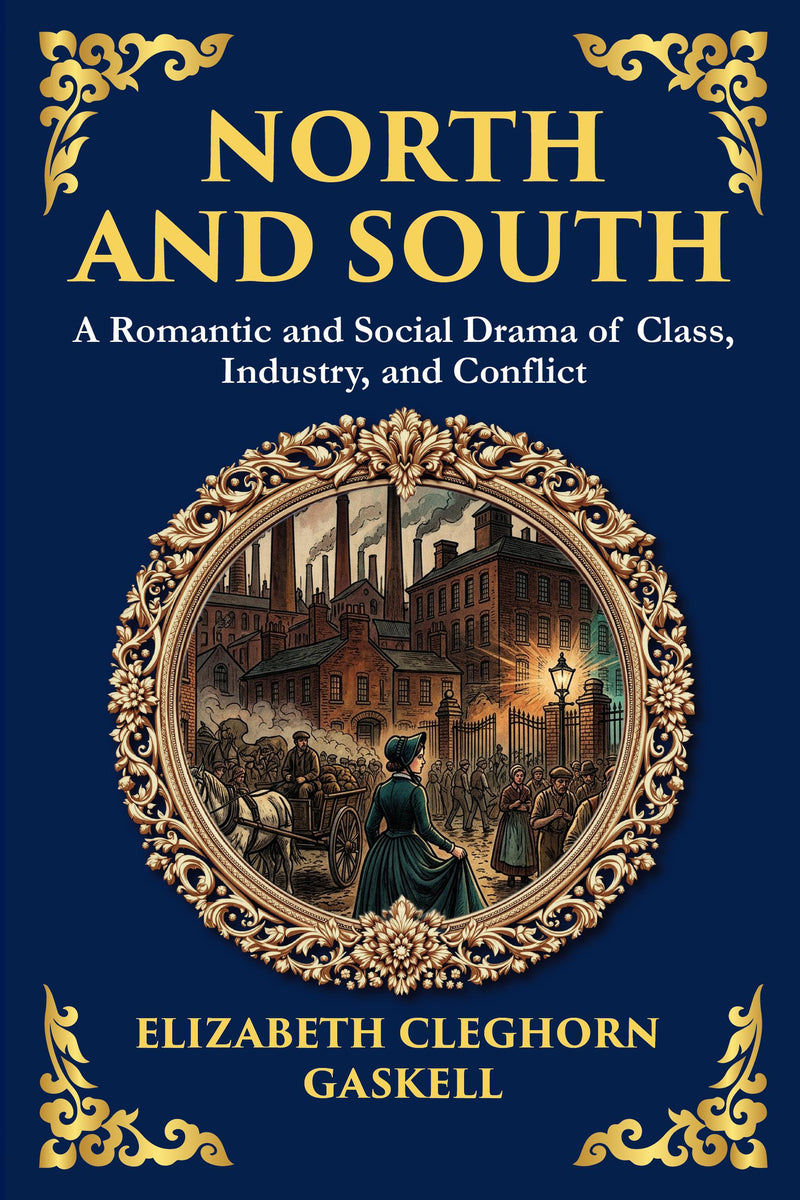
North and South
Elizabeth Gaskell A tale of love, pride, and transformation amidst the turbulent backdrop of England’s Industrial Revolution.
or free app
10,000+ hrs library
30-day guarantee
The complete North and South appears in modern English through Library of Alexandria Press, available online with audiobook narration included for members.
Have you ever wondered why love and social change often collide during times of great upheaval? In North and South, Elizabeth Gaskell weaves a powerful narrative of love, conflict, and transformation set against the dramatic backdrop of the Industrial Revolution. This beloved classic delves into the human stories behind the sweeping changes of a rapidly industrializing society.
Margaret Hale’s life is turned upside down when her family moves from the tranquil countryside to the gritty, smoke-filled city of Milton. There, she encounters stark class divisions, labor strikes, and the harsh realities of industrial life. At the center of it all is John Thornton, a self- made mill owner whose unyielding pride and determination to succeed often put him at odds with Margaret’s ideals of justice and compassion.
As tensions between workers and masters intensify, Margaret finds herself drawn into a complex web of loyalty, love, and social responsibility. Their fiery relationship—marked by misunderstandings, respect, and deep passion—unfolds amidst the backdrop of strikes, protests, and the struggle for workers’ rights.
What you’ll discover in this modern edition
- A Moving Love Story – Experience the slow-burning romance between Margaret Hale and John Thornton as they navigate personal pride and societal expectations.
- Industrial Revolution Drama – Explore the lives of workers, mill owners, and families living through the upheaval of England’s manufacturing boom.
- Themes of Social Justice and Compassion – Witness the clash between tradition and progress, wealth and poverty, power and empathy.
- Richly Drawn Characters and Relationships – Meet unforgettable characters whose struggles and triumphs reflect timeless human experiences.
- A Blend of Romance and Social Commentary – Discover why this novel remains one of the most celebrated works of 19th-century literature.
| Formats | eBook (EPUB + PDF) · Audiobook · Paperback · Hardcover · Large Print |
| Language | English |
| Trim size (print) | 6 × 9 in |
| Binding | Paperback — perfect-bound · Hardcover — casewrap |
| Large Print edition | Same text in a larger, easy-read type — a larger font, not a larger trim |
| Print pricing | Every physical book at our true cost — at-cost, no profit (members) |
| Library | 873 restored titles, always growing |
| Length | 169,543 words · ~11 hr 18 min reading |
| Reading level | Grade 6 · an easy, flowing read (this modern-English edition) |
| Edition | Modern English translation · 2026 |
Member reviews for this edition are collected as readers finish it — be the first. Across the library: 12,000+ books shipped, every plan covered by a 365-day print guarantee.
About this edition
A faithful, unabridged modern-English edition by The Library of Alexandria — carefully rendered for today's reader and verified paragraph-by-paragraph against the public-domain source. Available as eBook, audiobook, paperback, hardcover, and large print.
- Complete & unabridgedVerified paragraph by paragraph against the source — never a scan, never abridged.
- Modern English, faithfulReadable today, with the author’s meaning kept intact. Readable — not simplified.
- Every format, one membershipRead in your browser or the free app, or listen to the full audiobook.
Included free with your membership
Cancel anytime, one click · 30-day money-back guarantee
Edition last updated July 2026
What’s inside
North and South — complete and unabridged: all 53 sections included with membership, plus the full audiobook.
Begin reading North and South
In clear modern English — the complete text is included with membership.
Introduction
When Elizabeth Gaskell sat down to write the novel that would become one of the defining works of Victorian literature, she did so with a peculiar disadvantage and an extraordinary advantage all at once. The disadvantage was that she was attempting something genuinely difficult: to take the raw, smoke-blackened reality of industrial England—a subject many of her contemporaries found either too sordid or too dull for serious fiction—and forge it into a story of feeling, argument, and human transformation. The advantage was that she knew this world intimately. As the wife of a Unitarian minister in Manchester, she had walked the streets where mill workers lived and died, had sat with the dying and the destitute, had heard the arguments of masters and the grievances of men. The result is a book that pulses with the heat of furnaces and the chill of moral uncertainty, a novel that refuses easy answers and instead invites its reader into one of the most honest conversations the nineteenth century ever produced about how people who do not understand one another might learn to.
This edition presents that conversation to you in a modern translation, carefully adapted for the contemporary reader. What does that mean in practice, and why should it matter to you as you begin? It means that the obstacles which sometimes stand between a modern reader and a Victorian masterpiece—the dense thickets of period syntax, the vocabulary that has drifted out of use, the rhythms of speech that can feel ornate or oblique to ears trained on twenty-first-century prose—have been thoughtfully smoothed without sacrificing the substance, the intelligence, or the emotional power of the original. The aim has not been to simplify Gaskell or to dilute her, but to remove the friction that can cause a reader to set a great book aside before its greatness has had a chance to declare itself. The thoughts remain hers. The story remains hers. The fierce moral seriousness, the wit, the slow-burning romance, the social anger—all of it is preserved. What you hold is an invitation rather than an obstacle course.
And it is worth understanding, before you begin, just how worth the journey this particular book is. Gaskell’s novel has endured for more than a century and a half not because it is a relic of a vanished age but because it speaks to questions that have never stopped being urgent. How should we treat the people whose labor builds our comforts? What do the privileged owe to the poor, and what, if anything, do the poor owe to those above them? Can people raised in opposite circumstances—opposite values, opposite assumptions about how the world should run—ever truly see one another clearly enough to love or respect one another? These are not antique concerns. They sit at the center of our own political and personal lives, and Gaskell examines them with a steadiness and generosity that few writers, then or now, have matched.
A Writer of Conscience and the World That Made Her
To read this novel well, it helps to know something of the remarkable woman who wrote it and the turbulent moment in history she was writing about. Elizabeth Cleghorn Gaskell, born Elizabeth Stevenson in 1810, came of age in a Britain being remade by the most violent and rapid economic transformation the world had ever seen. The Industrial Revolution had turned sleepy market towns into roaring centers of manufacture almost overnight. Cities like Manchester—the great cotton metropolis that stands behind the fictional industrial town of this novel—swelled with workers who had left the countryside in search of wages, only to find themselves packed into overcrowded districts, breathing air thick with cotton fibers, laboring impossible hours in deafening mills, and living at the mercy of trade cycles they could neither understand nor control. Fortunes were made and unmade with terrifying speed. A few men grew enormously rich. Many more lived a hand’s breadth from ruin.
Gaskell saw all of this directly. In 1832 she married William Gaskell, a Unitarian minister whose ministry placed him at the heart of Manchester’s intellectual and charitable life. Unitarianism, with its emphasis on reason, social responsibility, and the dignity of every individual, shaped Elizabeth profoundly. Through her husband’s work and her own efforts, she came to know mill workers not as an abstraction or a statistic but as neighbors, parishioners, and friends. She visited the sick and the grieving. She understood the texture of working-class life—its pride and its precariousness, its dialect and its dignity—in a way that almost no other novelist of her standing did. This is why her industrial scenes carry such conviction. She was not slumming or reporting from a safe distance. She had been there.
Her first novel, Mary Barton, published in 1848, drew on this knowledge to portray the sufferings of Manchester’s poor with such sympathy that some manufacturers accused her of bias against the masters. The charge stung, and it is one of the keys to understanding the book before you. For when Gaskell came to write this later, greater work, she set herself a more ambitious and more balanced task. She would not simply champion the workers against the owners. Instead she would try to understand both—to inhabit the perspective of the manufacturer as fully as that of the laborer, to grant each side its reasons, its grievances, and its blindness. The novel was first published in serial form in Household Words, the magazine edited by Charles Dickens, between 1854 and 1855, and then issued as a complete book. It represents a deliberate broadening of her vision, an attempt to hold contradictory truths in a single steady gaze.
That word steady matters. One of the most striking things about Gaskell as a writer is her refusal to flatten her characters into heroes and villains. The figures who populate this story are complicated, contradictory, and capable of change. The manufacturer who seems hard and unfeeling has reasons for his hardness, and a depth of integrity beneath it. The worker who seems merely a victim is also a man of conviction and intelligence, capable of his own kind of stubbornness and error. Even the characters who are wrong are wrong for reasons we can understand. This is the moral generosity that makes Gaskell so rewarding. She does not let us off the hook by handing us someone simple to despise. She makes us think.
She was, it should be said, an artist as much as a moralist. She had a gift for the small, telling detail—the way a room is arranged, the way a person’s hands move when they are nervous, the particular silence that falls between two people who have wounded one another. She understood the slow choreography of misunderstanding, how two intelligent people can talk past each other for chapters, each convinced of their own rightness, each unaware of how they appear to the other. And she understood the long, difficult, beautiful process by which understanding finally arrives—not as a sudden revelation but as an accumulation of moments, observations, and reluctant admissions. This patience is one of the great pleasures of the book, and it rewards a reader willing to slow down and watch its characters grow.
It is worth noting, too, that Gaskell wrote at a time when women novelists were often confined to the domestic sphere—to courtship, marriage, and the management of households. She wrote about those things superbly. But she also insisted on her right to write about the public world: about economics, labor, strikes, poverty, and the structures of power. In doing so she helped to expand what the novel could be and what a woman writer was permitted to attempt. The book you are about to read is at once an intimate story of the heart and a sweeping examination of a society in crisis, and Gaskell saw no contradiction between the two. For her, the personal and the political were always intertwined. How we treat the people closest to us and how we treat the strangers whose labor sustains us were, in her view, two expressions of the same fundamental question: do we recognize the full humanity of others, or do we not?
The Heart of the Story: Worlds in Collision
Without revealing the turns of the plot—which you deserve to discover for yourself, unspoiled—it is worth sketching the architecture of feeling and idea that gives this novel its remarkable power. The title itself announces the book’s great theme: a collision between two worlds, two ways of life, two sets of values, embodied in the contrast between the gentle, settled, traditional south of England and the harsh, dynamic, money-driven industrial north. The protagonist is a young woman who has grown up in the soft beauty of the rural south, surrounded by the gentility and quiet rhythms of a clergyman’s household and the casual elegance of London society. When circumstances uproot her and transplant her into the smoke and clamor of a northern manufacturing town, she experiences something like culture shock—a profound disorientation that the novel renders with great psychological precision.
This is, at its heart, a story about a person learning to see. When she first arrives in the industrial north, our heroine carries with her all the prejudices of her upbringing. She finds the place ugly, the people coarse, the obsession with trade and money vulgar and beneath her. The manufacturers strike her as brutal materialists; the whole frantic enterprise of industry seems to her a betrayal of everything refined and humane. And yet, as the novel proceeds, she is forced—slowly, painfully, against her own resistance—to revise these judgments. She comes to see that there is integrity, intelligence, and even a rough nobility in this world she had despised. She discovers that the people she dismissed are capable of depths she never imagined. And she is compelled to recognize the limitations and the complacencies of her own background, the comfortable assumptions she had mistaken for truths.
This education of perception is mirrored in the novel’s central relationship, which I will not describe in detail except to say that it is one of the most justly celebrated love stories in English literature precisely because it is so hard-won. This is not a romance of instant attraction and easy resolution. It is a romance built on conflict, misunderstanding, wounded pride, and the long labor of learning to know another person truly. The two figures at its center begin as something close to antagonists, divided by class, by temperament, by a series of misjudgments that each makes about the other. What unfolds between them is a drama of gradual, reluctant revision—each forced to confront the ways they have misread the other, each humbled, each transformed. The emotional satisfaction of such a story comes not from the inevitability of its conclusion but from the genuine difficulty of the road that leads there. We believe in these characters because we have watched them earn their understanding.
Surrounding this central relationship is a richly populated social world, and here Gaskell’s even-handedness comes fully into play. The novel takes us inside the world of the masters—the manufacturers who own the mills and direct the great machinery of industry, who must navigate brutal competition, fluctuating markets, and the constant threat of ruin. It also takes us inside the world of the workers—the men and women who labor in the mills, who organize and strike for better wages, who suffer the diseases bred by cotton dust and the desperation bred by unemployment. Gaskell gives us a major strike, rendered with extraordinary vividness and fairness, in which we are made to understand the logic and the legitimate grievances of both sides. We see why the workers strike. We also see why the masters resist. We feel the human cost of the conflict as it falls on individuals caught in the machinery of economic forces larger than themselves.
What makes this so compelling, even today, is Gaskell’s refusal to offer a simple ideological solution. She is not writing propaganda. She does not pretend that there is an easy answer to the conflict between labor and capital, between the legitimate needs of workers and the legitimate pressures on owners. Instead, she dramatizes the problem in all its complexity and suggests—tentatively, hopefully—that the beginning of any solution lies in human contact, in conversation, in the willingness of people on opposite sides of a divide to sit down and actually speak to one another as fellow human beings. The novel’s faith, finally, is in understanding: in the slow, difficult work of seeing across the barriers of class and prejudice and self-interest to recognize the shared humanity on the other side. It is a faith that the central characters must learn to share, and the personal and political strands of the story converge on exactly this point.
Cancel anytime, one click · 30-day money-back guarantee
Founding annual rate available now — your price locks for life when you join.
Not ready? Get this free chapter by email — read it anytime.
✓ Sent — check your inbox for North and South.
Questions about North and South
What is North and South about?
Elizabeth Gaskell A tale of love, pride, and transformation amidst the turbulent backdrop of England’s Industrial Revolution. When Margaret Hale is uprooted from her peaceful rural home to the bustling industrial town of Milton, she is thrust into a world of poverty, class division, and labor unrest. At the heart of this conflict stands John Thornton, a wealthy mill owner whose stern demeanor masks a heart yearning for understanding.
Who wrote North and South?
North and South was written by Elizabeth Cleghorn Gaskell. This edition presents the complete work in clear modern English, faithfully rendered from the public-domain original by Library of Alexandria Press.
Is North and South free to read?
The opening chapter is free to read on this page. Members read and listen to the complete work — and the entire library — free, and can order any physical book at our true print cost.
How long is North and South?
53 chapters (~169,543 words) — about 11 hr 18 min of reading in this modern-English edition.
Is this an abridged version of North and South?
No. This is the complete, unabridged North and South, carefully rendered into clear modern English and verified paragraph-by-paragraph against the public-domain source — nothing is cut or summarised.
What formats does North and South come in?
North and South is available as eBook, paperback and hardcover. eBook and audiobook are included with membership; printed editions ship at our true print cost.
Shipping & returns
Billing & membership
More from the library


Explore Children's Classics
- Peter and Wendy · J. M. Barrie
- Jack and Jill · Louisa May Alcott
- The Wonderful Wizard of Oz · L. Frank Baum
- Anne of Green Gables · L. M. Montgomery
- The Secret Garden · Frances Hodgson Burnett
- The Tale of Peter Rabbit · Beatrix Potter
- Peter Pan · J. M. Barrie
- The Prince and the Pauper · Mark Twain
- The Red Fairy Book · Andrew Lang
- Old Christmas: from the Sketch Book of Washington Irving · Washington Irving
- A Houseful of Girls · Sarah Tytler
- In the hollow of His hand · Hesba Stretton
- Miss Primrose · Agnes Giberne
- Five Little Peppers and How They Grew · Margaret Sidney
- The Loss of the Swansea: A Story of the Florida Coast · W. L. Alden
- Sky Island · L. Frank Baum
- The Book of Dragons · E. Nesbit
- Wild Animals I Have Known · Ernest Thompson Seton
- Skinny McCord · Percy Keese Fitzhugh
- The Hunniwell Boys and the Platinum Mystery · L. P. Wyman
- Rainbow Valley · L. M. Montgomery
- "Us and Our Donkey" · Amy Le Feuvre
- Dorothy and the Wizard in Oz · L. Frank Baum
- The Home Book of Verse — Volume 4 · Burton Egbert Stevenson
- The Story of Doctor Dolittle · Hugh Lofting
- The Tale of Benjamin Bunny · Beatrix Potter
- Fifty Famous Stories Retold · James Baldwin
- Rilla of Ingleside · L. M. Montgomery
- The House at Pooh Corner · A. A. Milne
- Rich and Humble: A Story for Young People · Oliver Optic
North and South
North and South
A Romantic and Social Drama of Class, Industry, and Conflict
Elizabeth Cleghorn Gaskell
Contents
- Introduction
- Chapter 1
- Chapter 2
- Chapter 3
- Chapter 4
- Chapter 5
- Chapter 6
- Chapter 7
- Chapter 8
- Chapter 9
- Chapter 10
- Chapter 11
- Chapter 12
- Chapter 13
- Chapter 14
- Chapter 15
- Chapter 16
- Chapter 17
- Chapter 18
- Chapter 19
- Chapter 20
- Chapter 21
- Chapter 22
- Chapter 23
- Chapter 24
- Chapter 25
- Chapter 26
- Chapter 27
- Chapter 28
- Chapter 29
- Chapter 30
- Chapter 31
- Chapter 32
- Chapter 33
- Chapter 34
- Chapter 35
- Chapter 36
- Chapter 37
- Chapter 38
- Chapter 39
- … and 13 more chapters
Introduction
When Elizabeth Gaskell sat down to write the novel that would become one of the defining works of Victorian literature, she did so with a peculiar disadvantage and an extraordinary advantage all at once. The disadvantage was that she was attempting something genuinely difficult: to take the raw, smoke-blackened reality of industrial England—a subject many of her contemporaries found either too sordid or too dull for serious fiction—and forge it into a story of feeling, argument, and human transformation. The advantage was that she knew this world intimately. As the wife of a Unitarian minister in Manchester, she had walked the streets where mill workers lived and died, had sat with the dying and the destitute, had heard the arguments of masters and the grievances of men. The result is a book that pulses with the heat of furnaces and the chill of moral uncertainty, a novel that refuses easy answers and instead invites its reader into one of the most honest conversations the nineteenth century ever produced about how people who do not understand one another might learn to.
This edition presents that conversation to you in a modern translation, carefully adapted for the contemporary reader. What does that mean in practice, and why should it matter to you as you begin? It means that the obstacles which sometimes stand between a modern reader and a Victorian masterpiece—the dense thickets of period syntax, the vocabulary that has drifted out of use, the rhythms of speech that can feel ornate or oblique to ears trained on twenty-first-century prose—have been thoughtfully smoothed without sacrificing the substance, the intelligence, or the emotional power of the original. The aim has not been to simplify Gaskell or to dilute her, but to remove the friction that can cause a reader to set a great book aside before its greatness has had a chance to declare itself. The thoughts remain hers. The story remains hers. The fierce moral seriousness, the wit, the slow-burning romance, the social anger—all of it is preserved. What you hold is an invitation rather than an obstacle course.
And it is worth understanding, before you begin, just how worth the journey this particular book is. Gaskell’s novel has endured for more than a century and a half not because it is a relic of a vanished age but because it speaks to questions that have never stopped being urgent. How should we treat the people whose labor builds our comforts? What do the privileged owe to the poor, and what, if anything, do the poor owe to those above them? Can people raised in opposite circumstances—opposite values, opposite assumptions about how the world should run—ever truly see one another clearly enough to love or respect one another? These are not antique concerns. They sit at the center of our own political and personal lives, and Gaskell examines them with a steadiness and generosity that few writers, then or now, have matched.
A Writer of Conscience and the World That Made Her
To read this novel well, it helps to know something of the remarkable woman who wrote it and the turbulent moment in history she was writing about. Elizabeth Cleghorn Gaskell, born Elizabeth Stevenson in 1810, came of age in a Britain being remade by the most violent and rapid economic transformation the world had ever seen. The Industrial Revolution had turned sleepy market towns into roaring centers of manufacture almost overnight. Cities like Manchester—the great cotton metropolis that stands behind the fictional industrial town of this novel—swelled with workers who had left the countryside in search of wages, only to find themselves packed into overcrowded districts, breathing air thick with cotton fibers, laboring impossible hours in deafening mills, and living at the mercy of trade cycles they could neither understand nor control. Fortunes were made and unmade with terrifying speed. A few men grew enormously rich. Many more lived a hand’s breadth from ruin.
Gaskell saw all of this directly. In 1832 she married William Gaskell, a Unitarian minister whose ministry placed him at the heart of Manchester’s intellectual and charitable life. Unitarianism, with its emphasis on reason, social responsibility, and the dignity of every individual, shaped Elizabeth profoundly. Through her husband’s work and her own efforts, she came to know mill workers not as an abstraction or a statistic but as neighbors, parishioners, and friends. She visited the sick and the grieving. She understood the texture of working-class life—its pride and its precariousness, its dialect and its dignity—in a way that almost no other novelist of her standing did. This is why her industrial scenes carry such conviction. She was not slumming or reporting from a safe distance. She had been there.
Her first novel, Mary Barton, published in 1848, drew on this knowledge to portray the sufferings of Manchester’s poor with such sympathy that some manufacturers accused her of bias against the masters. The charge stung, and it is one of the keys to understanding the book before you. For when Gaskell came to write this later, greater work, she set herself a more ambitious and more balanced task. She would not simply champion the workers against the owners. Instead she would try to understand both—to inhabit the perspective of the manufacturer as fully as that of the laborer, to grant each side its reasons, its grievances, and its blindness. The novel was first published in serial form in Household Words, the magazine edited by Charles Dickens, between 1854 and 1855, and then issued as a complete book. It represents a deliberate broadening of her vision, an attempt to hold contradictory truths in a single steady gaze.
That word steady matters. One of the most striking things about Gaskell as a writer is her refusal to flatten her characters into heroes and villains. The figures who populate this story are complicated, contradictory, and capable of change. The manufacturer who seems hard and unfeeling has reasons for his hardness, and a depth of integrity beneath it. The worker who seems merely a victim is also a man of conviction and intelligence, capable of his own kind of stubbornness and error. Even the characters who are wrong are wrong for reasons we can understand. This is the moral generosity that makes Gaskell so rewarding. She does not let us off the hook by handing us someone simple to despise. She makes us think.
She was, it should be said, an artist as much as a moralist. She had a gift for the small, telling detail—the way a room is arranged, the way a person’s hands move when they are nervous, the particular silence that falls between two people who have wounded one another. She understood the slow choreography of misunderstanding, how two intelligent people can talk past each other for chapters, each convinced of their own rightness, each unaware of how they appear to the other. And she understood the long, difficult, beautiful process by which understanding finally arrives—not as a sudden revelation but as an accumulation of moments, observations, and reluctant admissions. This patience is one of the great pleasures of the book, and it rewards a reader willing to slow down and watch its characters grow.
It is worth noting, too, that Gaskell wrote at a time when women novelists were often confined to the domestic sphere—to courtship, marriage, and the management of households. She wrote about those things superbly. But she also insisted on her right to write about the public world: about economics, labor, strikes, poverty, and the structures of power. In doing so she helped to expand what the novel could be and what a woman writer was permitted to attempt. The book you are about to read is at once an intimate story of the heart and a sweeping examination of a society in crisis, and Gaskell saw no contradiction between the two. For her, the personal and the political were always intertwined. How we treat the people closest to us and how we treat the strangers whose labor sustains us were, in her view, two expressions of the same fundamental question: do we recognize the full humanity of others, or do we not?
The Heart of the Story: Worlds in Collision
Without revealing the turns of the plot—which you deserve to discover for yourself, unspoiled—it is worth sketching the architecture of feeling and idea that gives this novel its remarkable power. The title itself announces the book’s great theme: a collision between two worlds, two ways of life, two sets of values, embodied in the contrast between the gentle, settled, traditional south of England and the harsh, dynamic, money-driven industrial north. The protagonist is a young woman who has grown up in the soft beauty of the rural south, surrounded by the gentility and quiet rhythms of a clergyman’s household and the casual elegance of London society. When circumstances uproot her and transplant her into the smoke and clamor of a northern manufacturing town, she experiences something like culture shock—a profound disorientation that the novel renders with great psychological precision.
This is, at its heart, a story about a person learning to see. When she first arrives in the industrial north, our heroine carries with her all the prejudices of her upbringing. She finds the place ugly, the people coarse, the obsession with trade and money vulgar and beneath her. The manufacturers strike her as brutal materialists; the whole frantic enterprise of industry seems to her a betrayal of everything refined and humane. And yet, as the novel proceeds, she is forced—slowly, painfully, against her own resistance—to revise these judgments. She comes to see that there is integrity, intelligence, and even a rough nobility in this world she had despised. She discovers that the people she dismissed are capable of depths she never imagined. And she is compelled to recognize the limitations and the complacencies of her own background, the comfortable assumptions she had mistaken for truths.
This education of perception is mirrored in the novel’s central relationship, which I will not describe in detail except to say that it is one of the most justly celebrated love stories in English literature precisely because it is so hard-won. This is not a romance of instant attraction and easy resolution. It is a romance built on conflict, misunderstanding, wounded pride, and the long labor of learning to know another person truly. The two figures at its center begin as something close to antagonists, divided by class, by temperament, by a series of misjudgments that each makes about the other. What unfolds between them is a drama of gradual, reluctant revision—each forced to confront the ways they have misread the other, each humbled, each transformed. The emotional satisfaction of such a story comes not from the inevitability of its conclusion but from the genuine difficulty of the road that leads there. We believe in these characters because we have watched them earn their understanding.
Surrounding this central relationship is a richly populated social world, and here Gaskell’s even-handedness comes fully into play. The novel takes us inside the world of the masters—the manufacturers who own the mills and direct the great machinery of industry, who must navigate brutal competition, fluctuating markets, and the constant threat of ruin. It also takes us inside the world of the workers—the men and women who labor in the mills, who organize and strike for better wages, who suffer the diseases bred by cotton dust and the desperation bred by unemployment. Gaskell gives us a major strike, rendered with extraordinary vividness and fairness, in which we are made to understand the logic and the legitimate grievances of both sides. We see why the workers strike. We also see why the masters resist. We feel the human cost of the conflict as it falls on individuals caught in the machinery of economic forces larger than themselves.
What makes this so compelling, even today, is Gaskell’s refusal to offer a simple ideological solution. She is not writing propaganda. She does not pretend that there is an easy answer to the conflict between labor and capital, between the legitimate needs of workers and the legitimate pressures on owners. Instead, she dramatizes the problem in all its complexity and suggests—tentatively, hopefully—that the beginning of any solution lies in human contact, in conversation, in the willingness of people on opposite sides of a divide to sit down and actually speak to one another as fellow human beings. The novel’s faith, finally, is in understanding: in the slow, difficult work of seeing across the barriers of class and prejudice and self-interest to recognize the shared humanity on the other side. It is a faith that the central characters must learn to share, and the personal and political strands of the story converge on exactly this point.
But as Margaret suspected, Edith had fallen asleep. She was curled up on the sofa in the back drawing room on Harley Street, looking lovely in her white muslin and blue ribbons. If Titania had ever worn white muslin and blue ribbons and fallen asleep on a crimson damask sofa, she would have looked just like Edith. Margaret was struck once again by her cousin’s beauty. They had grown up together, and everyone except Margaret had always commented on how pretty Edith was. Margaret hadn’t really thought about it until the last few days, when the thought of losing her companion soon made every one of Edith’s sweet charms seem more vivid. They had been talking about wedding dresses and ceremonies; about Captain Lennox and what he had told Edith about her future life in Corfu, where his regiment was stationed; and the difficulty of keeping a piano in tune (which Edith seemed to think was one of the biggest challenges she would face in marriage); and what gowns she would need for the visits to Scotland immediately after the wedding. Gradually, their whispering had become drowsy. After a few minutes of silence, Margaret realized that despite the noise in the next room, Edith had curled herself into a soft ball of muslin, ribbons, and silken curls, and had drifted off into a peaceful after-dinner nap.
Margaret had been about to tell her cousin about her own plans and visions for her future life at the country parsonage where her parents lived. She had spent all her happy holidays there, even though her Aunt Shaw’s house had been her primary home for the last ten years. But with no one to listen, she had to think about the changes in her life silently, as she always had. It was a pleasant daydream, though tinged with sadness at being separated for an unknown amount of time from her kind aunt and dear cousin. As she imagined the joy of being the only daughter at the Helstone parsonage, snippets of conversation from the next room reached her. Her Aunt Shaw was talking to the five or six ladies who had dined with them while their husbands remained in the dining room. These were regular acquaintances—neighbors whom Mrs. Shaw called friends because she dined with them more than anyone else, and because they didn’t hesitate to drop by each other’s houses before lunch if they needed something. These couples had been invited as friends to a farewell dinner in honor of Edith’s upcoming marriage. Edith had actually objected to the party, since Captain Lennox was expected to arrive on a late train that very evening. However, although she was a spoiled child, she was too lazy and passive to have a strong will of her own. She gave in once she realized her mother had ordered those seasonal delicacies that are always thought to cure the grief of a farewell dinner. She settled for leaning back in her chair, merely playing with her food and looking solemn and distant, while everyone else enjoyed the witty remarks of Mr. Grey. Mr. Grey always sat at the end of the table at Mrs. Shaw’s parties and was the one who asked Edith to play some music in the drawing room. Mr. Grey was especially charming during this farewell dinner, and the men stayed downstairs longer than usual. Based on the fragments of conversation Margaret overheard, it was probably for the best.
End of the free sample
Keep reading, free
Members read and listen to the complete book — and the entire library. Cancel anytime, one click · 30-day money-back guarantee.