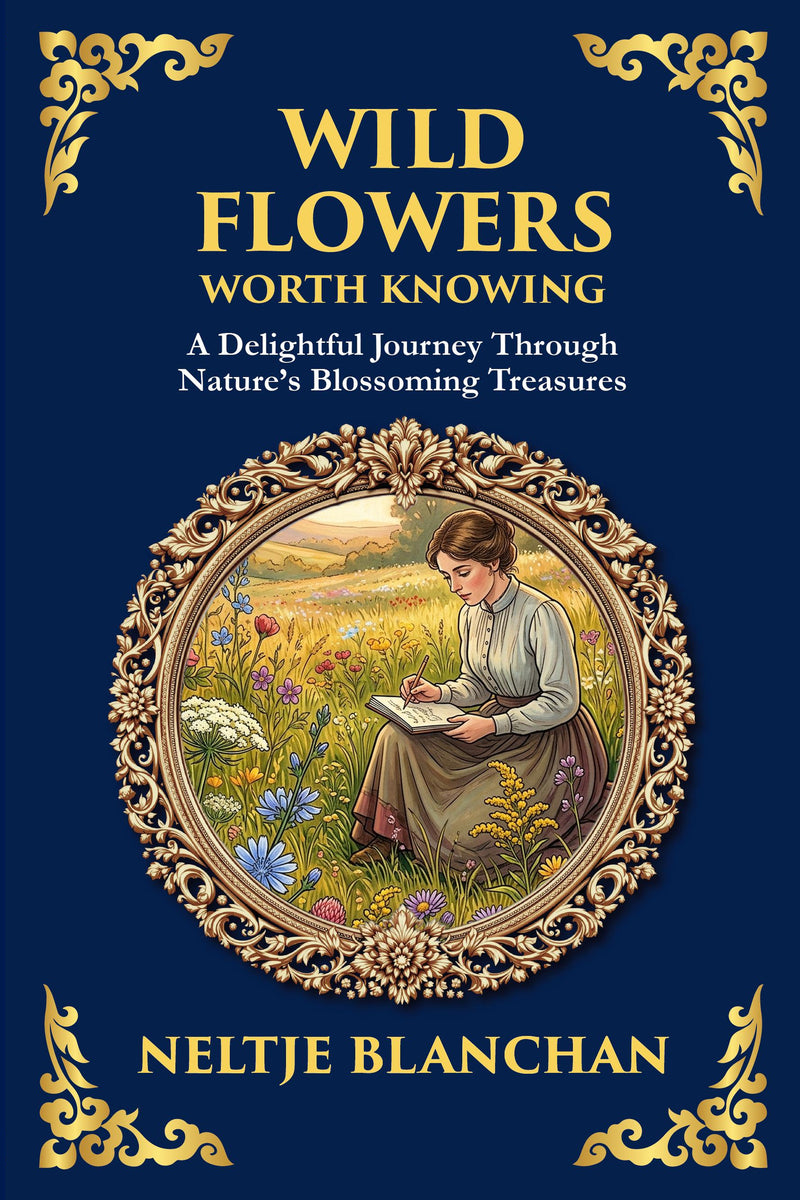
Wild Flowers Worth Knowing
Step into a world where meadows become storybooks and blossoms whisper ancient secrets. Wild Flowers Worth Knowing is more than a botanical guide—it’s an invitation to slow down, observe, and reconnect with the wonder of the wild.
or free app
10,000+ hrs library
30-day guarantee
The complete Wild Flowers Worth Knowing appears in modern English through Library of Alexandria Press, available online with audiobook narration included for members.
Have you ever wondered why some flowers seem to bloom just for you? Wild Flowers Worth Knowing by Neltje Blanchan is a timeless celebration of nature’s vibrant masterpieces. This modernized edition of Blanchan’s classic guide presents an accessible, engaging, and visually descriptive journey through the world of wildflowers—turning every reader into a joyful student of the forest floor, prairie field, and alpine slope.
With warmth and wonder, Blanchan introduces readers to dozens of native wildflowers, describing not just their physical traits but their personalities, legends, habitats, and blooming cycles. Ideal for nature lovers, educators, hikers, gardeners, and dreamers, this edition has been carefully reformatted for ease of use while preserving the author’s lyrical spirit.
What you’ll discover in this modern edition
- A Charming Introduction to Native Wildflowers – Meet dozens of North American species, from the shy trillium to the radiant goldenrod.
- Where and When They Bloom – Learn which flowers to expect on mountain trails, shaded forests, open meadows, and sun-drenched paths.
- How to Identify Wild Flowers with Ease – Discover simple language and visual cues to recognize species without jargon or complex keys.
- Folklore and Flower Personality – Read stories, symbolism, and curious facts that connect flowers to history and the human heart.
- An Invitation to Pause and Appreciate – Rediscover the joy of simply observing, noticing, and naming the natural beauty around you. This isn’t just a field guide—it’s a love letter to the wild.
| Formats | eBook (EPUB + PDF) · Audiobook · Paperback · Hardcover · Large Print |
| Language | English |
| Trim size (print) | 6 × 9 in |
| Binding | Paperback — perfect-bound · Hardcover — casewrap |
| Large Print edition | Same text in a larger, easy-read type — a larger font, not a larger trim |
| Print pricing | Every physical book at our true cost — at-cost, no profit (members) |
| Library | 873 restored titles, always growing |
| Length | 67,500 words · ~4 hr 30 min reading |
| Reading level | Grade 13 · a demanding, literary read (this modern-English edition) |
| Edition | Modern English translation · 2026 |
Member reviews for this edition are collected as readers finish it — be the first. Across the library: 12,000+ books shipped, every plan covered by a 365-day print guarantee.
About this edition
A faithful, unabridged modern-English edition by The Library of Alexandria — carefully rendered for today's reader and verified paragraph-by-paragraph against the public-domain source. Available as eBook, audiobook, paperback, hardcover, and large print.
- Complete & unabridgedVerified paragraph by paragraph against the source — never a scan, never abridged.
- Modern English, faithfulReadable today, with the author’s meaning kept intact. Readable — not simplified.
- Every format, one membershipRead in your browser or the free app, or listen to the full audiobook.
Included free with your membership
Cancel anytime, one click · 30-day money-back guarantee
Edition last updated July 2026
What’s inside
Wild Flowers Worth Knowing — complete and unabridged: all 35 sections included with membership, plus the full audiobook.
Begin reading Wild Flowers Worth Knowing
In clear modern English — the complete text is included with membership.
Introduction
There is a particular kind of book that does not announce its ambitions loudly. It does not open with a manifesto or close with a grand summation. It simply begins, quietly and with great confidence, in the shallows of a pond or at the edge of a woodland path, and it trusts that if you follow it far enough, you will find yourself changed in ways you did not anticipate when you first picked it up. The volume you are holding is exactly that kind of book. It began its life as a much larger work called Nature’s Garden, written by the naturalist and popular science writer who published under the name Neltje Blanchan, and it was subsequently condensed and adapted by the librarian and editor Asa Don Dickinson, whose careful hand shaped the edition that has come down to us. The result, published in 1917, is one of the most quietly radical works of popular natural history ever produced in the American tradition — a book that looks, on its surface, like a field guide, but is, in its deepest intentions, a work of philosophy dressed in petals.
To read it now, more than a century after its publication, is to experience something that very few books from that era can still deliver: the sensation of being genuinely surprised by the world you thought you already knew. The wildflowers described in these pages grow in the same meadows, along the same creek banks, and at the edges of the same woodlands they have always occupied. The arrow-head still wades into shallow water like a heron. The Jack-in-the-Pulpit still erects its striped pulpit in damp woodland shade. The fringed gentian still opens its extraordinary blue fringes to the autumn sky. None of that has changed. What this book offers is not new information about these plants so much as a new way of seeing them — a way of seeing that, once acquired, cannot be unacquired, and that will follow you into every field and forest for the rest of your life.
The name Neltje Blanchan was a pen name, and the biographical record of the person behind it is somewhat incomplete. What we can say with confidence is that the author was deeply embedded in the intellectual and social world of turn-of-the-century American natural history, was a prolific writer on birds and flowers and gardens, and brought to all of that writing a combination of scientific seriousness and genuine literary flair that was, and remains, genuinely rare. The preface to this edition, written in the author’s own voice, gives us a clear statement of purpose: flowers, we are told, have distinct objects in life, and everything they are, they are for the most justifiable of reasons — the perpetuation and improvement of their species. The means they employ to accomplish these ends are, the author insists, so various and so consummately clever that in learning to understand them, we are brought to realize how similar they are to the fundamental aims of even the human race. This is not a casual observation. It is the organizing principle of the entire book, and it is worth pausing over before you begin reading, because it will change the way every subsequent page lands.
What the author is proposing is nothing less than a reframing of the relationship between human beings and the plant world. We are accustomed, most of us, to thinking of flowers as beautiful objects — things to be admired, photographed, picked, arranged in vases, pressed between the pages of books. We think of them as passive, as decorative, as essentially inert. This book asks us to think again. The flowers described in these pages are not passive. They are engaged in a continuous, intricate, often ruthless negotiation with their environment, with the insects that visit them, with the seasons that constrain them, and with the other plants that compete with them for light and soil and pollinators. They have solved, in their own idiom, problems that human societies are still struggling with: how to ensure healthy offspring, how to send children out into the world with the best possible start, how to colonize new territories, how to build cooperative relationships with other species, how to store resources against future scarcity. The flowers have worked all of this out, the author tells us, with the help of insects, through the ages. To understand what they are doing is to gain a broader sympathy with both man and nature, and to add a real interest and joy to life.
That claim — that understanding the mechanisms of flowers adds joy to life — might sound like the kind of thing people say in prefaces without really meaning it. In this case, it is entirely sincere, and the book itself makes good on the promise. There is a passage early in the text, in the entry on the broad-leaved arrow-head, where the author pauses to note that when Kepler discovered the majestic order of movement of the heavenly bodies, he exclaimed, “O God, I think Thy thoughts after Thee!” — and then suggests that every reverent soul must feel something similar when penetrating, even a little way, into the inner meaning of the humblest wayside weed. This is not mere rhetoric. It is a genuine description of the experience the book is designed to produce. And it does produce it. By the time you have read a dozen entries, you will find yourself looking at the flowers you pass every day with something very close to the feeling Kepler described — the feeling of having glimpsed, however briefly, the logic behind the appearance.
It would be a mistake to read this book the way you might read a conventional field guide — that is, to use it purely as a reference, consulting it only when you have a specific flower in hand and want to know its name. That approach will yield some pleasure, but it will miss most of what the book has to offer. The entries here are not merely descriptive. They are argumentative. Each one builds a case for why the flower in question looks and behaves exactly as it does, and the cumulative effect of reading them in sequence is something like the effect of reading a series of interconnected essays on a single great theme. The theme, stated simply, is this: nothing in nature is arbitrary. Every color, every shape, every scent, every structural detail of every flower is the product of a long negotiation between the plant and its environment, and once you understand the terms of that negotiation, the flower becomes not just beautiful but meaningful in a much deeper sense.
The best way to read this book, then, is to read it slowly and in order, at least for the first several chapters. Let the author build the argument gradually. The early entries establish the basic framework — the relationship between flower structure and pollination, the role of color and scent in attracting specific insects, the mechanisms by which plants prevent self-fertilization and encourage cross-pollination. Once that framework is in place, the later entries become richer and more resonant, because you begin to see each new flower not as an isolated specimen but as a variation on a set of themes you have already begun to understand. The Jack-in-the-Pulpit’s elaborate trap for fungus gnats makes more sense once you have read about the arrow-head’s amphibious adaptations. The fringed gentian’s extraordinary timing makes more sense once you have read about the various strategies different flowers use to ensure that their pollinators are available when they bloom. The book rewards sequential reading in a way that very few works of popular natural history do.
That said, there is also great pleasure to be had in reading it the other way — in taking it into the field, finding a flower you do not recognize, and then hunting through the color key at the back to find the relevant entry. The color key is a practical tool, organized by the hue of the flower, and it will get you to the right entry quickly. But even when you use the book this way, as a field companion, try to read the full entry rather than just the identification details at the top. The identification details — the flower’s preferred habitat, its flowering season, its distribution — are useful, but they are not the point. The point is always the prose that follows, which will tell you something about the flower that you could not have guessed from looking at it, and that will make you look at it again with entirely new eyes.
It is also worth knowing that the nomenclature used in this edition follows Gray’s New Manual of Botany as rearranged and revised by Professors Robinson and Fernald, a system based on the work of Eichler as developed by Engler and Prantl. This is noted in the editor’s note at the front of the original text, and it is worth mentioning here because some of the scientific names you will encounter may differ from those in more recent field guides. Taxonomy is a living science, and the names of plants change as our understanding of their relationships evolves. Where the names in this book differ significantly from current usage, we have added brief notes to assist identification. But do not let the occasional unfamiliar name slow you down. The common names — and this book is extraordinarily rich in common names, often listing half a dozen for a single plant — will almost always be enough to orient you.
There is a particular quality of attention that this book cultivates, and it is worth trying to describe it, because it is one of the things that makes the reading experience so distinctive. It is not the attention of the taxonomist, who is primarily interested in classification and relationship. It is not the attention of the painter, who is primarily interested in color and form. It is something closer to the attention of a very good detective — an attention that looks at the surface of things and asks, persistently and without embarrassment, why. Why is this flower this color? Why does it open at this time of day? Why does it smell the way it does, and to whom is that smell addressed? Why are its petals arranged in this particular way, and what does that arrangement accomplish? These are not naive questions. They are the questions that lead, if you follow them far enough, to some of the deepest insights that biology has to offer.
The author is particularly brilliant on the subject of the relationship between flowers and insects, which is one of the great co-evolutionary stories in the history of life on earth. The flowers in this book are not simply visited by insects; they are in active negotiation with them. Some flowers, like the Jack-in-the-Pulpit, lure insects in with the promise of shelter and then trap them temporarily, dusting them with pollen before releasing them to carry that pollen to another plant. Others, like the milkweed, have developed elaborate mechanisms that attach pollen masses directly to the legs of visiting insects, ensuring that the pollen is transported efficiently and deposited precisely where it needs to go. Still others have evolved colors and patterns that are invisible to human eyes but brilliantly visible to bees, which can see into the ultraviolet spectrum. The flower that looks plain white to us may be, to a bee, a vivid landing strip of color, pointing the way to the nectar at its center.
What makes all of this so compelling in the author’s telling is the combination of scientific precision and genuine wonder. The author never loses sight of the fact that these mechanisms are extraordinary — that the degree of coordination between flower and insect, evolved over millions of years without any conscious intention on either side, is one of the most astonishing things in the natural world. But the wonder is always grounded in specific, verifiable detail. You are never asked simply to marvel; you are always shown exactly what to marvel at, and why. This combination of precision and wonder is the hallmark of the best popular science writing, and it is present on almost every page of this book.
The prose itself deserves a word. It is the prose of a writer who has read widely and thought carefully, and who is not afraid to be funny, or sharp, or occasionally a little severe. The description of the Jack-in-the-Pulpit as a gay deceiver, a wolf in sheep’s clothing, a murderer of innocent benefactors, is not just colorful; it is a precise description of what the plant actually does to the insects it traps. The observation that female botanizing classes pounce upon the Jack-in-the-Pulpit as they would upon a pious young clergyman is a joke, but it is also a gentle rebuke to the kind of sentimental nature appreciation that sees flowers only as pretty things and misses the ruthless ingenuity underneath. The author has no patience for sentimentality, but has enormous patience for beauty — and understands, crucially, that the two are not the same thing. The beauty of these flowers is not diminished by understanding how they work. It is deepened by it.
Cancel anytime, one click · 30-day money-back guarantee
Founding annual rate available now — your price locks for life when you join.
Not ready? Get this free chapter by email — read it anytime.
✓ Sent — check your inbox for Wild Flowers Worth Knowing.
Questions about Wild Flowers Worth Knowing
What is Wild Flowers Worth Knowing about?
Step into a world where meadows become storybooks and blossoms whisper ancient secrets. Wild Flowers Worth Knowing is more than a botanical guide—it’s an invitation to slow down, observe, and reconnect with the wonder of the wild. With poetic charm and botanical expertise, Neltje Blanchan brings to life the character, habitat, and beauty of North America's most beloved native wildflowers.
Who wrote Wild Flowers Worth Knowing?
Wild Flowers Worth Knowing was written by Neltje Blanchan. This edition presents the complete work in clear modern English, faithfully rendered from the public-domain original by Library of Alexandria Press.
Is Wild Flowers Worth Knowing free to read?
The opening chapter is free to read on this page. Members read and listen to the complete work — and the entire library — free, and can order any physical book at our true print cost.
How long is Wild Flowers Worth Knowing?
35 chapters (~67,500 words) — about 4 hr 30 min of reading in this modern-English edition.
Is this an abridged version of Wild Flowers Worth Knowing?
No. This is the complete, unabridged Wild Flowers Worth Knowing, carefully rendered into clear modern English and verified paragraph-by-paragraph against the public-domain source — nothing is cut or summarised.
What formats does Wild Flowers Worth Knowing come in?
Wild Flowers Worth Knowing is available as eBook, paperback, hardcover and large print. eBook and audiobook are included with membership; printed editions ship at our true print cost.
Shipping & returns
Billing & membership
More from the library


Explore Free eBooks
- Kant's Prolegomena to Any Future Metaphysics · Immanuel Kant
- The Advancement of Learning · Francis Bacon
- The Dawn of Day · Friedrich Nietzsche
- Meditations · Marcus Aurelius
- The Confessions of St. Augustine · Saint Augustine of Hippo
- Resurrection · Leo Tolstoy
- Dialogues Concerning Natural Religion · David Hume
- As You Like It · William Shakespeare
- Jack and Jill · Louisa May Alcott
- Dream Psychology: Psychoanalysis for Beginners · Sigmund Freud
- The Raven · Edgar Allan Poe
- Considerations on Representative Government · John Stuart Mill
- The Will to Power: An Attempted Transvaluation of All Values. Book III and IV · Friedrich Nietzsche
- Tarzan of the Apes · Edgar Rice Burroughs
- Fundamental Principles of the Metaphysic of Morals · Immanuel Kant
- The Confessions of Jean Jacques Rousseau — Complete · Jean-Jacques Rousseau
- The Merchant of Venice · William Shakespeare
- Democracy in America — Volume 2 · Alexis de Tocqueville
- Ecce Homo · Friedrich Wilhelm Nietzsche
- Second Treatise of Government · John Locke
- The Wonderful Wizard of Oz · L. Frank Baum
- The Prince · Niccolò Machiavelli
- Anne of Green Gables · L. M. Montgomery
- De Profundis · Oscar Wilde
- Thus Spake Zarathustra: A Book for All and None · Friedrich Nietzsche
- Anna Karenina · Leo Tolstoy
- Great Expectations · Charles Dickens
- The Island of Doctor Moreau · H. G. Wells
- A Midsummer Night's Dream · William Shakespeare
- The Strange Case of Dr. Jekyll and Mr. Hyde · Robert Louis Stevenson
Wild Flowers Worth Knowing
Wild Flowers Worth Knowing
A Modern Translation
Neltje Blanchan
Contents
- Introduction
- Chapter 1
- Preface by the Author
- Chapter 2
- Chapter 3
- Chapter 4
- Chapter 5
- Chapter 6
- Chapter 7
- Chapter 8
- Chapter 9
- Chapter 10
- Chapter 11
- Chapter 12
- Chapter 13
- Chapter 14
- Chapter 15
- Chapter 16
- Chapter 17
- Chapter 18
- Chapter 19
- Chapter 20
- Chapter 21
- Chapter 22
- Chapter 23
- Chapter 24
- Chapter 25
- Chapter 26
- Chapter 27
- Chapter 28
- Chapter 29
- Chapter 30
- Chapter 31
- Chapter 32
- Chapter 33
Introduction
There is a particular kind of book that does not announce its ambitions loudly. It does not open with a manifesto or close with a grand summation. It simply begins, quietly and with great confidence, in the shallows of a pond or at the edge of a woodland path, and it trusts that if you follow it far enough, you will find yourself changed in ways you did not anticipate when you first picked it up. The volume you are holding is exactly that kind of book. It began its life as a much larger work called Nature’s Garden, written by the naturalist and popular science writer who published under the name Neltje Blanchan, and it was subsequently condensed and adapted by the librarian and editor Asa Don Dickinson, whose careful hand shaped the edition that has come down to us. The result, published in 1917, is one of the most quietly radical works of popular natural history ever produced in the American tradition — a book that looks, on its surface, like a field guide, but is, in its deepest intentions, a work of philosophy dressed in petals.
To read it now, more than a century after its publication, is to experience something that very few books from that era can still deliver: the sensation of being genuinely surprised by the world you thought you already knew. The wildflowers described in these pages grow in the same meadows, along the same creek banks, and at the edges of the same woodlands they have always occupied. The arrow-head still wades into shallow water like a heron. The Jack-in-the-Pulpit still erects its striped pulpit in damp woodland shade. The fringed gentian still opens its extraordinary blue fringes to the autumn sky. None of that has changed. What this book offers is not new information about these plants so much as a new way of seeing them — a way of seeing that, once acquired, cannot be unacquired, and that will follow you into every field and forest for the rest of your life.
The name Neltje Blanchan was a pen name, and the biographical record of the person behind it is somewhat incomplete. What we can say with confidence is that the author was deeply embedded in the intellectual and social world of turn-of-the-century American natural history, was a prolific writer on birds and flowers and gardens, and brought to all of that writing a combination of scientific seriousness and genuine literary flair that was, and remains, genuinely rare. The preface to this edition, written in the author’s own voice, gives us a clear statement of purpose: flowers, we are told, have distinct objects in life, and everything they are, they are for the most justifiable of reasons — the perpetuation and improvement of their species. The means they employ to accomplish these ends are, the author insists, so various and so consummately clever that in learning to understand them, we are brought to realize how similar they are to the fundamental aims of even the human race. This is not a casual observation. It is the organizing principle of the entire book, and it is worth pausing over before you begin reading, because it will change the way every subsequent page lands.
What the author is proposing is nothing less than a reframing of the relationship between human beings and the plant world. We are accustomed, most of us, to thinking of flowers as beautiful objects — things to be admired, photographed, picked, arranged in vases, pressed between the pages of books. We think of them as passive, as decorative, as essentially inert. This book asks us to think again. The flowers described in these pages are not passive. They are engaged in a continuous, intricate, often ruthless negotiation with their environment, with the insects that visit them, with the seasons that constrain them, and with the other plants that compete with them for light and soil and pollinators. They have solved, in their own idiom, problems that human societies are still struggling with: how to ensure healthy offspring, how to send children out into the world with the best possible start, how to colonize new territories, how to build cooperative relationships with other species, how to store resources against future scarcity. The flowers have worked all of this out, the author tells us, with the help of insects, through the ages. To understand what they are doing is to gain a broader sympathy with both man and nature, and to add a real interest and joy to life.
That claim — that understanding the mechanisms of flowers adds joy to life — might sound like the kind of thing people say in prefaces without really meaning it. In this case, it is entirely sincere, and the book itself makes good on the promise. There is a passage early in the text, in the entry on the broad-leaved arrow-head, where the author pauses to note that when Kepler discovered the majestic order of movement of the heavenly bodies, he exclaimed, “O God, I think Thy thoughts after Thee!” — and then suggests that every reverent soul must feel something similar when penetrating, even a little way, into the inner meaning of the humblest wayside weed. This is not mere rhetoric. It is a genuine description of the experience the book is designed to produce. And it does produce it. By the time you have read a dozen entries, you will find yourself looking at the flowers you pass every day with something very close to the feeling Kepler described — the feeling of having glimpsed, however briefly, the logic behind the appearance.
It would be a mistake to read this book the way you might read a conventional field guide — that is, to use it purely as a reference, consulting it only when you have a specific flower in hand and want to know its name. That approach will yield some pleasure, but it will miss most of what the book has to offer. The entries here are not merely descriptive. They are argumentative. Each one builds a case for why the flower in question looks and behaves exactly as it does, and the cumulative effect of reading them in sequence is something like the effect of reading a series of interconnected essays on a single great theme. The theme, stated simply, is this: nothing in nature is arbitrary. Every color, every shape, every scent, every structural detail of every flower is the product of a long negotiation between the plant and its environment, and once you understand the terms of that negotiation, the flower becomes not just beautiful but meaningful in a much deeper sense.
The best way to read this book, then, is to read it slowly and in order, at least for the first several chapters. Let the author build the argument gradually. The early entries establish the basic framework — the relationship between flower structure and pollination, the role of color and scent in attracting specific insects, the mechanisms by which plants prevent self-fertilization and encourage cross-pollination. Once that framework is in place, the later entries become richer and more resonant, because you begin to see each new flower not as an isolated specimen but as a variation on a set of themes you have already begun to understand. The Jack-in-the-Pulpit’s elaborate trap for fungus gnats makes more sense once you have read about the arrow-head’s amphibious adaptations. The fringed gentian’s extraordinary timing makes more sense once you have read about the various strategies different flowers use to ensure that their pollinators are available when they bloom. The book rewards sequential reading in a way that very few works of popular natural history do.
That said, there is also great pleasure to be had in reading it the other way — in taking it into the field, finding a flower you do not recognize, and then hunting through the color key at the back to find the relevant entry. The color key is a practical tool, organized by the hue of the flower, and it will get you to the right entry quickly. But even when you use the book this way, as a field companion, try to read the full entry rather than just the identification details at the top. The identification details — the flower’s preferred habitat, its flowering season, its distribution — are useful, but they are not the point. The point is always the prose that follows, which will tell you something about the flower that you could not have guessed from looking at it, and that will make you look at it again with entirely new eyes.
It is also worth knowing that the nomenclature used in this edition follows Gray’s New Manual of Botany as rearranged and revised by Professors Robinson and Fernald, a system based on the work of Eichler as developed by Engler and Prantl. This is noted in the editor’s note at the front of the original text, and it is worth mentioning here because some of the scientific names you will encounter may differ from those in more recent field guides. Taxonomy is a living science, and the names of plants change as our understanding of their relationships evolves. Where the names in this book differ significantly from current usage, we have added brief notes to assist identification. But do not let the occasional unfamiliar name slow you down. The common names — and this book is extraordinarily rich in common names, often listing half a dozen for a single plant — will almost always be enough to orient you.
There is a particular quality of attention that this book cultivates, and it is worth trying to describe it, because it is one of the things that makes the reading experience so distinctive. It is not the attention of the taxonomist, who is primarily interested in classification and relationship. It is not the attention of the painter, who is primarily interested in color and form. It is something closer to the attention of a very good detective — an attention that looks at the surface of things and asks, persistently and without embarrassment, why. Why is this flower this color? Why does it open at this time of day? Why does it smell the way it does, and to whom is that smell addressed? Why are its petals arranged in this particular way, and what does that arrangement accomplish? These are not naive questions. They are the questions that lead, if you follow them far enough, to some of the deepest insights that biology has to offer.
The author is particularly brilliant on the subject of the relationship between flowers and insects, which is one of the great co-evolutionary stories in the history of life on earth. The flowers in this book are not simply visited by insects; they are in active negotiation with them. Some flowers, like the Jack-in-the-Pulpit, lure insects in with the promise of shelter and then trap them temporarily, dusting them with pollen before releasing them to carry that pollen to another plant. Others, like the milkweed, have developed elaborate mechanisms that attach pollen masses directly to the legs of visiting insects, ensuring that the pollen is transported efficiently and deposited precisely where it needs to go. Still others have evolved colors and patterns that are invisible to human eyes but brilliantly visible to bees, which can see into the ultraviolet spectrum. The flower that looks plain white to us may be, to a bee, a vivid landing strip of color, pointing the way to the nectar at its center.
What makes all of this so compelling in the author’s telling is the combination of scientific precision and genuine wonder. The author never loses sight of the fact that these mechanisms are extraordinary — that the degree of coordination between flower and insect, evolved over millions of years without any conscious intention on either side, is one of the most astonishing things in the natural world. But the wonder is always grounded in specific, verifiable detail. You are never asked simply to marvel; you are always shown exactly what to marvel at, and why. This combination of precision and wonder is the hallmark of the best popular science writing, and it is present on almost every page of this book.
The prose itself deserves a word. It is the prose of a writer who has read widely and thought carefully, and who is not afraid to be funny, or sharp, or occasionally a little severe. The description of the Jack-in-the-Pulpit as a gay deceiver, a wolf in sheep’s clothing, a murderer of innocent benefactors, is not just colorful; it is a precise description of what the plant actually does to the insects it traps. The observation that female botanizing classes pounce upon the Jack-in-the-Pulpit as they would upon a pious young clergyman is a joke, but it is also a gentle rebuke to the kind of sentimental nature appreciation that sees flowers only as pretty things and misses the ruthless ingenuity underneath. The author has no patience for sentimentality, but has enormous patience for beauty — and understands, crucially, that the two are not the same thing. The beauty of these flowers is not diminished by understanding how they work. It is deepened by it.
To move away from the religious analogy, let us look inside the protective sheath, called the spathe, or simply remove it. Doctor Torrey notes that plants with dark-striped spathes are fertile, while those with green and whitish lines are sterile. Inside are smooth, shiny columns. Near the base of each column are the actual flowers—tiny structures. Some are male (staminate), while others, on separate plants, are female (pistillate) and produce the berries. Rarely, both male and female flowers appear on the same club, suggesting that the plant’s strategy to prevent self-fertilization is not yet perfect. Plants, like nations and people, can be seen as evolving toward an ideal state. Presumably, once this mechanism is perfected, the plant’s “guilt” will vanish.
Slightly above the flowers, the club widens suddenly, creating a ledge that effectively blocks the exit for many unsuspecting victims. A fungus gnat, perhaps attracted by the striped shelter from cold spring winds and the promise of food below, enters and slides down the inner walls or the slippery, colored column. Descending is easy; returning is very difficult or impossible for these tiny visitors. After squeezing past the ledge, the gnat enters a spacious area where the floor—the bottom of the “pulpit”—is covered in fine pollen, provided the male flowers are mature. The plant’s entire goal in luring visitors into its polished walls is to have the gnat cover itself in pollen and transfer it to the tiny female flowers waiting in a different chamber. But how do they escape? Attempts to crawl back up the slippery surface only leave them exhausted and discouraged where they started. The overhead ledge prevents them from using their wings, as the gap between the ledge and the spathe is too narrow for flight. If a gnat is persistent, it may find a gap where the spathe folds together in front. Through this tiny opening, it escapes, only to enter another “pulpit” like a trusting messenger, depositing vital pollen on the fertile flowers.
End of the free sample
Keep reading, free
Members read and listen to the complete book — and the entire library. Cancel anytime, one click · 30-day money-back guarantee.