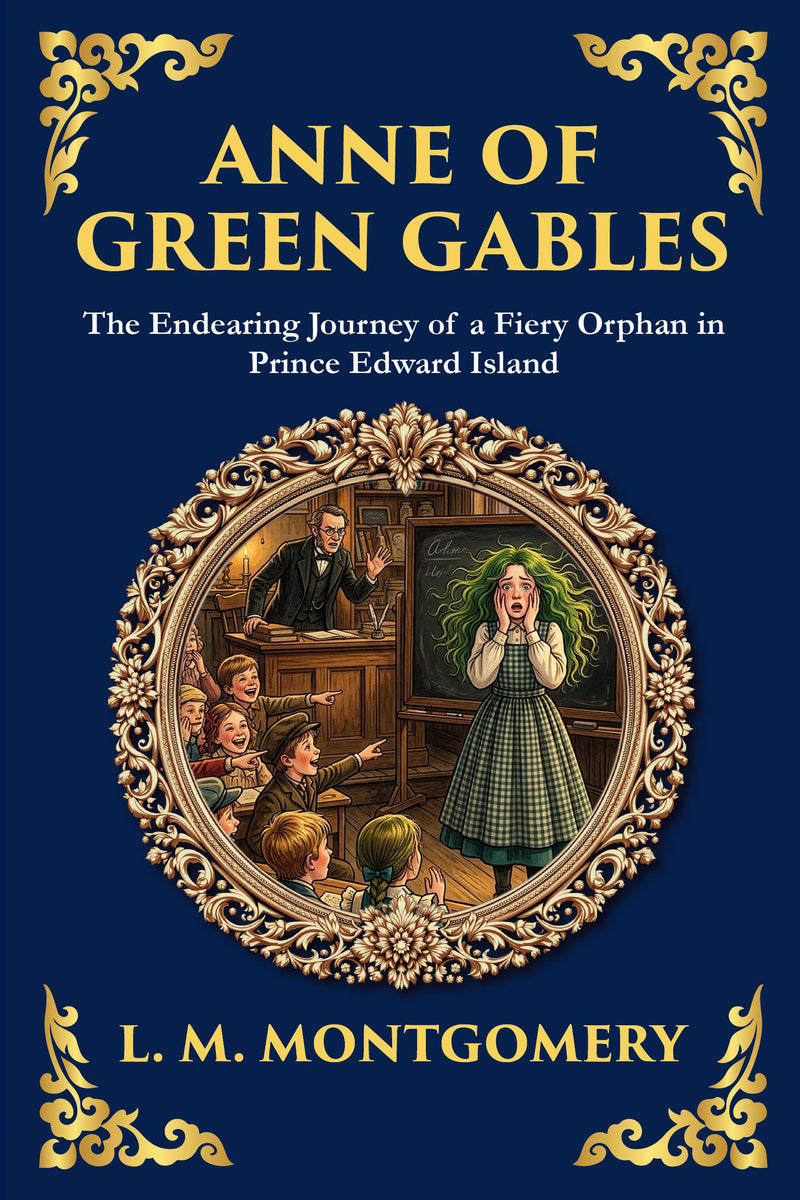
Anne of Green Gables
When an imaginative, red-haired orphan named Anne Shirley arrives by mistake at Green Gables, she brings more than just her belongings—she brings a storm of adventure, heart, and transformation.
or free app
10,000+ hrs library
30-day guarantee
The complete Anne of Green Gables appears in modern English through Library of Alexandria Press, available online with audiobook narration included for members.
Have you ever wondered why Anne Shirley remains one of the most beloved literary characters of all time? Anne of Green Gables: The Endearing Journey of a Fiery Orphan in Prince Edward Island is L. M. Montgomery’s timeless tale of imagination, resilience, and the redemptive power of belonging. When eleven-year-old Anne arrives at Green Gables, she expects to finally find a home—and to her surprise, the quiet, tradition-bound Cuthberts find themselves slowly and wonderfully changed by Anne’s vibrant spirit.
With a heart full of dreams and a mind bursting with words, Anne transforms the small village of Avonlea through her curious misadventures, passionate convictions, and relentless optimism.
What you’ll discover in this modern edition
- A Heroine Who Inspires Generations – Meet Anne Shirley: fiercely imaginative, quick- tempered, and irresistibly lovable.
- A Heartwarming Story of Belonging – Witness Anne’s journey from lonely orphan to cherished family member and friend.
- The Charm of Prince Edward Island – Wander through a richly painted Canadian countryside full of gardens, forests, and lakes that breathe life into every page.
- Unforgettable Characters and Friendships – From the gentle Matthew and stern Marilla to loyal Diana Barry and rival Gilbert Blythe, the people of Avonlea leave a lasting mark.
- Themes That Transcend Time – Explore identity, girlhood, forgiveness, personal growth, and the power of second chances.
| Formats | eBook (EPUB + PDF) · Audiobook · Paperback · Hardcover · Large Print |
| Language | English |
| Trim size (print) | 6 × 9 in |
| Binding | Paperback — perfect-bound · Hardcover — casewrap |
| Large Print edition | Same text in a larger, easy-read type — a larger font, not a larger trim |
| Print pricing | Every physical book at our true cost — at-cost, no profit (members) |
| Library | 873 restored titles, always growing |
| Length | 100,672 words · ~6 hr 43 min reading |
| Reading level | Grade 7 · an easy, flowing read (this modern-English edition) |
| Edition | Modern English translation · 2026 |
Member reviews for this edition are collected as readers finish it — be the first. Across the library: 12,000+ books shipped, every plan covered by a 365-day print guarantee.
About this edition
A faithful, unabridged modern-English edition by The Library of Alexandria — carefully rendered for today's reader and verified paragraph-by-paragraph against the public-domain source. Available as eBook, audiobook, paperback, hardcover, and large print.
- Complete & unabridgedVerified paragraph by paragraph against the source — never a scan, never abridged.
- Modern English, faithfulReadable today, with the author’s meaning kept intact. Readable — not simplified.
- Every format, one membershipRead in your browser or the free app, or listen to the full audiobook.
Included free with your membership
Cancel anytime, one click · 30-day money-back guarantee
Edition last updated July 2026
What’s inside
Anne of Green Gables — complete and unabridged: all 39 sections included with membership, plus the full audiobook.
Begin reading Anne of Green Gables
In clear modern English — the complete text is included with membership.
Introduction
There are certain characters in literature who feel less like inventions of an author and more like people we have actually known—friends we carry with us long after the final page, voices that surface unbidden in moments of joy or trouble, reminding us how to see the world with fresh eyes. Among this rare company stands a red-haired girl with a prodigious imagination, an untamed tongue, and a heart so vast that it has, over the course of more than a century, won the devotion of readers across every continent and generation. She arrives at a quiet farmhouse on the edge of a small Canadian island expecting to be sent away, and in the span of a single, transformative story, she utterly remakes the lives of everyone she meets—and, very likely, the life of every reader who encounters her.
The novel you are about to read is a classic in the truest sense of the word: a book that has never gone out of print, that has been translated into dozens of languages, adapted for stage and screen countless times, and that continues to attract pilgrims from around the globe to the windswept shores where its story unfolds. Yet despite its enormous fame, the tale itself remains intimate, gentle, and wonderfully human. It is not a story of grand adventures or world-altering events. It is, instead, a story about the slow miracle of belonging—about how a person who has known only rejection and hardship can, through love and patience and the simple act of being wanted, blossom into someone extraordinary.
This particular edition has been thoughtfully adapted for the contemporary reader, with the aim of preserving everything that makes the original beloved while ensuring that its language and rhythms feel accessible to modern eyes and ears. The essence of the work—its humor, its warmth, its sudden bursts of beauty and feeling—remains entirely intact. What has been gently refreshed is the occasional turn of phrase or construction that might have once given a present-day reader pause, so that nothing stands between you and the full, immersive pleasure of the experience. The goal has been to honor the spirit of the author’s vision while opening the door a little wider, inviting new generations to step inside and discover why this story has endured so completely and for so long.
Before you begin, it is worth pausing to consider the setting, for in this book the place is very nearly a character in its own right. The story takes place on Prince Edward Island, a small, crescent-shaped province off the eastern coast of Canada, famed for its red soil, its rolling green farmland, its sparkling bays, and its quiet, close-knit rural communities. At the time the novel was written, near the turn of the twentieth century, life on the Island moved to the rhythm of the seasons—planting and harvest, churchgoing and visiting, the long slow turning of days marked by the work of the farm and the gossip of neighbors. It was a world without telephones in most homes, without automobiles, without the constant hum of distraction that fills our own lives. Children walked to school along dusty lanes, fetched water from wells, and found their entertainment in books, in nature, and in the boundless theater of their own imaginations.
For the modern reader, this slower world is one of the great gifts of the story. There is something deeply restorative about entering a place where a walk through a flowering orchard can be the high point of a day, where a new dress with puffed sleeves can occasion weeks of breathless anticipation, where a quarrel between friends can feel like the end of the world and a reconciliation like its rebirth. The author renders this landscape with such loving precision that you may find yourself able to smell the apple blossoms, hear the wind in the spruce trees, and feel the cool of a brook running over stones. She had an extraordinary gift for capturing the particular beauty of her native island, and she poured that gift into every page. The cherry trees in bloom, the shimmer of a pond at twilight, the dark green hush of a wooded path—these are described not as mere backdrop but as living, breathing presences, full of wonder for anyone with the eyes to perceive them.
And that, perhaps, is the deepest theme running through the whole book: the idea that the world is brimming with beauty and possibility, if only we are willing to look. Our heroine arrives in this place with almost nothing—no family, no possessions, no security, no claim on anyone’s affection. What she possesses instead is an imagination so powerful that it transforms everything it touches. A plain avenue of apple trees becomes, in her mind, the “White Way of Delight.” An ordinary pond becomes the “Lake of Shining Waters.” She renames the world to make it more beautiful, and in doing so she teaches everyone around her—and every reader who follows her—to find enchantment in the everyday. This is not escapism. It is a kind of wisdom, a way of moving through life that insists on noticing, on cherishing, on refusing to let the ordinary remain ordinary. In an age such as ours, so crowded with noise and speed and the relentless tug of screens, there may be no lesson more quietly radical than this one.
The community the author depicts is small and, in many ways, conservative. It is a place where reputations matter, where everyone knows everyone else’s business, where unconventional behavior is met with raised eyebrows and clucking tongues. Much of the book’s humor—and it is a very funny book, far funnier than its reputation as a “girls’ classic” might suggest—arises from the collision between this buttoned-up, proper society and the irrepressible, rule-bending, utterly original spirit who has landed in its midst. There are scenes in this novel of such comic perfection that they have been quoted and beloved for generations: mishaps in the kitchen, disasters at social gatherings, dramatic accidents born of pride and imagination, and any number of well-intentioned schemes that go gloriously, hilariously awry. The author understood children—their logic, their fierce emotions, their capacity for both heartbreak and high comedy—with rare and tender accuracy, and she never condescends to them. The result is a book that can make you laugh aloud on one page and bring a lump to your throat on the next.
It is also a book about a particular relationship that lies at the very heart of the story: the bond between a child and the two aging, undemonstrative siblings who take her in. These two adults, set in their ways, unaccustomed to children, expecting their quiet lives to continue undisturbed, are utterly unprepared for the whirlwind that enters their home. Watching them be changed—watching the slow thaw of reserve, the dawning of affection that neither of them knows quite how to express, the gradual recognition that this strange, talkative, exasperating child has become the most precious thing in their world—is one of the most moving experiences the book has to offer. The author handles this emotional transformation with extraordinary delicacy, never overstating, never sentimentalizing, allowing the love between these characters to reveal itself in small gestures, in things left unsaid, in the quiet acts of care that speak far louder than any declaration. By the time you reach the final chapters, this relationship will likely have lodged itself permanently in your heart.
To understand the remarkable authenticity of this story, it helps to know something about the woman who wrote it. Lucy Maud Montgomery was born in 1874 on Prince Edward Island, in the very landscape she would later immortalize. Her own childhood was marked by loss: her mother died when she was very young, and her father, unable or unwilling to raise her himself, left her in the care of her maternal grandparents. They were strict, elderly, and not given to open displays of affection—a household not unlike, in some respects, the one she would later create in fiction. The young Maud, as she was called, grew up in many ways a lonely child, finding refuge and companionship in books, in nature, and above all in the boundless world of her own imagination.
It is impossible to read this novel without recognizing how deeply it draws upon the author’s own experience. The orphaned child, longing for belonging; the powerful inner life that compensates for the absence of warmth in the external world; the intense, almost painful sensitivity to natural beauty; the fierce hunger for love and recognition—all of these are drawn from a wellspring of genuine feeling. The author once explained that the idea for the story came from a brief notation she had jotted in a notebook years earlier, a single line about an elderly couple who apply to an orphanage for a boy to help with the farm work, only to be sent a girl by mistake. From that small seed grew an entire world, populated by characters so vivid and true that they have outlived their creator by more than a century and show no sign of fading.
Montgomery wrote the book over the course of about two years, working in the evenings after long days of other obligations, scribbling in notebooks at her grandmother’s home. When she finished it, she submitted the manuscript to several publishers—and was rejected, again and again. Discouraged, she put the manuscript away in a hatbox, where it sat for a time, nearly abandoned. It was only when she rediscovered it and decided to try once more that the book finally found a home with a publisher. It was released in 1908, and its success was immediate and overwhelming. The first printing sold out, then another and another. Letters poured in from readers of every age and background. The author, who had labored in relative obscurity, found herself the creator of a beloved phenomenon, one that would define her life and career and that would eventually grow into a series of sequels, following her heroine through adolescence, adulthood, marriage, and motherhood.
The book’s success was not merely commercial; it was deeply personal for countless readers. Among its earliest and most famous admirers was the great American author Mark Twain, who is said to have written of the heroine as “the dearest and most moving and delightful child since the immortal Alice”—a comparison to Lewis Carroll’s Alice that placed Montgomery’s creation in the very highest company of literary children. That comparison has proven prophetic. Like Alice, this red-haired girl has transcended the boundaries of her original book to become a cultural figure, a touchstone, an icon recognized even by those who have never read a word of her story. She has inspired tourism, scholarship, fan societies, and an unending stream of adaptations, including a famous Japanese animated series that introduced her to an entirely new continent of devoted admirers, where she remains beloved to this day.
Yet it would be a mistake to approach this book as a museum piece, a relic to be admired from a respectful distance. The reason it has survived—the reason it continues to find new readers in every generation—is that it remains vividly, urgently alive. The emotions it explores are universal and timeless. The longing to belong, to be seen, to be loved for who we truly are; the agonies and ecstasies of friendship; the awkward, painful, hilarious process of growing up; the tension between who the world expects us to be and who we feel ourselves to be inside—these are not concerns of a bygone era. They are the concerns of every human heart, in every time and place. The author wrote about a small island community at the turn of the twentieth century, but she wrote about feelings that you, reading this today, will recognize as intimately your own.
There is, too, a quietly progressive spirit running through the work that may surprise readers who expect an old-fashioned story to be old-fashioned in its values. The heroine is, above all, a person of fierce intelligence and ambition. She refuses to be confined by the narrow expectations placed upon girls of her time. She loves learning with a passion that borders on hunger; she dreams of accomplishment and recognition; she competes, openly and without apology, with the cleverest minds in her school. The author, herself a woman who built a successful career as a writer in an age that offered women few such opportunities, clearly invested her heroine with her own determination and intellectual fire. The story celebrates a girl who is allowed to be imperfect, opinionated, stubborn, and proud—who makes mistakes and learns from them, who has a temper she struggles to control, who is praised not for being demure and obedient but for being spirited, original, and true to herself. This is a heroine who insists, against all the pressures of her world, on the value of her own imagination and her own voice. That insistence feels as fresh and necessary today as it ever has.
Cancel anytime, one click · 30-day money-back guarantee
Founding annual rate available now — your price locks for life when you join.
Not ready? Get this free chapter by email — read it anytime.
✓ Sent — check your inbox for Anne of Green Gables.
Questions about Anne of Green Gables
What is Anne of Green Gables about?
When an imaginative, red-haired orphan named Anne Shirley arrives by mistake at Green Gables, she brings more than just her belongings—she brings a storm of adventure, heart, and transformation. The aging siblings Marilla and Matthew Cuthbert expected a boy to help on their farm. Instead, they find their world turned upside down by a spirited girl who refuses to be anything but herself.
Who wrote Anne of Green Gables?
Anne of Green Gables was written by L. M. Montgomery. This edition presents the complete work in clear modern English, faithfully rendered from the public-domain original by Library of Alexandria Press.
Is Anne of Green Gables free to read?
The opening chapter is free to read on this page. Members read and listen to the complete work — and the entire library — free, and can order any physical book at our true print cost.
How long is Anne of Green Gables?
39 chapters (~100,672 words) — about 6 hr 43 min of reading in this modern-English edition.
Is this an abridged version of Anne of Green Gables?
No. This is the complete, unabridged Anne of Green Gables, carefully rendered into clear modern English and verified paragraph-by-paragraph against the public-domain source — nothing is cut or summarised.
What formats does Anne of Green Gables come in?
Anne of Green Gables is available as eBook, paperback, hardcover and large print. eBook and audiobook are included with membership; printed editions ship at our true print cost.
Shipping & returns
Billing & membership
More from the library


Explore Children's Classics
- Jack and Jill · Louisa May Alcott
- The Wonderful Wizard of Oz · L. Frank Baum
- Peter Pan · J. M. Barrie
- The Prince and the Pauper · Mark Twain
- The Red Fairy Book · Andrew Lang
- Old Christmas: from the Sketch Book of Washington Irving · Washington Irving
- A Houseful of Girls · Sarah Tytler
- In the hollow of His hand · Hesba Stretton
- Miss Primrose · Agnes Giberne
- Five Little Peppers and How They Grew · Margaret Sidney
- The Loss of the Swansea: A Story of the Florida Coast · W. L. Alden
- Sky Island · L. Frank Baum
- The Book of Dragons · E. Nesbit
- Wild Animals I Have Known · Ernest Thompson Seton
- Skinny McCord · Percy Keese Fitzhugh
- The Hunniwell Boys and the Platinum Mystery · L. P. Wyman
- Rainbow Valley · L. M. Montgomery
- "Us and Our Donkey" · Amy Le Feuvre
- Dorothy and the Wizard in Oz · L. Frank Baum
- The Home Book of Verse — Volume 4 · Burton Egbert Stevenson
- The Story of Doctor Dolittle · Hugh Lofting
- The Tale of Benjamin Bunny · Beatrix Potter
- Fifty Famous Stories Retold · James Baldwin
- Rilla of Ingleside · L. M. Montgomery
- The House at Pooh Corner · A. A. Milne
- Rich and Humble: A Story for Young People · Oliver Optic
- The Three Bears · A. E. Kennedy
- Peter and Wendy · J. M. Barrie
- The Marvelous Land of Oz · L. Frank Baum
- Andersen’s Fairy Tales · H. C. Andersen
Anne of Green Gables
Anne of Green Gables
The Endearing Journey of a Fiery Orphan in Prince Edward Island
L. M. Montgomery
Contents
- Introduction
- Chapter 1
- Chapter 2
- Chapter 3
- Chapter 4
- Chapter 5
- Chapter 6
- Chapter 7
- Chapter 8
- Chapter 9
- Chapter 10
- Chapter 11
- Chapter 12
- Chapter 13
- Chapter 14
- Chapter 15
- Chapter 16
- Chapter 17
- Chapter 18
- Chapter 19
- Chapter 20
- Chapter 21
- Chapter 22
- Chapter 23
- Chapter 24
- Chapter 25
- Chapter 26
- Chapter 27
- Chapter 28
- Chapter 29
- Chapter 30
- Chapter 31
- Chapter 32
- Chapter 33
- Chapter 34
- Chapter 35
- Chapter 36
- Chapter 37
- Chapter 38
Introduction
There are certain characters in literature who feel less like inventions of an author and more like people we have actually known—friends we carry with us long after the final page, voices that surface unbidden in moments of joy or trouble, reminding us how to see the world with fresh eyes. Among this rare company stands a red-haired girl with a prodigious imagination, an untamed tongue, and a heart so vast that it has, over the course of more than a century, won the devotion of readers across every continent and generation. She arrives at a quiet farmhouse on the edge of a small Canadian island expecting to be sent away, and in the span of a single, transformative story, she utterly remakes the lives of everyone she meets—and, very likely, the life of every reader who encounters her.
The novel you are about to read is a classic in the truest sense of the word: a book that has never gone out of print, that has been translated into dozens of languages, adapted for stage and screen countless times, and that continues to attract pilgrims from around the globe to the windswept shores where its story unfolds. Yet despite its enormous fame, the tale itself remains intimate, gentle, and wonderfully human. It is not a story of grand adventures or world-altering events. It is, instead, a story about the slow miracle of belonging—about how a person who has known only rejection and hardship can, through love and patience and the simple act of being wanted, blossom into someone extraordinary.
This particular edition has been thoughtfully adapted for the contemporary reader, with the aim of preserving everything that makes the original beloved while ensuring that its language and rhythms feel accessible to modern eyes and ears. The essence of the work—its humor, its warmth, its sudden bursts of beauty and feeling—remains entirely intact. What has been gently refreshed is the occasional turn of phrase or construction that might have once given a present-day reader pause, so that nothing stands between you and the full, immersive pleasure of the experience. The goal has been to honor the spirit of the author’s vision while opening the door a little wider, inviting new generations to step inside and discover why this story has endured so completely and for so long.
Before you begin, it is worth pausing to consider the setting, for in this book the place is very nearly a character in its own right. The story takes place on Prince Edward Island, a small, crescent-shaped province off the eastern coast of Canada, famed for its red soil, its rolling green farmland, its sparkling bays, and its quiet, close-knit rural communities. At the time the novel was written, near the turn of the twentieth century, life on the Island moved to the rhythm of the seasons—planting and harvest, churchgoing and visiting, the long slow turning of days marked by the work of the farm and the gossip of neighbors. It was a world without telephones in most homes, without automobiles, without the constant hum of distraction that fills our own lives. Children walked to school along dusty lanes, fetched water from wells, and found their entertainment in books, in nature, and in the boundless theater of their own imaginations.
For the modern reader, this slower world is one of the great gifts of the story. There is something deeply restorative about entering a place where a walk through a flowering orchard can be the high point of a day, where a new dress with puffed sleeves can occasion weeks of breathless anticipation, where a quarrel between friends can feel like the end of the world and a reconciliation like its rebirth. The author renders this landscape with such loving precision that you may find yourself able to smell the apple blossoms, hear the wind in the spruce trees, and feel the cool of a brook running over stones. She had an extraordinary gift for capturing the particular beauty of her native island, and she poured that gift into every page. The cherry trees in bloom, the shimmer of a pond at twilight, the dark green hush of a wooded path—these are described not as mere backdrop but as living, breathing presences, full of wonder for anyone with the eyes to perceive them.
And that, perhaps, is the deepest theme running through the whole book: the idea that the world is brimming with beauty and possibility, if only we are willing to look. Our heroine arrives in this place with almost nothing—no family, no possessions, no security, no claim on anyone’s affection. What she possesses instead is an imagination so powerful that it transforms everything it touches. A plain avenue of apple trees becomes, in her mind, the “White Way of Delight.” An ordinary pond becomes the “Lake of Shining Waters.” She renames the world to make it more beautiful, and in doing so she teaches everyone around her—and every reader who follows her—to find enchantment in the everyday. This is not escapism. It is a kind of wisdom, a way of moving through life that insists on noticing, on cherishing, on refusing to let the ordinary remain ordinary. In an age such as ours, so crowded with noise and speed and the relentless tug of screens, there may be no lesson more quietly radical than this one.
The community the author depicts is small and, in many ways, conservative. It is a place where reputations matter, where everyone knows everyone else’s business, where unconventional behavior is met with raised eyebrows and clucking tongues. Much of the book’s humor—and it is a very funny book, far funnier than its reputation as a “girls’ classic” might suggest—arises from the collision between this buttoned-up, proper society and the irrepressible, rule-bending, utterly original spirit who has landed in its midst. There are scenes in this novel of such comic perfection that they have been quoted and beloved for generations: mishaps in the kitchen, disasters at social gatherings, dramatic accidents born of pride and imagination, and any number of well-intentioned schemes that go gloriously, hilariously awry. The author understood children—their logic, their fierce emotions, their capacity for both heartbreak and high comedy—with rare and tender accuracy, and she never condescends to them. The result is a book that can make you laugh aloud on one page and bring a lump to your throat on the next.
It is also a book about a particular relationship that lies at the very heart of the story: the bond between a child and the two aging, undemonstrative siblings who take her in. These two adults, set in their ways, unaccustomed to children, expecting their quiet lives to continue undisturbed, are utterly unprepared for the whirlwind that enters their home. Watching them be changed—watching the slow thaw of reserve, the dawning of affection that neither of them knows quite how to express, the gradual recognition that this strange, talkative, exasperating child has become the most precious thing in their world—is one of the most moving experiences the book has to offer. The author handles this emotional transformation with extraordinary delicacy, never overstating, never sentimentalizing, allowing the love between these characters to reveal itself in small gestures, in things left unsaid, in the quiet acts of care that speak far louder than any declaration. By the time you reach the final chapters, this relationship will likely have lodged itself permanently in your heart.
To understand the remarkable authenticity of this story, it helps to know something about the woman who wrote it. Lucy Maud Montgomery was born in 1874 on Prince Edward Island, in the very landscape she would later immortalize. Her own childhood was marked by loss: her mother died when she was very young, and her father, unable or unwilling to raise her himself, left her in the care of her maternal grandparents. They were strict, elderly, and not given to open displays of affection—a household not unlike, in some respects, the one she would later create in fiction. The young Maud, as she was called, grew up in many ways a lonely child, finding refuge and companionship in books, in nature, and above all in the boundless world of her own imagination.
It is impossible to read this novel without recognizing how deeply it draws upon the author’s own experience. The orphaned child, longing for belonging; the powerful inner life that compensates for the absence of warmth in the external world; the intense, almost painful sensitivity to natural beauty; the fierce hunger for love and recognition—all of these are drawn from a wellspring of genuine feeling. The author once explained that the idea for the story came from a brief notation she had jotted in a notebook years earlier, a single line about an elderly couple who apply to an orphanage for a boy to help with the farm work, only to be sent a girl by mistake. From that small seed grew an entire world, populated by characters so vivid and true that they have outlived their creator by more than a century and show no sign of fading.
Montgomery wrote the book over the course of about two years, working in the evenings after long days of other obligations, scribbling in notebooks at her grandmother’s home. When she finished it, she submitted the manuscript to several publishers—and was rejected, again and again. Discouraged, she put the manuscript away in a hatbox, where it sat for a time, nearly abandoned. It was only when she rediscovered it and decided to try once more that the book finally found a home with a publisher. It was released in 1908, and its success was immediate and overwhelming. The first printing sold out, then another and another. Letters poured in from readers of every age and background. The author, who had labored in relative obscurity, found herself the creator of a beloved phenomenon, one that would define her life and career and that would eventually grow into a series of sequels, following her heroine through adolescence, adulthood, marriage, and motherhood.
The book’s success was not merely commercial; it was deeply personal for countless readers. Among its earliest and most famous admirers was the great American author Mark Twain, who is said to have written of the heroine as “the dearest and most moving and delightful child since the immortal Alice”—a comparison to Lewis Carroll’s Alice that placed Montgomery’s creation in the very highest company of literary children. That comparison has proven prophetic. Like Alice, this red-haired girl has transcended the boundaries of her original book to become a cultural figure, a touchstone, an icon recognized even by those who have never read a word of her story. She has inspired tourism, scholarship, fan societies, and an unending stream of adaptations, including a famous Japanese animated series that introduced her to an entirely new continent of devoted admirers, where she remains beloved to this day.
Yet it would be a mistake to approach this book as a museum piece, a relic to be admired from a respectful distance. The reason it has survived—the reason it continues to find new readers in every generation—is that it remains vividly, urgently alive. The emotions it explores are universal and timeless. The longing to belong, to be seen, to be loved for who we truly are; the agonies and ecstasies of friendship; the awkward, painful, hilarious process of growing up; the tension between who the world expects us to be and who we feel ourselves to be inside—these are not concerns of a bygone era. They are the concerns of every human heart, in every time and place. The author wrote about a small island community at the turn of the twentieth century, but she wrote about feelings that you, reading this today, will recognize as intimately your own.
There is, too, a quietly progressive spirit running through the work that may surprise readers who expect an old-fashioned story to be old-fashioned in its values. The heroine is, above all, a person of fierce intelligence and ambition. She refuses to be confined by the narrow expectations placed upon girls of her time. She loves learning with a passion that borders on hunger; she dreams of accomplishment and recognition; she competes, openly and without apology, with the cleverest minds in her school. The author, herself a woman who built a successful career as a writer in an age that offered women few such opportunities, clearly invested her heroine with her own determination and intellectual fire. The story celebrates a girl who is allowed to be imperfect, opinionated, stubborn, and proud—who makes mistakes and learns from them, who has a temper she struggles to control, who is praised not for being demure and obedient but for being spirited, original, and true to herself. This is a heroine who insists, against all the pressures of her world, on the value of her own imagination and her own voice. That insistence feels as fresh and necessary today as it ever has.
Mrs. Rachel Lynde lived right where the Avonlea main road dipped into a small valley. The area was lined with alders and ladies’ eardrops and crossed by a brook that started deep in the woods of the old Cuthbert place. People said that in its early stages through those woods, the brook was wild and unpredictable, full of hidden pools and waterfalls. However, by the time it reached Lynde’s Hollow, it became a quiet, well-behaved little stream. After all, not even a brook could flow past Mrs. Rachel Lynde’s door without behaving properly. The stream was likely aware that Mrs. Rachel sat at her window, keeping a close eye on everything that passed—from the water to the local children. If she noticed anything strange or out of place, she wouldn’t rest until she had discovered exactly why it was happening.
Many people in and around Avonlea manage to keep a close eye on their neighbors’ business by neglecting their own. Mrs. Rachel Lynde, however, was one of those capable women who could handle her own affairs and everyone else’s at the same time. She was an impressive housekeeper; her chores were always finished and done well. She managed the Sewing Circle, helped run the Sunday school, and was a leading member of the Church Aid Society and the Foreign Missions Auxiliary. Despite all this, Mrs. Rachel still found plenty of time to sit for hours at her kitchen window, knitting “cotton warp” quilts—she had made sixteen of them, as the local housewives often whispered in awe. From there, she watched the main road that crossed the valley and wound up the steep red hill. Because Avonlea sat on a small triangular peninsula jutting into the Gulf of St. Lawrence, anyone entering or leaving town had to use that hill road, meaning they inevitably passed under the watchful gaze of Mrs. Rachel.
End of the free sample
Keep reading, free
Members read and listen to the complete book — and the entire library. Cancel anytime, one click · 30-day money-back guarantee.