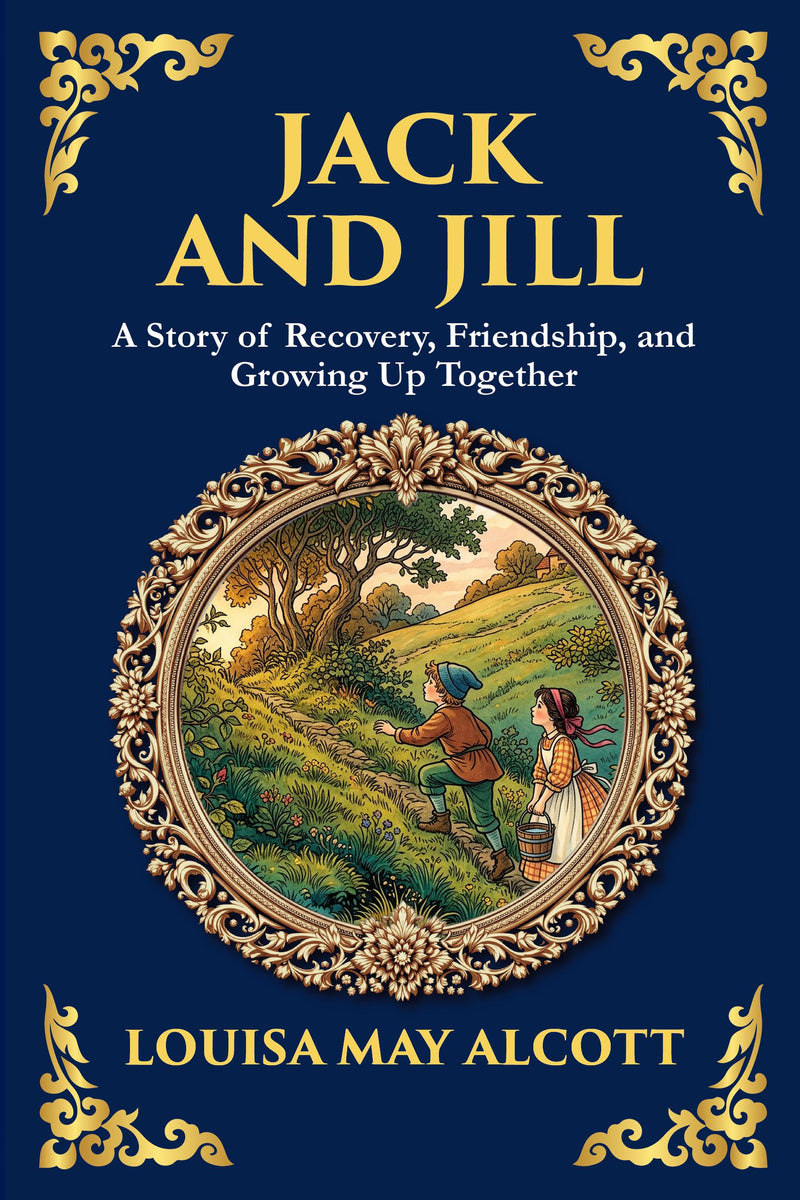
Jack and Jill
In a quiet New England town, a joyful sled ride ends in tragedy—leaving two children, Jack and Jill, badly injured. What follows is not only a physical recovery, but a journey of emotional healing, self-discovery, and the blossoming of true friendship.
or free app
10,000+ hrs library
30-day guarantee
The complete Jack and Jill appears in modern English through Library of Alexandria Press, available online with audiobook narration included for members.
Have you ever wondered why the hardest falls often lead to the most meaningful growth? Jack and Jill is a tender and deeply human story about two children who must rebuild their lives after a life-changing accident. With the same insight and compassion that made Little Women a beloved classic, Louisa May Alcott turns her attention to the quieter, everyday struggles of recovery—and the courage it takes to rise again.
After Jack and Jill suffer serious injuries in a winter sledding accident, they are forced into long periods of rest, reflection, and rehabilitation. But through it all, they are never alone. Their mothers, friends, teachers, and each other become pillars of support as the children learn patience, humility, and strength.
What you’ll discover in this modern edition
- A Gentle Exploration of Healing – Physical, emotional, and moral recovery is at the heart of Jack and Jill’s journey
- The Power of Friendship and Community – A close-knit neighborhood shows how small acts of kindness can lead to big transformations
- Lessons in Character and Virtue – Themes of generosity, responsibility, gratitude, and resilience are lovingly woven into every chapter
- A Story Rich in Heart and Hope – Alcott’s warm prose turns hardship into a beautiful path of self-discovery and joy
- Perfect for All Ages – Whether read by young readers or adults, this story resonates across generations with its timeless truths
| Formats | eBook (EPUB + PDF) · Audiobook · Paperback · Hardcover · Large Print |
| Language | English |
| Trim size (print) | 6 × 9 in |
| Binding | Paperback — perfect-bound · Hardcover — casewrap |
| Large Print edition | Same text in a larger, easy-read type — a larger font, not a larger trim |
| Print pricing | Every physical book at our true cost — at-cost, no profit (members) |
| Library | 873 restored titles, always growing |
| Length | 95,593 words · ~6 hr 22 min reading |
| Reading level | Grade 8 · an easy, flowing read (this modern-English edition) |
| Edition | Modern English translation · 2026 |
Member reviews for this edition are collected as readers finish it — be the first. Across the library: 12,000+ books shipped, every plan covered by a 365-day print guarantee.
About this edition
A faithful, unabridged modern-English edition by The Library of Alexandria — carefully rendered for today's reader and verified paragraph-by-paragraph against the public-domain source. Available as eBook, audiobook, paperback, hardcover, and large print.
- Complete & unabridgedVerified paragraph by paragraph against the source — never a scan, never abridged.
- Modern English, faithfulReadable today, with the author’s meaning kept intact. Readable — not simplified.
- Every format, one membershipRead in your browser or the free app, or listen to the full audiobook.
Included free with your membership
Cancel anytime, one click · 30-day money-back guarantee
Edition last updated July 2026
What’s inside
Jack and Jill — complete and unabridged: all 25 sections included with membership, plus the full audiobook.
Begin reading Jack and Jill
In clear modern English — the complete text is included with membership.
Introduction
There is a particular kind of December afternoon in New England when the snow lies thick on the hills, the sky burns a brittle blue, and every child within reach of a sled is out testing the slopes with reckless joy. It is precisely such an afternoon that opens this story, and it is precisely such a moment of high spirits that turns, in the space of a heartbeat, into something graver. Louisa May Alcott understood as well as any writer who ever lived that the boundary between play and peril, between an ordinary day and a life-altering one, can be as thin as a sheet of ice on a frozen pond. From that single accident on a snowy hillside, she builds a story that is at once smaller and larger than her more famous works: smaller in its setting, confined largely to two neighboring households and the quiet rhythms of a country village, and larger in its patient attention to what it actually takes for a young person to grow up well.
Published in 1879, more than a decade after the book that made her name a household word, this novel found Alcott at the height of her powers and her popularity. She no longer needed to prove that she could hold the attention of young readers; she had become, in the eyes of thousands of American families, a trusted voice—almost a member of the household—whose new books were awaited as eagerly as a letter from a beloved aunt. With that trust came a freedom to write the kind of story she most cared about: not a thrilling adventure or a sweeping romance, but an intimate, deeply observed account of children learning, slowly and often painfully, how to become the people they want to be. The result is a book that may not announce its ambitions loudly, but rewards the patient reader with a warmth and wisdom that linger long after the last page.
To understand what makes this novel tick, it helps to know a little about the woman who wrote it and the world she drew upon. Louisa May Alcott was born in 1832 into a family that was rich in ideas and chronically poor in money. Her father, Amos Bronson Alcott, was a philosopher and educational reformer of genuine originality and almost no practical sense, a man who dreamed of transforming society through schools and communal living while leaving the actual feeding and clothing of his daughters to others. That “others” was largely Louisa herself, who from a young age understood that the burden of keeping the family afloat would fall on her shoulders. She sewed, she taught, she worked as a domestic servant, and—crucially—she wrote, churning out sensational thrillers under pseudonyms before she found the vein of writing that would make her fortune.
The Alcotts moved restlessly through Massachusetts, but the town of Concord became their spiritual and physical home, and it was there that Louisa absorbed the atmosphere that breathes through so much of her fiction. Concord in her youth was an extraordinary place, a kind of intellectual village where her father’s friends included Ralph Waldo Emerson, Henry David Thoreau, and Nathaniel Hawthorne. These were not distant celebrities but neighbors, dinner guests, and, in Thoreau’s case, a man who took young Louisa walking in the woods and taught her to see nature with attentive eyes. From this milieu she inherited a set of convictions that run quietly beneath the surface of all her best work: a belief in the moral seriousness of everyday life, a conviction that character is forged through small daily choices rather than grand dramatic gestures, and a deep faith that even the most ordinary person possesses an inner life worthy of careful attention.
By the time she came to write this book, Alcott was a national institution, but also an exhausted one. Her health, never robust, had been permanently damaged by mercury poisoning from the medicines she received while serving as a Civil War nurse—an experience that itself produced one of her most powerful early works. She knew sickrooms intimately. She knew what it meant to lie helpless and frustrated, to depend on the patience and care of others, to measure progress in tiny increments and to fight the despair that comes when the body refuses to cooperate with the will. This hard-won knowledge gives the convalescence at the heart of this novel a texture of authenticity that no amount of research could supply. When Alcott writes about the long, slow business of healing, about the boredom and the discouragement and the unexpected gifts that come with enforced stillness, she is writing from the inside.
It is worth pausing on the way Alcott regarded her own success. She had a famously complicated relationship with the wholesome family stories that made her rich. She sometimes referred to them, half-jokingly and half-bitterly, as “moral pap for the young,” and she would have preferred, in her heart, to write the darker, more passionate fiction that her sensational thrillers hinted at. Yet there is no condescension in her domestic novels, no sense that she is going through the motions. Whatever her private feelings, when she sat down to write for children she gave them her full intelligence and her full heart. She respected her young readers too much to talk down to them, and she trusted them to absorb difficult truths about pain, disappointment, and self-discipline. This respect is one of the secrets of her enduring appeal. Children, then and now, can sense when an author takes them seriously, and Alcott always did.
The novel you are about to read drew directly on Alcott’s own neighborhood and the children she knew in it. Like much of her fiction, it began close to home, with real young people whose personalities and escapades she transformed into art. This rootedness in observed reality is part of what keeps the book from sliding into sentimentality. The children here are not idealized cherubs; they are vain and stubborn and lazy and quick-tempered by turns, capable of cruelty and selfishness as well as kindness, and the drama of the book lies precisely in watching them wrestle with these flaws. Alcott never pretends that becoming a good person is easy or automatic. She shows it as the work of years, full of backsliding and frustration, achieved only through repeated effort and the steadying influence of those who love us enough to expect the best of us.
One more biographical note deserves mention, because it shadows the warmth of this story with a poignancy that readers may sense even without knowing the facts. Alcott’s beloved younger sister, May—the model for the artistic, ambitious youngest sister in her most famous novel—was living abroad and pursuing her own painting career while Louisa wrote this book. Alcott was always acutely conscious of the bonds and tensions among siblings, of the way children grow up together, compete, support one another, and are shaped by the small society of the family and the neighborhood. That consciousness suffuses these pages. The relationships here are not just between individuals but among a whole web of young people, each watching and learning from the others, and the book is finally as much about community as it is about any single child.
A Story of Bodies, Spirits, and Slow Repair
What kind of story is this, then, beneath its period trappings of sleds and sewing and village schoolrooms? At its core, it is a story about the long, patient work of repair—the repair of a body, yes, but also the repair of a temperament, the mending of a friendship, the gradual reshaping of a character into something stronger and finer than it was before. The accident that sets the plot in motion is over almost as soon as it begins, but its consequences ripple outward across the entire book, touching not only the two children most directly affected but everyone around them. Alcott was fascinated by the way a single event can become a crucible, forcing people to discover what they are truly made of and giving them an opportunity—if they choose to take it—to become something more.
The two young people named in the title are wonderfully drawn, and they are deliberately contrasted. One comes from comfort and refinement; the other from a humbler, more boisterous household. One is naturally gentle and accustomed to gentleness; the other is fiery, impulsive, proud, and far less practiced in the arts of patience and self-control. Bringing these two temperaments into close, prolonged contact—forcing them to share the same trial and the same long road to recovery—allows Alcott to explore one of her favorite themes: the way that different kinds of people can teach and complete one another. Neither child is presented as simply the model for the other to imitate. Each has something the other lacks, and part of the pleasure of the book lies in watching them rub against each other, strike sparks, and gradually polish away their roughest edges.
Around this central pair, Alcott assembles a rich cast of supporting characters, and it is here that the novel reveals its generosity of vision. There are mothers of very different sorts, each loving in her own way and each imperfect; there are brothers and sisters and schoolmates who form a lively, quarrelsome, affectionate little world; and there are adults whose wisdom is offered not through lectures but through example and through the patient setting of expectations. One of the recurring delights of Alcott’s writing is her portrait of the grown-ups who guide children without controlling them—who understand that a young person must be allowed to make mistakes, to struggle, and ultimately to choose the right path freely, because virtue imposed from outside is no virtue at all. The mothers and mentors in this book are some of the most appealing figures in all of Alcott’s work, precisely because they know when to speak and when to keep silent, when to comfort and when to challenge.
It would be a mistake, though, to imagine this as a solemn or preachy book. For all its moral seriousness, it is also full of fun. Alcott had a sharp eye for comedy and a deep sympathy for the irrepressible energy of childhood, and the novel is studded with scenes of pure high spirits: theatrical productions cooked up by enthusiastic amateurs, secret clubs and their elaborate rules, holiday celebrations, practical jokes, the agonies and ecstasies of adolescent friendship and rivalry. There is a particular warmth in the way she renders the texture of daily life among children—the small economies and ambitions, the fierce loyalties and sudden quarrels, the way a homemade gift can mean more than a costly one, the way a single careless word can wound for days. Readers who come to this book expecting only edification will be surprised by how often they laugh, and how vividly the long-vanished world of nineteenth-century New England springs to life.
That world, of course, is part of the book’s appeal and part of its challenge for the modern reader. This is a story rooted in a particular time and place, with its own assumptions about how families work, how children should behave, what a girl might aspire to and what a boy might, and how religion and duty weave themselves into ordinary life. Some of these assumptions will feel quaint or even confining to a contemporary reader, and it is worth approaching them with a measure of historical imagination rather than impatience. Alcott was, in many respects, a progressive for her time—she believed passionately in the education and independence of women, in the dignity of work, in social reform—but she was also a woman of her era, and her books reflect both the limitations and the genuine moral seriousness of the culture that produced them. Part of the richness of reading older fiction lies in this double awareness: we enter a world different from our own, recognize what we share with it, and notice clearly what has changed.
This brings us to the matter of the present edition. The book in your hands has been prepared as a modern translation, adapted for the contemporary reader, and a word about what that means—and does not mean—may help you read with confidence. The aim of such an adaptation is not to rewrite Alcott or to substitute a modern voice for hers, but to remove the small obstacles that can stand between today’s reader and the living heart of the story. Nineteenth-century prose, for all its beauty, can present hurdles: archaic turns of phrase, references to objects and customs that have vanished from daily life, sentence structures that wind on at a leisurely pace ill-suited to modern reading habits, and vocabulary that has shifted its meaning over the intervening century and a half. A thoughtful adaptation eases these difficulties so that the reader can give full attention to what matters most: the characters, the relationships, the emotional truth of the story, and the gentle wisdom that Alcott wove into every chapter.
Cancel anytime, one click · 30-day money-back guarantee
Founding annual rate available now — your price locks for life when you join.
Not ready? Get this free chapter by email — read it anytime.
✓ Sent — check your inbox for Jack and Jill.
Questions about Jack and Jill
What is Jack and Jill about?
In a quiet New England town, a joyful sled ride ends in tragedy—leaving two children, Jack and Jill, badly injured. What follows is not only a physical recovery, but a journey of emotional healing, self-discovery, and the blossoming of true friendship. Louisa May Alcott, author of Little Women, weaves a heartfelt tale that goes beyond childhood antics to explore resilience, the strength of community, and the growth that comes from adversity.
Who wrote Jack and Jill?
Jack and Jill was written by Louisa May Alcott. This edition presents the complete work in clear modern English, faithfully rendered from the public-domain original by Library of Alexandria Press.
Is Jack and Jill free to read?
The opening chapter is free to read on this page. Members read and listen to the complete work — and the entire library — free, and can order any physical book at our true print cost.
How long is Jack and Jill?
25 chapters (~95,593 words) — about 6 hr 22 min of reading in this modern-English edition.
Is this an abridged version of Jack and Jill?
No. This is the complete, unabridged Jack and Jill, carefully rendered into clear modern English and verified paragraph-by-paragraph against the public-domain source — nothing is cut or summarised.
What formats does Jack and Jill come in?
Jack and Jill is available as eBook, paperback, hardcover and large print. eBook and audiobook are included with membership; printed editions ship at our true print cost.
Shipping & returns
Billing & membership
More from the library


Explore Children's Classics
- Peter and Wendy · J. M. Barrie
- The Wonderful Wizard of Oz · L. Frank Baum
- Anne of Green Gables · L. M. Montgomery
- The Secret Garden · Frances Hodgson Burnett
- The Tale of Peter Rabbit · Beatrix Potter
- Peter Pan · J. M. Barrie
- The Prince and the Pauper · Mark Twain
- The Red Fairy Book · Andrew Lang
- Old Christmas: from the Sketch Book of Washington Irving · Washington Irving
- A Houseful of Girls · Sarah Tytler
- In the hollow of His hand · Hesba Stretton
- Miss Primrose · Agnes Giberne
- Five Little Peppers and How They Grew · Margaret Sidney
- The Loss of the Swansea: A Story of the Florida Coast · W. L. Alden
- Sky Island · L. Frank Baum
- The Book of Dragons · E. Nesbit
- Wild Animals I Have Known · Ernest Thompson Seton
- Skinny McCord · Percy Keese Fitzhugh
- The Hunniwell Boys and the Platinum Mystery · L. P. Wyman
- Rainbow Valley · L. M. Montgomery
- "Us and Our Donkey" · Amy Le Feuvre
- Dorothy and the Wizard in Oz · L. Frank Baum
- The Home Book of Verse — Volume 4 · Burton Egbert Stevenson
- The Story of Doctor Dolittle · Hugh Lofting
- The Tale of Benjamin Bunny · Beatrix Potter
- Fifty Famous Stories Retold · James Baldwin
- Rilla of Ingleside · L. M. Montgomery
- The House at Pooh Corner · A. A. Milne
- Rich and Humble: A Story for Young People · Oliver Optic
- The Three Bears · A. E. Kennedy
Jack and Jill
Jack and Jill
A Story of Healing, Friendship, and Growing Up Together
Louisa May Alcott
Contents
- Introduction
- Chapter 1
- Chapter 2
- Chapter 3
- Chapter 4
- Chapter 5
- Chapter 6
- Chapter 7
- Chapter 8
- Chapter 9
- Chapter 10
- Chapter 11
- Chapter 12
- Chapter 13
- Chapter 14
- Chapter 15
- Chapter 16
- Chapter 17
- Chapter 18
- Chapter 19
- Chapter 20
- Chapter 21
- Chapter 22
- Chapter 23
- Chapter 24
Introduction
There is a particular kind of December afternoon in New England when the snow lies thick on the hills, the sky burns a brittle blue, and every child within reach of a sled is out testing the slopes with reckless joy. It is precisely such an afternoon that opens this story, and it is precisely such a moment of high spirits that turns, in the space of a heartbeat, into something graver. Louisa May Alcott understood as well as any writer who ever lived that the boundary between play and peril, between an ordinary day and a life-altering one, can be as thin as a sheet of ice on a frozen pond. From that single accident on a snowy hillside, she builds a story that is at once smaller and larger than her more famous works: smaller in its setting, confined largely to two neighboring households and the quiet rhythms of a country village, and larger in its patient attention to what it actually takes for a young person to grow up well.
Published in 1879, more than a decade after the book that made her name a household word, this novel found Alcott at the height of her powers and her popularity. She no longer needed to prove that she could hold the attention of young readers; she had become, in the eyes of thousands of American families, a trusted voice—almost a member of the household—whose new books were awaited as eagerly as a letter from a beloved aunt. With that trust came a freedom to write the kind of story she most cared about: not a thrilling adventure or a sweeping romance, but an intimate, deeply observed account of children learning, slowly and often painfully, how to become the people they want to be. The result is a book that may not announce its ambitions loudly, but rewards the patient reader with a warmth and wisdom that linger long after the last page.
To understand what makes this novel tick, it helps to know a little about the woman who wrote it and the world she drew upon. Louisa May Alcott was born in 1832 into a family that was rich in ideas and chronically poor in money. Her father, Amos Bronson Alcott, was a philosopher and educational reformer of genuine originality and almost no practical sense, a man who dreamed of transforming society through schools and communal living while leaving the actual feeding and clothing of his daughters to others. That “others” was largely Louisa herself, who from a young age understood that the burden of keeping the family afloat would fall on her shoulders. She sewed, she taught, she worked as a domestic servant, and—crucially—she wrote, churning out sensational thrillers under pseudonyms before she found the vein of writing that would make her fortune.
The Alcotts moved restlessly through Massachusetts, but the town of Concord became their spiritual and physical home, and it was there that Louisa absorbed the atmosphere that breathes through so much of her fiction. Concord in her youth was an extraordinary place, a kind of intellectual village where her father’s friends included Ralph Waldo Emerson, Henry David Thoreau, and Nathaniel Hawthorne. These were not distant celebrities but neighbors, dinner guests, and, in Thoreau’s case, a man who took young Louisa walking in the woods and taught her to see nature with attentive eyes. From this milieu she inherited a set of convictions that run quietly beneath the surface of all her best work: a belief in the moral seriousness of everyday life, a conviction that character is forged through small daily choices rather than grand dramatic gestures, and a deep faith that even the most ordinary person possesses an inner life worthy of careful attention.
By the time she came to write this book, Alcott was a national institution, but also an exhausted one. Her health, never robust, had been permanently damaged by mercury poisoning from the medicines she received while serving as a Civil War nurse—an experience that itself produced one of her most powerful early works. She knew sickrooms intimately. She knew what it meant to lie helpless and frustrated, to depend on the patience and care of others, to measure progress in tiny increments and to fight the despair that comes when the body refuses to cooperate with the will. This hard-won knowledge gives the convalescence at the heart of this novel a texture of authenticity that no amount of research could supply. When Alcott writes about the long, slow business of healing, about the boredom and the discouragement and the unexpected gifts that come with enforced stillness, she is writing from the inside.
It is worth pausing on the way Alcott regarded her own success. She had a famously complicated relationship with the wholesome family stories that made her rich. She sometimes referred to them, half-jokingly and half-bitterly, as “moral pap for the young,” and she would have preferred, in her heart, to write the darker, more passionate fiction that her sensational thrillers hinted at. Yet there is no condescension in her domestic novels, no sense that she is going through the motions. Whatever her private feelings, when she sat down to write for children she gave them her full intelligence and her full heart. She respected her young readers too much to talk down to them, and she trusted them to absorb difficult truths about pain, disappointment, and self-discipline. This respect is one of the secrets of her enduring appeal. Children, then and now, can sense when an author takes them seriously, and Alcott always did.
The novel you are about to read drew directly on Alcott’s own neighborhood and the children she knew in it. Like much of her fiction, it began close to home, with real young people whose personalities and escapades she transformed into art. This rootedness in observed reality is part of what keeps the book from sliding into sentimentality. The children here are not idealized cherubs; they are vain and stubborn and lazy and quick-tempered by turns, capable of cruelty and selfishness as well as kindness, and the drama of the book lies precisely in watching them wrestle with these flaws. Alcott never pretends that becoming a good person is easy or automatic. She shows it as the work of years, full of backsliding and frustration, achieved only through repeated effort and the steadying influence of those who love us enough to expect the best of us.
One more biographical note deserves mention, because it shadows the warmth of this story with a poignancy that readers may sense even without knowing the facts. Alcott’s beloved younger sister, May—the model for the artistic, ambitious youngest sister in her most famous novel—was living abroad and pursuing her own painting career while Louisa wrote this book. Alcott was always acutely conscious of the bonds and tensions among siblings, of the way children grow up together, compete, support one another, and are shaped by the small society of the family and the neighborhood. That consciousness suffuses these pages. The relationships here are not just between individuals but among a whole web of young people, each watching and learning from the others, and the book is finally as much about community as it is about any single child.
A Story of Bodies, Spirits, and Slow Repair
What kind of story is this, then, beneath its period trappings of sleds and sewing and village schoolrooms? At its core, it is a story about the long, patient work of repair—the repair of a body, yes, but also the repair of a temperament, the mending of a friendship, the gradual reshaping of a character into something stronger and finer than it was before. The accident that sets the plot in motion is over almost as soon as it begins, but its consequences ripple outward across the entire book, touching not only the two children most directly affected but everyone around them. Alcott was fascinated by the way a single event can become a crucible, forcing people to discover what they are truly made of and giving them an opportunity—if they choose to take it—to become something more.
The two young people named in the title are wonderfully drawn, and they are deliberately contrasted. One comes from comfort and refinement; the other from a humbler, more boisterous household. One is naturally gentle and accustomed to gentleness; the other is fiery, impulsive, proud, and far less practiced in the arts of patience and self-control. Bringing these two temperaments into close, prolonged contact—forcing them to share the same trial and the same long road to recovery—allows Alcott to explore one of her favorite themes: the way that different kinds of people can teach and complete one another. Neither child is presented as simply the model for the other to imitate. Each has something the other lacks, and part of the pleasure of the book lies in watching them rub against each other, strike sparks, and gradually polish away their roughest edges.
Around this central pair, Alcott assembles a rich cast of supporting characters, and it is here that the novel reveals its generosity of vision. There are mothers of very different sorts, each loving in her own way and each imperfect; there are brothers and sisters and schoolmates who form a lively, quarrelsome, affectionate little world; and there are adults whose wisdom is offered not through lectures but through example and through the patient setting of expectations. One of the recurring delights of Alcott’s writing is her portrait of the grown-ups who guide children without controlling them—who understand that a young person must be allowed to make mistakes, to struggle, and ultimately to choose the right path freely, because virtue imposed from outside is no virtue at all. The mothers and mentors in this book are some of the most appealing figures in all of Alcott’s work, precisely because they know when to speak and when to keep silent, when to comfort and when to challenge.
It would be a mistake, though, to imagine this as a solemn or preachy book. For all its moral seriousness, it is also full of fun. Alcott had a sharp eye for comedy and a deep sympathy for the irrepressible energy of childhood, and the novel is studded with scenes of pure high spirits: theatrical productions cooked up by enthusiastic amateurs, secret clubs and their elaborate rules, holiday celebrations, practical jokes, the agonies and ecstasies of adolescent friendship and rivalry. There is a particular warmth in the way she renders the texture of daily life among children—the small economies and ambitions, the fierce loyalties and sudden quarrels, the way a homemade gift can mean more than a costly one, the way a single careless word can wound for days. Readers who come to this book expecting only edification will be surprised by how often they laugh, and how vividly the long-vanished world of nineteenth-century New England springs to life.
That world, of course, is part of the book’s appeal and part of its challenge for the modern reader. This is a story rooted in a particular time and place, with its own assumptions about how families work, how children should behave, what a girl might aspire to and what a boy might, and how religion and duty weave themselves into ordinary life. Some of these assumptions will feel quaint or even confining to a contemporary reader, and it is worth approaching them with a measure of historical imagination rather than impatience. Alcott was, in many respects, a progressive for her time—she believed passionately in the education and independence of women, in the dignity of work, in social reform—but she was also a woman of her era, and her books reflect both the limitations and the genuine moral seriousness of the culture that produced them. Part of the richness of reading older fiction lies in this double awareness: we enter a world different from our own, recognize what we share with it, and notice clearly what has changed.
This brings us to the matter of the present edition. The book in your hands has been prepared as a modern translation, adapted for the contemporary reader, and a word about what that means—and does not mean—may help you read with confidence. The aim of such an adaptation is not to rewrite Alcott or to substitute a modern voice for hers, but to remove the small obstacles that can stand between today’s reader and the living heart of the story. Nineteenth-century prose, for all its beauty, can present hurdles: archaic turns of phrase, references to objects and customs that have vanished from daily life, sentence structures that wind on at a leisurely pace ill-suited to modern reading habits, and vocabulary that has shifted its meaning over the intervening century and a half. A thoughtful adaptation eases these difficulties so that the reader can give full attention to what matters most: the characters, the relationships, the emotional truth of the story, and the gentle wisdom that Alcott wove into every chapter.
“Get out of the way!” everyone shouted on a sunny December afternoon, while all the children of Harmony Village enjoyed the first heavy snowfall of the year. They zoomed up and down three long slopes as fast as their legs and sleds could take them. One smooth trail led into the meadow, where the children gathered; another swept across the pond, where skaters zipped around like water bugs; and the third, starting from the very top of a steep hill, ended suddenly at a fence on the high bank above the road. A group of boys and girls sat or leaned against this fence to catch their breath after a thrilling race, and while they rested, they had fun making fun of their friends who were still caught up in the excitement of the winter sports.
“Here comes Frank Minot, looking as serious as a judge!” someone yelled as a tall sixteen-year-old sped past. He had a determined look on his face and a sharp glint in his eyes, staring at the distant finish line with a look of total resolve.
Another person shouted, and a girl with wild, flowing hair rushed down, bringing a small boy with her. He was so chubby that his short legs poked out from the sides, and his round face looked over her shoulder like a full moon.
“Look at Gus Burton! Isn’t he fast?” someone yelled as a very tall boy zoomed past. He was so long that it almost looked like his heels were still at the top of the hill while his head had already reached the bottom!
“Hooray for Ed Devlin!” the crowd cheered for a sweet-looking boy. He had a smile on his face, a healthy glow on his brown cheeks, and a cheerful comment for every girl he passed.
End of the free sample
Keep reading, free
Members read and listen to the complete book — and the entire library. Cancel anytime, one click · 30-day money-back guarantee.