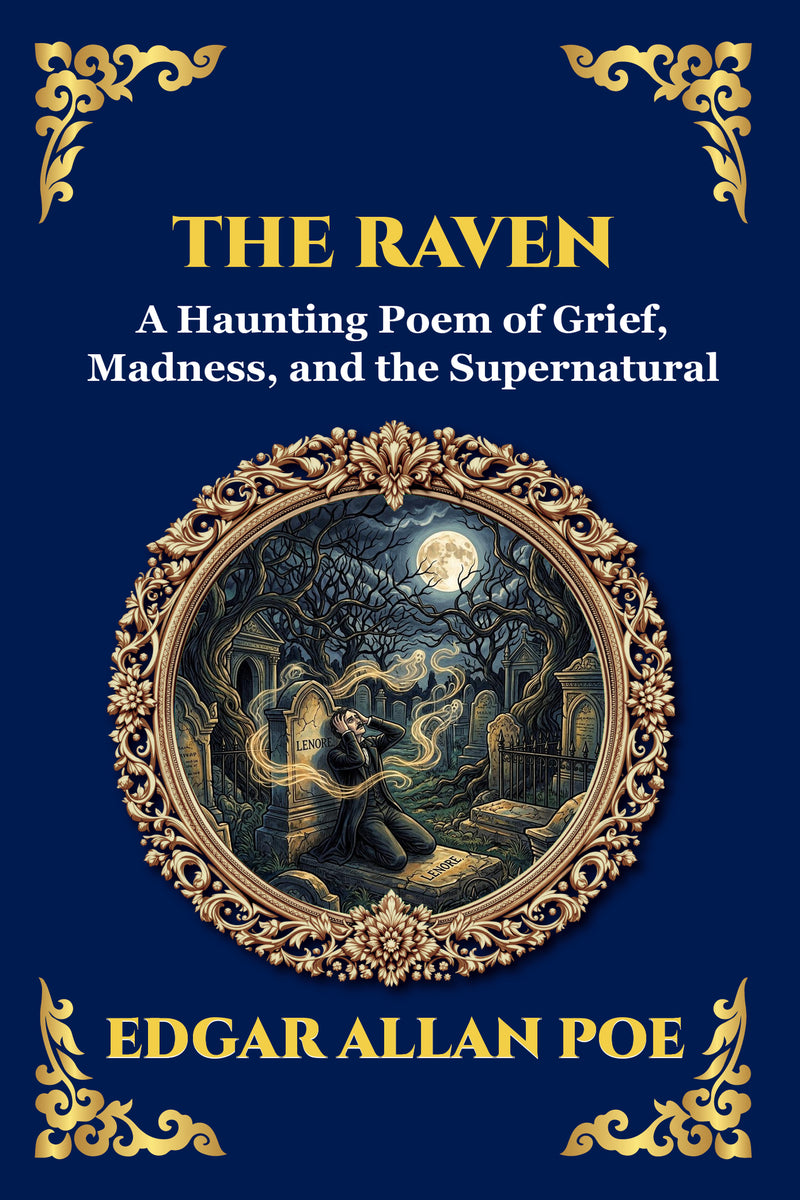
The Raven
In the dead of night, a grieving man is visited by a mysterious raven who speaks but one word: “Nevermore.” With its hypnotic rhythm and unforgettable imagery, The Raven remains one of the most iconic poems in all of literature—a chilling descent into sorrow, obsession, and madness.
or free app
10,000+ hrs library
30-day guarantee
The complete The Raven appears in modern English through Library of Alexandria Press, available online with audiobook narration included for members.
Have you ever wondered why “The Raven” is the most haunting poem ever written? A cornerstone of American gothic literature, The Raven by Edgar Allan Poe is more than a poem—it’s a psychological portrait of a mind unraveling under the weight of grief and longing. On a bleak December evening, a man mourning the loss of his beloved Lenore hears an ominous tapping at his door.
What follows is a masterclass in escalating suspense as a mysterious black raven enters his chamber, delivering its dark prophecy with a single word: “Nevermore.” With its powerful use of meter, repetition, and symbolism, Poe’s poem evokes themes of death, memory, madness, and the supernatural. It is a meditation on the fragility of the human psyche and the ways in which sorrow can distort reality.
What you’ll discover in this modern edition
- A Masterpiece of Melancholy and Atmosphere Experience the haunting cadence and vivid imagery that have made The Raven a fixture in literary history.
- Psychological Depth and Symbolism Uncover the deeper meanings hidden within the Raven, the chamber, and the narrator’s slow descent into despair.
- A Lyrical Journey Through Loss and Madness Explore the torment of a man caught between memory and delusion, pleading for release yet bound by sorrow.
- An Accessible Presentation for Today’s Reader With clean formatting and insightful presentation, this edition preserves the poetic intensity while making it easy to revisit or study.
| Formats | eBook (EPUB + PDF) · Audiobook · Paperback · Hardcover · Large Print |
| Language | English |
| Trim size (print) | 6 × 9 in |
| Binding | Paperback — perfect-bound · Hardcover — casewrap |
| Large Print edition | Same text in a larger, easy-read type — a larger font, not a larger trim |
| Print pricing | Every physical book at our true cost — at-cost, no profit (members) |
| Library | 873 restored titles, always growing |
| Length | 9,492 words · ~38 min reading |
| Reading level | Grade 6 · an easy, flowing read (this modern-English edition) |
| Edition | Modern English translation · 2026 |
Member reviews for this edition are collected as readers finish it — be the first. Across the library: 12,000+ books shipped, every plan covered by a 365-day print guarantee.
About this edition
A faithful, unabridged modern-English edition by The Library of Alexandria — carefully rendered for today's reader and verified paragraph-by-paragraph against the public-domain source. Available as eBook, audiobook, paperback, hardcover, and large print.
- Complete & unabridgedVerified paragraph by paragraph against the source — never a scan, never abridged.
- Modern English, faithfulReadable today, with the author’s meaning kept intact. Readable — not simplified.
- Every format, one membershipRead in your browser or the free app, or listen to the full audiobook.
Included free with your membership
Cancel anytime, one click · 30-day money-back guarantee
Edition last updated July 2026
What’s inside
The Raven — complete and unabridged, included in full with membership, plus the full audiobook.
Begin reading The Raven
In clear modern English — the complete text is included with membership.
Introduction
There is a bird sitting in your mind right now. You may not have read this poem in years, or perhaps you have never read it at all, but you know the bird. You know the word it speaks. You know, in some wordless way, the feeling of a door opening onto darkness, of a question asked into the void and answered with something worse than silence. Edgar Allan Poe wrote one hundred and eight lines of verse in the early 1840s, and those lines have never stopped echoing. That is not a small thing. Most poems, even celebrated ones, require a certain amount of cultural scaffolding before a reader can feel them. They need footnotes, context, a professor explaining what the imagery meant to its original audience. The Raven requires none of that. It arrives fully loaded, and it detonates on contact.
What Poe accomplished with this poem is something that serious literary critics have spent nearly two centuries trying to explain without quite managing to diminish. He built a machine for producing dread. Every element, the meter that rocks like a cradle or a pendulum, the rhyme scheme that keeps folding back on itself, the single repeated word that shifts meaning with each repetition, the claustrophobic single room, the unnamed grief, the bird that cannot possibly mean what the narrator insists on making it mean, all of it is engineered. Poe himself said so, famously and controversially, in an essay he wrote after the poem’s success. He claimed he had calculated every effect in advance, chosen every word with the precision of a mathematician. Readers have argued ever since about whether to believe him. The argument itself is part of the poem’s legacy.
This introduction will not tell you what the poem means. Partly that is because the poem resists that kind of summary, and partly it is because the experience of reading it, of being inside its rhythm and its mounting desperation, is the meaning. What this introduction will do is give you the world the poem came from, the man who made it, and some honest guidance about how to meet it on its own terms. The Raven is short enough to read in ten minutes and strange enough to reward a lifetime of returning to it. Both of those things are true at once, and that combination is rarer than it sounds.
Edgar Allan Poe was born in Boston on January 19, 1809, to parents who were both traveling actors. His father, David Poe Jr., abandoned the family early. His mother, Eliza Poe, died of tuberculosis in Richmond, Virginia, in December 1811, when Edgar was two years old. He was taken in, though never formally adopted, by John and Frances Allan of Richmond, whose surname he absorbed into his own. Frances Allan was a source of warmth in his childhood. John Allan was not. Their relationship was one of mutual disappointment conducted over decades, and it shaped Poe’s understanding of what it meant to be dependent on someone who held power over you and exercised it without tenderness.
Poe attended the University of Virginia briefly in 1826, where he distinguished himself academically and accumulated gambling debts that John Allan refused to cover. He enrolled at West Point in 1830 and got himself dismissed in 1831 by deliberately neglecting his duties, having concluded that Allan would never support his literary ambitions and that there was no point pretending otherwise. By then he had already published two small collections of poetry, largely at his own expense and largely ignored. He moved to Baltimore, where he lived with his aunt, Maria Clemm, and her daughter Virginia. He was twenty-two. Virginia was nine.
The years that followed were years of grinding literary labor conducted in poverty. Poe worked as an editor and critic for various magazines in Richmond, Philadelphia, and New York, writing fiction, poetry, and criticism at a pace that would exhaust a healthy person, which Poe was not. He was prone to illness, prone to drinking, and prone to the kind of spectacular professional self-destruction that comes from being both genuinely brilliant and constitutionally unable to tolerate fools, of whom the American publishing world of the 1830s and 1840s had a generous supply. He married Virginia Clemm in 1835, when she was thirteen and he was twenty-six. The marriage, whatever its complications, appears to have been one of genuine affection. Virginia developed tuberculosis in 1842. She died in January 1847.
The Raven was published in January 1845, in the New York Evening Mirror, while Virginia was still alive but already ill, already coughing blood, already the embodiment of the thing Poe most feared losing. The poem made him famous almost overnight. It was reprinted across the country with a speed that would be recognizable to anyone who has watched something go viral, copied from paper to paper, recited at public gatherings, parodied, praised, and argued over. Poe became, briefly, a celebrity. He gave readings. He was invited to salons. He was pointed out on the street. None of this translated into financial security, because the American copyright system of the era offered writers almost no protection, and fame without money is a particularly cruel condition.
Poe had been thinking about the poem for years before he wrote it. He was deeply influenced by Elizabeth Barrett’s poem Lady Geraldine’s Courtship, which used a similar meter, and by the tradition of Gothic verse that ran through English Romanticism. He was also, characteristically, thinking about effect before he was thinking about content. What kind of poem would produce the maximum emotional impact? What subject was inherently most poetic? In his 1846 essay The Philosophy of Composition, he argued that the death of a beautiful woman was the most poetic topic in the world, and that a grieving lover was the ideal narrator for such a subject. Critics have debated whether this essay is a genuine account of his creative process or a retrospective performance, a piece of criticism as fiction. What is not debatable is that the poem works, and that it works in precisely the ways Poe described, which is either evidence that he was telling the truth or evidence that he was a good enough writer to make his theory true after the fact.
The raven as a symbol had a long history before Poe got to it. Ravens appear in Norse mythology as the companions of Odin, birds of wisdom and ill omen. They appear in the Bible. They appear in Dickens, whose novel Barnaby Rudge featured a talking raven named Grip, a bird Poe had reviewed and apparently found memorable. The choice of a raven rather than, say, a parrot, which could also plausibly speak a single word, was deliberate. A parrot is comic. A raven is ancient, dark, associated with death and prophecy. It arrives from outside the narrator’s world and refuses to leave. It is, in the poem’s logic, both completely explicable, a bird that has been taught one word, and completely inexplicable, a messenger from whatever darkness lies beyond the narrator’s grief.
The most obvious reason The Raven still matters is that it is about something that has not gone away. Grief has not gone away. The specific texture of grief that Poe captures, the way a mourning mind turns everything into evidence of its loss, the way a person in pain will ask questions they know will hurt them and then be hurt by the answers, the way the mind at two in the morning is not the same mind that functions in daylight, all of that is as accurate now as it was in 1845. The poem is not really about a supernatural bird. It is about a man who is doing something to himself, who is using the bird as an instrument of self-torture, who keeps asking questions whose only possible answer is the word he most dreads hearing. The raven does not torment the narrator. The narrator torments himself, and the raven is simply willing to assist.
This is psychologically sophisticated in a way that feels modern. Poe understood, perhaps from extensive personal experience, that grief is not passive. It is active. It seeks out its own confirmation. The narrator in this poem is not a victim of the bird’s malice. He is a man who has found, in this strange visitor, the perfect collaborator for his own despair. By the poem’s final stanzas, when he is demanding to know whether there is any balm in Gilead, whether he will ever hold Lenore again in some paradise beyond death, he already knows the answer he is going to get. He asks anyway. That is the poem’s real horror, and it is a horror that anyone who has ever lain awake rehearsing their worst fears will recognize immediately.
The poem’s influence on subsequent literature and culture is so extensive that it is almost impossible to map completely. It helped establish the Gothic mode in American literature, a tradition that runs through Ambrose Bierce, H.P. Lovecraft, Shirley Jackson, Stephen King, and dozens of others. Its meter, a variant of trochaic octameter, became one of the most recognizable rhythms in the English language, parodied so often precisely because it is so distinctive and so powerful. The single repeated word as a structural device, the refrain that accumulates meaning through repetition, influenced poets from Tennyson to Sylvia Plath. The image of the raven itself entered the permanent vocabulary of Western culture, appearing in paintings, films, songs, sports team names, and countless other contexts, most of which have retained at least a ghost of the original meaning, darkness, intelligence, the persistence of what we cannot escape.
There is also the matter of Poe’s influence on the detective story, the horror story, and the short psychological tale, all of which he essentially invented or perfected, and all of which trace their DNA back to the same obsessions visible in The Raven. The locked room. The unreliable narrator. The mind turning on itself. The atmosphere of enclosure and dread. These are Poe’s gifts to literature, and The Raven is their purest lyric expression.
Read it aloud. This is not a generic suggestion. It is the single most important thing you can do with this particular poem, because The Raven is, at its core, a sound machine, and reading it silently is like looking at sheet music instead of listening to the performance. The meter is insistent to the point of being hypnotic, and that hypnotic quality is not incidental. It is the mechanism by which Poe puts you inside the narrator’s state of mind. When you read it aloud, you will feel the rhythm pulling you forward even when the content is pulling you toward dread. That tension between the rocking, almost lullaby-like meter and the increasingly desperate content is where the poem lives.
Pay attention to the rhyme scheme, specifically to the internal rhymes. Each stanza rhymes not just at the end of lines but within them. Once upon a midnight dreary, while I pondered, weak and weary. The rhyme is inside the line, not just at its end. This creates a doubling effect, a sense of the poem folding back on itself, of the narrator’s thoughts circling rather than progressing. Notice how this mirrors the narrator’s psychological state. He is not moving forward. He is going in circles, returning again and again to the same wound.
Notice what the poem withholds. We never learn who Lenore was, exactly. We never learn how she died. We never learn the narrator’s name or profession, though the books and the bust of Pallas suggest a scholar of some kind. We never learn where the raven came from or what, if anything, it represents beyond itself. Poe withholds all of this deliberately, because specificity would limit the poem’s reach. Lenore is every lost beloved. The narrator is every grieving person. The raven is every thought that will not leave you alone at night. The poem’s universality depends on its vagueness about particulars.
Watch the narrator’s relationship to the raven change across the poem’s eighteen stanzas. In the early stanzas, the narrator is almost amused by the bird, charmed by its stately manner, treating its single word as a kind of joke. He even smiles. By the middle stanzas, he is beginning to invest the word with meaning he knows it cannot carry. By the final stanzas, he has fully surrendered to the interpretation that destroys him, insisting that the raven is a prophet, a thing of evil, a messenger from the darkness, when the poem has given us every reason to believe it is simply a bird that knows one word. The narrator’s descent is the poem’s arc, and it happens gradually enough that you can watch each step if you are paying attention.
Cancel anytime, one click · 30-day money-back guarantee
Founding annual rate available now — your price locks for life when you join.
Not ready? Get this free chapter by email — read it anytime.
✓ Sent — check your inbox for The Raven.
Questions about The Raven
What is The Raven about?
In the dead of night, a grieving man is visited by a mysterious raven who speaks but one word: “Nevermore.” With its hypnotic rhythm and unforgettable imagery, The Raven remains one of the most iconic poems in all of literature—a chilling descent into sorrow, obsession, and madness. In this definitive edition of Edgar Allan Poe’s timeless masterpiece, readers are invited to experience the eerie atmosphere, psychological torment, and gothic beauty that have inspired generations of writers, artists, and dreamers. Whe
Who wrote The Raven?
The Raven was written by Edgar Allan Poe. This edition presents the complete work in clear modern English, faithfully rendered from the public-domain original by Library of Alexandria Press.
Is The Raven free to read?
The opening chapter is free to read on this page. Members read and listen to the complete work — and the entire library — free, and can order any physical book at our true print cost.
How long is The Raven?
2 chapters (~9,492 words) — about 38 min of reading in this modern-English edition.
Is this an abridged version of The Raven?
No. This is the complete, unabridged The Raven, carefully rendered into clear modern English and verified paragraph-by-paragraph against the public-domain source — nothing is cut or summarised.
What formats does The Raven come in?
The Raven is available as eBook, paperback, hardcover and large print. eBook and audiobook are included with membership; printed editions ship at our true print cost.
Shipping & returns
Billing & membership
More from the library


Explore Poetry & Drama
- As You Like It · William Shakespeare
- The Merchant of Venice · William Shakespeare
- A Midsummer Night’s Dream · William Shakespeare
- Romeo and Juliet · William Shakespeare
- The Imaginary Invalid · Molière
- A Woman of No Importance · Oscar Wilde
- Gitanjali · Rabindranath Tagore
- Sonnets from the Portuguese · Elizabeth Barrett Browning
- The New Life (La Vita Nuova) · Dante Alighieri
- The Rime of the Ancient Mariner · Samuel Taylor Coleridge
- Lady Windermere’s Fan · Oscar Wilde
- The Home Book of Verse — Volume 4 · Burton Egbert Stevenson
- Ghosts · Henrik Ibsen
- Mrs. Warren’s Profession · Bernard Shaw
- An Enemy of the People · Henrik Ibsen
- Gawayne and the Green Knight: A Fairy Tale · Charlton M. Lewis
- The Nibelungenlied · G. H. Needler
- Julius Caesar · William Shakespeare
- The Aeneid of Virgil · Virgil
- Troilus and Criseyde · Geoffrey Chaucer
- The Post Office · Rabindranath Tagore
- Lamia · John Keats
- The Ballad of the White Horse · G. K. Chesterton
- A Shropshire Lad · A. E. Housman
- The Birth of the War-God: A Poem by Kalidasa · Kálidása
- Riders to the Sea · J. M. Synge
- The Prophet · Kahlil Gibran
- Twelfth Night; Or, What You Will · William Shakespeare
- Othello, the Moor of Venice · William Shakespeare
- Salomé: A Tragedy in One Act · Oscar Wilde
The Raven
The Raven
A Haunting Poem of Grief, Madness, and the Supernatural
Edgar Allan Poe
Contents
- Introduction
- Comment on the Poem
Introduction
There is a bird sitting in your mind right now. You may not have read this poem in years, or perhaps you have never read it at all, but you know the bird. You know the word it speaks. You know, in some wordless way, the feeling of a door opening onto darkness, of a question asked into the void and answered with something worse than silence. Edgar Allan Poe wrote one hundred and eight lines of verse in the early 1840s, and those lines have never stopped echoing. That is not a small thing. Most poems, even celebrated ones, require a certain amount of cultural scaffolding before a reader can feel them. They need footnotes, context, a professor explaining what the imagery meant to its original audience. The Raven requires none of that. It arrives fully loaded, and it detonates on contact.
What Poe accomplished with this poem is something that serious literary critics have spent nearly two centuries trying to explain without quite managing to diminish. He built a machine for producing dread. Every element, the meter that rocks like a cradle or a pendulum, the rhyme scheme that keeps folding back on itself, the single repeated word that shifts meaning with each repetition, the claustrophobic single room, the unnamed grief, the bird that cannot possibly mean what the narrator insists on making it mean, all of it is engineered. Poe himself said so, famously and controversially, in an essay he wrote after the poem’s success. He claimed he had calculated every effect in advance, chosen every word with the precision of a mathematician. Readers have argued ever since about whether to believe him. The argument itself is part of the poem’s legacy.
This introduction will not tell you what the poem means. Partly that is because the poem resists that kind of summary, and partly it is because the experience of reading it, of being inside its rhythm and its mounting desperation, is the meaning. What this introduction will do is give you the world the poem came from, the man who made it, and some honest guidance about how to meet it on its own terms. The Raven is short enough to read in ten minutes and strange enough to reward a lifetime of returning to it. Both of those things are true at once, and that combination is rarer than it sounds.
Edgar Allan Poe was born in Boston on January 19, 1809, to parents who were both traveling actors. His father, David Poe Jr., abandoned the family early. His mother, Eliza Poe, died of tuberculosis in Richmond, Virginia, in December 1811, when Edgar was two years old. He was taken in, though never formally adopted, by John and Frances Allan of Richmond, whose surname he absorbed into his own. Frances Allan was a source of warmth in his childhood. John Allan was not. Their relationship was one of mutual disappointment conducted over decades, and it shaped Poe’s understanding of what it meant to be dependent on someone who held power over you and exercised it without tenderness.
Poe attended the University of Virginia briefly in 1826, where he distinguished himself academically and accumulated gambling debts that John Allan refused to cover. He enrolled at West Point in 1830 and got himself dismissed in 1831 by deliberately neglecting his duties, having concluded that Allan would never support his literary ambitions and that there was no point pretending otherwise. By then he had already published two small collections of poetry, largely at his own expense and largely ignored. He moved to Baltimore, where he lived with his aunt, Maria Clemm, and her daughter Virginia. He was twenty-two. Virginia was nine.
The years that followed were years of grinding literary labor conducted in poverty. Poe worked as an editor and critic for various magazines in Richmond, Philadelphia, and New York, writing fiction, poetry, and criticism at a pace that would exhaust a healthy person, which Poe was not. He was prone to illness, prone to drinking, and prone to the kind of spectacular professional self-destruction that comes from being both genuinely brilliant and constitutionally unable to tolerate fools, of whom the American publishing world of the 1830s and 1840s had a generous supply. He married Virginia Clemm in 1835, when she was thirteen and he was twenty-six. The marriage, whatever its complications, appears to have been one of genuine affection. Virginia developed tuberculosis in 1842. She died in January 1847.
The Raven was published in January 1845, in the New York Evening Mirror, while Virginia was still alive but already ill, already coughing blood, already the embodiment of the thing Poe most feared losing. The poem made him famous almost overnight. It was reprinted across the country with a speed that would be recognizable to anyone who has watched something go viral, copied from paper to paper, recited at public gatherings, parodied, praised, and argued over. Poe became, briefly, a celebrity. He gave readings. He was invited to salons. He was pointed out on the street. None of this translated into financial security, because the American copyright system of the era offered writers almost no protection, and fame without money is a particularly cruel condition.
Poe had been thinking about the poem for years before he wrote it. He was deeply influenced by Elizabeth Barrett’s poem Lady Geraldine’s Courtship, which used a similar meter, and by the tradition of Gothic verse that ran through English Romanticism. He was also, characteristically, thinking about effect before he was thinking about content. What kind of poem would produce the maximum emotional impact? What subject was inherently most poetic? In his 1846 essay The Philosophy of Composition, he argued that the death of a beautiful woman was the most poetic topic in the world, and that a grieving lover was the ideal narrator for such a subject. Critics have debated whether this essay is a genuine account of his creative process or a retrospective performance, a piece of criticism as fiction. What is not debatable is that the poem works, and that it works in precisely the ways Poe described, which is either evidence that he was telling the truth or evidence that he was a good enough writer to make his theory true after the fact.
The raven as a symbol had a long history before Poe got to it. Ravens appear in Norse mythology as the companions of Odin, birds of wisdom and ill omen. They appear in the Bible. They appear in Dickens, whose novel Barnaby Rudge featured a talking raven named Grip, a bird Poe had reviewed and apparently found memorable. The choice of a raven rather than, say, a parrot, which could also plausibly speak a single word, was deliberate. A parrot is comic. A raven is ancient, dark, associated with death and prophecy. It arrives from outside the narrator’s world and refuses to leave. It is, in the poem’s logic, both completely explicable, a bird that has been taught one word, and completely inexplicable, a messenger from whatever darkness lies beyond the narrator’s grief.
The most obvious reason The Raven still matters is that it is about something that has not gone away. Grief has not gone away. The specific texture of grief that Poe captures, the way a mourning mind turns everything into evidence of its loss, the way a person in pain will ask questions they know will hurt them and then be hurt by the answers, the way the mind at two in the morning is not the same mind that functions in daylight, all of that is as accurate now as it was in 1845. The poem is not really about a supernatural bird. It is about a man who is doing something to himself, who is using the bird as an instrument of self-torture, who keeps asking questions whose only possible answer is the word he most dreads hearing. The raven does not torment the narrator. The narrator torments himself, and the raven is simply willing to assist.
This is psychologically sophisticated in a way that feels modern. Poe understood, perhaps from extensive personal experience, that grief is not passive. It is active. It seeks out its own confirmation. The narrator in this poem is not a victim of the bird’s malice. He is a man who has found, in this strange visitor, the perfect collaborator for his own despair. By the poem’s final stanzas, when he is demanding to know whether there is any balm in Gilead, whether he will ever hold Lenore again in some paradise beyond death, he already knows the answer he is going to get. He asks anyway. That is the poem’s real horror, and it is a horror that anyone who has ever lain awake rehearsing their worst fears will recognize immediately.
The poem’s influence on subsequent literature and culture is so extensive that it is almost impossible to map completely. It helped establish the Gothic mode in American literature, a tradition that runs through Ambrose Bierce, H.P. Lovecraft, Shirley Jackson, Stephen King, and dozens of others. Its meter, a variant of trochaic octameter, became one of the most recognizable rhythms in the English language, parodied so often precisely because it is so distinctive and so powerful. The single repeated word as a structural device, the refrain that accumulates meaning through repetition, influenced poets from Tennyson to Sylvia Plath. The image of the raven itself entered the permanent vocabulary of Western culture, appearing in paintings, films, songs, sports team names, and countless other contexts, most of which have retained at least a ghost of the original meaning, darkness, intelligence, the persistence of what we cannot escape.
There is also the matter of Poe’s influence on the detective story, the horror story, and the short psychological tale, all of which he essentially invented or perfected, and all of which trace their DNA back to the same obsessions visible in The Raven. The locked room. The unreliable narrator. The mind turning on itself. The atmosphere of enclosure and dread. These are Poe’s gifts to literature, and The Raven is their purest lyric expression.
Read it aloud. This is not a generic suggestion. It is the single most important thing you can do with this particular poem, because The Raven is, at its core, a sound machine, and reading it silently is like looking at sheet music instead of listening to the performance. The meter is insistent to the point of being hypnotic, and that hypnotic quality is not incidental. It is the mechanism by which Poe puts you inside the narrator’s state of mind. When you read it aloud, you will feel the rhythm pulling you forward even when the content is pulling you toward dread. That tension between the rocking, almost lullaby-like meter and the increasingly desperate content is where the poem lives.
Pay attention to the rhyme scheme, specifically to the internal rhymes. Each stanza rhymes not just at the end of lines but within them. Once upon a midnight dreary, while I pondered, weak and weary. The rhyme is inside the line, not just at its end. This creates a doubling effect, a sense of the poem folding back on itself, of the narrator’s thoughts circling rather than progressing. Notice how this mirrors the narrator’s psychological state. He is not moving forward. He is going in circles, returning again and again to the same wound.
Notice what the poem withholds. We never learn who Lenore was, exactly. We never learn how she died. We never learn the narrator’s name or profession, though the books and the bust of Pallas suggest a scholar of some kind. We never learn where the raven came from or what, if anything, it represents beyond itself. Poe withholds all of this deliberately, because specificity would limit the poem’s reach. Lenore is every lost beloved. The narrator is every grieving person. The raven is every thought that will not leave you alone at night. The poem’s universality depends on its vagueness about particulars.
Watch the narrator’s relationship to the raven change across the poem’s eighteen stanzas. In the early stanzas, the narrator is almost amused by the bird, charmed by its stately manner, treating its single word as a kind of joke. He even smiles. By the middle stanzas, he is beginning to invest the word with meaning he knows it cannot carry. By the final stanzas, he has fully surrendered to the interpretation that destroys him, insisting that the raven is a prophet, a thing of evil, a messenger from the darkness, when the poem has given us every reason to believe it is simply a bird that knows one word. The narrator’s descent is the poem’s arc, and it happens gradually enough that you can watch each step if you are paying attention.
The secret of a poem, just like the secret of a good joke, lies in the ear of the person who hears it. Give in to its spell and accept the poet’s state of mind -- that, in the end, is what the wise say when you ask them what a poem is worth. Even if the poet himself, in a different mood, tells you that his art is nothing but sleight of hand, that his food is an enchanter’s food, and offers to show you how the trick is done -- don’t believe him. Wait for his inspired hour, then open yourself to his passion, his joy or his pain. “We are in Love’s hand today!” sings Gautier, in Swinburne’s lively paraphrase -- and from morning to sunset we are carried along on a violent sea: there is only one love, one May, one flowering shore. Love is eternal; everything else is unreal and set aside. The vision ends and the scene changes, but we have gained something -- the memory of a charm. Every poet has his own charm. There is the charm of Evanescence, which gives to supreme beauty and grace a glow of Pathos. Share with Landor his one “night of memories and of sighs” for Rose Aylmer, and you will feel this fully.
Now take the hand of a new-world poet, one who had wandered from some more fitting home into that rough and discordant America which, as Baudelaire saw, “was for Poe only a vast prison through which he ran, back and forth, with the feverish restlessness of a being created to breathe in a purer world,” and where “his inner life, spiritual as a poet’s, spiritual even as a drunkard’s, was nothing but one endless effort to escape the influence of this hostile atmosphere.” Clasp the sensitive hand of this troubled singer enduring his strange fate, and share with him the world in which he found -- never during the day, always in the night -- if not the lost Atlantis from which he had wandered, at least a place of refuge from the prison in which by day he was locked away.
End of the free sample
Keep reading, free
Members read and listen to the complete book — and the entire library. Cancel anytime, one click · 30-day money-back guarantee.