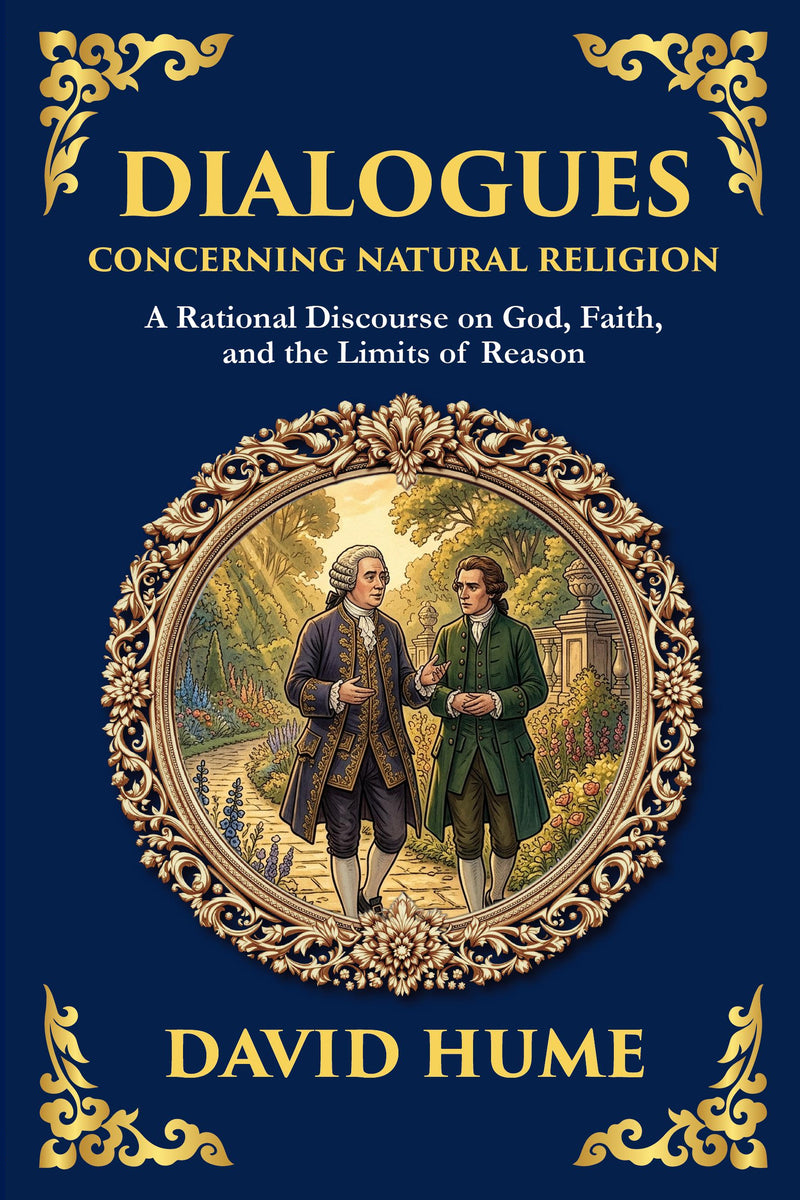
Dialogues Concerning Natural Religion
In Dialogues Concerning Natural Religion, the great Scottish philosopher David Hume explores one of the most enduring and profound questions in human thought: Can reason alone prove the existence of God?
or free app
10,000+ hrs library
30-day guarantee
The complete Dialogues Concerning Natural appears in modern English through Library of Alexandria Press, available online with audiobook narration included for members.
Have you ever wondered why belief in God remains so powerful—even when reason offers no certain answers? David Hume’s Dialogues Concerning Natural Religion is one of the most important philosophical works ever written on the relationship between faith and reason. Set as a debate between three distinct voices—Philo the skeptic, Demea the religious mystic, and Cleanthes the rational theist —this thought-provoking masterpiece examines whether the existence and nature of God can be discovered through human logic and experience.
Hume’s unique literary format allows each perspective to shine while subtly guiding the reader through his own skepticism. Though penned in the 18th century, the themes remain astonishingly relevant: the origin of the universe, the problem of evil, the limitations of human knowledge, and the place of religion in a scientific age. This edition presents a modernized and accessible version of Hume’s brilliant work, perfect for students of philosophy, theology, or anyone seeking clarity in an increasingly complex world.
What you’ll discover in this modern edition
- A Timeless Philosophical Debate – Follow the intellectual exchange between three characters, each presenting different worldviews on religion and reason.
- The Limits of Human Understanding – Explore Hume’s arguments about the weaknesses of analogy, causality, and anthropomorphism in theology.
- The Problem of Evil – Engage with one of the most powerful early critiques of the idea of an all-good, all-powerful deity.
- A Foundation for Modern Atheism and Agnosticism – See why this book influenced thinkers from Darwin to Bertrand Russell and continues to inspire secular philosophy.
- Accessible, Relevant, and Endlessly Thought-Provoking – Perfect for readers interested in critical thinking, religious philosophy, and Enlightenment-era literature.
| Formats | eBook (EPUB + PDF) · Audiobook · Paperback · Hardcover · Large Print |
| Language | English |
| Trim size (print) | 6 × 9 in |
| Binding | Paperback — perfect-bound · Hardcover — casewrap |
| Large Print edition | Same text in a larger, easy-read type — a larger font, not a larger trim |
| Print pricing | Every physical book at our true cost — at-cost, no profit (members) |
| Library | 873 restored titles, always growing |
| Length | 36,809 words · ~2 hr 27 min reading |
| Reading level | Grade 12 · a confident, adult read (this modern-English edition) |
| Edition | Modern English translation · 2026 |
Member reviews for this edition are collected as readers finish it — be the first. Across the library: 12,000+ books shipped, every plan covered by a 365-day print guarantee.
About this edition
A faithful, unabridged modern-English edition by The Library of Alexandria — carefully rendered for today's reader and verified paragraph-by-paragraph against the public-domain source. Available as eBook, audiobook, paperback, hardcover, and large print.
- Complete & unabridgedVerified paragraph by paragraph against the source — never a scan, never abridged.
- Modern English, faithfulReadable today, with the author’s meaning kept intact. Readable — not simplified.
- Every format, one membershipRead in your browser or the free app, or listen to the full audiobook.
Included free with your membership
Cancel anytime, one click · 30-day money-back guarantee
Edition last updated July 2026
What’s inside
Dialogues Concerning Natural Religion — complete and unabridged: all 13 sections included with membership, plus the full audiobook.
Begin reading Dialogues Concerning Natural Religion
In clear modern English — the complete text is included with membership.
Introduction
There are books that argue with you, and there are books that teach you how to argue with yourself. David Hume’s Dialogues Concerning Natural Religion belongs unmistakably to the second, rarer category. It does not hand you a doctrine to memorize or a creed to defend. Instead, it pulls up three chairs in a quiet study, sits you down between speakers who refuse to let one another off the hook, and invites you to listen as the most fundamental questions a human mind can ask are turned over, examined, and turned over again. By the time you reach the final page, you will not have been told what to think. You will have been shown, with unsettling clarity, how thinking itself proceeds when it dares to address the largest subject of all.
Written in the eighteenth century by one of the sharpest minds the Western tradition ever produced, this work circles a single, enduring question: what can human reason actually establish about the divine? Not what faith asserts, not what scripture promises, not what tradition assumes—but what reason, working on its own terms and from the evidence available to it, can honestly conclude. The question sounds narrow when stated so plainly, yet it opens outward like a fan, touching the nature of the universe, the limits of human understanding, the structure of belief, the meaning of evidence, and the strange and stubborn relationship between what we hope to be true and what we can prove. Few books have asked it more honestly, and almost none have asked it with such grace.
This edition has been prepared specifically for the contemporary reader. The language has been carefully modernized so that the elegance of the original argument shines through without the friction of antique phrasing and unfamiliar constructions. What has not been changed is the substance: the logical architecture, the carefully balanced positions, the slow tightening of each line of reasoning. The goal of this adaptation is to remove the barriers of time while preserving everything that makes the work worth reading in the first place. You are about to encounter the genuine article, rendered in prose that respects both the author’s intentions and your own intelligence.
Why a Conversation, and Why These Three Voices
The first thing to understand about this book is its form, because the form is not decoration—it is the argument’s living body. Hume could have written a treatise. He could have laid out his views in numbered propositions, defended them against objections, and concluded with a triumphant summary. He did not. He chose instead to stage a dialogue, a method as old as Plato, in which distinct characters embody distinct positions and the truth, if it emerges at all, emerges from the collision and conversation between them. This choice was deliberate, and it changes everything about how the book should be read.
When a single author asserts a single thesis, the reader’s job is simple: agree or disagree. But when three thoughtful people debate, the reader is drawn into the room. You cannot simply side with the author, because there is no single author-voice to side with. Each speaker is given real intelligence, real arguments, and—crucially—real dignity. Hume does not build straw men to knock down. He builds opponents worthy of respect, gives each the strongest case available, and then lets them go at one another with genuine force. The result is that you, the reader, must do the work of weighing. You must hold competing ideas in your mind at once, follow them as they develop, and notice where each begins to strain or break. This is not a passive reading experience. It is a participatory one, and that is precisely its value.
The three principal voices belong to figures whose temperaments are as important as their opinions. One speaks with serene confidence in the power of reason to demonstrate truths about the world’s ultimate cause, drawing analogies between the universe and the works of human design. He is impressed by order, by the intricate fitting-together of natural things, and he believes this order points unmistakably toward an intelligent source. His arguments will feel familiar, because they remain among the most popular and intuitive that human beings reach for when they look at the sky and wonder.
A second voice is more cautious, more skeptical, more inclined to probe the limits of what we can claim to know. Where the first sees confident demonstration, the second sees overreach. He presses the question of whether our small experience, drawn from a corner of one world, can be stretched to cover the origin and nature of all things. He is not hostile to belief, but he is relentless about the difference between what we may sincerely feel and what we can rigorously prove. His role is to test every claim against the hard standard of evidence and inference, and he does so with a patience that can be either liberating or maddening, depending on your own disposition.
The third voice is the most pious, the most insistent that human reason is a feeble instrument when turned toward the infinite, and that faith—not argument—is the proper foundation of religious conviction. He distrusts the whole project of trying to prove the divine, suspecting that such proofs, when they fail, do more damage than they would have done had they never been attempted. There is a deep irony in his position, one the careful reader will savor: his very devotion leads him to a kind of skepticism, and his skepticism, in turn, produces some of the book’s most provocative moments.
Around and between these three moves a narrator, who frames the conversation and reflects on it, offering the reader a vantage point and, in the famous closing pages, a judgment of sorts—though even that judgment has been debated by readers for centuries, which tells you something about how carefully it was constructed. The interplay of all these voices is the genius of the work. You will find yourself agreeing with one speaker, then the next, then doubting your earlier agreement, then circling back. This is not confusion. This is the experience the book is designed to produce. The dialogue form is a machine for generating intellectual honesty, and Hume operated it with a master’s hand.
Read slowly, and read with attention to who is speaking. The pleasure of this text lies substantially in watching positions shift, in noticing when a speaker concedes a point, in catching the moments when one voice scores a hit and another absorbs it and regroups. Treat the conversation as you would treat a chess match between grandmasters: every move matters, and the elegance is in the strategy as much as the result. If you read it as a sermon or a manifesto, you will miss almost everything that makes it great. If you read it as a living conversation among brilliant, fallible, sincere people, it will repay you many times over.
It also helps to know that the book builds. Early sections establish the terms and the temperaments; later sections push the central arguments to their limits and beyond. There are passages of remarkable beauty, where the description of the universe’s order rises to something like poetry, and passages of remorseless logic, where an argument is pursued so far that it arrives at conclusions its own proponents did not anticipate. Hume was a writer of extraordinary control, and he paced this work with care. The patience he asks of you in the opening pages is rewarded richly as the conversation deepens. Do not rush. The slow accumulation of distinctions and qualifications is not throat-clearing; it is the foundation on which the most powerful later moments stand.
To read this book well, it helps to know something about the man who wrote it and the daring with which he approached his subject. David Hume was, by temperament and by reputation, one of the most genial and good-natured philosophers who ever lived—famous among his friends for his warmth, his wit, and his utter lack of pretension. He was also, by the standards of his age, intellectually fearless. He pursued arguments wherever they led, untroubled by where they were supposed to lead, and he did so with a calm that could be more disconcerting than any anger. He did not rage against received opinion. He simply asked, again and again, with unfailing politeness, how do we know that?—and he had a genius for noticing when the honest answer was we don’t.
That single question—how do we know?—runs through everything Hume wrote, and it is the engine of this book in particular. He belonged to a tradition that took seriously the idea that all our knowledge of the world must ultimately rest on experience. We learn that fire burns by being burned, that bread nourishes by eating it, that one event follows another by observing the sequence many times. This grounding in experience is powerful, but it has edges, and Hume was endlessly fascinated by those edges—by the points where our confident habits of inference run out of evidence to stand on. The question of the divine sits precisely at such an edge, and perhaps beyond it, which is what makes it the ultimate test case for his entire way of thinking. If reasoning from experience can establish anything about the origin and nature of the universe as a whole, then the project of natural religion succeeds. If it cannot, then we must reckon honestly with that limitation. The book is, among other things, an extended and exquisitely careful examination of where that edge actually lies.
It is worth pausing on a fact that tells you much about both the man and the era: this work was not published during his lifetime. Hume completed it, revised it over many years, valued it greatly—and arranged for it to appear only after his death. He understood perfectly well that the questions he was raising were dangerous to raise openly, that the calm dismantling of comfortable certainties was the kind of thing that earned a man enemies and worse. His caution was not cowardice; it was the prudence of someone who had measured exactly how much honesty his society could bear and chose to deliver his most penetrating work in a form and at a time that would let it speak without being silenced. The very existence of this book, then, is a small drama of intellectual courage, and reading it carries a faint echo of the risk its author once weighed.
This historical setting matters for another reason. Hume wrote in an age newly intoxicated by the achievements of science. The discoveries of the preceding century had revealed a universe of breathtaking order—planets moving in calculable orbits, light behaving according to discoverable laws, living bodies organized with an intricacy that staggered the imagination. To many of Hume’s contemporaries, this order seemed to shout a conclusion: a world so finely arranged must have been arranged by a mind. The analogy between the cosmos and a beautifully made machine—a watch, a building, an instrument—felt not merely persuasive but almost irresistible. The argument from design, as it came to be called, was the great confident proof of the age, embraced by serious thinkers and ordinary believers alike. It is this very argument, in its most respectable and sophisticated form, that the book takes as its central subject. And it is the close, fair, devastating, and yet curiously open-ended examination of that argument that constitutes the book’s enduring contribution.
What makes Hume’s treatment so remarkable is its fairness. A lesser thinker, hostile to the argument, would have caricatured it. A lesser thinker, sympathetic to it, would have shielded it from scrutiny. Hume does neither. He gives the argument its strongest possible statement—genuinely strong, genuinely moving—and only then begins to ask the hard questions. What exactly does the analogy establish? If the universe resembles a made thing, how far does the resemblance run, and what does it imply about the maker? Does it imply one maker or many? A perfect maker or a flawed one? A maker still present or long departed? Does the comparison even hold, given that we have seen many watches made but never seen a universe made, and have nothing to compare this universe to? Each question is asked not to wound but to clarify, and the cumulative effect is to reveal just how much the confident proof was carrying that it could not, on inspection, support.
Cancel anytime, one click · 30-day money-back guarantee
Founding annual rate available now — your price locks for life when you join.
Not ready? Get this free chapter by email — read it anytime.
✓ Sent — check your inbox for Dialogues Concerning Natural Religion.
Questions about Dialogues Concerning Natural Religion
What is Dialogues Concerning Natural about?
In Dialogues Concerning Natural Religion, the great Scottish philosopher David Hume explores one of the most enduring and profound questions in human thought: Can reason alone prove the existence of God? Through a brilliantly crafted fictional conversation among three characters —a skeptic, a theist, and an empiricist—Hume dismantles traditional arguments for the divine, challenges religious dogma, and offers a compelling meditation on faith, uncertainty, and human understanding. Written in the Enlightenment era ye
Who wrote Dialogues Concerning Natural?
Dialogues Concerning Natural was written by David Hume. This edition presents the complete work in clear modern English, faithfully rendered from the public-domain original by Library of Alexandria Press.
Is Dialogues Concerning Natural free to read?
The opening chapter is free to read on this page. Members read and listen to the complete work — and the entire library — free, and can order any physical book at our true print cost.
How long is Dialogues Concerning Natural?
13 chapters (~36,809 words) — about 2 hr 27 min of reading in this modern-English edition.
Is this an abridged version of Dialogues Concerning Natural?
No. This is the complete, unabridged Dialogues Concerning Natural, carefully rendered into clear modern English and verified paragraph-by-paragraph against the public-domain source — nothing is cut or summarised.
What formats does Dialogues Concerning Natural come in?
Dialogues Concerning Natural is available as eBook, paperback, hardcover and large print. eBook and audiobook are included with membership; printed editions ship at our true print cost.
Shipping & returns
Billing & membership
More from the library


Explore Philosophy & Ideas
- Kant's Prolegomena to Any Future Metaphysics · Immanuel Kant
- The Advancement of Learning · Francis Bacon
- The Dawn of Day · Friedrich Wilhelm Nietzsche
- Meditations · Marcus Aurelius
- The Confessions of St. Augustine · Saint Augustine
- Considerations on Representative Government · John Stuart Mill
- The Will to Power: An Attempted Transvaluation of All Values. Book III and IV · Friedrich Nietzsche
- Groundwork of the Metaphysics of Morals · Immanuel Kant
- The Confessions of Jean-Jacques Rousseau — Complete · Jean-Jacques Rousseau
- Democracy in America — Volume 2 · Alexis de Tocqueville
- Ecce Homo · Friedrich Wilhelm Nietzsche
- Second Treatise of Government · John Locke
- The Prince · Niccolò Machiavelli
- Thus Spake Zarathustra: A Book for All and None · Friedrich Wilhelm Nietzsche
- The Island of Doctor Moreau · H. G. Wells
- Sophist · Plato
- The Seven Lamps of Architecture · John Ruskin
- Essays — First Series · Ralph Waldo Emerson
- The Book of the Damned · Charles Fort
- The Everlasting Man · G. K. Chesterton
- The Initiates of the Flame · Manly P. Hall
- The Book of Tea · Kakuzo Okakura
- The Japanese Spirit · Yoshisaburo Okakura
- The Analysis of Mind · Bertrand Russell
- Orthodoxy · G. K. Chesterton
- Apology, Crito, and Phaedo of Socrates · Plato
- Euthyphro · Plato
- Timaeus · Plato
- Ion · Plato
- Essays of Schopenhauer · Arthur Schopenhauer
Dialogues Concerning Natural Religion
Dialogues Concerning Natural Religion
A Logical Discussion on God, Faith, and the Boundaries of Reason
David Hume
Contents
- Introduction
- Part 1
- Part 2
- Part 3
- Part 4
- Part 5
- Part 6
- Part 7
- Part 8
- Part 9
- Part 10
- Part 11
- Part 12
Introduction
There are books that argue with you, and there are books that teach you how to argue with yourself. David Hume’s Dialogues Concerning Natural Religion belongs unmistakably to the second, rarer category. It does not hand you a doctrine to memorize or a creed to defend. Instead, it pulls up three chairs in a quiet study, sits you down between speakers who refuse to let one another off the hook, and invites you to listen as the most fundamental questions a human mind can ask are turned over, examined, and turned over again. By the time you reach the final page, you will not have been told what to think. You will have been shown, with unsettling clarity, how thinking itself proceeds when it dares to address the largest subject of all.
Written in the eighteenth century by one of the sharpest minds the Western tradition ever produced, this work circles a single, enduring question: what can human reason actually establish about the divine? Not what faith asserts, not what scripture promises, not what tradition assumes—but what reason, working on its own terms and from the evidence available to it, can honestly conclude. The question sounds narrow when stated so plainly, yet it opens outward like a fan, touching the nature of the universe, the limits of human understanding, the structure of belief, the meaning of evidence, and the strange and stubborn relationship between what we hope to be true and what we can prove. Few books have asked it more honestly, and almost none have asked it with such grace.
This edition has been prepared specifically for the contemporary reader. The language has been carefully modernized so that the elegance of the original argument shines through without the friction of antique phrasing and unfamiliar constructions. What has not been changed is the substance: the logical architecture, the carefully balanced positions, the slow tightening of each line of reasoning. The goal of this adaptation is to remove the barriers of time while preserving everything that makes the work worth reading in the first place. You are about to encounter the genuine article, rendered in prose that respects both the author’s intentions and your own intelligence.
Why a Conversation, and Why These Three Voices
The first thing to understand about this book is its form, because the form is not decoration—it is the argument’s living body. Hume could have written a treatise. He could have laid out his views in numbered propositions, defended them against objections, and concluded with a triumphant summary. He did not. He chose instead to stage a dialogue, a method as old as Plato, in which distinct characters embody distinct positions and the truth, if it emerges at all, emerges from the collision and conversation between them. This choice was deliberate, and it changes everything about how the book should be read.
When a single author asserts a single thesis, the reader’s job is simple: agree or disagree. But when three thoughtful people debate, the reader is drawn into the room. You cannot simply side with the author, because there is no single author-voice to side with. Each speaker is given real intelligence, real arguments, and—crucially—real dignity. Hume does not build straw men to knock down. He builds opponents worthy of respect, gives each the strongest case available, and then lets them go at one another with genuine force. The result is that you, the reader, must do the work of weighing. You must hold competing ideas in your mind at once, follow them as they develop, and notice where each begins to strain or break. This is not a passive reading experience. It is a participatory one, and that is precisely its value.
The three principal voices belong to figures whose temperaments are as important as their opinions. One speaks with serene confidence in the power of reason to demonstrate truths about the world’s ultimate cause, drawing analogies between the universe and the works of human design. He is impressed by order, by the intricate fitting-together of natural things, and he believes this order points unmistakably toward an intelligent source. His arguments will feel familiar, because they remain among the most popular and intuitive that human beings reach for when they look at the sky and wonder.
A second voice is more cautious, more skeptical, more inclined to probe the limits of what we can claim to know. Where the first sees confident demonstration, the second sees overreach. He presses the question of whether our small experience, drawn from a corner of one world, can be stretched to cover the origin and nature of all things. He is not hostile to belief, but he is relentless about the difference between what we may sincerely feel and what we can rigorously prove. His role is to test every claim against the hard standard of evidence and inference, and he does so with a patience that can be either liberating or maddening, depending on your own disposition.
The third voice is the most pious, the most insistent that human reason is a feeble instrument when turned toward the infinite, and that faith—not argument—is the proper foundation of religious conviction. He distrusts the whole project of trying to prove the divine, suspecting that such proofs, when they fail, do more damage than they would have done had they never been attempted. There is a deep irony in his position, one the careful reader will savor: his very devotion leads him to a kind of skepticism, and his skepticism, in turn, produces some of the book’s most provocative moments.
Around and between these three moves a narrator, who frames the conversation and reflects on it, offering the reader a vantage point and, in the famous closing pages, a judgment of sorts—though even that judgment has been debated by readers for centuries, which tells you something about how carefully it was constructed. The interplay of all these voices is the genius of the work. You will find yourself agreeing with one speaker, then the next, then doubting your earlier agreement, then circling back. This is not confusion. This is the experience the book is designed to produce. The dialogue form is a machine for generating intellectual honesty, and Hume operated it with a master’s hand.
Read slowly, and read with attention to who is speaking. The pleasure of this text lies substantially in watching positions shift, in noticing when a speaker concedes a point, in catching the moments when one voice scores a hit and another absorbs it and regroups. Treat the conversation as you would treat a chess match between grandmasters: every move matters, and the elegance is in the strategy as much as the result. If you read it as a sermon or a manifesto, you will miss almost everything that makes it great. If you read it as a living conversation among brilliant, fallible, sincere people, it will repay you many times over.
It also helps to know that the book builds. Early sections establish the terms and the temperaments; later sections push the central arguments to their limits and beyond. There are passages of remarkable beauty, where the description of the universe’s order rises to something like poetry, and passages of remorseless logic, where an argument is pursued so far that it arrives at conclusions its own proponents did not anticipate. Hume was a writer of extraordinary control, and he paced this work with care. The patience he asks of you in the opening pages is rewarded richly as the conversation deepens. Do not rush. The slow accumulation of distinctions and qualifications is not throat-clearing; it is the foundation on which the most powerful later moments stand.
To read this book well, it helps to know something about the man who wrote it and the daring with which he approached his subject. David Hume was, by temperament and by reputation, one of the most genial and good-natured philosophers who ever lived—famous among his friends for his warmth, his wit, and his utter lack of pretension. He was also, by the standards of his age, intellectually fearless. He pursued arguments wherever they led, untroubled by where they were supposed to lead, and he did so with a calm that could be more disconcerting than any anger. He did not rage against received opinion. He simply asked, again and again, with unfailing politeness, how do we know that?—and he had a genius for noticing when the honest answer was we don’t.
That single question—how do we know?—runs through everything Hume wrote, and it is the engine of this book in particular. He belonged to a tradition that took seriously the idea that all our knowledge of the world must ultimately rest on experience. We learn that fire burns by being burned, that bread nourishes by eating it, that one event follows another by observing the sequence many times. This grounding in experience is powerful, but it has edges, and Hume was endlessly fascinated by those edges—by the points where our confident habits of inference run out of evidence to stand on. The question of the divine sits precisely at such an edge, and perhaps beyond it, which is what makes it the ultimate test case for his entire way of thinking. If reasoning from experience can establish anything about the origin and nature of the universe as a whole, then the project of natural religion succeeds. If it cannot, then we must reckon honestly with that limitation. The book is, among other things, an extended and exquisitely careful examination of where that edge actually lies.
It is worth pausing on a fact that tells you much about both the man and the era: this work was not published during his lifetime. Hume completed it, revised it over many years, valued it greatly—and arranged for it to appear only after his death. He understood perfectly well that the questions he was raising were dangerous to raise openly, that the calm dismantling of comfortable certainties was the kind of thing that earned a man enemies and worse. His caution was not cowardice; it was the prudence of someone who had measured exactly how much honesty his society could bear and chose to deliver his most penetrating work in a form and at a time that would let it speak without being silenced. The very existence of this book, then, is a small drama of intellectual courage, and reading it carries a faint echo of the risk its author once weighed.
This historical setting matters for another reason. Hume wrote in an age newly intoxicated by the achievements of science. The discoveries of the preceding century had revealed a universe of breathtaking order—planets moving in calculable orbits, light behaving according to discoverable laws, living bodies organized with an intricacy that staggered the imagination. To many of Hume’s contemporaries, this order seemed to shout a conclusion: a world so finely arranged must have been arranged by a mind. The analogy between the cosmos and a beautifully made machine—a watch, a building, an instrument—felt not merely persuasive but almost irresistible. The argument from design, as it came to be called, was the great confident proof of the age, embraced by serious thinkers and ordinary believers alike. It is this very argument, in its most respectable and sophisticated form, that the book takes as its central subject. And it is the close, fair, devastating, and yet curiously open-ended examination of that argument that constitutes the book’s enduring contribution.
What makes Hume’s treatment so remarkable is its fairness. A lesser thinker, hostile to the argument, would have caricatured it. A lesser thinker, sympathetic to it, would have shielded it from scrutiny. Hume does neither. He gives the argument its strongest possible statement—genuinely strong, genuinely moving—and only then begins to ask the hard questions. What exactly does the analogy establish? If the universe resembles a made thing, how far does the resemblance run, and what does it imply about the maker? Does it imply one maker or many? A perfect maker or a flawed one? A maker still present or long departed? Does the comparison even hold, given that we have seen many watches made but never seen a universe made, and have nothing to compare this universe to? Each question is asked not to wound but to clarify, and the cumulative effect is to reveal just how much the confident proof was carrying that it could not, on inspection, support.
After I joined the group, whom I found gathered in Cleanthes’s library, Demea praised Cleanthes for the great care he took in my education and for his tireless loyalty and consistency in all his friendships. He noted that the father of Pamphilus had been Cleanthes’s close friend, and now the son was his student; in fact, he could be seen as an adopted son, considering the effort Cleanthes spent teaching him every useful area of literature and science. Demea added that he was convinced Cleanthes possessed as much wisdom as he did hard work. Therefore, Demea decided to share a rule he used with his own children to see if it matched Cleanthes’s approach. His method of education was based on an ancient saying: “Students of philosophy should first study logic, then ethics, then physics, and finally the nature of the gods.” According to this view, natural theology is the deepest and most complex of all sciences, requiring the most mature judgment from its students; only a mind already well-versed in all other sciences can safely handle it.
Philo asked, “Do you really wait that long before teaching your children the principles of religion? Isn’t there a risk they might ignore or completely reject those beliefs, since they’ve heard so little about them throughout their entire education?” Demea replied that he only delays the study of Natural Theology when it is treated as a science subject to human reasoning and debate. His primary goal is to instill piety in them from an early age; through constant guidance, instruction, and hopefully by example, he embeds a habitual reverence for all religious principles into their young minds. While they study other sciences, he constantly points out the uncertainty of each subject, the endless arguments among men, the vagueness of all philosophy, and the strange, absurd conclusions that some of the greatest geniuses have reached using only human reason. By training their minds to be humble and cautious in this way, he no longer worries about introducing them to the greatest mysteries of religion, nor does he fear the arrogance of philosophy might lead them to reject established doctrines and beliefs.
End of the free sample
Keep reading, free
Members read and listen to the complete book — and the entire library. Cancel anytime, one click · 30-day money-back guarantee.