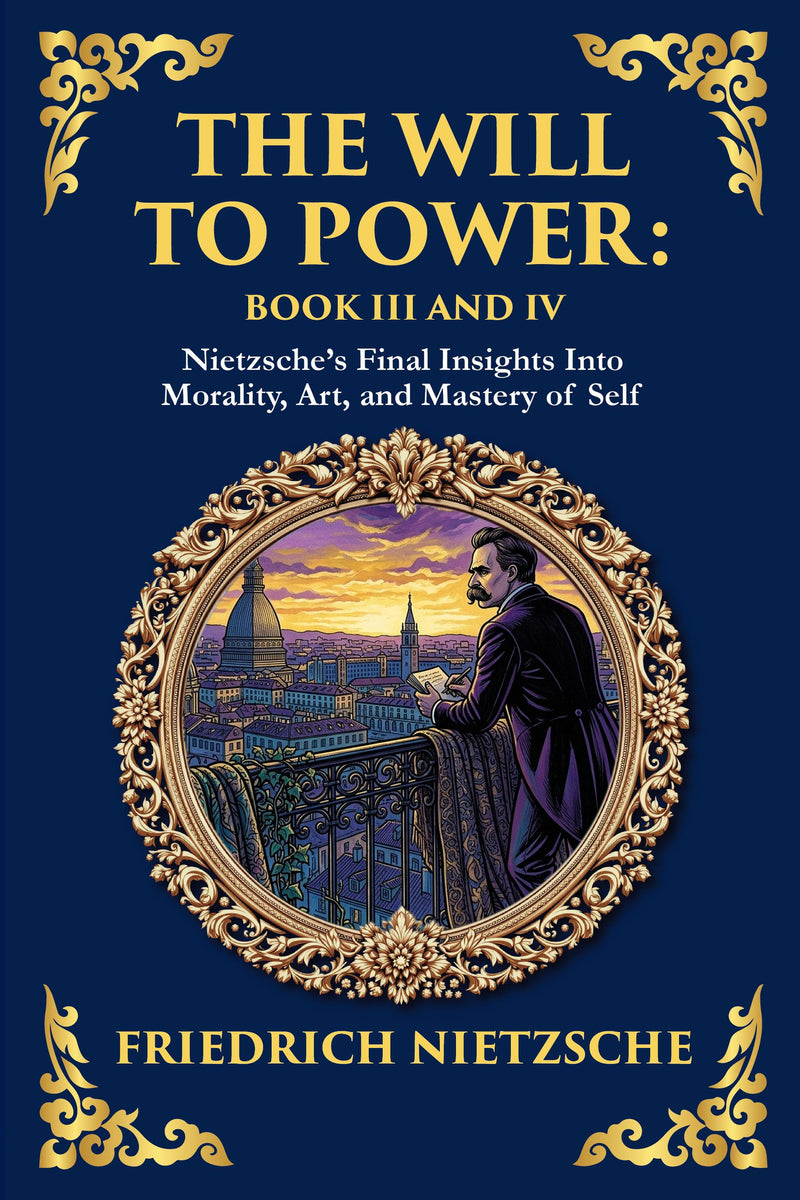
The Will to Power: An Attempted Transvaluation of All Values. Book III and IV
In this powerful continuation of The Will to Power, Friedrich Nietzsche penetrates deeper into the core themes of his late philosophy: morality, art, the will, and the becoming of the self.
or free app
10,000+ hrs library
30-day guarantee
The complete The Will to Power: Book III and IV appears in modern English through Library of Alexandria Press, available online with audiobook narration included for members.
Have you ever wondered why true freedom demands the destruction of false ideals? Nietzsche’s The Will to Power is not merely a philosophical work—it is a declaration of war on conventional morality and a call to arms for the individual spirit. In Books III and IV, Nietzsche explores the depths of creative power, the roots of aesthetic experience, and the revolutionary idea that human greatness lies not in submission but in self- overcoming.
These writings were assembled posthumously from Nietzsche’s notebooks but form a coherent philosophical trajectory toward what he saw as the next stage of human evolution.
What you’ll discover in this modern edition
- The Essence of the Artist-Philosopher – Understand Nietzsche’s notion of art as the highest expression of life’s will.
- Morality Reexamined – Explore why Nietzsche believed our inherited values were a form of weakness and decay.
- The Drive for Power – Learn about the foundational force Nietzsche saw as guiding all living things—not survival, but will to power.
- The Overcoming of Man – Witness his call for a new type of human being who rises above herd morality to live nobly and creatively.
- Reflections on Nihilism and the Future of Humanity – Dive into Nietzsche’s insights on how to navigate a world stripped of absolutes.
| Formats | eBook (EPUB + PDF) · Audiobook · Paperback · Hardcover · Large Print |
| Language | English |
| Trim size (print) | 6 × 9 in |
| Binding | Paperback — perfect-bound · Hardcover — casewrap |
| Large Print edition | Same text in a larger, easy-read type — a larger font, not a larger trim |
| Print pricing | Every physical book at our true cost — at-cost, no profit (members) |
| Library | 873 restored titles, always growing |
| Length | 96,839 words · ~6 hr 27 min reading |
| Reading level | Grade 3 · an easy, flowing read (this modern-English edition) |
| Edition | Modern English translation · 2026 |
Member reviews for this edition are collected as readers finish it — be the first. Across the library: 12,000+ books shipped, every plan covered by a 365-day print guarantee.
About this edition
A faithful, unabridged modern-English edition by The Library of Alexandria — carefully rendered for today's reader and verified paragraph-by-paragraph against the public-domain source. Available as eBook, audiobook, paperback, hardcover, and large print.
- Complete & unabridgedVerified paragraph by paragraph against the source — never a scan, never abridged.
- Modern English, faithfulReadable today, with the author’s meaning kept intact. Readable — not simplified.
- Every format, one membershipRead in your browser or the free app, or listen to the full audiobook.
Included free with your membership
Cancel anytime, one click · 30-day money-back guarantee
Edition last updated July 2026
What’s inside
The Will to Power: An Attempted Transvaluation of All Values. Book III and IV — complete and unabridged: all 8 sections included with membership, plus the full audiobook.
Begin reading The Will to Power: An Attempted Transvaluation of All Values. Book III and IV
In clear modern English — the complete text is included with membership.
Introduction
There are books that ask to be read, and there are books that ask to be wrestled with. The collection of notes, fragments, and aphorisms that has come down to us under the title The Will to Power belongs unmistakably to the second category. To open its pages — and especially the two books gathered here, Book III and Book IV — is to enter the workshop of one of the most disruptive minds in the history of Western thought, a mind that refused to leave any inherited certainty unexamined and that turned its relentless scrutiny upon the very foundations of morality, knowledge, art, and the human will itself. What you hold is not a finished cathedral of philosophy but something closer to the scattered drawings, abandoned sketches, and feverish blueprints of an architect who never lived to raise his final building. And yet, paradoxically, this unfinished quality is part of what makes the work so electrifying. You are reading thought in motion, ideas caught mid-leap.
This edition presents that material in a modern translation, adapted for the contemporary reader. That phrase deserves a moment of honesty before we go further, because the history of this particular text is unusually complicated, and you deserve to understand what you are entering. The aim of the adaptation is not to dilute or soften the provocations contained in these pages — anyone hoping for a gentle, reassuring read has come to the wrong book — but rather to clear away the obstacles of antiquated phrasing, tangled nineteenth-century syntax, and the dense scholarly apparatus that can make the original German and its earliest English renderings feel like a locked room. The goal is to let the lightning of the thought strike you directly, without the lightning rod of period style absorbing its charge. What follows in these pages is meant to be felt as much as understood, and the modernized language is in service of that immediacy.
Before you begin, it is worth orienting yourself to three things: who the author was and what he was trying to do, what these particular books actually contain and how they are best approached, and finally, how to read them in a way that gives you the richest possible experience while protecting you from the most common misunderstandings. Let us take each in turn.
The thinker whose notebooks fill these pages was a philosopher who described himself as someone who philosophized with a hammer — not, as is often assumed, to smash things to rubble, but in the way a sculptor taps a finished work to hear whether it rings true or hollow, and in the way a physician taps a patient’s chest to sound out what lies beneath the surface. He was, by training, a brilliant young classical scholar, appointed to a university professorship at an astonishingly early age, steeped in the literature and philosophy of the ancient Greeks. But his temperament was never that of the comfortable academic. He was a man of restless health and restless mind, plagued by debilitating illness for much of his adult life, who wrote many of his most important works in conditions of physical suffering, often in cheap boarding houses across the mountains and seacoasts of Europe, moving from one climate to another in search of relief that rarely came.
This biographical fact matters for the reading that lies ahead, because the philosophy contained here is not the product of a serene mind contemplating eternal truths from a position of safety and abundance. It is the work of someone who lived close to the edge — close to pain, close to solitude, close to the abyss of meaning that he believed was opening up beneath the feet of modern civilization. When he writes about strength, about the affirmation of life, about the overcoming of suffering and the transformation of pain into power, he is not theorizing abstractly. He is reporting from the front lines of his own existence. This gives the writing a quality of lived urgency that distinguishes it from almost all systematic philosophy. You are not being lectured; you are being confided in, challenged, sometimes provoked to the point of outrage, by someone who staked his entire being on the questions he raises.
The diagnosis at the heart of his life’s work can be stated simply, even if its implications are vast. He believed that Western civilization had been built upon a particular set of values — values rooted in a religious and moral framework — and that this framework was, in his own day, quietly collapsing. The famous and frequently misquoted declaration that “God is dead” was never a triumphant boast. It was an observation, delivered with something closer to dread than celebration. He saw that the metaphysical scaffolding which had given meaning, direction, and moral weight to human life for two thousand years was crumbling under the pressure of science, skepticism, and historical self-awareness. And he saw, with terrifying clarity, that most people had not yet grasped the consequences. The values would linger like the light of a star that has already burned out, but eventually the darkness would arrive. What then?
His response to this crisis was not nostalgia for the old certainties, nor was it a cheerful embrace of nihilism — the conviction that nothing matters and all values are worthless. On the contrary, he regarded passive nihilism as the great danger of the coming age, a kind of spiritual exhaustion that would leave humanity weary, comfortable, and incapable of greatness. His project, instead, was a transvaluation of all values: a deliberate, courageous reassessment of where our values come from, what purposes they serve, who they benefit, and whether they help life to flourish or quietly poison it. The subtitle of this very volume — An Attempted Transvaluation of All Values — names that ambition directly. The word “attempted” is significant and honest. This was a project he did not complete. These books are the surviving materials toward that uncompleted task.
A word, then, about the strange and contested history of the text itself, because to read it well you should know what you are reading. During the most productive years of his life, the philosopher filled notebook after notebook with observations, fragments, draft aphorisms, and experimental formulations. He sketched plans for a great culminating work that would systematize his mature thought, and he gave that projected work various titles over the years, The Will to Power among them. But before he could complete and shape this material into the polished, deliberately constructed books that he was famous for — works in which every word was weighed and every aphorism honed to a razor’s edge — his mind collapsed into a mental breakdown from which he never recovered. He spent his final years incapacitated, unable to write or to oversee his legacy.
It was others, after his collapse, who gathered the notebooks and assembled selections from them into the volume that became known as The Will to Power. The editorial decisions involved — which fragments to include, in what order to arrange them, how to number and group them — were not the author’s own. This means that the architecture you will encounter here, the division into books and the sequence of sections, reflects editorial choices made after the fact, not a structure the philosopher personally authorized. Scholars have rightly cautioned readers to keep this in mind, and reputable scholarship today treats these notes as exactly that: notes, raw material, the contents of a working mind, rather than a definitive testament. None of this diminishes the value of what you are about to read. The thoughts are genuinely his, drawn from his own hand. But you should hold the organization loosely, and read the individual fragments for the sparks of insight they contain rather than searching for an airtight systematic argument that the author himself never built. Think of it as overhearing a great composer working through themes at the piano, rather than attending the finished symphony. There is something thrilling about that proximity to the creative process — but it asks a particular kind of attentiveness from you.
Book III and Book IV form the second half of the assembled collection, and in many respects they contain its most constructive and forward-looking material. Where the earlier books are largely concerned with diagnosis — naming the sickness of European nihilism, tracing the genealogy of our moral concepts, exposing the hidden mechanisms behind our supposedly objective beliefs — the books gathered here turn increasingly toward the question of what comes after the demolition. If the old values are dying, what shall we build in their place? If the inherited foundations are revealed to be illusions, how shall a human being live with strength, beauty, and meaning? These are the questions that animate the pages ahead.
The subtitle of this edition points to three great themes that run through this material: morality, art, and self-mastery. Each deserves a brief word of preparation, not to summarize conclusions — there are few tidy conclusions to be had, and discovering the movement of the thought for yourself is the whole pleasure — but to attune your ear to what you will be hearing.
On the question of morality, you should prepare to have your assumptions disturbed. The central provocation is that what we call “good” and “evil” are not eternal facts written into the structure of the universe, but human creations with a history, a psychology, and a function. The philosopher invites you to ask uncomfortable questions: Where did our particular moral feelings come from? Whose interests do they serve? Is it possible that some of what we most piously celebrate as virtue — meekness, self-denial, the suspicion of strength and ambition and joy — might in fact be an expression of weakness dressed up as righteousness, a way for the powerless to take revenge on the powerful by redefining the very meaning of goodness? This is dangerous territory, and it has been catastrophically misunderstood. We will return to that danger shortly. But read in good faith, this is not an invitation to cruelty. It is an invitation to honesty — to look without flinching at the genealogy of our own consciences and to ask whether the values we have inherited make us larger or smaller, more alive or more diminished.
On the question of art, you will find some of the most affirmative and even joyful passages in the entire work. For this thinker, art was never mere decoration or entertainment. It was the great counter-movement to nihilism, the supreme human activity through which existence is justified and redeemed. Where philosophy and religion had tried to make life bearable by pointing beyond it to some truer world, art makes life bearable — and more than bearable, glorious — by transfiguring this world, by imposing form upon chaos, by saying yes to existence in all its terror and beauty. The artist, in this vision, is a kind of model for the highest human type: someone who creates rather than merely discovers, who shapes raw material into something that did not exist before, who has the strength to look at the most terrible aspects of reality and respond not with denial or despair but with creative power. The discussions of art here are bound up with the concept that gives the collection its title — the will to power — which is far subtler and more interesting than its grim-sounding name suggests. It is not primarily about domination over others. It is about the fundamental drive of all living things toward growth, expansion, mastery, and the overcoming of resistance, including the resistance within oneself.
This leads directly to the third theme, self-mastery, which may be the deepest and most personally rewarding strand of the entire work. For all his reputation as a philosopher of power and conflict, the kind of power this thinker most admired was power over oneself: the capacity to organize one’s own chaos of drives and passions into a coherent, commanding character. The highest individual, in his view, is not the tyrant who lords over others but the self-creator who has given style to his own existence, who has become the author of his own values rather than the passive inheritor of someone else’s. The famous imperative to “become who you are” captures this perfectly. It is not a call to discover a fixed, pre-existing self waiting to be uncovered, but a call to create a self through discipline, struggle, and the courageous affirmation of one’s own life — including its suffering, its failures, and its losses. There is profound consolation in this material, and a kind of bracing, mountain-air freedom, for any reader willing to take it seriously.
Cancel anytime, one click · 30-day money-back guarantee
Founding annual rate available now — your price locks for life when you join.
Not ready? Get this free chapter by email — read it anytime.
✓ Sent — check your inbox for The Will to Power: An Attempted Transvaluation of All Values. Book III and IV.
Questions about The Will to Power: An Attempted Transvaluation of All Values. Book III and IV
What is The Will to Power: Book III and IV about?
In this powerful continuation of The Will to Power, Friedrich Nietzsche penetrates deeper into the core themes of his late philosophy: morality, art, the will, and the becoming of the self. Books III and IV offer profound meditations on the human condition and the struggle to overcome imposed values in the pursuit of inner sovereignty. These final sections capture the essence of Nietzsche’s radical revaluation of all values and his relentless drive toward the cultivation of the Übermensch.
Who wrote The Will to Power: Book III and IV?
The Will to Power: Book III and IV was written by Friedrich Nietzsche. This edition presents the complete work in clear modern English, faithfully rendered from the public-domain original by Library of Alexandria Press.
Is The Will to Power: Book III and IV free to read?
The opening chapter is free to read on this page. Members read and listen to the complete work — and the entire library — free, and can order any physical book at our true print cost.
How long is The Will to Power: Book III and IV?
8 chapters (~96,839 words) — about 6 hr 27 min of reading in this modern-English edition.
Is this an abridged version of The Will to Power: Book III and IV?
No. This is the complete, unabridged The Will to Power: Book III and IV, carefully rendered into clear modern English and verified paragraph-by-paragraph against the public-domain source — nothing is cut or summarised.
What formats does The Will to Power: Book III and IV come in?
The Will to Power: Book III and IV is available as eBook, paperback, hardcover and large print. eBook and audiobook are included with membership; printed editions ship at our true print cost.
Shipping & returns
Billing & membership
More from the library


Explore Philosophy & Ideas
- Kant's Prolegomena to Any Future Metaphysics · Immanuel Kant
- The Advancement of Learning · Francis Bacon
- The Dawn of Day · Friedrich Wilhelm Nietzsche
- Meditations · Marcus Aurelius
- The Confessions of St. Augustine · Saint Augustine
- Dialogues Concerning Natural Religion · David Hume
- Considerations on Representative Government · John Stuart Mill
- Groundwork of the Metaphysics of Morals · Immanuel Kant
- The Confessions of Jean-Jacques Rousseau — Complete · Jean-Jacques Rousseau
- Democracy in America — Volume 2 · Alexis de Tocqueville
- Ecce Homo · Friedrich Wilhelm Nietzsche
- Second Treatise of Government · John Locke
- The Prince · Niccolò Machiavelli
- Thus Spake Zarathustra: A Book for All and None · Friedrich Wilhelm Nietzsche
- The Island of Doctor Moreau · H. G. Wells
- Sophist · Plato
- The Seven Lamps of Architecture · John Ruskin
- Essays — First Series · Ralph Waldo Emerson
- The Book of the Damned · Charles Fort
- The Everlasting Man · G. K. Chesterton
- The Initiates of the Flame · Manly P. Hall
- The Book of Tea · Kakuzo Okakura
- The Japanese Spirit · Yoshisaburo Okakura
- The Analysis of Mind · Bertrand Russell
- Orthodoxy · G. K. Chesterton
- Apology, Crito, and Phaedo of Socrates · Plato
- Euthyphro · Plato
- Timaeus · Plato
- Ion · Plato
- Essays of Schopenhauer · Arthur Schopenhauer
The Will to Power: An Attempted Transvaluation of All Values. Book III and IV
The Will to Power: An Attempted Transvaluation of All Values. Book III and IV
Nietzsche’s Final Thoughts on Morality, Art, and Self-Mastery
Friedrich Nietzsche
Contents
- Introduction
- Chapter 1
- Chapter 2
- Chapter 3
- Chapter 4
- Chapter 5
- Chapter 6
- Chapter 7
Introduction
There are books that ask to be read, and there are books that ask to be wrestled with. The collection of notes, fragments, and aphorisms that has come down to us under the title The Will to Power belongs unmistakably to the second category. To open its pages — and especially the two books gathered here, Book III and Book IV — is to enter the workshop of one of the most disruptive minds in the history of Western thought, a mind that refused to leave any inherited certainty unexamined and that turned its relentless scrutiny upon the very foundations of morality, knowledge, art, and the human will itself. What you hold is not a finished cathedral of philosophy but something closer to the scattered drawings, abandoned sketches, and feverish blueprints of an architect who never lived to raise his final building. And yet, paradoxically, this unfinished quality is part of what makes the work so electrifying. You are reading thought in motion, ideas caught mid-leap.
This edition presents that material in a modern translation, adapted for the contemporary reader. That phrase deserves a moment of honesty before we go further, because the history of this particular text is unusually complicated, and you deserve to understand what you are entering. The aim of the adaptation is not to dilute or soften the provocations contained in these pages — anyone hoping for a gentle, reassuring read has come to the wrong book — but rather to clear away the obstacles of antiquated phrasing, tangled nineteenth-century syntax, and the dense scholarly apparatus that can make the original German and its earliest English renderings feel like a locked room. The goal is to let the lightning of the thought strike you directly, without the lightning rod of period style absorbing its charge. What follows in these pages is meant to be felt as much as understood, and the modernized language is in service of that immediacy.
Before you begin, it is worth orienting yourself to three things: who the author was and what he was trying to do, what these particular books actually contain and how they are best approached, and finally, how to read them in a way that gives you the richest possible experience while protecting you from the most common misunderstandings. Let us take each in turn.
The thinker whose notebooks fill these pages was a philosopher who described himself as someone who philosophized with a hammer — not, as is often assumed, to smash things to rubble, but in the way a sculptor taps a finished work to hear whether it rings true or hollow, and in the way a physician taps a patient’s chest to sound out what lies beneath the surface. He was, by training, a brilliant young classical scholar, appointed to a university professorship at an astonishingly early age, steeped in the literature and philosophy of the ancient Greeks. But his temperament was never that of the comfortable academic. He was a man of restless health and restless mind, plagued by debilitating illness for much of his adult life, who wrote many of his most important works in conditions of physical suffering, often in cheap boarding houses across the mountains and seacoasts of Europe, moving from one climate to another in search of relief that rarely came.
This biographical fact matters for the reading that lies ahead, because the philosophy contained here is not the product of a serene mind contemplating eternal truths from a position of safety and abundance. It is the work of someone who lived close to the edge — close to pain, close to solitude, close to the abyss of meaning that he believed was opening up beneath the feet of modern civilization. When he writes about strength, about the affirmation of life, about the overcoming of suffering and the transformation of pain into power, he is not theorizing abstractly. He is reporting from the front lines of his own existence. This gives the writing a quality of lived urgency that distinguishes it from almost all systematic philosophy. You are not being lectured; you are being confided in, challenged, sometimes provoked to the point of outrage, by someone who staked his entire being on the questions he raises.
The diagnosis at the heart of his life’s work can be stated simply, even if its implications are vast. He believed that Western civilization had been built upon a particular set of values — values rooted in a religious and moral framework — and that this framework was, in his own day, quietly collapsing. The famous and frequently misquoted declaration that “God is dead” was never a triumphant boast. It was an observation, delivered with something closer to dread than celebration. He saw that the metaphysical scaffolding which had given meaning, direction, and moral weight to human life for two thousand years was crumbling under the pressure of science, skepticism, and historical self-awareness. And he saw, with terrifying clarity, that most people had not yet grasped the consequences. The values would linger like the light of a star that has already burned out, but eventually the darkness would arrive. What then?
His response to this crisis was not nostalgia for the old certainties, nor was it a cheerful embrace of nihilism — the conviction that nothing matters and all values are worthless. On the contrary, he regarded passive nihilism as the great danger of the coming age, a kind of spiritual exhaustion that would leave humanity weary, comfortable, and incapable of greatness. His project, instead, was a transvaluation of all values: a deliberate, courageous reassessment of where our values come from, what purposes they serve, who they benefit, and whether they help life to flourish or quietly poison it. The subtitle of this very volume — An Attempted Transvaluation of All Values — names that ambition directly. The word “attempted” is significant and honest. This was a project he did not complete. These books are the surviving materials toward that uncompleted task.
A word, then, about the strange and contested history of the text itself, because to read it well you should know what you are reading. During the most productive years of his life, the philosopher filled notebook after notebook with observations, fragments, draft aphorisms, and experimental formulations. He sketched plans for a great culminating work that would systematize his mature thought, and he gave that projected work various titles over the years, The Will to Power among them. But before he could complete and shape this material into the polished, deliberately constructed books that he was famous for — works in which every word was weighed and every aphorism honed to a razor’s edge — his mind collapsed into a mental breakdown from which he never recovered. He spent his final years incapacitated, unable to write or to oversee his legacy.
It was others, after his collapse, who gathered the notebooks and assembled selections from them into the volume that became known as The Will to Power. The editorial decisions involved — which fragments to include, in what order to arrange them, how to number and group them — were not the author’s own. This means that the architecture you will encounter here, the division into books and the sequence of sections, reflects editorial choices made after the fact, not a structure the philosopher personally authorized. Scholars have rightly cautioned readers to keep this in mind, and reputable scholarship today treats these notes as exactly that: notes, raw material, the contents of a working mind, rather than a definitive testament. None of this diminishes the value of what you are about to read. The thoughts are genuinely his, drawn from his own hand. But you should hold the organization loosely, and read the individual fragments for the sparks of insight they contain rather than searching for an airtight systematic argument that the author himself never built. Think of it as overhearing a great composer working through themes at the piano, rather than attending the finished symphony. There is something thrilling about that proximity to the creative process — but it asks a particular kind of attentiveness from you.
Book III and Book IV form the second half of the assembled collection, and in many respects they contain its most constructive and forward-looking material. Where the earlier books are largely concerned with diagnosis — naming the sickness of European nihilism, tracing the genealogy of our moral concepts, exposing the hidden mechanisms behind our supposedly objective beliefs — the books gathered here turn increasingly toward the question of what comes after the demolition. If the old values are dying, what shall we build in their place? If the inherited foundations are revealed to be illusions, how shall a human being live with strength, beauty, and meaning? These are the questions that animate the pages ahead.
The subtitle of this edition points to three great themes that run through this material: morality, art, and self-mastery. Each deserves a brief word of preparation, not to summarize conclusions — there are few tidy conclusions to be had, and discovering the movement of the thought for yourself is the whole pleasure — but to attune your ear to what you will be hearing.
On the question of morality, you should prepare to have your assumptions disturbed. The central provocation is that what we call “good” and “evil” are not eternal facts written into the structure of the universe, but human creations with a history, a psychology, and a function. The philosopher invites you to ask uncomfortable questions: Where did our particular moral feelings come from? Whose interests do they serve? Is it possible that some of what we most piously celebrate as virtue — meekness, self-denial, the suspicion of strength and ambition and joy — might in fact be an expression of weakness dressed up as righteousness, a way for the powerless to take revenge on the powerful by redefining the very meaning of goodness? This is dangerous territory, and it has been catastrophically misunderstood. We will return to that danger shortly. But read in good faith, this is not an invitation to cruelty. It is an invitation to honesty — to look without flinching at the genealogy of our own consciences and to ask whether the values we have inherited make us larger or smaller, more alive or more diminished.
On the question of art, you will find some of the most affirmative and even joyful passages in the entire work. For this thinker, art was never mere decoration or entertainment. It was the great counter-movement to nihilism, the supreme human activity through which existence is justified and redeemed. Where philosophy and religion had tried to make life bearable by pointing beyond it to some truer world, art makes life bearable — and more than bearable, glorious — by transfiguring this world, by imposing form upon chaos, by saying yes to existence in all its terror and beauty. The artist, in this vision, is a kind of model for the highest human type: someone who creates rather than merely discovers, who shapes raw material into something that did not exist before, who has the strength to look at the most terrible aspects of reality and respond not with denial or despair but with creative power. The discussions of art here are bound up with the concept that gives the collection its title — the will to power — which is far subtler and more interesting than its grim-sounding name suggests. It is not primarily about domination over others. It is about the fundamental drive of all living things toward growth, expansion, mastery, and the overcoming of resistance, including the resistance within oneself.
This leads directly to the third theme, self-mastery, which may be the deepest and most personally rewarding strand of the entire work. For all his reputation as a philosopher of power and conflict, the kind of power this thinker most admired was power over oneself: the capacity to organize one’s own chaos of drives and passions into a coherent, commanding character. The highest individual, in his view, is not the tyrant who lords over others but the self-creator who has given style to his own existence, who has become the author of his own values rather than the passive inheritor of someone else’s. The famous imperative to “become who you are” captures this perfectly. It is not a call to discover a fixed, pre-existing self waiting to be uncovered, but a call to create a self through discipline, struggle, and the courageous affirmation of one’s own life — including its suffering, its failures, and its losses. There is profound consolation in this material, and a kind of bracing, mountain-air freedom, for any reader willing to take it seriously.
The defining characteristic of our nineteenth century is not that science has triumphed, but that the scientific method has triumphed over science itself.
Auguste Comte viewed the history of scientific methods as being nearly identical to philosophy itself.
The great experts on methodology: Aristotle, Bacon, Descartes, and Auguste Comte.
The most precious knowledge is always found last; however, this knowledge consists of methods.
For centuries, all the methods and hypotheses that modern science relies on were treated with total contempt. Because of them, a person could be cast out from respectable society—viewed as an “enemy of God,” someone who insulted the highest ideals, or simply a lunatic.
We faced the full emotional weight of humanity against us. Our ideas about what “truth” should be, how to serve the truth, our objectivity, our methods, and our calm, careful, and skeptical approach were all seen as worthless. Ultimately, the biggest obstacle was a matter of taste: people believed truth should be visually or dramatically striking. They wanted scientists to create a powerful appeal to their imagination.
Based on the above, it almost looks as if the opposite happened, or as if there was a sudden leap. In reality, the intense discipline of moral extremes slowly paved the way for the more moderate passion that eventually defined the scientist.
The religious person’s attention to detail and self-discipline served as a training ground for the scientific mind. Similarly, the mental habit of taking problems seriously—regardless of any personal gain—was incredibly important.
A deep reluctance to settle forever on any single, shared worldview. The appeal of the opposing perspective: a refusal to give up the excitement found in the mysterious.
End of the free sample
Keep reading, free
Members read and listen to the complete book — and the entire library. Cancel anytime, one click · 30-day money-back guarantee.