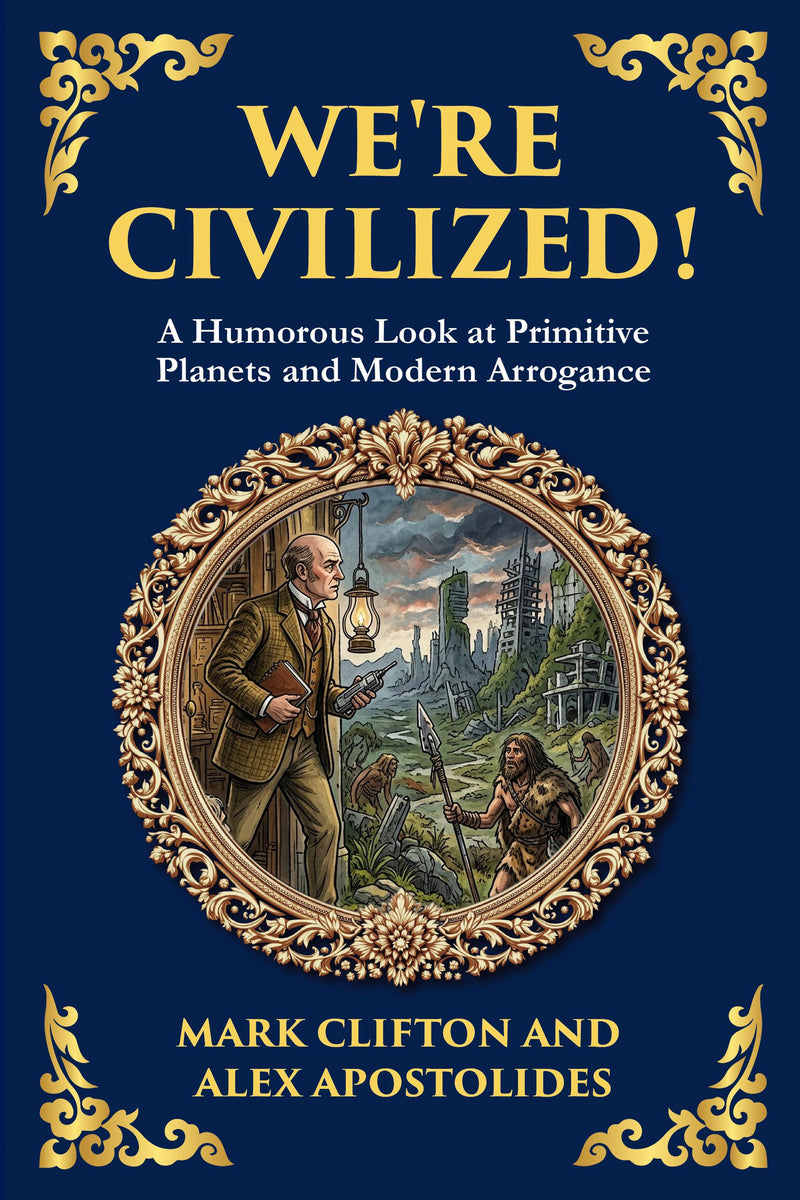
We're Civilized!
Mark Clifton In We're Civilized!, Mark Clifton and Alex Apostolides deliver a sharp, satirical exploration of what it really means to be “advanced.” When representatives from Earth visit a seemingly primitive alien planet, they expect to encounter backward customs, undeveloped societies, and plenty of opportunities for
or free app
10,000+ hrs library
30-day guarantee
The complete We're Civilized! appears in modern English through Library of Alexandria Press, available online with audiobook narration included for members.
Have you ever wondered why the most dangerous delusion is thinking you’re always the smartest one in the room? In We're Civilized!, classic science fiction gets a comedic twist. Authors Mark Clifton and Alex Apostolides craft a wildly entertaining and surprisingly insightful tale about Earth’s emissaries traveling to a distant planet in the hopes of bringing civilization to the so-called savages—only to find that the joke may be on them.
When two interplanetary envoys arrive on an alien world, they’re equipped with data, diplomacy, and a strong sense of cultural superiority. But as they attempt to diagnose, dissect, and define the local population through the lens of Earth’s ideals, they are met with one perplexing contradiction after another. The "natives" appear simple, but beneath the surface lies a society with depth, clarity, and perhaps a wisdom far more advanced than our heroes can comprehend.
What you’ll discover in this modern edition
- A Hilarious Take on First Contact – Explore what happens when “civilized” explorers find themselves completely out of their depth.
| Formats | eBook (EPUB + PDF) · Audiobook · Paperback · Hardcover · Large Print |
| Language | English |
| Trim size (print) | 6 × 9 in |
| Binding | Paperback — perfect-bound · Hardcover — casewrap |
| Large Print edition | Same text in a larger, easy-read type — a larger font, not a larger trim |
| Print pricing | Every physical book at our true cost — at-cost, no profit (members) |
| Library | 873 restored titles, always growing |
| Length | 7,391 words · ~30 min reading |
| Reading level | Grade 10 · a comfortable read (this modern-English edition) |
| Edition | Modern English translation · 2026 |
Member reviews for this edition are collected as readers finish it — be the first. Across the library: 12,000+ books shipped, every plan covered by a 365-day print guarantee.
About this edition
A faithful, unabridged modern-English edition by The Library of Alexandria — carefully rendered for today's reader and verified paragraph-by-paragraph against the public-domain source. Available as eBook, audiobook, paperback, hardcover, and large print.
- Complete & unabridgedVerified paragraph by paragraph against the source — never a scan, never abridged.
- Modern English, faithfulReadable today, with the author’s meaning kept intact. Readable — not simplified.
- Every format, one membershipRead in your browser or the free app, or listen to the full audiobook.
Included free with your membership
Cancel anytime, one click · 30-day money-back guarantee
Edition last updated July 2026
What’s inside
We're Civilized! — complete and unabridged, included in full with membership, plus the full audiobook.
Begin reading We're Civilized!
In clear modern English — the complete text is included with membership.
Introduction
There is a particular kind of science fiction story that does something sneaky and wonderful: it pretends to be about the stars, the rockets, and the strange creatures of distant worlds, when in fact it is holding up a mirror to the reader and asking, with a perfectly straight face, “And what exactly makes you so special?” The short tale you are about to read, written in the heyday of mid-century American science fiction by the collaborative team of Mark Clifton and Alex Apostolides, belongs squarely to that mischievous tradition. It wears the costume of a space adventure. It speaks the language of explorers, expeditions, and first contact. But underneath the trappings of pulp adventure, it is a sharp and gleeful satire about the oldest human folly of them all — the unshakeable, sublimely ridiculous conviction that whoever we happen to be, wherever we happen to stand, and whatever we happen to believe, we are the civilized ones, and everybody else is a primitive.
The title alone tells you most of what you need to know about the spirit of the thing. We’re Civilized! — exclamation point fully intended — is the kind of proud, defensive boast that, in the right context, becomes a punchline. Say it once and it sounds like a statement of fact. Say it twice, in the presence of the absurdities the story sets up, and it starts to sound like a man insisting on his dignity while slipping on a banana peel. Clifton and Apostolides understood that the surest way to puncture pomposity is not to argue with it but to let it strut around the stage until it trips over its own assumptions. This is comedy of the highest and most durable sort, because it is comedy that has a point.
Before you turn to the first page, it is worth taking a little time to understand the world that produced this story, the writers who crafted it, and the particular pleasures it offers the modern reader. That is what this introduction is for. It is not here to spoil the surprises — and there are surprises, the kind that work best when they arrive unannounced — but rather to set the table, to sharpen your appetite, and to make sure you come to the meal ready to taste everything the chefs have prepared.
To appreciate what Clifton and Apostolides were up to, you have to picture the moment in which they were writing. The 1950s were a golden, anxious, contradictory decade for the American imagination. The atomic bomb had ended one war and inaugurated a new and far stranger kind of fear. Rockets were no longer the stuff of comic strips; they were government programs. Within a few years, satellites would be circling the planet, and the very idea of “outer space” would shift from fantasy to front-page news. Meanwhile, on the ground, postwar prosperity was building a confident, consumer-driven, suburban America that believed in progress with an almost religious fervor. Bigger cars, brighter kitchens, taller buildings — surely this was civilization at its peak.
Science fiction of the period absorbed all of this and reflected it back in a thousand directions. The magazines that filled the newsstands — Astounding, Galaxy, If, Imagination, and dozens of others — were crammed with stories of interstellar empires, robot servants, telepathic mutants, and brave Earthmen carrying the banner of human progress to the far corners of the galaxy. A great deal of this fiction was, frankly, propaganda for human exceptionalism. Earthmen were clever, resourceful, and morally superior. Aliens were either menaces to be defeated or savages to be uplifted. The arc of the universe, these stories implied, bent toward humanity’s inevitable triumph.
But the smartest writers of the era understood that this confidence was ripe for satire. If the surrounding culture was busy congratulating itself on being the most advanced civilization in history, then the science fiction writer had a unique tool at hand: the alien encounter. By inventing a meeting between humans and some other intelligent species — or by sending humans to a planet they presumed to be “primitive” — a writer could stage a confrontation between human self-regard and an outside perspective that did not share humanity’s flattering assumptions. The results could be horrifying, as in the darker stories of the period, or they could be hilarious. Clifton and Apostolides chose hilarious, and that choice is itself a kind of wisdom. Laughter, after all, slips past our defenses in a way that lecturing never can. You can argue with a sermon. It is much harder to argue with a joke that has already made you laugh at yourself.
This was also a period when the very idea of “civilization” was being interrogated outside of fiction. Anthropology was maturing as a discipline, and educated readers were increasingly aware that the words “primitive” and “savage” said more about the people using them than about the people they described. The colonial confidence of earlier generations — the notion that there was a single ladder of progress with European-style industrial society at the top — was beginning to crack. Thoughtful people were starting to ask uncomfortable questions. By whose standard do we measure advancement? Is a culture with no skyscrapers but a rich spiritual life “behind” a culture with skyscrapers but spiritual emptiness? Who gets to do the measuring, and why do they always seem to come out on top?
Into this swirl of confidence and doubt, of rockets and reflection, Clifton and Apostolides dropped their little firecracker of a story. It takes the era’s favorite fantasy — the heroic human expedition to a less-developed world — and gives it a wicked twist, inviting the reader to laugh not at the so-called primitives but at the very people who would presume to call them that.
Mark Clifton is one of those figures from science fiction’s golden age whose work deserves more attention than it tends to get. Active primarily in the 1950s, he came to fiction relatively late in life and after an unusual career. Before he was a writer, Clifton worked for many years in industrial psychology and personnel evaluation — a job that involved studying, interviewing, and assessing thousands upon thousands of ordinary human beings. He once estimated that he had personally interviewed an astonishing number of people over the course of his career, and that experience left a deep mark on everything he wrote.
This background matters enormously, because it explains the particular flavor of Clifton’s science fiction. He was not, at heart, a writer of gadgets and spaceships, even when gadgets and spaceships appeared on the page. He was a writer about people — about how human beings think, how they deceive themselves, how they organize into institutions, and how those institutions develop their own peculiar blindnesses. He had spent his professional life watching people justify themselves, defend their prejudices, climb their little hierarchies, and rationalize their decisions. He understood from the inside how bureaucracies behave, how authority figures protect their own importance, and how the official story almost always differs from the real one. When he turned that knowledge toward fiction, the result was satire with teeth — funny, yes, but rooted in a clear-eyed and slightly weary understanding of human nature.
Clifton won acclaim in his own time. He collaborated on one of the early winners of science fiction’s most prestigious novel award, and his short fiction appeared regularly in the leading magazines. He had a knack for the kind of story that seems modest on the surface but lingers in the mind afterward, the kind that makes you chuckle in the moment and then, hours later, makes you think. His best work consistently turns on a single deflating insight: that the people in charge — the experts, the authorities, the self-appointed bearers of civilization — are very often the ones who understand the least.
Alex Apostolides, his collaborator on this and several other stories, is a more shadowy figure in the historical record, but the partnership produced a string of memorable shorter works in the early 1950s. Collaboration in science fiction can be a tricky business, but when it works, it tends to sharpen a story’s edges, because each writer can catch the other’s weaknesses and amplify the other’s strengths. The stories Clifton and Apostolides produced together have a brisk, polished, professional quality, with carefully timed reveals and a real sense of comic structure. They knew how to set up a premise, how to let it develop, and how to land the final twist with maximum impact. Reading their collaborative work, you get the sense of two craftsmen who genuinely enjoyed the game of fooling the reader in the most pleasurable possible way.
What unites all of Clifton’s work, solo and collaborative, is a deeply humane skepticism. He was skeptical of authority, skeptical of conventional wisdom, skeptical of the easy assumption that the powerful must also be the wise. But his skepticism was never cruel. He did not hate the foolish characters he wrote about; he understood them too well for that. He recognized that the impulse to feel superior is one of the most universal of human weaknesses, and that nearly all of us are guilty of it in one form or another. This generous, knowing irony is what keeps his satire from curdling into mere mockery. He invites us to laugh at his characters precisely because he is inviting us to laugh at ourselves.
That self-implicating quality is the secret ingredient of We’re Civilized! The story is not a finger-wagging exercise in which a smug author tells the reader how much smarter the author is than everyone else. It is something far more disarming. It catches us in the very act of feeling superior — it gets us nodding along with assumptions that the story will, in due course, gently and gleefully knock out from under us. The best satires are the ones in which you suddenly realize, somewhere in the middle, that the joke is partly on you. This is one of those satires.
Let me say a few words about the experience that awaits you, without giving away the particular delights that the authors have so carefully arranged. This is a short work — a piece you can read comfortably in a single sitting — and like most great short fiction, it depends on economy and surprise. Every element is in its place for a reason. The descriptions, the dialogue, the small details that might seem like mere color: keep an eye on them, because Clifton and Apostolides are not the kind of writers who waste words. In a story this compact, everything counts.
The pleasure here is largely the pleasure of perspective. The story is built around the gap between how people see themselves and how they appear from the outside — between the dignity we assume we possess and the absurdity that an impartial observer might detect. This is one of the oldest engines of comedy, and one of the most reliable. Think of every great comic moment in literature and you will find some version of this gap at its heart: the pompous man who does not know there is spinach in his teeth, the official who delivers a grand speech while standing in a puddle, the expert who confidently explains a thing he has completely misunderstood. Clifton and Apostolides take this fundamental comic mechanism and aim it at the grandest target imaginable: the concept of civilization itself, and humanity’s flattering image of its own place in the cosmos.
As you read, I would encourage you to pay attention to the word “civilized” each time it appears, and to ask yourself what it is actually doing in that sentence. Notice how slippery the word becomes the more you examine it. Is it a description of technology? Of manners? Of moral conduct? Of power? Of mere familiarity — the comfortable assurance that our way of doing things is the normal way and everyone else’s is a quaint deviation? The genius of the story is the way it pries this loaded little word apart and shows us all the unexamined assumptions hiding inside it. By the time you reach the end, you may find that you can no longer say “civilized” with quite the same easy confidence you had before. That is not an accident. That is the whole point.
Cancel anytime, one click · 30-day money-back guarantee
Founding annual rate available now — your price locks for life when you join.
Not ready? Get this free chapter by email — read it anytime.
✓ Sent — check your inbox for We're Civilized!.
Questions about We're Civilized!
What is We're Civilized! about?
Mark Clifton In We're Civilized!, Mark Clifton and Alex Apostolides deliver a sharp, satirical exploration of what it really means to be “advanced.” When representatives from Earth visit a seemingly primitive alien planet, they expect to encounter backward customs, undeveloped societies, and plenty of opportunities for enlightened guidance. What they don’t expect is to have their superiority—and sanity—challenged at every turn. A clever and thought-provoking romp through interstellar misunderstanding and egotism, W
Is We're Civilized! free to read?
The opening chapter is free to read on this page. Members read and listen to the complete work — and the entire library — free, and can order any physical book at our true print cost.
How long is We're Civilized!?
2 chapters (~7,391 words) — about 30 min of reading in this modern-English edition.
Is this an abridged version of We're Civilized!?
No. This is the complete, unabridged We're Civilized!, carefully rendered into clear modern English and verified paragraph-by-paragraph against the public-domain source — nothing is cut or summarised.
What formats does We're Civilized! come in?
We're Civilized! is available as eBook, paperback, hardcover and large print. eBook and audiobook are included with membership; printed editions ship at our true print cost.
Shipping & returns
Billing & membership
More from the library


Explore Free eBooks
- Kant's Prolegomena to Any Future Metaphysics · Immanuel Kant
- The Advancement of Learning · Francis Bacon
- The Dawn of Day · Friedrich Nietzsche
- Meditations · Marcus Aurelius
- The Confessions of St. Augustine · Saint Augustine of Hippo
- Resurrection · Leo Tolstoy
- Dialogues Concerning Natural Religion · David Hume
- As You Like It · William Shakespeare
- Jack and Jill · Louisa May Alcott
- Dream Psychology: Psychoanalysis for Beginners · Sigmund Freud
- The Raven · Edgar Allan Poe
- Considerations on Representative Government · John Stuart Mill
- The Will to Power: An Attempted Transvaluation of All Values. Book III and IV · Friedrich Nietzsche
- Tarzan of the Apes · Edgar Rice Burroughs
- Fundamental Principles of the Metaphysic of Morals · Immanuel Kant
- The Confessions of Jean Jacques Rousseau — Complete · Jean-Jacques Rousseau
- The Merchant of Venice · William Shakespeare
- Democracy in America — Volume 2 · Alexis de Tocqueville
- Ecce Homo · Friedrich Wilhelm Nietzsche
- Second Treatise of Government · John Locke
- The Wonderful Wizard of Oz · L. Frank Baum
- The Prince · Niccolò Machiavelli
- Anne of Green Gables · L. M. Montgomery
- De Profundis · Oscar Wilde
- Thus Spake Zarathustra: A Book for All and None · Friedrich Nietzsche
- Anna Karenina · Leo Tolstoy
- Great Expectations · Charles Dickens
- The Island of Doctor Moreau · H. G. Wells
- A Midsummer Night's Dream · William Shakespeare
- The Strange Case of Dr. Jekyll and Mr. Hyde · Robert Louis Stevenson
We're Civilized!
We're Civilized!
A Funny Look at Primitive Planets and Modern Arrogance
Anonymous
Contents
- Introduction
- We're Civilized!
Introduction
There is a particular kind of science fiction story that does something sneaky and wonderful: it pretends to be about the stars, the rockets, and the strange creatures of distant worlds, when in fact it is holding up a mirror to the reader and asking, with a perfectly straight face, “And what exactly makes you so special?” The short tale you are about to read, written in the heyday of mid-century American science fiction by the collaborative team of Mark Clifton and Alex Apostolides, belongs squarely to that mischievous tradition. It wears the costume of a space adventure. It speaks the language of explorers, expeditions, and first contact. But underneath the trappings of pulp adventure, it is a sharp and gleeful satire about the oldest human folly of them all — the unshakeable, sublimely ridiculous conviction that whoever we happen to be, wherever we happen to stand, and whatever we happen to believe, we are the civilized ones, and everybody else is a primitive.
The title alone tells you most of what you need to know about the spirit of the thing. We’re Civilized! — exclamation point fully intended — is the kind of proud, defensive boast that, in the right context, becomes a punchline. Say it once and it sounds like a statement of fact. Say it twice, in the presence of the absurdities the story sets up, and it starts to sound like a man insisting on his dignity while slipping on a banana peel. Clifton and Apostolides understood that the surest way to puncture pomposity is not to argue with it but to let it strut around the stage until it trips over its own assumptions. This is comedy of the highest and most durable sort, because it is comedy that has a point.
Before you turn to the first page, it is worth taking a little time to understand the world that produced this story, the writers who crafted it, and the particular pleasures it offers the modern reader. That is what this introduction is for. It is not here to spoil the surprises — and there are surprises, the kind that work best when they arrive unannounced — but rather to set the table, to sharpen your appetite, and to make sure you come to the meal ready to taste everything the chefs have prepared.
To appreciate what Clifton and Apostolides were up to, you have to picture the moment in which they were writing. The 1950s were a golden, anxious, contradictory decade for the American imagination. The atomic bomb had ended one war and inaugurated a new and far stranger kind of fear. Rockets were no longer the stuff of comic strips; they were government programs. Within a few years, satellites would be circling the planet, and the very idea of “outer space” would shift from fantasy to front-page news. Meanwhile, on the ground, postwar prosperity was building a confident, consumer-driven, suburban America that believed in progress with an almost religious fervor. Bigger cars, brighter kitchens, taller buildings — surely this was civilization at its peak.
Science fiction of the period absorbed all of this and reflected it back in a thousand directions. The magazines that filled the newsstands — Astounding, Galaxy, If, Imagination, and dozens of others — were crammed with stories of interstellar empires, robot servants, telepathic mutants, and brave Earthmen carrying the banner of human progress to the far corners of the galaxy. A great deal of this fiction was, frankly, propaganda for human exceptionalism. Earthmen were clever, resourceful, and morally superior. Aliens were either menaces to be defeated or savages to be uplifted. The arc of the universe, these stories implied, bent toward humanity’s inevitable triumph.
But the smartest writers of the era understood that this confidence was ripe for satire. If the surrounding culture was busy congratulating itself on being the most advanced civilization in history, then the science fiction writer had a unique tool at hand: the alien encounter. By inventing a meeting between humans and some other intelligent species — or by sending humans to a planet they presumed to be “primitive” — a writer could stage a confrontation between human self-regard and an outside perspective that did not share humanity’s flattering assumptions. The results could be horrifying, as in the darker stories of the period, or they could be hilarious. Clifton and Apostolides chose hilarious, and that choice is itself a kind of wisdom. Laughter, after all, slips past our defenses in a way that lecturing never can. You can argue with a sermon. It is much harder to argue with a joke that has already made you laugh at yourself.
This was also a period when the very idea of “civilization” was being interrogated outside of fiction. Anthropology was maturing as a discipline, and educated readers were increasingly aware that the words “primitive” and “savage” said more about the people using them than about the people they described. The colonial confidence of earlier generations — the notion that there was a single ladder of progress with European-style industrial society at the top — was beginning to crack. Thoughtful people were starting to ask uncomfortable questions. By whose standard do we measure advancement? Is a culture with no skyscrapers but a rich spiritual life “behind” a culture with skyscrapers but spiritual emptiness? Who gets to do the measuring, and why do they always seem to come out on top?
Into this swirl of confidence and doubt, of rockets and reflection, Clifton and Apostolides dropped their little firecracker of a story. It takes the era’s favorite fantasy — the heroic human expedition to a less-developed world — and gives it a wicked twist, inviting the reader to laugh not at the so-called primitives but at the very people who would presume to call them that.
Mark Clifton is one of those figures from science fiction’s golden age whose work deserves more attention than it tends to get. Active primarily in the 1950s, he came to fiction relatively late in life and after an unusual career. Before he was a writer, Clifton worked for many years in industrial psychology and personnel evaluation — a job that involved studying, interviewing, and assessing thousands upon thousands of ordinary human beings. He once estimated that he had personally interviewed an astonishing number of people over the course of his career, and that experience left a deep mark on everything he wrote.
This background matters enormously, because it explains the particular flavor of Clifton’s science fiction. He was not, at heart, a writer of gadgets and spaceships, even when gadgets and spaceships appeared on the page. He was a writer about people — about how human beings think, how they deceive themselves, how they organize into institutions, and how those institutions develop their own peculiar blindnesses. He had spent his professional life watching people justify themselves, defend their prejudices, climb their little hierarchies, and rationalize their decisions. He understood from the inside how bureaucracies behave, how authority figures protect their own importance, and how the official story almost always differs from the real one. When he turned that knowledge toward fiction, the result was satire with teeth — funny, yes, but rooted in a clear-eyed and slightly weary understanding of human nature.
Clifton won acclaim in his own time. He collaborated on one of the early winners of science fiction’s most prestigious novel award, and his short fiction appeared regularly in the leading magazines. He had a knack for the kind of story that seems modest on the surface but lingers in the mind afterward, the kind that makes you chuckle in the moment and then, hours later, makes you think. His best work consistently turns on a single deflating insight: that the people in charge — the experts, the authorities, the self-appointed bearers of civilization — are very often the ones who understand the least.
Alex Apostolides, his collaborator on this and several other stories, is a more shadowy figure in the historical record, but the partnership produced a string of memorable shorter works in the early 1950s. Collaboration in science fiction can be a tricky business, but when it works, it tends to sharpen a story’s edges, because each writer can catch the other’s weaknesses and amplify the other’s strengths. The stories Clifton and Apostolides produced together have a brisk, polished, professional quality, with carefully timed reveals and a real sense of comic structure. They knew how to set up a premise, how to let it develop, and how to land the final twist with maximum impact. Reading their collaborative work, you get the sense of two craftsmen who genuinely enjoyed the game of fooling the reader in the most pleasurable possible way.
What unites all of Clifton’s work, solo and collaborative, is a deeply humane skepticism. He was skeptical of authority, skeptical of conventional wisdom, skeptical of the easy assumption that the powerful must also be the wise. But his skepticism was never cruel. He did not hate the foolish characters he wrote about; he understood them too well for that. He recognized that the impulse to feel superior is one of the most universal of human weaknesses, and that nearly all of us are guilty of it in one form or another. This generous, knowing irony is what keeps his satire from curdling into mere mockery. He invites us to laugh at his characters precisely because he is inviting us to laugh at ourselves.
That self-implicating quality is the secret ingredient of We’re Civilized! The story is not a finger-wagging exercise in which a smug author tells the reader how much smarter the author is than everyone else. It is something far more disarming. It catches us in the very act of feeling superior — it gets us nodding along with assumptions that the story will, in due course, gently and gleefully knock out from under us. The best satires are the ones in which you suddenly realize, somewhere in the middle, that the joke is partly on you. This is one of those satires.
Let me say a few words about the experience that awaits you, without giving away the particular delights that the authors have so carefully arranged. This is a short work — a piece you can read comfortably in a single sitting — and like most great short fiction, it depends on economy and surprise. Every element is in its place for a reason. The descriptions, the dialogue, the small details that might seem like mere color: keep an eye on them, because Clifton and Apostolides are not the kind of writers who waste words. In a story this compact, everything counts.
The pleasure here is largely the pleasure of perspective. The story is built around the gap between how people see themselves and how they appear from the outside — between the dignity we assume we possess and the absurdity that an impartial observer might detect. This is one of the oldest engines of comedy, and one of the most reliable. Think of every great comic moment in literature and you will find some version of this gap at its heart: the pompous man who does not know there is spinach in his teeth, the official who delivers a grand speech while standing in a puddle, the expert who confidently explains a thing he has completely misunderstood. Clifton and Apostolides take this fundamental comic mechanism and aim it at the grandest target imaginable: the concept of civilization itself, and humanity’s flattering image of its own place in the cosmos.
As you read, I would encourage you to pay attention to the word “civilized” each time it appears, and to ask yourself what it is actually doing in that sentence. Notice how slippery the word becomes the more you examine it. Is it a description of technology? Of manners? Of moral conduct? Of power? Of mere familiarity — the comfortable assurance that our way of doing things is the normal way and everyone else’s is a quaint deviation? The genius of the story is the way it pries this loaded little word apart and shows us all the unexamined assumptions hiding inside it. By the time you reach the end, you may find that you can no longer say “civilized” with quite the same easy confidence you had before. That is not an accident. That is the whole point.
The women and children worked among the lichen, gathering the largest and ripest leaves for food and water, completing their part in the cycle of symbiosis.
The men worked on the surface of the canals or in open pits. Using their wide, mutated hands, they chipped away at the rock-hard clay to create a channel. This channel would be filled with sand and then sealed with clay on every side and across the top. This design allowed water to seep through the sand from the poles of Mars to the equator without evaporating or being lost. It flowed freely so that everyone’s lichen plants would receive moisture, ensuring that no one suffered from thirst or hunger.
The water had to keep flowing. Even in the deepest, oldest memories of their race, there had never been anyone who took more than their fair share. Doing so would be like the fingers of one hand stealing blood from the fingers of the other.
The Martian race had many words for contentment and the kinship they felt for one another. They had words to describe the thrill of watching the eternal stars, day and night, through the thin, dark atmosphere. They had words for the joy of breathing deeply through their slit-like nostrils in sheltered areas where the wind didn’t blow the sand, and for the pleasure of unfolding their rubbery skin to soak up the weak rays of the distant sun.
However, they had no words for “mine” that were separate from “yours.” Nor did they feel any urge to ask, “Why am I here? What is the point of all this?”
Everyone had a purpose, and they accepted it with a calm, unquestioning spirit. Each person repaired or expanded the seepage canals so that future generations could experience the same joys and thrills they did. The work itself was a source of happiness; they embraced it as naturally as healthy lungs breathe in fresh, cool air.
End of the free sample
Keep reading, free
Members read and listen to the complete book — and the entire library. Cancel anytime, one click · 30-day money-back guarantee.