A Houseful of Girls
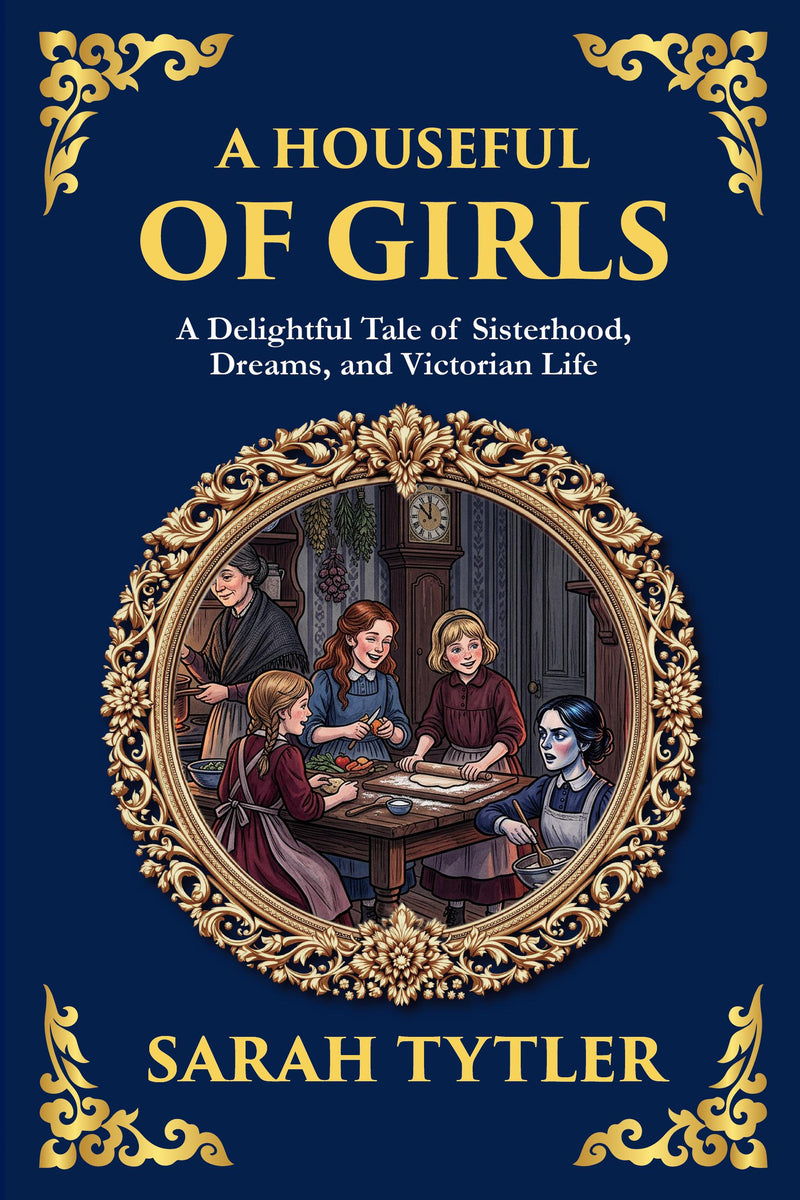
Step into a bustling Victorian household brimming with laughter, learning, and love. In A Houseful of Girls, Sarah Tytler paints a heartfelt portrait of five sisters navigating the joys and trials of growing up under the watchful eye of their strong-willed mother.
or free app
10,000+ hrs library
30-day guarantee
The complete A Houseful of Girls appears in modern English through Library of Alexandria Press, available online with audiobook narration included for members.
Have you ever wondered why the heart of a family often lies with its daughters? In A Houseful of Girls, Sarah Tytler invites readers into a tender and bustling Victorian household led by a widowed matriarch and her five spirited daughters. Each girl, with her own hopes, flaws, and dreams, must find her path in a society that demands both decorum and quiet resilience.
This beautifully observed novel is not just a story of growing up, but a celebration of the strength found in family, feminine ambition, and the simple moments that define a life well-lived. Through illness, heartache, triumphs, and teacups, the girls come of age under one roof—held together by love, discipline, and shared memory.
What you’ll discover in this modern edition
- An Intimate Portrait of Victorian Family Life – Explore the joys, duties, and challenges that shaped the lives of young women in 19th-century Britain.
- Five Distinctive and Relatable Sisters – Meet the studious, the shy, the bold, the artistic, and the dreamer—each with her unique journey.
- Themes of Sisterhood, Maturity, and Personal Growth – Follow how the girls evolve in spirit and ambition while remaining bound by their shared roots.
- A Captivating Glimpse into a Bygone Era – Discover the elegance, customs, and expectations of a middle-class Victorian family.
- A Story of Love in Its Many Forms – From romantic aspirations to maternal strength and sibling loyalty, love anchors the narrative.
| Formats | eBook (EPUB + PDF) · Audiobook · Paperback · Hardcover · Large Print |
| Language | English |
| Trim size (print) | 6 × 9 in |
| Binding | Paperback — perfect-bound · Hardcover — casewrap |
| Large Print edition | Same text in a larger, easy-read type — a larger font, not a larger trim |
| Print pricing | Every physical book at our true cost — at-cost, no profit (members) |
| Library | 873 restored titles, always growing |
| Length | 86,533 words · ~5 hr 46 min reading |
| Reading level | Grade 10 · a comfortable read (this modern-English edition) |
| Edition | Modern English translation · 2026 |
Member reviews for this edition are collected as readers finish it — be the first. Across the library: 12,000+ books shipped, every plan covered by a 365-day print guarantee.
About this edition
A faithful, unabridged modern-English edition by The Library of Alexandria — carefully rendered for today's reader and verified paragraph-by-paragraph against the public-domain source. Available as eBook, audiobook, paperback, hardcover, and large print.
- Complete & unabridgedVerified paragraph by paragraph against the source — never a scan, never abridged.
- Modern English, faithfulReadable today, with the author’s meaning kept intact. Readable — not simplified.
- Every format, one membershipRead in your browser or the free app, or listen to the full audiobook.
Included free with your membership
Cancel anytime, one click · 30-day money-back guarantee
Edition last updated July 2026
What’s inside
A Houseful of Girls — complete and unabridged: all 54 sections included with membership, plus the full audiobook.
Begin reading A Houseful of Girls
In clear modern English — the complete text is included with membership.
Introduction
There is a particular kind of Victorian novel that has been almost entirely lost to us — not because it was bad, but because it was good in ways we stopped knowing how to value. It was domestic without being trivial, morally serious without being preachy, and deeply interested in the texture of ordinary life without mistaking ordinariness for insignificance. It understood that the drama of a household — the negotiations, the jealousies, the small heroisms, the daily grind of making ends meet and keeping up appearances — was as worthy of sustained literary attention as any battlefield or courtroom or palace. The novel you are about to read belongs to that tradition, and it belongs there with considerable distinction.
Published in London in 1889 by Walter Smith and Innes, this story of the Millar sisters of Redcross arrived at a moment when the so-called Woman Question was not merely a topic of polite debate but a lived emergency for thousands of middle-class families across Britain. The author who signed herself Sarah Tytler was a prolific writer whose real name was Henrietta Keddie — a Scottish woman of letters who produced an extraordinary volume of fiction, biography, and essays across a career spanning several decades of the nineteenth century. The pen name was well established by the time this book appeared; readers who picked it up from a lending library shelf in 1889 would have recognized the name from earlier works including Citoyenne Jacqueline, a novel of the French Revolution, and Papers for Thoughtful Girls, a collection of essays that gives some indication of the moral seriousness Tytler brought to her understanding of young womanhood. She was not a writer who condescended to her female characters or her female readers, and that refusal of condescension is one of the qualities that makes her work worth recovering now.
It would be a mistake, however, to approach this novel primarily as a historical document or a sociological exhibit. It is, first and last, a story — and a very entertaining one. The opening pages announce this with a kind of cheerful confidence that is immediately winning. The question with which the novel begins — whether there is any sensation equal to that produced by the first lover and the first proposal arriving in a large family of girls — is posed with a wit and a knowingness that signals at once what kind of company we are in. This is a writer who has thought carefully about the comedy and the pathos of female experience, who understands that the two are rarely separable, and who trusts her readers to hold both at once.
The four Millar girls — Annie, Dora, Rose, and May — live with their parents in the Old Doctor’s House in Redcross, an old-fashioned country town somewhere in the English Midlands. Their father is a physician, their family is respectable, their circumstances are comfortable enough, and their world is, at the novel’s opening, a pleasantly enclosed one of music lessons, drawing classes, lawn tennis, and the mild social rituals of a provincial town where everyone of any standing knows everyone else. The eldest, Annie, is twenty-two and very pretty, with all the authority that four years of being considered grown-up confers on an eldest sister. Dora is twenty, shy and small and possessed of strong opinions about the height and hair color of any hypothetical future husband. Rose is eighteen and has just left school, at that delicious stage of life where one is too old to pretend ignorance of the world’s interesting events and too young to carry off the pretense of indifference. May, the youngest of the four, is between sixteen and seventeen, the tallest of the sisters despite being called Little May, and already showing signs of a directness and a moral seriousness that will matter greatly as the story unfolds.
The novel opens with a proposal — or rather, with the electric aftermath of a proposal, the news of it spreading through the household like a current through water, impossible to contain and impossible to ignore. Tom Robinson, a young man of the town who has the misfortune to be associated with a large and prosperous draper’s shop, has made his interest in Dora known to Dr. Millar, and the sisters are in a state of delighted, mocking, tender uproar about it. The scene is beautifully managed. The dialogue crackles with the particular energy of sisters who know each other too well to be polite and love each other too much to be truly unkind. Annie sits upon her younger sisters with the magnificent condescension of the eldest. Rose and May refuse to be sat upon. Dora, the subject of all this attention, oscillates between mortification and a shy, half-acknowledged pleasure that she is at considerable pains to deny. The comedy is real and the characterization is sharp, and within a few pages Tytler has established four distinct personalities with an economy and a confidence that many more celebrated novelists might envy.
But the novel is not simply a comedy of courtship, and Tytler is not simply a writer of drawing-room entertainment. The chapter titles alone — The Crash, The Cloud Deepens, Rose Goes West and Annie Goes East, Life in an Hospital Ward, Is May to Become a Scholar or a Shop-Girl? — tell us that something more serious is coming, that the comfortable world of the opening pages is not going to remain comfortable, and that the Millar girls are going to be required to become something more than the pleasant, accomplished, marriageable young women their upbringing has prepared them to be. The novel is, at its heart, about what happens when the economic ground shifts beneath a middle-class family, when the protection that a father’s profession and a family’s respectability have always seemed to guarantee is suddenly and shockingly withdrawn, and when four young women who have been raised to expect a certain kind of life are forced to confront a very different one.
This is territory that Victorian fiction explored repeatedly and with great urgency, because it reflected a social reality that was both widespread and deeply frightening to the people who lived through it. The precariousness of middle-class prosperity — the way in which a single financial catastrophe, a failed investment, a professional disaster, an unexpected death, could strip away everything that had seemed solid and permanent — was one of the great anxieties of the age. What made it particularly acute for women was that their options for responding to it were so much more limited than men’s. A son could be sent out into the world to make his way; a daughter’s choices were far more constrained by convention, by education, by the social codes that governed what a respectable woman could and could not do to earn her living. The question of how a gentlewoman maintained her dignity, her sense of self, and her relationships with the people she loved while doing work that her upbringing had not prepared her for and that her social world regarded with at best ambivalence — this is the question that drives the novel’s second half, and it is asked with a seriousness and a specificity that give the book its lasting power.
The best way to approach this novel is to resist the temptation to read it as a period piece — as a charming but safely distant artifact of a world that no longer exists. The temptation is understandable. The social codes are different, the options available to the characters are different, the language in which they discuss their situation is different. But the underlying human experiences — the shock of sudden financial loss, the difficulty of adjusting one’s sense of self to radically changed circumstances, the tension between what one has been taught to want and what one actually needs, the complicated dynamics of a family under pressure, the question of what work means and what it costs — these are not period experiences. They are permanent ones, and Tytler writes about them with a directness and an intelligence that crosses the distance of more than a century without difficulty.
It also helps to read with attention to the comedy, which is not merely decorative but structural. Tytler uses humor — the sisters’ banter, the social absurdities of provincial life, the gap between characters’ self-images and their actual situations — as a way of keeping the novel’s more painful material from becoming oppressive. This is a technique that requires considerable skill and considerable trust in the reader, because it depends on the reader being willing to laugh and to feel the weight of things at the same time, to hold the comedy and the pathos in the same hand. The novel rewards that willingness generously. Some of the funniest scenes in the book are also, on reflection, among the most revealing about the pressures the characters are under, and some of the most moving scenes have a thread of dry comedy running through them that keeps them honest.
Pay attention, too, to the minor characters. Tytler peoples her world with a generosity and a specificity that repays close reading. Mrs. Jennings and her daughter Hester, who appear in their own chapter, are not merely background figures; they illuminate something important about the range of ways in which women of this period navigated the intersection of necessity and respectability. The various employers and landladies and professional acquaintances the Millar girls encounter as their world expands beyond Redcross are drawn with a precision that reflects genuine observation of social types, and they complicate the novel’s moral landscape in ways that a less careful writer would have avoided. Tytler is not interested in simple villains or uncomplicated saints. She is interested in people, which means she is interested in the ways in which people are shaped by their circumstances, their vanities, their fears, and their better impulses all at once.
The question of education — what it is for, who deserves it, what it costs and what it enables — runs through the novel with particular insistence. The chapter title that asks whether May is to become a scholar or a shop-girl is not merely a plot question; it is a question about value, about what society chooses to honor and what it chooses to dismiss, about the relationship between intellectual capacity and economic opportunity. Tytler’s treatment of this question is neither simple nor sentimental. She understands that education is not a magic solution, that the world into which educated women emerged in the 1880s was not always ready to receive them on terms that honored their abilities, and that the gap between what a woman was capable of and what she was permitted to do was a source of real suffering. But she also understands that education matters, that the life of the mind is not a luxury but a necessity for certain kinds of people, and that the struggle to claim it is worth the cost.
It is worth saying something about Tytler’s prose style, because it is one of the pleasures of the book and one of the things that distinguishes her from many of her contemporaries. She writes with a directness and a confidence that are immediately engaging. Her sentences are clear without being simple, her observations are precise without being cold, and her narrative voice has a quality of warm intelligence — of a writer who is genuinely interested in her characters and genuinely respectful of her readers — that makes the book a pleasure to spend time with. She is not afraid of irony, but her irony is never cruel. She is not afraid of sentiment, but her sentiment is never mawkish. She occupies a tonal middle ground that is harder to achieve than it looks, and she occupies it with an ease that speaks to long practice and genuine talent.
The opening paragraph of the novel is worth reading twice, because it announces this voice with particular clarity. The description of the sensation produced by the first lover and the first proposal arriving in a large family of girls — delightfully sentimental, comical, complimentary, affronting, rousing, tiresome, all in one — is not merely a clever list. It is a statement of method. Tytler is telling us that she intends to hold multiple registers simultaneously, that she will not simplify experience into a single emotional key, that she trusts the complexity of ordinary life to be interesting enough without being artificially heightened. This is a promise she keeps throughout the novel, and it is one of the reasons the book remains readable and alive more than a hundred and thirty years after its first publication.
Cancel anytime, one click · 30-day money-back guarantee
Founding annual rate available now — your price locks for life when you join.
Not ready? Get this free chapter by email — read it anytime.
✓ Sent — check your inbox for A Houseful of Girls.
Questions about A Houseful of Girls
What is A Houseful of Girls about?
Step into a bustling Victorian household brimming with laughter, learning, and love. In A Houseful of Girls, Sarah Tytler paints a heartfelt portrait of five sisters navigating the joys and trials of growing up under the watchful eye of their strong-willed mother. Set against the backdrop of 19th-century domestic life, the novel captures the delicate interplay between duty and desire, independence and family, as each girl embarks on her own journey toward identity and fulfillment.
Who wrote A Houseful of Girls?
A Houseful of Girls was written by Sarah Tytler. This edition presents the complete work in clear modern English, faithfully rendered from the public-domain original by Library of Alexandria Press.
Is A Houseful of Girls free to read?
The opening chapter is free to read on this page. Members read and listen to the complete work — and the entire library — free, and can order any physical book at our true print cost.
How long is A Houseful of Girls?
54 chapters (~86,533 words) — about 5 hr 46 min of reading in this modern-English edition.
Is this an abridged version of A Houseful of Girls?
No. This is the complete, unabridged A Houseful of Girls, carefully rendered into clear modern English and verified paragraph-by-paragraph against the public-domain source — nothing is cut or summarised.
What formats does A Houseful of Girls come in?
A Houseful of Girls is available as eBook, paperback, hardcover and large print. eBook and audiobook are included with membership; printed editions ship at our true print cost.
Shipping & returns
Billing & membership
More from the library


Explore Children's Classics
- Peter and Wendy · J. M. Barrie
- Jack and Jill · Louisa May Alcott
- The Wonderful Wizard of Oz · L. Frank Baum
- Anne of Green Gables · L. M. Montgomery
- The Secret Garden · Frances Hodgson Burnett
- The Tale of Peter Rabbit · Beatrix Potter
- Peter Pan · J. M. Barrie
- The Prince and the Pauper · Mark Twain
- The Red Fairy Book · Andrew Lang
- Old Christmas: from the Sketch Book of Washington Irving · Washington Irving
- In the hollow of His hand · Hesba Stretton
- Miss Primrose · Agnes Giberne
- Five Little Peppers and How They Grew · Margaret Sidney
- The Loss of the Swansea: A Story of the Florida Coast · W. L. Alden
- Sky Island · L. Frank Baum
- The Book of Dragons · E. Nesbit
- Wild Animals I Have Known · Ernest Thompson Seton
- Skinny McCord · Percy Keese Fitzhugh
- The Hunniwell Boys and the Platinum Mystery · L. P. Wyman
- Rainbow Valley · L. M. Montgomery
- "Us and Our Donkey" · Amy Le Feuvre
- Dorothy and the Wizard in Oz · L. Frank Baum
- The Home Book of Verse — Volume 4 · Burton Egbert Stevenson
- The Story of Doctor Dolittle · Hugh Lofting
- The Tale of Benjamin Bunny · Beatrix Potter
- Fifty Famous Stories Retold · James Baldwin
- Rilla of Ingleside · L. M. Montgomery
- The House at Pooh Corner · A. A. Milne
- Rich and Humble: A Story for Young People · Oliver Optic
- The Three Bears · A. E. Kennedy
A Houseful of Girls
A Houseful of Girls
A Modern Translation
Sarah Tytler
Contents
- Introduction
- Chapter 1
- Chapter 2
- Chapter 3
- Chapter 4
- Chapter 5
- Chapter 6
- Chapter 7
- Chapter 8
- Chapter 9
- Chapter 10
- Chapter 11
- Chapter 12
- Chapter 13
- Chapter 14
- Chapter 15
- Chapter 16
- Chapter 17
- Chapter 18
- Chapter 19
- Chapter 20
- Chapter 21
- Chapter 22
- Chapter 23
- Chapter 24
- Chapter 25
- Chapter 26
- Chapter 27
- Chapter 28
- Chapter 29
- Chapter 30
- Chapter 31
- Chapter 32
- Chapter 33
- Chapter 34
- Chapter 35
- Chapter 36
- Chapter 37
- Chapter 38
- Chapter 39
- … and 14 more chapters
Introduction
There is a particular kind of Victorian novel that has been almost entirely lost to us — not because it was bad, but because it was good in ways we stopped knowing how to value. It was domestic without being trivial, morally serious without being preachy, and deeply interested in the texture of ordinary life without mistaking ordinariness for insignificance. It understood that the drama of a household — the negotiations, the jealousies, the small heroisms, the daily grind of making ends meet and keeping up appearances — was as worthy of sustained literary attention as any battlefield or courtroom or palace. The novel you are about to read belongs to that tradition, and it belongs there with considerable distinction.
Published in London in 1889 by Walter Smith and Innes, this story of the Millar sisters of Redcross arrived at a moment when the so-called Woman Question was not merely a topic of polite debate but a lived emergency for thousands of middle-class families across Britain. The author who signed herself Sarah Tytler was a prolific writer whose real name was Henrietta Keddie — a Scottish woman of letters who produced an extraordinary volume of fiction, biography, and essays across a career spanning several decades of the nineteenth century. The pen name was well established by the time this book appeared; readers who picked it up from a lending library shelf in 1889 would have recognized the name from earlier works including Citoyenne Jacqueline, a novel of the French Revolution, and Papers for Thoughtful Girls, a collection of essays that gives some indication of the moral seriousness Tytler brought to her understanding of young womanhood. She was not a writer who condescended to her female characters or her female readers, and that refusal of condescension is one of the qualities that makes her work worth recovering now.
It would be a mistake, however, to approach this novel primarily as a historical document or a sociological exhibit. It is, first and last, a story — and a very entertaining one. The opening pages announce this with a kind of cheerful confidence that is immediately winning. The question with which the novel begins — whether there is any sensation equal to that produced by the first lover and the first proposal arriving in a large family of girls — is posed with a wit and a knowingness that signals at once what kind of company we are in. This is a writer who has thought carefully about the comedy and the pathos of female experience, who understands that the two are rarely separable, and who trusts her readers to hold both at once.
The four Millar girls — Annie, Dora, Rose, and May — live with their parents in the Old Doctor’s House in Redcross, an old-fashioned country town somewhere in the English Midlands. Their father is a physician, their family is respectable, their circumstances are comfortable enough, and their world is, at the novel’s opening, a pleasantly enclosed one of music lessons, drawing classes, lawn tennis, and the mild social rituals of a provincial town where everyone of any standing knows everyone else. The eldest, Annie, is twenty-two and very pretty, with all the authority that four years of being considered grown-up confers on an eldest sister. Dora is twenty, shy and small and possessed of strong opinions about the height and hair color of any hypothetical future husband. Rose is eighteen and has just left school, at that delicious stage of life where one is too old to pretend ignorance of the world’s interesting events and too young to carry off the pretense of indifference. May, the youngest of the four, is between sixteen and seventeen, the tallest of the sisters despite being called Little May, and already showing signs of a directness and a moral seriousness that will matter greatly as the story unfolds.
The novel opens with a proposal — or rather, with the electric aftermath of a proposal, the news of it spreading through the household like a current through water, impossible to contain and impossible to ignore. Tom Robinson, a young man of the town who has the misfortune to be associated with a large and prosperous draper’s shop, has made his interest in Dora known to Dr. Millar, and the sisters are in a state of delighted, mocking, tender uproar about it. The scene is beautifully managed. The dialogue crackles with the particular energy of sisters who know each other too well to be polite and love each other too much to be truly unkind. Annie sits upon her younger sisters with the magnificent condescension of the eldest. Rose and May refuse to be sat upon. Dora, the subject of all this attention, oscillates between mortification and a shy, half-acknowledged pleasure that she is at considerable pains to deny. The comedy is real and the characterization is sharp, and within a few pages Tytler has established four distinct personalities with an economy and a confidence that many more celebrated novelists might envy.
But the novel is not simply a comedy of courtship, and Tytler is not simply a writer of drawing-room entertainment. The chapter titles alone — The Crash, The Cloud Deepens, Rose Goes West and Annie Goes East, Life in an Hospital Ward, Is May to Become a Scholar or a Shop-Girl? — tell us that something more serious is coming, that the comfortable world of the opening pages is not going to remain comfortable, and that the Millar girls are going to be required to become something more than the pleasant, accomplished, marriageable young women their upbringing has prepared them to be. The novel is, at its heart, about what happens when the economic ground shifts beneath a middle-class family, when the protection that a father’s profession and a family’s respectability have always seemed to guarantee is suddenly and shockingly withdrawn, and when four young women who have been raised to expect a certain kind of life are forced to confront a very different one.
This is territory that Victorian fiction explored repeatedly and with great urgency, because it reflected a social reality that was both widespread and deeply frightening to the people who lived through it. The precariousness of middle-class prosperity — the way in which a single financial catastrophe, a failed investment, a professional disaster, an unexpected death, could strip away everything that had seemed solid and permanent — was one of the great anxieties of the age. What made it particularly acute for women was that their options for responding to it were so much more limited than men’s. A son could be sent out into the world to make his way; a daughter’s choices were far more constrained by convention, by education, by the social codes that governed what a respectable woman could and could not do to earn her living. The question of how a gentlewoman maintained her dignity, her sense of self, and her relationships with the people she loved while doing work that her upbringing had not prepared her for and that her social world regarded with at best ambivalence — this is the question that drives the novel’s second half, and it is asked with a seriousness and a specificity that give the book its lasting power.
The best way to approach this novel is to resist the temptation to read it as a period piece — as a charming but safely distant artifact of a world that no longer exists. The temptation is understandable. The social codes are different, the options available to the characters are different, the language in which they discuss their situation is different. But the underlying human experiences — the shock of sudden financial loss, the difficulty of adjusting one’s sense of self to radically changed circumstances, the tension between what one has been taught to want and what one actually needs, the complicated dynamics of a family under pressure, the question of what work means and what it costs — these are not period experiences. They are permanent ones, and Tytler writes about them with a directness and an intelligence that crosses the distance of more than a century without difficulty.
It also helps to read with attention to the comedy, which is not merely decorative but structural. Tytler uses humor — the sisters’ banter, the social absurdities of provincial life, the gap between characters’ self-images and their actual situations — as a way of keeping the novel’s more painful material from becoming oppressive. This is a technique that requires considerable skill and considerable trust in the reader, because it depends on the reader being willing to laugh and to feel the weight of things at the same time, to hold the comedy and the pathos in the same hand. The novel rewards that willingness generously. Some of the funniest scenes in the book are also, on reflection, among the most revealing about the pressures the characters are under, and some of the most moving scenes have a thread of dry comedy running through them that keeps them honest.
Pay attention, too, to the minor characters. Tytler peoples her world with a generosity and a specificity that repays close reading. Mrs. Jennings and her daughter Hester, who appear in their own chapter, are not merely background figures; they illuminate something important about the range of ways in which women of this period navigated the intersection of necessity and respectability. The various employers and landladies and professional acquaintances the Millar girls encounter as their world expands beyond Redcross are drawn with a precision that reflects genuine observation of social types, and they complicate the novel’s moral landscape in ways that a less careful writer would have avoided. Tytler is not interested in simple villains or uncomplicated saints. She is interested in people, which means she is interested in the ways in which people are shaped by their circumstances, their vanities, their fears, and their better impulses all at once.
The question of education — what it is for, who deserves it, what it costs and what it enables — runs through the novel with particular insistence. The chapter title that asks whether May is to become a scholar or a shop-girl is not merely a plot question; it is a question about value, about what society chooses to honor and what it chooses to dismiss, about the relationship between intellectual capacity and economic opportunity. Tytler’s treatment of this question is neither simple nor sentimental. She understands that education is not a magic solution, that the world into which educated women emerged in the 1880s was not always ready to receive them on terms that honored their abilities, and that the gap between what a woman was capable of and what she was permitted to do was a source of real suffering. But she also understands that education matters, that the life of the mind is not a luxury but a necessity for certain kinds of people, and that the struggle to claim it is worth the cost.
It is worth saying something about Tytler’s prose style, because it is one of the pleasures of the book and one of the things that distinguishes her from many of her contemporaries. She writes with a directness and a confidence that are immediately engaging. Her sentences are clear without being simple, her observations are precise without being cold, and her narrative voice has a quality of warm intelligence — of a writer who is genuinely interested in her characters and genuinely respectful of her readers — that makes the book a pleasure to spend time with. She is not afraid of irony, but her irony is never cruel. She is not afraid of sentiment, but her sentiment is never mawkish. She occupies a tonal middle ground that is harder to achieve than it looks, and she occupies it with an ease that speaks to long practice and genuine talent.
The opening paragraph of the novel is worth reading twice, because it announces this voice with particular clarity. The description of the sensation produced by the first lover and the first proposal arriving in a large family of girls — delightfully sentimental, comical, complimentary, affronting, rousing, tiresome, all in one — is not merely a clever list. It is a statement of method. Tytler is telling us that she intends to hold multiple registers simultaneously, that she will not simplify experience into a single emotional key, that she trusts the complexity of ordinary life to be interesting enough without being artificially heightened. This is a promise she keeps throughout the novel, and it is one of the reasons the book remains readable and alive more than a hundred and thirty years after its first publication.
Is there any feeling quite like the one produced when the first suitor and the first marriage proposal arrive for a girl in a large family of daughters? It is a mix of everything: sentimental, funny, flattering, insulting, exciting, and exhausting. It signals the start of a parade of lovers, proposals, and major life changes. It is the first time real life—with its intense passions, serious turns of fate, and great joys and sorrows—collides with idle fantasies, lighthearted spirits, and simple experiences that had previously been shielded from harsh realities.
It doesn’t matter much if the family is rich or poor, unless early and severe poverty creates a maturity that deepens a girl’s character prematurely. By turning them into women sooner, poverty robs them of some of the thoughtlessness, fearlessness, and impracticality of girlhood. But girlhood, like many natural states, is hard to kill; its sweet, bright illusions, its wisdom, and its foolishness survive even fairly severe hardships.
The younger sisters are politely supposed to be kept in the dark about the big event happening to one of the older ones. It is considered both a delicate and prudent precaution to prevent the veil hiding the future and its risks from being lifted too early for young minds, lest they become unstable and unfit for the healthy discipline of school lessons and the simple pleasure of school treats. The flower in the bud should be kept with its petals closed, in its innocent lack of self-consciousness, until the very last moment.
However, there is an electric sympathy in the air that defeats all precautions. There is a secret bond of emerging womanhood that awakens everywhere. How do young people pick up so quickly and accurately the looks and whispers meant to go over their heads—the playful glances, nervous shrugs, quick blushes, and indignant pouts that have suddenly become common in their circle? The observers are supposed to be preoccupied with their music lessons, drawing classes, basic Latin and Greek—if anyone is pursuing higher education for women—their pets, lawn tennis, or the girl friends they are always making plans with to walk, practice singing, study, or put together living pictures and plays.
End of the free sample
Keep reading, free
Members read and listen to the complete book — and the entire library. Cancel anytime, one click · 30-day money-back guarantee.