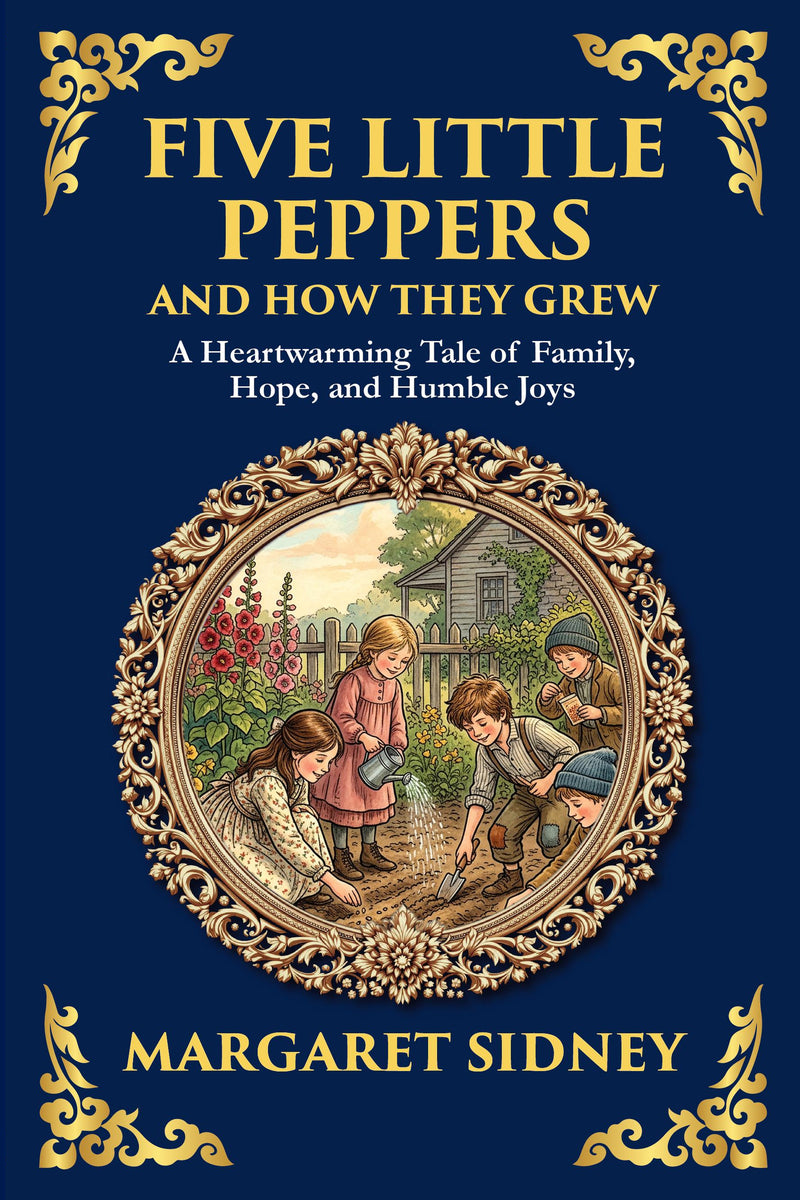
Five Little Peppers and How They Grew
In a tiny, tattered kitchen warmed by a single stove and boundless love, five siblings and their devoted mother face life’s hardships with grit, grace, and unshakable unity.
or free app
10,000+ hrs library
30-day guarantee
The complete Five Little Peppers and How They appears in modern English through Library of Alexandria Press, available online with audiobook narration included for members.
Have you ever wondered why the simplest lives often yield the richest hearts? Five Little Peppers and How They Grew is a timeless treasure of children’s literature—an uplifting story of perseverance, familial love, and the humble joys of daily life. First published in 1881, Margaret Sidney’s novel follows the five Pepper children and their widowed mother, “Mamsie,” as they navigate poverty with resilience, warmth, and an infectious spirit of cheer.
Though they live in a small, run-down cottage with little to spare, the Peppers’ world is full of laughter, creativity, and unwavering devotion to one another. From making paper dolls out of old newspapers to devising clever ways to surprise their mother on her birthday, the children teach us that joy is not measured in money—but in love, effort, and kindness. This modern edition offers a beautifully typeset and accessible version of Sidney’s heartwarming tale for new generations of readers—perfect for families, classrooms, and nostalgic hearts alike.
What you’ll discover in this modern edition
- A Celebrated Story of Family and Fortitude – Meet Ben, Polly, Joel, Davie, and little Phronsie as they turn adversity into opportunity with laughter and love.
- Timeless Lessons in Gratitude and Resilience – See how small acts of kindness and selflessness create a life of meaning.
- A Window into 19th-Century American Life – Explore themes of work, community, and resourcefulness through an inspiring family’s eyes.
- Ideal for Shared Reading and Discussion – Perfect for parents, teachers, and young readers learning about values and virtues.
- A Faithful Modern Reprint – Preserves the charm and heart of the original while updating layout and design for today’s readers.
| Formats | eBook (EPUB + PDF) · Audiobook · Paperback · Hardcover · Large Print |
| Language | English |
| Trim size (print) | 6 × 9 in |
| Binding | Paperback — perfect-bound · Hardcover — casewrap |
| Large Print edition | Same text in a larger, easy-read type — a larger font, not a larger trim |
| Print pricing | Every physical book at our true cost — at-cost, no profit (members) |
| Library | 873 restored titles, always growing |
| Length | 71,776 words · ~4 hr 47 min reading |
| Reading level | Grade 3 · an easy, flowing read (this modern-English edition) |
| Edition | Modern English translation · 2026 |
Member reviews for this edition are collected as readers finish it — be the first. Across the library: 12,000+ books shipped, every plan covered by a 365-day print guarantee.
About this edition
A faithful, unabridged modern-English edition by The Library of Alexandria — carefully rendered for today's reader and verified paragraph-by-paragraph against the public-domain source. Available as eBook, audiobook, paperback, hardcover, and large print.
- Complete & unabridgedVerified paragraph by paragraph against the source — never a scan, never abridged.
- Modern English, faithfulReadable today, with the author’s meaning kept intact. Readable — not simplified.
- Every format, one membershipRead in your browser or the free app, or listen to the full audiobook.
Included free with your membership
Cancel anytime, one click · 30-day money-back guarantee
Edition last updated July 2026
What’s inside
Five Little Peppers and How They Grew — complete and unabridged: all 8 sections included with membership, plus the full audiobook.
Begin reading Five Little Peppers and How They Grew
In clear modern English — the complete text is included with membership.
Introduction
There are certain books that seem to carry the warmth of a well-tended hearth within their very pages, stories that wrap around the reader like a quilt stitched by loving hands. Five Little Peppers and How They Grew is one of these rare treasures—a tale that has comforted, delighted, and encouraged generations of readers since it first appeared in the closing decades of the nineteenth century. To open its pages is to step into a world where poverty cannot dim the brightness of the human spirit, where laughter rings out in the smallest of kitchens, and where the bonds of family prove stronger than any hardship life can throw their way.
This modern translation, prepared with great care for the contemporary reader, seeks to preserve everything that has made the original such an enduring classic while gently smoothing the path for those encountering it for the first time. The language has been refreshed, certain antiquated phrasings have been clarified, and the rhythms of the prose have been adjusted so that the story flows naturally for modern eyes and ears. Yet the heart of the book remains entirely intact. The Peppers are still the Peppers—warm, mischievous, brave, and irrepressibly hopeful—and the little brown house they call home still stands at the center of a story that has the power to move us as deeply today as it did the readers of more than a century ago.
Before you begin, it is worth pausing to consider what kind of book you are about to read, where it came from, and why it has endured so remarkably well. Understanding a little about its origins, its author, and the spirit in which it was written can only enrich the experience that lies ahead. This introduction is offered in that spirit—not to summarize or spoil the events of the story, which deserve to unfold for you fresh and unhurried, but to prepare the ground so that the seeds of this gentle tale can take root in your imagination and grow, much as the little Peppers themselves grow over the course of their adventures.
The name “Margaret Sidney” was a pen name, a literary mask worn by a woman named Harriett Mulford Stone Lothrop. Born in New Haven, Connecticut, in 1844, she came of age in an America that was rapidly transforming itself. The nation was being reshaped by industry, by the great upheaval of the Civil War, and by waves of immigration that were changing the face of its cities and towns. It was an era of enormous contrasts—of immense new wealth concentrated in the hands of a few, and of grinding poverty endured by many. Against this backdrop, the figure of the struggling but dignified family, getting by on hard work, ingenuity, and love, became a powerful and beloved image in the popular imagination.
Harriett began writing under her pseudonym partly out of the modesty that was expected of respectable women of her time, and partly, perhaps, out of a wish to keep her creative life somewhat separate from her private one. She married Daniel Lothrop, a prominent publisher whose firm specialized in wholesome literature for young readers, and through this union her literary career found both a platform and a purpose. The publishing house championed books that were meant to instruct as well as entertain, stories that would shape the moral character of the children who read them while keeping them thoroughly engaged.
It was in 1881 that the first installment of the Peppers’ story appeared in a children’s magazine, and the response was immediate and warm. Readers wrote in, eager for more, captivated by the brave and cheerful family living in the little brown house. The serialized chapters were gathered together and published as a complete book in 1881, and the popularity of the Peppers only continued to grow. Sidney would go on to write numerous sequels, following the family through the years and chronicling the further adventures of the children as they matured. But it is this first volume—the original tale of how the five little Peppers grew—that remains the most cherished, the one that captured something essential and lasting about the human heart.
To understand the appeal of the book, it helps to picture the world in which its first readers lived. Many families of the period knew real hardship. Money was scarce, work was hard, and illness could strike without warning and without remedy. Children grew up quickly, often shouldering responsibilities that would seem astonishing to us now. In such a world, a story that showed how a poor family could face their difficulties not with despair but with courage, humor, and unshakable affection for one another was not merely entertaining—it was genuinely sustaining. It offered hope. It suggested that even when the cupboard was nearly bare and the future looked uncertain, there was richness to be found in the love shared around a humble table.
Margaret Sidney understood her audience deeply, and she wrote with an instinctive grasp of what children long for and what they need. She did not write down to her young readers, nor did she shield them entirely from the realities of want and struggle. Instead, she trusted them to recognize the truth in her characters and to draw their own strength from the example of the Peppers. This trust, this respect for the inner lives of children, is one of the qualities that has helped the book survive long after many of its contemporaries have been forgotten.
It is also worth noting that Sidney was a woman of considerable energy and conviction beyond her writing. Later in her life, she became deeply involved in the preservation of American historical sites and the promotion of patriotic education. She and her husband purchased and restored the Wayside, the historic Massachusetts home that had once been occupied by Nathaniel Hawthorne and the Alcott family—a fitting connection, perhaps, given that Little Women and the Pepper stories share a kindred spirit of warmth, domesticity, and moral seriousness wrapped in genuine affection. Sidney’s commitment to preserving the past and nurturing the values she held dear runs through her fiction as surely as it ran through her public life.
When she died in 1924, she left behind a body of work that had brought comfort and joy to countless readers, and a literary legacy that continues to find new audiences with each passing generation. The fact that you hold a fresh translation of her most famous work in your hands today is testament to the enduring power of the story she created in that little brown house of her imagination.
What is it, exactly, that makes Five Little Peppers and How They Grew so beloved? The answer lies not in any single dramatic event or grand adventure, but in the cumulative effect of small moments—the texture of daily life lived with grace and good humor in the face of difficulty. This is, at its core, a domestic story. It is about a family making the best of what they have, finding joy in simple pleasures, and supporting one another through thick and thin. And it is precisely this focus on the everyday, on the ordinary heroism of getting through life’s challenges with one’s heart intact, that gives the book its timeless quality.
At the center of the story is a mother—affectionately known as “Mamsie”—whose strength, wisdom, and boundless love hold the family together. She is a figure of immense warmth, a woman who works tirelessly to provide for her children and who never loses faith in them or in the possibility of better days. Around her gather the five children, each one drawn with distinct personality and charm. There is the eldest, who carries responsibility with a maturity beyond her years; there is the spirited and headstrong one whose passions sometimes lead to trouble but whose heart is always in the right place; there are the little ones, full of mischief and sweetness, whose antics bring both laughter and tenderness to the household. Each child contributes to the warm, bustling life of the home, and each grows and changes over the course of the story in ways that feel both believable and deeply satisfying.
The little brown house itself is almost a character in its own right—a modest dwelling, cramped and worn, but filled to the rafters with love. It is a place where every meal is a small victory, where every kindness is treasured, and where the children learn the values that will shape them into the people they are meaning to become. Readers who grow to love the Peppers will find themselves longing to step inside that house, to sit by the stove, to share in the family’s modest feasts and their evening conversations. There is a coziness to the book, an atmosphere of safety and belonging, that has a powerful pull on the imagination.
But the story is not all sunshine and comfort. The Peppers face real difficulties—the constant struggle to make ends meet, the worry of illness, the uncertainty of the future. Sidney does not pretend that poverty is easy or that the family’s situation is anything other than precarious. What she shows, instead, is how the Peppers meet these challenges. They meet them with hard work, with ingenuity, with humor, and above all with an unwavering commitment to one another. When trouble comes, they face it together. When one of them suffers, the others rally around. This portrait of family solidarity—of love as a practical force that sustains and protects—is one of the most moving aspects of the book, and it speaks to readers across the centuries because it touches something universal in the human experience.
There is also, woven throughout the story, a thread of genuine moral seriousness. The Peppers are good people, and the book is unashamed in its celebration of goodness. Kindness, honesty, generosity, patience, courage—these are the virtues the children learn and practice, and the story quietly invites its readers to admire and emulate them. Yet this moral dimension never becomes heavy-handed or preachy. The lessons emerge naturally from the events of the story, from the choices the characters make and the consequences they face. The Peppers are not saints; they make mistakes, they quarrel, they sometimes give in to temptation. But they learn, they grow, and they always find their way back to the values that bind them together. This is one of the great strengths of the book: it teaches without lecturing, and it inspires without idealizing.
Modern readers may find themselves struck by how different the world of the Peppers is from their own. There are no electronic devices here, no fast-paced entertainments, no instant communication. The pleasures of the Peppers are simple ones—a shared meal, a small gift, a kind word, a quiet moment of rest after a hard day’s work. And yet, paradoxically, this very simplicity may be part of what makes the book so refreshing and even healing to read in our own hurried, distracted age. To spend time with the Peppers is to be reminded of what truly matters—of the deep satisfactions that come not from having much, but from loving well and living with integrity. In a culture that often equates happiness with acquisition, the story of this poor but joyful family offers a gentle and welcome corrective.
It is also worth saying something about the sheer charm and readability of the book. For all its emotional depth and moral substance, Five Little Peppers is, first and foremost, a delight to read. The chapters move briskly, the dialogue sparkles with life, and the characters are so vividly drawn that they seem to step off the page. There is humor here in abundance—the children’s schemes and mishaps, their small triumphs and comic misunderstandings, will draw smiles and even laughter from readers of all ages. And there are moments of genuine emotion, scenes of tenderness and sacrifice and joy that have the power to bring tears to the eyes. Sidney was a gifted storyteller, and she knew how to balance light and shade, comedy and pathos, in a way that keeps the reader thoroughly engaged from beginning to end.
This modern translation has been undertaken with the goal of making that engagement as easy and pleasurable as possible. The original text, while beautiful, contains turns of phrase and modes of expression that can feel distant or even puzzling to readers today. Certain words have changed their meanings over the years; certain conventions of dialect and speech, which Sidney used to bring her characters to life, can now slow the reader down or create confusion. In preparing this edition, great care has been taken to clarify these elements while preserving the essential voice and spirit of the original. The aim has been to create a reading experience that feels natural and inviting to the contemporary reader, without sacrificing the warmth, the period flavor, or the emotional truth of Sidney’s storytelling. The Peppers speak to us still, and this translation hopes simply to make their voices a little clearer.
Cancel anytime, one click · 30-day money-back guarantee
Founding annual rate available now — your price locks for life when you join.
Not ready? Get this free chapter by email — read it anytime.
✓ Sent — check your inbox for Five Little Peppers and How They Grew.
Questions about Five Little Peppers and How They Grew
What is Five Little Peppers and How They about?
In a tiny, tattered kitchen warmed by a single stove and boundless love, five siblings and their devoted mother face life’s hardships with grit, grace, and unshakable unity. Five Little Peppers and How They Grew is an enduring classic that celebrates the power of family, the joy of simple pleasures, and the richness of a life lived with love. Through laughter, struggle, and the occasional burnt biscuit, the Peppers show us that joy does not come from wealth—but from the warmth of one another.
Who wrote Five Little Peppers and How They?
Five Little Peppers and How They was written by Margaret Sidney. This edition presents the complete work in clear modern English, faithfully rendered from the public-domain original by Library of Alexandria Press.
Is Five Little Peppers and How They free to read?
The opening chapter is free to read on this page. Members read and listen to the complete work — and the entire library — free, and can order any physical book at our true print cost.
How long is Five Little Peppers and How They?
8 chapters (~71,776 words) — about 4 hr 47 min of reading in this modern-English edition.
Is this an abridged version of Five Little Peppers and How They?
No. This is the complete, unabridged Five Little Peppers and How They, carefully rendered into clear modern English and verified paragraph-by-paragraph against the public-domain source — nothing is cut or summarised.
What formats does Five Little Peppers and How They come in?
Five Little Peppers and How They is available as eBook, paperback, hardcover and large print. eBook and audiobook are included with membership; printed editions ship at our true print cost.
Shipping & returns
Billing & membership
More from the library


Explore Children's Classics
- Peter and Wendy · J. M. Barrie
- Jack and Jill · Louisa May Alcott
- The Wonderful Wizard of Oz · L. Frank Baum
- Anne of Green Gables · L. M. Montgomery
- The Secret Garden · Frances Hodgson Burnett
- The Tale of Peter Rabbit · Beatrix Potter
- Peter Pan · J. M. Barrie
- The Prince and the Pauper · Mark Twain
- The Red Fairy Book · Andrew Lang
- Old Christmas: from the Sketch Book of Washington Irving · Washington Irving
- A Houseful of Girls · Sarah Tytler
- In the hollow of His hand · Hesba Stretton
- Miss Primrose · Agnes Giberne
- The Loss of the Swansea: A Story of the Florida Coast · W. L. Alden
- Sky Island · L. Frank Baum
- The Book of Dragons · E. Nesbit
- Wild Animals I Have Known · Ernest Thompson Seton
- Skinny McCord · Percy Keese Fitzhugh
- The Hunniwell Boys and the Platinum Mystery · L. P. Wyman
- Rainbow Valley · L. M. Montgomery
- "Us and Our Donkey" · Amy Le Feuvre
- Dorothy and the Wizard in Oz · L. Frank Baum
- The Home Book of Verse — Volume 4 · Burton Egbert Stevenson
- The Story of Doctor Dolittle · Hugh Lofting
- The Tale of Benjamin Bunny · Beatrix Potter
- Fifty Famous Stories Retold · James Baldwin
- Rilla of Ingleside · L. M. Montgomery
- The House at Pooh Corner · A. A. Milne
- Rich and Humble: A Story for Young People · Oliver Optic
- The Three Bears · A. E. Kennedy
Five Little Peppers and How They Grew
Five Little Peppers and How They Grew
A heartwarming story about family, hope, and simple pleasures
Margaret Sidney
Contents
- Introduction
- Chapter 1
- Chapter 2
- Chapter 3
- Chapter 4
- Chapter 5
- Chapter 6
- Chapter 7
Introduction
There are certain books that seem to carry the warmth of a well-tended hearth within their very pages, stories that wrap around the reader like a quilt stitched by loving hands. Five Little Peppers and How They Grew is one of these rare treasures—a tale that has comforted, delighted, and encouraged generations of readers since it first appeared in the closing decades of the nineteenth century. To open its pages is to step into a world where poverty cannot dim the brightness of the human spirit, where laughter rings out in the smallest of kitchens, and where the bonds of family prove stronger than any hardship life can throw their way.
This modern translation, prepared with great care for the contemporary reader, seeks to preserve everything that has made the original such an enduring classic while gently smoothing the path for those encountering it for the first time. The language has been refreshed, certain antiquated phrasings have been clarified, and the rhythms of the prose have been adjusted so that the story flows naturally for modern eyes and ears. Yet the heart of the book remains entirely intact. The Peppers are still the Peppers—warm, mischievous, brave, and irrepressibly hopeful—and the little brown house they call home still stands at the center of a story that has the power to move us as deeply today as it did the readers of more than a century ago.
Before you begin, it is worth pausing to consider what kind of book you are about to read, where it came from, and why it has endured so remarkably well. Understanding a little about its origins, its author, and the spirit in which it was written can only enrich the experience that lies ahead. This introduction is offered in that spirit—not to summarize or spoil the events of the story, which deserve to unfold for you fresh and unhurried, but to prepare the ground so that the seeds of this gentle tale can take root in your imagination and grow, much as the little Peppers themselves grow over the course of their adventures.
The name “Margaret Sidney” was a pen name, a literary mask worn by a woman named Harriett Mulford Stone Lothrop. Born in New Haven, Connecticut, in 1844, she came of age in an America that was rapidly transforming itself. The nation was being reshaped by industry, by the great upheaval of the Civil War, and by waves of immigration that were changing the face of its cities and towns. It was an era of enormous contrasts—of immense new wealth concentrated in the hands of a few, and of grinding poverty endured by many. Against this backdrop, the figure of the struggling but dignified family, getting by on hard work, ingenuity, and love, became a powerful and beloved image in the popular imagination.
Harriett began writing under her pseudonym partly out of the modesty that was expected of respectable women of her time, and partly, perhaps, out of a wish to keep her creative life somewhat separate from her private one. She married Daniel Lothrop, a prominent publisher whose firm specialized in wholesome literature for young readers, and through this union her literary career found both a platform and a purpose. The publishing house championed books that were meant to instruct as well as entertain, stories that would shape the moral character of the children who read them while keeping them thoroughly engaged.
It was in 1881 that the first installment of the Peppers’ story appeared in a children’s magazine, and the response was immediate and warm. Readers wrote in, eager for more, captivated by the brave and cheerful family living in the little brown house. The serialized chapters were gathered together and published as a complete book in 1881, and the popularity of the Peppers only continued to grow. Sidney would go on to write numerous sequels, following the family through the years and chronicling the further adventures of the children as they matured. But it is this first volume—the original tale of how the five little Peppers grew—that remains the most cherished, the one that captured something essential and lasting about the human heart.
To understand the appeal of the book, it helps to picture the world in which its first readers lived. Many families of the period knew real hardship. Money was scarce, work was hard, and illness could strike without warning and without remedy. Children grew up quickly, often shouldering responsibilities that would seem astonishing to us now. In such a world, a story that showed how a poor family could face their difficulties not with despair but with courage, humor, and unshakable affection for one another was not merely entertaining—it was genuinely sustaining. It offered hope. It suggested that even when the cupboard was nearly bare and the future looked uncertain, there was richness to be found in the love shared around a humble table.
Margaret Sidney understood her audience deeply, and she wrote with an instinctive grasp of what children long for and what they need. She did not write down to her young readers, nor did she shield them entirely from the realities of want and struggle. Instead, she trusted them to recognize the truth in her characters and to draw their own strength from the example of the Peppers. This trust, this respect for the inner lives of children, is one of the qualities that has helped the book survive long after many of its contemporaries have been forgotten.
It is also worth noting that Sidney was a woman of considerable energy and conviction beyond her writing. Later in her life, she became deeply involved in the preservation of American historical sites and the promotion of patriotic education. She and her husband purchased and restored the Wayside, the historic Massachusetts home that had once been occupied by Nathaniel Hawthorne and the Alcott family—a fitting connection, perhaps, given that Little Women and the Pepper stories share a kindred spirit of warmth, domesticity, and moral seriousness wrapped in genuine affection. Sidney’s commitment to preserving the past and nurturing the values she held dear runs through her fiction as surely as it ran through her public life.
When she died in 1924, she left behind a body of work that had brought comfort and joy to countless readers, and a literary legacy that continues to find new audiences with each passing generation. The fact that you hold a fresh translation of her most famous work in your hands today is testament to the enduring power of the story she created in that little brown house of her imagination.
What is it, exactly, that makes Five Little Peppers and How They Grew so beloved? The answer lies not in any single dramatic event or grand adventure, but in the cumulative effect of small moments—the texture of daily life lived with grace and good humor in the face of difficulty. This is, at its core, a domestic story. It is about a family making the best of what they have, finding joy in simple pleasures, and supporting one another through thick and thin. And it is precisely this focus on the everyday, on the ordinary heroism of getting through life’s challenges with one’s heart intact, that gives the book its timeless quality.
At the center of the story is a mother—affectionately known as “Mamsie”—whose strength, wisdom, and boundless love hold the family together. She is a figure of immense warmth, a woman who works tirelessly to provide for her children and who never loses faith in them or in the possibility of better days. Around her gather the five children, each one drawn with distinct personality and charm. There is the eldest, who carries responsibility with a maturity beyond her years; there is the spirited and headstrong one whose passions sometimes lead to trouble but whose heart is always in the right place; there are the little ones, full of mischief and sweetness, whose antics bring both laughter and tenderness to the household. Each child contributes to the warm, bustling life of the home, and each grows and changes over the course of the story in ways that feel both believable and deeply satisfying.
The little brown house itself is almost a character in its own right—a modest dwelling, cramped and worn, but filled to the rafters with love. It is a place where every meal is a small victory, where every kindness is treasured, and where the children learn the values that will shape them into the people they are meaning to become. Readers who grow to love the Peppers will find themselves longing to step inside that house, to sit by the stove, to share in the family’s modest feasts and their evening conversations. There is a coziness to the book, an atmosphere of safety and belonging, that has a powerful pull on the imagination.
But the story is not all sunshine and comfort. The Peppers face real difficulties—the constant struggle to make ends meet, the worry of illness, the uncertainty of the future. Sidney does not pretend that poverty is easy or that the family’s situation is anything other than precarious. What she shows, instead, is how the Peppers meet these challenges. They meet them with hard work, with ingenuity, with humor, and above all with an unwavering commitment to one another. When trouble comes, they face it together. When one of them suffers, the others rally around. This portrait of family solidarity—of love as a practical force that sustains and protects—is one of the most moving aspects of the book, and it speaks to readers across the centuries because it touches something universal in the human experience.
There is also, woven throughout the story, a thread of genuine moral seriousness. The Peppers are good people, and the book is unashamed in its celebration of goodness. Kindness, honesty, generosity, patience, courage—these are the virtues the children learn and practice, and the story quietly invites its readers to admire and emulate them. Yet this moral dimension never becomes heavy-handed or preachy. The lessons emerge naturally from the events of the story, from the choices the characters make and the consequences they face. The Peppers are not saints; they make mistakes, they quarrel, they sometimes give in to temptation. But they learn, they grow, and they always find their way back to the values that bind them together. This is one of the great strengths of the book: it teaches without lecturing, and it inspires without idealizing.
Modern readers may find themselves struck by how different the world of the Peppers is from their own. There are no electronic devices here, no fast-paced entertainments, no instant communication. The pleasures of the Peppers are simple ones—a shared meal, a small gift, a kind word, a quiet moment of rest after a hard day’s work. And yet, paradoxically, this very simplicity may be part of what makes the book so refreshing and even healing to read in our own hurried, distracted age. To spend time with the Peppers is to be reminded of what truly matters—of the deep satisfactions that come not from having much, but from loving well and living with integrity. In a culture that often equates happiness with acquisition, the story of this poor but joyful family offers a gentle and welcome corrective.
It is also worth saying something about the sheer charm and readability of the book. For all its emotional depth and moral substance, Five Little Peppers is, first and foremost, a delight to read. The chapters move briskly, the dialogue sparkles with life, and the characters are so vividly drawn that they seem to step off the page. There is humor here in abundance—the children’s schemes and mishaps, their small triumphs and comic misunderstandings, will draw smiles and even laughter from readers of all ages. And there are moments of genuine emotion, scenes of tenderness and sacrifice and joy that have the power to bring tears to the eyes. Sidney was a gifted storyteller, and she knew how to balance light and shade, comedy and pathos, in a way that keeps the reader thoroughly engaged from beginning to end.
This modern translation has been undertaken with the goal of making that engagement as easy and pleasurable as possible. The original text, while beautiful, contains turns of phrase and modes of expression that can feel distant or even puzzling to readers today. Certain words have changed their meanings over the years; certain conventions of dialect and speech, which Sidney used to bring her characters to life, can now slow the reader down or create confusion. In preparing this edition, great care has been taken to clarify these elements while preserving the essential voice and spirit of the original. The aim has been to create a reading experience that feels natural and inviting to the contemporary reader, without sacrificing the warmth, the period flavor, or the emotional truth of Sidney’s storytelling. The Peppers speak to us still, and this translation hopes simply to make their voices a little clearer.
The small, old kitchen had finally calmed down after the midday chaos. Now, in the quiet of the afternoon, it felt peaceful and cozy—exactly how the main room of the brown house should feel. Twilight was just beginning to set in. All the Pepper children, except for the oldest, Ben, were taking a “breathing spell,” as their mother called it. This meant doing some quiet work that suited the time of day. However, the poor children didn’t get many of these breaks. Life was always a struggle for them lately. Since their father passed away when Phronsie was just a baby, Mrs. Pepper had worked tirelessly to earn enough money to feed her children and pay the rent on their little brown house.
But she was too brave to let life break her. With a strong spirit and a cheerful expression, she spent her days sewing coats, tailoring, and doing all kinds of mending. She felt a deep, visible pride watching her loud, happy children grow up around her. They brought her great comfort and filled the little brown house with laughter and joy.
“Poor children!” she would tell herself, “they’ve had no proper upbringing; they’ve just grown up on their own!” Then she would press her lips together firmly and work harder than ever. “I have to find a way to get them an education, but I just don’t know how!”
A few times she thought, “The time is finally coming!” but it never happened. Winter arrived with a deep freeze, and feeding and warming the children cost so much more that her money disappeared faster than ever. Then, just when things seemed to be improving, the store changed owners. For a long while, she couldn’t get the usual supply of sacks and coats to sew, which ruined the small amount of money she had saved for the future. But she would tell herself, “Well, it will happen eventually, because it has to!” And she would get back to work with even more energy.
End of the free sample
Keep reading, free
Members read and listen to the complete book — and the entire library. Cancel anytime, one click · 30-day money-back guarantee.