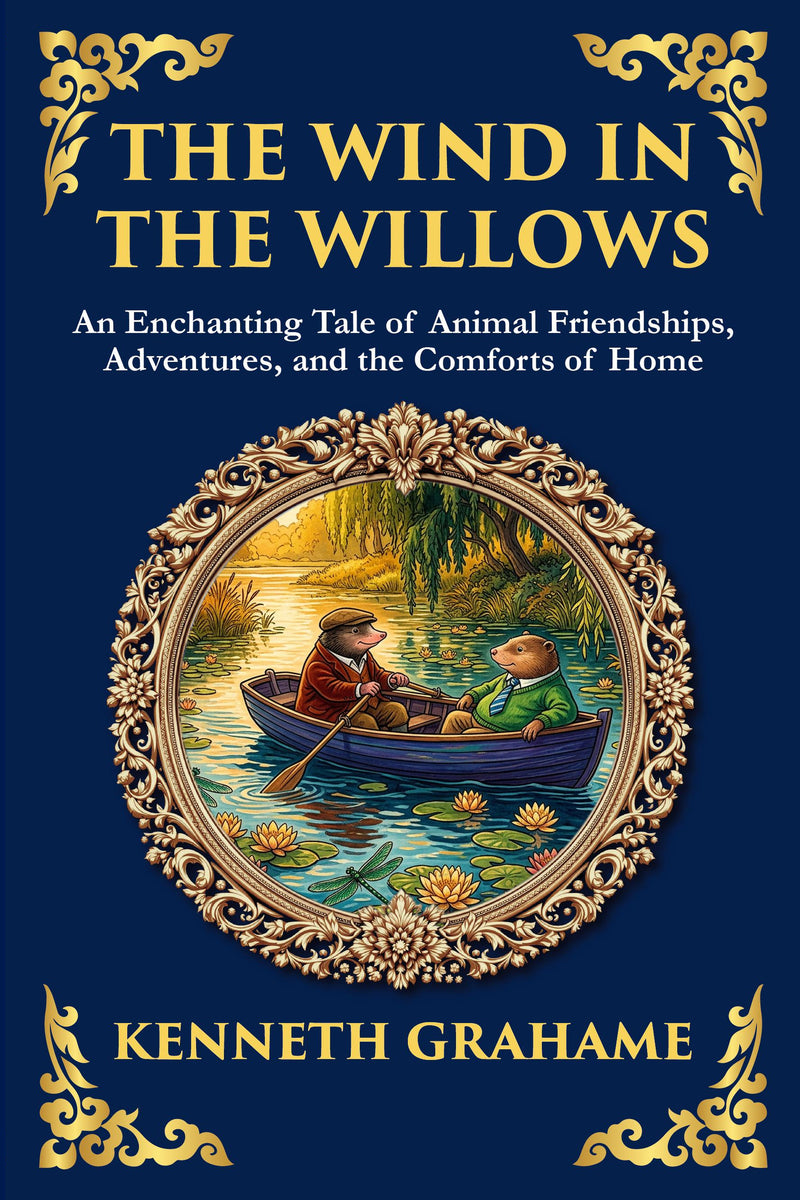
The Wind in the Willows
In the quiet English countryside along the riverbank, the lives of four charming animal friends unfold in a series of whimsical, heartwarming, and often hilariously unexpected adventures.
or free app
10,000+ hrs library
30-day guarantee
The complete The Wind in the Willows appears in modern English through Library of Alexandria Press, available online with audiobook narration included for members.
Have you ever wondered why some of life’s greatest adventures begin in the comfort of home? In The Wind in the Willows, Kenneth Grahame invites readers into a lush, enchanted landscape where animals talk, boats drift lazily down the river, and adventure awaits just beyond the hedgerows. Blending lyrical storytelling with humorous escapades, this beloved classic explores the themes of friendship, freedom, mischief, and the unshakable importance of belonging.
From Mole’s wide-eyed discovery of the world beyond his burrow to Rat’s deep love of the river, from Toad’s reckless obsession with motorcars to Badger’s gruff wisdom, the novel gently guides us through a series of delightful episodes that mirror both the excitement and serenity of life.
What you’ll discover in this modern edition
- A Story of Endearing Friendships – The unwavering bonds between Mole, Rat, Toad, and Badger are the heart of the story, full of warmth and loyalty.
- A Gentle Adventure Through Nature – Grahame’s prose paints the English countryside in poetic detail, creating a magical world of woods, rivers, and cozy dens.
- Comedic Escapades and Timeless Lessons – Toad’s hilarious blunders offer both laughter and gentle reminders about humility, impulse, and growth.
- A Celebration of Home – At its core, this is a story about finding comfort, safety, and identity in the places and people we love.
- A Book for All Ages – Though often labeled a children’s tale, its wit, charm, and reflections on life resonate deeply with adult readers.
| Formats | eBook (EPUB + PDF) · Audiobook · Paperback · Hardcover · Large Print |
| Language | English |
| Trim size (print) | 6 × 9 in |
| Binding | Paperback — perfect-bound · Hardcover — casewrap |
| Large Print edition | Same text in a larger, easy-read type — a larger font, not a larger trim |
| Print pricing | Every physical book at our true cost — at-cost, no profit (members) |
| Library | 873 restored titles, always growing |
| Length | 57,230 words · ~3 hr 49 min reading |
| Reading level | Grade 6 · an easy, flowing read (this modern-English edition) |
| Edition | Modern English translation · 2026 |
Member reviews for this edition are collected as readers finish it — be the first. Across the library: 12,000+ books shipped, every plan covered by a 365-day print guarantee.
About this edition
A faithful, unabridged modern-English edition by The Library of Alexandria — carefully rendered for today's reader and verified paragraph-by-paragraph against the public-domain source. Available as eBook, audiobook, paperback, hardcover, and large print.
- Complete & unabridgedVerified paragraph by paragraph against the source — never a scan, never abridged.
- Modern English, faithfulReadable today, with the author’s meaning kept intact. Readable — not simplified.
- Every format, one membershipRead in your browser or the free app, or listen to the full audiobook.
Included free with your membership
Cancel anytime, one click · 30-day money-back guarantee
Edition last updated July 2026
What’s inside
The Wind in the Willows — complete and unabridged: all 13 sections included with membership, plus the full audiobook.
Begin reading The Wind in the Willows
In clear modern English — the complete text is included with membership.
Introduction
There are certain books that do not so much tell a story as open a door. You step across the threshold expecting a tale, and instead you find yourself standing on the bank of a slow-moving river on a warm afternoon, the smell of mud and green growing things in the air, the hum of insects all around, and the gentle conviction settling over you that there is nowhere else in the world you would rather be. This is one of those books. It is a work that has, for well over a century, given readers something far rarer than mere entertainment: it has given them a place to belong. To open its pages is to be welcomed into a snug burrow with a fire crackling in the grate, into the company of friends who never tire of you, into a landscape so lovingly rendered that you may close the book and feel, with a small ache, that you have just come home from somewhere real.
What you hold in your hands is a story that began, improbably enough, as a series of bedtime tales and letters written by a father to his son. It was never planned as a great work of literature. It grew, as the best things often do, out of love and necessity and the particular tenderness that passes between a parent and a child. And yet from those humble, intimate beginnings emerged a book that has outlived its century, that has been read aloud in countless nurseries and quoted by grown men and women who find that certain passages have lodged permanently in their hearts. Few books manage to be at once so gentle and so profound, so suited to a small child drifting off to sleep and so capable of moving an adult to unexpected tears.
This edition presents the tale in a modern translation, carefully adapted for the contemporary reader. The aim has been to clear away the small obstacles that time inevitably places between a reader and an older book — the antiquated turns of phrase, the vocabulary that has slipped out of common use, the rhythms of speech that can feel stiff or remote to a modern ear — while preserving with the utmost care the spirit, the warmth, and the unmistakable music of the original. The intention is not to replace the classic but to open it wider, to ensure that the magic flows freely to a new generation of readers who deserve to meet these characters without the friction of unfamiliar language standing in their way. What remains is the essence: the river, the riverbank, the friendships, the adventures, and above all the deep and abiding comfort of home that gives this book its enduring power.
A River, a Riverbank, and the Friends Who Live There
To describe what happens in these pages would be to do you a disservice, and so I will resist the temptation. What I can tell you is the kind of world you are about to enter, and the company you will keep there, for it is the company that makes this book what it is.
You will meet a small, anxious, deeply lovable creature who lives underground and who, at the very start of the story, does something quite out of character: he abandons his spring cleaning, drops his whitewash brush, and bursts up out of the dark earth into the bright open air. It is one of literature’s great opening movements — that irresistible surge of energy and longing, the sense of a soul that has been cooped up too long suddenly tasting freedom and finding it almost unbearably delicious. From that first impulsive escape, everything follows. He discovers the river, and the river changes his life.
He also discovers friendship, in the form of a relaxed, generous, supremely contented fellow who lives by the water and considers a day spent messing about in boats to be the finest way to spend any day at all. This new friend takes him in, feeds him, teaches him, and offers him without hesitation the gift of belonging. Their companionship — easy, loyal, full of small kindnesses and gentle teasing — forms the warm beating heart of the book. There is something almost utopian in the way these creatures care for one another, in the way a friend’s home is always open, a meal always offered, a quarrel always forgiven.
You will meet others, too. There is a gruff, solitary, formidable figure who lives deep in a wild and somewhat frightening wood — a creature of great strength and greater wisdom, who values his privacy fiercely but whose loyalty, once given, is absolute. He is the sort of friend everyone wishes they had: someone who will say the hard things, who will turn up when needed, who can be counted upon utterly in a crisis. And there is one more, perhaps the most famous of all the characters in the book — a wealthy, exuberant, hopelessly enthusiastic personality whose passions seize him completely and carry him from one craze to the next with reckless abandon. He is vain, he is foolish, he is endlessly self-important, and he is utterly impossible not to love. His escapades supply the book with much of its comedy and a good deal of its narrative momentum, and his friends’ patient, exasperated devotion to him — their refusal to give up on him no matter how absurdly he behaves — tells us something tender and true about what it means to love someone in spite of, and even because of, their flaws.
These four are the soul of the story, but the world they inhabit is itself a character — perhaps the most important character of all. The river, ever-flowing, ever-changing, is described with such reverence and such precise affection that you will come to feel its presence as a living thing, full of moods and secrets. The Wild Wood, dark and dangerous, holds its own terrors and its own truths. And beyond it all stretches the Wide World, which the wiser characters regard with deep suspicion, preferring the cozy familiarity of the places they know and love. The geography of this book is also its philosophy. It is a story that asks, again and again, where we truly belong, and what we owe to the places and people that hold our hearts.
It is worth saying, too, that this is not a single, tightly plotted adventure but rather a sequence of interwoven episodes, each with its own flavor. Some chapters are full of incident and excitement — escapes and chases, captures and rescues, daring schemes and narrow victories. Others are quiet, contemplative, almost dreamlike, concerned not with action at all but with feeling, with atmosphere, with the slow turning of the seasons and the deep emotions stirred by a homecoming or a vision glimpsed at dawn. This variety is one of the book’s great strengths, though it can surprise readers who come expecting a conventional narrative. The chapters move between high adventure and pure lyricism, between farce and something close to the sacred. If you allow yourself to flow with these changes of mood rather than resisting them, you will discover that the book rewards you in ways you did not anticipate. The quiet chapters are not interruptions of the story; they are the story, in its deepest sense.
It is impossible to fully appreciate this book without knowing something of the man who wrote it, for the story is, in many ways, a portrait of his own longings, his own losses, and his own search for peace.
Kenneth Grahame was born in Scotland in 1859, and his early life was marked by a sorrow that would echo through everything he later wrote. His mother died when he was very young, and his father, overcome by grief and drink, proved unable to care for his children. Kenneth and his siblings were sent to live with relatives in the gentle countryside of the English Thames valley — and it was there, on the banks of that famous river, that the boy found solace. The riverbank became his refuge, the natural world his comfort, the slow rhythms of country life a balm for the wounds of an unsettled childhood. Anyone who reads this book attentively will recognize, in its almost worshipful descriptions of the river and its banks, the lifelong gratitude of a man who was rescued, as a child, by the beauty of the natural world.
As a young man, Grahame longed to attend university and pursue a literary life, but his family could not afford it, and he was instead sent to work at the Bank of England, where he would spend the greater part of his career. He rose steadily through its ranks, eventually becoming its Secretary, one of the most senior positions in the institution. It is one of the lovely ironies of literary history that this dreamy, river-loving, story-spinning soul spent his days in the most respectable and unromantic of professions, surrounded by ledgers and gold and the gray business of finance. But he wrote in his spare hours, publishing essays and stories that gained him a quiet reputation, and he never lost his yearning for the green and watery world of his childhood.
The book you are about to read had its true origin in fatherhood. Grahame married relatively late, and he and his wife had a single child, a son named Alastair, who was born with serious health problems, including blindness in one eye. The boy — nicknamed “Mouse” — was the center of his father’s world, and the bedtime stories Grahame invented for him were the seeds from which this entire book grew. When the family went on holiday and the boy was separated from his father, Grahame continued the stories in a series of letters, and it is from these letters and these bedtime tales that the adventures of a certain irrepressible character first sprang. The book, then, was born of a father’s love and a father’s anxiety — born of the desire to delight a vulnerable child, to give him a world of safety and warmth and laughter where nothing truly bad could ever happen for long.
This origin explains a great deal about the book’s particular qualities. It explains the deep tenderness, the protective coziness, the insistence that home is the place where everything is, finally, all right. It explains, too, the slightly melancholy undertone that runs beneath even the most cheerful passages — the sense of a man trying to build, in words, a sanctuary he knew the real world could not always provide. When the book was published in 1908, it was not an immediate critical success; some reviewers were baffled by it, uncertain whether it was a children’s book or something else entirely. But readers loved it, and its reputation grew steadily until it became recognized as one of the towering achievements of English literature, a book cherished across the world and across the generations.
The story of Grahame’s own life did not end happily. His beloved son died young, while still a student, and the loss devastated him. Knowing this lends the book an additional poignancy — for here, preserved forever in print, is the world of safety and friendship and eternal summer that a loving father built for a child he could not, in the end, protect. To read this book is, in a quiet way, to honor that love. It is to enter the sanctuary Grahame created and to find it still standing, still warm, still full of light, more than a century later. Few books carry within them such a moving human story; few are so plainly an act of love.
There is one more thing worth knowing about Grahame as a writer, and it concerns his extraordinary gift for prose. He was, quite simply, one of the finest stylists of his age, capable of writing passages of such beauty and rhythm that they read almost like poetry. His descriptions of nature — of light on water, of the changing seasons, of the small dramas of the riverbank — are among the most exquisite in the language. In adapting his work for the modern reader, the greatest care has been taken to preserve this beauty, to ensure that the music of his sentences still sings even as the language is made more accessible. For it is in these descriptive passages that the book reveals its deepest soul. Grahame did not merely tell stories about animals; he wrote a love letter to the English countryside, to the river that saved him as a boy, to the whole green and breathing world. Read slowly, and you will hear that love in every line.
How to Read This Book, and Why It Still Matters
Let me offer a few thoughts on how best to approach what lies ahead, for this is a book that rewards a particular kind of reading.
Cancel anytime, one click · 30-day money-back guarantee
Founding annual rate available now — your price locks for life when you join.
Not ready? Get this free chapter by email — read it anytime.
✓ Sent — check your inbox for The Wind in the Willows.
Questions about The Wind in the Willows
What is The Wind in the Willows about?
In the quiet English countryside along the riverbank, the lives of four charming animal friends unfold in a series of whimsical, heartwarming, and often hilariously unexpected adventures. Mole, Rat, Toad, and Badger navigate the joys of friendship, the call of adventure, and the pull of home in The Wind in the Willows—a timeless celebration of nature, loyalty, and the gentle rhythms of life. Kenneth Grahame’s beloved tale is a beautifully written journey into a world where animals live with very human hearts.
Who wrote The Wind in the Willows?
The Wind in the Willows was written by Kenneth Grahame. This edition presents the complete work in clear modern English, faithfully rendered from the public-domain original by Library of Alexandria Press.
Is The Wind in the Willows free to read?
The opening chapter is free to read on this page. Members read and listen to the complete work — and the entire library — free, and can order any physical book at our true print cost.
How long is The Wind in the Willows?
13 chapters (~57,230 words) — about 3 hr 49 min of reading in this modern-English edition.
Is this an abridged version of The Wind in the Willows?
No. This is the complete, unabridged The Wind in the Willows, carefully rendered into clear modern English and verified paragraph-by-paragraph against the public-domain source — nothing is cut or summarised.
What formats does The Wind in the Willows come in?
The Wind in the Willows is available as eBook, paperback, hardcover and large print. eBook and audiobook are included with membership; printed editions ship at our true print cost.
Shipping & returns
Billing & membership
More from the library


Explore Children's Classics
- Peter and Wendy · J. M. Barrie
- Jack and Jill · Louisa May Alcott
- The Wonderful Wizard of Oz · L. Frank Baum
- Anne of Green Gables · L. M. Montgomery
- The Secret Garden · Frances Hodgson Burnett
- The Tale of Peter Rabbit · Beatrix Potter
- Peter Pan · J. M. Barrie
- The Prince and the Pauper · Mark Twain
- The Red Fairy Book · Andrew Lang
- Old Christmas: from the Sketch Book of Washington Irving · Washington Irving
- A Houseful of Girls · Sarah Tytler
- In the hollow of His hand · Hesba Stretton
- Miss Primrose · Agnes Giberne
- Five Little Peppers and How They Grew · Margaret Sidney
- The Loss of the Swansea: A Story of the Florida Coast · W. L. Alden
- Sky Island · L. Frank Baum
- The Book of Dragons · E. Nesbit
- Wild Animals I Have Known · Ernest Thompson Seton
- Skinny McCord · Percy Keese Fitzhugh
- The Hunniwell Boys and the Platinum Mystery · L. P. Wyman
- Rainbow Valley · L. M. Montgomery
- "Us and Our Donkey" · Amy Le Feuvre
- Dorothy and the Wizard in Oz · L. Frank Baum
- The Home Book of Verse — Volume 4 · Burton Egbert Stevenson
- The Story of Doctor Dolittle · Hugh Lofting
- The Tale of Benjamin Bunny · Beatrix Potter
- Fifty Famous Stories Retold · James Baldwin
- Rilla of Ingleside · L. M. Montgomery
- The House at Pooh Corner · A. A. Milne
- Rich and Humble: A Story for Young People · Oliver Optic
The Wind in the Willows
The Wind in the Willows
A Magical Tale of Animal Friendships, Adventures, and the Comforts of Home
Kenneth Grahame
Contents
- Introduction
- Chapter 1
- Chapter 2
- Chapter 3
- Chapter 4
- Chapter 5
- Chapter 6
- Chapter 7
- Chapter 8
- Chapter 9
- Chapter 10
- Chapter 11
- Chapter 12
Introduction
There are certain books that do not so much tell a story as open a door. You step across the threshold expecting a tale, and instead you find yourself standing on the bank of a slow-moving river on a warm afternoon, the smell of mud and green growing things in the air, the hum of insects all around, and the gentle conviction settling over you that there is nowhere else in the world you would rather be. This is one of those books. It is a work that has, for well over a century, given readers something far rarer than mere entertainment: it has given them a place to belong. To open its pages is to be welcomed into a snug burrow with a fire crackling in the grate, into the company of friends who never tire of you, into a landscape so lovingly rendered that you may close the book and feel, with a small ache, that you have just come home from somewhere real.
What you hold in your hands is a story that began, improbably enough, as a series of bedtime tales and letters written by a father to his son. It was never planned as a great work of literature. It grew, as the best things often do, out of love and necessity and the particular tenderness that passes between a parent and a child. And yet from those humble, intimate beginnings emerged a book that has outlived its century, that has been read aloud in countless nurseries and quoted by grown men and women who find that certain passages have lodged permanently in their hearts. Few books manage to be at once so gentle and so profound, so suited to a small child drifting off to sleep and so capable of moving an adult to unexpected tears.
This edition presents the tale in a modern translation, carefully adapted for the contemporary reader. The aim has been to clear away the small obstacles that time inevitably places between a reader and an older book — the antiquated turns of phrase, the vocabulary that has slipped out of common use, the rhythms of speech that can feel stiff or remote to a modern ear — while preserving with the utmost care the spirit, the warmth, and the unmistakable music of the original. The intention is not to replace the classic but to open it wider, to ensure that the magic flows freely to a new generation of readers who deserve to meet these characters without the friction of unfamiliar language standing in their way. What remains is the essence: the river, the riverbank, the friendships, the adventures, and above all the deep and abiding comfort of home that gives this book its enduring power.
A River, a Riverbank, and the Friends Who Live There
To describe what happens in these pages would be to do you a disservice, and so I will resist the temptation. What I can tell you is the kind of world you are about to enter, and the company you will keep there, for it is the company that makes this book what it is.
You will meet a small, anxious, deeply lovable creature who lives underground and who, at the very start of the story, does something quite out of character: he abandons his spring cleaning, drops his whitewash brush, and bursts up out of the dark earth into the bright open air. It is one of literature’s great opening movements — that irresistible surge of energy and longing, the sense of a soul that has been cooped up too long suddenly tasting freedom and finding it almost unbearably delicious. From that first impulsive escape, everything follows. He discovers the river, and the river changes his life.
He also discovers friendship, in the form of a relaxed, generous, supremely contented fellow who lives by the water and considers a day spent messing about in boats to be the finest way to spend any day at all. This new friend takes him in, feeds him, teaches him, and offers him without hesitation the gift of belonging. Their companionship — easy, loyal, full of small kindnesses and gentle teasing — forms the warm beating heart of the book. There is something almost utopian in the way these creatures care for one another, in the way a friend’s home is always open, a meal always offered, a quarrel always forgiven.
You will meet others, too. There is a gruff, solitary, formidable figure who lives deep in a wild and somewhat frightening wood — a creature of great strength and greater wisdom, who values his privacy fiercely but whose loyalty, once given, is absolute. He is the sort of friend everyone wishes they had: someone who will say the hard things, who will turn up when needed, who can be counted upon utterly in a crisis. And there is one more, perhaps the most famous of all the characters in the book — a wealthy, exuberant, hopelessly enthusiastic personality whose passions seize him completely and carry him from one craze to the next with reckless abandon. He is vain, he is foolish, he is endlessly self-important, and he is utterly impossible not to love. His escapades supply the book with much of its comedy and a good deal of its narrative momentum, and his friends’ patient, exasperated devotion to him — their refusal to give up on him no matter how absurdly he behaves — tells us something tender and true about what it means to love someone in spite of, and even because of, their flaws.
These four are the soul of the story, but the world they inhabit is itself a character — perhaps the most important character of all. The river, ever-flowing, ever-changing, is described with such reverence and such precise affection that you will come to feel its presence as a living thing, full of moods and secrets. The Wild Wood, dark and dangerous, holds its own terrors and its own truths. And beyond it all stretches the Wide World, which the wiser characters regard with deep suspicion, preferring the cozy familiarity of the places they know and love. The geography of this book is also its philosophy. It is a story that asks, again and again, where we truly belong, and what we owe to the places and people that hold our hearts.
It is worth saying, too, that this is not a single, tightly plotted adventure but rather a sequence of interwoven episodes, each with its own flavor. Some chapters are full of incident and excitement — escapes and chases, captures and rescues, daring schemes and narrow victories. Others are quiet, contemplative, almost dreamlike, concerned not with action at all but with feeling, with atmosphere, with the slow turning of the seasons and the deep emotions stirred by a homecoming or a vision glimpsed at dawn. This variety is one of the book’s great strengths, though it can surprise readers who come expecting a conventional narrative. The chapters move between high adventure and pure lyricism, between farce and something close to the sacred. If you allow yourself to flow with these changes of mood rather than resisting them, you will discover that the book rewards you in ways you did not anticipate. The quiet chapters are not interruptions of the story; they are the story, in its deepest sense.
It is impossible to fully appreciate this book without knowing something of the man who wrote it, for the story is, in many ways, a portrait of his own longings, his own losses, and his own search for peace.
Kenneth Grahame was born in Scotland in 1859, and his early life was marked by a sorrow that would echo through everything he later wrote. His mother died when he was very young, and his father, overcome by grief and drink, proved unable to care for his children. Kenneth and his siblings were sent to live with relatives in the gentle countryside of the English Thames valley — and it was there, on the banks of that famous river, that the boy found solace. The riverbank became his refuge, the natural world his comfort, the slow rhythms of country life a balm for the wounds of an unsettled childhood. Anyone who reads this book attentively will recognize, in its almost worshipful descriptions of the river and its banks, the lifelong gratitude of a man who was rescued, as a child, by the beauty of the natural world.
As a young man, Grahame longed to attend university and pursue a literary life, but his family could not afford it, and he was instead sent to work at the Bank of England, where he would spend the greater part of his career. He rose steadily through its ranks, eventually becoming its Secretary, one of the most senior positions in the institution. It is one of the lovely ironies of literary history that this dreamy, river-loving, story-spinning soul spent his days in the most respectable and unromantic of professions, surrounded by ledgers and gold and the gray business of finance. But he wrote in his spare hours, publishing essays and stories that gained him a quiet reputation, and he never lost his yearning for the green and watery world of his childhood.
The book you are about to read had its true origin in fatherhood. Grahame married relatively late, and he and his wife had a single child, a son named Alastair, who was born with serious health problems, including blindness in one eye. The boy — nicknamed “Mouse” — was the center of his father’s world, and the bedtime stories Grahame invented for him were the seeds from which this entire book grew. When the family went on holiday and the boy was separated from his father, Grahame continued the stories in a series of letters, and it is from these letters and these bedtime tales that the adventures of a certain irrepressible character first sprang. The book, then, was born of a father’s love and a father’s anxiety — born of the desire to delight a vulnerable child, to give him a world of safety and warmth and laughter where nothing truly bad could ever happen for long.
This origin explains a great deal about the book’s particular qualities. It explains the deep tenderness, the protective coziness, the insistence that home is the place where everything is, finally, all right. It explains, too, the slightly melancholy undertone that runs beneath even the most cheerful passages — the sense of a man trying to build, in words, a sanctuary he knew the real world could not always provide. When the book was published in 1908, it was not an immediate critical success; some reviewers were baffled by it, uncertain whether it was a children’s book or something else entirely. But readers loved it, and its reputation grew steadily until it became recognized as one of the towering achievements of English literature, a book cherished across the world and across the generations.
The story of Grahame’s own life did not end happily. His beloved son died young, while still a student, and the loss devastated him. Knowing this lends the book an additional poignancy — for here, preserved forever in print, is the world of safety and friendship and eternal summer that a loving father built for a child he could not, in the end, protect. To read this book is, in a quiet way, to honor that love. It is to enter the sanctuary Grahame created and to find it still standing, still warm, still full of light, more than a century later. Few books carry within them such a moving human story; few are so plainly an act of love.
There is one more thing worth knowing about Grahame as a writer, and it concerns his extraordinary gift for prose. He was, quite simply, one of the finest stylists of his age, capable of writing passages of such beauty and rhythm that they read almost like poetry. His descriptions of nature — of light on water, of the changing seasons, of the small dramas of the riverbank — are among the most exquisite in the language. In adapting his work for the modern reader, the greatest care has been taken to preserve this beauty, to ensure that the music of his sentences still sings even as the language is made more accessible. For it is in these descriptive passages that the book reveals its deepest soul. Grahame did not merely tell stories about animals; he wrote a love letter to the English countryside, to the river that saved him as a boy, to the whole green and breathing world. Read slowly, and you will hear that love in every line.
How to Read This Book, and Why It Still Matters
Let me offer a few thoughts on how best to approach what lies ahead, for this is a book that rewards a particular kind of reading.
The Mole had been working hard all morning, spring-cleaning his little home. He started with brooms, then moved to dusters, and then climbed ladders, steps, and chairs with a brush and a bucket of whitewash. By the time he was done, his throat and eyes were full of dust, his black fur was splattered with white paint, and his back and arms were aching. All around him, above and below the ground, spring was arriving. Its spirit of restlessness and longing seeped even into his dark, humble little house. It was no surprise, then, when he suddenly slammed his brush onto the floor, shouted, “Forget this!” and “To heck with spring-cleaning!” and bolted out of the house without even stopping to put on his coat. Something above was calling to him urgently. He headed for the steep little tunnel that served as his version of the gravel driveway used by animals who live closer to the sun and fresh air. He scraped, scratched, and clawed his way up, working busily with his little paws and muttering, “Up we go! Up we go!” until finally—pop!—his nose poked into the sunlight, and he tumbled into the warm grass of a wide meadow.
“This is great!” he told himself. “This is way better than painting!” The sun felt hot on his fur, and soft breezes brushed against his forehead. After spending so long secluded in his cellar, the songs of happy birds sounded almost like shouts to his dull ears. Leaping up on all four legs, filled with the joy of living and the delight of a spring without cleaning, he hurried across the meadow until he reached the hedge on the other side.
“Hold it!” an elderly rabbit said at a gap in the hedge. “Sixpence for the privilege of using this private road!” The impatient and dismissive Mole instantly knocked him over and trotted along the hedge, teasing the other rabbits as they peeked out of their holes to see what the commotion was about. “Onion sauce! Onion sauce!” he jeered, disappearing before they could think of a good comeback. Then they all started arguing with each other. “How stupid are you! Why didn’t you tell him—” “Well, why didn’t you say—” “You should have reminded him—” and so on, as usual. Of course, by then it was far too late, as it always is.
End of the free sample
Keep reading, free
Members read and listen to the complete book — and the entire library. Cancel anytime, one click · 30-day money-back guarantee.