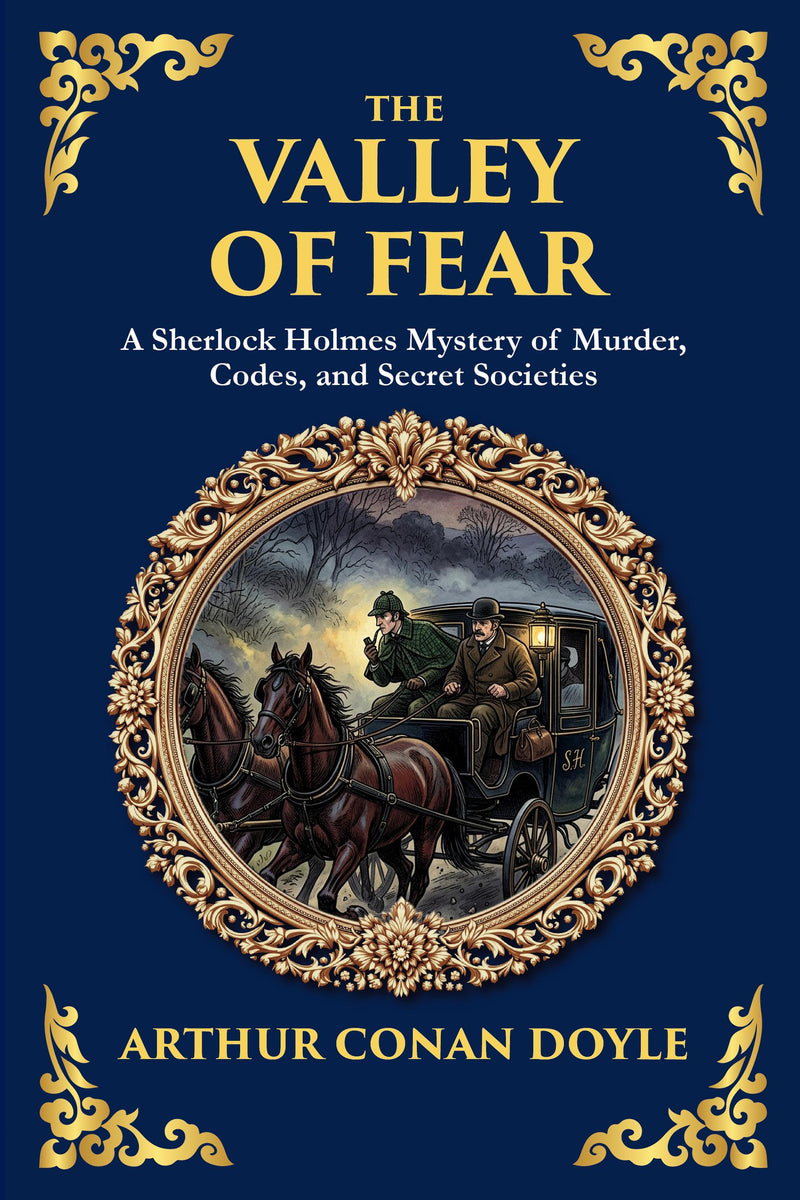
The Valley of Fear — Large Print
In the final Sherlock Holmes novel, the legendary detective is thrust into a chilling mystery involving a murdered man, a hidden identity, and a trail of cryptic clues.
or free app
10,000+ hrs library
30-day guarantee
The complete The Valley of Fear appears in modern English through Library of Alexandria Press, available online with audiobook narration included for members.
Have you ever wondered why some secrets are buried so deep they’re protected by blood? Step into the shadowy world of Sherlock Holmes in The Valley of Fear, Arthur Conan Doyle’s most complex and atmospheric mystery. A cryptic cipher.
A locked-room murder. A corpse with a mangled face. At the center of it all is a mystery that leads Holmes and Watson from the drawing rooms of England to the violent underworld of secret brotherhoods in America.
This novel is more than a whodunit—it's a dual-narrative thriller that unearths a man’s dark past and the brutal society he once tried to escape. With precision and suspense, Conan Doyle unveils a layered story of justice and revenge, morality and disguise.
What you’ll discover in this modern edition
- A Riveting Holmes Mystery – One of Holmes’s most intellectually challenging cases, involving murder, hidden identities, and ciphers.
| Formats | eBook (EPUB + PDF) · Audiobook · Paperback · Hardcover · Large Print |
| Language | English |
| Trim size (print) | 6 × 9 in |
| Binding | Paperback — perfect-bound · Hardcover — casewrap |
| Large Print edition | Same text in a larger, easy-read type — a larger font, not a larger trim |
| Print pricing | Every physical book at our true cost — at-cost, no profit (members) |
| Library | 873 restored titles, always growing |
| Length | 56,277 words · ~3 hr 45 min reading |
| Reading level | Grade 6 · an easy, flowing read (this modern-English edition) |
| Edition | Modern English translation · 2026 |
Member reviews for this edition are collected as readers finish it — be the first. Across the library: 12,000+ books shipped, every plan covered by a 365-day print guarantee.
About this edition
A faithful, unabridged modern-English edition by The Library of Alexandria — carefully rendered for today's reader and verified paragraph-by-paragraph against the public-domain source. Available as eBook, audiobook, paperback, hardcover, and large print.
- Complete & unabridgedVerified paragraph by paragraph against the source — never a scan, never abridged.
- Modern English, faithfulReadable today, with the author’s meaning kept intact. Readable — not simplified.
- Every format, one membershipRead in your browser or the free app, or listen to the full audiobook.
Included free with your membership
Cancel anytime, one click · 30-day money-back guarantee
Edition last updated July 2026
What’s inside
The Valley of Fear — Large Print — complete and unabridged: all 10 sections included with membership, plus the full audiobook.
Begin reading The Valley of Fear — Large Print
In clear modern English — the complete text is included with membership.
Introduction
There is a particular pleasure that comes from settling into a story you know was built by a master craftsman at the height of his powers. You sense it in the opening pages — a tightening of the prose, a confidence in the pacing, an author who knows exactly how much to reveal and when to hold back. The book you are about to read offers precisely that pleasure. It is one of the four full-length novels Arthur Conan Doyle wrote featuring the world’s most famous consulting detective, and it stands among the most ingeniously constructed of all his works. By the time Doyle composed it, he had already lived through the strange experience of trying to retire his creation, only to find that the public would not allow Sherlock Holmes to die. The result is a story written by a man who understood, perhaps better than any writer before or since, the full machinery of suspense.
This particular tale arrived late in the chronology of Holmes adventures, first appearing serialized between 1914 and 1915, in the very shadow of the First World War. Yet despite the date of its publication, it reaches backward in time, setting much of its drama in earlier decades and in places far removed from the foggy streets of Victorian London that readers most associate with the detective. That reach is part of what makes the book unusual and rewarding. It is not simply another sitting-room mystery solved over a pipe and a cup of tea. It is a story of two halves, two worlds, and two kinds of fear — and the way those halves connect is one of the great structural surprises in detective fiction. To say more would be to spoil the experience, and that is something this introduction is carefully designed to avoid.
What you should know going in is that this edition has been prepared as a modern translation, adapted for the contemporary reader. That phrase deserves a little explanation, because it speaks directly to the kind of reading experience that awaits you. Doyle wrote in the idiom of his age, an age now more than a century behind us. His sentences could be long and ornate, studded with references to objects, customs, currencies, and social codes that would have been instantly familiar to an Edwardian reader picking up a magazine but that can trip up a reader today. The aim of this adaptation is not to rewrite Doyle or to flatten his distinctive voice, but to clear away the small obstacles that can interrupt the flow — to ensure that the wit lands, the tension builds, and the revelations strike with their full intended force. The cleverness of the plotting, the warmth and friction of the central friendship, the slow-burning dread of the story’s darker passages: all of it is preserved and, ideally, sharpened. You are meeting the great detective on terms that feel natural to a reader of the present day, without losing the period atmosphere that gives the whole thing its soul.
To appreciate fully what Doyle accomplishes here, it helps to remember who Sherlock Holmes was to his original audience and what he has become to us. When the detective first appeared in print in the late 1880s, he was something genuinely new. The world had seen clever investigators in fiction before — Edgar Allan Poe had given us the analytical Dupin, and Émile Gaboriau had offered his methodical French detectives — but Doyle fused those influences into a character of unprecedented vividness. Holmes was not merely clever; he was a personality, a presence, a man with quirks and appetites and a temperament that made him as memorable as any solution he reached. He played the violin at odd hours. He kept tobacco in a slipper. He could be cold, even cruel, in his pursuit of the truth, and yet he was capable of sudden, surprising tenderness. He was a genius who needed problems the way other men need food, and who sank into something close to despair when the world failed to supply him with mysteries worthy of his attention.
The method he brought to those mysteries was the source of his lasting fame. Holmes practiced what he called the science of deduction, though what he really demonstrated was the power of disciplined observation. He saw what everyone else saw, but he noticed it. A scuff on a boot, the calluses on a hand, the particular way a man held himself or the wear pattern on the sleeve of a coat — these became, in Holmes’s mind, sentences in a story that the rest of the world walked past every day. Part of the abiding joy of reading these books is the way Doyle lets us watch this process unfold. We are given the same clues Holmes is given, and we fail, again and again, to assemble them correctly. Then comes the explanation, and the world clicks into a new and more orderly shape. It is a magic trick performed in full view, and it never grows old.
Crucial to all of this is the man who tells the stories. Dr. John Watson is far more than a sidekick or a convenient narrator. He is our representative inside the world of the great detective — the ordinary, decent, intelligent man who stands beside the genius and reacts as we would react: with astonishment, with admiration, occasionally with exasperation. Watson is brave, loyal, and observant in his own right, a former army doctor who has seen real danger and who is no fool. But he is not Holmes, and that gap between them is the engine of the whole enterprise. Because Watson cannot see everything, neither can we, and the suspense survives. Because Watson loves and respects his friend, we are drawn into the warmth of their partnership. Some of the most enduring pleasures of these stories have nothing to do with crime at all; they live in the small domestic exchanges, the gentle teasing, the deep and unspoken affection between two very different men who have made a home of their shared rooms and their shared work.
In the present book, that partnership is on full display from the very first scene. The story opens with the kind of exchange that fans of the detective will recognize and treasure — Holmes in a mood, Watson pressing him, a puzzle landing on the breakfast table and immediately seizing the detective’s restless intelligence. Yet what unfolds from that opening is anything but routine. Doyle was not content, in his longer works, simply to repeat the formula that had made his short stories so popular. He used the extra space a novel afforded him to do something more ambitious, to build a larger and stranger architecture. And he placed across from Holmes, somewhere in the deep background of this case, the shadow of an adversary worthy of him — an intelligence as formidable as his own, a presence that lends the proceedings a weight and menace that elevate the whole affair above the ordinary run of mysteries.
It is worth saying a word about that adversary without saying too much. Readers who know the Holmes canon will be aware that the detective faced, across the span of his career, a small number of genuinely dangerous opponents — figures who could match his intellect and who turned the contest of detection into something closer to warfare. The criminal world Doyle imagined was not a chaos of random villains but, at its highest level, an organized and terrible thing, with its own command structure and its own cold logic. The sense that Holmes is not merely solving a puzzle but contending against a vast, patient, malignant network gives this story a flavor distinct from many of the lighter adventures. There is real fear in these pages, as the title promises, and that fear is rooted in the recognition that some forces cannot simply be reasoned with or outwitted in a single afternoon. They must be fought, and fighting them carries a cost.
The most distinctive feature of this novel — and the thing that makes it such a fascinating object of study as well as a thrilling read — is its structure. Without revealing the particulars, it is fair to prepare you for the fact that the book does not move in a single straight line. It is built in parts, and the relationship between those parts is itself one of the story’s masterstrokes. Doyle had used a similar two-part construction in the very first Holmes novel, years earlier, and here he returned to it with far greater confidence and control. The effect on first reading can be startling. Just when you believe you understand the shape of the story you are in, the ground shifts beneath you, and you find yourself transported — in time, in place, in tone — to a world that at first seems to have nothing to do with what came before.
This is a feature, not a flaw, and it rewards a reader who is willing to trust the author. Some readers, encountering the shift for the first time, have felt momentarily disoriented, wondering where the detective has gone and why the familiar comforts of his company have been suspended. But the patient reader is richly repaid. The two halves of the book illuminate each other. What begins as a puzzle becomes, in the second movement, something more like a saga — a story of community, loyalty, betrayal, courage, and terror, set against a backdrop very different from the genteel surroundings in which the case is first presented. The second portion of the book has the sweep of an adventure novel, with its own heroes and villains, its own slow accumulation of dread, its own breathless turns. And when the two threads finally rejoin, the reader experiences the satisfaction of seeing a vast design complete itself.
This ambition reflects the kind of writer Doyle truly was. It is easy to think of him only as the inventor of Sherlock Holmes, but he considered himself a novelist of much broader range, and he chafed somewhat at the way the detective overshadowed his other work. He wrote historical adventures, tales of the sea, stories of war and exploration, and he poured into them a genuine love of pace, incident, and atmosphere. The second half of this book is, in a sense, Doyle the adventure novelist let off the leash, free to build a world from the ground up and to populate it with figures who feel drawn from life. That he was able to graft this expansive storytelling onto the precise machinery of a Holmes mystery, and to make the two work as a single unified whole, is a considerable achievement. It is one of the reasons this title has held its place in the affection of readers for more than a century.
The setting of that second movement also gives the book a texture rarely found elsewhere in the canon. Doyle drew, for parts of his story, on a real historical situation — a chapter of social conflict and organized intimidation that gripped a particular industrial community in the United States during the latter part of the nineteenth century. He took the bones of fact and clothed them in fiction, transforming reported events into a tense and atmospheric drama of fear and resistance. The result feels grounded and urgent in a way that pure invention rarely does. There is the menace of a place where ordinary people live under the constant pressure of a hidden power, where neighbors watch one another, where a wrong word might bring ruin, and where courage is a quality with a price attached to it. The “valley” of the title is more than a geographical location; it is a state of being, a condition of dread that settles over a community and seeps into every interaction. Doyle’s evocation of that condition is one of the most memorable things in the book.
For all its darkness, the novel is not without its pleasures of the lighter kind. The opening section, in which the case is first laid out and Holmes turns his attention to it, contains some of Doyle’s most enjoyable detective work. There is a code to be broken — a cipher that must be unraveled before the meaning of a warning can be understood — and watching Holmes attack the problem is a delight in itself. There is a country house with its secrets, a circle of characters each with something to hide, and the steady, methodical peeling back of appearances that is the bread and butter of the genre. The official police are present too, in the form of an inspector who provides a useful contrast to Holmes’s methods, and the friendly rivalry between the brilliant amateur and the dogged professional supplies its own quiet entertainment. Readers who come to this book chiefly for the classic experience of a locked-room style investigation will find that experience delivered with skill and flair in the opening movement, before the story opens out into its larger ambitions.
Cancel anytime, one click · 30-day money-back guarantee
Founding annual rate available now — your price locks for life when you join.
Not ready? Get this free chapter by email — read it anytime.
✓ Sent — check your inbox for The Valley of Fear — Large Print.
Questions about The Valley of Fear — Large Print
What is The Valley of Fear about?
In the final Sherlock Holmes novel, the legendary detective is thrust into a chilling mystery involving a murdered man, a hidden identity, and a trail of cryptic clues. When a coded message reaches 221B Baker Street warning of imminent violence, Holmes and Watson find themselves unraveling a case that stretches from the foggy English countryside to the lawless depths of an American criminal syndicate. As Holmes delves deeper, he uncovers a deadly conspiracy rooted in vengeance and betrayal —a secret society whose r
Who wrote The Valley of Fear?
The Valley of Fear was written by Arthur Conan Doyle. This edition presents the complete work in clear modern English, faithfully rendered from the public-domain original by Library of Alexandria Press.
Is The Valley of Fear free to read?
The opening chapter is free to read on this page. Members read and listen to the complete work — and the entire library — free, and can order any physical book at our true print cost.
How long is The Valley of Fear?
10 chapters (~56,277 words) — about 3 hr 45 min of reading in this modern-English edition.
Is this an abridged version of The Valley of Fear?
No. This is the complete, unabridged The Valley of Fear, carefully rendered into clear modern English and verified paragraph-by-paragraph against the public-domain source — nothing is cut or summarised.
What formats does The Valley of Fear come in?
The Valley of Fear is available as eBook, paperback, hardcover and large print. eBook and audiobook are included with membership; printed editions ship at our true print cost.
Shipping & returns
Billing & membership
More from the library


Explore Mystery & Crime
- Resurrection · Leo Tolstoy
- Crime and Punishment · Fyodor Dostoyevsky
- The Strange Case of Dr. Jekyll and Mr. Hyde · Robert Louis Stevenson
- The Riddle of the Sands · Erskine Childers
- The Wisdom of Father Brown · G. K. Chesterton
- The Cask of Amontillado · Edgar Allan Poe
- The Tomb of Ts’in · Edgar Wallace
- Ghost Stories of an Antiquary · M. R. James
- The Hunniwell Boys and the Platinum Mystery · L. P. Wyman
- The Seven Dials Mystery · Agatha Christie
- The Thirty-Nine Steps · John Buchan
- The Hand in the Dark · Arthur J. Rees
- Lady Audley’s Secret · M. E. Braddon
- The Mystery of the Blue Train · Agatha Christie
- The Secret Adversary · Agatha Christie
- The Call of Cthulhu · H. P. Lovecraft
- The Adventures of Heine · Edgar Wallace
- The Valley of Fear · Arthur Conan Doyle
- The Innocence of Father Brown · G. K. Chesterton
- McTeague: A Story of San Francisco · Frank Norris
- Tess of the d’Urbervilles: A Pure Woman · Thomas Hardy
- The Big Fix · George O. Smith
- The Ambulance Made Two Trips · Murray Leinster
- Time Crime · H. Beam Piper
- The Misplaced Battleship · Harry Harrison
- Supermind · Randall Garrett and Laurence M....
- Lone Star Planet · H. Beam Piper and John J. McGuire
- Dracula · Bram Stoker
- The Murder on the Links · Agatha Christie
- The Hound of the Baskervilles · Arthur Conan Doyle
The Valley of Fear — Large Print
The Valley of Fear — Large Print
A Sherlock Holmes Mystery of Murder, Codes, and Secret Societies
Arthur Conan Doyle
Contents
- Introduction
- Part 1
- Chapter 1
- Chapter 2
- Chapter 3
- Chapter 4
- Chapter 5
- Chapter 6
- Chapter 7
- Part 2
Introduction
There is a particular pleasure that comes from settling into a story you know was built by a master craftsman at the height of his powers. You sense it in the opening pages — a tightening of the prose, a confidence in the pacing, an author who knows exactly how much to reveal and when to hold back. The book you are about to read offers precisely that pleasure. It is one of the four full-length novels Arthur Conan Doyle wrote featuring the world’s most famous consulting detective, and it stands among the most ingeniously constructed of all his works. By the time Doyle composed it, he had already lived through the strange experience of trying to retire his creation, only to find that the public would not allow Sherlock Holmes to die. The result is a story written by a man who understood, perhaps better than any writer before or since, the full machinery of suspense.
This particular tale arrived late in the chronology of Holmes adventures, first appearing serialized between 1914 and 1915, in the very shadow of the First World War. Yet despite the date of its publication, it reaches backward in time, setting much of its drama in earlier decades and in places far removed from the foggy streets of Victorian London that readers most associate with the detective. That reach is part of what makes the book unusual and rewarding. It is not simply another sitting-room mystery solved over a pipe and a cup of tea. It is a story of two halves, two worlds, and two kinds of fear — and the way those halves connect is one of the great structural surprises in detective fiction. To say more would be to spoil the experience, and that is something this introduction is carefully designed to avoid.
What you should know going in is that this edition has been prepared as a modern translation, adapted for the contemporary reader. That phrase deserves a little explanation, because it speaks directly to the kind of reading experience that awaits you. Doyle wrote in the idiom of his age, an age now more than a century behind us. His sentences could be long and ornate, studded with references to objects, customs, currencies, and social codes that would have been instantly familiar to an Edwardian reader picking up a magazine but that can trip up a reader today. The aim of this adaptation is not to rewrite Doyle or to flatten his distinctive voice, but to clear away the small obstacles that can interrupt the flow — to ensure that the wit lands, the tension builds, and the revelations strike with their full intended force. The cleverness of the plotting, the warmth and friction of the central friendship, the slow-burning dread of the story’s darker passages: all of it is preserved and, ideally, sharpened. You are meeting the great detective on terms that feel natural to a reader of the present day, without losing the period atmosphere that gives the whole thing its soul.
To appreciate fully what Doyle accomplishes here, it helps to remember who Sherlock Holmes was to his original audience and what he has become to us. When the detective first appeared in print in the late 1880s, he was something genuinely new. The world had seen clever investigators in fiction before — Edgar Allan Poe had given us the analytical Dupin, and Émile Gaboriau had offered his methodical French detectives — but Doyle fused those influences into a character of unprecedented vividness. Holmes was not merely clever; he was a personality, a presence, a man with quirks and appetites and a temperament that made him as memorable as any solution he reached. He played the violin at odd hours. He kept tobacco in a slipper. He could be cold, even cruel, in his pursuit of the truth, and yet he was capable of sudden, surprising tenderness. He was a genius who needed problems the way other men need food, and who sank into something close to despair when the world failed to supply him with mysteries worthy of his attention.
The method he brought to those mysteries was the source of his lasting fame. Holmes practiced what he called the science of deduction, though what he really demonstrated was the power of disciplined observation. He saw what everyone else saw, but he noticed it. A scuff on a boot, the calluses on a hand, the particular way a man held himself or the wear pattern on the sleeve of a coat — these became, in Holmes’s mind, sentences in a story that the rest of the world walked past every day. Part of the abiding joy of reading these books is the way Doyle lets us watch this process unfold. We are given the same clues Holmes is given, and we fail, again and again, to assemble them correctly. Then comes the explanation, and the world clicks into a new and more orderly shape. It is a magic trick performed in full view, and it never grows old.
Crucial to all of this is the man who tells the stories. Dr. John Watson is far more than a sidekick or a convenient narrator. He is our representative inside the world of the great detective — the ordinary, decent, intelligent man who stands beside the genius and reacts as we would react: with astonishment, with admiration, occasionally with exasperation. Watson is brave, loyal, and observant in his own right, a former army doctor who has seen real danger and who is no fool. But he is not Holmes, and that gap between them is the engine of the whole enterprise. Because Watson cannot see everything, neither can we, and the suspense survives. Because Watson loves and respects his friend, we are drawn into the warmth of their partnership. Some of the most enduring pleasures of these stories have nothing to do with crime at all; they live in the small domestic exchanges, the gentle teasing, the deep and unspoken affection between two very different men who have made a home of their shared rooms and their shared work.
In the present book, that partnership is on full display from the very first scene. The story opens with the kind of exchange that fans of the detective will recognize and treasure — Holmes in a mood, Watson pressing him, a puzzle landing on the breakfast table and immediately seizing the detective’s restless intelligence. Yet what unfolds from that opening is anything but routine. Doyle was not content, in his longer works, simply to repeat the formula that had made his short stories so popular. He used the extra space a novel afforded him to do something more ambitious, to build a larger and stranger architecture. And he placed across from Holmes, somewhere in the deep background of this case, the shadow of an adversary worthy of him — an intelligence as formidable as his own, a presence that lends the proceedings a weight and menace that elevate the whole affair above the ordinary run of mysteries.
It is worth saying a word about that adversary without saying too much. Readers who know the Holmes canon will be aware that the detective faced, across the span of his career, a small number of genuinely dangerous opponents — figures who could match his intellect and who turned the contest of detection into something closer to warfare. The criminal world Doyle imagined was not a chaos of random villains but, at its highest level, an organized and terrible thing, with its own command structure and its own cold logic. The sense that Holmes is not merely solving a puzzle but contending against a vast, patient, malignant network gives this story a flavor distinct from many of the lighter adventures. There is real fear in these pages, as the title promises, and that fear is rooted in the recognition that some forces cannot simply be reasoned with or outwitted in a single afternoon. They must be fought, and fighting them carries a cost.
The most distinctive feature of this novel — and the thing that makes it such a fascinating object of study as well as a thrilling read — is its structure. Without revealing the particulars, it is fair to prepare you for the fact that the book does not move in a single straight line. It is built in parts, and the relationship between those parts is itself one of the story’s masterstrokes. Doyle had used a similar two-part construction in the very first Holmes novel, years earlier, and here he returned to it with far greater confidence and control. The effect on first reading can be startling. Just when you believe you understand the shape of the story you are in, the ground shifts beneath you, and you find yourself transported — in time, in place, in tone — to a world that at first seems to have nothing to do with what came before.
This is a feature, not a flaw, and it rewards a reader who is willing to trust the author. Some readers, encountering the shift for the first time, have felt momentarily disoriented, wondering where the detective has gone and why the familiar comforts of his company have been suspended. But the patient reader is richly repaid. The two halves of the book illuminate each other. What begins as a puzzle becomes, in the second movement, something more like a saga — a story of community, loyalty, betrayal, courage, and terror, set against a backdrop very different from the genteel surroundings in which the case is first presented. The second portion of the book has the sweep of an adventure novel, with its own heroes and villains, its own slow accumulation of dread, its own breathless turns. And when the two threads finally rejoin, the reader experiences the satisfaction of seeing a vast design complete itself.
This ambition reflects the kind of writer Doyle truly was. It is easy to think of him only as the inventor of Sherlock Holmes, but he considered himself a novelist of much broader range, and he chafed somewhat at the way the detective overshadowed his other work. He wrote historical adventures, tales of the sea, stories of war and exploration, and he poured into them a genuine love of pace, incident, and atmosphere. The second half of this book is, in a sense, Doyle the adventure novelist let off the leash, free to build a world from the ground up and to populate it with figures who feel drawn from life. That he was able to graft this expansive storytelling onto the precise machinery of a Holmes mystery, and to make the two work as a single unified whole, is a considerable achievement. It is one of the reasons this title has held its place in the affection of readers for more than a century.
The setting of that second movement also gives the book a texture rarely found elsewhere in the canon. Doyle drew, for parts of his story, on a real historical situation — a chapter of social conflict and organized intimidation that gripped a particular industrial community in the United States during the latter part of the nineteenth century. He took the bones of fact and clothed them in fiction, transforming reported events into a tense and atmospheric drama of fear and resistance. The result feels grounded and urgent in a way that pure invention rarely does. There is the menace of a place where ordinary people live under the constant pressure of a hidden power, where neighbors watch one another, where a wrong word might bring ruin, and where courage is a quality with a price attached to it. The “valley” of the title is more than a geographical location; it is a state of being, a condition of dread that settles over a community and seeps into every interaction. Doyle’s evocation of that condition is one of the most memorable things in the book.
For all its darkness, the novel is not without its pleasures of the lighter kind. The opening section, in which the case is first laid out and Holmes turns his attention to it, contains some of Doyle’s most enjoyable detective work. There is a code to be broken — a cipher that must be unraveled before the meaning of a warning can be understood — and watching Holmes attack the problem is a delight in itself. There is a country house with its secrets, a circle of characters each with something to hide, and the steady, methodical peeling back of appearances that is the bread and butter of the genre. The official police are present too, in the form of an inspector who provides a useful contrast to Holmes’s methods, and the friendly rivalry between the brilliant amateur and the dogged professional supplies its own quiet entertainment. Readers who come to this book chiefly for the classic experience of a locked-room style investigation will find that experience delivered with skill and flair in the opening movement, before the story opens out into its larger ambitions.
“You should think,” Sherlock Holmes interrupted impatiently.
I consider myself to be one of the most patient people alive, but I must admit that his mocking interruption annoyed me. “Honestly, Holmes,” I said sternly, “you can be quite frustrating sometimes.”
He was too deep in thought to answer my complaint right away. He leaned on his hand, ignoring his breakfast, and stared at the small piece of paper he had just taken out of the envelope. Then he picked up the envelope, held it up to the light, and carefully examined the outside and the flap.
“This is Porlock’s handwriting,” he said thoughtfully. “I’m almost certain it’s his, even though I’ve only seen it twice before. The way he writes the Greek letter epsilon with that specific flourish at the top is a dead giveaway. But if it really is from Porlock, then this must be something incredibly important.”
He was talking more to himself than to me, but my annoyance faded as I became curious about what he was saying.
“Porlock, Watson, is a pseudonym—just a label. Behind that name is a slippery and elusive person. In a previous letter, he told me openly that it wasn’t his real name and challenged me to try and find him among the millions of people in this huge city. Porlock isn’t important because of who he is, but because of the powerful man he works for. Think of a pilot fish swimming with a shark, or a jackal following a lion—something small and unimportant compared to something terrifying. And not just terrifying, Watson, but evil—truly evil. That is why he interests me. Have I mentioned Professor Moriarty to you?”
“The famous scientific criminal, who is as well-known among thieves as—”
End of the free sample
Keep reading, free
Members read and listen to the complete book — and the entire library. Cancel anytime, one click · 30-day money-back guarantee.