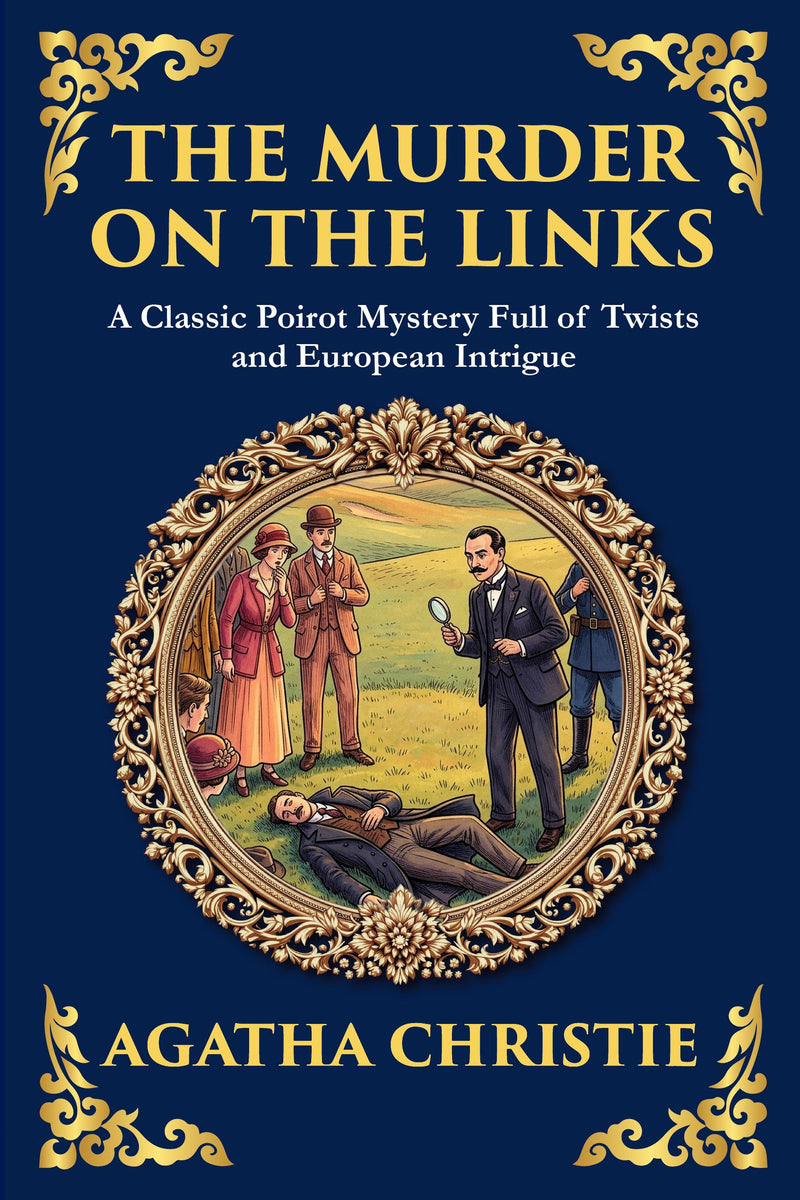
The Murder on the Links
In a quiet town on the northern coast of France, a wealthy man is found murdered near a golf course—his body laid in a strange position, his face frozen in terror.
or free app
10,000+ hrs library
30-day guarantee
The complete The Murder on the Links appears in modern English through Library of Alexandria Press, available online with audiobook narration included for members.
Have you ever wondered why Hercule Poirot remains the most iconic detective in mystery fiction? In The Murder on the Links: A Classic Poirot Mystery Full of Twists and European Intrigue, Agatha Christie spins a tale so full of deception, betrayal, and carefully planted clues that even the most seasoned mystery lovers will be second-guessing until the final chapter. When Poirot receives a desperate letter from a man fearing for his life, he travels to France— only to find the man already dead, buried hastily near a golf course under suspicious circumstances.
The scene reeks of a staged murder. As Poirot begins his methodical investigation, he must navigate a tangle of lies, old flames, and baffling clues. Meanwhile, Captain Hastings becomes entangled in his own romantic dilemma—complicating matters further.
What you’ll discover in this modern edition
- A Locked-Room Style Crime – A body discovered under strange conditions, with conflicting eyewitness accounts.
- A French Setting Full of Secrets – Explore the luxurious yet shadowy world of seaside villas and social elites.
- Hercule Poirot’s Signature Logic – Watch the master detective piece together a baffling puzzle that spans countries and identities.
- Romance, Deception, and Revenge – A mystery entwined with emotional motives and dangerous passion.
- A Cast of Unforgettable Characters – From the dashing Renauld family to mysterious women from the past, each character hides more than they reveal.
| Formats | eBook (EPUB + PDF) · Audiobook · Paperback · Hardcover · Large Print |
| Language | English |
| Trim size (print) | 6 × 9 in |
| Binding | Paperback — perfect-bound · Hardcover — casewrap |
| Large Print edition | Same text in a larger, easy-read type — a larger font, not a larger trim |
| Print pricing | Every physical book at our true cost — at-cost, no profit (members) |
| Library | 873 restored titles, always growing |
| Length | 61,215 words · ~4 hr 5 min reading |
| Reading level | Grade 6 · an easy, flowing read (this modern-English edition) |
| Edition | Modern English translation · 2026 |
Member reviews for this edition are collected as readers finish it — be the first. Across the library: 12,000+ books shipped, every plan covered by a 365-day print guarantee.
About this edition
A faithful, unabridged modern-English edition by The Library of Alexandria — carefully rendered for today's reader and verified paragraph-by-paragraph against the public-domain source. Available as eBook, audiobook, paperback, hardcover, and large print.
- Complete & unabridgedVerified paragraph by paragraph against the source — never a scan, never abridged.
- Modern English, faithfulReadable today, with the author’s meaning kept intact. Readable — not simplified.
- Every format, one membershipRead in your browser or the free app, or listen to the full audiobook.
Included free with your membership
Cancel anytime, one click · 30-day money-back guarantee
Edition last updated July 2026
What’s inside
The Murder on the Links — complete and unabridged: all 28 sections included with membership, plus the full audiobook.
Begin reading The Murder on the Links
In clear modern English — the complete text is included with membership.
Introduction
When Agatha Christie sat down to write her second Hercule Poirot novel, she was a young author still finding her footing, yet already possessed of an instinct for storytelling that would, in time, make her the best-selling novelist in the history of the world. The book you are about to read represents a fascinating moment in the evolution of detective fiction—a moment when the genre was shaking off the long shadow of Sherlock Holmes and discovering, somewhat tentatively, what it might become. Here we find a writer experimenting boldly, borrowing from the masters who came before her, and yet bending every borrowed element toward something distinctly her own. The result is a mystery that crackles with energy, surprises with its audacity, and rewards the reader with one of the most satisfying revelations in the early canon of the Queen of Crime.
This modern translation has been prepared with a singular purpose: to allow today’s reader to encounter the cleverness, the wit, and the sheer narrative momentum of Christie’s craft without the friction that sometimes accompanies prose written a century ago. The slang of the 1920s, the social assumptions of a vanished world, the occasional turn of phrase that has drifted out of common usage—these can form a subtle barrier between the modern reader and the pleasures of the original. By gently smoothing these edges while preserving the essential character, voice, and ingenuity of the work, this edition aims to deliver the experience Christie’s first readers enjoyed: the thrill of being thoroughly, delightfully outwitted by a master puzzle-maker.
What follows in these pages is more than a simple whodunit. It is a story of buried secrets and old crimes, of mistaken identities and dangerous passions, of two women who could not be more different and a detective whose methods strike at the very heart of how we understand human nature. It is also, in a quiet way, a meditation on rivalry, on pride, and on the limits of pure logic. To prepare you for the journey, let us consider the context in which this remarkable book was written, the qualities that make it endure, and the particular pleasures that await the attentive reader.
To understand the significance of this novel, one must first understand where Agatha Christie stood at the moment of its creation. Her debut, which introduced the fastidious Belgian detective Hercule Poirot to the world, had been published to modest but encouraging acclaim. It had taken her several years and several rejections to see that first book into print, and the publishing landscape of the early 1920s offered no guarantees. A single successful detective novel did not make a career; it made, at best, a promising start. Christie understood, as all working writers must, that the second book would test whether she had a future in the trade or whether her debut had been a happy accident.
She approached this challenge with characteristic determination and, crucially, with a willingness to take risks. Where many authors might have played it safe, simply replicating the formula that had worked the first time, Christie chose instead to stretch herself. She set her story not in the comfortable confines of an English country house but on foreign soil, in France, lending the narrative an exotic flavor and a sense of displacement that heightens its tension. She wove into her plot the structure of a real and notorious criminal case that had captured public imagination, demonstrating an interest in the relationship between fact and fiction that would recur throughout her long career. And she experimented with the dynamics of her central characters in ways that would have lasting consequences for the series.
The detective at the center of this tale, Hercule Poirot, was at this stage still very much a work in progress. Christie had not yet fully grasped the cultural phenomenon he would become, nor had she anticipated the decades she would spend in his company—decades during which, by her own famous admission, she would grow rather weary of him. In this early outing, we see Poirot in a fascinating intermediate state. The signature traits are present: the egg-shaped head, the meticulous mustache, the obsessive tidiness, the conviction that the truth is to be found not by crawling about for cigarette ash and footprints but by exercising the “little grey cells” of the brain. Yet there is also a freshness here, a sense of a character still being discovered by his creator, that makes him feel more vital and less mannered than he would sometimes appear in later, more comfortable years.
One of the most striking aspects of this book is the way Christie deliberately positions Poirot against an alternative model of detection. The narrative introduces a rival investigator who represents the methodology Poirot disdains—the school of physical evidence, of measurements and clues, of the bloodhound following a scent. This juxtaposition is not accidental. Christie was making an argument about the nature of detection itself, and by extension about the kind of mystery writer she intended to be. She was declaring her allegiance to the psychological, to the understanding of human motive and character, over the merely mechanical. This intellectual through-line gives the book a richness that elevates it well above the level of a simple entertainment.
It is worth pausing on the way Christie was clearly working in dialogue with the towering figure of Sherlock Holmes and his creator. The structure of a brilliant detective accompanied by a faithful but less perceptive companion who narrates the proceedings was, by the early 1920s, a thoroughly established convention. Christie adopted it, but she also played with it, gently mocked it, and ultimately began to subvert it. The narrator of this story, Poirot’s loyal friend, is given a more substantial emotional life than such characters typically enjoyed. He is allowed to be foolish, to be swept up by feeling, to make decisions that complicate the investigation rather than merely chronicle it. This willingness to grant the “Watson figure” genuine agency, and genuine vulnerability, is one of the ways the novel feels surprisingly modern even now.
There is, threaded through the whole, a vein of humor that readers sometimes forget to expect from a murder mystery. Christie possessed a sharp comic sensibility, and she deploys it here in the bantering exchanges between her characters, in Poirot’s vanities and exasperations, and in the gentle teasing of the conventions of the genre she was helping to define. This lightness of touch is essential to her enduring appeal. A lesser writer might have weighed the proceedings down with gloom; Christie understood that the pleasure of a mystery lies as much in its playfulness as in its puzzle. Death is the engine of the plot, but the experience of reading is buoyant, brisk, and frequently a great deal of fun.
The European setting deserves particular attention, as it does so much to give this story its distinctive atmosphere. By transporting her detective and his companion across the Channel, Christie was able to exploit a sense of glamour and uncertainty. The seaside resort, the elegant villa, the wealthy expatriates and their tangled affairs—all of this conjures a world that feels at once luxurious and faintly menacing. There is something about a crime committed in unfamiliar surroundings, among people whose customs and assumptions differ subtly from one’s own, that intensifies the reader’s sense of disorientation and unease. The very landscape becomes a kind of accomplice to the mystery, holding its secrets close.
What truly distinguishes this novel, and what has kept readers returning to it for a hundred years, is the sheer ingenuity of its construction. Christie was, above all else, an architect of plot. She built her stories the way a master joiner builds a cabinet—every piece cut precisely, every joint concealed, the whole thing fitting together with a satisfying click that you do not anticipate until the very moment it occurs. To read one of her mysteries is to be invited into a game, a contest of wits between author and reader, and Christie played that game with a scrupulous fairness that distinguishes the finest practitioners of the form from the merely competent.
The principle of fair play is central to the appeal of golden-age detective fiction, and Christie was one of its great champions. The idea is simple but demanding: the author must present the reader with all the information necessary to solve the mystery, hiding nothing essential, cheating in no way—and yet must so arrange that information, so cloak it in misdirection and false significance, that the reader nevertheless fails to see what was in plain sight all along. When done well, the effect upon the revelation is almost magical. The reader experiences a double pleasure: the shock of surprise, followed immediately by the recognition that the solution was inevitable, that the clues were there to be found, that one had simply been too clever or too foolish to notice them. Christie excelled at producing precisely this sensation, and this novel is among her early triumphs in the art.
The plot of this book turns upon a discovery that sets in motion a chain of investigation, and from that point forward the narrative complicates itself with a series of revelations, each of which seems to clarify matters only to deepen the mystery further. Layers are peeled back to reveal more layers beneath. Characters who appear straightforward turn out to harbor secrets; secrets that seem central turn out to be peripheral, while details that seemed trivial assume sudden, devastating importance. Christie manages all of this with a control that belies her relative inexperience. There is hardly a wasted scene, hardly a conversation that does not contribute to the gradual construction of the puzzle and, simultaneously, to its concealment.
Particularly noteworthy is the way the book handles the question of the past. Christie understood, perhaps better than any writer of her generation, that crimes do not occur in a vacuum. The present is haunted by what came before. The dead carry their histories with them, and those histories, once unearthed, illuminate everything. The structure of this novel involves a kind of archaeology of human relationships, a careful excavation of old connections and ancient wounds. The reader, like the detective, must learn to read the present through the lens of the past, to understand that the answer to “who” depends entirely upon the answer to “why,” and that the “why” lies buried in events that long predate the opening of the story.
This emphasis on motive over mechanism is one of the things that separates Christie from her contemporaries who specialized in elaborate “impossible crime” puzzles, in locked rooms and ingenious mechanical contrivances. Christie was occasionally capable of such tricks, but her genius lay elsewhere. She understood people. She understood the small vanities, the buried resentments, the desperate loves and corrosive jealousies that drive human beings to extremity. Her murderers are rarely monsters; they are recognizable people pushed beyond their limits, and the horror of her fiction lies precisely in this recognizability. When the truth is finally revealed in her best work, the reader feels not merely surprise but a chill of understanding—a sense that, given the right circumstances, such darkness might lurk anywhere, even within ourselves.
The pacing of the narrative deserves admiration as well. Christie understood the rhythm of suspense—when to accelerate and when to slow, when to deliver a shock and when to let tension simmer. She knew how to end a chapter on a note that compels the reader onward, and how to space her revelations so that the reader never feels either overwhelmed or starved of progress. This instinctive command of tempo is one of the reasons her books remain so eminently readable, so difficult to set aside. There is always something just ahead, some new question demanding an answer, some fresh complication beckoning. The famous quality of being “unputdownable” is not an accident; it is the product of a craftsmanship so refined that it conceals itself entirely.
Cancel anytime, one click · 30-day money-back guarantee
Founding annual rate available now — your price locks for life when you join.
Not ready? Get this free chapter by email — read it anytime.
✓ Sent — check your inbox for The Murder on the Links.
Questions about The Murder on the Links
What is The Murder on the Links about?
In a quiet town on the northern coast of France, a wealthy man is found murdered near a golf course—his body laid in a strange position, his face frozen in terror. Just hours before, he had urgently summoned famed Belgian detective Hercule Poirot. Now it’s up to Poirot and his loyal companion Captain Hastings to untangle a web of secrets, disguises, and double lives.
Who wrote The Murder on the Links?
The Murder on the Links was written by Agatha Christie. This edition presents the complete work in clear modern English, faithfully rendered from the public-domain original by Library of Alexandria Press.
Is The Murder on the Links free to read?
The opening chapter is free to read on this page. Members read and listen to the complete work — and the entire library — free, and can order any physical book at our true print cost.
How long is The Murder on the Links?
28 chapters (~61,215 words) — about 4 hr 5 min of reading in this modern-English edition.
Is this an abridged version of The Murder on the Links?
No. This is the complete, unabridged The Murder on the Links, carefully rendered into clear modern English and verified paragraph-by-paragraph against the public-domain source — nothing is cut or summarised.
What formats does The Murder on the Links come in?
The Murder on the Links is available as eBook, paperback, hardcover and large print. eBook and audiobook are included with membership; printed editions ship at our true print cost.
Shipping & returns
Billing & membership
More from the library


Explore Mystery & Crime
- Resurrection · Leo Tolstoy
- Crime and Punishment · Fyodor Dostoyevsky
- The Strange Case of Dr. Jekyll and Mr. Hyde · Robert Louis Stevenson
- The Riddle of the Sands · Erskine Childers
- The Wisdom of Father Brown · G. K. Chesterton
- The Cask of Amontillado · Edgar Allan Poe
- The Tomb of Ts’in · Edgar Wallace
- Ghost Stories of an Antiquary · M. R. James
- The Hunniwell Boys and the Platinum Mystery · L. P. Wyman
- The Seven Dials Mystery · Agatha Christie
- The Thirty-Nine Steps · John Buchan
- The Hand in the Dark · Arthur J. Rees
- Lady Audley’s Secret · M. E. Braddon
- The Mystery of the Blue Train · Agatha Christie
- The Secret Adversary · Agatha Christie
- The Call of Cthulhu · H. P. Lovecraft
- The Adventures of Heine · Edgar Wallace
- The Valley of Fear · Arthur Conan Doyle
- The Innocence of Father Brown · G. K. Chesterton
- McTeague: A Story of San Francisco · Frank Norris
- Tess of the d’Urbervilles: A Pure Woman · Thomas Hardy
- The Big Fix · George O. Smith
- The Ambulance Made Two Trips · Murray Leinster
- Time Crime · H. Beam Piper
- The Misplaced Battleship · Harry Harrison
- Supermind · Randall Garrett and Laurence M....
- Lone Star Planet · H. Beam Piper and John J. McGuire
- Dracula · Bram Stoker
- The Hound of the Baskervilles · Arthur Conan Doyle
- The King in Yellow · Robert W. Chambers
The Murder on the Links
The Murder on the Links
A Classic Poirot Mystery Full of Twists and European Intrigue
Agatha Christie
Contents
- Introduction
- Chapter 1
- Chapter 2
- Chapter 3
- Chapter 4
- Chapter 5
- Chapter 6
- Chapter 7
- Chapter 8
- Chapter 9
- Chapter 10
- Chapter 11
- Chapter 12
- Chapter 13
- Chapter 14
- Chapter 15
- Chapter 16
- Chapter 17
- Chapter 18
- Chapter 19
- Chapter 20
- Chapter 21
- Chapter 22
- Chapter 23
- Chapter 24
- Chapter 25
- Chapter 26
- Chapter 27
Introduction
When Agatha Christie sat down to write her second Hercule Poirot novel, she was a young author still finding her footing, yet already possessed of an instinct for storytelling that would, in time, make her the best-selling novelist in the history of the world. The book you are about to read represents a fascinating moment in the evolution of detective fiction—a moment when the genre was shaking off the long shadow of Sherlock Holmes and discovering, somewhat tentatively, what it might become. Here we find a writer experimenting boldly, borrowing from the masters who came before her, and yet bending every borrowed element toward something distinctly her own. The result is a mystery that crackles with energy, surprises with its audacity, and rewards the reader with one of the most satisfying revelations in the early canon of the Queen of Crime.
This modern translation has been prepared with a singular purpose: to allow today’s reader to encounter the cleverness, the wit, and the sheer narrative momentum of Christie’s craft without the friction that sometimes accompanies prose written a century ago. The slang of the 1920s, the social assumptions of a vanished world, the occasional turn of phrase that has drifted out of common usage—these can form a subtle barrier between the modern reader and the pleasures of the original. By gently smoothing these edges while preserving the essential character, voice, and ingenuity of the work, this edition aims to deliver the experience Christie’s first readers enjoyed: the thrill of being thoroughly, delightfully outwitted by a master puzzle-maker.
What follows in these pages is more than a simple whodunit. It is a story of buried secrets and old crimes, of mistaken identities and dangerous passions, of two women who could not be more different and a detective whose methods strike at the very heart of how we understand human nature. It is also, in a quiet way, a meditation on rivalry, on pride, and on the limits of pure logic. To prepare you for the journey, let us consider the context in which this remarkable book was written, the qualities that make it endure, and the particular pleasures that await the attentive reader.
To understand the significance of this novel, one must first understand where Agatha Christie stood at the moment of its creation. Her debut, which introduced the fastidious Belgian detective Hercule Poirot to the world, had been published to modest but encouraging acclaim. It had taken her several years and several rejections to see that first book into print, and the publishing landscape of the early 1920s offered no guarantees. A single successful detective novel did not make a career; it made, at best, a promising start. Christie understood, as all working writers must, that the second book would test whether she had a future in the trade or whether her debut had been a happy accident.
She approached this challenge with characteristic determination and, crucially, with a willingness to take risks. Where many authors might have played it safe, simply replicating the formula that had worked the first time, Christie chose instead to stretch herself. She set her story not in the comfortable confines of an English country house but on foreign soil, in France, lending the narrative an exotic flavor and a sense of displacement that heightens its tension. She wove into her plot the structure of a real and notorious criminal case that had captured public imagination, demonstrating an interest in the relationship between fact and fiction that would recur throughout her long career. And she experimented with the dynamics of her central characters in ways that would have lasting consequences for the series.
The detective at the center of this tale, Hercule Poirot, was at this stage still very much a work in progress. Christie had not yet fully grasped the cultural phenomenon he would become, nor had she anticipated the decades she would spend in his company—decades during which, by her own famous admission, she would grow rather weary of him. In this early outing, we see Poirot in a fascinating intermediate state. The signature traits are present: the egg-shaped head, the meticulous mustache, the obsessive tidiness, the conviction that the truth is to be found not by crawling about for cigarette ash and footprints but by exercising the “little grey cells” of the brain. Yet there is also a freshness here, a sense of a character still being discovered by his creator, that makes him feel more vital and less mannered than he would sometimes appear in later, more comfortable years.
One of the most striking aspects of this book is the way Christie deliberately positions Poirot against an alternative model of detection. The narrative introduces a rival investigator who represents the methodology Poirot disdains—the school of physical evidence, of measurements and clues, of the bloodhound following a scent. This juxtaposition is not accidental. Christie was making an argument about the nature of detection itself, and by extension about the kind of mystery writer she intended to be. She was declaring her allegiance to the psychological, to the understanding of human motive and character, over the merely mechanical. This intellectual through-line gives the book a richness that elevates it well above the level of a simple entertainment.
It is worth pausing on the way Christie was clearly working in dialogue with the towering figure of Sherlock Holmes and his creator. The structure of a brilliant detective accompanied by a faithful but less perceptive companion who narrates the proceedings was, by the early 1920s, a thoroughly established convention. Christie adopted it, but she also played with it, gently mocked it, and ultimately began to subvert it. The narrator of this story, Poirot’s loyal friend, is given a more substantial emotional life than such characters typically enjoyed. He is allowed to be foolish, to be swept up by feeling, to make decisions that complicate the investigation rather than merely chronicle it. This willingness to grant the “Watson figure” genuine agency, and genuine vulnerability, is one of the ways the novel feels surprisingly modern even now.
There is, threaded through the whole, a vein of humor that readers sometimes forget to expect from a murder mystery. Christie possessed a sharp comic sensibility, and she deploys it here in the bantering exchanges between her characters, in Poirot’s vanities and exasperations, and in the gentle teasing of the conventions of the genre she was helping to define. This lightness of touch is essential to her enduring appeal. A lesser writer might have weighed the proceedings down with gloom; Christie understood that the pleasure of a mystery lies as much in its playfulness as in its puzzle. Death is the engine of the plot, but the experience of reading is buoyant, brisk, and frequently a great deal of fun.
The European setting deserves particular attention, as it does so much to give this story its distinctive atmosphere. By transporting her detective and his companion across the Channel, Christie was able to exploit a sense of glamour and uncertainty. The seaside resort, the elegant villa, the wealthy expatriates and their tangled affairs—all of this conjures a world that feels at once luxurious and faintly menacing. There is something about a crime committed in unfamiliar surroundings, among people whose customs and assumptions differ subtly from one’s own, that intensifies the reader’s sense of disorientation and unease. The very landscape becomes a kind of accomplice to the mystery, holding its secrets close.
What truly distinguishes this novel, and what has kept readers returning to it for a hundred years, is the sheer ingenuity of its construction. Christie was, above all else, an architect of plot. She built her stories the way a master joiner builds a cabinet—every piece cut precisely, every joint concealed, the whole thing fitting together with a satisfying click that you do not anticipate until the very moment it occurs. To read one of her mysteries is to be invited into a game, a contest of wits between author and reader, and Christie played that game with a scrupulous fairness that distinguishes the finest practitioners of the form from the merely competent.
The principle of fair play is central to the appeal of golden-age detective fiction, and Christie was one of its great champions. The idea is simple but demanding: the author must present the reader with all the information necessary to solve the mystery, hiding nothing essential, cheating in no way—and yet must so arrange that information, so cloak it in misdirection and false significance, that the reader nevertheless fails to see what was in plain sight all along. When done well, the effect upon the revelation is almost magical. The reader experiences a double pleasure: the shock of surprise, followed immediately by the recognition that the solution was inevitable, that the clues were there to be found, that one had simply been too clever or too foolish to notice them. Christie excelled at producing precisely this sensation, and this novel is among her early triumphs in the art.
The plot of this book turns upon a discovery that sets in motion a chain of investigation, and from that point forward the narrative complicates itself with a series of revelations, each of which seems to clarify matters only to deepen the mystery further. Layers are peeled back to reveal more layers beneath. Characters who appear straightforward turn out to harbor secrets; secrets that seem central turn out to be peripheral, while details that seemed trivial assume sudden, devastating importance. Christie manages all of this with a control that belies her relative inexperience. There is hardly a wasted scene, hardly a conversation that does not contribute to the gradual construction of the puzzle and, simultaneously, to its concealment.
Particularly noteworthy is the way the book handles the question of the past. Christie understood, perhaps better than any writer of her generation, that crimes do not occur in a vacuum. The present is haunted by what came before. The dead carry their histories with them, and those histories, once unearthed, illuminate everything. The structure of this novel involves a kind of archaeology of human relationships, a careful excavation of old connections and ancient wounds. The reader, like the detective, must learn to read the present through the lens of the past, to understand that the answer to “who” depends entirely upon the answer to “why,” and that the “why” lies buried in events that long predate the opening of the story.
This emphasis on motive over mechanism is one of the things that separates Christie from her contemporaries who specialized in elaborate “impossible crime” puzzles, in locked rooms and ingenious mechanical contrivances. Christie was occasionally capable of such tricks, but her genius lay elsewhere. She understood people. She understood the small vanities, the buried resentments, the desperate loves and corrosive jealousies that drive human beings to extremity. Her murderers are rarely monsters; they are recognizable people pushed beyond their limits, and the horror of her fiction lies precisely in this recognizability. When the truth is finally revealed in her best work, the reader feels not merely surprise but a chill of understanding—a sense that, given the right circumstances, such darkness might lurk anywhere, even within ourselves.
The pacing of the narrative deserves admiration as well. Christie understood the rhythm of suspense—when to accelerate and when to slow, when to deliver a shock and when to let tension simmer. She knew how to end a chapter on a note that compels the reader onward, and how to space her revelations so that the reader never feels either overwhelmed or starved of progress. This instinctive command of tempo is one of the reasons her books remain so eminently readable, so difficult to set aside. There is always something just ahead, some new question demanding an answer, some fresh complication beckoning. The famous quality of being “unputdownable” is not an accident; it is the product of a craftsmanship so refined that it conceals itself entirely.
I believe there is a well-known story about a young writer who wanted the beginning of his book to be so bold and original that it would grab the attention of even the most bored editor. He wrote the following sentence:
Strangely enough, my own story begins in a very similar way. Except the woman who shouted it wasn’t a Duchess!
It was a day in early June. I had been handling some business in Paris and was taking the morning train back to London, where I was still sharing an apartment with my old friend, the former Belgian detective Hercule Poirot.
The Calais express was unusually empty; in fact, I was the only other person in my compartment. I had left the hotel in a rush and was double-checking that I had all my bags when the train started moving. Until then, I had barely noticed my companion, but I was suddenly reminded of her presence. She jumped up from her seat, rolled down the window, stuck her head out, and then pulled it back in, shouting a brief and forceful, “Hell!”
Now, I am a bit old-fashioned. I believe a woman should act like a lady. I have no patience for the modern, neurotic girl who parties from morning to night, smokes like a chimney, and uses language that would make a fishmonger blush!
I looked up, frowning slightly, at a pretty, bold face topped with a jaunty little red hat. Thick black curls covered each of her ears. I guessed she was barely seventeen, but her face was heavily powdered and her lips were an impossible shade of scarlet.
Unfazed, she looked back at me and made a dramatic face.
“Oh dear, we’ve shocked the nice gentleman!” she told an imaginary audience. “I apologize for my language! Totally unladylike, I know, but good Lord, I have a reason for it! Did you know I’ve lost my only sister?”
End of the free sample
Keep reading, free
Members read and listen to the complete book — and the entire library. Cancel anytime, one click · 30-day money-back guarantee.