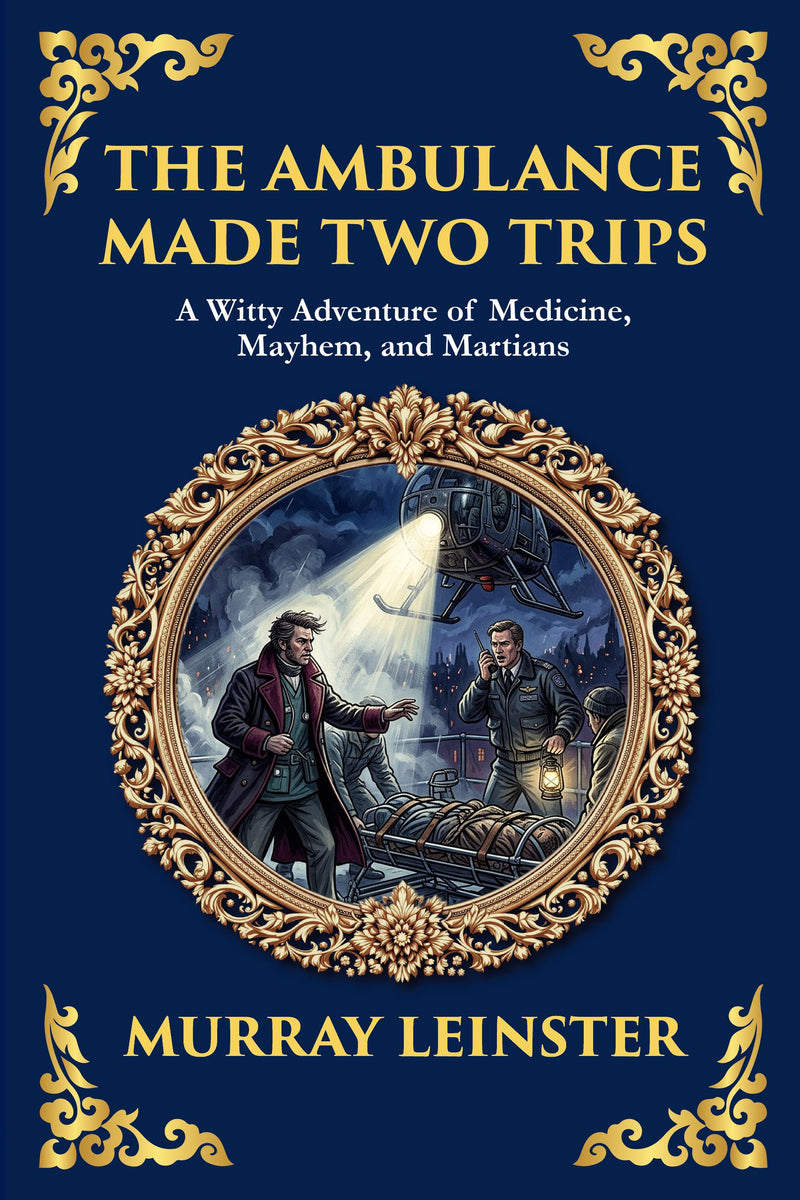
The Ambulance Made Two Trips
When Dr. Morton Blake begins his medical rounds, he doesn’t expect his day to involve space invaders, mad scientists, or a curious case of extraterrestrial indigestion.
or free app
10,000+ hrs library
30-day guarantee
The complete The Ambulance Made Two Trips appears in modern English through Library of Alexandria Press, available online with audiobook narration included for members.
Have you ever wondered why even Martians might need house calls? In The Ambulance Made Two Trips, legendary science fiction writer Murray Leinster delivers a brilliant blend of medical mystery, slapstick sci-fi, and small-town charm. Packed with wit and wonder, this short novel is a comedic gem from the author known as “the Dean of Science Fiction.” Dr.
Blake is a quiet, respectable physician in a quiet, respectable town—until strange accidents, unusual house calls, and a mysterious ambulance start turning his world upside down. Before long, he’s tangled in a bizarre web involving an out-of-this-world patient, oddball locals, shady officials, and secrets that might just come from another planet. But who’s calling the shots—and why does the ambulance keep showing up… and leaving… so fast?
With its pitch-perfect blend of humor, science, and lighthearted suspense, The Ambulance Made Two Trips is a wonderful entry point for sci-fi newcomers and a treat for longtime fans of Murray Leinster’s classic storytelling.
What you’ll discover in this modern edition
- A Delightful Collision of Medicine and Mayhem – A country doctor finds himself caught in the middle of a bizarre alien conundrum.
| Formats | eBook (EPUB + PDF) · Audiobook · Paperback · Hardcover · Large Print |
| Language | English |
| Trim size (print) | 6 × 9 in |
| Binding | Paperback — perfect-bound · Hardcover — casewrap |
| Large Print edition | Same text in a larger, easy-read type — a larger font, not a larger trim |
| Print pricing | Every physical book at our true cost — at-cost, no profit (members) |
| Library | 873 restored titles, always growing |
| Length | 11,072 words · ~44 min reading |
| Reading level | Grade 3 · an easy, flowing read (this modern-English edition) |
| Edition | Modern English translation · 2026 |
Member reviews for this edition are collected as readers finish it — be the first. Across the library: 12,000+ books shipped, every plan covered by a 365-day print guarantee.
About this edition
A faithful, unabridged modern-English edition by The Library of Alexandria — carefully rendered for today's reader and verified paragraph-by-paragraph against the public-domain source. Available as eBook, audiobook, paperback, hardcover, and large print.
- Complete & unabridgedVerified paragraph by paragraph against the source — never a scan, never abridged.
- Modern English, faithfulReadable today, with the author’s meaning kept intact. Readable — not simplified.
- Every format, one membershipRead in your browser or the free app, or listen to the full audiobook.
Included free with your membership
Cancel anytime, one click · 30-day money-back guarantee
Edition last updated July 2026
What’s inside
The Ambulance Made Two Trips — complete and unabridged, included in full with membership, plus the full audiobook.
Begin reading The Ambulance Made Two Trips
In clear modern English — the complete text is included with membership.
Introduction
There is a particular pleasure in discovering a story that refuses to take itself too seriously while taking its ideas very seriously indeed. The Ambulance Made Two Trips is exactly that kind of tale—a brisk, witty, and surprisingly warm slice of speculative fiction from one of the genre’s most reliable craftsmen. To open these pages is to step into the company of a writer who spent more than half a century learning precisely how to delight a reader, and who, by the time he wrote stories like this one, could do it almost effortlessly. What you hold is a modern translation and adaptation, gently smoothed for the contemporary reader so that nothing stands between you and the sheer fun of the thing, while preserving every ounce of the cleverness and charm that made the original such a treat.
Before you begin, it is worth pausing to understand a little about the man who wrote it, the world that shaped it, and the peculiar magic of the kind of fiction it represents. None of what follows will spoil the experience waiting for you—rest assured, the surprises remain entirely intact—but a bit of context will sharpen your appreciation and let you settle into the rhythm of the story with the confidence of someone who knows exactly what sort of adventure they have signed up for.
The author listed on this volume, Murray Leinster, was the pen name of William Fitzgerald Jenkins, born in Norfolk, Virginia, in 1896. If that birth year gives you pause, it should: Jenkins began publishing fiction in the second decade of the twentieth century and was still producing work in the 1960s. That is an astonishing span. He lived through the dawn of powered flight, two world wars, the rise of radio and then television, the atomic age, and the early years of the space race—and he wrote his way through all of it, often anticipating the very technologies that would come to define each era. Few writers have ever had a longer or more consistently inventive career, and fewer still managed to keep their sense of humor and humanity intact across so many decades of relentless change.
Jenkins never finished high school in the formal sense; his education came largely from voracious reading and an insatiable curiosity about how things worked. That curiosity is the secret engine of nearly everything he wrote. He was, by temperament, a tinkerer and a problem-solver, and he held actual patents—most famously for a technique called front projection that became a standard tool in film and television special effects. This is not incidental trivia. The mind that could devise a practical solution to a real-world technical problem is the same mind that animates his fiction, where heroes are rarely musclebound saviors and far more often clever, observant people who notice the one detail everyone else has overlooked and figure out what to do about it.
He earned the affectionate and entirely deserved nickname “the Dean of Science Fiction.” It was not a title bestowed lightly. Jenkins was one of the first writers to imagine, in detail, a global computer network that ordinary people would consult for information—an idea he laid out decades before anything resembling the internet existed. He wrote about parallel universes, alternate histories, first contact with alien intelligences, and the messy practical consequences of new technologies, all with a steady, unpretentious clarity that made the strangest concepts feel grounded and plausible. He understood, perhaps better than any of his contemporaries, that the most interesting thing about a fantastic premise is not the premise itself but the human beings who have to live with it.
What distinguishes Jenkins from many of his peers, then and now, is his fundamental decency and his refusal to let cleverness curdle into coldness. His stories are populated by recognizable people—competent professionals, harried officials, ordinary folks caught up in extraordinary circumstances—who behave with a believable mixture of bewilderment, ingenuity, and good humor. He had a particular fondness for the practical man and woman, the kind of person who, faced with an impossible situation, rolls up their sleeves and starts working the problem rather than delivering a speech about it. This grounded, hands-on sensibility gives even his most outlandish tales a comforting sturdiness. You always feel, reading Jenkins, that you are in the hands of someone who respects both his subject and his audience.
He wrote across an enormous range of genres beyond science fiction—westerns, mysteries, adventure stories, romances—often under various pen names, simply because a working writer in his era had to be versatile to make a living. This breadth shows in his science fiction, which never feels insular or self-referential. He brought the pacing of pulp adventure, the puzzle-logic of detective fiction, and the warmth of popular romance to bear on his speculative work, and the result is a body of fiction that remains remarkably accessible and entertaining to readers who might otherwise find vintage science fiction stiff or dated. He wanted, above all, to tell a good story well, and he understood that a good story is one a reader cannot bear to put down.
A Title That Tells You Everything and Nothing
Consider, for a moment, the title of this book: The Ambulance Made Two Trips. It is a small marvel of comic understatement, and it tells you a great deal about the kind of experience you are about to have. Notice what it does not say. It does not promise galactic war, or the end of the world, or the heroic conquest of the stars. It promises an ambulance—a humble, even mundane vehicle—and it informs us, with deadpan precision, that this ambulance made two trips. Why two? What happened on the first that necessitated the second? The phrasing is so dry, so matter-of-fact, that it practically dares you to laugh, and it perfectly captures Leinster’s signature blend of the cosmic and the comic.
The subtitle expands the promise just enough to whet the appetite: a tale of medicine, chaos, and Martians. Here, then, is the collision at the heart of the book. On one side stands the orderly, rational, deeply human world of medicine—a profession built on diagnosis, treatment, and the careful management of crisis. On the other side stands the great unknown of the cosmos, embodied by that most enduring of pulp-era figures, the Martian. And between them, lubricating the whole machine, is chaos: the glorious, escalating, comic mayhem that ensues when the methodical world of doctors and ambulances suddenly has to contend with something it was never trained to handle.
This is one of the great pleasures of Leinster at his best. He loved to take the ordinary machinery of everyday life—a hospital, an emergency response, a small town’s worth of professionals doing their jobs—and drop something utterly impossible into the middle of it, then watch how the system responds. The comedy and the tension both arise from the same source: competent people trying to apply ordinary procedures to a wildly extraordinary problem. There is something deeply satisfying about watching characters insist on filling out the proper paperwork, following the correct protocols, and maintaining professional decorum in the face of the genuinely unbelievable. It is funny, yes, but it is also strangely reassuring, a quiet tribute to the human instinct to impose order on the universe even when the universe has no intention of cooperating.
The mid-twentieth century, when stories like this flourished, was positively saturated with Martians. The Red Planet held a grip on the popular imagination that is difficult to overstate. Ever since the late nineteenth century, when astronomers reported seeing what they took to be artificial canals crisscrossing the Martian surface, the idea of an intelligent neighboring civilization had captured writers and readers alike. Mars became the default home of the alien, the nearest plausible source of visitors from beyond Earth, and a convenient mirror in which humanity could examine its own anxieties and hopes. By the time Leinster was writing, the Martian had become a beloved fixture of popular fiction—sometimes terrifying, sometimes comic, sometimes both at once.
What is delightful about the way Leinster typically deploys such elements is his refusal to treat them with either solemn dread or empty spectacle. Where some writers used Martians as instruments of apocalyptic terror and others as mere set dressing for ray-gun adventures, Leinster tended to approach the fantastic with a raised eyebrow and a problem-solver’s pragmatism. The question he loved to ask was not “How magnificent and terrible is this thing?” but rather “All right, this has happened—now what on earth do we actually do about it?” That shift in emphasis, from awe to practicality, is what gives his work its distinctive flavor and its enduring readability. It transforms the alien from a symbol into a situation, and situations can be funny, frustrating, and humanly relatable in ways that pure symbols never can.
So when you read that the ambulance made two trips, savor the implication. Something has gone wrong—or right—in a way that required not one but two journeys. The mundane vehicle of human emergency has been pressed into service for a crisis it was never designed to address. That is the comic engine of the whole enterprise, and it is a uniquely Leinsterian conceit: the great cosmic mystery rendered manageable, almost domestic, by the stubborn, slightly absurd persistence of ordinary human systems.
The Art of the Adaptation and How to Read It
A word, now, about the nature of this particular edition, because it shapes the experience in ways worth understanding before you begin. This is described as a modern translation, adapted for the contemporary reader. What does that mean in practice, and why should it matter to you?
Fiction written in the first half of the twentieth century, however brilliant, inevitably carries the linguistic fingerprints of its era. Sentence structures were often more elaborate; certain idioms and references that were instantly clear to readers in 1950 have since faded into obscurity; the rhythm of dialogue followed conventions that can feel slightly formal or stilted to a modern ear. None of this diminishes the genius of the original work, but it can create a small but real barrier between the contemporary reader and the pleasures the author intended. A modern adaptation aims to dissolve that barrier—to clear away the incidental dust of changing language so that the timeless qualities of the story shine through unobstructed.
The goal of a thoughtful adaptation is never to replace the author’s vision but to serve it. The wit, the ingenuity, the warmth, the comic timing, the satisfying logic of the plot—all of this is preserved and, ideally, made more immediately accessible. Think of it as the literary equivalent of carefully cleaning and restoring an old painting: the image was always magnificent, but now you can see it clearly, without the yellowed varnish of intervening decades coming between you and the artist’s intention. The colors are the same colors the painter chose; you are simply seeing them as they were meant to be seen.
This matters especially for a writer like Leinster, whose appeal was always rooted in clarity and momentum. He was not a stylist who buried his meaning in dense, ornate prose; he was a storyteller who prized readability above almost everything else. He wanted his readers to turn pages quickly, to be carried along by the unfolding of events, to laugh and gasp and grin at the right moments. A modern adaptation honors that priority by ensuring the prose moves with the briskness Leinster himself would have wanted, free of any old-fashioned friction that might slow a contemporary reader down. In a very real sense, an adaptation like this brings the book closer to the experience its original readers had—reading it as a fresh, current, immediate entertainment rather than as a historical artifact to be admired from a respectful distance.
Cancel anytime, one click · 30-day money-back guarantee
Founding annual rate available now — your price locks for life when you join.
Not ready? Get this free chapter by email — read it anytime.
✓ Sent — check your inbox for The Ambulance Made Two Trips.
Questions about The Ambulance Made Two Trips
What is The Ambulance Made Two Trips about?
When Dr. Morton Blake begins his medical rounds, he doesn’t expect his day to involve space invaders, mad scientists, or a curious case of extraterrestrial indigestion. But in The Ambulance Made Two Trips, nothing is ever quite what it seems.
Who wrote The Ambulance Made Two Trips?
The Ambulance Made Two Trips was written by Murray Leinster. This edition presents the complete work in clear modern English, faithfully rendered from the public-domain original by Library of Alexandria Press.
Is The Ambulance Made Two Trips free to read?
The opening chapter is free to read on this page. Members read and listen to the complete work — and the entire library — free, and can order any physical book at our true print cost.
How long is The Ambulance Made Two Trips?
2 chapters (~11,072 words) — about 44 min of reading in this modern-English edition.
Is this an abridged version of The Ambulance Made Two Trips?
No. This is the complete, unabridged The Ambulance Made Two Trips, carefully rendered into clear modern English and verified paragraph-by-paragraph against the public-domain source — nothing is cut or summarised.
What formats does The Ambulance Made Two Trips come in?
The Ambulance Made Two Trips is available as eBook, paperback, hardcover and large print. eBook and audiobook are included with membership; printed editions ship at our true print cost.
Shipping & returns
Billing & membership
More from the library


Explore Mystery & Crime
- Resurrection · Leo Tolstoy
- Crime and Punishment · Fyodor Dostoyevsky
- The Strange Case of Dr. Jekyll and Mr. Hyde · Robert Louis Stevenson
- The Riddle of the Sands · Erskine Childers
- The Wisdom of Father Brown · G. K. Chesterton
- The Cask of Amontillado · Edgar Allan Poe
- The Tomb of Ts’in · Edgar Wallace
- Ghost Stories of an Antiquary · M. R. James
- The Hunniwell Boys and the Platinum Mystery · L. P. Wyman
- The Seven Dials Mystery · Agatha Christie
- The Thirty-Nine Steps · John Buchan
- The Hand in the Dark · Arthur J. Rees
- Lady Audley’s Secret · M. E. Braddon
- The Mystery of the Blue Train · Agatha Christie
- The Secret Adversary · Agatha Christie
- The Call of Cthulhu · H. P. Lovecraft
- The Adventures of Heine · Edgar Wallace
- The Valley of Fear · Arthur Conan Doyle
- The Innocence of Father Brown · G. K. Chesterton
- McTeague: A Story of San Francisco · Frank Norris
- Tess of the d’Urbervilles: A Pure Woman · Thomas Hardy
- The Big Fix · George O. Smith
- Time Crime · H. Beam Piper
- The Misplaced Battleship · Harry Harrison
- Supermind · Randall Garrett and Laurence M....
- Lone Star Planet · H. Beam Piper and John J. McGuire
- Dracula · Bram Stoker
- The Murder on the Links · Agatha Christie
- The Hound of the Baskervilles · Arthur Conan Doyle
- The King in Yellow · Robert W. Chambers
The Ambulance Made Two Trips
The Ambulance Made Two Trips
A Clever Tale of Medicine, Chaos, and Martians
Murray Leinster
Contents
- Introduction
- The Ambulance Made Two Trips
Introduction
There is a particular pleasure in discovering a story that refuses to take itself too seriously while taking its ideas very seriously indeed. The Ambulance Made Two Trips is exactly that kind of tale—a brisk, witty, and surprisingly warm slice of speculative fiction from one of the genre’s most reliable craftsmen. To open these pages is to step into the company of a writer who spent more than half a century learning precisely how to delight a reader, and who, by the time he wrote stories like this one, could do it almost effortlessly. What you hold is a modern translation and adaptation, gently smoothed for the contemporary reader so that nothing stands between you and the sheer fun of the thing, while preserving every ounce of the cleverness and charm that made the original such a treat.
Before you begin, it is worth pausing to understand a little about the man who wrote it, the world that shaped it, and the peculiar magic of the kind of fiction it represents. None of what follows will spoil the experience waiting for you—rest assured, the surprises remain entirely intact—but a bit of context will sharpen your appreciation and let you settle into the rhythm of the story with the confidence of someone who knows exactly what sort of adventure they have signed up for.
The author listed on this volume, Murray Leinster, was the pen name of William Fitzgerald Jenkins, born in Norfolk, Virginia, in 1896. If that birth year gives you pause, it should: Jenkins began publishing fiction in the second decade of the twentieth century and was still producing work in the 1960s. That is an astonishing span. He lived through the dawn of powered flight, two world wars, the rise of radio and then television, the atomic age, and the early years of the space race—and he wrote his way through all of it, often anticipating the very technologies that would come to define each era. Few writers have ever had a longer or more consistently inventive career, and fewer still managed to keep their sense of humor and humanity intact across so many decades of relentless change.
Jenkins never finished high school in the formal sense; his education came largely from voracious reading and an insatiable curiosity about how things worked. That curiosity is the secret engine of nearly everything he wrote. He was, by temperament, a tinkerer and a problem-solver, and he held actual patents—most famously for a technique called front projection that became a standard tool in film and television special effects. This is not incidental trivia. The mind that could devise a practical solution to a real-world technical problem is the same mind that animates his fiction, where heroes are rarely musclebound saviors and far more often clever, observant people who notice the one detail everyone else has overlooked and figure out what to do about it.
He earned the affectionate and entirely deserved nickname “the Dean of Science Fiction.” It was not a title bestowed lightly. Jenkins was one of the first writers to imagine, in detail, a global computer network that ordinary people would consult for information—an idea he laid out decades before anything resembling the internet existed. He wrote about parallel universes, alternate histories, first contact with alien intelligences, and the messy practical consequences of new technologies, all with a steady, unpretentious clarity that made the strangest concepts feel grounded and plausible. He understood, perhaps better than any of his contemporaries, that the most interesting thing about a fantastic premise is not the premise itself but the human beings who have to live with it.
What distinguishes Jenkins from many of his peers, then and now, is his fundamental decency and his refusal to let cleverness curdle into coldness. His stories are populated by recognizable people—competent professionals, harried officials, ordinary folks caught up in extraordinary circumstances—who behave with a believable mixture of bewilderment, ingenuity, and good humor. He had a particular fondness for the practical man and woman, the kind of person who, faced with an impossible situation, rolls up their sleeves and starts working the problem rather than delivering a speech about it. This grounded, hands-on sensibility gives even his most outlandish tales a comforting sturdiness. You always feel, reading Jenkins, that you are in the hands of someone who respects both his subject and his audience.
He wrote across an enormous range of genres beyond science fiction—westerns, mysteries, adventure stories, romances—often under various pen names, simply because a working writer in his era had to be versatile to make a living. This breadth shows in his science fiction, which never feels insular or self-referential. He brought the pacing of pulp adventure, the puzzle-logic of detective fiction, and the warmth of popular romance to bear on his speculative work, and the result is a body of fiction that remains remarkably accessible and entertaining to readers who might otherwise find vintage science fiction stiff or dated. He wanted, above all, to tell a good story well, and he understood that a good story is one a reader cannot bear to put down.
A Title That Tells You Everything and Nothing
Consider, for a moment, the title of this book: The Ambulance Made Two Trips. It is a small marvel of comic understatement, and it tells you a great deal about the kind of experience you are about to have. Notice what it does not say. It does not promise galactic war, or the end of the world, or the heroic conquest of the stars. It promises an ambulance—a humble, even mundane vehicle—and it informs us, with deadpan precision, that this ambulance made two trips. Why two? What happened on the first that necessitated the second? The phrasing is so dry, so matter-of-fact, that it practically dares you to laugh, and it perfectly captures Leinster’s signature blend of the cosmic and the comic.
The subtitle expands the promise just enough to whet the appetite: a tale of medicine, chaos, and Martians. Here, then, is the collision at the heart of the book. On one side stands the orderly, rational, deeply human world of medicine—a profession built on diagnosis, treatment, and the careful management of crisis. On the other side stands the great unknown of the cosmos, embodied by that most enduring of pulp-era figures, the Martian. And between them, lubricating the whole machine, is chaos: the glorious, escalating, comic mayhem that ensues when the methodical world of doctors and ambulances suddenly has to contend with something it was never trained to handle.
This is one of the great pleasures of Leinster at his best. He loved to take the ordinary machinery of everyday life—a hospital, an emergency response, a small town’s worth of professionals doing their jobs—and drop something utterly impossible into the middle of it, then watch how the system responds. The comedy and the tension both arise from the same source: competent people trying to apply ordinary procedures to a wildly extraordinary problem. There is something deeply satisfying about watching characters insist on filling out the proper paperwork, following the correct protocols, and maintaining professional decorum in the face of the genuinely unbelievable. It is funny, yes, but it is also strangely reassuring, a quiet tribute to the human instinct to impose order on the universe even when the universe has no intention of cooperating.
The mid-twentieth century, when stories like this flourished, was positively saturated with Martians. The Red Planet held a grip on the popular imagination that is difficult to overstate. Ever since the late nineteenth century, when astronomers reported seeing what they took to be artificial canals crisscrossing the Martian surface, the idea of an intelligent neighboring civilization had captured writers and readers alike. Mars became the default home of the alien, the nearest plausible source of visitors from beyond Earth, and a convenient mirror in which humanity could examine its own anxieties and hopes. By the time Leinster was writing, the Martian had become a beloved fixture of popular fiction—sometimes terrifying, sometimes comic, sometimes both at once.
What is delightful about the way Leinster typically deploys such elements is his refusal to treat them with either solemn dread or empty spectacle. Where some writers used Martians as instruments of apocalyptic terror and others as mere set dressing for ray-gun adventures, Leinster tended to approach the fantastic with a raised eyebrow and a problem-solver’s pragmatism. The question he loved to ask was not “How magnificent and terrible is this thing?” but rather “All right, this has happened—now what on earth do we actually do about it?” That shift in emphasis, from awe to practicality, is what gives his work its distinctive flavor and its enduring readability. It transforms the alien from a symbol into a situation, and situations can be funny, frustrating, and humanly relatable in ways that pure symbols never can.
So when you read that the ambulance made two trips, savor the implication. Something has gone wrong—or right—in a way that required not one but two journeys. The mundane vehicle of human emergency has been pressed into service for a crisis it was never designed to address. That is the comic engine of the whole enterprise, and it is a uniquely Leinsterian conceit: the great cosmic mystery rendered manageable, almost domestic, by the stubborn, slightly absurd persistence of ordinary human systems.
The Art of the Adaptation and How to Read It
A word, now, about the nature of this particular edition, because it shapes the experience in ways worth understanding before you begin. This is described as a modern translation, adapted for the contemporary reader. What does that mean in practice, and why should it matter to you?
Fiction written in the first half of the twentieth century, however brilliant, inevitably carries the linguistic fingerprints of its era. Sentence structures were often more elaborate; certain idioms and references that were instantly clear to readers in 1950 have since faded into obscurity; the rhythm of dialogue followed conventions that can feel slightly formal or stilted to a modern ear. None of this diminishes the genius of the original work, but it can create a small but real barrier between the contemporary reader and the pleasures the author intended. A modern adaptation aims to dissolve that barrier—to clear away the incidental dust of changing language so that the timeless qualities of the story shine through unobstructed.
The goal of a thoughtful adaptation is never to replace the author’s vision but to serve it. The wit, the ingenuity, the warmth, the comic timing, the satisfying logic of the plot—all of this is preserved and, ideally, made more immediately accessible. Think of it as the literary equivalent of carefully cleaning and restoring an old painting: the image was always magnificent, but now you can see it clearly, without the yellowed varnish of intervening decades coming between you and the artist’s intention. The colors are the same colors the painter chose; you are simply seeing them as they were meant to be seen.
This matters especially for a writer like Leinster, whose appeal was always rooted in clarity and momentum. He was not a stylist who buried his meaning in dense, ornate prose; he was a storyteller who prized readability above almost everything else. He wanted his readers to turn pages quickly, to be carried along by the unfolding of events, to laugh and gasp and grin at the right moments. A modern adaptation honors that priority by ensuring the prose moves with the briskness Leinster himself would have wanted, free of any old-fashioned friction that might slow a contemporary reader down. In a very real sense, an adaptation like this brings the book closer to the experience its original readers had—reading it as a fresh, current, immediate entertainment rather than as a historical artifact to be admired from a respectful distance.
If it takes a thief to catch a thief, what does it take to stop a racketeer...?
Detective Sergeant Fitzgerald found a package by his door that morning, delivered with the milk. He brought it inside and opened it. It was a beautiful meerschaum pipe, the kind of thing the sergeant had wanted for years for no particular reason. There was no note or card included. He cursed angrily.
On his way to headquarters, he stopped at the orphanage where he usually dropped off such gifts. In the past, he had left bottles of Scotch, a fishing rod, expensive sets of lures, and dozens of pairs of silk socks. The woman in charge of the orphanage accepted the gift gratefully.
“I doubt any of your kids will actually smoke this,” Fitzgerald said gloomily, “but I want it gone, and I want people to know it’s gone.” He paused. “Are you getting many other gifts like this from other cops? Like you used to?”
The head of the orphanage admitted that the number of gifts had decreased. Fitzgerald continued on his way, deep in thought. He had been receiving anonymous presents ever since Big Jake Connors moved to town with his “bright ideas.” Big Jake denied being the generous donor and claimed he knew nothing about it. But Detective Sergeant Fitzgerald knew better. These gifts were affecting the police force. One lieutenant’s wife had received a mink stole out of nowhere; she refused to speak to her husband for ten days after he donated it to a charity drive. He wouldn’t make that mistake again! Another sergeant—not Fitzgerald—had found four new whitewall tires on his porch, and his teenage children shunned him after he turned them over to the police Lost and Found. Fitzgerald gave his gifts to an orphanage, completely ignoring how inappropriate they were. However, he darkly suspected that many of his colleagues were giving in. The presents weren’t bribes. Big Jake didn’t ask for any favors in return; in fact, he denied sending them. But naturally, the officers who found luxury items with their morning milk felt less angry about what Big Jake was doing—and the fact that he wasn’t getting caught.
End of the free sample
Keep reading, free
Members read and listen to the complete book — and the entire library. Cancel anytime, one click · 30-day money-back guarantee.