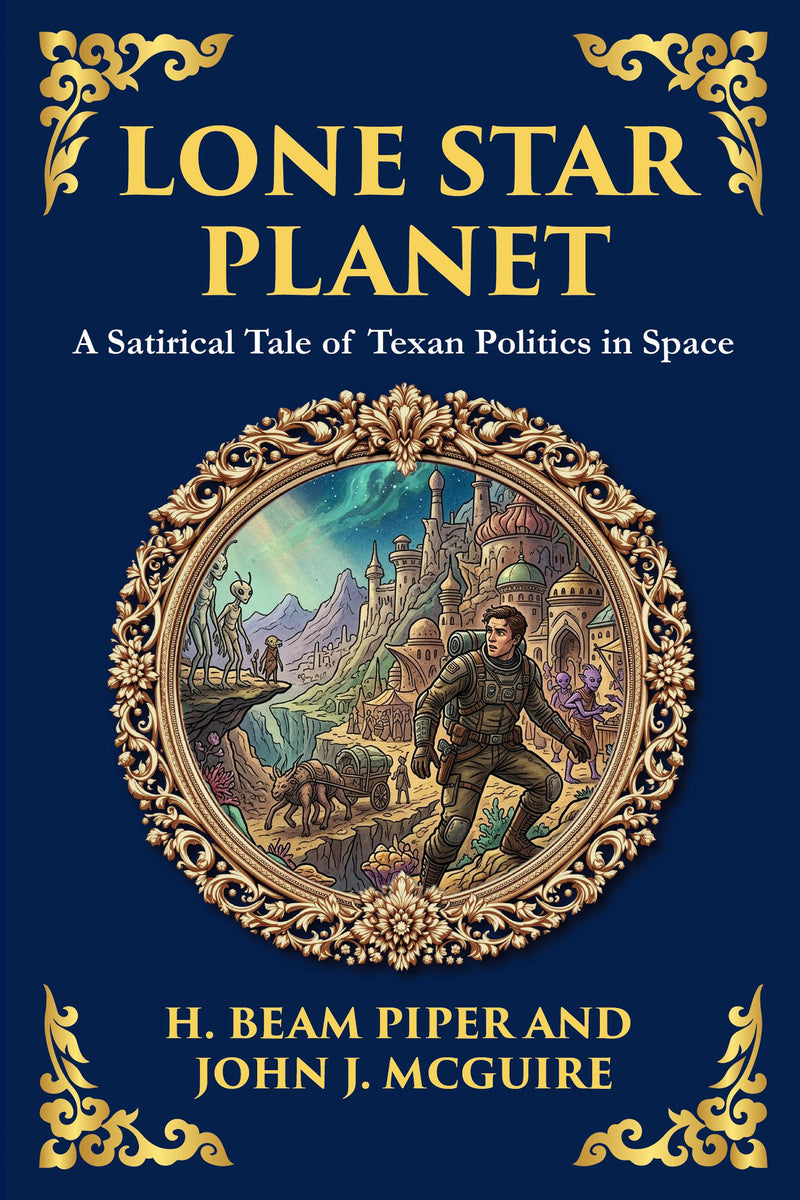
Lone Star Planet
H. Beam Piper In Lone Star Planet, satire meets sci-fi in a wild, witty, and wildly entertaining tale of rugged independence, political parody, and interstellar diplomacy—with a Texas-sized twist.
or free app
10,000+ hrs library
30-day guarantee
The complete Lone Star Planet appears in modern English through Library of Alexandria Press, available online with audiobook narration included for members.
Have you ever wondered why some societies prefer chaos to control—and still make it work? Lone Star Planet by H. Beam Piper and John J. McGuire is a legendary mash-up of interstellar science fiction and sharp political satire. First published in 1958, this clever novel imagines a colony founded by Texans who revolted against Earth’s bureaucracy to build their own libertarian utopia on a distant planet.
The result? A society that runs on guns, grudges, and unapologetic frontier values. Into this world steps Stephen Silk, a career diplomat from Earth tasked with forging a diplomatic solution between the Earth Federation and the unruly citizens of New Texas.
But things go sideways quickly when he discovers that insults can be fatal, lawyers wear six- shooters, and the economy runs on beef and bullets. As Silk attempts to negotiate a treaty, he finds himself caught between two hostile alien races, a freedom-loving (and trigger-happy) population, and his own shifting loyalties. Can reason survive in a world that thrives on rugged individualism—or will diplomacy die at high noon?
What you’ll discover in this modern edition
- A Brilliant Satire of Politics and Culture – Explore how a society can embrace total personal freedom while rejecting traditional government.
| Formats | eBook (EPUB + PDF) · Audiobook · Paperback · Hardcover · Large Print |
| Language | English |
| Trim size (print) | 6 × 9 in |
| Binding | Paperback — perfect-bound · Hardcover — casewrap |
| Large Print edition | Same text in a larger, easy-read type — a larger font, not a larger trim |
| Print pricing | Every physical book at our true cost — at-cost, no profit (members) |
| Library | 873 restored titles, always growing |
| Length | 32,271 words · ~2 hr 9 min reading |
| Reading level | Grade 8 · an easy, flowing read (this modern-English edition) |
| Edition | Modern English translation · 2026 |
Member reviews for this edition are collected as readers finish it — be the first. Across the library: 12,000+ books shipped, every plan covered by a 365-day print guarantee.
About this edition
A faithful, unabridged modern-English edition by The Library of Alexandria — carefully rendered for today's reader and verified paragraph-by-paragraph against the public-domain source. Available as eBook, audiobook, paperback, hardcover, and large print.
- Complete & unabridgedVerified paragraph by paragraph against the source — never a scan, never abridged.
- Modern English, faithfulReadable today, with the author’s meaning kept intact. Readable — not simplified.
- Every format, one membershipRead in your browser or the free app, or listen to the full audiobook.
Included free with your membership
Cancel anytime, one click · 30-day money-back guarantee
Edition last updated July 2026
What’s inside
Lone Star Planet — complete and unabridged: all 12 sections included with membership, plus the full audiobook.
Begin reading Lone Star Planet
In clear modern English — the complete text is included with membership.
Introduction
There is a particular kind of pleasure in discovering a book that knows exactly what it is doing while never quite admitting it. Lone Star Planet is such a book. Written in the middle of the twentieth century by two authors who understood the machinery of political institutions and the eternal comedy of human governance, it is a work that wears the costume of science fiction adventure while delivering something far slier underneath. It is a romp, a satire, a love letter, and a sharp-eyed examination of one of the most provocative questions ever asked about democracy: what would happen to a society if the murder of a public official were not merely permitted but, under certain circumstances, celebrated as a civic virtue?
That question is the beating heart of this short, fast, and frequently hilarious novel, and it is worth pausing at the very outset to appreciate how cleverly the premise is constructed. The story takes us to a distant world called New Texas, a planet settled by colonists who carried with them the swagger, the self-reliance, and the deeply held suspicions of the original Lone Star State. On New Texas, the prevailing wisdom holds that a politician who fears for his life will be a politician who behaves himself. The assassination of a corrupt or overreaching official is treated not as a crime but as a kind of public service, subject to a curious legal apparatus that determines, after the fact, whether the deceased had it coming. It is an idea both absurd and oddly logical, and the authors mine it for every ounce of wit it contains.
To read this book in the right spirit is to recognize that beneath the gunsmoke and the interstellar diplomacy lies a genuine philosophical provocation. The novel asks us to consider the relationship between citizens and the people they elect to rule them. It asks whether accountability requires fear, whether liberty thrives best when power remains nervous, and whether the comfortable distance between governors and governed is itself a kind of corruption. These are not small questions, and the genius of the work is that it raises them while making us laugh. You will not find dry political theory here. You will find tall tales, exaggerated characters, ferocious banquets, courtroom theatrics, and a diplomatic crisis that threatens to engulf an entire planet. The ideas arrive wrapped in entertainment, which is precisely how the best satire has always operated, from the ancient Greek comedians through Jonathan Swift and onward into the modern age.
The authorship of this novel deserves a moment of attention, because it tells us something about the texture of the writing itself. H. Beam Piper was one of the most distinctive voices in mid-century American science fiction, a writer whose work was animated by a deep love of history, a respect for craftsmanship, and an abiding interest in the patterns by which civilizations rise, govern themselves, and fall. Piper had a knack for imagining future societies that felt lived-in, governed by recognizable human impulses rather than by sterile utopian schemes. His characters tend to be competent professionals navigating institutions that are messy, political, and resistant to simple solutions. He understood bureaucracy, he understood diplomacy, and above all he understood that people remain people no matter how far they travel from Earth.
John J. McGuire collaborated with Piper on several works, and their partnership produced fiction marked by brisk pacing, clever dialogue, and a willingness to let big ideas share the stage with broad comedy. Lone Star Planet showcases the strengths of both writers. The political machinery clicks along with the precision you would expect from authors who took governance seriously, while the comic exaggeration of New Texan culture gives the whole enterprise a buoyant, freewheeling energy. The result is a book that feels effortless to read even as it juggles weighty themes, and that effortlessness is itself an achievement, the kind of thing that only comes from careful craft disguised as casual fun.
It is worth understanding the moment in which this novel was born. It emerged from an era when science fiction was beginning to flex its muscles as a vehicle for social commentary. Writers were discovering that by setting their stories on distant planets and in imagined futures, they could examine the institutions and assumptions of their own time with a freedom that more conventional fiction did not allow. A story about a faraway world governed by strange customs could say things about democracy, about power, about the relationship between citizens and the state, that might have seemed too pointed or too dangerous in a contemporary setting. New Texas is, in this sense, a funhouse mirror held up to certain American ideals: the love of liberty, the suspicion of central authority, the romance of the frontier, the conviction that an armed and watchful citizenry is the surest guarantee of freedom. The novel takes these ideals seriously enough to push them to their logical extreme, and in doing so it invites us to laugh at them, admire them, and question them all at once.
A World Built on the Frontier of Imagination
What makes New Texas such a delightful invention is the consistency with which its absurdities are imagined. This is not a planet that exists merely to make a single point and then dissolve. The authors have thought through the culture in loving, comic detail. They have considered what it would mean for a society to organize itself around the principle that the powerful must always feel the breath of the populace on their necks. They have imagined the legal traditions that would grow up around such a principle, the social rituals, the manner of speech, the food, the manners, and the peculiar dignity of a people who consider their willingness to hold their leaders mortally accountable to be the highest expression of their freedom.
The food alone is worth the price of admission. New Texas is a world of cattle, of vast herds and even vaster appetites, and the descriptions of the planet’s cuisine are among the small pleasures that make the book come alive. The colonists have brought with them an outsized version of Texan hospitality, and the meals they serve are events, spectacles, demonstrations of abundance and pride. These touches matter because they ground the satire in something tangible and warm. We are not asked to sneer at New Texas from a comfortable distance. We are invited to sit at the table, to enjoy the company, and to feel the genuine appeal of a culture that, for all its strangeness, possesses a certain rough-hewn integrity.
The frontier sensibility runs through everything. There is in New Texan culture a profound impatience with pretension, with the soft hypocrisies of polished diplomacy, with the kind of bureaucratic doublespeak that allows the powerful to evade responsibility for their actions. The New Texans say what they mean, do what they say, and expect others to do the same. This directness is both their charm and their danger. It makes them admirable and exasperating in equal measure, and it sets the stage beautifully for the central conflict of the novel, which pits this blunt, self-governing planet against the more complicated demands of interstellar politics.
For the people of New Texas are not alone in the galaxy. Their world exists within a larger framework of human and alien civilizations, and that larger framework cannot simply ignore a planet whose customs strike outsiders as barbaric, dangerous, or merely incomprehensible. The tension between New Texas and the wider universe is where the story finds its narrative engine. A representative arrives, charged with navigating the gap between New Texan custom and the expectations of a galactic order that finds the casual assassination of officials more than a little alarming. The clash of cultures that follows is the source of much of the book’s comedy and most of its suspense.
There is also, looming at the edges of the story, the presence of an alien threat. The galaxy of Lone Star Planet is not a peaceful place, and the question of how a fiercely independent, prickly, heavily armed planet fits into the broader strategic picture is never far from the surface. This adds stakes to the proceedings that elevate the satire beyond mere comedy. The fate of New Texas, and perhaps of more than New Texas, depends on whether the gulf between its peculiar ways and the demands of the wider civilization can be bridged. The novel handles this with a light touch, never letting the cosmic stakes overwhelm the human comedy, but the presence of genuine danger gives the whole story a forward momentum that keeps the pages turning.
The protagonist through whom we experience all of this is an engaging figure, the kind of capable but unpretentious observer that Piper excelled at creating. He arrives as something of an outsider, which makes him the perfect guide for the reader. He is no wide-eyed innocent, but neither is he a cynic. He approaches New Texas with a mixture of professional caution and genuine curiosity, and as he comes to understand the planet’s customs, so do we. His growing appreciation for the people of New Texas, and his recognition of both the wisdom and the madness in their way of life, mirrors the journey the reader is invited to take. By the end, we have come to see New Texas not as a mere curiosity but as a place with its own logic, its own values, and its own claim on our sympathies.
It would be a disservice to reveal the twists and turns the plot takes, but it is fair to say that the novel moves through several distinct registers with admirable agility. There is the comedy of cultural misunderstanding, as the protagonist learns to navigate a society where the wrong word can have lethal consequences. There is the suspense of a political situation that grows steadily more precarious. There is romance, handled with the brisk economy typical of the era but with genuine warmth. And there is, threading through it all, the central satirical investigation into the nature of self-government, which gives the entertainment its intellectual ballast. The plot is constructed so that each of these elements reinforces the others. The comedy heightens the stakes by making us care about the characters; the suspense gives the satire urgency; the romance humanizes the political themes. It is a remarkably well-balanced piece of storytelling, more carefully built than its breezy surface might suggest.
The Art of Saying Serious Things with a Smile
The lasting value of Lone Star Planet lies in its satire, and to appreciate it fully, the modern reader should approach it with an awareness of how satire works. The novel does not endorse the New Texan system as a literal proposal for political reform. It is not seriously suggesting that we should arm ourselves and start shooting our representatives. What it is doing is far more interesting. By taking a familiar political ideal, the notion that government should fear its citizens rather than the other way around, and following it to its logical and lethal conclusion, the authors force us to examine the assumptions buried within that ideal. They make us laugh at its excesses while quietly acknowledging the kernel of truth at its center.
For there is a truth there, and the novel is honest enough to admit it. The relationship between the governed and those who govern them has always been fraught with the danger of complacency, corruption, and the slow erosion of accountability. The New Texans, in their extreme way, have solved a problem that more conventional democracies still struggle with: how to keep the powerful honest. Their solution is monstrous, of course, and the novel never lets us forget that. But the problem they are responding to is real, and by exaggerating their response to the point of absurdity, the authors illuminate the problem with a clarity that a more sober treatment might have lacked.
Cancel anytime, one click · 30-day money-back guarantee
Founding annual rate available now — your price locks for life when you join.
Not ready? Get this free chapter by email — read it anytime.
✓ Sent — check your inbox for Lone Star Planet.
Questions about Lone Star Planet
What is Lone Star Planet about?
H. Beam Piper In Lone Star Planet, satire meets sci-fi in a wild, witty, and wildly entertaining tale of rugged independence, political parody, and interstellar diplomacy—with a Texas-sized twist. When diplomat Stephen Silk is sent to the planet of New Texas to mediate a dispute between Earth and its fiercely individualistic settlers, he finds himself in a world where the right to bear arms is sacred, the government is optional, and calling someone a liar is grounds for legal assassination. Can Silk navigate the po
Who wrote Lone Star Planet?
Lone Star Planet was written by H. Beam Piper and John J. McGuire. This edition presents the complete work in clear modern English, faithfully rendered from the public-domain original by Library of Alexandria Press.
Is Lone Star Planet free to read?
The opening chapter is free to read on this page. Members read and listen to the complete work — and the entire library — free, and can order any physical book at our true print cost.
How long is Lone Star Planet?
12 chapters (~32,271 words) — about 2 hr 9 min of reading in this modern-English edition.
Is this an abridged version of Lone Star Planet?
No. This is the complete, unabridged Lone Star Planet, carefully rendered into clear modern English and verified paragraph-by-paragraph against the public-domain source — nothing is cut or summarised.
What formats does Lone Star Planet come in?
Lone Star Planet is available as eBook, paperback, hardcover and large print. eBook and audiobook are included with membership; printed editions ship at our true print cost.
Shipping & returns
Billing & membership
More from the library


Explore Mystery & Crime
- Resurrection · Leo Tolstoy
- Crime and Punishment · Fyodor Dostoyevsky
- The Strange Case of Dr. Jekyll and Mr. Hyde · Robert Louis Stevenson
- The Adventures of Heine — Large Print · Edgar Wallace
- The Hound of the Baskervilles — Large Print · Arthur Conan Doyle
- Bleak House · Charles Dickens
- Bleak House — Large Print · Charles Dickens
- The Valley of Fear — Large Print · Arthur Conan Doyle
- The Beckoning Hand, and Other Stories — Large Print · Grant Allen
- A Bid for Fortune; Or, Dr. Nikola's Vendetta · Guy Boothby
- The Beckoning Hand, and Other Stories · Grant Allen
- Four Square Jane · Edgar Wallace
- Kim · Rudyard Kipling
- The Queen of Hearts — Large Print · Wilkie Collins
- Uncle Silas — Large Print · Joseph Sheridan Le Fanu
- Catherine — Large Print · William Makepeace Thackeray
- Uncle Silas · Joseph Sheridan Le Fanu
- Catherine · William Makepeace Thackeray
- Philo Gubb, Correspondence-School Detective — Large Print · Ellis Parker Butler
- The Queen of Hearts · Wilkie Collins
- Ruth Fielding and the Gypsies — Large Print · Alice B. Emerson
- New Arabian Nights · Robert Louis Stevenson
- The Book of Swindles — Large Print · Zhang Yingyu
- A Double Barrelled Detective Story — Large Print · Mark Twain
- Unravelled Knots — Large Print · Baroness Orczy
- Philo Gubb, Correspondence-School Detective · Ellis Parker Butler
- A Double Barrelled Detective Story · Mark Twain
- Ruth Fielding and the Gypsies · Alice B. Emerson
- Unravelled Knots · Baroness Orczy
- The Wrecker — Large Print · Robert Louis Stevenson; Lloyd O...
Lone Star Planet
Lone Star Planet
A Satirical Tale of Texan Politics in Space
H. Beam Piper and John J. McGuire
Contents
- Introduction
- Chapter 1
- Chapter 2
- Chapter 3
- Chapter 4
- Chapter 5
- Chapter 6
- Chapter 7
- Chapter 8
- Chapter 9
- Chapter 10
- Chapter 11
Introduction
There is a particular kind of pleasure in discovering a book that knows exactly what it is doing while never quite admitting it. Lone Star Planet is such a book. Written in the middle of the twentieth century by two authors who understood the machinery of political institutions and the eternal comedy of human governance, it is a work that wears the costume of science fiction adventure while delivering something far slier underneath. It is a romp, a satire, a love letter, and a sharp-eyed examination of one of the most provocative questions ever asked about democracy: what would happen to a society if the murder of a public official were not merely permitted but, under certain circumstances, celebrated as a civic virtue?
That question is the beating heart of this short, fast, and frequently hilarious novel, and it is worth pausing at the very outset to appreciate how cleverly the premise is constructed. The story takes us to a distant world called New Texas, a planet settled by colonists who carried with them the swagger, the self-reliance, and the deeply held suspicions of the original Lone Star State. On New Texas, the prevailing wisdom holds that a politician who fears for his life will be a politician who behaves himself. The assassination of a corrupt or overreaching official is treated not as a crime but as a kind of public service, subject to a curious legal apparatus that determines, after the fact, whether the deceased had it coming. It is an idea both absurd and oddly logical, and the authors mine it for every ounce of wit it contains.
To read this book in the right spirit is to recognize that beneath the gunsmoke and the interstellar diplomacy lies a genuine philosophical provocation. The novel asks us to consider the relationship between citizens and the people they elect to rule them. It asks whether accountability requires fear, whether liberty thrives best when power remains nervous, and whether the comfortable distance between governors and governed is itself a kind of corruption. These are not small questions, and the genius of the work is that it raises them while making us laugh. You will not find dry political theory here. You will find tall tales, exaggerated characters, ferocious banquets, courtroom theatrics, and a diplomatic crisis that threatens to engulf an entire planet. The ideas arrive wrapped in entertainment, which is precisely how the best satire has always operated, from the ancient Greek comedians through Jonathan Swift and onward into the modern age.
The authorship of this novel deserves a moment of attention, because it tells us something about the texture of the writing itself. H. Beam Piper was one of the most distinctive voices in mid-century American science fiction, a writer whose work was animated by a deep love of history, a respect for craftsmanship, and an abiding interest in the patterns by which civilizations rise, govern themselves, and fall. Piper had a knack for imagining future societies that felt lived-in, governed by recognizable human impulses rather than by sterile utopian schemes. His characters tend to be competent professionals navigating institutions that are messy, political, and resistant to simple solutions. He understood bureaucracy, he understood diplomacy, and above all he understood that people remain people no matter how far they travel from Earth.
John J. McGuire collaborated with Piper on several works, and their partnership produced fiction marked by brisk pacing, clever dialogue, and a willingness to let big ideas share the stage with broad comedy. Lone Star Planet showcases the strengths of both writers. The political machinery clicks along with the precision you would expect from authors who took governance seriously, while the comic exaggeration of New Texan culture gives the whole enterprise a buoyant, freewheeling energy. The result is a book that feels effortless to read even as it juggles weighty themes, and that effortlessness is itself an achievement, the kind of thing that only comes from careful craft disguised as casual fun.
It is worth understanding the moment in which this novel was born. It emerged from an era when science fiction was beginning to flex its muscles as a vehicle for social commentary. Writers were discovering that by setting their stories on distant planets and in imagined futures, they could examine the institutions and assumptions of their own time with a freedom that more conventional fiction did not allow. A story about a faraway world governed by strange customs could say things about democracy, about power, about the relationship between citizens and the state, that might have seemed too pointed or too dangerous in a contemporary setting. New Texas is, in this sense, a funhouse mirror held up to certain American ideals: the love of liberty, the suspicion of central authority, the romance of the frontier, the conviction that an armed and watchful citizenry is the surest guarantee of freedom. The novel takes these ideals seriously enough to push them to their logical extreme, and in doing so it invites us to laugh at them, admire them, and question them all at once.
A World Built on the Frontier of Imagination
What makes New Texas such a delightful invention is the consistency with which its absurdities are imagined. This is not a planet that exists merely to make a single point and then dissolve. The authors have thought through the culture in loving, comic detail. They have considered what it would mean for a society to organize itself around the principle that the powerful must always feel the breath of the populace on their necks. They have imagined the legal traditions that would grow up around such a principle, the social rituals, the manner of speech, the food, the manners, and the peculiar dignity of a people who consider their willingness to hold their leaders mortally accountable to be the highest expression of their freedom.
The food alone is worth the price of admission. New Texas is a world of cattle, of vast herds and even vaster appetites, and the descriptions of the planet’s cuisine are among the small pleasures that make the book come alive. The colonists have brought with them an outsized version of Texan hospitality, and the meals they serve are events, spectacles, demonstrations of abundance and pride. These touches matter because they ground the satire in something tangible and warm. We are not asked to sneer at New Texas from a comfortable distance. We are invited to sit at the table, to enjoy the company, and to feel the genuine appeal of a culture that, for all its strangeness, possesses a certain rough-hewn integrity.
The frontier sensibility runs through everything. There is in New Texan culture a profound impatience with pretension, with the soft hypocrisies of polished diplomacy, with the kind of bureaucratic doublespeak that allows the powerful to evade responsibility for their actions. The New Texans say what they mean, do what they say, and expect others to do the same. This directness is both their charm and their danger. It makes them admirable and exasperating in equal measure, and it sets the stage beautifully for the central conflict of the novel, which pits this blunt, self-governing planet against the more complicated demands of interstellar politics.
For the people of New Texas are not alone in the galaxy. Their world exists within a larger framework of human and alien civilizations, and that larger framework cannot simply ignore a planet whose customs strike outsiders as barbaric, dangerous, or merely incomprehensible. The tension between New Texas and the wider universe is where the story finds its narrative engine. A representative arrives, charged with navigating the gap between New Texan custom and the expectations of a galactic order that finds the casual assassination of officials more than a little alarming. The clash of cultures that follows is the source of much of the book’s comedy and most of its suspense.
There is also, looming at the edges of the story, the presence of an alien threat. The galaxy of Lone Star Planet is not a peaceful place, and the question of how a fiercely independent, prickly, heavily armed planet fits into the broader strategic picture is never far from the surface. This adds stakes to the proceedings that elevate the satire beyond mere comedy. The fate of New Texas, and perhaps of more than New Texas, depends on whether the gulf between its peculiar ways and the demands of the wider civilization can be bridged. The novel handles this with a light touch, never letting the cosmic stakes overwhelm the human comedy, but the presence of genuine danger gives the whole story a forward momentum that keeps the pages turning.
The protagonist through whom we experience all of this is an engaging figure, the kind of capable but unpretentious observer that Piper excelled at creating. He arrives as something of an outsider, which makes him the perfect guide for the reader. He is no wide-eyed innocent, but neither is he a cynic. He approaches New Texas with a mixture of professional caution and genuine curiosity, and as he comes to understand the planet’s customs, so do we. His growing appreciation for the people of New Texas, and his recognition of both the wisdom and the madness in their way of life, mirrors the journey the reader is invited to take. By the end, we have come to see New Texas not as a mere curiosity but as a place with its own logic, its own values, and its own claim on our sympathies.
It would be a disservice to reveal the twists and turns the plot takes, but it is fair to say that the novel moves through several distinct registers with admirable agility. There is the comedy of cultural misunderstanding, as the protagonist learns to navigate a society where the wrong word can have lethal consequences. There is the suspense of a political situation that grows steadily more precarious. There is romance, handled with the brisk economy typical of the era but with genuine warmth. And there is, threading through it all, the central satirical investigation into the nature of self-government, which gives the entertainment its intellectual ballast. The plot is constructed so that each of these elements reinforces the others. The comedy heightens the stakes by making us care about the characters; the suspense gives the satire urgency; the romance humanizes the political themes. It is a remarkably well-balanced piece of storytelling, more carefully built than its breezy surface might suggest.
The Art of Saying Serious Things with a Smile
The lasting value of Lone Star Planet lies in its satire, and to appreciate it fully, the modern reader should approach it with an awareness of how satire works. The novel does not endorse the New Texan system as a literal proposal for political reform. It is not seriously suggesting that we should arm ourselves and start shooting our representatives. What it is doing is far more interesting. By taking a familiar political ideal, the notion that government should fear its citizens rather than the other way around, and following it to its logical and lethal conclusion, the authors force us to examine the assumptions buried within that ideal. They make us laugh at its excesses while quietly acknowledging the kernel of truth at its center.
For there is a truth there, and the novel is honest enough to admit it. The relationship between the governed and those who govern them has always been fraught with the danger of complacency, corruption, and the slow erosion of accountability. The New Texans, in their extreme way, have solved a problem that more conventional democracies still struggle with: how to keep the powerful honest. Their solution is monstrous, of course, and the novel never lets us forget that. But the problem they are responding to is real, and by exaggerating their response to the point of absurdity, the authors illuminate the problem with a clarity that a more sober treatment might have lacked.
They started giving me a hard time the moment I walked into the Secretary’s outer office.
Ethel K’wang-Li, the Secretary’s receptionist, was at her desk. Also there were Courtlant Staynes, the assistant secretary to the Undersecretary for Economic Penetration; Norman Gazarin from Protocol; Toby Lawder from Humanoid Peoples’ Affairs; Raoul Chavier; Hans Mannteufel; and Olga Reznik.
It was surprising that more people weren’t watching the condemned man walk to the gallows; news that the Secretary had summoned me must have spread through the Department as soon as the offices opened.
“Ah, Mr. Machiavelli, I presume,” Ethel kicked off.
“Machiavelli, Junior.” Olga picked up the ball. “At least, that’s how he signs it.”
“He’s a godsend for the Consular Service, and the Consular Service’s gift to Policy Planning,” Gazarin added.
“Calm down, everyone. These Hooligan Diplomats are just as likely to shoot you as they are to look at you,” Mannteufel warned.
“Make sure to tell the Secretary that all your friends want high-ranking positions in the Galactic Empire.” Olga spoke again.
“Well, I’m glad some of you could read it,” I snapped back. “Maybe a few of you even understood what it was actually about.”
“Don’t worry, Silk,” Gazarin told me. “Secretary Ghopal understands exactly what happened. You’ll find he knows it all too well.”
A buzzer sounded softly on Ethel K’wang-Li’s desk. She grabbed the phone and whispered into it. The room went deathly silent as she listened, whispered a few more words, and then hung up.
“Secretary Ghopal is ready to see Mr. Stephen Silk,” she said. “This way, please.”
As I walked across the room, Staynes started drumming his fingers on the desk—a slow, steady beat like the rhythm of a man marching to his execution.
End of the free sample
Keep reading, free
Members read and listen to the complete book — and the entire library. Cancel anytime, one click · 30-day money-back guarantee.