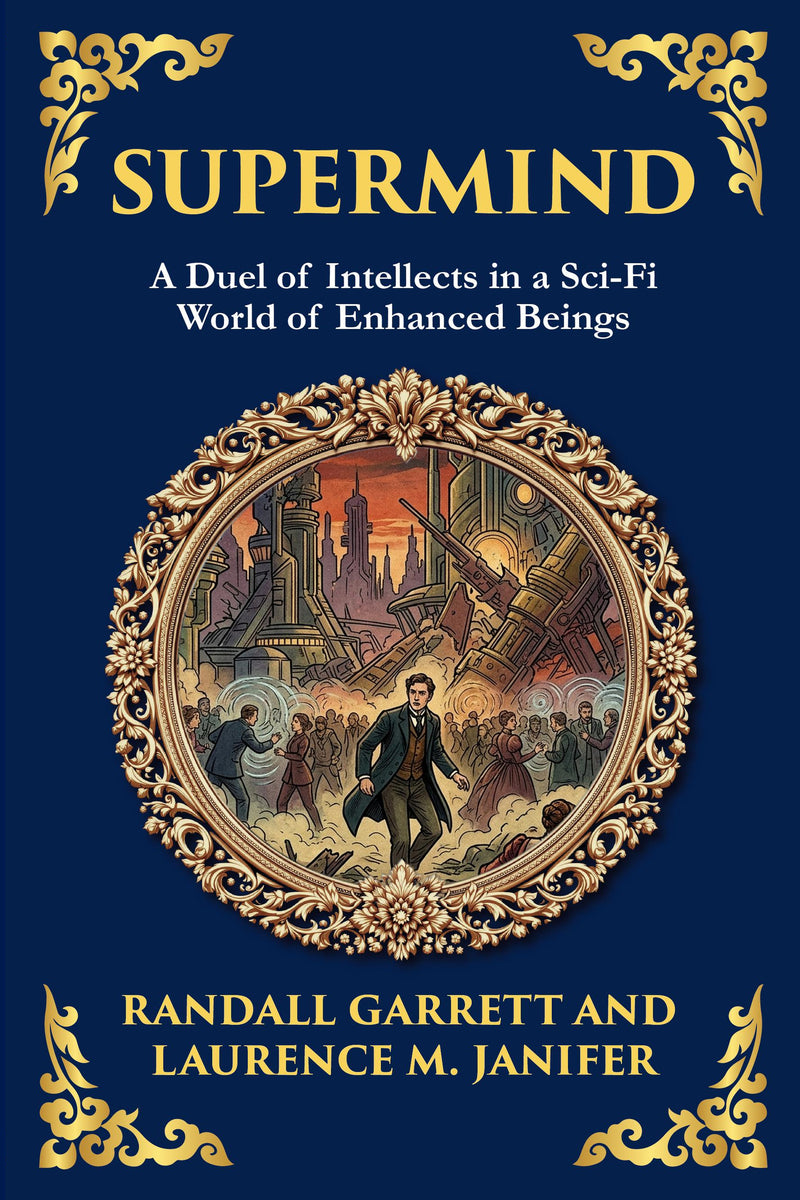
Supermind
Randall Garrett In a future where intelligence is power, and telepathy has become a reality, the most dangerous battlefield lies not in outer space—but within the mind.
or free app
10,000+ hrs library
30-day guarantee
The complete Supermind appears in modern English through Library of Alexandria Press, available online with audiobook narration included for members.
Have you ever wondered why the most dangerous weapon in the universe might be the human mind itself? In Supermind, co-authors Randall Garrett and Laurence M. Janifer launch readers into a suspenseful, high-concept science fiction narrative where enhanced intelligence is both blessing and curse. The story follows a gifted operative navigating a galaxy of secret agencies, psychic warfare, and post-human evolution.
In a society where minds have been upgraded, ESP is weaponized, and government control runs deep, who really holds the upper hand—the Superminds, or those still ruled by instinct and fear? When a deadly mystery arises—a murder carried out without any physical evidence—the investigation pulls back the curtain on a vast conspiracy involving telepathic beings, advanced brain manipulation, and a war between those with mental supremacy and those who seek to control them. With razor-sharp dialogue, fast-paced twists, and thought-provoking ideas, Supermind is an explosive blend of mystery, espionage, and speculative science fiction.
What you’ll discover in this modern edition
- A Galaxy of Thought-Powered Beings – Explore a future where ESP, telepathy, and enhanced IQs redefine human identity and evolution.
| Formats | eBook (EPUB + PDF) · Audiobook · Paperback · Hardcover · Large Print |
| Language | English |
| Trim size (print) | 6 × 9 in |
| Binding | Paperback — perfect-bound · Hardcover — casewrap |
| Large Print edition | Same text in a larger, easy-read type — a larger font, not a larger trim |
| Print pricing | Every physical book at our true cost — at-cost, no profit (members) |
| Library | 873 restored titles, always growing |
| Length | 70,696 words · ~4 hr 43 min reading |
| Reading level | Grade 4 · an easy, flowing read (this modern-English edition) |
| Edition | Modern English translation · 2026 |
Member reviews for this edition are collected as readers finish it — be the first. Across the library: 12,000+ books shipped, every plan covered by a 365-day print guarantee.
About this edition
A faithful, unabridged modern-English edition by The Library of Alexandria — carefully rendered for today's reader and verified paragraph-by-paragraph against the public-domain source. Available as eBook, audiobook, paperback, hardcover, and large print.
- Complete & unabridgedVerified paragraph by paragraph against the source — never a scan, never abridged.
- Modern English, faithfulReadable today, with the author’s meaning kept intact. Readable — not simplified.
- Every format, one membershipRead in your browser or the free app, or listen to the full audiobook.
Included free with your membership
Cancel anytime, one click · 30-day money-back guarantee
Edition last updated July 2026
What’s inside
Supermind — complete and unabridged: all 17 sections included with membership, plus the full audiobook.
Begin reading Supermind
In clear modern English — the complete text is included with membership.
Introduction
There are some books that arrive with grand pretensions, announcing their own importance from the first page, demanding to be taken seriously as monuments of literature. And then there are books like this one—quick, sly, irresistibly entertaining, written by men who understood that the deepest pleasures of science fiction often arrive wrapped in laughter, in clever wordplay, in the sheer joy of a puzzle elegantly constructed and elegantly solved. This is a book that wears its intelligence lightly, that flatters the reader by trusting them to keep up, and that delivers, beneath its breezy surface, a genuinely provocative meditation on the nature of mind, talent, security, and the strange ways human beings respond to the existence of powers they cannot fully understand.
What you hold in your hands is a modern translation, a careful adaptation prepared with the contemporary reader in mind. The language has been gently refreshed where the decades had left it stiff or dated, the rhythms tuned for ears accustomed to a different cadence of prose, and the small frictions that can trip up a present-day reader smoothed away—all while preserving the wit, the voice, and the essential character of the original. The goal throughout has been faithfulness of spirit rather than slavish reproduction of every antique idiom. The authors were craftsmen of pace and dialogue, and the work here has been to ensure that their craftsmanship reaches you undimmed, that nothing stands between you and the headlong momentum of the story they built. You are not reading a museum piece behind protective glass. You are reading a living adventure, restored and made ready for your enjoyment.
Before you begin, it may help to understand a little about where this story comes from, who made it, and what makes it such a distinctive and rewarding experience. None of what follows will spoil a single twist or surprise. Rather, the intention is to sharpen your appetite, to set the table properly, so that when you turn to the first chapter you bring with you the kind of informed attention that transforms a good reading experience into a memorable one.
To appreciate what makes this novel tick, it helps to know something about the two men who wrote it, and about the remarkable creative environment that produced them. Randall Garrett and Laurence M. Janifer were both products of the great mid-century flowering of American science fiction—that astonishing, fertile period when the genre was finding its voice, defining its conventions, and producing an extraordinary volume of work for the magazines that served as its laboratory and proving ground.
Randall Garrett, in particular, was one of the genre’s most prolific and versatile talents, a writer of dazzling facility who could turn his hand to almost any kind of story. He was famous among his peers for the speed and ease with which he wrote, for an encyclopedic knowledge that ranged across science, history, theology, and the classics, and for a sense of humor that was forever bubbling up through his prose. Garrett was a man who took genuine delight in cleverness—in puzzles, in puns, in the satisfying architecture of a plot that locks together like a well-made watch. He understood, perhaps better than almost anyone of his generation, that science fiction could be both serious and playful at once, that a story could ask profound questions while never losing its sense of fun. His work has the quality of a magician performing for the sheer love of the trick, inviting you to watch closely and daring you to figure out how it’s done.
Laurence M. Janifer was a writer of considerable range and intelligence in his own right, a man with a gift for sharp dialogue and a keen eye for the absurdities of human institutions. His collaborations brought a distinctive flavor of urbane wit and structural discipline. Together, Garrett and Janifer formed a partnership that produced work greater than the sum of its parts—the kind of creative chemistry that happens when two compatible imaginations strike sparks off one another, each pushing the other toward greater audacity, greater polish, greater fun.
This novel belongs to a sequence of stories the two men created together, featuring a particular kind of hero operating in a particular kind of imagined future. These stories were originally serialized in the science fiction magazines of their era—a publishing context worth pausing over, because it shaped the very DNA of the work. Magazine serialization demanded a certain kind of writing: each installment had to hook the reader, build toward a satisfying turn, and leave them hungry for the next chapter. This discipline rewarded propulsive pacing, vivid characterization established in a few deft strokes, and the regular delivery of incident and revelation. The result, when done well, is fiction that simply will not let you put it down—and this is fiction done well. You will feel the engine of that serialized origin in the way each chapter builds momentum, the way questions are planted and harvested, the way the narrative keeps moving forward with an almost athletic energy.
It is worth dwelling for a moment on the cultural moment that produced these writers, because it illuminates so much about the assumptions and obsessions woven through the story. The mid-twentieth century was a period intensely preoccupied with the workings of the mind and with the apparatus of secrecy and security. The intelligence services and counter-intelligence operations of the era loomed large in the public imagination. At the same time, there was an enormous popular fascination with the possibility of psychic powers, latent human potential, and the idea that the human mind might harbor capacities far beyond the ordinary—telepathy, prescience, the ability to perceive and manipulate the world in ways that defied conventional explanation. Science fiction was where these two preoccupations met and mingled most freely. The genre offered a space to ask: What if some people really could do extraordinary things with their minds? How would society organize itself around such people? Who would want to control them, protect them, exploit them, or destroy them? And how would those gifted individuals see themselves—as guardians, as outsiders, as something altogether new?
These are precisely the questions that animate this book, and they are questions that have, if anything, grown more rather than less relevant. We now live in an age obsessed with augmentation, with the enhancement of human capabilities, with the boundary between the natural and the engineered mind. The subtitle’s promise of “a sci-fi world of augmented beings” speaks directly to anxieties and fascinations that occupy us today. Garrett and Janifer were exploring, decades ahead of their time, the social and psychological implications of minds that exceed the ordinary range—and the bureaucratic, political, and human chaos that ensues when such minds must be accounted for, managed, and protected. The book is a period piece, yes, but it is a period piece whose central concerns feel startlingly contemporary, which is one of the great pleasures of returning to the best science fiction of this vintage. These writers were peering into the future, and a surprising amount of what they saw turns out to look like our present.
The phrase in the subtitle—”a battle of wits”—is no idle marketing flourish. It captures something essential about the kind of story you are about to enjoy. This is, at its heart, a mystery as much as it is a work of science fiction: a problem to be solved, a puzzle to be unraveled, a conspiracy whose true shape must be discerned through a fog of misdirection, false leads, and competing agendas. And the particular delight of the book lies in the way it fuses the satisfactions of detective fiction with the imaginative liberty of the science fiction premise.
Consider what happens when you take the classic structure of the mystery—the investigator confronting an enigma, gathering clues, ruling out suspects, edging toward a revelation—and then introduce the wild card of minds that work in genuinely extraordinary ways. Suddenly the rules of the game are transformed. What does it mean to investigate a crime, or unravel a plot, in a world where some participants may be able to perceive things others cannot, where the boundaries of the possible have been redrawn? The authors take obvious relish in playing with these possibilities, in setting up situations that would be impossible in a conventional thriller and then working through their implications with rigorous, often hilarious logic. The “battle of wits” is not merely between characters; it is also, in a sense, a battle between the reader and the authors, who lay out their puzzle with scrupulous fairness while doing everything in their considerable power to keep you guessing.
There is a particular quality to Garrett and Janifer’s humor that deserves mention, because it is so central to the experience of reading them. This is not the broad, slapstick comedy of farce, nor is it the bleak irony that so often passes for wit in more self-serious literature. It is, rather, a kind of intelligent, good-humored playfulness—a delight in absurdity, a sharp eye for the comedy inherent in bureaucracy and officialdom, a fondness for characters whose eccentricities are rendered with affection rather than contempt. The authors clearly enjoy the company of their own creations, and that enjoyment is infectious. You will find yourself smiling at the sheer ingenuity of certain scenes, at the deftness with which a difficult situation is resolved, at the way a piece of dialogue lands with perfect timing. There is a generosity to this kind of comedy, an underlying warmth, that distinguishes it from the more cynical entertainments of our own moment. These writers wanted you to have a good time, and they were extraordinarily good at making sure you did.
But it would be a mistake to think of the book as mere light entertainment, as froth without substance. Beneath the wit and the pace and the puzzle-box plotting, there is real thoughtfulness about its central themes. The questions the book raises—about talent and its burdens, about the relationship between exceptional individuals and the societies that depend on them, about trust and suspicion, about how we know what we know—are genuine questions, and the book engages them with more seriousness than its breezy surface might suggest. One of the marks of a truly skilled writer is the ability to smuggle profundity past the reader’s defenses, to make you think hard about something while you believe you are merely being entertained. Garrett and Janifer were masters of this art. You will close the book having had a wonderful time, and only later realize how much it gave you to ponder.
The world-building deserves particular admiration. In a relatively compact space, the authors construct a future society that feels coherent, lived-in, and internally consistent. They understand a principle that many writers of more bloated fictions never grasp: that you do not need to explain everything, that a world becomes more real precisely through the things left implied, through the casual references and offhand details that suggest a vast hinterland of history and custom just beyond the edges of the page. The setting is sketched with economy and confidence, allowing you to fill in the rest with your own imagination, which is always more powerful than exhaustive description. This restraint is itself a kind of respect for the reader—a trust that you are intelligent enough to inhabit the world without having every corner of it mapped out for you.
The central figure of the story is a creation of considerable charm and complexity, a protagonist whose perspective shapes the entire narrative and whose voice carries you along from the first page to the last. There is something deeply appealing about a hero who must rely on intelligence, observation, and nerve rather than brute force—who solves problems by thinking rather than by smashing. This is detective-story heroism, the heroism of the deductive mind, and it has an enduring appeal precisely because it flatters our own desire to be clever, to see what others miss, to puzzle out the truth from scattered fragments. As you follow this character through the twists and turns of the plot, you become, in a sense, their partner—watching, weighing, theorizing, occasionally getting ahead of them, more often being deftly outmaneuvered by the authors who hold all the cards. It is one of the most pleasurable relationships a reader can have with a book.
Cancel anytime, one click · 30-day money-back guarantee
Founding annual rate available now — your price locks for life when you join.
Not ready? Get this free chapter by email — read it anytime.
✓ Sent — check your inbox for Supermind.
Questions about Supermind
What is Supermind about?
Randall Garrett In a future where intelligence is power, and telepathy has become a reality, the most dangerous battlefield lies not in outer space—but within the mind. Supermind is a gripping, cerebral science fiction classic where brilliant minds clash in a high-stakes battle for truth, survival, and the next stage of human evolution. What happens when the line between genius and madness blurs?
Who wrote Supermind?
Supermind was written by Randall Garrett and Laurence M. Janifer. This edition presents the complete work in clear modern English, faithfully rendered from the public-domain original by Library of Alexandria Press.
Is Supermind free to read?
The opening chapter is free to read on this page. Members read and listen to the complete work — and the entire library — free, and can order any physical book at our true print cost.
How long is Supermind?
17 chapters (~70,696 words) — about 4 hr 43 min of reading in this modern-English edition.
Is this an abridged version of Supermind?
No. This is the complete, unabridged Supermind, carefully rendered into clear modern English and verified paragraph-by-paragraph against the public-domain source — nothing is cut or summarised.
What formats does Supermind come in?
Supermind is available as eBook, paperback, hardcover and large print. eBook and audiobook are included with membership; printed editions ship at our true print cost.
Shipping & returns
Billing & membership
More from the library


Explore Mystery & Crime
- Resurrection · Leo Tolstoy
- Crime and Punishment · Fyodor Dostoyevsky
- The Strange Case of Dr. Jekyll and Mr. Hyde · Robert Louis Stevenson
- The Riddle of the Sands · Erskine Childers
- The Wisdom of Father Brown · G. K. Chesterton
- The Cask of Amontillado · Edgar Allan Poe
- The Tomb of Ts’in · Edgar Wallace
- Ghost Stories of an Antiquary · M. R. James
- The Hunniwell Boys and the Platinum Mystery · L. P. Wyman
- The Seven Dials Mystery · Agatha Christie
- The Thirty-Nine Steps · John Buchan
- The Hand in the Dark · Arthur J. Rees
- Lady Audley’s Secret · M. E. Braddon
- The Mystery of the Blue Train · Agatha Christie
- The Secret Adversary · Agatha Christie
- The Call of Cthulhu · H. P. Lovecraft
- The Adventures of Heine · Edgar Wallace
- The Valley of Fear · Arthur Conan Doyle
- The Innocence of Father Brown · G. K. Chesterton
- McTeague: A Story of San Francisco · Frank Norris
- Tess of the d’Urbervilles: A Pure Woman · Thomas Hardy
- The Big Fix · George O. Smith
- The Ambulance Made Two Trips · Murray Leinster
- Time Crime · H. Beam Piper
- The Misplaced Battleship · Harry Harrison
- Lone Star Planet · H. Beam Piper and John J. McGuire
- Dracula · Bram Stoker
- The Murder on the Links · Agatha Christie
- The Hound of the Baskervilles · Arthur Conan Doyle
- The King in Yellow · Robert W. Chambers
Supermind
Supermind
A Battle of Wits in a Sci-Fi World of Augmented Beings
Randall Garrett and Laurence M. Janifer
Contents
- Introduction
- Chapter 1
- Chapter 2
- Chapter 3
- Chapter 4
- Chapter 5
- Chapter 6
- Chapter 7
- Chapter 8
- Chapter 9
- Chapter 10
- Chapter 11
- Chapter 12
- Chapter 13
- Chapter 14
- Chapter 15
- Chapter 16
Introduction
There are some books that arrive with grand pretensions, announcing their own importance from the first page, demanding to be taken seriously as monuments of literature. And then there are books like this one—quick, sly, irresistibly entertaining, written by men who understood that the deepest pleasures of science fiction often arrive wrapped in laughter, in clever wordplay, in the sheer joy of a puzzle elegantly constructed and elegantly solved. This is a book that wears its intelligence lightly, that flatters the reader by trusting them to keep up, and that delivers, beneath its breezy surface, a genuinely provocative meditation on the nature of mind, talent, security, and the strange ways human beings respond to the existence of powers they cannot fully understand.
What you hold in your hands is a modern translation, a careful adaptation prepared with the contemporary reader in mind. The language has been gently refreshed where the decades had left it stiff or dated, the rhythms tuned for ears accustomed to a different cadence of prose, and the small frictions that can trip up a present-day reader smoothed away—all while preserving the wit, the voice, and the essential character of the original. The goal throughout has been faithfulness of spirit rather than slavish reproduction of every antique idiom. The authors were craftsmen of pace and dialogue, and the work here has been to ensure that their craftsmanship reaches you undimmed, that nothing stands between you and the headlong momentum of the story they built. You are not reading a museum piece behind protective glass. You are reading a living adventure, restored and made ready for your enjoyment.
Before you begin, it may help to understand a little about where this story comes from, who made it, and what makes it such a distinctive and rewarding experience. None of what follows will spoil a single twist or surprise. Rather, the intention is to sharpen your appetite, to set the table properly, so that when you turn to the first chapter you bring with you the kind of informed attention that transforms a good reading experience into a memorable one.
To appreciate what makes this novel tick, it helps to know something about the two men who wrote it, and about the remarkable creative environment that produced them. Randall Garrett and Laurence M. Janifer were both products of the great mid-century flowering of American science fiction—that astonishing, fertile period when the genre was finding its voice, defining its conventions, and producing an extraordinary volume of work for the magazines that served as its laboratory and proving ground.
Randall Garrett, in particular, was one of the genre’s most prolific and versatile talents, a writer of dazzling facility who could turn his hand to almost any kind of story. He was famous among his peers for the speed and ease with which he wrote, for an encyclopedic knowledge that ranged across science, history, theology, and the classics, and for a sense of humor that was forever bubbling up through his prose. Garrett was a man who took genuine delight in cleverness—in puzzles, in puns, in the satisfying architecture of a plot that locks together like a well-made watch. He understood, perhaps better than almost anyone of his generation, that science fiction could be both serious and playful at once, that a story could ask profound questions while never losing its sense of fun. His work has the quality of a magician performing for the sheer love of the trick, inviting you to watch closely and daring you to figure out how it’s done.
Laurence M. Janifer was a writer of considerable range and intelligence in his own right, a man with a gift for sharp dialogue and a keen eye for the absurdities of human institutions. His collaborations brought a distinctive flavor of urbane wit and structural discipline. Together, Garrett and Janifer formed a partnership that produced work greater than the sum of its parts—the kind of creative chemistry that happens when two compatible imaginations strike sparks off one another, each pushing the other toward greater audacity, greater polish, greater fun.
This novel belongs to a sequence of stories the two men created together, featuring a particular kind of hero operating in a particular kind of imagined future. These stories were originally serialized in the science fiction magazines of their era—a publishing context worth pausing over, because it shaped the very DNA of the work. Magazine serialization demanded a certain kind of writing: each installment had to hook the reader, build toward a satisfying turn, and leave them hungry for the next chapter. This discipline rewarded propulsive pacing, vivid characterization established in a few deft strokes, and the regular delivery of incident and revelation. The result, when done well, is fiction that simply will not let you put it down—and this is fiction done well. You will feel the engine of that serialized origin in the way each chapter builds momentum, the way questions are planted and harvested, the way the narrative keeps moving forward with an almost athletic energy.
It is worth dwelling for a moment on the cultural moment that produced these writers, because it illuminates so much about the assumptions and obsessions woven through the story. The mid-twentieth century was a period intensely preoccupied with the workings of the mind and with the apparatus of secrecy and security. The intelligence services and counter-intelligence operations of the era loomed large in the public imagination. At the same time, there was an enormous popular fascination with the possibility of psychic powers, latent human potential, and the idea that the human mind might harbor capacities far beyond the ordinary—telepathy, prescience, the ability to perceive and manipulate the world in ways that defied conventional explanation. Science fiction was where these two preoccupations met and mingled most freely. The genre offered a space to ask: What if some people really could do extraordinary things with their minds? How would society organize itself around such people? Who would want to control them, protect them, exploit them, or destroy them? And how would those gifted individuals see themselves—as guardians, as outsiders, as something altogether new?
These are precisely the questions that animate this book, and they are questions that have, if anything, grown more rather than less relevant. We now live in an age obsessed with augmentation, with the enhancement of human capabilities, with the boundary between the natural and the engineered mind. The subtitle’s promise of “a sci-fi world of augmented beings” speaks directly to anxieties and fascinations that occupy us today. Garrett and Janifer were exploring, decades ahead of their time, the social and psychological implications of minds that exceed the ordinary range—and the bureaucratic, political, and human chaos that ensues when such minds must be accounted for, managed, and protected. The book is a period piece, yes, but it is a period piece whose central concerns feel startlingly contemporary, which is one of the great pleasures of returning to the best science fiction of this vintage. These writers were peering into the future, and a surprising amount of what they saw turns out to look like our present.
The phrase in the subtitle—”a battle of wits”—is no idle marketing flourish. It captures something essential about the kind of story you are about to enjoy. This is, at its heart, a mystery as much as it is a work of science fiction: a problem to be solved, a puzzle to be unraveled, a conspiracy whose true shape must be discerned through a fog of misdirection, false leads, and competing agendas. And the particular delight of the book lies in the way it fuses the satisfactions of detective fiction with the imaginative liberty of the science fiction premise.
Consider what happens when you take the classic structure of the mystery—the investigator confronting an enigma, gathering clues, ruling out suspects, edging toward a revelation—and then introduce the wild card of minds that work in genuinely extraordinary ways. Suddenly the rules of the game are transformed. What does it mean to investigate a crime, or unravel a plot, in a world where some participants may be able to perceive things others cannot, where the boundaries of the possible have been redrawn? The authors take obvious relish in playing with these possibilities, in setting up situations that would be impossible in a conventional thriller and then working through their implications with rigorous, often hilarious logic. The “battle of wits” is not merely between characters; it is also, in a sense, a battle between the reader and the authors, who lay out their puzzle with scrupulous fairness while doing everything in their considerable power to keep you guessing.
There is a particular quality to Garrett and Janifer’s humor that deserves mention, because it is so central to the experience of reading them. This is not the broad, slapstick comedy of farce, nor is it the bleak irony that so often passes for wit in more self-serious literature. It is, rather, a kind of intelligent, good-humored playfulness—a delight in absurdity, a sharp eye for the comedy inherent in bureaucracy and officialdom, a fondness for characters whose eccentricities are rendered with affection rather than contempt. The authors clearly enjoy the company of their own creations, and that enjoyment is infectious. You will find yourself smiling at the sheer ingenuity of certain scenes, at the deftness with which a difficult situation is resolved, at the way a piece of dialogue lands with perfect timing. There is a generosity to this kind of comedy, an underlying warmth, that distinguishes it from the more cynical entertainments of our own moment. These writers wanted you to have a good time, and they were extraordinarily good at making sure you did.
But it would be a mistake to think of the book as mere light entertainment, as froth without substance. Beneath the wit and the pace and the puzzle-box plotting, there is real thoughtfulness about its central themes. The questions the book raises—about talent and its burdens, about the relationship between exceptional individuals and the societies that depend on them, about trust and suspicion, about how we know what we know—are genuine questions, and the book engages them with more seriousness than its breezy surface might suggest. One of the marks of a truly skilled writer is the ability to smuggle profundity past the reader’s defenses, to make you think hard about something while you believe you are merely being entertained. Garrett and Janifer were masters of this art. You will close the book having had a wonderful time, and only later realize how much it gave you to ponder.
The world-building deserves particular admiration. In a relatively compact space, the authors construct a future society that feels coherent, lived-in, and internally consistent. They understand a principle that many writers of more bloated fictions never grasp: that you do not need to explain everything, that a world becomes more real precisely through the things left implied, through the casual references and offhand details that suggest a vast hinterland of history and custom just beyond the edges of the page. The setting is sketched with economy and confidence, allowing you to fill in the rest with your own imagination, which is always more powerful than exhaustive description. This restraint is itself a kind of respect for the reader—a trust that you are intelligent enough to inhabit the world without having every corner of it mapped out for you.
The central figure of the story is a creation of considerable charm and complexity, a protagonist whose perspective shapes the entire narrative and whose voice carries you along from the first page to the last. There is something deeply appealing about a hero who must rely on intelligence, observation, and nerve rather than brute force—who solves problems by thinking rather than by smashing. This is detective-story heroism, the heroism of the deductive mind, and it has an enduring appeal precisely because it flatters our own desire to be clever, to see what others miss, to puzzle out the truth from scattered fragments. As you follow this character through the twists and turns of the plot, you become, in a sense, their partner—watching, weighing, theorizing, occasionally getting ahead of them, more often being deftly outmaneuvered by the authors who hold all the cards. It is one of the most pleasurable relationships a reader can have with a book.
Back in 1914, the targets were enemy aliens.
By 1930, the focus shifted to the Wobblies.
In 1957, it was the communist sympathizers.
By 1971, the targets had become unstable telepaths.
“We have no clue what the hell this thing is,” said Andrew J. Burris, the Director of the FBI. He threw up his hands, looking completely bewildered and lost.
Kenneth J. Malone tried to sound understanding. “What exactly is it?” he asked.
Burris frowned, tapping his fingers on his large desk. “Malone,” he said, “speak clearly. And stop rambling.”
“Rambling?” Malone replied. “You said you didn’t know what it was. That you had no idea what the hell it was. Well, I want to know what it is.”
“That’s the problem,” Burris said. “I don’t know.”
Malone sighed, fighting the urge to scream. “Now hold on, Chief—” he began.
Burris frowned again. “Don’t call me Chief,” he said.
Malone nodded. “Fine,” he said. “But if you don’t know what it is, you must at least have a clue about what you’re missing. I mean, is it bigger than a breadbox? Does it do anything useful? Is it self-sufficient?”
“Malone,” Burris sighed, “you belong on television.”
“Let me explain,” Burris said. His voice was steadier now, and he spoke as if he were stating the most obvious and timeless truths. “The country,” he said, “is falling apart completely.”
Malone nodded again. “Well, after all, Chief—”
“Don’t call me Chief,” Burris said tiredly.
“Whatever you say,” Malone agreed calmly. He looked at the Director of the FBI with caution. “Besides, it’s nothing new,” he continued. “The country has always been falling apart, one way or another. Just look at Rome.”
End of the free sample
Keep reading, free
Members read and listen to the complete book — and the entire library. Cancel anytime, one click · 30-day money-back guarantee.