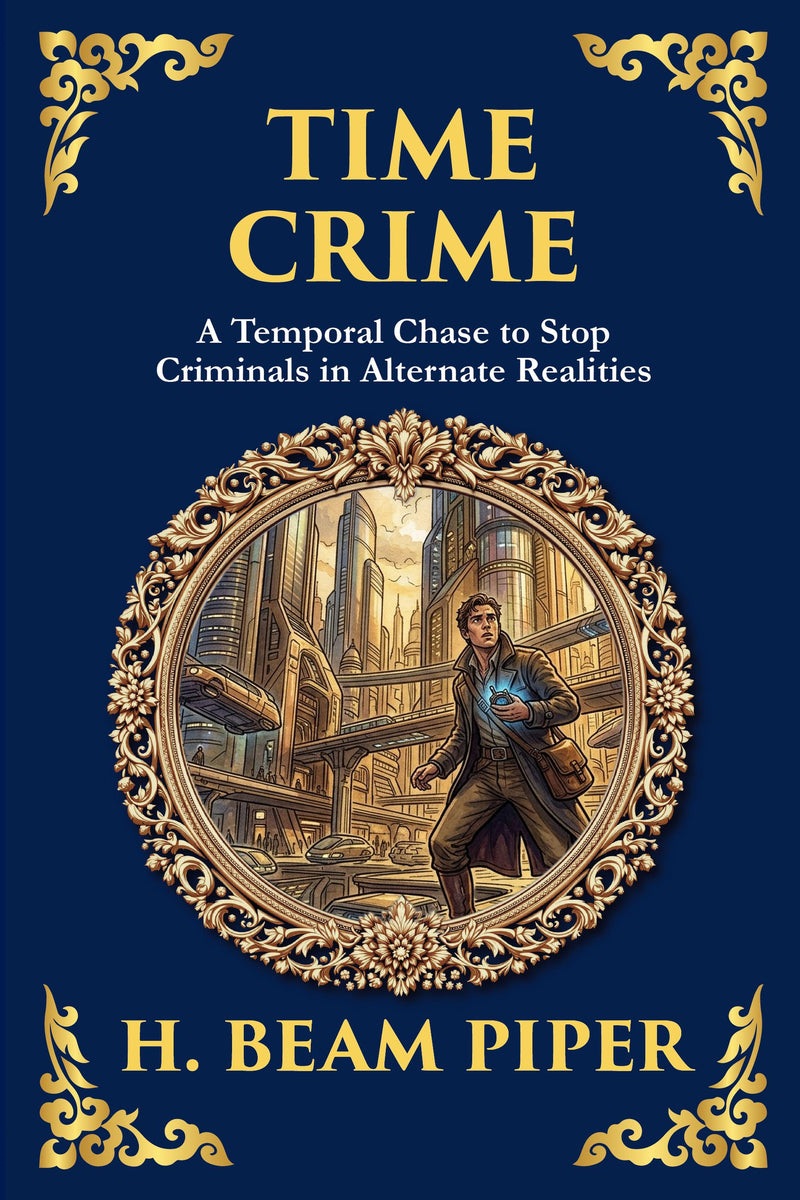
Time Crime
In a universe of infinite timelines, where alternate realities intersect and diverge with every decision, crime doesn’t just happen—it multiplies.
or free app
10,000+ hrs library
30-day guarantee
The complete Time Crime appears in modern English through Library of Alexandria Press, available online with audiobook narration included for members.
Have you ever wondered why stopping a crime in one reality might save the entire multiverse? H. Beam Piper’s Time Crime is a groundbreaking science fiction novella that fuses time travel with crime thriller, set in a universe where alternate realities are navigable—and vulnerable. The Paratime Police are an elite task force charged with protecting the fragile network of parallel worlds from illegal activity.
When a case of interdimensional slavery surfaces, agents Verkan Vall and Hadron Dalla are dispatched to investigate. What they uncover is far more dangerous than trafficking—it’s a plot that could fracture timelines, spark civilizational collapse, and unravel the order that holds infinite Earths together. Time Crime blends complex world-building, high-stakes investigation, and philosophical depth to deliver an action-packed story of duty, justice, and the consequences of power without boundaries.
What you’ll discover in this modern edition
- A Multiverse of Intrigue and Danger – Explore alternate Earths, each with its own society, politics, and threats.
| Formats | eBook (EPUB + PDF) · Audiobook · Paperback · Hardcover · Large Print |
| Language | English |
| Trim size (print) | 6 × 9 in |
| Binding | Paperback — perfect-bound · Hardcover — casewrap |
| Large Print edition | Same text in a larger, easy-read type — a larger font, not a larger trim |
| Print pricing | Every physical book at our true cost — at-cost, no profit (members) |
| Library | 873 restored titles, always growing |
| Length | 39,545 words · ~2 hr 38 min reading |
| Reading level | Grade 3 · an easy, flowing read (this modern-English edition) |
| Edition | Modern English translation · 2026 |
Member reviews for this edition are collected as readers finish it — be the first. Across the library: 12,000+ books shipped, every plan covered by a 365-day print guarantee.
About this edition
A faithful, unabridged modern-English edition by The Library of Alexandria — carefully rendered for today's reader and verified paragraph-by-paragraph against the public-domain source. Available as eBook, audiobook, paperback, hardcover, and large print.
- Complete & unabridgedVerified paragraph by paragraph against the source — never a scan, never abridged.
- Modern English, faithfulReadable today, with the author’s meaning kept intact. Readable — not simplified.
- Every format, one membershipRead in your browser or the free app, or listen to the full audiobook.
Included free with your membership
Cancel anytime, one click · 30-day money-back guarantee
Edition last updated July 2026
What’s inside
Time Crime — complete and unabridged: all 3 sections included with membership, plus the full audiobook.
Begin reading Time Crime
In clear modern English — the complete text is included with membership.
Introduction
When H. Beam Piper sat down to write the stories that would become Time Crime, he was working at the height of his powers within one of the most ingenious frameworks in all of science fiction: the Paratime Police. To pick up this book is to step into a universe that Piper built with the patience of an engineer and the imagination of a born storyteller—a universe where the boundaries between worlds are not the walls of distant galaxies but the invisible partitions between alternate versions of our own Earth. What follows in these pages is a chase, yes, and a crime story in the truest sense, but it is also a meditation on order, civilization, and the terrible responsibility that comes with power no other people in any reality possess.
This modern translation has been prepared with a single guiding purpose: to make Piper’s brilliant, intricate vision accessible and thrilling to readers today, without sacrificing the texture, intelligence, and moral weight that made his work endure long after his lifetime. The language has been carefully refreshed, the pacing tuned for the contemporary ear, and the occasional dated reference smoothed so that nothing stands between you and the story. What has not been changed is the heart of the thing—the relentless logic of Piper’s plotting, the crisp authority of his characters, and the sweeping grandeur of the worlds he invites you to visit. Before you begin, allow this introduction to orient you, to deepen your appreciation, and to set the stage for one of the most satisfying adventures the golden age of science fiction ever produced.
Henry Beam Piper was, in many ways, an unlikely architect of so vast and disciplined a fictional cosmos. Born in 1904 in Altoona, Pennsylvania, he was largely self-educated, a working man who spent years as a laborer and night watchman for the Pennsylvania Railroad while quietly amassing one of the most formidable private libraries imaginable and teaching himself history, anthropology, linguistics, and the hard sciences. He read voraciously and remembered everything. That habit of disciplined, omnivorous study is the foundation upon which his fiction rests, and it is the reason his invented worlds feel so unnervingly real. When Piper describes a society, an economy, a system of governance, or the mechanics of a technology, he does so with the confidence of a man who has thought through every implication. Nothing is decorative. Everything connects.
Piper began publishing in the 1940s and rose to prominence in the 1950s and early 1960s, the era when Astounding Science Fiction under John W. Campbell set the intellectual tone for the entire genre. Campbell prized stories that took an idea—any idea—and pursued it rigorously to its logical conclusions, demanding that the fiction be as much a thought experiment as an entertainment. Piper was a natural fit for this philosophy, and the Paratime series, of which this book is a centerpiece, represents perhaps his purest fusion of speculative rigor and pure narrative momentum.
His career, however, was marked by a quiet tragedy that lends a particular poignancy to the act of reading him today. In 1964, beset by financial difficulties he believed to be insurmountable and apparently convinced that his writing career had stalled, Piper took his own life. The cruel irony is that he was wrong about nearly all of it. His agent had in fact sold work and secured money he never knew about; his reputation, far from fading, was on the cusp of a long and durable resurgence. In the decades since, his books have been reprinted again and again, his ideas have influenced generations of writers, and readers continue to discover the elegance of his craft. There is something deeply moving about encountering an author whose confidence in his own work faltered at precisely the moment when posterity was preparing to vindicate him. As you read, you are participating in that vindication. You are proving, with your attention, that the worlds Piper labored to build were worth building, and that they have outlasted the despair of their creator.
It helps to understand the specific genius of the Paratime concept, because it is the engine that drives everything in this book. Piper’s premise begins with a single, audacious idea: that there exists not one Earth but an effectively infinite number of them, arranged across what he called the “lateral dimension” of probability. Every choice that could have gone otherwise, every historical fork that could have been taken differently, has in fact been taken in some parallel timeline. There are Earths where the great civilizations of antiquity never fell, Earths where they never rose, Earths where humanity itself developed along utterly different lines. This is the multiverse, decades before the word entered popular vocabulary, rendered not as a gimmick but as a fully realized cosmological framework with its own internal physics and its own moral consequences.
Crucially, only one civilization across all these countless worlds has discovered how to travel between them. This is the home timeline of the First Level—a society descended from a people who, in their own deep past, exhausted their planet’s resources and survived only by learning to siphon what they needed from the unsuspecting alternate Earths of the other “levels.” That dependence created a need, and that need created a secret. The entire prosperity of First Level civilization rests on a foundation that must never be revealed to the worlds it quietly exploits. To protect that secret—and to protect the parallel worlds from the chaos that would follow if the technology were ever loosed among people unready for it—exists the Paratime Police.
It is impossible to overstate how clever and how productive this setup is as a foundation for storytelling. The Paratime Police are at once a detective agency, a peacekeeping force, an intelligence service, and a kind of cosmic civil-defense organization, charged with maintaining what is called the Paratime Secret across literally innumerable worlds. Their jurisdiction is the entire probability dimension. Their criminals can flee not merely to another city or another country but to another reality altogether, where the laws are different, the technology is different, and the very assumptions of civilization may be unrecognizable. And their fundamental constraint—the rule that gives every story its tension—is that they must accomplish their work without ever letting the outtime peoples discover that they exist or that travel between worlds is possible.
This single constraint transforms every operation into a delicate, high-stakes exercise in discretion. A pursuit cannot simply be a matter of overwhelming force, because overwhelming force leaves traces, and traces raise questions, and questions threaten the Secret. The Paratime agent must blend in, must understand the local culture deeply enough to pass within it, must solve the immediate problem while leaving the larger illusion intact. In the hands of a lesser writer, this might become a tedious set of restrictions. In Piper’s hands, it becomes a source of endless ingenuity, forcing his characters to think their way through problems that cannot be solved by brute strength alone. The result is intelligent action: chase and confrontation grounded in cleverness, anthropology, and hard-won expertise.
At the heart of this organization stands Verkan Vall, one of the genre’s most quietly compelling protagonists. He is a senior agent of the Paratime Police, a man of formidable competence, deep cultural knowledge, and an almost serene professional confidence. What makes Vall such a satisfying figure to follow is that he is not a superhero and not an everyman, but a true expert—the kind of operative whose authority comes from genuine mastery rather than from luck or raw power. Watching him work is like watching any great professional at the top of their field: there is pleasure simply in the competence, in the way he reads a situation, marshals resources, anticipates the moves of his quarry, and adapts when his plans collide with the messy contingencies of the real. Piper trusts his readers to find satisfaction in intelligence, and he is right to.
The crime at the center of this story is no ordinary one. The Paratime Secret is not merely an abstract principle to be defended in the way a bureaucracy defends its protocols; it is the thin membrane upon which the safety of countless worlds depends. When that membrane is threatened—when criminals exploit the very technology meant to be the most closely guarded knowledge in existence—the consequences ripple outward in ways that can destabilize entire timelines. The investigation that unfolds in these pages is therefore a matter of genuine gravity. The stakes are not the fate of a single person or even a single world but the integrity of the whole system that keeps the worlds apart and at peace. And because the criminals can move laterally across the probability dimension just as the Police can, the chase becomes a true contest of skill and will across realities, each with its own rules, its own dangers, and its own moral landscape.
What elevates the narrative beyond pure adventure is the way Piper uses the alternate worlds as windows onto questions about civilization itself. Each timeline the story touches is a kind of thought experiment about how a society might be organized, what values it might hold, what cruelties it might tolerate or institutionalize. Some of these worlds are deeply uncomfortable to contemplate, and Piper does not flinch from depicting societies built on slavery, exploitation, and casual brutality. He is not endorsing these systems; he is examining them, holding them up against one another and against the assumptions of his own characters, asking the reader to consider what makes a civilization just or unjust, stable or doomed. This is the genre at its most valuable—using the freedom of the speculative to illuminate truths about power, order, and the human capacity for both cruelty and decency that a strictly realistic narrative could never approach.
It is worth pausing here to acknowledge something for the contemporary reader. Piper was writing in the 1950s, a man shaped by his time, and the worlds he invents include depictions of societies organized around domination and the trafficking of human beings. These are presented as the practices of alien or corrupted timelines, as moral problems to be confronted rather than as endorsements, but a modern reader will rightly bring a sharpened sensitivity to such material. This translation preserves the essential moral architecture of Piper’s vision while presenting it in language suited to today. The intent throughout has been to honor what Piper was attempting—a clear-eyed look at the varieties of human social organization across the probability dimension—while ensuring that the reading experience remains fluid and undistracted. The villainy in these pages is meant to be recognized as villainy, and the moral seriousness with which the Paratime Police regard their charge to protect the vulnerable across the timelines is one of the work’s quiet strengths.
There is also, running beneath the surface of all the action, a fascination with the very nature of order. The Paratime civilization is, in its own way, an empire of secrecy, a society whose entire way of life depends on a deception maintained across infinite worlds. Piper does not present this uncritically. He is interested in the cost of such an arrangement, in the discipline it requires, in the moral compromises it entails, and in the constant vigilance necessary to keep the whole improbable structure from collapsing. The Paratime Police are heroes, but they are heroes burdened by an almost impossible responsibility, and the best moments in the story arise precisely from the tension between their personal decency and the cold imperatives of the system they serve. This is what gives the adventure its weight. It is never merely a question of catching the criminals; it is a question of what the pursuit reveals about the pursuers, and about the price of maintaining a civilization on a foundation that can never be openly acknowledged.
Cancel anytime, one click · 30-day money-back guarantee
Founding annual rate available now — your price locks for life when you join.
Not ready? Get this free chapter by email — read it anytime.
✓ Sent — check your inbox for Time Crime.
Questions about Time Crime
What is Time Crime about?
In a universe of infinite timelines, where alternate realities intersect and diverge with every decision, crime doesn’t just happen—it multiplies. Time Crime plunges readers into a futuristic society where the Paratime Police patrol not just space, but the very structure of possibility. When a seemingly routine investigation unravels a sinister conspiracy involving slavery, forbidden science, and power beyond comprehension, one time cop must race across realities to preserve order—and morality—on every plane of exi
Who wrote Time Crime?
Time Crime was written by H. Beam Piper. This edition presents the complete work in clear modern English, faithfully rendered from the public-domain original by Library of Alexandria Press.
Is Time Crime free to read?
The opening chapter is free to read on this page. Members read and listen to the complete work — and the entire library — free, and can order any physical book at our true print cost.
How long is Time Crime?
3 chapters (~39,545 words) — about 2 hr 38 min of reading in this modern-English edition.
Is this an abridged version of Time Crime?
No. This is the complete, unabridged Time Crime, carefully rendered into clear modern English and verified paragraph-by-paragraph against the public-domain source — nothing is cut or summarised.
What formats does Time Crime come in?
Time Crime is available as eBook, paperback, hardcover and large print. eBook and audiobook are included with membership; printed editions ship at our true print cost.
Shipping & returns
Billing & membership
More from the library


Explore Free eBooks
- Kant's Prolegomena to Any Future Metaphysics · Immanuel Kant
- The Advancement of Learning · Francis Bacon
- The Dawn of Day · Friedrich Nietzsche
- Peter and Wendy · J. M. Barrie
- Meditations · Marcus Aurelius
- The Confessions of St. Augustine · Saint Augustine of Hippo
- Resurrection · Leo Tolstoy
- Dialogues Concerning Natural Religion · David Hume
- As You Like It · William Shakespeare
- Jack and Jill · Louisa May Alcott
- Dream Psychology: Psychoanalysis for Beginners · Sigmund Freud
- The Raven · Edgar Allan Poe
- Considerations on Representative Government · John Stuart Mill
- The Will to Power: An Attempted Transvaluation of All Values. Book III and IV · Friedrich Nietzsche
- Tarzan of the Apes · Edgar Rice Burroughs
- Fundamental Principles of the Metaphysic of Morals · Immanuel Kant
- The Confessions of Jean Jacques Rousseau — Complete · Jean-Jacques Rousseau
- The Merchant of Venice · William Shakespeare
- Democracy in America — Volume 2 · Alexis de Tocqueville
- Ecce Homo · Friedrich Wilhelm Nietzsche
- Second Treatise of Government · John Locke
- The Wonderful Wizard of Oz · L. Frank Baum
- The Prince · Niccolò Machiavelli
- Anne of Green Gables · L. M. Montgomery
- De Profundis · Oscar Wilde
- Thus Spake Zarathustra: A Book for All and None · Friedrich Nietzsche
- Anna Karenina · Leo Tolstoy
- Great Expectations · Charles Dickens
- The Island of Doctor Moreau · H. G. Wells
- A Midsummer Night's Dream · William Shakespeare
Time Crime
Time Crime
A Temporal Chase to Stop Criminals in Alternate Realities
H. Beam Piper
Contents
- Introduction
- Chapter 1
- Chapter 2
Introduction
When H. Beam Piper sat down to write the stories that would become Time Crime, he was working at the height of his powers within one of the most ingenious frameworks in all of science fiction: the Paratime Police. To pick up this book is to step into a universe that Piper built with the patience of an engineer and the imagination of a born storyteller—a universe where the boundaries between worlds are not the walls of distant galaxies but the invisible partitions between alternate versions of our own Earth. What follows in these pages is a chase, yes, and a crime story in the truest sense, but it is also a meditation on order, civilization, and the terrible responsibility that comes with power no other people in any reality possess.
This modern translation has been prepared with a single guiding purpose: to make Piper’s brilliant, intricate vision accessible and thrilling to readers today, without sacrificing the texture, intelligence, and moral weight that made his work endure long after his lifetime. The language has been carefully refreshed, the pacing tuned for the contemporary ear, and the occasional dated reference smoothed so that nothing stands between you and the story. What has not been changed is the heart of the thing—the relentless logic of Piper’s plotting, the crisp authority of his characters, and the sweeping grandeur of the worlds he invites you to visit. Before you begin, allow this introduction to orient you, to deepen your appreciation, and to set the stage for one of the most satisfying adventures the golden age of science fiction ever produced.
Henry Beam Piper was, in many ways, an unlikely architect of so vast and disciplined a fictional cosmos. Born in 1904 in Altoona, Pennsylvania, he was largely self-educated, a working man who spent years as a laborer and night watchman for the Pennsylvania Railroad while quietly amassing one of the most formidable private libraries imaginable and teaching himself history, anthropology, linguistics, and the hard sciences. He read voraciously and remembered everything. That habit of disciplined, omnivorous study is the foundation upon which his fiction rests, and it is the reason his invented worlds feel so unnervingly real. When Piper describes a society, an economy, a system of governance, or the mechanics of a technology, he does so with the confidence of a man who has thought through every implication. Nothing is decorative. Everything connects.
Piper began publishing in the 1940s and rose to prominence in the 1950s and early 1960s, the era when Astounding Science Fiction under John W. Campbell set the intellectual tone for the entire genre. Campbell prized stories that took an idea—any idea—and pursued it rigorously to its logical conclusions, demanding that the fiction be as much a thought experiment as an entertainment. Piper was a natural fit for this philosophy, and the Paratime series, of which this book is a centerpiece, represents perhaps his purest fusion of speculative rigor and pure narrative momentum.
His career, however, was marked by a quiet tragedy that lends a particular poignancy to the act of reading him today. In 1964, beset by financial difficulties he believed to be insurmountable and apparently convinced that his writing career had stalled, Piper took his own life. The cruel irony is that he was wrong about nearly all of it. His agent had in fact sold work and secured money he never knew about; his reputation, far from fading, was on the cusp of a long and durable resurgence. In the decades since, his books have been reprinted again and again, his ideas have influenced generations of writers, and readers continue to discover the elegance of his craft. There is something deeply moving about encountering an author whose confidence in his own work faltered at precisely the moment when posterity was preparing to vindicate him. As you read, you are participating in that vindication. You are proving, with your attention, that the worlds Piper labored to build were worth building, and that they have outlasted the despair of their creator.
It helps to understand the specific genius of the Paratime concept, because it is the engine that drives everything in this book. Piper’s premise begins with a single, audacious idea: that there exists not one Earth but an effectively infinite number of them, arranged across what he called the “lateral dimension” of probability. Every choice that could have gone otherwise, every historical fork that could have been taken differently, has in fact been taken in some parallel timeline. There are Earths where the great civilizations of antiquity never fell, Earths where they never rose, Earths where humanity itself developed along utterly different lines. This is the multiverse, decades before the word entered popular vocabulary, rendered not as a gimmick but as a fully realized cosmological framework with its own internal physics and its own moral consequences.
Crucially, only one civilization across all these countless worlds has discovered how to travel between them. This is the home timeline of the First Level—a society descended from a people who, in their own deep past, exhausted their planet’s resources and survived only by learning to siphon what they needed from the unsuspecting alternate Earths of the other “levels.” That dependence created a need, and that need created a secret. The entire prosperity of First Level civilization rests on a foundation that must never be revealed to the worlds it quietly exploits. To protect that secret—and to protect the parallel worlds from the chaos that would follow if the technology were ever loosed among people unready for it—exists the Paratime Police.
It is impossible to overstate how clever and how productive this setup is as a foundation for storytelling. The Paratime Police are at once a detective agency, a peacekeeping force, an intelligence service, and a kind of cosmic civil-defense organization, charged with maintaining what is called the Paratime Secret across literally innumerable worlds. Their jurisdiction is the entire probability dimension. Their criminals can flee not merely to another city or another country but to another reality altogether, where the laws are different, the technology is different, and the very assumptions of civilization may be unrecognizable. And their fundamental constraint—the rule that gives every story its tension—is that they must accomplish their work without ever letting the outtime peoples discover that they exist or that travel between worlds is possible.
This single constraint transforms every operation into a delicate, high-stakes exercise in discretion. A pursuit cannot simply be a matter of overwhelming force, because overwhelming force leaves traces, and traces raise questions, and questions threaten the Secret. The Paratime agent must blend in, must understand the local culture deeply enough to pass within it, must solve the immediate problem while leaving the larger illusion intact. In the hands of a lesser writer, this might become a tedious set of restrictions. In Piper’s hands, it becomes a source of endless ingenuity, forcing his characters to think their way through problems that cannot be solved by brute strength alone. The result is intelligent action: chase and confrontation grounded in cleverness, anthropology, and hard-won expertise.
At the heart of this organization stands Verkan Vall, one of the genre’s most quietly compelling protagonists. He is a senior agent of the Paratime Police, a man of formidable competence, deep cultural knowledge, and an almost serene professional confidence. What makes Vall such a satisfying figure to follow is that he is not a superhero and not an everyman, but a true expert—the kind of operative whose authority comes from genuine mastery rather than from luck or raw power. Watching him work is like watching any great professional at the top of their field: there is pleasure simply in the competence, in the way he reads a situation, marshals resources, anticipates the moves of his quarry, and adapts when his plans collide with the messy contingencies of the real. Piper trusts his readers to find satisfaction in intelligence, and he is right to.
The crime at the center of this story is no ordinary one. The Paratime Secret is not merely an abstract principle to be defended in the way a bureaucracy defends its protocols; it is the thin membrane upon which the safety of countless worlds depends. When that membrane is threatened—when criminals exploit the very technology meant to be the most closely guarded knowledge in existence—the consequences ripple outward in ways that can destabilize entire timelines. The investigation that unfolds in these pages is therefore a matter of genuine gravity. The stakes are not the fate of a single person or even a single world but the integrity of the whole system that keeps the worlds apart and at peace. And because the criminals can move laterally across the probability dimension just as the Police can, the chase becomes a true contest of skill and will across realities, each with its own rules, its own dangers, and its own moral landscape.
What elevates the narrative beyond pure adventure is the way Piper uses the alternate worlds as windows onto questions about civilization itself. Each timeline the story touches is a kind of thought experiment about how a society might be organized, what values it might hold, what cruelties it might tolerate or institutionalize. Some of these worlds are deeply uncomfortable to contemplate, and Piper does not flinch from depicting societies built on slavery, exploitation, and casual brutality. He is not endorsing these systems; he is examining them, holding them up against one another and against the assumptions of his own characters, asking the reader to consider what makes a civilization just or unjust, stable or doomed. This is the genre at its most valuable—using the freedom of the speculative to illuminate truths about power, order, and the human capacity for both cruelty and decency that a strictly realistic narrative could never approach.
It is worth pausing here to acknowledge something for the contemporary reader. Piper was writing in the 1950s, a man shaped by his time, and the worlds he invents include depictions of societies organized around domination and the trafficking of human beings. These are presented as the practices of alien or corrupted timelines, as moral problems to be confronted rather than as endorsements, but a modern reader will rightly bring a sharpened sensitivity to such material. This translation preserves the essential moral architecture of Piper’s vision while presenting it in language suited to today. The intent throughout has been to honor what Piper was attempting—a clear-eyed look at the varieties of human social organization across the probability dimension—while ensuring that the reading experience remains fluid and undistracted. The villainy in these pages is meant to be recognized as villainy, and the moral seriousness with which the Paratime Police regard their charge to protect the vulnerable across the timelines is one of the work’s quiet strengths.
There is also, running beneath the surface of all the action, a fascination with the very nature of order. The Paratime civilization is, in its own way, an empire of secrecy, a society whose entire way of life depends on a deception maintained across infinite worlds. Piper does not present this uncritically. He is interested in the cost of such an arrangement, in the discipline it requires, in the moral compromises it entails, and in the constant vigilance necessary to keep the whole improbable structure from collapsing. The Paratime Police are heroes, but they are heroes burdened by an almost impossible responsibility, and the best moments in the story arise precisely from the tension between their personal decency and the cold imperatives of the system they serve. This is what gives the adventure its weight. It is never merely a question of catching the criminals; it is a question of what the pursuit reveals about the pursuers, and about the price of maintaining a civilization on a foundation that can never be openly acknowledged.
The captain of the guard, Kiro Soran, stood in the shade of the porch roof, his white cloak pushed back to reveal its red lining. He thoughtfully rubbed his hand against the checkered grip of his pistol while watching the four men at the table.
“And ten tens make a hundred,” said one of the clerks wearing a blue jacket, as he added another stack to the pile of gold coins.
“Nineteen hundred,” agreed one of the two men in dirty, striped robes, picking up a stone from the box before him and tossing it aside. Only one stone was left. “One hundred more to pay.”
One of the blue-jacketed plantation clerks made a mark on his list; his partner counted out the coins in groups of ten.
Dosu Golan, the manager of the plantation, tapped his polished boot impatiently with a thin riding crop.
“I don’t like this,” he said, speaking in a completely different language. “I realize that slavery is a standard practice in this sector and that we must follow local customs, but it disgusts me to bargain with these pigs over the price of people. In the Zarkantha Sector, we used only paid laborers.”
“Seasonal workers,” the guard captain added. “Setting aside the moral side of things, I can think of much better ways to handle labor on a fruit farm than buying slaves you only need for three months a year, but have to feed, house, clothe, and provide medical care for all year long.”
“Twenty hundred obus,” said the clerk who had been counting the money. “That is the total payment, correct, Coru-hin-Irigod?”
“That is the payment,” the slave dealer answered.
The clerk swept up the last of the coins, and his partner gathered them and locked them in an iron-bound chest. The two guards, who had been idling nearby, slung their rifles over their shoulders and carried the chest into the plantation house. The slave dealer and his companion stood up and put their payment into a leather bag; Coru-hin-Irigod turned and bowed to the two men wearing white cloaks.
End of the free sample
Keep reading, free
Members read and listen to the complete book — and the entire library. Cancel anytime, one click · 30-day money-back guarantee.