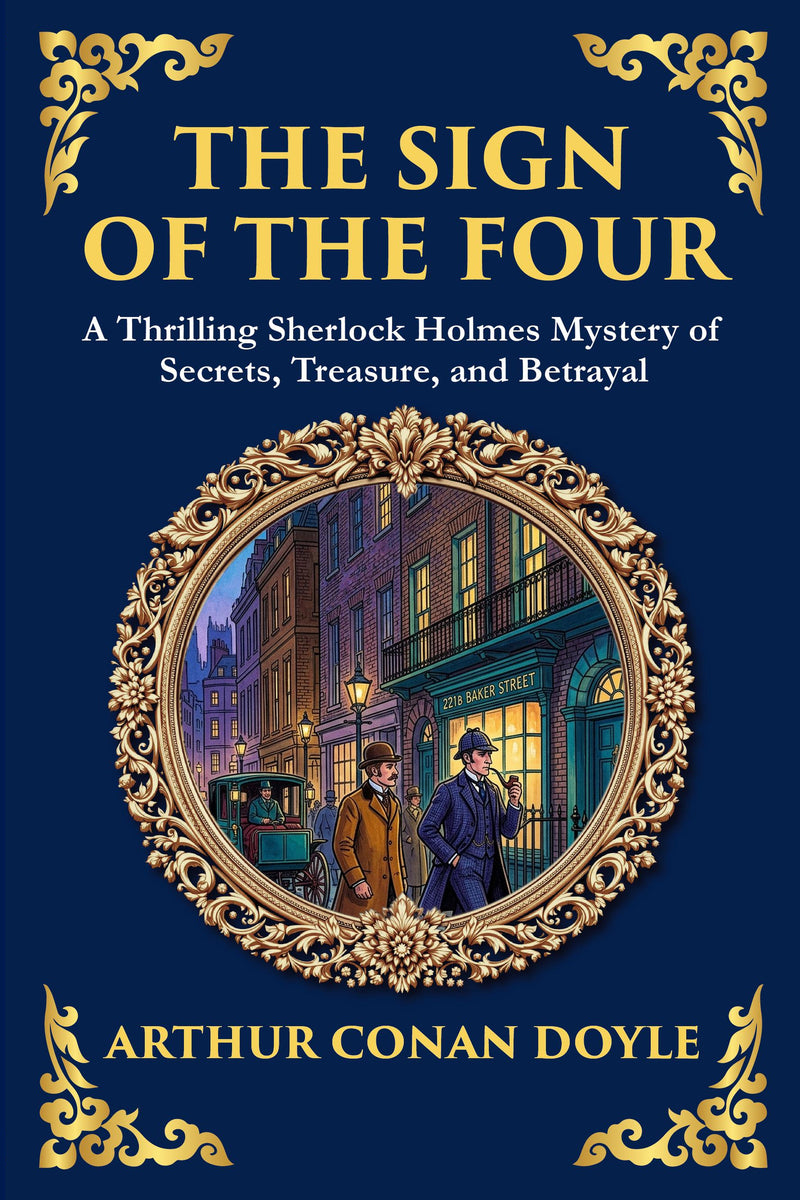
The Sign of the Four — Large Print
An eerie letter. A missing father. A hidden treasure. And a murder that defies logic. In The Sign of the Four, the brilliant detective Sherlock Holmes is faced with one of his most puzzling and perilous cases yet.
or free app
10,000+ hrs library
30-day guarantee
The complete The Sign of the Four appears in modern English through Library of Alexandria Press, available online with audiobook narration included for members.
Have you ever wondered why the sharpest minds are drawn to the deepest mysteries? Arthur Conan Doyle’s The Sign of the Four is a masterwork of suspense and intellect, starring the world’s most famous detective, Sherlock Holmes. In this second novel of the Holmes canon, a cryptic message leads to a labyrinth of deceit, stolen treasure, and a chilling legacy of vengeance.
When the intelligent and composed Miss Mary Morstan approaches Holmes with a tale of her vanished father and strange annual gifts of pearls from an anonymous benefactor, the game is afoot. The case quickly entangles Holmes and his ever-loyal companion Dr. Watson in a whirlwind of secret alliances, coded messages, and danger lurking in every shadow.
As they investigate, the trail uncovers a chilling pact made in colonial India—the “Sign of the Four”—and a legacy of greed that has left a trail of betrayal, imprisonment, and bloodshed. With scenes ranging from eerie nighttime chases on the Thames to tense interviews in London’s darkest alleys, The Sign of the Four is not only a dazzling puzzle—it’s a story of moral complexity, colonial guilt, and human obsession.
What you’ll discover in this modern edition
- An Ingenious Case of Hidden Treasure and Murder – Follow Holmes as he dissects the clues with unmatched logic.
- The Introduction of Mary Morstan – A pivotal figure in the Holmes-Watson universe.
- Action-Packed Adventure with Intellectual Flair – Riveting pursuits, exotic backstories, and criminal psychology all wrapped into one.
- Themes of Greed, Justice, and Colonial Shadows – A deeper layer of historical and ethical reflection within the thrills.
- Dynamic Holmes-Watson Relationship – Watch their partnership grow, blending brilliance with heart. The Sign of the Four is more than a mystery—it’s a blueprint for detective fiction that remains unrivaled in depth and pace.
| Formats | eBook (EPUB + PDF) · Audiobook · Paperback · Hardcover · Large Print |
| Language | English |
| Trim size (print) | 6 × 9 in |
| Binding | Paperback — perfect-bound · Hardcover — casewrap |
| Large Print edition | Same text in a larger, easy-read type — a larger font, not a larger trim |
| Print pricing | Every physical book at our true cost — at-cost, no profit (members) |
| Library | 873 restored titles, always growing |
| Length | 42,607 words · ~2 hr 50 min reading |
| Reading level | Grade 5 · an easy, flowing read (this modern-English edition) |
| Edition | Modern English translation · 2026 |
Member reviews for this edition are collected as readers finish it — be the first. Across the library: 12,000+ books shipped, every plan covered by a 365-day print guarantee.
About this edition
A faithful, unabridged modern-English edition by The Library of Alexandria — carefully rendered for today's reader and verified paragraph-by-paragraph against the public-domain source. Available as eBook, audiobook, paperback, hardcover, and large print.
- Complete & unabridgedVerified paragraph by paragraph against the source — never a scan, never abridged.
- Modern English, faithfulReadable today, with the author’s meaning kept intact. Readable — not simplified.
- Every format, one membershipRead in your browser or the free app, or listen to the full audiobook.
Included free with your membership
Cancel anytime, one click · 30-day money-back guarantee
Edition last updated July 2026
What’s inside
The Sign of the Four — Large Print — complete and unabridged: all 13 sections included with membership, plus the full audiobook.
Begin reading The Sign of the Four — Large Print
In clear modern English — the complete text is included with membership.
Introduction
There is a particular kind of pleasure that comes from watching a great mind at work, and few characters in the history of literature offer that pleasure more completely than Sherlock Holmes. When Arthur Conan Doyle sat down to write the second full-length adventure of his famous consulting detective, he was not yet the literary phenomenon he would later become. He was a struggling young physician, working long hours and waiting between patients in a quiet medical practice, scribbling stories to supplement an income that barely covered his needs. He could not have known that the strange, brilliant, restless figure he was sketching out on those pages would become one of the most recognizable characters ever created, instantly identifiable across cultures and continents more than a century after his birth. This book stands at the very threshold of that legend, and to read it is to witness the foundation stones of an extraordinary cultural monument being laid.
The story you are about to read first appeared in 1890, commissioned over a memorable dinner that has since passed into literary lore. An American editor, hoping to secure new fiction for a British magazine, invited two promising authors to dine with him. One was Oscar Wilde, who would go on to write The Picture of Dorian Gray as a result of that evening. The other was Conan Doyle, who agreed to produce a second Holmes adventure following the modest success of his first. From that single dinner came two enduring works of literature, a coincidence so neat it almost reads like one of the detective’s own deductions. The novel that emerged is a tightly wound tale of mystery, suspense, and revelation, and it is here, more than in any earlier work, that the world first truly fell in love with Sherlock Holmes.
To appreciate what makes this adventure so satisfying, it helps to understand the remarkable partnership that lies at its heart. Conan Doyle gave the world not one memorable character but two, and the relationship between them is the engine that drives every story in the canon. There is Holmes himself, of course, the towering intellect, the man who can glance at a stranger and recount their occupation, their recent travels, and the secret troubles of their domestic life simply by observing the wear on their cuffs or the calluses on their fingers. And then there is the man who watches him do it, records it, and shares our amazement: Doctor John Watson.
It is no accident that Holmes appears more brilliant when we see him through Watson’s eyes. The good doctor is our representative within the story, the ordinary man of intelligence and decency through whom we experience the detective’s genius. Watson is no fool, despite the way later parodies and adaptations have sometimes reduced him to a bumbling sidekick. He is a brave former army surgeon, a man of action and feeling, observant and capable in his own right. But he is not Holmes, and that difference is precisely the point. When Watson marvels at a deduction, we marvel with him. When he fails to see the significance of a detail that Holmes seizes upon at once, we feel the same humbling jolt of recognition. The friendship between these two men, with all its warmth and friction, its mutual respect and occasional exasperation, gives the cold machinery of detection a beating human heart.
In this particular novel, that friendship reaches a significant milestone, and the reader who is meeting these characters for the first time should pay close attention to the development of Watson as a man rather than merely as a narrator. Without revealing what unfolds, it is fair to say that this story marks an important turning point in his personal life, one that adds an emotional dimension to a tale that might otherwise be a purely intellectual exercise. Conan Doyle understood, instinctively, that a mystery becomes far more gripping when something is at stake beyond the simple solution of a puzzle. Here, the stakes are made personal, and that decision transforms a clever entertainment into something genuinely moving.
The opening pages of this novel are among the most celebrated in all of detective fiction, and they introduce us to Holmes in a manner that is both shocking and revealing. We find him in a state of restless agitation, a mind so powerful and so hungry for stimulation that it cannot bear the dullness of ordinary life. The famous declaration that he abhors the dull routine of existence, that he craves mental exaltation, tells us everything we need to know about why this man does what he does. He is not a policeman motivated by duty, nor a hero motivated by glory. He is an artist of reason, and the cases that come his way are the canvases on which he performs. The portrait Conan Doyle paints in these early scenes is unflinching, showing us the genius alongside his flaws, the brilliance alongside the boredom that gnaws at him in the absence of a worthy problem.
It is worth noting, too, the way Holmes describes his own methods in these pages, for he lays out a philosophy of observation and deduction that has influenced not only fiction but the actual practice of criminal investigation. Real forensic scientists and detectives have cited these stories as inspirations. The idea that a person could be read like an open book, that the smallest physical traces could betray the largest secrets, was revolutionary in its time and remains compelling now. When Holmes performs his deductions for the astonished Watson at the start of the adventure, demonstrating how he can know the history of an object simply by examining it, we are watching the birth of a method that would echo through a thousand imitations. None of those imitations, however, quite captures the original magic, the sense that we are in the presence of a wholly new kind of mind.
The novel also wrestles, in its own way, with a darker aspect of the detective’s character that Conan Doyle handled with surprising frankness for his era. Holmes is a man of appetites and addictions, and the way he copes with the empty stretches between cases is treated honestly within these pages. Modern readers will find that this complexity makes the character more rather than less compelling. He is not a flawless paragon but a deeply human figure, a man whose extraordinary gifts come bound together with real vulnerabilities. This honesty is part of what has kept Holmes alive in the imagination of readers for so long. He feels real because he is not perfect, because his greatness and his troubles spring from the same restless source.
As the plot unfolds, a client arrives at the famous rooms in Baker Street with a mystery that immediately seizes both Holmes’s attention and our own. A young woman comes seeking help with a strange situation, one involving a long-vanished father, a series of unusual events, and a puzzle that has shadowed her life for years. The case that develops from her visit is rich with the elements that make for the very best mystery fiction: hidden treasure, secret pacts, distant lands, broken promises, and a chain of events that reaches back across years and oceans. The reader is carried along through a series of escalating discoveries, each one raising new questions even as it answers old ones, until the full shape of the affair finally emerges in a climax of genuine excitement.
What makes Conan Doyle such a masterful storyteller is the way he balances the cerebral satisfactions of the puzzle with the visceral thrills of adventure. This is not a static drawing-room mystery in which characters sit and discuss clues over tea. There is pursuit, danger, action across the city and along its waterways, and a sense of urgency that builds toward a thrilling conclusion. Holmes leaves his armchair and takes to the streets, and we follow him through a vividly rendered London that becomes a character in its own right. The chase sequences in particular have a kinetic energy that still feels remarkably fresh, propelling the reader forward with all the momentum of the finest modern thrillers.
Part of the enduring fascination of these stories lies in the world they inhabit. The London that Conan Doyle conjures is a place of fog and gaslight, of hansom cabs clattering over cobblestones and telegrams arriving with breathless news. It is a city of stark contrasts, where grand wealth and grinding poverty exist side by side, where respectable streets give way to dangerous quarters within the space of a short walk. Conan Doyle knew this London intimately, and he brings it to life with a journalist’s eye for detail and a novelist’s gift for atmosphere. To read these pages is to step into a fully realized world, one that feels at once exotic in its strangeness and familiar in its humanity.
This was the great city at the height of an empire that stretched around the globe, and the story reflects the realities of that age in ways both fascinating and complex. The plot reaches outward to distant colonial possessions, drawing in events and characters from far-flung corners of a vast imperial network. The treasure at the center of the mystery, the secrets that surround it, and the histories of the people caught up in its pursuit all bear the marks of that imperial moment. For the contemporary reader, this provides a window not only into a gripping story but into the attitudes, assumptions, and anxieties of a particular time and place.
It must be said, with honesty and care, that this novel contains depictions and language reflecting the prejudices of the late nineteenth century, particularly in its portrayal of characters from outside Europe. These elements can be jarring to a modern sensibility, and rightly so. They are products of an era whose understanding of race, empire, and the wider world was profoundly limited and often deeply unjust. We do not present them here as endorsements but as historical artifacts, part of the honest texture of a work written more than a century ago. A thoughtful reader can hold two truths at once: appreciation for the genuine artistry and excitement of the storytelling, and clear-eyed recognition of the period’s failings. Indeed, reading the classics with this dual awareness is one of the great rewards of engaging with literature from the past. It allows us to enjoy the craft while reflecting on how far our collective understanding has traveled, and on how much of the human condition remains recognizable across the centuries.
This edition has been thoughtfully prepared as a modern translation, adapted for the contemporary reader. The aim of this approach is to smooth away the obstacles that can sometimes stand between today’s audience and the pleasures of a classic text, while preserving the spirit, the voice, and the essential character of the original. Victorian prose, for all its beauty, can occasionally feel dense or remote to the modern eye, weighed down by elaborate constructions and vocabulary that has fallen out of common use. By gently modernizing the language where it serves clarity, this edition seeks to ensure that the story moves with the same swiftness and force that its first readers would have experienced. The wit of Holmes, the warmth of Watson, the suspense of the mystery, and the thrill of the chase all remain fully intact. What changes is simply the ease with which a reader today can fall into the story and stay there, undistracted by linguistic hurdles.
This kind of adaptation is offered in the spirit of accessibility, with the conviction that great stories deserve to find new audiences in every generation. A reader who might otherwise be intimidated by the formality of nineteenth-century prose can here meet Sherlock Holmes on welcoming terms, and perhaps go on to explore the original texts and the wider canon with newfound confidence. Far from diminishing the work, such an approach honors its fundamental purpose, which was always to entertain, to thrill, and to delight. Conan Doyle wrote for a popular audience, for ordinary people seeking the pleasure of a well-told tale, and he would surely have approved of any effort to keep that pleasure alive and available.
Cancel anytime, one click · 30-day money-back guarantee
Founding annual rate available now — your price locks for life when you join.
Not ready? Get this free chapter by email — read it anytime.
✓ Sent — check your inbox for The Sign of the Four — Large Print.
Questions about The Sign of the Four — Large Print
What is The Sign of the Four about?
An eerie letter. A missing father. A hidden treasure.
Who wrote The Sign of the Four?
The Sign of the Four was written by Arthur Conan Doyle. This edition presents the complete work in clear modern English, faithfully rendered from the public-domain original by Library of Alexandria Press.
Is The Sign of the Four free to read?
The opening chapter is free to read on this page. Members read and listen to the complete work — and the entire library — free, and can order any physical book at our true print cost.
How long is The Sign of the Four?
13 chapters (~42,607 words) — about 2 hr 50 min of reading in this modern-English edition.
Is this an abridged version of The Sign of the Four?
No. This is the complete, unabridged The Sign of the Four, carefully rendered into clear modern English and verified paragraph-by-paragraph against the public-domain source — nothing is cut or summarised.
What formats does The Sign of the Four come in?
The Sign of the Four is available as eBook, paperback, hardcover and large print. eBook and audiobook are included with membership; printed editions ship at our true print cost.
Shipping & returns
Billing & membership
More from the library


Explore Mystery & Crime
- Resurrection · Leo Tolstoy
- Crime and Punishment · Fyodor Dostoyevsky
- The Strange Case of Dr. Jekyll and Mr. Hyde · Robert Louis Stevenson
- The Riddle of the Sands · Erskine Childers
- The Wisdom of Father Brown · G. K. Chesterton
- The Cask of Amontillado · Edgar Allan Poe
- The Tomb of Ts’in · Edgar Wallace
- Ghost Stories of an Antiquary · M. R. James
- The Hunniwell Boys and the Platinum Mystery · L. P. Wyman
- The Seven Dials Mystery · Agatha Christie
- The Thirty-Nine Steps · John Buchan
- The Hand in the Dark · Arthur J. Rees
- Lady Audley’s Secret · M. E. Braddon
- The Mystery of the Blue Train · Agatha Christie
- The Secret Adversary · Agatha Christie
- The Call of Cthulhu · H. P. Lovecraft
- The Adventures of Heine · Edgar Wallace
- The Valley of Fear · Arthur Conan Doyle
- The Innocence of Father Brown · G. K. Chesterton
- McTeague: A Story of San Francisco · Frank Norris
- Tess of the d’Urbervilles: A Pure Woman · Thomas Hardy
- The Big Fix · George O. Smith
- The Ambulance Made Two Trips · Murray Leinster
- Time Crime · H. Beam Piper
- The Misplaced Battleship · Harry Harrison
- Supermind · Randall Garrett and Laurence M....
- Lone Star Planet · H. Beam Piper and John J. McGuire
- Dracula · Bram Stoker
- The Murder on the Links · Agatha Christie
- The Hound of the Baskervilles · Arthur Conan Doyle
The Sign of the Four — Large Print
The Sign of the Four — Large Print
A Thrilling Sherlock Holmes Mystery of Secrets, Treasure, and Betrayal
Arthur Conan Doyle
Contents
- Introduction
- Chapter 1
- Chapter 2
- Chapter 3
- Chapter 4
- Chapter 5
- Chapter 6
- Chapter 7
- Chapter 8
- Chapter 9
- Chapter 10
- Chapter 11
- Chapter 12
Introduction
There is a particular kind of pleasure that comes from watching a great mind at work, and few characters in the history of literature offer that pleasure more completely than Sherlock Holmes. When Arthur Conan Doyle sat down to write the second full-length adventure of his famous consulting detective, he was not yet the literary phenomenon he would later become. He was a struggling young physician, working long hours and waiting between patients in a quiet medical practice, scribbling stories to supplement an income that barely covered his needs. He could not have known that the strange, brilliant, restless figure he was sketching out on those pages would become one of the most recognizable characters ever created, instantly identifiable across cultures and continents more than a century after his birth. This book stands at the very threshold of that legend, and to read it is to witness the foundation stones of an extraordinary cultural monument being laid.
The story you are about to read first appeared in 1890, commissioned over a memorable dinner that has since passed into literary lore. An American editor, hoping to secure new fiction for a British magazine, invited two promising authors to dine with him. One was Oscar Wilde, who would go on to write The Picture of Dorian Gray as a result of that evening. The other was Conan Doyle, who agreed to produce a second Holmes adventure following the modest success of his first. From that single dinner came two enduring works of literature, a coincidence so neat it almost reads like one of the detective’s own deductions. The novel that emerged is a tightly wound tale of mystery, suspense, and revelation, and it is here, more than in any earlier work, that the world first truly fell in love with Sherlock Holmes.
To appreciate what makes this adventure so satisfying, it helps to understand the remarkable partnership that lies at its heart. Conan Doyle gave the world not one memorable character but two, and the relationship between them is the engine that drives every story in the canon. There is Holmes himself, of course, the towering intellect, the man who can glance at a stranger and recount their occupation, their recent travels, and the secret troubles of their domestic life simply by observing the wear on their cuffs or the calluses on their fingers. And then there is the man who watches him do it, records it, and shares our amazement: Doctor John Watson.
It is no accident that Holmes appears more brilliant when we see him through Watson’s eyes. The good doctor is our representative within the story, the ordinary man of intelligence and decency through whom we experience the detective’s genius. Watson is no fool, despite the way later parodies and adaptations have sometimes reduced him to a bumbling sidekick. He is a brave former army surgeon, a man of action and feeling, observant and capable in his own right. But he is not Holmes, and that difference is precisely the point. When Watson marvels at a deduction, we marvel with him. When he fails to see the significance of a detail that Holmes seizes upon at once, we feel the same humbling jolt of recognition. The friendship between these two men, with all its warmth and friction, its mutual respect and occasional exasperation, gives the cold machinery of detection a beating human heart.
In this particular novel, that friendship reaches a significant milestone, and the reader who is meeting these characters for the first time should pay close attention to the development of Watson as a man rather than merely as a narrator. Without revealing what unfolds, it is fair to say that this story marks an important turning point in his personal life, one that adds an emotional dimension to a tale that might otherwise be a purely intellectual exercise. Conan Doyle understood, instinctively, that a mystery becomes far more gripping when something is at stake beyond the simple solution of a puzzle. Here, the stakes are made personal, and that decision transforms a clever entertainment into something genuinely moving.
The opening pages of this novel are among the most celebrated in all of detective fiction, and they introduce us to Holmes in a manner that is both shocking and revealing. We find him in a state of restless agitation, a mind so powerful and so hungry for stimulation that it cannot bear the dullness of ordinary life. The famous declaration that he abhors the dull routine of existence, that he craves mental exaltation, tells us everything we need to know about why this man does what he does. He is not a policeman motivated by duty, nor a hero motivated by glory. He is an artist of reason, and the cases that come his way are the canvases on which he performs. The portrait Conan Doyle paints in these early scenes is unflinching, showing us the genius alongside his flaws, the brilliance alongside the boredom that gnaws at him in the absence of a worthy problem.
It is worth noting, too, the way Holmes describes his own methods in these pages, for he lays out a philosophy of observation and deduction that has influenced not only fiction but the actual practice of criminal investigation. Real forensic scientists and detectives have cited these stories as inspirations. The idea that a person could be read like an open book, that the smallest physical traces could betray the largest secrets, was revolutionary in its time and remains compelling now. When Holmes performs his deductions for the astonished Watson at the start of the adventure, demonstrating how he can know the history of an object simply by examining it, we are watching the birth of a method that would echo through a thousand imitations. None of those imitations, however, quite captures the original magic, the sense that we are in the presence of a wholly new kind of mind.
The novel also wrestles, in its own way, with a darker aspect of the detective’s character that Conan Doyle handled with surprising frankness for his era. Holmes is a man of appetites and addictions, and the way he copes with the empty stretches between cases is treated honestly within these pages. Modern readers will find that this complexity makes the character more rather than less compelling. He is not a flawless paragon but a deeply human figure, a man whose extraordinary gifts come bound together with real vulnerabilities. This honesty is part of what has kept Holmes alive in the imagination of readers for so long. He feels real because he is not perfect, because his greatness and his troubles spring from the same restless source.
As the plot unfolds, a client arrives at the famous rooms in Baker Street with a mystery that immediately seizes both Holmes’s attention and our own. A young woman comes seeking help with a strange situation, one involving a long-vanished father, a series of unusual events, and a puzzle that has shadowed her life for years. The case that develops from her visit is rich with the elements that make for the very best mystery fiction: hidden treasure, secret pacts, distant lands, broken promises, and a chain of events that reaches back across years and oceans. The reader is carried along through a series of escalating discoveries, each one raising new questions even as it answers old ones, until the full shape of the affair finally emerges in a climax of genuine excitement.
What makes Conan Doyle such a masterful storyteller is the way he balances the cerebral satisfactions of the puzzle with the visceral thrills of adventure. This is not a static drawing-room mystery in which characters sit and discuss clues over tea. There is pursuit, danger, action across the city and along its waterways, and a sense of urgency that builds toward a thrilling conclusion. Holmes leaves his armchair and takes to the streets, and we follow him through a vividly rendered London that becomes a character in its own right. The chase sequences in particular have a kinetic energy that still feels remarkably fresh, propelling the reader forward with all the momentum of the finest modern thrillers.
Part of the enduring fascination of these stories lies in the world they inhabit. The London that Conan Doyle conjures is a place of fog and gaslight, of hansom cabs clattering over cobblestones and telegrams arriving with breathless news. It is a city of stark contrasts, where grand wealth and grinding poverty exist side by side, where respectable streets give way to dangerous quarters within the space of a short walk. Conan Doyle knew this London intimately, and he brings it to life with a journalist’s eye for detail and a novelist’s gift for atmosphere. To read these pages is to step into a fully realized world, one that feels at once exotic in its strangeness and familiar in its humanity.
This was the great city at the height of an empire that stretched around the globe, and the story reflects the realities of that age in ways both fascinating and complex. The plot reaches outward to distant colonial possessions, drawing in events and characters from far-flung corners of a vast imperial network. The treasure at the center of the mystery, the secrets that surround it, and the histories of the people caught up in its pursuit all bear the marks of that imperial moment. For the contemporary reader, this provides a window not only into a gripping story but into the attitudes, assumptions, and anxieties of a particular time and place.
It must be said, with honesty and care, that this novel contains depictions and language reflecting the prejudices of the late nineteenth century, particularly in its portrayal of characters from outside Europe. These elements can be jarring to a modern sensibility, and rightly so. They are products of an era whose understanding of race, empire, and the wider world was profoundly limited and often deeply unjust. We do not present them here as endorsements but as historical artifacts, part of the honest texture of a work written more than a century ago. A thoughtful reader can hold two truths at once: appreciation for the genuine artistry and excitement of the storytelling, and clear-eyed recognition of the period’s failings. Indeed, reading the classics with this dual awareness is one of the great rewards of engaging with literature from the past. It allows us to enjoy the craft while reflecting on how far our collective understanding has traveled, and on how much of the human condition remains recognizable across the centuries.
This edition has been thoughtfully prepared as a modern translation, adapted for the contemporary reader. The aim of this approach is to smooth away the obstacles that can sometimes stand between today’s audience and the pleasures of a classic text, while preserving the spirit, the voice, and the essential character of the original. Victorian prose, for all its beauty, can occasionally feel dense or remote to the modern eye, weighed down by elaborate constructions and vocabulary that has fallen out of common use. By gently modernizing the language where it serves clarity, this edition seeks to ensure that the story moves with the same swiftness and force that its first readers would have experienced. The wit of Holmes, the warmth of Watson, the suspense of the mystery, and the thrill of the chase all remain fully intact. What changes is simply the ease with which a reader today can fall into the story and stay there, undistracted by linguistic hurdles.
This kind of adaptation is offered in the spirit of accessibility, with the conviction that great stories deserve to find new audiences in every generation. A reader who might otherwise be intimidated by the formality of nineteenth-century prose can here meet Sherlock Holmes on welcoming terms, and perhaps go on to explore the original texts and the wider canon with newfound confidence. Far from diminishing the work, such an approach honors its fundamental purpose, which was always to entertain, to thrill, and to delight. Conan Doyle wrote for a popular audience, for ordinary people seeking the pleasure of a well-told tale, and he would surely have approved of any effort to keep that pleasure alive and available.
Sherlock Holmes took a bottle from the corner of the mantelpiece and his hypodermic syringe from its neat leather case. With his long, pale, restless fingers, he adjusted the delicate needle and rolled up his left shirt cuff. For a moment, he looked thoughtfully at his muscular forearm and wrist, which were covered in countless puncture marks. Finally, he pushed the needle in, pressed the small plunger, and sank back into the velvet armchair with a long sigh of satisfaction.
I had watched this routine three times a day for many months, but I never got used to it. On the contrary, I grew more irritated every time I saw it, and every night I felt guilty for lacking the courage to speak up. Time and again, I promised myself I would finally say something, but there was something about my companion’s cool, indifferent manner that made him the last person I wanted to offend. His brilliance, his commanding presence, and everything I knew of his extraordinary abilities made me hesitant to cross him.
But that afternoon, whether it was the Beaune wine I’d had with lunch or the sheer frustration of his slow, deliberate movements, I suddenly felt I couldn’t take it anymore.
“Which one is it today?” I asked. “Morphine or cocaine?”
He looked up lazily from the old, gothic-style book he had been reading. “It’s cocaine,” he said. “A seven-percent solution. Would you like to try some?”
“No, thank you,” I answered sharply. “My health hasn’t fully recovered from the Afghan campaign. I can’t afford to put any more strain on my system.”
He smiled at my intensity. “Perhaps you’re right, Watson,” he said. “I suppose it is physically harmful. However, I find it so incredibly stimulating and clarifying for the mind that the side effects are a minor concern.”
End of the free sample
Keep reading, free
Members read and listen to the complete book — and the entire library. Cancel anytime, one click · 30-day money-back guarantee.