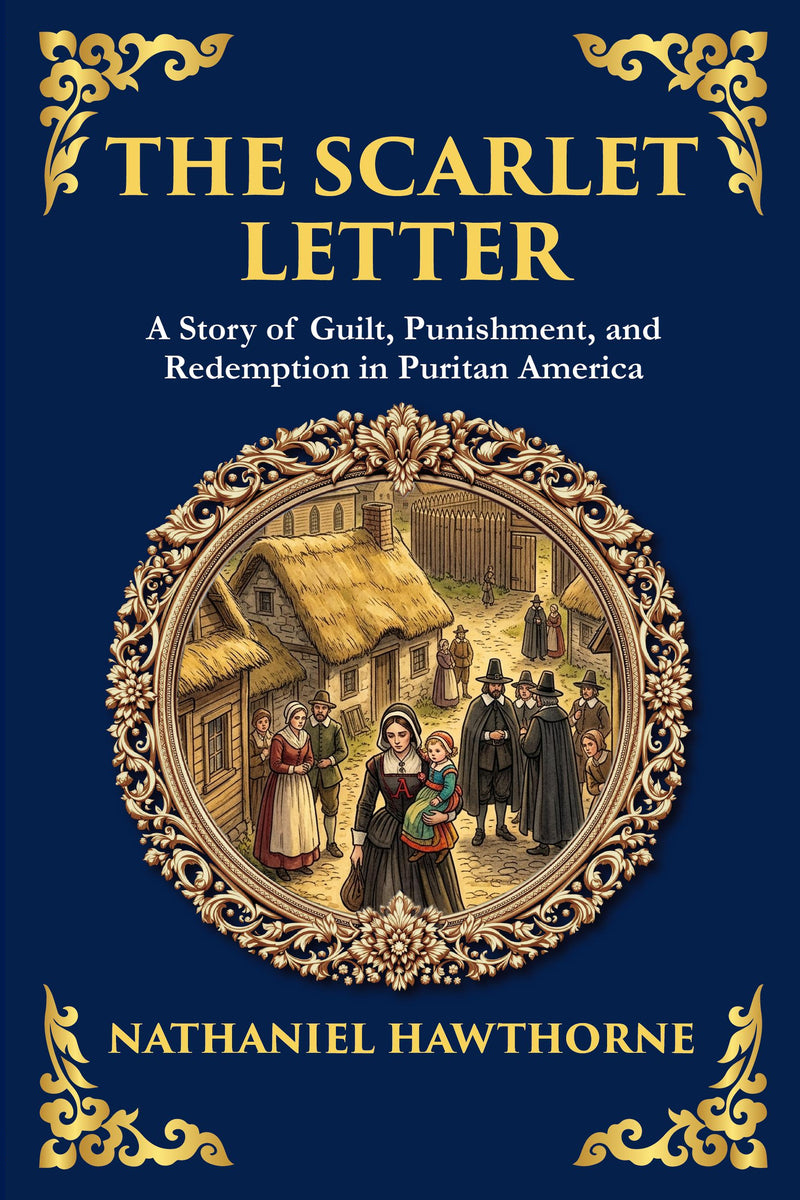
The Scarlet Letter
In a stern Puritan society, a single act of passion changes the life of Hester Prynne forever. Branded with the scarlet letter “A” for adultery, she must face public shame, inner torment, and the struggle to find redemption.
or free app
10,000+ hrs library
30-day guarantee
The complete The Scarlet Letter appears in modern English through Library of Alexandria Press, available online with audiobook narration included for members.
Have you ever wondered why shame can destroy—or heal—the human soul? Nathaniel Hawthorne’s The Scarlet Letter is a gripping tale of passion, punishment, and redemption, set in the rigid, unforgiving world of 17th-century Puritan New England. It is a story that examines how guilt and societal judgment can shape a person’s destiny—and how strength and courage can reclaim it.
Hester Prynne, a young woman condemned for an illicit affair, is forced to wear the scarlet letter “A” upon her chest as a public mark of shame. As she endures the scorn of her community, she raises her daughter Pearl alone while facing relentless persecution. Yet Hester remains steadfast and dignified, slowly transforming her punishment into a symbol of resilience.
Meanwhile, Reverend Arthur Dimmesdale, the man who shares her sin, is consumed by inner torment and fear of exposure. His hidden guilt eats away at his soul, creating a stark contrast to Hester’s open courage. At the same time, Hester’s estranged husband, now living under an assumed identity, plots a relentless and twisted revenge against the man who wronged him.
Hawthorne weaves a rich tapestry of human emotion and moral conflict, exploring themes that remain relevant today: hypocrisy, redemption, justice, and the complex nature of sin.
What you’ll discover in this modern edition
- The Strength of the Human Spirit – Witness Hester’s journey as she faces punishment and transforms her disgrace into a symbol of hope and resilience.
- The Destructive Power of Guilt – Follow Dimmesdale’s descent into psychological torment as he struggles with secrets and hypocrisy.
- A Tale of Passion and Vengeance – Experience the intertwining lives of three characters locked in a tragic cycle of love, betrayal, and revenge.
- A Masterpiece of American Literature – Discover why Hawthorne’s novel has remained essential reading for over 170 years.
- Themes That Still Resonate Today – Explore questions of morality, judgment, and the balance between justice and compassion.
| Formats | eBook (EPUB + PDF) · Audiobook · Paperback · Hardcover · Large Print |
| Language | English |
| Trim size (print) | 6 × 9 in |
| Binding | Paperback — perfect-bound · Hardcover — casewrap |
| Large Print edition | Same text in a larger, easy-read type — a larger font, not a larger trim |
| Print pricing | Every physical book at our true cost — at-cost, no profit (members) |
| Library | 873 restored titles, always growing |
| Length | 79,376 words · ~5 hr 18 min reading |
| Reading level | Grade 8 · an easy, flowing read (this modern-English edition) |
| Edition | Modern English translation · 2026 |
Member reviews for this edition are collected as readers finish it — be the first. Across the library: 12,000+ books shipped, every plan covered by a 365-day print guarantee.
About this edition
A faithful, unabridged modern-English edition by The Library of Alexandria — carefully rendered for today's reader and verified paragraph-by-paragraph against the public-domain source. Available as eBook, audiobook, paperback, hardcover, and large print.
- Complete & unabridgedVerified paragraph by paragraph against the source — never a scan, never abridged.
- Modern English, faithfulReadable today, with the author’s meaning kept intact. Readable — not simplified.
- Every format, one membershipRead in your browser or the free app, or listen to the full audiobook.
Included free with your membership
Cancel anytime, one click · 30-day money-back guarantee
Edition last updated July 2026
What’s inside
The Scarlet Letter — complete and unabridged: all 26 sections included with membership, plus the full audiobook.
Begin reading The Scarlet Letter
In clear modern English — the complete text is included with membership.
Introduction
When Nathaniel Hawthorne sat down to write the book you are about to read, he was a man in his middle forties who had spent years measuring barrels and cargo at the Salem Custom House, a position he had taken to support his family after the modest success of his earlier writing failed to keep him fed. He had recently lost that government post in a politically motivated dismissal, and the bitterness of that loss, combined with the death of his beloved mother, seems to have cracked something open in him. Out of that period of grief and uncertainty came a story so concentrated, so morally severe, and so emotionally luminous that it would establish him at once as one of the finest writers his young nation had yet produced. Published in 1850, this novel arrived at a moment when American literature was still searching for its own voice—still wondering whether a country so new could produce anything to rival the great works of Europe. With this slim, intense book, Hawthorne answered the question decisively.
The story unfolds in the Puritan settlement of Boston in the seventeenth century, roughly two centuries before Hawthorne wrote it. This was a world he knew intimately, not from personal experience but from inheritance. His own ancestors had been among the original Puritan settlers of New England, and one of them, John Hathorne, had served as a judge during the notorious Salem witch trials—a man who never repented of the cruelties he had helped inflict. Hawthorne was so disturbed by this family legacy that he added a “w” to his surname, partly to distance himself from those forebears. Yet he could never fully escape them, and much of his greatest work is haunted by the moral world they represented: a society obsessed with sin, with public reputation, with the visible signs of God’s favor or disfavor, and with the terrible machinery of judgment that human beings build when they believe themselves to be enforcing divine law. This novel is, in many ways, Hawthorne’s reckoning with that inheritance—an attempt to understand, and perhaps to judge, the very people who made him.
What you hold in your hands is a modern adaptation of that classic, prepared so that the contemporary reader can move through Hawthorne’s world without the obstacles that nineteenth-century prose can sometimes place in our path. Hawthorne wrote in long, winding sentences thick with subordinate clauses, archaic vocabulary, and the formal cadences of his era. These were beautiful in their time, and they remain beautiful to readers willing to slow down and decode them. But for many readers today, that density can become a wall rather than a window, keeping us at a distance from the urgent human drama at the story’s heart. This edition aims to lower that wall while preserving everything that matters: the moral seriousness, the psychological depth, the symbolic richness, and above all the searing emotional truth of a story about guilt, shame, secrecy, and the long, painful road toward something resembling peace. The goal is not to simplify Hawthorne but to make his power newly accessible—to let his voice reach you across the gulf of nearly two centuries without losing its force.
At the center of this novel stands one of the most famous symbols in all of literature: a piece of embroidered cloth, a single letter of the alphabet, worn upon a woman’s breast as a mark of public condemnation. From this small object, Hawthorne spins out an entire universe of meaning. The genius of the book lies in the way that symbol refuses to stay fixed. What begins as a brand of disgrace, intended by the community to humiliate and to warn, becomes over the course of the story something far more complex and far more ambiguous. It shifts and deepens, taking on new meanings as the years pass and as the characters change. By the end, the reader may find it impossible to say with certainty what the letter actually means—and that uncertainty is precisely Hawthorne’s point. He wants us to understand that the labels we attach to one another, the judgments we pronounce, the categories of shame and honor we so confidently apply, are far less stable and far less truthful than we like to believe.
This is a story about a woman who has transgressed against the strict moral code of her community and who is forced to bear the public consequences of that transgression. But Hawthorne is not nearly as interested in the transgression itself as he is in everything that follows from it. He is interested in how a person carries shame, in how a community administers punishment, in what secrecy does to the human soul, and in the strange and unexpected forms that strength, dignity, and even grace can take in the aftermath of disgrace. The woman at the heart of this novel is one of the great characters in literature—proud, intelligent, generous, and possessed of a quiet endurance that gradually transforms her from an object of scorn into something approaching a figure of reverence. Watching her navigate her impossible situation, the reader comes to feel that the real moral failures in the story may lie not with the person who sinned openly and accepted her punishment, but with those who hide their sins, and with those who appoint themselves the agents of cruelty.
Around this central figure, Hawthorne arranges a small cast of unforgettable characters. There is a man tormented by a secret he cannot bring himself to confess, whose inner suffering becomes one of the most harrowing psychological portraits in nineteenth-century fiction. There is another man consumed by an obsession that slowly corrodes whatever was once human in him, a figure who embodies one of Hawthorne’s deepest convictions: that the coldest and most unforgivable sin is not passion but the deliberate, calculated violation of another person’s heart. And there is a child—strange, wild, perceptive beyond her years—who functions almost as a living embodiment of the very transgression that brought her into the world, a creature who seems to see through every pretense and to demand truth from the adults around her. These four figures are bound together in a tight knot of love, guilt, vengeance, and concealment, and the slow tightening of that knot drives the novel toward its unforgettable conclusion.
What makes the book so enduring is that Hawthorne refuses to make any of this simple. He does not offer us obvious villains and obvious heroes. Even the most sympathetic characters are flawed, capable of cowardice or pride or self-deception, and even the most culpable are granted moments in which we glimpse the suffering or the warped logic that drives them. Hawthorne understood, perhaps better than any American writer before him, that the human heart is a tangled and shadowy place, and that the line between sin and virtue, between the punished and the deserving of punishment, is rarely as clear as we would like it to be. This moral complexity is the source of the book’s strange, lingering power. Long after you have finished reading, you may find yourself returning in your mind to its central questions, turning them over, unable to settle on easy answers. That is exactly the effect Hawthorne intended.
It is worth saying a word here about how the novel actually opens, because Hawthorne does something unusual that has surprised and occasionally frustrated readers for generations. The story proper is preceded by a long introductory section in which the author describes his time working at a custom house and claims to have discovered, among some old papers and a faded scrap of embroidered cloth, the documents on which the following narrative is supposedly based. This framing device is partly a literary game—a way of lending the story an air of authenticity—and partly a vehicle for Hawthorne’s wry, satirical observations about the petty politics and dusty routines of bureaucratic life. Some readers find this opening section delightful; others find it a barrier between themselves and the main event. In this adaptation, the framing material has been handled with the contemporary reader in mind, so that you can appreciate its purpose without feeling that you must wade through it to reach the heart of the book. Should you find yourself eager to reach the story itself, know that the patience required at the outset will be richly rewarded.
To read this novel well, it helps to understand something about the Puritan society in which it is set, because that society is not merely a backdrop but practically a character in its own right. The Puritans who settled New England in the early seventeenth century had crossed an ocean to build what they imagined would be a holy community, a city upon a hill that would serve as a model of godly living for the whole world to see. They took their religion with a seriousness that can be difficult for modern readers to fully grasp. For them, every aspect of life was saturated with religious meaning, and the boundaries between the spiritual and the civic, between sin and crime, between the church and the courtroom, were almost nonexistent. To violate the moral code was not merely a private failing; it was an offense against the entire community and against God himself, and it demanded public acknowledgment and public punishment.
This is the world into which Hawthorne plunges us, and he renders it with extraordinary vividness—the dark wooden buildings, the somber clothing, the unforgiving stares, the grim satisfaction the townspeople take in the spectacle of another’s disgrace. Yet Hawthorne’s attitude toward this world is complicated. He clearly admires certain qualities of the Puritan character: their seriousness, their courage, their willingness to sacrifice comfort for conviction. But he is also profoundly critical of their harshness, their self-righteousness, their tendency to mistake their own judgments for the will of heaven. He understood that a society so fixated on rooting out sin can easily become cruel, and that the public shaming of an individual often says more about the insecurity and hypocrisy of the community than about the guilt of the person being shamed. In this sense, the novel is not only a story set in the past; it is a meditation on the timeless human impulse to judge and condemn others, an impulse that has hardly weakened in the centuries since Hawthorne wrote.
There is something startlingly modern, in fact, about the book’s central concerns. We live in an age that has rediscovered, in its own way, the mechanics of public shaming—the swift, collective, often anonymous condemnation of those judged to have transgressed against prevailing norms. Hawthorne’s exploration of what it means to be marked, to be made into a public example, to carry a visible sign of one’s supposed failings before the eyes of an entire community, resonates with uncomfortable force today. So too does his careful attention to the difference between those who sin openly and those who conceal their failings behind a mask of respectability. The novel asks us to consider who is really damaged by secrecy and hypocrisy, and whether the person who is forced to wear her shame openly might in some ways be freer—and ultimately more honest, more whole, more human—than those who hide. These are not antiquated questions. They are as alive now as they were in 1850, or in the seventeenth century.
Hawthorne also belonged to a particular moment in American intellectual history that shaped his vision in important ways. He lived and worked alongside the great writers and thinkers of the American Renaissance—a flowering of literature and philosophy in mid-nineteenth-century New England that included figures such as Ralph Waldo Emerson, Henry David Thoreau, and, a bit later, Herman Melville, who became a passionate admirer of Hawthorne’s work and dedicated one of his own masterpieces to him. Many of these writers were associated with the optimistic, expansive philosophy known as Transcendentalism, which celebrated the divinity of nature, the goodness of the individual soul, and the possibility of human perfection. Hawthorne knew these people well and even spent time at an experimental utopian community, but temperamentally he was something of a skeptic among the optimists. He could not bring himself to share the sunny faith of his Transcendentalist neighbors in the essential goodness and perfectibility of human nature. His own vision was darker, more attuned to the persistence of sin, the reality of suffering, and the shadows that lurk in even the most virtuous-seeming hearts.
Cancel anytime, one click · 30-day money-back guarantee
Founding annual rate available now — your price locks for life when you join.
Not ready? Get this free chapter by email — read it anytime.
✓ Sent — check your inbox for The Scarlet Letter.
Questions about The Scarlet Letter
What is The Scarlet Letter about?
In a stern Puritan society, a single act of passion changes the life of Hester Prynne forever. Branded with the scarlet letter “A” for adultery, she must face public shame, inner torment, and the struggle to find redemption. As the townspeople condemn her, secrets fester in the hearts of those around her—including the pious minister tormented by hidden guilt and the vengeful man who seeks to destroy them both.
Who wrote The Scarlet Letter?
The Scarlet Letter was written by Nathaniel Hawthorne. This edition presents the complete work in clear modern English, faithfully rendered from the public-domain original by Library of Alexandria Press.
Is The Scarlet Letter free to read?
The opening chapter is free to read on this page. Members read and listen to the complete work — and the entire library — free, and can order any physical book at our true print cost.
How long is The Scarlet Letter?
26 chapters (~79,376 words) — about 5 hr 18 min of reading in this modern-English edition.
Is this an abridged version of The Scarlet Letter?
No. This is the complete, unabridged The Scarlet Letter, carefully rendered into clear modern English and verified paragraph-by-paragraph against the public-domain source — nothing is cut or summarised.
What formats does The Scarlet Letter come in?
The Scarlet Letter is available as eBook, paperback, hardcover and large print. eBook and audiobook are included with membership; printed editions ship at our true print cost.
Shipping & returns
Billing & membership
More from the library


Explore Children's Classics
- Peter and Wendy · J. M. Barrie
- Jack and Jill · Louisa May Alcott
- The Wonderful Wizard of Oz · L. Frank Baum
- Anne of Green Gables · L. M. Montgomery
- The Secret Garden · Frances Hodgson Burnett
- The Tale of Peter Rabbit · Beatrix Potter
- Peter Pan · J. M. Barrie
- The Prince and the Pauper · Mark Twain
- The Red Fairy Book · Andrew Lang
- Old Christmas: from the Sketch Book of Washington Irving · Washington Irving
- A Houseful of Girls · Sarah Tytler
- In the hollow of His hand · Hesba Stretton
- Miss Primrose · Agnes Giberne
- Five Little Peppers and How They Grew · Margaret Sidney
- The Loss of the Swansea: A Story of the Florida Coast · W. L. Alden
- Sky Island · L. Frank Baum
- The Book of Dragons · E. Nesbit
- Wild Animals I Have Known · Ernest Thompson Seton
- Skinny McCord · Percy Keese Fitzhugh
- The Hunniwell Boys and the Platinum Mystery · L. P. Wyman
- Rainbow Valley · L. M. Montgomery
- "Us and Our Donkey" · Amy Le Feuvre
- Dorothy and the Wizard in Oz · L. Frank Baum
- The Home Book of Verse — Volume 4 · Burton Egbert Stevenson
- The Story of Doctor Dolittle · Hugh Lofting
- The Tale of Benjamin Bunny · Beatrix Potter
- Fifty Famous Stories Retold · James Baldwin
- Rilla of Ingleside · L. M. Montgomery
- The House at Pooh Corner · A. A. Milne
- Rich and Humble: A Story for Young People · Oliver Optic
The Scarlet Letter
The Scarlet Letter
A Story of Guilt, Punishment, and Redemption in Puritan America
Nathaniel Hawthorne
Contents
- Introduction
- The Custom House
- Chapter 1
- Chapter 2
- Chapter 3
- Chapter 4
- Chapter 5
- Chapter 6
- Chapter 7
- Chapter 8
- Chapter 9
- Chapter 10
- Chapter 11
- Chapter 12
- Chapter 13
- Chapter 14
- Chapter 15
- Chapter 16
- Chapter 17
- Chapter 18
- Chapter 19
- Chapter 20
- Chapter 21
- Chapter 22
- Chapter 23
- Chapter 24
Introduction
When Nathaniel Hawthorne sat down to write the book you are about to read, he was a man in his middle forties who had spent years measuring barrels and cargo at the Salem Custom House, a position he had taken to support his family after the modest success of his earlier writing failed to keep him fed. He had recently lost that government post in a politically motivated dismissal, and the bitterness of that loss, combined with the death of his beloved mother, seems to have cracked something open in him. Out of that period of grief and uncertainty came a story so concentrated, so morally severe, and so emotionally luminous that it would establish him at once as one of the finest writers his young nation had yet produced. Published in 1850, this novel arrived at a moment when American literature was still searching for its own voice—still wondering whether a country so new could produce anything to rival the great works of Europe. With this slim, intense book, Hawthorne answered the question decisively.
The story unfolds in the Puritan settlement of Boston in the seventeenth century, roughly two centuries before Hawthorne wrote it. This was a world he knew intimately, not from personal experience but from inheritance. His own ancestors had been among the original Puritan settlers of New England, and one of them, John Hathorne, had served as a judge during the notorious Salem witch trials—a man who never repented of the cruelties he had helped inflict. Hawthorne was so disturbed by this family legacy that he added a “w” to his surname, partly to distance himself from those forebears. Yet he could never fully escape them, and much of his greatest work is haunted by the moral world they represented: a society obsessed with sin, with public reputation, with the visible signs of God’s favor or disfavor, and with the terrible machinery of judgment that human beings build when they believe themselves to be enforcing divine law. This novel is, in many ways, Hawthorne’s reckoning with that inheritance—an attempt to understand, and perhaps to judge, the very people who made him.
What you hold in your hands is a modern adaptation of that classic, prepared so that the contemporary reader can move through Hawthorne’s world without the obstacles that nineteenth-century prose can sometimes place in our path. Hawthorne wrote in long, winding sentences thick with subordinate clauses, archaic vocabulary, and the formal cadences of his era. These were beautiful in their time, and they remain beautiful to readers willing to slow down and decode them. But for many readers today, that density can become a wall rather than a window, keeping us at a distance from the urgent human drama at the story’s heart. This edition aims to lower that wall while preserving everything that matters: the moral seriousness, the psychological depth, the symbolic richness, and above all the searing emotional truth of a story about guilt, shame, secrecy, and the long, painful road toward something resembling peace. The goal is not to simplify Hawthorne but to make his power newly accessible—to let his voice reach you across the gulf of nearly two centuries without losing its force.
At the center of this novel stands one of the most famous symbols in all of literature: a piece of embroidered cloth, a single letter of the alphabet, worn upon a woman’s breast as a mark of public condemnation. From this small object, Hawthorne spins out an entire universe of meaning. The genius of the book lies in the way that symbol refuses to stay fixed. What begins as a brand of disgrace, intended by the community to humiliate and to warn, becomes over the course of the story something far more complex and far more ambiguous. It shifts and deepens, taking on new meanings as the years pass and as the characters change. By the end, the reader may find it impossible to say with certainty what the letter actually means—and that uncertainty is precisely Hawthorne’s point. He wants us to understand that the labels we attach to one another, the judgments we pronounce, the categories of shame and honor we so confidently apply, are far less stable and far less truthful than we like to believe.
This is a story about a woman who has transgressed against the strict moral code of her community and who is forced to bear the public consequences of that transgression. But Hawthorne is not nearly as interested in the transgression itself as he is in everything that follows from it. He is interested in how a person carries shame, in how a community administers punishment, in what secrecy does to the human soul, and in the strange and unexpected forms that strength, dignity, and even grace can take in the aftermath of disgrace. The woman at the heart of this novel is one of the great characters in literature—proud, intelligent, generous, and possessed of a quiet endurance that gradually transforms her from an object of scorn into something approaching a figure of reverence. Watching her navigate her impossible situation, the reader comes to feel that the real moral failures in the story may lie not with the person who sinned openly and accepted her punishment, but with those who hide their sins, and with those who appoint themselves the agents of cruelty.
Around this central figure, Hawthorne arranges a small cast of unforgettable characters. There is a man tormented by a secret he cannot bring himself to confess, whose inner suffering becomes one of the most harrowing psychological portraits in nineteenth-century fiction. There is another man consumed by an obsession that slowly corrodes whatever was once human in him, a figure who embodies one of Hawthorne’s deepest convictions: that the coldest and most unforgivable sin is not passion but the deliberate, calculated violation of another person’s heart. And there is a child—strange, wild, perceptive beyond her years—who functions almost as a living embodiment of the very transgression that brought her into the world, a creature who seems to see through every pretense and to demand truth from the adults around her. These four figures are bound together in a tight knot of love, guilt, vengeance, and concealment, and the slow tightening of that knot drives the novel toward its unforgettable conclusion.
What makes the book so enduring is that Hawthorne refuses to make any of this simple. He does not offer us obvious villains and obvious heroes. Even the most sympathetic characters are flawed, capable of cowardice or pride or self-deception, and even the most culpable are granted moments in which we glimpse the suffering or the warped logic that drives them. Hawthorne understood, perhaps better than any American writer before him, that the human heart is a tangled and shadowy place, and that the line between sin and virtue, between the punished and the deserving of punishment, is rarely as clear as we would like it to be. This moral complexity is the source of the book’s strange, lingering power. Long after you have finished reading, you may find yourself returning in your mind to its central questions, turning them over, unable to settle on easy answers. That is exactly the effect Hawthorne intended.
It is worth saying a word here about how the novel actually opens, because Hawthorne does something unusual that has surprised and occasionally frustrated readers for generations. The story proper is preceded by a long introductory section in which the author describes his time working at a custom house and claims to have discovered, among some old papers and a faded scrap of embroidered cloth, the documents on which the following narrative is supposedly based. This framing device is partly a literary game—a way of lending the story an air of authenticity—and partly a vehicle for Hawthorne’s wry, satirical observations about the petty politics and dusty routines of bureaucratic life. Some readers find this opening section delightful; others find it a barrier between themselves and the main event. In this adaptation, the framing material has been handled with the contemporary reader in mind, so that you can appreciate its purpose without feeling that you must wade through it to reach the heart of the book. Should you find yourself eager to reach the story itself, know that the patience required at the outset will be richly rewarded.
To read this novel well, it helps to understand something about the Puritan society in which it is set, because that society is not merely a backdrop but practically a character in its own right. The Puritans who settled New England in the early seventeenth century had crossed an ocean to build what they imagined would be a holy community, a city upon a hill that would serve as a model of godly living for the whole world to see. They took their religion with a seriousness that can be difficult for modern readers to fully grasp. For them, every aspect of life was saturated with religious meaning, and the boundaries between the spiritual and the civic, between sin and crime, between the church and the courtroom, were almost nonexistent. To violate the moral code was not merely a private failing; it was an offense against the entire community and against God himself, and it demanded public acknowledgment and public punishment.
This is the world into which Hawthorne plunges us, and he renders it with extraordinary vividness—the dark wooden buildings, the somber clothing, the unforgiving stares, the grim satisfaction the townspeople take in the spectacle of another’s disgrace. Yet Hawthorne’s attitude toward this world is complicated. He clearly admires certain qualities of the Puritan character: their seriousness, their courage, their willingness to sacrifice comfort for conviction. But he is also profoundly critical of their harshness, their self-righteousness, their tendency to mistake their own judgments for the will of heaven. He understood that a society so fixated on rooting out sin can easily become cruel, and that the public shaming of an individual often says more about the insecurity and hypocrisy of the community than about the guilt of the person being shamed. In this sense, the novel is not only a story set in the past; it is a meditation on the timeless human impulse to judge and condemn others, an impulse that has hardly weakened in the centuries since Hawthorne wrote.
There is something startlingly modern, in fact, about the book’s central concerns. We live in an age that has rediscovered, in its own way, the mechanics of public shaming—the swift, collective, often anonymous condemnation of those judged to have transgressed against prevailing norms. Hawthorne’s exploration of what it means to be marked, to be made into a public example, to carry a visible sign of one’s supposed failings before the eyes of an entire community, resonates with uncomfortable force today. So too does his careful attention to the difference between those who sin openly and those who conceal their failings behind a mask of respectability. The novel asks us to consider who is really damaged by secrecy and hypocrisy, and whether the person who is forced to wear her shame openly might in some ways be freer—and ultimately more honest, more whole, more human—than those who hide. These are not antiquated questions. They are as alive now as they were in 1850, or in the seventeenth century.
Hawthorne also belonged to a particular moment in American intellectual history that shaped his vision in important ways. He lived and worked alongside the great writers and thinkers of the American Renaissance—a flowering of literature and philosophy in mid-nineteenth-century New England that included figures such as Ralph Waldo Emerson, Henry David Thoreau, and, a bit later, Herman Melville, who became a passionate admirer of Hawthorne’s work and dedicated one of his own masterpieces to him. Many of these writers were associated with the optimistic, expansive philosophy known as Transcendentalism, which celebrated the divinity of nature, the goodness of the individual soul, and the possibility of human perfection. Hawthorne knew these people well and even spent time at an experimental utopian community, but temperamentally he was something of a skeptic among the optimists. He could not bring himself to share the sunny faith of his Transcendentalist neighbors in the essential goodness and perfectibility of human nature. His own vision was darker, more attuned to the persistence of sin, the reality of suffering, and the shadows that lurk in even the most virtuous-seeming hearts.
It is a bit strange that—even though I don’t like to talk too much about myself or my business at home or with my close friends—an urge to write an autobiography has taken over me twice when addressing the public. The first time was three or four years ago, when I gave the reader a description of my life in the deep quiet of an Old Manse—something I did for no earthly reason that either the patient reader or the nosy author could possibly justify. And now—because I was lucky enough to find a few listeners the first time—I am grabbing the public’s attention again to talk about my three years of experience in a Custom House. I have followed the example of the famous “P. P., Clerk of this Parish” very closely. The truth is, however, that when an author puts his thoughts out into the world, he isn’t really talking to the many people who will toss his book aside or never pick it up. Instead, he is talking to the few who will understand him better than most of his old classmates or lifelong acquaintances. Some authors go much further than this, sharing secrets that should only be told to a soulmate—as if a printed book, released into the wide world, were guaranteed to find the one person who shares the writer’s nature and complete his life by connecting them. However, it isn’t very polite to reveal everything, even when speaking generally. But since thoughts freeze and words fail unless the speaker feels a real connection with the audience, it is perhaps acceptable to imagine that a friend—a kind and attentive one, though not necessarily a best friend—is listening. With that warm feeling to break through a natural reserve, we can chat about our surroundings and even about ourselves, while still keeping our deepest inner self hidden. I believe that within these limits, an author can be autobiographical without violating the reader’s rights or his own.
End of the free sample
Keep reading, free
Members read and listen to the complete book — and the entire library. Cancel anytime, one click · 30-day money-back guarantee.