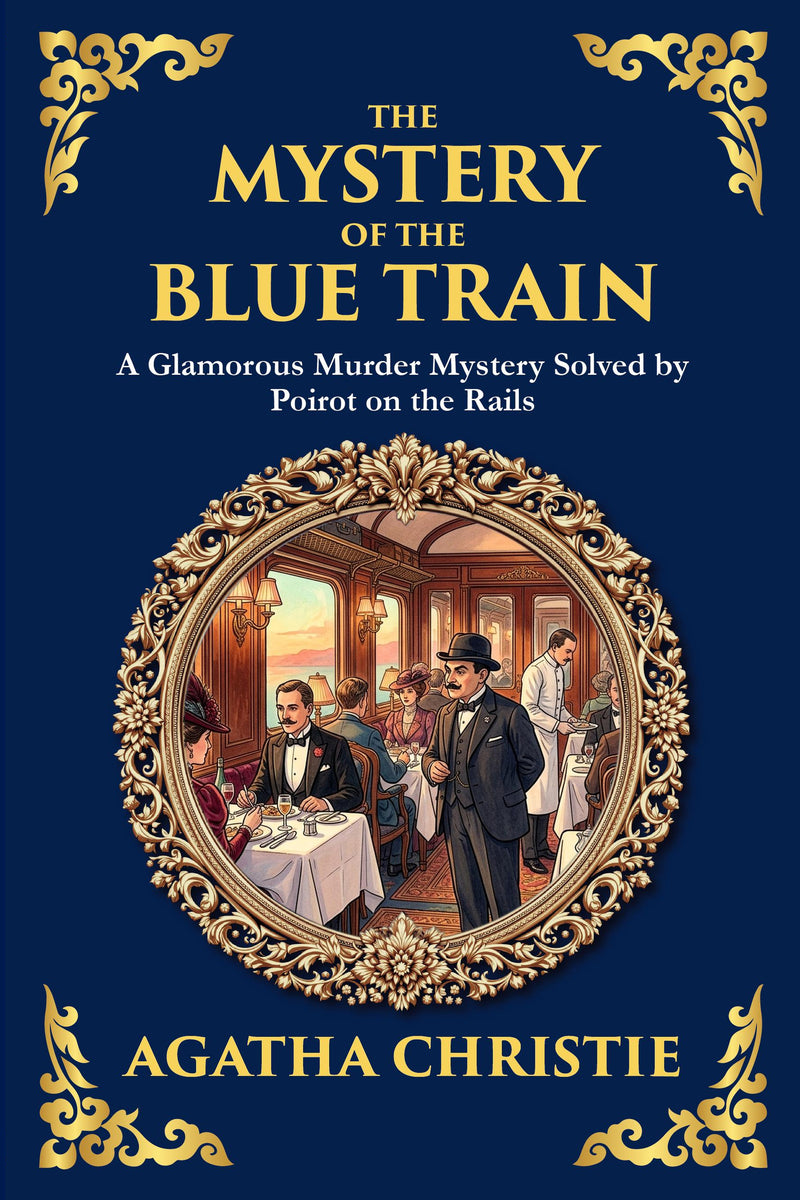
The Mystery of the Blue Train — Large Print
A luxury train, a priceless ruby, and a murdered heiress. When the opulent Blue Train departs from Calais to the French Riviera, it carries secrets—and death—within its lavish compartments.
or free app
10,000+ hrs library
30-day guarantee
The complete The Mystery of the Blue Train appears in modern English through Library of Alexandria Press, available online with audiobook narration included for members.
Have you ever wondered why the most elegant journeys hide the deadliest secrets? In The Mystery of the Blue Train, Agatha Christie brings readers a glamorous and deadly tale that unfolds aboard a fast-moving luxury train racing toward the Riviera. When the wealthy and beautiful Ruth Kettering is found strangled in her compartment, and her priceless ruby—“The Heart of Fire”—goes missing, suspicion falls on everyone from her estranged husband to mysterious fellow passengers.
Enter Hercule Poirot, who had only intended to travel in peace. With impeccable style and razor-sharp deduction, he soon finds himself embroiled in a case of stolen identity, twisted motives, and romantic entanglements that lead straight to murder. This edition offers the classic Christie experience in full: an intricate plot, vivid characters, and the ever-charismatic Poirot commanding the stage with brilliance and elegance.
What you’ll discover in this modern edition
- A Murder on the Rails – A rich heiress is killed en route to the Riviera. Only Poirot can sift through the smoke and secrets.
- An Ensemble of Mysterious Characters – Jewel thieves, scorned lovers, and socialites all become suspects in a tale of deceit.
- The Legendary Detective at Work – Witness Poirot’s logical brilliance and calm pursuit of the truth amidst high society.
- A Setting of Luxury and Suspicion – The Blue Train, filled with velvet and danger, becomes the perfect stage for crime.
- A Timeless Whodunit From the Queen of Crime – One of Christie’s most atmospheric and cleverly plotted novels.
| Formats | eBook (EPUB + PDF) · Audiobook · Paperback · Hardcover · Large Print |
| Language | English |
| Trim size (print) | 6 × 9 in |
| Binding | Paperback — perfect-bound · Hardcover — casewrap |
| Large Print edition | Same text in a larger, easy-read type — a larger font, not a larger trim |
| Print pricing | Every physical book at our true cost — at-cost, no profit (members) |
| Library | 873 restored titles, always growing |
| Length | 68,058 words · ~4 hr 32 min reading |
| Reading level | Grade 7 · an easy, flowing read (this modern-English edition) |
| Edition | Modern English translation · 2026 |
Member reviews for this edition are collected as readers finish it — be the first. Across the library: 12,000+ books shipped, every plan covered by a 365-day print guarantee.
About this edition
A faithful, unabridged modern-English edition by The Library of Alexandria — carefully rendered for today's reader and verified paragraph-by-paragraph against the public-domain source. Available as eBook, audiobook, paperback, hardcover, and large print.
- Complete & unabridgedVerified paragraph by paragraph against the source — never a scan, never abridged.
- Modern English, faithfulReadable today, with the author’s meaning kept intact. Readable — not simplified.
- Every format, one membershipRead in your browser or the free app, or listen to the full audiobook.
Included free with your membership
Cancel anytime, one click · 30-day money-back guarantee
Edition last updated July 2026
What’s inside
The Mystery of the Blue Train — Large Print — complete and unabridged: all 38 sections included with membership, plus the full audiobook.
Begin reading The Mystery of the Blue Train — Large Print
In clear modern English — the complete text is included with membership.
Introduction
There is a particular kind of pleasure that comes from boarding a train at dusk, watching the platform slide away into shadow, and surrendering yourself to the long hours of travel ahead. The world narrows to the dimensions of a corridor and a compartment; strangers become temporary companions; and the rhythm of wheels on rails lulls the mind into a state somewhere between vigilance and dream. For a few hours, you are nowhere in particular—suspended between the place you have left and the place you have not yet reached. It is in precisely this liminal world, this glittering and slightly unreal space of luxury rail travel between the wars, that Agatha Christie chose to stage one of her most atmospheric and underappreciated mysteries. The train in question is the famous Blue Train, the celebrated Train Bleu that carried the wealthy and the fashionable from the grey damp of London and Paris to the sun-warmed beaches of the French Riviera. And aboard it, as you will soon discover, something terrible is about to happen.
This edition has been prepared as a modern translation and adaptation for the contemporary reader, and it is worth pausing for a moment to explain what that means and why it matters. Agatha Christie wrote this novel in the late 1920s, in a prose that, while always clear and direct, carries the cadences and conventions of its time. Certain expressions, certain assumptions about money and class and the geography of travel, certain turns of phrase that her original readers would have absorbed without a second thought, can now create small moments of friction for the reader nearly a century later. The purpose of this adaptation is not to rewrite Christie, nor to strip away the period flavour that is so much a part of her charm. Rather, it is to smooth the path: to ensure that the wit lands as it was meant to land, that the dialogue feels alive rather than archaic, and that nothing stands between you and the pure, addictive pleasure of the puzzle. The bones of the story remain entirely Christie’s. The elegance, the misdirection, the slow tightening of the net—all of it is here, exactly as she designed it. What has changed is simply the lens through which you view it, polished and clarified so that the picture comes through with its original sharpness.
To understand why this particular book occupies such a special and somewhat poignant place in Christie’s enormous body of work, it helps to know a little about the circumstances under which it was written. This is not a story Christie remembered fondly. In fact, she came to regard it as one of the most difficult things she ever produced, and for reasons that had everything to do with the chaos of her own life at the time. The late 1920s were, for Agatha Christie, a period of profound personal upheaval. Her first marriage was collapsing in a manner that was both painful and, owing to her growing fame, distressingly public. Her mother had recently died. And she found herself, for the first time, writing not because she was seized by an irresistible idea but because she had to—because she was now a professional author with obligations, contracts, and a household to support. She later described the experience of writing this novel as one of grinding, joyless effort, of forcing the words onto the page when every part of her resisted. She said she hated it, and that she could never bring herself to reread it.
And yet—and this is one of the small, satisfying ironies of literary history—the book that Christie disliked so intensely has endured, has been loved by generations of readers, and has revealed itself over time to be far better than its own author was willing to admit. There is a lesson in this that goes beyond mere trivia. What it tells us is that Christie’s craftsmanship had become so deeply ingrained, so thoroughly a part of her instinct, that even when she was writing through grief and exhaustion and a kind of professional despair, she could not help but produce something accomplished. The machinery of the mystery still functioned beautifully. The clues were still planted with care. The solution still arrived with that characteristic snap of inevitability and surprise. If anything, knowing the difficult conditions of its creation makes the achievement more impressive. This is the work of a writer operating on pure skill, and the result is a novel that proves how formidable that skill had become.
There is one more reason this book holds a particular significance in Christie’s career, and it is a structural one that any devoted reader of mysteries will appreciate. Several of the elements you will encounter here—a certain configuration of victim and suspects, a particular way of arranging the players around a confined and moving setting, a key mechanism of deception—would later be reworked, refined, and elevated into one of the most celebrated detective novels ever written. This earlier version was, in a sense, a rehearsal. Christie was experimenting here with ideas that she would return to and perfect, and for the attentive reader who knows her work, there is a fascinating pleasure in seeing the first sketch alongside the finished masterpiece, in recognizing the seeds of later genius. But do not mistake this for a mere dry run or an inferior draft. The story stands entirely on its own. It has its own atmosphere, its own emotional weight, and its own distinct cast of characters who would not appear in any later work. It deserves to be read for itself, and not merely as a footnote to something else.
At the centre of this story stands Hercule Poirot, and what a delight it is to find him here, in a setting that suits him so perfectly. By the time of this novel, Poirot was already a beloved figure, and Christie understood her creation intimately—his vanity, his precision, his almost fussy attention to the small comforts of life, and beneath all of it, the relentless and brilliant machinery of his mind. The little Belgian detective, with his egg-shaped head, his immaculate moustaches, and his absolute faith in what he famously called the little grey cells, is a character whose appeal has never dimmed. There is something deeply reassuring about him. In a world of chaos and violence, of human passions spilling over into murder, Poirot represents order. He believes that everything can be understood, that every effect has a cause, that the truth, however cleverly concealed, can always be uncovered by the application of patient, logical thought. He does not need to chase suspects down dark alleys or wrestle weapons from killers’ hands. He sits, he observes, he listens, and he thinks. And in the end, he knows.
What makes Poirot so well suited to this particular tale is the environment in which the crime takes place. The luxury train is, in a way, the ideal Poirot setting—a closed, elegant, civilized space in which a small number of people are thrown together, where appearances matter enormously, and where the surface gleam of wealth and good manners conceals all manner of secrets. Poirot moves through this world with complete ease. He understands its codes. He appreciates fine food and good wine and well-cut clothes, and he can converse comfortably with millionaires and maids alike. But he is never deceived by glamour. He knows that behind the polished façade of the rich and the fashionable, the same dark impulses operate as anywhere else—greed, jealousy, fear, desire, and the desperate human capacity to do terrible things when cornered. Watching Poirot peel back these layers, one by one, with his unfailing courtesy and his quietly devastating intelligence, is one of the great pleasures this book has to offer.
There is also, in this novel, a quality that elevates Poirot above the level of a mere puzzle-solving machine. We are given glimpses of his compassion, his understanding of human nature, and even his philosophy of life. At certain moments, he steps outside the role of detective and becomes something closer to a wise observer of the human condition—a man who has seen a great deal of the world and has formed gentle but clear-eyed conclusions about what people want and what they fear. These passages, scattered throughout the story, give the book an emotional resonance that goes beyond the satisfaction of the solution. They remind us that Poirot’s interest is not merely in catching the guilty but in understanding the whole tangled web of human relationships from which the crime emerges. He cares about the people caught up in the tragedy, even—perhaps especially—the ones who are suffering, the ones who are afraid, the ones who have lost something precious. This warmth is one of the reasons Poirot has remained beloved for so long, and it is very much on display here.
Surrounding Poirot is a cast of characters who embody the world of the Blue Train with vivid colour. There are the very rich, with their casual command of money and their assumption that the world will arrange itself to their convenience. There are those who serve the rich, watching from the margins with their own opinions and their own ambitions. There are the adventurers and the fortune-hunters, the gamblers and the schemers, drawn to the Riviera as moths to a flame, hoping to attach themselves to wealth and bask in its glow. And then there is one young woman in particular—an ordinary person of modest means whose life is about to be transformed by an unexpected turn of fortune, and who finds herself drawn into events far darker and more dangerous than she could have imagined. Christie had a particular gift for these characters: the decent, intelligent, somewhat undervalued woman who proves to have more courage and insight than anyone around her gives her credit for. Through her eyes, we are invited into this glittering world, and her presence gives the story a human anchor amid all the wealth and intrigue. Her journey—the way she changes, the way she rises to meet the challenges placed before her—provides an emotional throughline that complements the intellectual pleasures of the mystery itself.
The other characters are drawn with Christie’s characteristic economy and precision. With a few deft strokes, she brings each one to life: a gesture, a turn of phrase, a revealing detail of dress or manner, and suddenly a whole personality stands before us. None of them is exactly what they first appear to be. This, of course, is the essence of the game. Christie understood that the pleasure of a mystery lies not only in the central question of who committed the crime, but in the gradual revelation that everyone has something to hide, that the respectable husband and the devoted servant and the charming stranger and the grieving relative all carry their own secrets, their own lies, their own reasons to fear the detective’s probing questions. Part of the joy of reading this book is the constant recalibration of suspicion—the way your certainty about one character dissolves as new information comes to light, and your attention shifts to another, and then another. Christie plays this game with a master’s hand, and she plays fair. The clues are all there, hidden in plain sight, waiting for the reader sharp enough to notice them.
To fully appreciate this novel, it is worth lingering for a moment on its setting, because the atmosphere of the Blue Train and the French Riviera is not merely a backdrop—it is essential to the mood and meaning of the entire book. The real Train Bleu was one of the most glamorous forms of travel in the world during the 1920s and 1930s. Its name came from the dark blue of its sleeping cars, and it ran from Calais and Paris down through France to the Mediterranean coast, to the playgrounds of the wealthy: Nice, Monte Carlo, the casinos and the grand hotels, the warm winters that drew the rich of northern Europe like migrating birds. To travel on the Blue Train was to announce that you belonged to a certain world—a world of money and leisure and effortless privilege. The dining cars served exquisite meals; the sleeping compartments were appointed with every comfort; the passengers dressed for dinner and gossiped over cocktails and watched the French countryside roll past their windows as they were carried, smoothly and luxuriously, from winter into spring.
Cancel anytime, one click · 30-day money-back guarantee
Founding annual rate available now — your price locks for life when you join.
Not ready? Get this free chapter by email — read it anytime.
✓ Sent — check your inbox for The Mystery of the Blue Train — Large Print.
Questions about The Mystery of the Blue Train — Large Print
What is The Mystery of the Blue Train about?
A luxury train, a priceless ruby, and a murdered heiress. When the opulent Blue Train departs from Calais to the French Riviera, it carries secrets—and death—within its lavish compartments. Among the passengers is Hercule Poirot, the legendary Belgian detective, who must untangle a web of deception, jealousy, and betrayal to uncover the killer.
Who wrote The Mystery of the Blue Train?
The Mystery of the Blue Train was written by Agatha Christie. This edition presents the complete work in clear modern English, faithfully rendered from the public-domain original by Library of Alexandria Press.
Is The Mystery of the Blue Train free to read?
The opening chapter is free to read on this page. Members read and listen to the complete work — and the entire library — free, and can order any physical book at our true print cost.
How long is The Mystery of the Blue Train?
38 chapters (~68,058 words) — about 4 hr 32 min of reading in this modern-English edition.
Is this an abridged version of The Mystery of the Blue Train?
No. This is the complete, unabridged The Mystery of the Blue Train, carefully rendered into clear modern English and verified paragraph-by-paragraph against the public-domain source — nothing is cut or summarised.
What formats does The Mystery of the Blue Train come in?
The Mystery of the Blue Train is available as eBook, paperback, hardcover and large print. eBook and audiobook are included with membership; printed editions ship at our true print cost.
Shipping & returns
Billing & membership
More from the library


Explore Mystery & Crime
- Resurrection · Leo Tolstoy
- Crime and Punishment · Fyodor Dostoyevsky
- The Strange Case of Dr. Jekyll and Mr. Hyde · Robert Louis Stevenson
- The Riddle of the Sands · Erskine Childers
- The Wisdom of Father Brown · G. K. Chesterton
- The Cask of Amontillado · Edgar Allan Poe
- The Tomb of Ts’in · Edgar Wallace
- Ghost Stories of an Antiquary · M. R. James
- The Hunniwell Boys and the Platinum Mystery · L. P. Wyman
- The Seven Dials Mystery · Agatha Christie
- The Thirty-Nine Steps · John Buchan
- The Hand in the Dark · Arthur J. Rees
- Lady Audley’s Secret · M. E. Braddon
- The Mystery of the Blue Train · Agatha Christie
- The Secret Adversary · Agatha Christie
- The Call of Cthulhu · H. P. Lovecraft
- The Adventures of Heine · Edgar Wallace
- The Valley of Fear · Arthur Conan Doyle
- The Innocence of Father Brown · G. K. Chesterton
- McTeague: A Story of San Francisco · Frank Norris
- Tess of the d’Urbervilles: A Pure Woman · Thomas Hardy
- The Big Fix · George O. Smith
- The Ambulance Made Two Trips · Murray Leinster
- Time Crime · H. Beam Piper
- The Misplaced Battleship · Harry Harrison
- Supermind · Randall Garrett and Laurence M....
- Lone Star Planet · H. Beam Piper and John J. McGuire
- Dracula · Bram Stoker
- The Murder on the Links · Agatha Christie
- The Hound of the Baskervilles · Arthur Conan Doyle
The Mystery of the Blue Train — Large Print
The Mystery of the Blue Train — Large Print
A glamorous murder mystery solved by Poirot on the rails
Agatha Christie
Contents
- Introduction
- Cast of Characters
- Chapter 1
- Chapter 2
- Chapter 3
- Chapter 4
- Chapter 5
- Chapter 6
- Chapter 7
- Chapter 8
- Chapter 9
- Chapter 10
- Chapter 11
- Chapter 12
- Chapter 13
- Chapter 14
- Chapter 15
- Chapter 16
- Chapter 17
- Chapter 18
- Chapter 19
- Chapter 20
- Chapter 21
- Chapter 22
- Chapter 23
- Chapter 24
- Chapter 25
- Chapter 26
- Chapter 27
- Chapter 28
- Chapter 29
- Chapter 30
- Chapter 31
- Chapter 32
- Chapter 33
- Chapter 34
- Chapter 35
- Chapter 36
Introduction
There is a particular kind of pleasure that comes from boarding a train at dusk, watching the platform slide away into shadow, and surrendering yourself to the long hours of travel ahead. The world narrows to the dimensions of a corridor and a compartment; strangers become temporary companions; and the rhythm of wheels on rails lulls the mind into a state somewhere between vigilance and dream. For a few hours, you are nowhere in particular—suspended between the place you have left and the place you have not yet reached. It is in precisely this liminal world, this glittering and slightly unreal space of luxury rail travel between the wars, that Agatha Christie chose to stage one of her most atmospheric and underappreciated mysteries. The train in question is the famous Blue Train, the celebrated Train Bleu that carried the wealthy and the fashionable from the grey damp of London and Paris to the sun-warmed beaches of the French Riviera. And aboard it, as you will soon discover, something terrible is about to happen.
This edition has been prepared as a modern translation and adaptation for the contemporary reader, and it is worth pausing for a moment to explain what that means and why it matters. Agatha Christie wrote this novel in the late 1920s, in a prose that, while always clear and direct, carries the cadences and conventions of its time. Certain expressions, certain assumptions about money and class and the geography of travel, certain turns of phrase that her original readers would have absorbed without a second thought, can now create small moments of friction for the reader nearly a century later. The purpose of this adaptation is not to rewrite Christie, nor to strip away the period flavour that is so much a part of her charm. Rather, it is to smooth the path: to ensure that the wit lands as it was meant to land, that the dialogue feels alive rather than archaic, and that nothing stands between you and the pure, addictive pleasure of the puzzle. The bones of the story remain entirely Christie’s. The elegance, the misdirection, the slow tightening of the net—all of it is here, exactly as she designed it. What has changed is simply the lens through which you view it, polished and clarified so that the picture comes through with its original sharpness.
To understand why this particular book occupies such a special and somewhat poignant place in Christie’s enormous body of work, it helps to know a little about the circumstances under which it was written. This is not a story Christie remembered fondly. In fact, she came to regard it as one of the most difficult things she ever produced, and for reasons that had everything to do with the chaos of her own life at the time. The late 1920s were, for Agatha Christie, a period of profound personal upheaval. Her first marriage was collapsing in a manner that was both painful and, owing to her growing fame, distressingly public. Her mother had recently died. And she found herself, for the first time, writing not because she was seized by an irresistible idea but because she had to—because she was now a professional author with obligations, contracts, and a household to support. She later described the experience of writing this novel as one of grinding, joyless effort, of forcing the words onto the page when every part of her resisted. She said she hated it, and that she could never bring herself to reread it.
And yet—and this is one of the small, satisfying ironies of literary history—the book that Christie disliked so intensely has endured, has been loved by generations of readers, and has revealed itself over time to be far better than its own author was willing to admit. There is a lesson in this that goes beyond mere trivia. What it tells us is that Christie’s craftsmanship had become so deeply ingrained, so thoroughly a part of her instinct, that even when she was writing through grief and exhaustion and a kind of professional despair, she could not help but produce something accomplished. The machinery of the mystery still functioned beautifully. The clues were still planted with care. The solution still arrived with that characteristic snap of inevitability and surprise. If anything, knowing the difficult conditions of its creation makes the achievement more impressive. This is the work of a writer operating on pure skill, and the result is a novel that proves how formidable that skill had become.
There is one more reason this book holds a particular significance in Christie’s career, and it is a structural one that any devoted reader of mysteries will appreciate. Several of the elements you will encounter here—a certain configuration of victim and suspects, a particular way of arranging the players around a confined and moving setting, a key mechanism of deception—would later be reworked, refined, and elevated into one of the most celebrated detective novels ever written. This earlier version was, in a sense, a rehearsal. Christie was experimenting here with ideas that she would return to and perfect, and for the attentive reader who knows her work, there is a fascinating pleasure in seeing the first sketch alongside the finished masterpiece, in recognizing the seeds of later genius. But do not mistake this for a mere dry run or an inferior draft. The story stands entirely on its own. It has its own atmosphere, its own emotional weight, and its own distinct cast of characters who would not appear in any later work. It deserves to be read for itself, and not merely as a footnote to something else.
At the centre of this story stands Hercule Poirot, and what a delight it is to find him here, in a setting that suits him so perfectly. By the time of this novel, Poirot was already a beloved figure, and Christie understood her creation intimately—his vanity, his precision, his almost fussy attention to the small comforts of life, and beneath all of it, the relentless and brilliant machinery of his mind. The little Belgian detective, with his egg-shaped head, his immaculate moustaches, and his absolute faith in what he famously called the little grey cells, is a character whose appeal has never dimmed. There is something deeply reassuring about him. In a world of chaos and violence, of human passions spilling over into murder, Poirot represents order. He believes that everything can be understood, that every effect has a cause, that the truth, however cleverly concealed, can always be uncovered by the application of patient, logical thought. He does not need to chase suspects down dark alleys or wrestle weapons from killers’ hands. He sits, he observes, he listens, and he thinks. And in the end, he knows.
What makes Poirot so well suited to this particular tale is the environment in which the crime takes place. The luxury train is, in a way, the ideal Poirot setting—a closed, elegant, civilized space in which a small number of people are thrown together, where appearances matter enormously, and where the surface gleam of wealth and good manners conceals all manner of secrets. Poirot moves through this world with complete ease. He understands its codes. He appreciates fine food and good wine and well-cut clothes, and he can converse comfortably with millionaires and maids alike. But he is never deceived by glamour. He knows that behind the polished façade of the rich and the fashionable, the same dark impulses operate as anywhere else—greed, jealousy, fear, desire, and the desperate human capacity to do terrible things when cornered. Watching Poirot peel back these layers, one by one, with his unfailing courtesy and his quietly devastating intelligence, is one of the great pleasures this book has to offer.
There is also, in this novel, a quality that elevates Poirot above the level of a mere puzzle-solving machine. We are given glimpses of his compassion, his understanding of human nature, and even his philosophy of life. At certain moments, he steps outside the role of detective and becomes something closer to a wise observer of the human condition—a man who has seen a great deal of the world and has formed gentle but clear-eyed conclusions about what people want and what they fear. These passages, scattered throughout the story, give the book an emotional resonance that goes beyond the satisfaction of the solution. They remind us that Poirot’s interest is not merely in catching the guilty but in understanding the whole tangled web of human relationships from which the crime emerges. He cares about the people caught up in the tragedy, even—perhaps especially—the ones who are suffering, the ones who are afraid, the ones who have lost something precious. This warmth is one of the reasons Poirot has remained beloved for so long, and it is very much on display here.
Surrounding Poirot is a cast of characters who embody the world of the Blue Train with vivid colour. There are the very rich, with their casual command of money and their assumption that the world will arrange itself to their convenience. There are those who serve the rich, watching from the margins with their own opinions and their own ambitions. There are the adventurers and the fortune-hunters, the gamblers and the schemers, drawn to the Riviera as moths to a flame, hoping to attach themselves to wealth and bask in its glow. And then there is one young woman in particular—an ordinary person of modest means whose life is about to be transformed by an unexpected turn of fortune, and who finds herself drawn into events far darker and more dangerous than she could have imagined. Christie had a particular gift for these characters: the decent, intelligent, somewhat undervalued woman who proves to have more courage and insight than anyone around her gives her credit for. Through her eyes, we are invited into this glittering world, and her presence gives the story a human anchor amid all the wealth and intrigue. Her journey—the way she changes, the way she rises to meet the challenges placed before her—provides an emotional throughline that complements the intellectual pleasures of the mystery itself.
The other characters are drawn with Christie’s characteristic economy and precision. With a few deft strokes, she brings each one to life: a gesture, a turn of phrase, a revealing detail of dress or manner, and suddenly a whole personality stands before us. None of them is exactly what they first appear to be. This, of course, is the essence of the game. Christie understood that the pleasure of a mystery lies not only in the central question of who committed the crime, but in the gradual revelation that everyone has something to hide, that the respectable husband and the devoted servant and the charming stranger and the grieving relative all carry their own secrets, their own lies, their own reasons to fear the detective’s probing questions. Part of the joy of reading this book is the constant recalibration of suspicion—the way your certainty about one character dissolves as new information comes to light, and your attention shifts to another, and then another. Christie plays this game with a master’s hand, and she plays fair. The clues are all there, hidden in plain sight, waiting for the reader sharp enough to notice them.
To fully appreciate this novel, it is worth lingering for a moment on its setting, because the atmosphere of the Blue Train and the French Riviera is not merely a backdrop—it is essential to the mood and meaning of the entire book. The real Train Bleu was one of the most glamorous forms of travel in the world during the 1920s and 1930s. Its name came from the dark blue of its sleeping cars, and it ran from Calais and Paris down through France to the Mediterranean coast, to the playgrounds of the wealthy: Nice, Monte Carlo, the casinos and the grand hotels, the warm winters that drew the rich of northern Europe like migrating birds. To travel on the Blue Train was to announce that you belonged to a certain world—a world of money and leisure and effortless privilege. The dining cars served exquisite meals; the sleeping compartments were appointed with every comfort; the passengers dressed for dinner and gossiped over cocktails and watched the French countryside roll past their windows as they were carried, smoothly and luxuriously, from winter into spring.
It was almost midnight when a man walked across the Place de la Concorde. Despite the expensive fur coat covering his thin frame, he seemed fundamentally weak and insignificant.
He was a small man with a face like a rat. He looked like someone who could never be noticed or become important in any field. However, anyone who jumped to that conclusion would be mistaken. Despite appearing insignificant and unremarkable, this man played a major role in the fate of the world. In an empire ruled by rats, he was their king.
Even now, an embassy was waiting for him to return. But he had other business to attend to first—work that the embassy didn’t officially know about. His face looked pale and sharp under the moonlight. His thin nose was almost perfectly straight. His father had been a Polish Jew who worked as a freelance tailor. It was the kind of shady business his father would have loved that brought him abroad tonight.
He reached the Seine, crossed the river, and entered one of the seedier districts of Paris. He stopped in front of a tall, crumbling house and went up to a fourth-floor apartment. He had barely knocked before a woman, who had clearly been expecting him, opened the door. She didn’t greet him; instead, she helped him take off his overcoat and led him into a cheaply decorated living room. The electric light was covered with dirty pink fringes, which softened but failed to hide the girl’s heavily made-up face. It also couldn’t hide her distinct Mongolian features. There was no mistaking Olga Demiroff’s profession or her nationality.
He nodded and whispered, “I don’t believe anyone followed me.”
End of the free sample
Keep reading, free
Members read and listen to the complete book — and the entire library. Cancel anytime, one click · 30-day money-back guarantee.