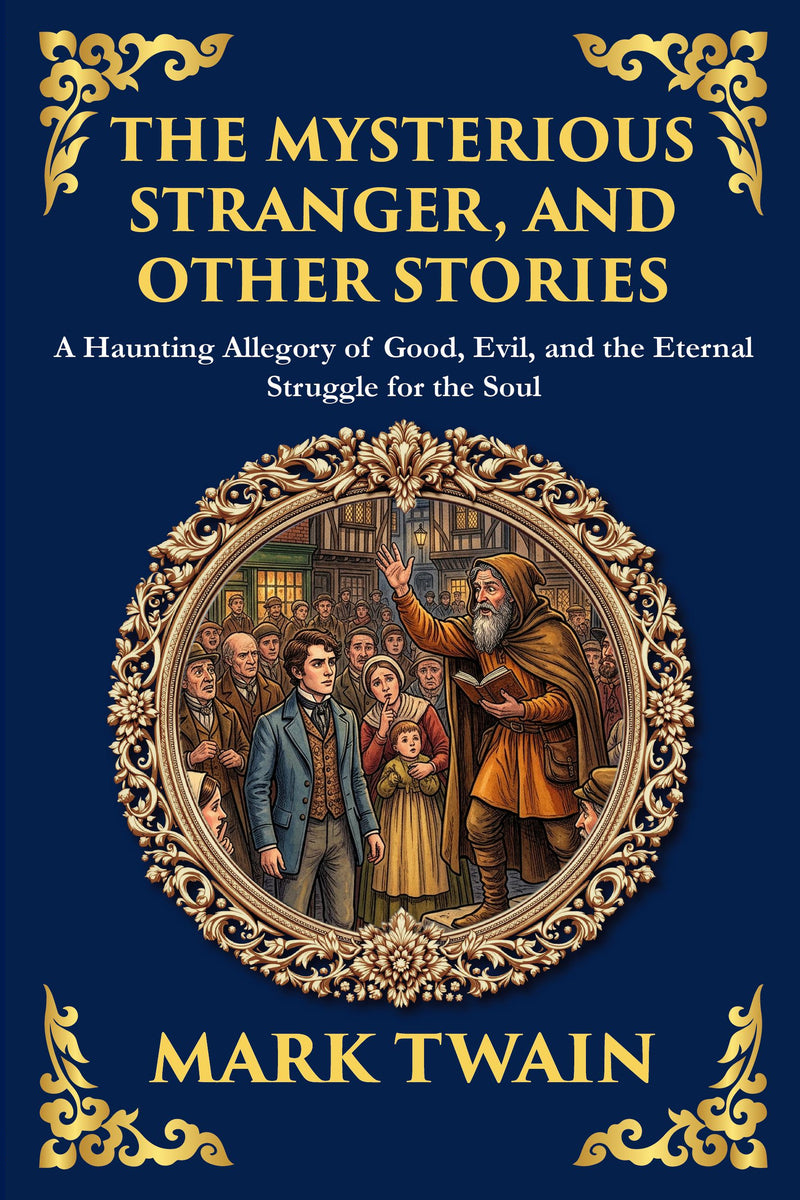
The Mysterious Stranger and Other Stories — Large Print
In The Mysterious Stranger, and Other Stories, Mark Twain delves into the darkest depths of human nature with wit, irony, and unflinching honesty.
or free app
10,000+ hrs library
30-day guarantee
The complete The Mysterious Stranger, and Other appears in modern English through Library of Alexandria Press, available online with audiobook narration included for members.
Have you ever wondered why the eternal struggle between good and evil lives within us all? Mark Twain’s The Mysterious Stranger, and Other Stories is far more than a collection of tales— it is a haunting exploration of morality, faith, and the human condition. With his trademark wit and biting satire, Twain invites readers to confront uncomfortable truths about society, belief, and the illusions we cling to.
At the heart of this collection lies The Mysterious Stranger, Twain’s unfinished masterpiece in which a supernatural being questions mankind’s morality, free will, and very existence. Accompanied by other powerful stories, this book reveals Twain at his most daring, weaving together irony, humor, and piercing philosophical insight.
What you’ll discover in this modern edition
- The Mysterious Stranger – A chilling allegory of good, evil, and the fragile illusions of human existence.
- A Fable – A satirical parable that examines truth, perception, and the limits of knowledge.
- The Man That Corrupted Hadleyburg – A scathing indictment of greed, hypocrisy, and moral weakness in a so-called “virtuous” town.
- Extracts from Adam’s Diary & Eve’s Diary – Poignant and humorous reflections on love, humanity, and the beginnings of life itself.
- Twain’s Darkest and Boldest Vision – A rare look at the author’s philosophical depth, questioning morality, faith, and human destiny.
| Formats | eBook (EPUB + PDF) · Audiobook · Paperback · Hardcover · Large Print |
| Language | English |
| Trim size (print) | 6 × 9 in |
| Binding | Paperback — perfect-bound · Hardcover — casewrap |
| Large Print edition | Same text in a larger, easy-read type — a larger font, not a larger trim |
| Print pricing | Every physical book at our true cost — at-cost, no profit (members) |
| Library | 873 restored titles, always growing |
| Length | 41,650 words · ~2 hr 47 min reading |
| Reading level | Grade 7 · an easy, flowing read (this modern-English edition) |
| Edition | Modern English translation · 2026 |
Member reviews for this edition are collected as readers finish it — be the first. Across the library: 12,000+ books shipped, every plan covered by a 365-day print guarantee.
About this edition
A faithful, unabridged modern-English edition by The Library of Alexandria — carefully rendered for today's reader and verified paragraph-by-paragraph against the public-domain source. Available as eBook, audiobook, paperback, hardcover, and large print.
- Complete & unabridgedVerified paragraph by paragraph against the source — never a scan, never abridged.
- Modern English, faithfulReadable today, with the author’s meaning kept intact. Readable — not simplified.
- Every format, one membershipRead in your browser or the free app, or listen to the full audiobook.
Included free with your membership
Cancel anytime, one click · 30-day money-back guarantee
Edition last updated July 2026
What’s inside
The Mysterious Stranger and Other Stories — Large Print — complete and unabridged: all 15 sections included with membership, plus the full audiobook.
Begin reading The Mysterious Stranger and Other Stories — Large Print
In clear modern English — the complete text is included with membership.
Introduction
There is a particular kind of literary experience that lingers long after the final page is turned—one that unsettles even as it enchants, that asks more questions than it answers, and that refuses to release its grip on the imagination. The Mysterious Stranger belongs firmly to this rare category. It is a work that arrives unexpectedly from a writer the world thought it knew completely, a writer celebrated for his warmth, his rolling humor, and his affection for the wide American river country of his youth. Yet here, in these darker and more philosophically daring pages, that same beloved author reveals a side of himself few of his contemporaries ever glimpsed: a thinker wrestling with the deepest and most disquieting questions about existence, morality, faith, and the very nature of reality itself.
To open this volume is to encounter Mark Twain not as the genial humorist of riverboats and small-town mischief, but as a mind grown weary of easy comforts and determined to look unflinchingly into the shadows that crowd the edges of human life. The collection gathered here represents some of the most ambitious and provocative work Twain ever attempted—work that he labored over for years, returning to it again and again, drafting and redrafting, never fully satisfied, and ultimately leaving behind a body of writing that has fascinated, troubled, and inspired readers for more than a century. This modern translation, carefully adapted for the contemporary reader, aims to bring that extraordinary achievement into clearer focus, smoothing the obstacles of archaic phrasing and dated reference so that the timeless power of Twain’s vision can shine through unobstructed.
To understand why these stories matter—and why they feel so startlingly different from the works that made their author famous—one must first understand something about the life that produced them. Samuel Langhorne Clemens, who adopted the pen name Mark Twain from the language of riverboat pilots measuring safe water, was by the latter decades of his life one of the most recognized and beloved figures in the entire English-speaking world. His face, framed by that famous shock of white hair and bristling mustache, was as familiar as any politician’s. His books had carried readers down the Mississippi, into the courts of medieval England, across the deserts and mining camps of the American West, and through the comic misadventures of innocents abroad. He was a public man, a performer, a lecturer who could fill halls and reduce audiences to helpless laughter with a single deadpan observation.
But behind that public mask lay a private grief that grew heavier with each passing year. Twain had known extraordinary success, but he had also known catastrophic loss. He suffered financial ruin from disastrous investments that wiped out his fortune and forced him into exhausting lecture tours to repay his debts. More devastating still were the personal losses: the death of his beloved daughter Susy from meningitis while he was abroad, the slow decline of his wife Olivia, and later the death of another daughter. These blows fell one after another upon a man already inclined toward melancholy beneath his sparkling wit, and they transformed his vision of the world.
The Twain of these later years was a man increasingly preoccupied with the largest questions human beings can ask. What is the meaning of suffering? Is there a benevolent power governing the universe, or merely indifference, or worse? Are human beings genuinely free, or are they bound by forces—biological, social, divine—over which they have no control? Is there any real distinction between dreaming and waking, between what we call reality and what we call illusion? These were not idle musings. They were the urgent inquiries of a brilliant mind grappling with grief, disillusionment, and the encroaching awareness of his own mortality.
It was in this state of mind that Twain turned, repeatedly and obsessively, to the material that forms the heart of this collection. He worked on these stories across many years, producing multiple versions, shifting his settings and characters, never quite achieving the resolution he sought. The result is a body of work unlike anything else in his catalogue—work that strips away the comforting reassurances of conventional belief and dares to confront the reader with possibilities both beautiful and terrifying. Where his earlier writing had often used humor as a tool of gentle satire, the humor here is sharper, more ironic, sometimes mordant, frequently shadowed by something close to despair. And yet there is also a strange exhilaration in these pages, a sense of liberation that comes from a writer who has finally given himself permission to say exactly what he thinks about the universe and the place of humanity within it.
For readers accustomed to the sunny mischief of Twain’s most famous boyhood adventures, this can come as a profound surprise. But it is a surprise worth embracing, for it reveals the full dimensions of a genius too often reduced to a single comic register. The man who could make the world laugh was also a man who could make it tremble, and the tales collected here represent his most sustained effort to do precisely that.
What makes these works so compelling is not merely their darkness but their intelligence and their courage. Twain was writing against the grain of his time, challenging the easy pieties and confident optimism of an era that liked to believe in inevitable progress and moral order. He asks his readers to question assumptions they may never have thought to examine, to consider the universe from angles that feel dizzying and dangerous, and to entertain ideas that even now retain their capacity to provoke. There is a fearlessness in this that commands respect. Twain had nothing left to lose and everything to say, and he said it with all the force of a master craftsman at the height of his powers, even as those powers turned toward subjects he had never before allowed himself to fully explore.
The central narrative that gives this volume its title is, in its most enduring form, set in a small village in a faraway place and time, far removed from the American landscapes Twain knew so well. This distancing was deliberate and significant. By removing the action to a setting both ancient and somehow timeless, Twain freed himself to speak in the language of fable and allegory, to construct a story that operates less like a conventional narrative and more like a parable—a tale designed to illuminate truths that ordinary realism could never reach. The reader who enters this world should be prepared to surrender certain expectations and to allow the story to work on a deeper, more symbolic level than mere plot might suggest.
One of the most remarkable qualities of this collection is its refusal to provide the kind of tidy resolution that readers so often crave and that lesser writers so readily supply. Twain was not interested in comfort. He was interested in truth, or at least in the relentless pursuit of it, and truth, as he had come to understand it through hard experience, rarely arrives in neat packages. The stories here pose their questions with extraordinary force and then leave them open, hovering, unresolved—not out of carelessness but out of a profound honesty about the limits of human understanding.
This is, perhaps, the single most important thing a new reader should know before beginning. These are not stories that will hand you a moral wrapped in a bow. They are stories that will challenge you, that will make you uncomfortable, that may even disturb your sleep. The title of this edition speaks of an allegory concerning good, evil, and the eternal struggle for the soul, and that is an apt description—but it would be a mistake to imagine that Twain offers any simple verdict in that struggle. Instead, he dramatizes the conflict in all its complexity, refusing to let either side claim an easy victory, and forcing the reader to grapple with the implications.
The figure of the stranger who gives the central work its name is one of the most fascinating creations in all of American literature. Mysterious indeed, this character moves through the narrative with a curious blend of charm and detachment, possessing abilities and perspectives that lie far beyond the ordinary human scale. The interactions between this enigmatic visitor and the villagers—particularly the young narrators through whose eyes much of the story unfolds—form the dramatic and philosophical core of the work. Through these encounters, Twain explores questions about power, knowledge, morality, and the vast gulf that separates human concerns from the cosmic perspective.
What gives these encounters their peculiar potency is the way they upend conventional expectations about wisdom and benevolence. The stranger is, in many ways, a teacher, but the lessons he offers are not the comforting ones we might expect. He sees the world from a vantage point so elevated that human suffering and human striving appear in an entirely new and often unsettling light. The reader is invited to share this vantage point, to step outside the familiar frame of human assumptions and to view existence as it might appear to a being unbound by the ordinary constraints of mortality, fear, and hope. It is a vertiginous experience, and Twain handles it with consummate skill, balancing moments of wonder and beauty against passages of genuine horror and bleak revelation.
The boys who befriend the stranger serve as essential anchors for the reader. Through their innocence, their curiosity, and their gradual, sometimes painful education, we experience the unfolding of the story’s deeper meanings. Twain understood that the encounter between innocence and devastating knowledge is one of the most powerful themes available to literature, and he exploits it here with remarkable subtlety. The friendship between the young narrator and the mysterious visitor is by turns delightful and troubling, marked by moments of genuine warmth alongside revelations that strip away the comforting illusions of childhood. This tension—between affection and dread, between the desire to understand and the fear of what understanding might bring—drives the narrative forward and gives it its haunting emotional resonance.
It would be a disservice to reveal more about the specific events that unfold, for much of the power of this work lies in the experience of discovery, in following the story’s surprising and often shocking turns without foreknowledge. Suffice it to say that Twain takes his readers on a journey that ranges from the everyday concerns of village life to the most exalted heights of philosophical speculation, and that the conclusion—or rather, the various conclusions, given the work’s complex textual history—delivers a final revelation that has the power to reorganize everything that came before it. This is storytelling of the highest order, in which every element serves the larger design, and in which the ending casts new light back across the entire narrative.
The additional stories gathered in this volume complement the central work, expanding and deepening its themes while showcasing the range of Twain’s late imagination. These pieces share the title work’s preoccupation with the fundamental questions of human existence, but they approach those questions from varied angles, employing different settings, characters, and narrative strategies. Together, they form a coherent body of meditation on the mysteries that troubled Twain in his final creative years—the nature of conscience, the reliability of moral judgment, the relationship between dream and reality, and the disquieting possibility that much of what we take for granted about our lives may be illusion. Reading them in sequence allows one to trace the contours of a mind in vigorous engagement with ideas that have occupied philosophers and theologians for millennia, but rendered here in the vivid, concrete, unforgettable language of a born storyteller.
Cancel anytime, one click · 30-day money-back guarantee
Founding annual rate available now — your price locks for life when you join.
Not ready? Get this free chapter by email — read it anytime.
✓ Sent — check your inbox for The Mysterious Stranger and Other Stories — Large Print.
Questions about The Mysterious Stranger and Other Stories — Large Print
What is The Mysterious Stranger, and Other about?
In The Mysterious Stranger, and Other Stories, Mark Twain delves into the darkest depths of human nature with wit, irony, and unflinching honesty. The haunting tale of a supernatural visitor who challenges humanity’s illusions is joined by other powerful works that explore morality, truth, and the frailties of the human soul. By turns unsettling, satirical, and deeply thought- provoking, this collection showcases Twain not only as America’s great humorist but also as one of its most profound philosophers.
Who wrote The Mysterious Stranger, and Other?
The Mysterious Stranger, and Other was written by Mark Twain. This edition presents the complete work in clear modern English, faithfully rendered from the public-domain original by Library of Alexandria Press.
Is The Mysterious Stranger, and Other free to read?
The opening chapter is free to read on this page. Members read and listen to the complete work — and the entire library — free, and can order any physical book at our true print cost.
How long is The Mysterious Stranger, and Other?
15 chapters (~41,650 words) — about 2 hr 47 min of reading in this modern-English edition.
Is this an abridged version of The Mysterious Stranger, and Other?
No. This is the complete, unabridged The Mysterious Stranger, and Other, carefully rendered into clear modern English and verified paragraph-by-paragraph against the public-domain source — nothing is cut or summarised.
What formats does The Mysterious Stranger, and Other come in?
The Mysterious Stranger, and Other is available as eBook, paperback, hardcover and large print. eBook and audiobook are included with membership; printed editions ship at our true print cost.
Shipping & returns
Billing & membership
More from the library


Explore Humour & Satire
- The Imaginary Invalid · Molière
- My Man Jeeves · P. G. Wodehouse
- Barry Lyndon · William Makepeace Thackeray
- The Man with Two Left Feet, and Other Stories · P. G. Wodehouse
- Carry On, Jeeves · P. G. Wodehouse
- The Confidence-Man: His Masquerade · Herman Melville
- Lucian’s True History · Lucian of Samosata
- Penrod · Booth Tarkington
- Status Quo · Mack Reynolds
- Herland · Charlotte Perkins Gilman
- Sartor Resartus: The Life and Opinions of Herr Teufelsdröckh · Thomas Carlyle
- The Satyricon of Petronius Arbiter · Petronius Arbiter
- Three Men in a Boat (To Say Nothing of the Dog) · Jerome K. Jerome
- A Connecticut Yankee in King Arthur’s Court · Mark Twain
- Northanger Abbey · Jane Austen
- Once Aboard the Lugger—The History of George and his Mary · A. S. M. Hutchinson
- Candide · Voltaire
- Gulliver’s Travels into Several Remote Regions of the World · Jonathan Swift
- Emma · Jane Austen
- A Room with a View · E. M. Forster
- The Eyes Have It · Philip K. Dick
- The Wind in the Willows · Kenneth Grahame
- Right Ho, Jeeves · P. G. Wodehouse
- The Mysterious Stranger and Other Stories · Mark Twain
- A Modest Proposal · Jonathan Swift
The Mysterious Stranger and Other Stories — Large Print
The Mysterious Stranger and Other Stories — Large Print
A Haunting Allegory of Good, Evil, and the Eternal Struggle for the Soul
Mark Twain
Contents
- Introduction
- Chapter 1
- Chapter 2
- Chapter 3
- Chapter 4
- Chapter 5
- Chapter 6
- Chapter 7
- Chapter 8
- Chapter 9
- Chapter 10
- Chapter 11
- Chapter 12
- Chapter 13
- Chapter 14
Introduction
There is a particular kind of literary experience that lingers long after the final page is turned—one that unsettles even as it enchants, that asks more questions than it answers, and that refuses to release its grip on the imagination. The Mysterious Stranger belongs firmly to this rare category. It is a work that arrives unexpectedly from a writer the world thought it knew completely, a writer celebrated for his warmth, his rolling humor, and his affection for the wide American river country of his youth. Yet here, in these darker and more philosophically daring pages, that same beloved author reveals a side of himself few of his contemporaries ever glimpsed: a thinker wrestling with the deepest and most disquieting questions about existence, morality, faith, and the very nature of reality itself.
To open this volume is to encounter Mark Twain not as the genial humorist of riverboats and small-town mischief, but as a mind grown weary of easy comforts and determined to look unflinchingly into the shadows that crowd the edges of human life. The collection gathered here represents some of the most ambitious and provocative work Twain ever attempted—work that he labored over for years, returning to it again and again, drafting and redrafting, never fully satisfied, and ultimately leaving behind a body of writing that has fascinated, troubled, and inspired readers for more than a century. This modern translation, carefully adapted for the contemporary reader, aims to bring that extraordinary achievement into clearer focus, smoothing the obstacles of archaic phrasing and dated reference so that the timeless power of Twain’s vision can shine through unobstructed.
To understand why these stories matter—and why they feel so startlingly different from the works that made their author famous—one must first understand something about the life that produced them. Samuel Langhorne Clemens, who adopted the pen name Mark Twain from the language of riverboat pilots measuring safe water, was by the latter decades of his life one of the most recognized and beloved figures in the entire English-speaking world. His face, framed by that famous shock of white hair and bristling mustache, was as familiar as any politician’s. His books had carried readers down the Mississippi, into the courts of medieval England, across the deserts and mining camps of the American West, and through the comic misadventures of innocents abroad. He was a public man, a performer, a lecturer who could fill halls and reduce audiences to helpless laughter with a single deadpan observation.
But behind that public mask lay a private grief that grew heavier with each passing year. Twain had known extraordinary success, but he had also known catastrophic loss. He suffered financial ruin from disastrous investments that wiped out his fortune and forced him into exhausting lecture tours to repay his debts. More devastating still were the personal losses: the death of his beloved daughter Susy from meningitis while he was abroad, the slow decline of his wife Olivia, and later the death of another daughter. These blows fell one after another upon a man already inclined toward melancholy beneath his sparkling wit, and they transformed his vision of the world.
The Twain of these later years was a man increasingly preoccupied with the largest questions human beings can ask. What is the meaning of suffering? Is there a benevolent power governing the universe, or merely indifference, or worse? Are human beings genuinely free, or are they bound by forces—biological, social, divine—over which they have no control? Is there any real distinction between dreaming and waking, between what we call reality and what we call illusion? These were not idle musings. They were the urgent inquiries of a brilliant mind grappling with grief, disillusionment, and the encroaching awareness of his own mortality.
It was in this state of mind that Twain turned, repeatedly and obsessively, to the material that forms the heart of this collection. He worked on these stories across many years, producing multiple versions, shifting his settings and characters, never quite achieving the resolution he sought. The result is a body of work unlike anything else in his catalogue—work that strips away the comforting reassurances of conventional belief and dares to confront the reader with possibilities both beautiful and terrifying. Where his earlier writing had often used humor as a tool of gentle satire, the humor here is sharper, more ironic, sometimes mordant, frequently shadowed by something close to despair. And yet there is also a strange exhilaration in these pages, a sense of liberation that comes from a writer who has finally given himself permission to say exactly what he thinks about the universe and the place of humanity within it.
For readers accustomed to the sunny mischief of Twain’s most famous boyhood adventures, this can come as a profound surprise. But it is a surprise worth embracing, for it reveals the full dimensions of a genius too often reduced to a single comic register. The man who could make the world laugh was also a man who could make it tremble, and the tales collected here represent his most sustained effort to do precisely that.
What makes these works so compelling is not merely their darkness but their intelligence and their courage. Twain was writing against the grain of his time, challenging the easy pieties and confident optimism of an era that liked to believe in inevitable progress and moral order. He asks his readers to question assumptions they may never have thought to examine, to consider the universe from angles that feel dizzying and dangerous, and to entertain ideas that even now retain their capacity to provoke. There is a fearlessness in this that commands respect. Twain had nothing left to lose and everything to say, and he said it with all the force of a master craftsman at the height of his powers, even as those powers turned toward subjects he had never before allowed himself to fully explore.
The central narrative that gives this volume its title is, in its most enduring form, set in a small village in a faraway place and time, far removed from the American landscapes Twain knew so well. This distancing was deliberate and significant. By removing the action to a setting both ancient and somehow timeless, Twain freed himself to speak in the language of fable and allegory, to construct a story that operates less like a conventional narrative and more like a parable—a tale designed to illuminate truths that ordinary realism could never reach. The reader who enters this world should be prepared to surrender certain expectations and to allow the story to work on a deeper, more symbolic level than mere plot might suggest.
One of the most remarkable qualities of this collection is its refusal to provide the kind of tidy resolution that readers so often crave and that lesser writers so readily supply. Twain was not interested in comfort. He was interested in truth, or at least in the relentless pursuit of it, and truth, as he had come to understand it through hard experience, rarely arrives in neat packages. The stories here pose their questions with extraordinary force and then leave them open, hovering, unresolved—not out of carelessness but out of a profound honesty about the limits of human understanding.
This is, perhaps, the single most important thing a new reader should know before beginning. These are not stories that will hand you a moral wrapped in a bow. They are stories that will challenge you, that will make you uncomfortable, that may even disturb your sleep. The title of this edition speaks of an allegory concerning good, evil, and the eternal struggle for the soul, and that is an apt description—but it would be a mistake to imagine that Twain offers any simple verdict in that struggle. Instead, he dramatizes the conflict in all its complexity, refusing to let either side claim an easy victory, and forcing the reader to grapple with the implications.
The figure of the stranger who gives the central work its name is one of the most fascinating creations in all of American literature. Mysterious indeed, this character moves through the narrative with a curious blend of charm and detachment, possessing abilities and perspectives that lie far beyond the ordinary human scale. The interactions between this enigmatic visitor and the villagers—particularly the young narrators through whose eyes much of the story unfolds—form the dramatic and philosophical core of the work. Through these encounters, Twain explores questions about power, knowledge, morality, and the vast gulf that separates human concerns from the cosmic perspective.
What gives these encounters their peculiar potency is the way they upend conventional expectations about wisdom and benevolence. The stranger is, in many ways, a teacher, but the lessons he offers are not the comforting ones we might expect. He sees the world from a vantage point so elevated that human suffering and human striving appear in an entirely new and often unsettling light. The reader is invited to share this vantage point, to step outside the familiar frame of human assumptions and to view existence as it might appear to a being unbound by the ordinary constraints of mortality, fear, and hope. It is a vertiginous experience, and Twain handles it with consummate skill, balancing moments of wonder and beauty against passages of genuine horror and bleak revelation.
The boys who befriend the stranger serve as essential anchors for the reader. Through their innocence, their curiosity, and their gradual, sometimes painful education, we experience the unfolding of the story’s deeper meanings. Twain understood that the encounter between innocence and devastating knowledge is one of the most powerful themes available to literature, and he exploits it here with remarkable subtlety. The friendship between the young narrator and the mysterious visitor is by turns delightful and troubling, marked by moments of genuine warmth alongside revelations that strip away the comforting illusions of childhood. This tension—between affection and dread, between the desire to understand and the fear of what understanding might bring—drives the narrative forward and gives it its haunting emotional resonance.
It would be a disservice to reveal more about the specific events that unfold, for much of the power of this work lies in the experience of discovery, in following the story’s surprising and often shocking turns without foreknowledge. Suffice it to say that Twain takes his readers on a journey that ranges from the everyday concerns of village life to the most exalted heights of philosophical speculation, and that the conclusion—or rather, the various conclusions, given the work’s complex textual history—delivers a final revelation that has the power to reorganize everything that came before it. This is storytelling of the highest order, in which every element serves the larger design, and in which the ending casts new light back across the entire narrative.
The additional stories gathered in this volume complement the central work, expanding and deepening its themes while showcasing the range of Twain’s late imagination. These pieces share the title work’s preoccupation with the fundamental questions of human existence, but they approach those questions from varied angles, employing different settings, characters, and narrative strategies. Together, they form a coherent body of meditation on the mysteries that troubled Twain in his final creative years—the nature of conscience, the reliability of moral judgment, the relationship between dream and reality, and the disquieting possibility that much of what we take for granted about our lives may be illusion. Reading them in sequence allows one to trace the contours of a mind in vigorous engagement with ideas that have occupied philosophers and theologians for millennia, but rendered here in the vivid, concrete, unforgettable language of a born storyteller.
It was winter in 1590. Austria was isolated from the rest of the world and seemed to be fast asleep; it was still the Middle Ages there, and it felt like it would stay that way forever. Some people even claimed it was centuries behind the times, saying that mentally and spiritually, Austria was still in the Age of Belief. They meant this as a compliment, not an insult, and we took it that way—we were all proud of it. I remember it well, even though I was only a boy, and I remember how much I enjoyed it.
Yes, Austria was far from the world and asleep, and our village was right in the middle of that slumber, since it was in the heart of Austria. It rested peacefully in the deep privacy of a hilly, wooded wilderness where news from the outside world rarely came to disturb its dreams. The village was perfectly content. A calm river flowed in front of it, its surface reflecting the clouds and the drifting flat-bottomed boats. Behind the village, wooded slopes rose up to the base of a towering cliff. At the top of that cliff sat a massive castle, its long line of towers and walls covered in vines. A few miles to the left, beyond the river, was a rugged stretch of forested hills split by winding gorges where the sun never reached. To the right, a cliff overlooked the river, and between that cliff and the hills lay a wide plain dotted with small farms nestled among orchards and shade trees.
The entire surrounding region for miles was the inherited property of a prince. His servants kept the castle in perfect condition, but neither he nor his family visited more than once every five years. When they did arrive, it felt as if the ruler of the world had come, bringing all the glory of his kingdoms with him. When they left, they left behind a silence like the deep sleep that follows a wild party.
End of the free sample
Keep reading, free
Members read and listen to the complete book — and the entire library. Cancel anytime, one click · 30-day money-back guarantee.