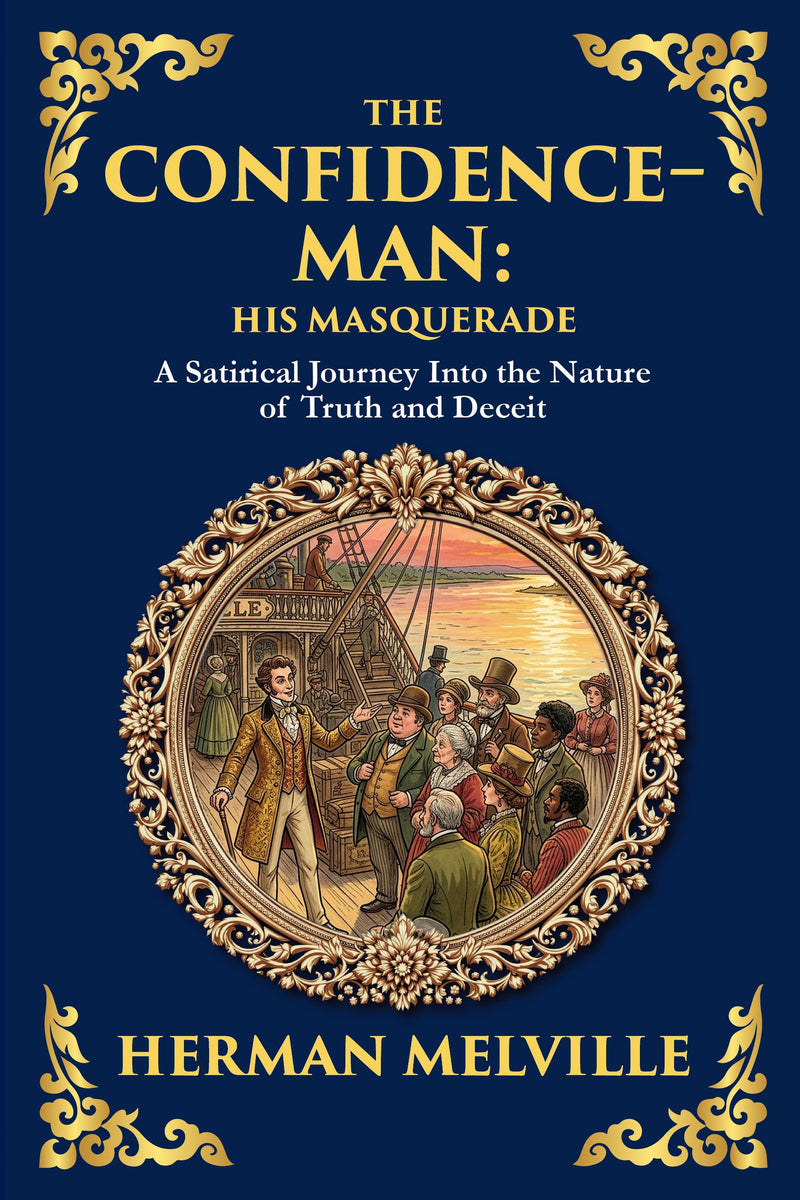
The Confidence-Man: His Masquerade
On April Fool’s Day, aboard a Mississippi steamboat drifting toward New Orleans, nothing is quite what it seems. A mysterious gentleman appears—ever-shifting in identity, persuading strangers to trust him, to part with their money, their secrets, their beliefs.
or free app
10,000+ hrs library
30-day guarantee
The complete The Confidence-Man: His Masquerade appears in modern English through Library of Alexandria Press, available online with audiobook narration included for members.
Have you ever wondered why we trust strangers—even when we know better? The Confidence-Man: His Masquerade is Herman Melville’s most daring and enigmatic novel— a sharp, satirical exploration of deception, faith, and the fragile bonds of social trust. Set aboard a Mississippi steamboat on April Fool’s Day, this literary masquerade follows a mysterious stranger who changes his appearance and identity again and again, testing the confidence of every passenger he encounters.
Far more than a mere conman story, Melville’s final novel invites readers into a philosophical labyrinth of shifting morals, absurd optimism, and existential ambiguity. Through a gallery of characters—from beggars to philosophers—The Confidence-Man critiques capitalism, religion, identity, and the very idea of “truth.” In this modernized edition, readers will discover: A Satirical Dissection of American Society Melville satirizes 19th-century ideals of charity, commerce, and moral righteousness with piercing wit. A Masterclass in Unreliable Narration and Psychological Intrigue As each persona of the Confidence-Man unfolds, the reader is left questioning everything—including the narrator’s own role in the deception.
Themes of Masquerade, Hypocrisy, and Existential Doubt Every conversation is layered with implication, exposing how easily people are misled by appearances. A Cast of Symbolic and Archetypal Characters From the lame beggar to the herb doctor to the agent of virtue, the passengers represent competing worldviews and belief systems. An Enduring Philosophical Puzzle Like Kafka and Camus, Melville forces us to ask: What do we believe, and why?
Can truth even be known—or is everything just a well-played performance? This is not just a novel—it’s a riddle wrapped in satire, disguised as a river journey. Equal parts comedy and tragedy, allegory and exposé, The Confidence-Man remains one of the boldest experiments in American fiction.
Perfect for readers of philosophical literature, literary satire, and anyone who dares to question the nature of belief itself.
What you’ll discover in this modern edition
- A razor-sharp critique of human credulity and social trust
- Shifting identities and unreliable narration that blur the line between truth and fiction
- An unforgettable cast of characters who each reflect a facet of American society
- A tale as timely today as when it was written—about how easily we are swayed by appearances and smooth words
- Melville’s final novel—his most experimental, challenging, and thought-provoking work Step onto the steamboat Fidèle and into a story where nothing is certain—except your own desire to believe.
| Formats | eBook (EPUB + PDF) · Audiobook · Paperback · Hardcover · Large Print |
| Language | English |
| Trim size (print) | 6 × 9 in |
| Binding | Paperback — perfect-bound · Hardcover — casewrap |
| Large Print edition | Same text in a larger, easy-read type — a larger font, not a larger trim |
| Print pricing | Every physical book at our true cost — at-cost, no profit (members) |
| Library | 873 restored titles, always growing |
| Length | 95,458 words · ~6 hr 22 min reading |
| Reading level | Grade 8 · an easy, flowing read (this modern-English edition) |
| Edition | Modern English translation · 2026 |
Member reviews for this edition are collected as readers finish it — be the first. Across the library: 12,000+ books shipped, every plan covered by a 365-day print guarantee.
About this edition
A faithful, unabridged modern-English edition by The Library of Alexandria — carefully rendered for today's reader and verified paragraph-by-paragraph against the public-domain source. Available as eBook, audiobook, paperback, hardcover, and large print.
- Complete & unabridgedVerified paragraph by paragraph against the source — never a scan, never abridged.
- Modern English, faithfulReadable today, with the author’s meaning kept intact. Readable — not simplified.
- Every format, one membershipRead in your browser or the free app, or listen to the full audiobook.
Included free with your membership
Cancel anytime, one click · 30-day money-back guarantee
Edition last updated July 2026
What’s inside
The Confidence-Man: His Masquerade — complete and unabridged: all 46 sections included with membership, plus the full audiobook.
Begin reading The Confidence-Man: His Masquerade
In clear modern English — the complete text is included with membership.
Introduction
There are books that comfort us, and there are books that unsettle us, and then there is a rare third category: books that refuse to let us rest in any easy certainty about who we are, what we believe, and why we believe it. The novel you are about to read belongs firmly to that third category. It is a work that has confounded, irritated, fascinated, and rewarded readers for well over a century and a half, and it arrives in your hands now in a form designed to make its strangeness more accessible without dulling its considerable edge. This is a story about belief itself—about the act of trusting another person, and about the peculiar vulnerability that opens up the moment we decide someone is worth believing.
Herman Melville published this novel in 1857, and the date matters. By then he was no longer the celebrated young author of seafaring adventures who had taken the literary world by storm in the late 1840s. The man who wrote about Polynesian islands and whaling voyages had, with the publication of his great whale epic in 1851, gradually slipped out of public favor. Readers who had wanted more exotic travelogues were puzzled and put off by his increasingly philosophical, increasingly demanding fiction. By the time this book appeared, Melville was a writer working largely against the current of his own audience’s expectations, and the novel reflects a sensibility that had grown deeply skeptical—not cynical, exactly, but profoundly aware of how much of human life is conducted through performance, persuasion, and faith.
What makes this work so distinctive, and what has earned it a steadily rising reputation among critics and serious readers in the modern era, is that it does not behave like a conventional novel at all. It does not offer a hero you root for, a villain you despise, and a satisfying resolution that ties everything together. Instead, it offers something far more provocative: a sustained meditation, dressed in the costume of fiction, on the question of whether and how much we should trust one another. It asks this question not as an abstract philosophical exercise but through a series of vivid, often very funny, often deeply uncomfortable human encounters. And it leaves the question open, returning it to you, the reader, with all its difficulty intact.
This modern adaptation has been prepared with a clear purpose: to remove the barriers that have, over the years, kept many readers from discovering the rewards of this remarkable book. Melville’s original prose, brilliant as it is, can be dense and demanding. His sentences sometimes wind through clause after clause; his vocabulary draws on the conventions and references of mid-nineteenth-century America; his rhythms belong to an age when readers expected to slow down and labor over a paragraph. The aim of this edition is to preserve the wit, the wisdom, and the unsettling power of the original while smoothing the path for a contemporary reader. Nothing essential has been lost. The ideas remain as sharp, the humor as dry, the central provocation as alive as ever. What has changed is the friction—the unnecessary obstacles that once stood between the reader and the experience Melville intended.
A World in Motion: The Setting and Its Meaning
Imagine a great riverboat making its way down one of the largest waterways in America, carrying a vast and varied assortment of passengers. Some are wealthy, some are poor; some are devout, some are scheming; some are sentimental, some are coldly rational. There are merchants and clergymen, invalids and entrepreneurs, college students and country folk, the credulous and the cunning. They board and disembark at various points along the journey, so that the population of the boat is always shifting, always renewing itself. This single vessel, moving steadily through the heart of a young and restless nation, is the entire stage on which the novel’s drama unfolds.
The choice of setting is anything but accidental, and once you grasp its significance, the whole book opens up before you. A riverboat is a microcosm—a small, contained world that mirrors the larger one. The passengers are strangers thrown together by circumstance, each knowing nothing of the others’ true histories or true characters. They must take one another at face value, judging by appearances, by manner, by the stories people tell about themselves. In this floating community, identity is fluid, reputation is unverifiable, and trust must be extended or withheld on the basis of almost nothing solid. It is the perfect environment in which to examine how human beings decide whom to believe.
There is something deeply American about this image, and Melville knew it. The nineteenth-century United States was a society defined by movement, by self-invention, by the endless flow of people heading toward new opportunities and new beginnings. It was a place where a person could shed an old identity and assume a new one, where the self was something to be constructed and presented rather than fixed and inherited. The riverboat captures this national restlessness perfectly. Everyone aboard is going somewhere, everyone is in transit, and in that condition of perpetual motion, the old anchors of community, family, and reputation lose their grip. You cannot check on a stranger’s references when you have only just met them on a boat that will deposit you in different places. You can only decide, in the moment, whether to trust.
The river itself adds another layer of meaning. Rivers have always carried symbolic weight in literature—they represent the passage of time, the flow of life, the journey toward an unknown destination. As the boat moves downstream, it also moves through a single day, and the structure of the novel follows this temporal current. There is a dreamlike, almost hallucinatory quality to the way the encounters succeed one another, each conversation flowing into the next, each new figure appearing and dissolving like a reflection on the water. Readers who attune themselves to this rhythm will find that the book has a hypnotic momentum all its own, quite unlike the plot-driven propulsion of a conventional novel.
The world of the boat is also a world of commerce, and money is never far from any of the conversations that take place upon it. People are buying and selling, investing and lending, asking for charity and offering schemes. This too is essential to Melville’s purpose. In a commercial society, trust is not merely a moral or emotional matter—it is the very basis of economic life. To do business with someone, you must extend them credit, in both the financial and the human sense. The word “confidence” itself, which sits at the heart of this book, carries both meanings: it is the trust we place in another person, and it is also the faith that underlies all financial transactions. When you lend money, you are expressing confidence that it will be repaid. When you invest, you are expressing confidence in a future you cannot see. The novel plays endlessly on this double meaning, showing how intimately our spiritual and material vulnerabilities are bound together.
To read this book well, then, is to enter into the spirit of its setting—to feel yourself a passenger on that crowded, anonymous vessel, surrounded by strangers whose intentions you cannot verify, drifting down a river toward a destination you cannot quite make out. From that vantage point, the questions the novel raises stop being abstract and become urgent and personal. Whom would you trust, in such a place? On what basis? And what would it cost you to be wrong?
The Art of Persuasion and the Question of Belief
At the center of this novel is a figure—or perhaps a series of figures—engaged in the delicate, fascinating, and morally ambiguous work of winning people’s trust. The very title announces a “masquerade,” and the word should put you on your guard from the first page. A masquerade is a performance, a play of disguises, a game in which appearances are deliberately deceiving. Throughout the book, you will encounter characters who present themselves in various guises, who tell stories about who they are and what they need, and who ask others to believe them. The drama lies in the responses they provoke: some people open their hearts and their wallets; others bristle with suspicion; still others find themselves caught between the desire to be generous and the fear of being fooled.
What is remarkable, and what gives the book its enduring power, is that Melville refuses to make these encounters simple. It would be easy to write a satire in which gullible fools are fleeced by an obvious scoundrel, and in which the reader is invited to feel superior to everyone involved. That is not what this novel does. Instead, the conversations between the persuaders and the persuaded are genuinely searching, genuinely intelligent, and genuinely difficult to resolve. The arguments made on behalf of trust are often beautiful and even moving. The arguments made on behalf of suspicion are often sensible and even wise. You will frequently find yourself unable to decide who has the better of an exchange, and that uncertainty is precisely the point.
Consider the position in which the novel places you. When a stranger appeals to your sympathy, asks for your help, or invites your trust, you face a real dilemma. To refuse is to risk hardening your heart, becoming cynical, treating every fellow human as a potential threat. To accept is to risk being exploited, made a fool of, taken advantage of by someone who has studied your kindness as a weakness. There is no perfectly safe path. The suspicious person protects himself but at the cost of a closed and lonely existence; the trusting person opens himself to others but at the cost of vulnerability. The novel dramatizes this dilemma again and again, from countless angles, and it never lets us off the hook with a tidy answer.
This is why the book has been read in so many different ways over the years. Some readers have seen it as a dark, pessimistic work, a portrait of a world in which everyone is either a deceiver or a dupe, and in which genuine human connection is impossible. Others have seen it as something more searching and even hopeful—a defense of the necessity of trust, an argument that a life lived in perpetual suspicion is not really a life at all. Still others have read it as a profound religious meditation, exploring questions of faith and doubt that go far beyond mere financial honesty. The fact that the book sustains all these interpretations is a mark of its richness, not a defect. Great literature does not tell us what to think; it equips us to think more deeply, and this novel is a master class in that kind of fertile ambiguity.
There is also a vein of philosophical inquiry running through the book that connects it to some of the deepest currents of nineteenth-century thought. Melville was writing in an age of enormous intellectual ferment, when traditional religious certainties were being challenged by new science, new philosophy, and new ways of understanding the human mind. The optimistic faith in human goodness and progress that characterized much of the culture around him was, in his view, dangerously naive—not because human beings are simply wicked, but because they are so easily misled, so prone to believe what flatters them, so eager to trust whatever confirms their existing hopes. At the same time, he saw the corrosive effects of total skepticism, the way a refusal to believe anything can wither the soul. The novel holds these two dangers in a constant, productive tension, and in doing so it speaks with startling directness to our own moment.
For we live, after all, in an age uniquely preoccupied with the questions this book raises. We are surrounded by claims competing for our belief, by persuaders of every kind seeking to win our confidence, by an endless flow of strangers whose true identities and motives we cannot verify. The technologies have changed beyond anything Melville could have imagined, but the fundamental human situation has not. We still must decide, every day, whom to trust and on what basis. We still face the danger of being deceived, and the opposite danger of becoming so guarded that we cut ourselves off from the genuine human connection that makes life worth living. Reading this novel today, you may be startled by how contemporary it feels, how precisely its insights apply to a world of which its author knew nothing. That is the mark of a truly great work: it speaks not only to its own time but across time, to readers it could never have foreseen.
Cancel anytime, one click · 30-day money-back guarantee
Founding annual rate available now — your price locks for life when you join.
Not ready? Get this free chapter by email — read it anytime.
✓ Sent — check your inbox for The Confidence-Man: His Masquerade.
Questions about The Confidence-Man: His Masquerade
What is The Confidence-Man: His Masquerade about?
On April Fool’s Day, aboard a Mississippi steamboat drifting toward New Orleans, nothing is quite what it seems. A mysterious gentleman appears—ever-shifting in identity, persuading strangers to trust him, to part with their money, their secrets, their beliefs. But who is he?
Who wrote The Confidence-Man: His Masquerade?
The Confidence-Man: His Masquerade was written by Herman Melville. This edition presents the complete work in clear modern English, faithfully rendered from the public-domain original by Library of Alexandria Press.
Is The Confidence-Man: His Masquerade free to read?
The opening chapter is free to read on this page. Members read and listen to the complete work — and the entire library — free, and can order any physical book at our true print cost.
How long is The Confidence-Man: His Masquerade?
46 chapters (~95,458 words) — about 6 hr 22 min of reading in this modern-English edition.
Is this an abridged version of The Confidence-Man: His Masquerade?
No. This is the complete, unabridged The Confidence-Man: His Masquerade, carefully rendered into clear modern English and verified paragraph-by-paragraph against the public-domain source — nothing is cut or summarised.
What formats does The Confidence-Man: His Masquerade come in?
The Confidence-Man: His Masquerade is available as eBook, paperback, hardcover and large print. eBook and audiobook are included with membership; printed editions ship at our true print cost.
Shipping & returns
Billing & membership
More from the library


Explore Humour & Satire
- The Imaginary Invalid · Molière
- My Man Jeeves · P. G. Wodehouse
- Barry Lyndon · William Makepeace Thackeray
- The Man with Two Left Feet, and Other Stories · P. G. Wodehouse
- Carry On, Jeeves · P. G. Wodehouse
- Lucian’s True History · Lucian of Samosata
- Penrod · Booth Tarkington
- Status Quo · Mack Reynolds
- Herland · Charlotte Perkins Gilman
- Sartor Resartus: The Life and Opinions of Herr Teufelsdröckh · Thomas Carlyle
- The Satyricon of Petronius Arbiter · Petronius Arbiter
- Three Men in a Boat (To Say Nothing of the Dog) · Jerome K. Jerome
- A Connecticut Yankee in King Arthur’s Court · Mark Twain
- Northanger Abbey · Jane Austen
- Once Aboard the Lugger—The History of George and his Mary · A. S. M. Hutchinson
- Candide · Voltaire
- Gulliver’s Travels into Several Remote Regions of the World · Jonathan Swift
- Emma · Jane Austen
- A Room with a View · E. M. Forster
- The Eyes Have It · Philip K. Dick
- The Wind in the Willows · Kenneth Grahame
- Right Ho, Jeeves · P. G. Wodehouse
- The Mysterious Stranger and Other Stories · Mark Twain
- A Modest Proposal · Jonathan Swift
The Confidence-Man: His Masquerade
The Confidence-Man: His Masquerade
A Satirical Journey Into the Nature of Truth and Deceit
Herman Melville
Contents
- Introduction
- Chapter 1
- Chapter 2
- Chapter 3
- Chapter 4
- Chapter 5
- Chapter 6
- Chapter 7
- Chapter 8
- Chapter 9
- Chapter 10
- Chapter 11
- Chapter 12
- Chapter 13
- Chapter 14
- Chapter 15
- Chapter 16
- Chapter 17
- Chapter 18
- Chapter 19
- Chapter 20
- Chapter 21
- Chapter 22
- Chapter 23
- Chapter 24
- Chapter 25
- Chapter 26
- Chapter 27
- Chapter 28
- Chapter 29
- Chapter 30
- Chapter 31
- Chapter 32
- Chapter 33
- Chapter 34
- Chapter 35
- Chapter 36
- Chapter 37
- Chapter 38
- Chapter 39
- … and 6 more chapters
Introduction
There are books that comfort us, and there are books that unsettle us, and then there is a rare third category: books that refuse to let us rest in any easy certainty about who we are, what we believe, and why we believe it. The novel you are about to read belongs firmly to that third category. It is a work that has confounded, irritated, fascinated, and rewarded readers for well over a century and a half, and it arrives in your hands now in a form designed to make its strangeness more accessible without dulling its considerable edge. This is a story about belief itself—about the act of trusting another person, and about the peculiar vulnerability that opens up the moment we decide someone is worth believing.
Herman Melville published this novel in 1857, and the date matters. By then he was no longer the celebrated young author of seafaring adventures who had taken the literary world by storm in the late 1840s. The man who wrote about Polynesian islands and whaling voyages had, with the publication of his great whale epic in 1851, gradually slipped out of public favor. Readers who had wanted more exotic travelogues were puzzled and put off by his increasingly philosophical, increasingly demanding fiction. By the time this book appeared, Melville was a writer working largely against the current of his own audience’s expectations, and the novel reflects a sensibility that had grown deeply skeptical—not cynical, exactly, but profoundly aware of how much of human life is conducted through performance, persuasion, and faith.
What makes this work so distinctive, and what has earned it a steadily rising reputation among critics and serious readers in the modern era, is that it does not behave like a conventional novel at all. It does not offer a hero you root for, a villain you despise, and a satisfying resolution that ties everything together. Instead, it offers something far more provocative: a sustained meditation, dressed in the costume of fiction, on the question of whether and how much we should trust one another. It asks this question not as an abstract philosophical exercise but through a series of vivid, often very funny, often deeply uncomfortable human encounters. And it leaves the question open, returning it to you, the reader, with all its difficulty intact.
This modern adaptation has been prepared with a clear purpose: to remove the barriers that have, over the years, kept many readers from discovering the rewards of this remarkable book. Melville’s original prose, brilliant as it is, can be dense and demanding. His sentences sometimes wind through clause after clause; his vocabulary draws on the conventions and references of mid-nineteenth-century America; his rhythms belong to an age when readers expected to slow down and labor over a paragraph. The aim of this edition is to preserve the wit, the wisdom, and the unsettling power of the original while smoothing the path for a contemporary reader. Nothing essential has been lost. The ideas remain as sharp, the humor as dry, the central provocation as alive as ever. What has changed is the friction—the unnecessary obstacles that once stood between the reader and the experience Melville intended.
A World in Motion: The Setting and Its Meaning
Imagine a great riverboat making its way down one of the largest waterways in America, carrying a vast and varied assortment of passengers. Some are wealthy, some are poor; some are devout, some are scheming; some are sentimental, some are coldly rational. There are merchants and clergymen, invalids and entrepreneurs, college students and country folk, the credulous and the cunning. They board and disembark at various points along the journey, so that the population of the boat is always shifting, always renewing itself. This single vessel, moving steadily through the heart of a young and restless nation, is the entire stage on which the novel’s drama unfolds.
The choice of setting is anything but accidental, and once you grasp its significance, the whole book opens up before you. A riverboat is a microcosm—a small, contained world that mirrors the larger one. The passengers are strangers thrown together by circumstance, each knowing nothing of the others’ true histories or true characters. They must take one another at face value, judging by appearances, by manner, by the stories people tell about themselves. In this floating community, identity is fluid, reputation is unverifiable, and trust must be extended or withheld on the basis of almost nothing solid. It is the perfect environment in which to examine how human beings decide whom to believe.
There is something deeply American about this image, and Melville knew it. The nineteenth-century United States was a society defined by movement, by self-invention, by the endless flow of people heading toward new opportunities and new beginnings. It was a place where a person could shed an old identity and assume a new one, where the self was something to be constructed and presented rather than fixed and inherited. The riverboat captures this national restlessness perfectly. Everyone aboard is going somewhere, everyone is in transit, and in that condition of perpetual motion, the old anchors of community, family, and reputation lose their grip. You cannot check on a stranger’s references when you have only just met them on a boat that will deposit you in different places. You can only decide, in the moment, whether to trust.
The river itself adds another layer of meaning. Rivers have always carried symbolic weight in literature—they represent the passage of time, the flow of life, the journey toward an unknown destination. As the boat moves downstream, it also moves through a single day, and the structure of the novel follows this temporal current. There is a dreamlike, almost hallucinatory quality to the way the encounters succeed one another, each conversation flowing into the next, each new figure appearing and dissolving like a reflection on the water. Readers who attune themselves to this rhythm will find that the book has a hypnotic momentum all its own, quite unlike the plot-driven propulsion of a conventional novel.
The world of the boat is also a world of commerce, and money is never far from any of the conversations that take place upon it. People are buying and selling, investing and lending, asking for charity and offering schemes. This too is essential to Melville’s purpose. In a commercial society, trust is not merely a moral or emotional matter—it is the very basis of economic life. To do business with someone, you must extend them credit, in both the financial and the human sense. The word “confidence” itself, which sits at the heart of this book, carries both meanings: it is the trust we place in another person, and it is also the faith that underlies all financial transactions. When you lend money, you are expressing confidence that it will be repaid. When you invest, you are expressing confidence in a future you cannot see. The novel plays endlessly on this double meaning, showing how intimately our spiritual and material vulnerabilities are bound together.
To read this book well, then, is to enter into the spirit of its setting—to feel yourself a passenger on that crowded, anonymous vessel, surrounded by strangers whose intentions you cannot verify, drifting down a river toward a destination you cannot quite make out. From that vantage point, the questions the novel raises stop being abstract and become urgent and personal. Whom would you trust, in such a place? On what basis? And what would it cost you to be wrong?
The Art of Persuasion and the Question of Belief
At the center of this novel is a figure—or perhaps a series of figures—engaged in the delicate, fascinating, and morally ambiguous work of winning people’s trust. The very title announces a “masquerade,” and the word should put you on your guard from the first page. A masquerade is a performance, a play of disguises, a game in which appearances are deliberately deceiving. Throughout the book, you will encounter characters who present themselves in various guises, who tell stories about who they are and what they need, and who ask others to believe them. The drama lies in the responses they provoke: some people open their hearts and their wallets; others bristle with suspicion; still others find themselves caught between the desire to be generous and the fear of being fooled.
What is remarkable, and what gives the book its enduring power, is that Melville refuses to make these encounters simple. It would be easy to write a satire in which gullible fools are fleeced by an obvious scoundrel, and in which the reader is invited to feel superior to everyone involved. That is not what this novel does. Instead, the conversations between the persuaders and the persuaded are genuinely searching, genuinely intelligent, and genuinely difficult to resolve. The arguments made on behalf of trust are often beautiful and even moving. The arguments made on behalf of suspicion are often sensible and even wise. You will frequently find yourself unable to decide who has the better of an exchange, and that uncertainty is precisely the point.
Consider the position in which the novel places you. When a stranger appeals to your sympathy, asks for your help, or invites your trust, you face a real dilemma. To refuse is to risk hardening your heart, becoming cynical, treating every fellow human as a potential threat. To accept is to risk being exploited, made a fool of, taken advantage of by someone who has studied your kindness as a weakness. There is no perfectly safe path. The suspicious person protects himself but at the cost of a closed and lonely existence; the trusting person opens himself to others but at the cost of vulnerability. The novel dramatizes this dilemma again and again, from countless angles, and it never lets us off the hook with a tidy answer.
This is why the book has been read in so many different ways over the years. Some readers have seen it as a dark, pessimistic work, a portrait of a world in which everyone is either a deceiver or a dupe, and in which genuine human connection is impossible. Others have seen it as something more searching and even hopeful—a defense of the necessity of trust, an argument that a life lived in perpetual suspicion is not really a life at all. Still others have read it as a profound religious meditation, exploring questions of faith and doubt that go far beyond mere financial honesty. The fact that the book sustains all these interpretations is a mark of its richness, not a defect. Great literature does not tell us what to think; it equips us to think more deeply, and this novel is a master class in that kind of fertile ambiguity.
There is also a vein of philosophical inquiry running through the book that connects it to some of the deepest currents of nineteenth-century thought. Melville was writing in an age of enormous intellectual ferment, when traditional religious certainties were being challenged by new science, new philosophy, and new ways of understanding the human mind. The optimistic faith in human goodness and progress that characterized much of the culture around him was, in his view, dangerously naive—not because human beings are simply wicked, but because they are so easily misled, so prone to believe what flatters them, so eager to trust whatever confirms their existing hopes. At the same time, he saw the corrosive effects of total skepticism, the way a refusal to believe anything can wither the soul. The novel holds these two dangers in a constant, productive tension, and in doing so it speaks with startling directness to our own moment.
For we live, after all, in an age uniquely preoccupied with the questions this book raises. We are surrounded by claims competing for our belief, by persuaders of every kind seeking to win our confidence, by an endless flow of strangers whose true identities and motives we cannot verify. The technologies have changed beyond anything Melville could have imagined, but the fundamental human situation has not. We still must decide, every day, whom to trust and on what basis. We still face the danger of being deceived, and the opposite danger of becoming so guarded that we cut ourselves off from the genuine human connection that makes life worth living. Reading this novel today, you may be startled by how contemporary it feels, how precisely its insights apply to a world of which its author knew nothing. That is the mark of a truly great work: it speaks not only to its own time but across time, to readers it could never have foreseen.
At sunrise on April 1st, a man dressed in cream-colored clothes suddenly appeared by the waterfront in St. Louis, as unexpected as Manco Capac at Lake Titicaca.
He had a fair complexion, a light dusting of hair on his chin, and flaxen hair. He wore a white fur hat with a long, soft nap. He carried no suitcase, travel bag, or package, and no porter followed him. He was alone. Based on the shrugged shoulders, giggles, whispers, and curious looks of the crowd, it was obvious that he was a complete stranger.
The moment he arrived, he stepped onto the popular steamer Fidèle, which was just about to leave for New Orleans. People stared at him, but no one greeted him. He acted as if he were neither seeking nor avoiding attention, but simply following his path of duty, whether it led through lonely places or busy cities. He walked along the lower deck until he happened upon a poster near the captain’s office. The notice offered a reward for the capture of a mysterious fraud who had supposedly arrived recently from the East. This man seemed to be a true genius in his line of work, though the poster didn’t explain exactly what made him so unique; however, it did provide what claimed to be a detailed physical description of him.
Crowds gathered around the announcement as if it were a theater advertisement. Among them were certain “gentlemen” whose eyes were clearly searching for wealthy targets, or at least trying to spot them from behind other people’s coats. As for their hands, they remained hidden and mysterious. However, during a brief lull, one of these men revealed himself by buying a popular money-belt from another “gentleman” who happened to be a peddler. Meanwhile, another versatile peddler in the middle of the crowd was selling pamphlets about the lives of Measan, the bandit of Ohio; Murrel, the pirate of the Mississippi; and the Harpe brothers, the thugs of the Green River region in Kentucky. These men, and others like them, had all been wiped out by that time. Much like the hunted wolves of those same regions, they had left behind very few successors. This would seem like a reason for pure celebration, and it is for everyone—except those who believe that in new countries, once the wolves are killed off, the foxes multiply.
End of the free sample
Keep reading, free
Members read and listen to the complete book — and the entire library. Cancel anytime, one click · 30-day money-back guarantee.