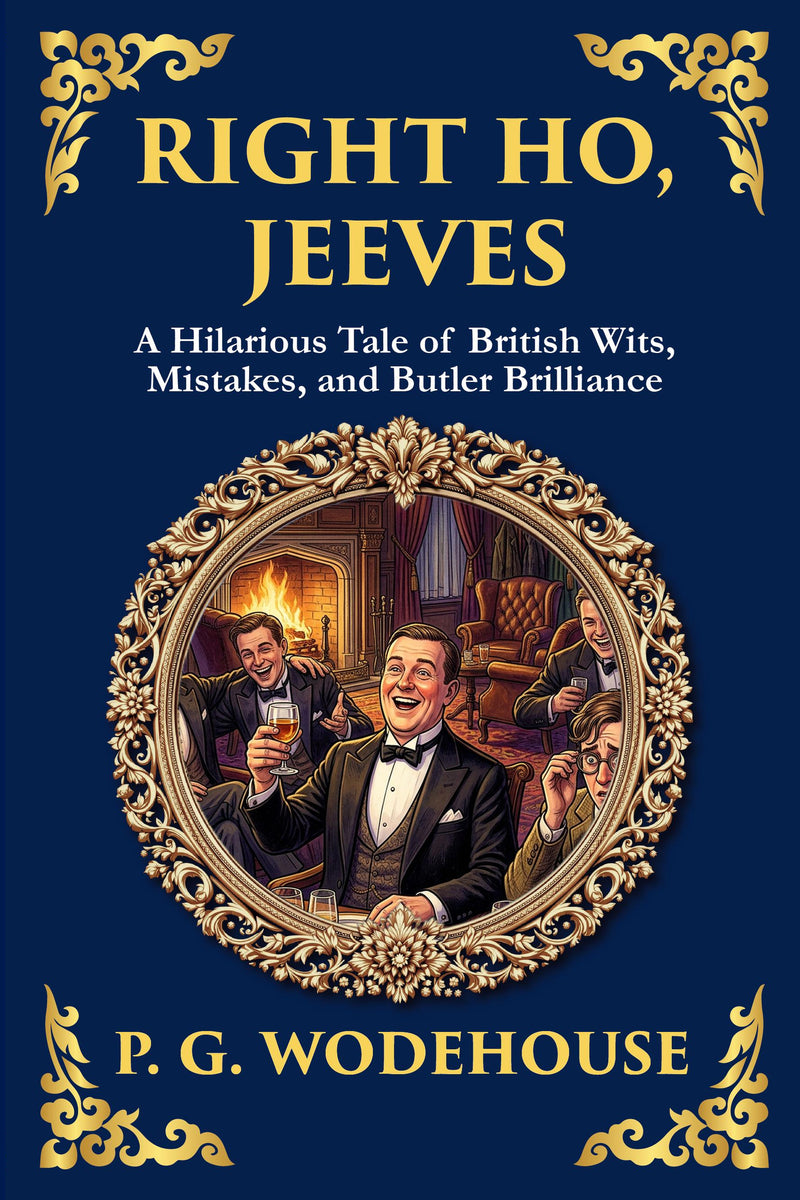
Right Ho, Jeeves
In Right Ho, Jeeves, P. G. Wodehouse delivers one of his most beloved comic masterpieces, filled with eccentric characters, laugh-out-loud misunderstandings, and the unshakable brilliance of the ever-resourceful Jeeves.
or free app
10,000+ hrs library
30-day guarantee
The complete Right Ho, Jeeves appears in modern English through Library of Alexandria Press, available online with audiobook narration included for members.
Have you ever wondered why the sharpest minds can be found in the most unexpected places? P. G. Wodehouse’s Right Ho, Jeeves is a comic triumph of wit, mishap, and the enduring brilliance of a butler who always saves the day. The tale follows the hapless Bertie Wooster, a well-meaning but bumbling gentleman, as he entangles himself in a web of social and romantic disasters.
From misguided advice to failed love affairs, Bertie’s plans rarely go as expected— until Jeeves steps in with his trademark elegance and ingenious problem-solving. This edition highlights Wodehouse’s razor-sharp dialogue, charming satire of the British upper class, and unforgettable humor. More than a novel, it’s a sparkling celebration of friendship, loyalty, and the delightful absurdities of human behavior.
What you’ll discover in this modern edition
- The Wit of Bertie Wooster – A gentleman with more enthusiasm than wisdom, whose blunders are as endearing as they are disastrous.
- The Brilliance of Jeeves – A butler whose intelligence, calm, and discretion turn impossible problems into elegant solutions.
- A Tangle of Romance and Mishap – From Gussie Fink-Nottle’s bumbling courtship to Madeline Bassett’s sentimentality, chaos rules until Jeeves takes charge.
- A Cast of Colorful Characters – Meet a host of eccentric personalities, each adding charm and laughter to Bertie’s misadventures.
- A Timeless Comedy of Manners – Wodehouse’s biting yet affectionate satire of high society remains as delightful today as ever.
| Formats | eBook (EPUB + PDF) · Audiobook · Paperback · Hardcover · Large Print |
| Language | English |
| Trim size (print) | 6 × 9 in |
| Binding | Paperback — perfect-bound · Hardcover — casewrap |
| Large Print edition | Same text in a larger, easy-read type — a larger font, not a larger trim |
| Print pricing | Every physical book at our true cost — at-cost, no profit (members) |
| Library | 873 restored titles, always growing |
| Length | 65,737 words · ~4 hr 23 min reading |
| Reading level | Grade 6 · an easy, flowing read (this modern-English edition) |
| Edition | Modern English translation · 2026 |
Member reviews for this edition are collected as readers finish it — be the first. Across the library: 12,000+ books shipped, every plan covered by a 365-day print guarantee.
About this edition
A faithful, unabridged modern-English edition by The Library of Alexandria — carefully rendered for today's reader and verified paragraph-by-paragraph against the public-domain source. Available as eBook, audiobook, paperback, hardcover, and large print.
- Complete & unabridgedVerified paragraph by paragraph against the source — never a scan, never abridged.
- Modern English, faithfulReadable today, with the author’s meaning kept intact. Readable — not simplified.
- Every format, one membershipRead in your browser or the free app, or listen to the full audiobook.
Included free with your membership
Cancel anytime, one click · 30-day money-back guarantee
Edition last updated July 2026
What’s inside
Right Ho, Jeeves — complete and unabridged: all 24 sections included with membership, plus the full audiobook.
Begin reading Right Ho, Jeeves
In clear modern English — the complete text is included with membership.
Introduction
There exists a particular variety of laughter that arrives not with a sudden burst but with a slow, helpless surrender. It begins as a quiet appreciation, deepens into a private smile, and then, before the reader quite knows what has happened, it tips over into the kind of giggling that makes strangers on trains glance over with concern. This is the laughter that P. G. Wodehouse produces, and the novel you are about to read is among the finest engines of it ever constructed in the English language. Within these pages lives a world so meticulously frivolous, so gloriously detached from the troubles that weigh upon ordinary existence, that it has comforted readers through wars, recessions, heartbreaks, and the simple ordinary tedium of a wet afternoon. To open this book is to step into a sunlit country house where the most serious crisis imaginable is whether a young man should propose to a soppy girl who believes the stars are God’s daisy chain, and where the resolution of such matters requires the full deployment of genius.
The story unfolds in the company of Bertie Wooster, a wealthy young bachelor of impeccable tailoring and entirely dispensable intellect, and his valet Jeeves, a man whose brain is so vast and so quietly powerful that one suspects entire governments could be run more efficiently if only he could be persuaded to take an interest. Bertie narrates his own adventures, and herein lies one of the great pleasures of the experience. He is a narrator who is perpetually convinced of his own competence, perpetually wrong, and perpetually charming about being wrong. He blunders into disasters of his own creation with the cheerful confidence of a man who has never once suspected that he is the architect of his own downfall. And hovering behind him, like a benevolent and faintly amused deity, stands Jeeves, ready to extricate his employer from whatever catastrophe has been set in motion, usually one that Bertie has insisted on handling himself precisely because he is certain that this time, finally, he does not need Jeeves at all.
That tension between confidence and competence is the beating heart of the comedy. Bertie is not a fool in the cruel sense; he is generous, loyal, and possessed of a peculiar code of honor that compels him to help his friends even when helping them is plainly insane. He simply lacks the equipment to carry out his own good intentions. The friends in question are themselves a marvelous gallery of the romantically incapacitated, the emotionally tangled, and the gastronomically dramatic, and the plot that brings them together is a masterpiece of escalating complication. Wodehouse builds his stories the way a clockmaker builds a watch, each tiny gear meshing with the next, each small misunderstanding feeding into a larger one, until the whole apparatus is spinning at a frantic pace and the reader can do nothing but hold on and laugh. You will not need to memorize any of these mechanics in advance. Part of the joy is watching the pieces assemble themselves without ever quite knowing where they are heading, and so I will say nothing here that would spoil the delight of discovery.
It is tempting, when introducing a comic writer, to apologize for him. Comedy is so often treated as the lesser sibling of literature, the entertainment we permit ourselves between bouts of serious reading. But to apologize for Wodehouse would be a profound error, because the lightness of his work is not a lack of substance. It is an achievement of extraordinary craft. The American humorist who wishes to be funny merely has to say something funny. Wodehouse achieves something far rarer. He constructs an entire universe governed by its own internal logic, populated by characters who behave with perfect consistency according to the absurd rules of that universe, and then he sets them in motion and lets the comedy emerge from their collision. Nothing is random. Every joke is earned. Every disaster is the inevitable consequence of what came before.
Consider the prose itself, which is the true marvel of these books. Wodehouse possessed one of the most precise comic styles in the history of English letters. His sentences are built like jokes, with the setup carefully laid and the punchline delivered at exactly the right moment. He has a gift for the unexpected comparison, for the metaphor that arrives from a direction you never anticipated and lands with a perfect little explosion of absurdity. A character does not merely look unhappy; he looks like a man who has been struck behind the ear by a sock full of wet sand. The morning does not merely arrive; it comes creeping in with all the reluctance of a guilty conscience. These flourishes are not decoration. They are the very texture of the reading experience, and they accumulate, page after page, into something that feels less like reading and more like being gently and continuously tickled.
The other great pleasure is the dialogue, and in particular the exchanges between Bertie and Jeeves. Here Wodehouse plays a long and beautifully sustained game. Bertie speaks in the slangy, breathless idiom of the wealthy young man about town of his era, all exclamations and half-finished thoughts and quotations he has half-remembered and gotten slightly wrong. Jeeves speaks in measured, formal, faintly archaic sentences of perfect grammatical poise, each one a small monument to discretion. The contrast between these two voices is itself a continuous source of comedy, and the relationship between the two men, though never stated in sentimental terms, is one of the most touching partnerships in fiction. They need each other completely. Bertie needs Jeeves to save him, and Jeeves, it is gently suggested, needs Bertie to be the kind of magnificently helpless person who provides a worthy stage for his talents.
This brings us to the matter of the present edition, which describes itself as a modern translation adapted for the contemporary reader. A word about what this means and why it matters is in order, because some readers may approach the idea with understandable caution. Wodehouse wrote in the early decades of the twentieth century, and his English, while crystalline in its own time, is studded with references, slang, and turns of phrase that have faded from common use. The young men of his world drop allusions to music hall songs no one now remembers, to brands of cigarette long discontinued, to social rituals that have vanished entirely. A contemporary reader, however delighted by the comedy, may occasionally find a joke landing in a fog of unfamiliarity, the punchline obscured by a reference that meant everything to a reader of 1934 and nothing at all today.
The aim of an adaptation such as this is not to flatten or modernize the wit, which would be an act of vandalism, but to clear away the small obstacles that stand between the reader and the laughter. The goal is to preserve the rhythm, the precision, and above all the personality of Wodehouse’s prose, while gently smoothing the path so that nothing interrupts the headlong rush of the comedy. The voices remain. Bertie is still Bertie, breathless and brilliant in his obtuseness. Jeeves still speaks with that magnificent, glacial courtesy. The metaphors still detonate at the right moment. What changes is only that the modern reader is spared the occasional stumble, and the joke arrives where it was always meant to arrive, in the funny bone rather than the footnotes. Purists may, of course, seek out the original text, and they will find much to treasure there. But for many readers, particularly those encountering this world for the first time, the adapted version offers the surest route to the pure pleasure that Wodehouse intended his work to deliver.
It is worth dwelling for a moment on why this particular comic universe has proven so durable, so beloved across generations and continents. Part of the answer lies in its complete and deliberate detachment from reality. The world of these stories is not the real England of the period, with its economic anxieties, its political upheavals, and its looming catastrophes. It is an idealized, sealed, perpetually sunny version of that world, a kind of comic Eden in which nothing truly bad can ever happen. The stakes are always trivial, even when the characters treat them as matters of life and death. No one is ever genuinely hurt. No one ever loses anything that matters. The worst that can befall a character is acute social embarrassment, and even that is temporary. This is not a limitation of the work but its entire purpose. Wodehouse offers the reader a holiday from consequence, a vacation from the weight of the real, and that gift is more precious now than ever.
There is a famous remark, often attributed to various admirers, that the world of these novels is a kind of earthly paradise, a place where the sun is always shining and the worst thing that can happen is a stern word from an aunt. The aunts, it should be said, are a force to be reckoned with. Bertie lives in a state of perpetual low-grade terror of his aunts, formidable women who descend upon him with demands and schemes and an absolute conviction of their right to organize his life. One aunt in particular plays a central role in the events of this story, and the dynamic between the dutiful, terrified nephew and the imperious, immovable aunt provides some of the funniest passages in the book. The aunts are not villains. They are simply forces of nature, and Bertie, like a small boat in a large storm, can only attempt to ride out their fury and hope that Jeeves will eventually tow him to harbor.
The plot of this novel deserves a closer look, not in its particulars, which I will continue to guard jealously, but in its construction, because the way Wodehouse engineers his comedy is itself a thing of beauty. The central comic mechanism of the Jeeves and Wooster stories is almost always the same, and yet it never grows stale, because the variations are infinite and the execution is flawless. Bertie, for reasons that always seem perfectly sensible to him, decides to take charge of some situation. Perhaps a friend is in romantic difficulty. Perhaps a misunderstanding needs clearing up. Perhaps, and this is the recurring tragicomic theme, Bertie has decided that Jeeves has been getting above himself and that the time has come for Bertie to prove that he can manage his own affairs without the constant interference of his valet.
This last impulse is the engine of the present story, and it produces a particularly rich vein of comedy. For Bertie, having resolved to demonstrate his independence, proceeds to handle a series of delicate situations entirely on his own initiative, with results that grow more catastrophic with each passing chapter. Jeeves, meanwhile, stands by, occasionally offering a suggestion that Bertie haughtily rejects, watching with the patient resignation of a chess master observing an amateur insist on a hopeless gambit. The dramatic irony is exquisite. The reader can see, often pages in advance, exactly how Bertie’s schemes will collapse, and the pleasure lies precisely in the anticipation, in watching the trap that Bertie has so carefully laid for himself snap shut at the worst possible moment.
What elevates all of this above mere farce is the warmth that suffuses every page. Wodehouse is never cruel to his characters. He laughs at them, certainly, and invites us to laugh, but it is the laughter of affection rather than contempt. Bertie’s friends, however ridiculous, are genuinely beloved by Bertie and by the reader. The young man who cannot summon the courage to propose, the friend whose romantic entanglements grow ever more knotted, the various eccentrics who drift through the country house where much of the action takes place, are all rendered with such evident fondness that we cannot help but care about whether their absurd problems are resolved. This is a crucial element of the magic. We laugh, but we also hope. We want the soppy couples to find their way to each other. We want Bertie to survive his aunt’s displeasure. We want, above all, to see Jeeves work his quiet miracle and restore order to the chaos that Bertie has so industriously created.
Cancel anytime, one click · 30-day money-back guarantee
Founding annual rate available now — your price locks for life when you join.
Not ready? Get this free chapter by email — read it anytime.
✓ Sent — check your inbox for Right Ho, Jeeves.
Questions about Right Ho, Jeeves
What is Right Ho, Jeeves about?
In Right Ho, Jeeves, P. G. Wodehouse delivers one of his most beloved comic masterpieces, filled with eccentric characters, laugh-out-loud misunderstandings, and the unshakable brilliance of the ever-resourceful Jeeves. When Bertie Wooster attempts to solve the romantic and social troubles of his friends, chaos inevitably follows—but Jeeves, with his calm wisdom and subtle genius, always knows just how to untangle the mess. With sparkling wit and irresistible charm, this is a timeless comedy of manners that showcas
Who wrote Right Ho, Jeeves?
Right Ho, Jeeves was written by P. G. Wodehouse. This edition presents the complete work in clear modern English, faithfully rendered from the public-domain original by Library of Alexandria Press.
Is Right Ho, Jeeves free to read?
The opening chapter is free to read on this page. Members read and listen to the complete work — and the entire library — free, and can order any physical book at our true print cost.
How long is Right Ho, Jeeves?
24 chapters (~65,737 words) — about 4 hr 23 min of reading in this modern-English edition.
Is this an abridged version of Right Ho, Jeeves?
No. This is the complete, unabridged Right Ho, Jeeves, carefully rendered into clear modern English and verified paragraph-by-paragraph against the public-domain source — nothing is cut or summarised.
What formats does Right Ho, Jeeves come in?
Right Ho, Jeeves is available as eBook, paperback, hardcover and large print. eBook and audiobook are included with membership; printed editions ship at our true print cost.
Shipping & returns
Billing & membership
More from the library


Explore Humour & Satire
- Tribulations of a Chinaman in China — Large Print · Jules Verne
- Tribulations of a Chinaman in China · Jules Verne
- The Way of the World · William Congreve
- The $30,000 Bequest, and Other Stories — Large Print · Mark Twain
- Erewhon; Or, Over the Range · Samuel Butler
- Arrowsmith — Large Print · Sinclair Lewis
- Max Havelaar; or, The Coffee Auctions of the Dutch Trading Company — Large Print · Multatuli
- Beasts and Super-Beasts · Saki
- All Things Considered — Large Print · G. K. Chesterton
- La Cintia — Large Print · Giambattista della Porta
- All Things Considered · G. K. Chesterton
- Arrowsmith · Sinclair Lewis
- The Ingoldsby Legends; or, Mirth and Marvels · Thomas Ingoldsby
- The Miser — Large Print · Molière
- Much Ado About Nothing — Large Print · William Shakespeare
- Don Juan, or the Stone Feast — Large Print · Molière
- The $30,000 Bequest, and Other Stories · Mark Twain
- The Way of All Flesh — Large Print · Samuel Butler
- La Cintia · Giambattista della Porta
- The Trimmed Lamp, and Other Stories of the Four Million — Large Print · O. Henry
- Max Havelaar; or, The Coffee Auctions of the Dutch Trading Company · Multatuli
- The Miser · Molière
- Much Ado About Nothing · William Shakespeare
- Elizabeth and Her German Garden — Large Print · Elizabeth von Arnim
- The Middle-Class Gentleman — Large Print · Molière
- The Taming of the Shrew — Large Print · William Shakespeare
- Castle Rackrent · Maria Edgeworth
- Lord Arthur Savile's Crime; The Portrait of Mr. W.H., and Other Stories — Large Print · Oscar Wilde
- The Rape of the Lock, and Other Poems — Large Print · Alexander Pope
- The Trimmed Lamp, and Other Stories of the Four Million · O. Henry
Right Ho, Jeeves
Right Ho, Jeeves
A Hilarious Tale of British Wits, Mistakes, and Butler Brilliance
P. G. Wodehouse
Contents
- Introduction
- Chapter 1
- Chapter 2
- Chapter 3
- Chapter 4
- Chapter 5
- Chapter 6
- Chapter 7
- Chapter 8
- Chapter 9
- Chapter 10
- Chapter 11
- Chapter 12
- Chapter 13
- Chapter 14
- Chapter 15
- Chapter 16
- Chapter 17
- Chapter 18
- Chapter 19
- Chapter 20
- Chapter 21
- Chapter 22
- Chapter 23
Introduction
There exists a particular variety of laughter that arrives not with a sudden burst but with a slow, helpless surrender. It begins as a quiet appreciation, deepens into a private smile, and then, before the reader quite knows what has happened, it tips over into the kind of giggling that makes strangers on trains glance over with concern. This is the laughter that P. G. Wodehouse produces, and the novel you are about to read is among the finest engines of it ever constructed in the English language. Within these pages lives a world so meticulously frivolous, so gloriously detached from the troubles that weigh upon ordinary existence, that it has comforted readers through wars, recessions, heartbreaks, and the simple ordinary tedium of a wet afternoon. To open this book is to step into a sunlit country house where the most serious crisis imaginable is whether a young man should propose to a soppy girl who believes the stars are God’s daisy chain, and where the resolution of such matters requires the full deployment of genius.
The story unfolds in the company of Bertie Wooster, a wealthy young bachelor of impeccable tailoring and entirely dispensable intellect, and his valet Jeeves, a man whose brain is so vast and so quietly powerful that one suspects entire governments could be run more efficiently if only he could be persuaded to take an interest. Bertie narrates his own adventures, and herein lies one of the great pleasures of the experience. He is a narrator who is perpetually convinced of his own competence, perpetually wrong, and perpetually charming about being wrong. He blunders into disasters of his own creation with the cheerful confidence of a man who has never once suspected that he is the architect of his own downfall. And hovering behind him, like a benevolent and faintly amused deity, stands Jeeves, ready to extricate his employer from whatever catastrophe has been set in motion, usually one that Bertie has insisted on handling himself precisely because he is certain that this time, finally, he does not need Jeeves at all.
That tension between confidence and competence is the beating heart of the comedy. Bertie is not a fool in the cruel sense; he is generous, loyal, and possessed of a peculiar code of honor that compels him to help his friends even when helping them is plainly insane. He simply lacks the equipment to carry out his own good intentions. The friends in question are themselves a marvelous gallery of the romantically incapacitated, the emotionally tangled, and the gastronomically dramatic, and the plot that brings them together is a masterpiece of escalating complication. Wodehouse builds his stories the way a clockmaker builds a watch, each tiny gear meshing with the next, each small misunderstanding feeding into a larger one, until the whole apparatus is spinning at a frantic pace and the reader can do nothing but hold on and laugh. You will not need to memorize any of these mechanics in advance. Part of the joy is watching the pieces assemble themselves without ever quite knowing where they are heading, and so I will say nothing here that would spoil the delight of discovery.
It is tempting, when introducing a comic writer, to apologize for him. Comedy is so often treated as the lesser sibling of literature, the entertainment we permit ourselves between bouts of serious reading. But to apologize for Wodehouse would be a profound error, because the lightness of his work is not a lack of substance. It is an achievement of extraordinary craft. The American humorist who wishes to be funny merely has to say something funny. Wodehouse achieves something far rarer. He constructs an entire universe governed by its own internal logic, populated by characters who behave with perfect consistency according to the absurd rules of that universe, and then he sets them in motion and lets the comedy emerge from their collision. Nothing is random. Every joke is earned. Every disaster is the inevitable consequence of what came before.
Consider the prose itself, which is the true marvel of these books. Wodehouse possessed one of the most precise comic styles in the history of English letters. His sentences are built like jokes, with the setup carefully laid and the punchline delivered at exactly the right moment. He has a gift for the unexpected comparison, for the metaphor that arrives from a direction you never anticipated and lands with a perfect little explosion of absurdity. A character does not merely look unhappy; he looks like a man who has been struck behind the ear by a sock full of wet sand. The morning does not merely arrive; it comes creeping in with all the reluctance of a guilty conscience. These flourishes are not decoration. They are the very texture of the reading experience, and they accumulate, page after page, into something that feels less like reading and more like being gently and continuously tickled.
The other great pleasure is the dialogue, and in particular the exchanges between Bertie and Jeeves. Here Wodehouse plays a long and beautifully sustained game. Bertie speaks in the slangy, breathless idiom of the wealthy young man about town of his era, all exclamations and half-finished thoughts and quotations he has half-remembered and gotten slightly wrong. Jeeves speaks in measured, formal, faintly archaic sentences of perfect grammatical poise, each one a small monument to discretion. The contrast between these two voices is itself a continuous source of comedy, and the relationship between the two men, though never stated in sentimental terms, is one of the most touching partnerships in fiction. They need each other completely. Bertie needs Jeeves to save him, and Jeeves, it is gently suggested, needs Bertie to be the kind of magnificently helpless person who provides a worthy stage for his talents.
This brings us to the matter of the present edition, which describes itself as a modern translation adapted for the contemporary reader. A word about what this means and why it matters is in order, because some readers may approach the idea with understandable caution. Wodehouse wrote in the early decades of the twentieth century, and his English, while crystalline in its own time, is studded with references, slang, and turns of phrase that have faded from common use. The young men of his world drop allusions to music hall songs no one now remembers, to brands of cigarette long discontinued, to social rituals that have vanished entirely. A contemporary reader, however delighted by the comedy, may occasionally find a joke landing in a fog of unfamiliarity, the punchline obscured by a reference that meant everything to a reader of 1934 and nothing at all today.
The aim of an adaptation such as this is not to flatten or modernize the wit, which would be an act of vandalism, but to clear away the small obstacles that stand between the reader and the laughter. The goal is to preserve the rhythm, the precision, and above all the personality of Wodehouse’s prose, while gently smoothing the path so that nothing interrupts the headlong rush of the comedy. The voices remain. Bertie is still Bertie, breathless and brilliant in his obtuseness. Jeeves still speaks with that magnificent, glacial courtesy. The metaphors still detonate at the right moment. What changes is only that the modern reader is spared the occasional stumble, and the joke arrives where it was always meant to arrive, in the funny bone rather than the footnotes. Purists may, of course, seek out the original text, and they will find much to treasure there. But for many readers, particularly those encountering this world for the first time, the adapted version offers the surest route to the pure pleasure that Wodehouse intended his work to deliver.
It is worth dwelling for a moment on why this particular comic universe has proven so durable, so beloved across generations and continents. Part of the answer lies in its complete and deliberate detachment from reality. The world of these stories is not the real England of the period, with its economic anxieties, its political upheavals, and its looming catastrophes. It is an idealized, sealed, perpetually sunny version of that world, a kind of comic Eden in which nothing truly bad can ever happen. The stakes are always trivial, even when the characters treat them as matters of life and death. No one is ever genuinely hurt. No one ever loses anything that matters. The worst that can befall a character is acute social embarrassment, and even that is temporary. This is not a limitation of the work but its entire purpose. Wodehouse offers the reader a holiday from consequence, a vacation from the weight of the real, and that gift is more precious now than ever.
There is a famous remark, often attributed to various admirers, that the world of these novels is a kind of earthly paradise, a place where the sun is always shining and the worst thing that can happen is a stern word from an aunt. The aunts, it should be said, are a force to be reckoned with. Bertie lives in a state of perpetual low-grade terror of his aunts, formidable women who descend upon him with demands and schemes and an absolute conviction of their right to organize his life. One aunt in particular plays a central role in the events of this story, and the dynamic between the dutiful, terrified nephew and the imperious, immovable aunt provides some of the funniest passages in the book. The aunts are not villains. They are simply forces of nature, and Bertie, like a small boat in a large storm, can only attempt to ride out their fury and hope that Jeeves will eventually tow him to harbor.
The plot of this novel deserves a closer look, not in its particulars, which I will continue to guard jealously, but in its construction, because the way Wodehouse engineers his comedy is itself a thing of beauty. The central comic mechanism of the Jeeves and Wooster stories is almost always the same, and yet it never grows stale, because the variations are infinite and the execution is flawless. Bertie, for reasons that always seem perfectly sensible to him, decides to take charge of some situation. Perhaps a friend is in romantic difficulty. Perhaps a misunderstanding needs clearing up. Perhaps, and this is the recurring tragicomic theme, Bertie has decided that Jeeves has been getting above himself and that the time has come for Bertie to prove that he can manage his own affairs without the constant interference of his valet.
This last impulse is the engine of the present story, and it produces a particularly rich vein of comedy. For Bertie, having resolved to demonstrate his independence, proceeds to handle a series of delicate situations entirely on his own initiative, with results that grow more catastrophic with each passing chapter. Jeeves, meanwhile, stands by, occasionally offering a suggestion that Bertie haughtily rejects, watching with the patient resignation of a chess master observing an amateur insist on a hopeless gambit. The dramatic irony is exquisite. The reader can see, often pages in advance, exactly how Bertie’s schemes will collapse, and the pleasure lies precisely in the anticipation, in watching the trap that Bertie has so carefully laid for himself snap shut at the worst possible moment.
What elevates all of this above mere farce is the warmth that suffuses every page. Wodehouse is never cruel to his characters. He laughs at them, certainly, and invites us to laugh, but it is the laughter of affection rather than contempt. Bertie’s friends, however ridiculous, are genuinely beloved by Bertie and by the reader. The young man who cannot summon the courage to propose, the friend whose romantic entanglements grow ever more knotted, the various eccentrics who drift through the country house where much of the action takes place, are all rendered with such evident fondness that we cannot help but care about whether their absurd problems are resolved. This is a crucial element of the magic. We laugh, but we also hope. We want the soppy couples to find their way to each other. We want Bertie to survive his aunt’s displeasure. We want, above all, to see Jeeves work his quiet miracle and restore order to the chaos that Bertie has so industriously created.
“Jeeves,” I said, “can I be honest with you?”
“What I have to say might hurt your feelings.”
No—wait. Hold on a second. I’ve completely lost my way.
I don’t know if you’ve ever felt this way, but the biggest problem I always run into when telling a story is figuring out where to start. It’s a tricky part because if you mess up the beginning, you’re finished. I mean, if you spend too much time at the start trying to “set the mood” or whatever other nonsense they call it, you’ll lose the audience and they’ll just tune out.
On the other hand, if you jump in too fast, your audience will be confused. They’ll just stare at you, wondering what on earth you’re talking about.
By starting my account of the messy situation involving Gussie Fink-Nottle, Madeline Bassett, my cousin Angela, my Aunt Dahlia, my Uncle Thomas, young Tuppy Glossop, and the cook, Anatole, with that little bit of dialogue, I realize I’ve made the second mistake.
I need to go back a bit. Looking at the big picture and weighing everything, I guess the whole thing started with my trip to Cannes. If I hadn’t gone, I wouldn’t have met the Bassetts or bought that white dinner jacket, Angela wouldn’t have encountered her shark, and Aunt Dahlia wouldn’t have played baccarat.
Yes, Cannes was definitely the turning point.
Alright then. Let me get my facts straight.
I went to Cannes around the beginning of June. I left Jeeves behind because he mentioned he didn’t want to miss the Ascot races. My Aunt Dahlia and her daughter Angela came with me. Tuppy Glossop, Angela’s fiancé, was supposed to join us, but he couldn’t get away at the last minute. Uncle Tom, Aunt Dahlia’s husband, stayed home because he can’t stand the South of France for any reason.
End of the free sample
Keep reading, free
Members read and listen to the complete book — and the entire library. Cancel anytime, one click · 30-day money-back guarantee.