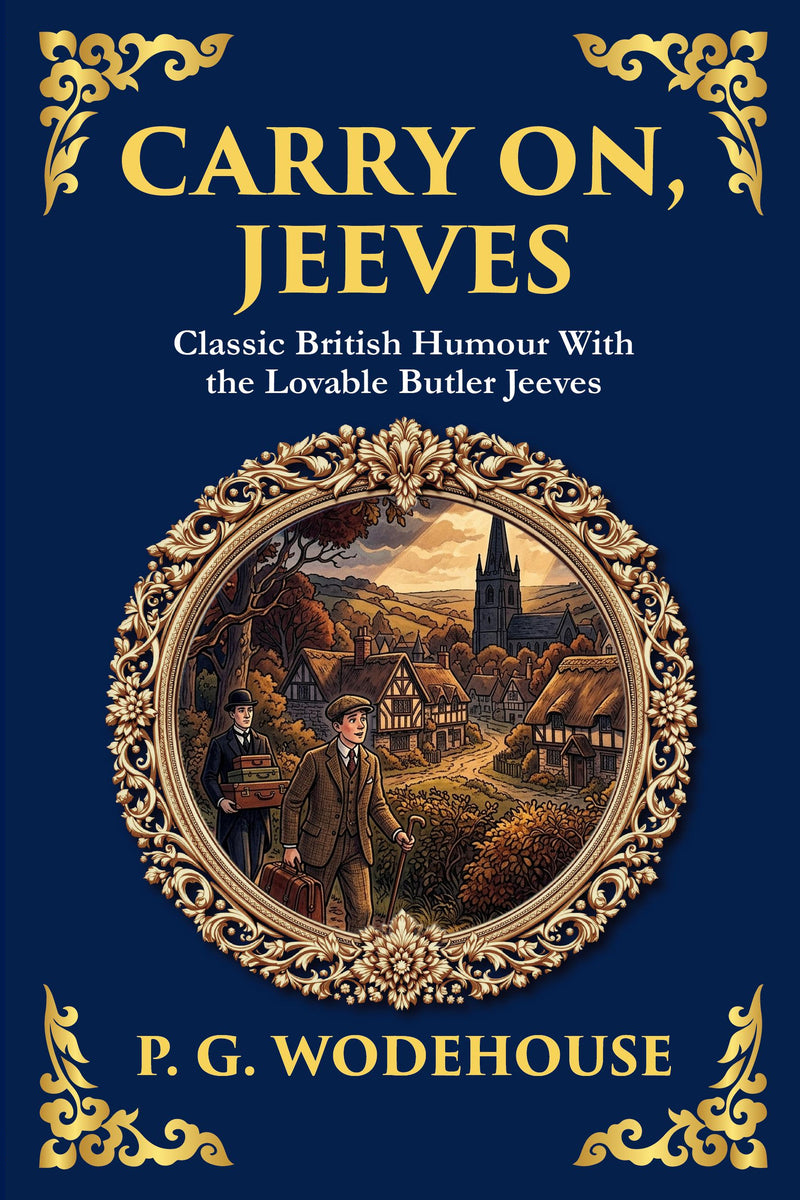
Carry On, Jeeves
Step into a world where charm meets chaos and every blunder is saved by the sharp mind of one peerless valet. In Carry On, Jeeves, P. G. Wodehouse introduces the most iconic gentleman’s gentleman in literary history—Jeeves—whose calm intellect saves Bertie Wooster from romantic entanglements, social embarrassments, and
or free app
10,000+ hrs library
30-day guarantee
The complete Carry On, Jeeves appears in modern English through Library of Alexandria Press, available online with audiobook narration included for members.
Have you ever wondered why the world fell in love with Jeeves—the ultimate problem- solver in a bowler hat? P. G. Wodehouse’s Carry On, Jeeves is a delightful collection of comic short stories that immortalized the legendary duo of Bertie Wooster and his ever-resourceful valet, Jeeves. Set in upper-class British society, each tale is a masterclass in timing, understatement, and hilarious misunderstandings, all brought to elegant resolution by the incomparable Jeeves.
In this modern reprint of a timeless classic, Wodehouse’s prose shines through in all its cleverness, wit, and gentle satire. Whether you're new to the Jeeves series or a longtime admirer, this edition delivers a joyously refined reading experience for fans of classic humour and sparkling storytelling.
What you’ll discover in this modern edition
- A Collection of Classic British Comedies – Includes beloved stories such as Jeeves Takes Charge, The Artistic Career of Corky, and Leave It to Jeeves.
- The Birth of a Legendary Literary Duo – Witness how the affable but hapless Bertie Wooster and the masterful Jeeves first met and forged an unbreakable bond.
- Timeless Humor and Social Satire – Wodehouse’s sharp observations on class, society, and absurdity still feel refreshingly modern today.
- A Celebration of Wit and Wordplay – Every page delivers a chuckle, a wry smile, or an outright laugh—perfect for lovers of intelligent humour.
| Formats | eBook (EPUB + PDF) · Audiobook · Paperback · Hardcover · Large Print |
| Language | English |
| Trim size (print) | 6 × 9 in |
| Binding | Paperback — perfect-bound · Hardcover — casewrap |
| Large Print edition | Same text in a larger, easy-read type — a larger font, not a larger trim |
| Print pricing | Every physical book at our true cost — at-cost, no profit (members) |
| Library | 873 restored titles, always growing |
| Length | 69,945 words · ~4 hr 40 min reading |
| Reading level | Grade 3 · an easy, flowing read (this modern-English edition) |
| Edition | Modern English translation · 2026 |
Member reviews for this edition are collected as readers finish it — be the first. Across the library: 12,000+ books shipped, every plan covered by a 365-day print guarantee.
About this edition
A faithful, unabridged modern-English edition by The Library of Alexandria — carefully rendered for today's reader and verified paragraph-by-paragraph against the public-domain source. Available as eBook, audiobook, paperback, hardcover, and large print.
- Complete & unabridgedVerified paragraph by paragraph against the source — never a scan, never abridged.
- Modern English, faithfulReadable today, with the author’s meaning kept intact. Readable — not simplified.
- Every format, one membershipRead in your browser or the free app, or listen to the full audiobook.
Included free with your membership
Cancel anytime, one click · 30-day money-back guarantee
Edition last updated July 2026
What’s inside
Carry On, Jeeves — complete and unabridged: all 5 sections included with membership, plus the full audiobook.
Begin reading Carry On, Jeeves
In clear modern English — the complete text is included with membership.
Introduction
There are few partnerships in all of literature as instantly recognizable, as endlessly imitated, and as profoundly comforting as that of a certain idle young gentleman and the imperturbable manservant who guides him through the perilous shoals of polite society. The moment you open these pages, you step into a world where the gravest catastrophe imaginable might be a poorly chosen pair of socks, where the threat of an unwanted engagement looms larger than any war, and where the sun seems perpetually to be either rising over a country house or filtering gently through the curtains of a Mayfair flat as breakfast is brought in on a tray. It is a world that never quite existed, and yet feels more real and more welcoming than the one we actually inhabit. To enter it is to be granted a holiday from anxiety, a respite from the relentless seriousness of modern living, and an invitation to laugh — genuinely, helplessly, gratefully — at the gentle absurdity of human beings doing their level best to muddle through.
This particular collection holds a special place in the larger saga, for it represents the moment when the curtain was drawn fully back and the dynamic between master and servant was allowed to breathe across an entire book of self-contained adventures. Each tale stands on its own, a perfectly constructed little machine of misunderstanding and rescue, yet together they accumulate into something greater: a complete portrait of a friendship that, beneath its comedy of class and protocol, is one of the most touching and durable in the English language. You need not have read a single word about these characters before to feel immediately at home. And if you have met them previously, you will find here some of the most beloved and frequently quoted episodes of the entire canon, polished to a high shine and brimming with the author’s distinctive genius.
Before we go any further, it is worth pausing to explain exactly what you are holding and why it has been prepared in this particular way. This edition has been thoughtfully adapted for the contemporary reader — a phrase that deserves some unpacking, because it is easy to misunderstand and easier still to be suspicious of. There is, quite rightly, a protective instinct among lovers of great writing that bristles at the very notion of “updating” a classic. The fear is that something essential will be lost, that the bloom will be rubbed off the fruit, that the irreplaceable music of an author’s voice will be flattened into bland, modern prose. Let me reassure you on this point at once: the aim of this adaptation is not to replace the author’s wit with someone else’s, nor to sand away the texture that makes his sentences sing. The author’s comic timing — the single most precious thing he possessed — remains entirely intact, because it is woven into the very architecture of how he constructs a joke, and no sensible editor would dream of touching it.
What a modern translation does accomplish is more modest and, I would argue, more generous. The original stories were written for readers of a particular era, an audience steeped in the slang of the day, the brand names of long-vanished products, the topical references that would have raised a knowing smile in their first readers and now produce only a furrowed brow and a reluctant reach for a search engine. Nothing kills a laugh quite so thoroughly as having to stop and decode it. The casual allusions to forgotten music-hall stars, to obscure tailors and bootmakers, to the precise social weight of certain neighborhoods or certain articles of clothing — these were the small currency of comedy in their time, and for a modern reader they can become little speed bumps that slow the glorious momentum the author worked so hard to build. This edition smooths those bumps where it can, gently clarifying what would otherwise be opaque, so that the rhythm of the comedy carries you forward exactly as it was meant to.
Consider also the matter of language itself. English is a living thing, and a century is a long time in the life of a language. Words that once meant one thing now mean another; turns of phrase that were crisp and immediate have softened into archaism; sentence structures that flowed naturally to the ear of the original audience can now feel slightly stiff and formal to ours. The careful work of adaptation is to preserve the spirit and the sparkle while easing the few genuine obstacles to comprehension, allowing the prose to land on a modern ear with the same effortless grace it had on its first hearers. The goal, always, is fidelity to the experience rather than slavish fidelity to every individual word. When the author wanted you to laugh, you should laugh — and you should laugh in the same place, for the same reason, with the same delighted surprise that his contemporaries felt.
It is important to be clear about what has not changed, because the answer is: almost everything that matters. The plots are untouched. The characters are exactly as their creator imagined them — the same vanities, the same loyalties, the same magnificent foolishness and quiet brilliance. The settings remain firmly in their period; this is not a story transplanted into a world of mobile phones and ride-sharing apps, and it would be a grotesque misunderstanding of the project to attempt such a thing. The gentleman still lounges in his flat; the manservant still glides silently into rooms; the aunts still terrify, the friends still blunder, and the engagements still threaten. What you are reading is the world of the original, faithfully maintained, with only the linguistic dust of a century lightly brushed away. Think of it as the difference between viewing an old master painting through a grimy varnish and viewing it after a sensitive cleaning: the image is the same, the genius is the same, but suddenly the colors are vivid again and you can see precisely what the artist intended you to see.
For the purist who wishes to encounter every comma exactly as it first appeared in print, the original texts remain available and always will. This edition exists alongside them, not in opposition to them. It is offered to the reader who has perhaps tried the classics before and found the going slightly heavy, who has heard for years how funny these stories are supposed to be and wondered why the humor seemed always to be just out of reach, hidden behind a screen of unfamiliar references and dated idiom. To that reader especially, this volume extends a hand and says: come in, the water is warm, and the joke is even better than you were promised.
To read these stories properly — to extract from them the maximum of pleasure — it helps to understand a little about how the author achieved his effects, because his comedy is far more deliberate and far more sophisticated than its breezy surface suggests. There is a persistent and entirely mistaken belief that lighthearted writing must be easy to produce, that froth and fizz come naturally to those who possess a sunny disposition. The truth is precisely the opposite. The kind of seemingly effortless prose you will encounter here was the product of obsessive labor, of endless rewriting, of a craftsman’s fanatical devotion to getting every single word in exactly the right place. The author was famous for pinning the pages of his work-in-progress to the wall of his study, arranging them at different heights according to how satisfied he was with each one, and refusing to move a page higher until he had made it as good as he could possibly make it. The result of all that hidden toil is the most weightless, buoyant, seemingly spontaneous comedy ever written. Nothing reads as more relaxed; nothing was ever produced with more rigor.
The first thing to notice as you read is the voice. These stories are largely narrated to us directly by our young gentleman protagonist, and that narrating voice is itself one of the great comic inventions in literature. He is amiable, generous, well-meaning, and not, it must be said, the sharpest knife in the drawer. But — and this is the crucial point — he is not a fool in any simple sense. He has a wonderful turn of phrase, a gift for the unexpected simile, a habit of mangling literary quotations in ways that are far funnier than getting them right would be. He reaches for grand language and lands somewhere splendidly askew. He is self-aware enough to know roughly where he stands in the intellectual pecking order, and there is real charm in his cheerful acceptance of his own limitations. We laugh at him, certainly, but we are never invited to despise him; rather, we are made his confederate, let in on the joke alongside him, so that our laughter is the laughter of affection rather than mockery. Pay attention, as you read, to the texture of his narration — the way he describes a sunrise, the way he characterizes a fearsome relative, the way he reports a conversation. The humor lives in those descriptions quite as much as in the events themselves.
The second thing to appreciate is the sheer perfection of the plotting. Beneath all the verbal sparkle, these are stories built like fine watches. A small problem is introduced — almost always something trivial by any rational standard — and then complications multiply with a logic that is both completely absurd and completely inevitable. One misunderstanding breeds another; one well-intentioned scheme collides with a second; threads that seemed unrelated are revealed, at the climactic moment, to have been part of the same tangle all along. And then, with a flourish, everything resolves, usually through the intervention of that supremely capable manservant whose intelligence stands in such delicious contrast to his employer’s amiable haze. The pleasure of these resolutions is the pleasure of watching a master magician complete a trick: you may not have seen quite how it was done, but the moment it lands you feel a satisfying click of rightness, the sense that all the pieces have fallen exactly where they were always destined to fall. Watch for this structure as you read. Part of the joy of these stories on a second encounter is admiring the machinery, noticing how early and how slyly the author planted the seeds of the eventual harvest.
The third element worth dwelling on is the central relationship itself, which is the beating heart of everything. On the surface it is a comedy of inversion: the servant is cleverer than the master, the employee solves the problems of the employer, the supposedly subordinate figure is in fact the true power in the household. This is funny in itself, and it taps into a delight in reversal that is as old as comedy. But what elevates the partnership beyond mere formula is the genuine warmth and mutual dependence that underlies it. The manservant is not contemptuous of his employer; he is, in his own undemonstrative way, devoted to him, and takes a real and tender pride in steering him clear of disaster. The young gentleman, for his part, may grumble about his servant’s tyranny in matters of dress and may occasionally rebel against his guidance, but he knows, at bottom, that he would be utterly lost without him, and there is real love beneath the banter. The recurring tension between them — frequently turning on some sartorial choice the servant disapproves of — is essentially a domestic comedy, the comedy of two people who know each other intimately and who must constantly negotiate the small frictions of a shared life. It is this emotional truth, hidden beneath the glittering surface, that has kept these characters alive and beloved for generation after generation. We do not merely find them funny; we are fond of them. We want them to be all right. And the wonderful reassurance of these stories is that, in the end, they always are.
A fourth pleasure, less often remarked upon, is the author’s extraordinary command of imagery and metaphor. He had a way of describing the world that was entirely his own — a knack for the startling, illuminating comparison that makes you see an ordinary thing in a wholly new way. A nervous man does not merely fidget; he behaves in some precise and ridiculous manner that the author renders unforgettable. A gloomy acquaintance does not merely look sad; he resembles, perhaps, something specific and surprising drawn from nature or mythology or domestic life. These flashes of imagery come thick and fast, sometimes several to a page, and they reward the reader who slows down just enough to savor them. There is a temptation, when reading something this entertaining, to race ahead to find out what happens next — and that temptation is entirely natural and not to be resisted too sternly. But on a second reading, or simply in a more leisurely first one, allow yourself to linger over the sentences. The plots are delightful, but the prose is sublime, and it is in the prose, line by line, that the author’s true greatness resides.
Cancel anytime, one click · 30-day money-back guarantee
Founding annual rate available now — your price locks for life when you join.
Not ready? Get this free chapter by email — read it anytime.
✓ Sent — check your inbox for Carry On, Jeeves.
Questions about Carry On, Jeeves
What is Carry On, Jeeves about?
Step into a world where charm meets chaos and every blunder is saved by the sharp mind of one peerless valet. In Carry On, Jeeves, P. G. Wodehouse introduces the most iconic gentleman’s gentleman in literary history—Jeeves—whose calm intellect saves Bertie Wooster from romantic entanglements, social embarrassments, and the occasional overzealous aunt. These sparkling stories of misadventures, mistaken identities, and wry British wit are the perfect escape into a world where logic and tea can fix nearly anything.
Who wrote Carry On, Jeeves?
Carry On, Jeeves was written by P. G. Wodehouse. This edition presents the complete work in clear modern English, faithfully rendered from the public-domain original by Library of Alexandria Press.
Is Carry On, Jeeves free to read?
The opening chapter is free to read on this page. Members read and listen to the complete work — and the entire library — free, and can order any physical book at our true print cost.
How long is Carry On, Jeeves?
5 chapters (~69,945 words) — about 4 hr 40 min of reading in this modern-English edition.
Is this an abridged version of Carry On, Jeeves?
No. This is the complete, unabridged Carry On, Jeeves, carefully rendered into clear modern English and verified paragraph-by-paragraph against the public-domain source — nothing is cut or summarised.
What formats does Carry On, Jeeves come in?
Carry On, Jeeves is available as eBook, paperback, hardcover and large print. eBook and audiobook are included with membership; printed editions ship at our true print cost.
Shipping & returns
Billing & membership
More from the library


Explore Humour & Satire
- The Imaginary Invalid · Molière
- My Man Jeeves · P. G. Wodehouse
- Barry Lyndon · William Makepeace Thackeray
- The Man with Two Left Feet, and Other Stories · P. G. Wodehouse
- The Confidence-Man: His Masquerade · Herman Melville
- Lucian’s True History · Lucian of Samosata
- Penrod · Booth Tarkington
- Status Quo · Mack Reynolds
- Herland · Charlotte Perkins Gilman
- Sartor Resartus: The Life and Opinions of Herr Teufelsdröckh · Thomas Carlyle
- The Satyricon of Petronius Arbiter · Petronius Arbiter
- Three Men in a Boat (To Say Nothing of the Dog) · Jerome K. Jerome
- A Connecticut Yankee in King Arthur’s Court · Mark Twain
- Northanger Abbey · Jane Austen
- Once Aboard the Lugger—The History of George and his Mary · A. S. M. Hutchinson
- Candide · Voltaire
- Gulliver’s Travels into Several Remote Regions of the World · Jonathan Swift
- Emma · Jane Austen
- A Room with a View · E. M. Forster
- The Eyes Have It · Philip K. Dick
- The Wind in the Willows · Kenneth Grahame
- Right Ho, Jeeves · P. G. Wodehouse
- The Mysterious Stranger and Other Stories · Mark Twain
- A Modest Proposal · Jonathan Swift
Carry On, Jeeves
Carry On, Jeeves
Classic British Comedy Featuring the Beloved Butler Jeeves
P. G. Wodehouse
Contents
- Introduction
- Chapter 1
- Chapter 2
- Chapter 6—The Rummy Affair of Old Biffy
- Chapter 10—Bertie Changes his Mind
Introduction
There are few partnerships in all of literature as instantly recognizable, as endlessly imitated, and as profoundly comforting as that of a certain idle young gentleman and the imperturbable manservant who guides him through the perilous shoals of polite society. The moment you open these pages, you step into a world where the gravest catastrophe imaginable might be a poorly chosen pair of socks, where the threat of an unwanted engagement looms larger than any war, and where the sun seems perpetually to be either rising over a country house or filtering gently through the curtains of a Mayfair flat as breakfast is brought in on a tray. It is a world that never quite existed, and yet feels more real and more welcoming than the one we actually inhabit. To enter it is to be granted a holiday from anxiety, a respite from the relentless seriousness of modern living, and an invitation to laugh — genuinely, helplessly, gratefully — at the gentle absurdity of human beings doing their level best to muddle through.
This particular collection holds a special place in the larger saga, for it represents the moment when the curtain was drawn fully back and the dynamic between master and servant was allowed to breathe across an entire book of self-contained adventures. Each tale stands on its own, a perfectly constructed little machine of misunderstanding and rescue, yet together they accumulate into something greater: a complete portrait of a friendship that, beneath its comedy of class and protocol, is one of the most touching and durable in the English language. You need not have read a single word about these characters before to feel immediately at home. And if you have met them previously, you will find here some of the most beloved and frequently quoted episodes of the entire canon, polished to a high shine and brimming with the author’s distinctive genius.
Before we go any further, it is worth pausing to explain exactly what you are holding and why it has been prepared in this particular way. This edition has been thoughtfully adapted for the contemporary reader — a phrase that deserves some unpacking, because it is easy to misunderstand and easier still to be suspicious of. There is, quite rightly, a protective instinct among lovers of great writing that bristles at the very notion of “updating” a classic. The fear is that something essential will be lost, that the bloom will be rubbed off the fruit, that the irreplaceable music of an author’s voice will be flattened into bland, modern prose. Let me reassure you on this point at once: the aim of this adaptation is not to replace the author’s wit with someone else’s, nor to sand away the texture that makes his sentences sing. The author’s comic timing — the single most precious thing he possessed — remains entirely intact, because it is woven into the very architecture of how he constructs a joke, and no sensible editor would dream of touching it.
What a modern translation does accomplish is more modest and, I would argue, more generous. The original stories were written for readers of a particular era, an audience steeped in the slang of the day, the brand names of long-vanished products, the topical references that would have raised a knowing smile in their first readers and now produce only a furrowed brow and a reluctant reach for a search engine. Nothing kills a laugh quite so thoroughly as having to stop and decode it. The casual allusions to forgotten music-hall stars, to obscure tailors and bootmakers, to the precise social weight of certain neighborhoods or certain articles of clothing — these were the small currency of comedy in their time, and for a modern reader they can become little speed bumps that slow the glorious momentum the author worked so hard to build. This edition smooths those bumps where it can, gently clarifying what would otherwise be opaque, so that the rhythm of the comedy carries you forward exactly as it was meant to.
Consider also the matter of language itself. English is a living thing, and a century is a long time in the life of a language. Words that once meant one thing now mean another; turns of phrase that were crisp and immediate have softened into archaism; sentence structures that flowed naturally to the ear of the original audience can now feel slightly stiff and formal to ours. The careful work of adaptation is to preserve the spirit and the sparkle while easing the few genuine obstacles to comprehension, allowing the prose to land on a modern ear with the same effortless grace it had on its first hearers. The goal, always, is fidelity to the experience rather than slavish fidelity to every individual word. When the author wanted you to laugh, you should laugh — and you should laugh in the same place, for the same reason, with the same delighted surprise that his contemporaries felt.
It is important to be clear about what has not changed, because the answer is: almost everything that matters. The plots are untouched. The characters are exactly as their creator imagined them — the same vanities, the same loyalties, the same magnificent foolishness and quiet brilliance. The settings remain firmly in their period; this is not a story transplanted into a world of mobile phones and ride-sharing apps, and it would be a grotesque misunderstanding of the project to attempt such a thing. The gentleman still lounges in his flat; the manservant still glides silently into rooms; the aunts still terrify, the friends still blunder, and the engagements still threaten. What you are reading is the world of the original, faithfully maintained, with only the linguistic dust of a century lightly brushed away. Think of it as the difference between viewing an old master painting through a grimy varnish and viewing it after a sensitive cleaning: the image is the same, the genius is the same, but suddenly the colors are vivid again and you can see precisely what the artist intended you to see.
For the purist who wishes to encounter every comma exactly as it first appeared in print, the original texts remain available and always will. This edition exists alongside them, not in opposition to them. It is offered to the reader who has perhaps tried the classics before and found the going slightly heavy, who has heard for years how funny these stories are supposed to be and wondered why the humor seemed always to be just out of reach, hidden behind a screen of unfamiliar references and dated idiom. To that reader especially, this volume extends a hand and says: come in, the water is warm, and the joke is even better than you were promised.
To read these stories properly — to extract from them the maximum of pleasure — it helps to understand a little about how the author achieved his effects, because his comedy is far more deliberate and far more sophisticated than its breezy surface suggests. There is a persistent and entirely mistaken belief that lighthearted writing must be easy to produce, that froth and fizz come naturally to those who possess a sunny disposition. The truth is precisely the opposite. The kind of seemingly effortless prose you will encounter here was the product of obsessive labor, of endless rewriting, of a craftsman’s fanatical devotion to getting every single word in exactly the right place. The author was famous for pinning the pages of his work-in-progress to the wall of his study, arranging them at different heights according to how satisfied he was with each one, and refusing to move a page higher until he had made it as good as he could possibly make it. The result of all that hidden toil is the most weightless, buoyant, seemingly spontaneous comedy ever written. Nothing reads as more relaxed; nothing was ever produced with more rigor.
The first thing to notice as you read is the voice. These stories are largely narrated to us directly by our young gentleman protagonist, and that narrating voice is itself one of the great comic inventions in literature. He is amiable, generous, well-meaning, and not, it must be said, the sharpest knife in the drawer. But — and this is the crucial point — he is not a fool in any simple sense. He has a wonderful turn of phrase, a gift for the unexpected simile, a habit of mangling literary quotations in ways that are far funnier than getting them right would be. He reaches for grand language and lands somewhere splendidly askew. He is self-aware enough to know roughly where he stands in the intellectual pecking order, and there is real charm in his cheerful acceptance of his own limitations. We laugh at him, certainly, but we are never invited to despise him; rather, we are made his confederate, let in on the joke alongside him, so that our laughter is the laughter of affection rather than mockery. Pay attention, as you read, to the texture of his narration — the way he describes a sunrise, the way he characterizes a fearsome relative, the way he reports a conversation. The humor lives in those descriptions quite as much as in the events themselves.
The second thing to appreciate is the sheer perfection of the plotting. Beneath all the verbal sparkle, these are stories built like fine watches. A small problem is introduced — almost always something trivial by any rational standard — and then complications multiply with a logic that is both completely absurd and completely inevitable. One misunderstanding breeds another; one well-intentioned scheme collides with a second; threads that seemed unrelated are revealed, at the climactic moment, to have been part of the same tangle all along. And then, with a flourish, everything resolves, usually through the intervention of that supremely capable manservant whose intelligence stands in such delicious contrast to his employer’s amiable haze. The pleasure of these resolutions is the pleasure of watching a master magician complete a trick: you may not have seen quite how it was done, but the moment it lands you feel a satisfying click of rightness, the sense that all the pieces have fallen exactly where they were always destined to fall. Watch for this structure as you read. Part of the joy of these stories on a second encounter is admiring the machinery, noticing how early and how slyly the author planted the seeds of the eventual harvest.
The third element worth dwelling on is the central relationship itself, which is the beating heart of everything. On the surface it is a comedy of inversion: the servant is cleverer than the master, the employee solves the problems of the employer, the supposedly subordinate figure is in fact the true power in the household. This is funny in itself, and it taps into a delight in reversal that is as old as comedy. But what elevates the partnership beyond mere formula is the genuine warmth and mutual dependence that underlies it. The manservant is not contemptuous of his employer; he is, in his own undemonstrative way, devoted to him, and takes a real and tender pride in steering him clear of disaster. The young gentleman, for his part, may grumble about his servant’s tyranny in matters of dress and may occasionally rebel against his guidance, but he knows, at bottom, that he would be utterly lost without him, and there is real love beneath the banter. The recurring tension between them — frequently turning on some sartorial choice the servant disapproves of — is essentially a domestic comedy, the comedy of two people who know each other intimately and who must constantly negotiate the small frictions of a shared life. It is this emotional truth, hidden beneath the glittering surface, that has kept these characters alive and beloved for generation after generation. We do not merely find them funny; we are fond of them. We want them to be all right. And the wonderful reassurance of these stories is that, in the end, they always are.
A fourth pleasure, less often remarked upon, is the author’s extraordinary command of imagery and metaphor. He had a way of describing the world that was entirely his own — a knack for the startling, illuminating comparison that makes you see an ordinary thing in a wholly new way. A nervous man does not merely fidget; he behaves in some precise and ridiculous manner that the author renders unforgettable. A gloomy acquaintance does not merely look sad; he resembles, perhaps, something specific and surprising drawn from nature or mythology or domestic life. These flashes of imagery come thick and fast, sometimes several to a page, and they reward the reader who slows down just enough to savor them. There is a temptation, when reading something this entertaining, to race ahead to find out what happens next — and that temptation is entirely natural and not to be resisted too sternly. But on a second reading, or simply in a more leisurely first one, allow yourself to linger over the sentences. The plots are delightful, but the prose is sublime, and it is in the prose, line by line, that the author’s true greatness resides.
Now, regarding the situation with old Jeeves—my valet, as you know—where do we stand? Many people believe I rely on him far too much. My Aunt Agatha has even gone so far as to call him my keeper. To that, I say: Why not? The man is a genius. From the neck up, he is in a league of his own; I stopped trying to manage my own life within a week of him joining my service. That was about six years ago, right after the strange business involving Florence Craye, my Uncle Willoughby’s book, and Edwin, the Boy Scout.
It all actually started when I returned to Easeby, my uncle’s estate in Shropshire. I usually spent a week or so there during the summer, but I had to cut my trip short to go back to London and hire a new valet. I had caught Meadowes, the man I’d brought to Easeby, stealing my silk socks, and that’s something no man with any self-respect can tolerate. Since it also turned out that he had been stealing various other things around the house, I was forced to fire the misguided idiot and head to London to have the employment agency find me a replacement. That was how I got Jeeves.
I will never forget the morning he arrived. As it happened, I had attended a very lively little dinner party the night before, and I was feeling pretty rough. To make matters worse, I was trying to read a book that Florence Craye had given me. She had been a guest at Easeby, and we had gotten engaged a few days before I left. I was scheduled to return at the end of the week, and I knew she would expect me to have finished the book by then. You see, she was very determined to raise my level of intelligence to match her own. She was a girl with a beautiful profile, but she was completely obsessed with serious subjects. To give you an idea of the situation, the book she gave me was titled Types of Ethical Theory, and when I opened it to a random page, I found this:
End of the free sample
Keep reading, free
Members read and listen to the complete book — and the entire library. Cancel anytime, one click · 30-day money-back guarantee.