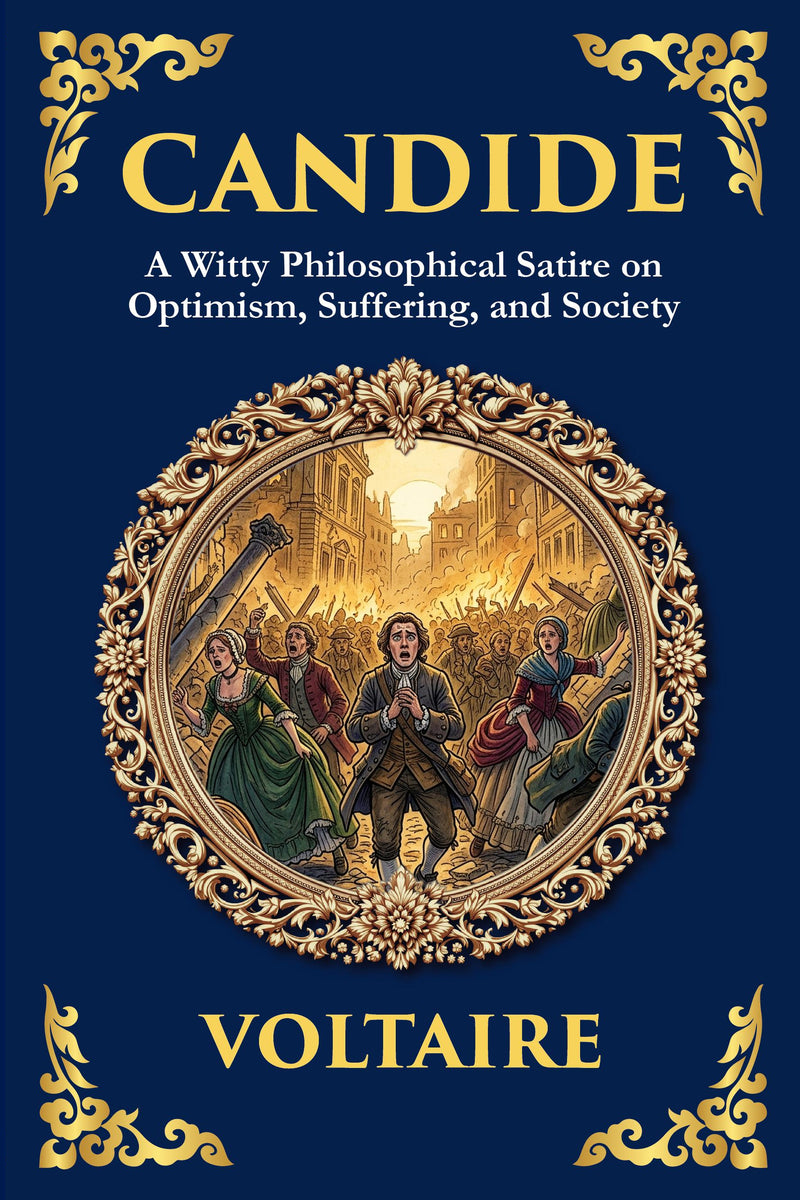
Candide
With a razor-sharp wit and a fearless eye for hypocrisy, Voltaire’s Candide skewers blind optimism, corrupt institutions, and philosophical pretension with dazzling brilliance.
or free app
10,000+ hrs library
30-day guarantee
The complete Candide appears in modern English through Library of Alexandria Press, available online with audiobook narration included for members.
Have you ever wondered why we cling to optimism even when the world falls apart? Candide by Voltaire is a relentless and hilarious journey through absurdity, disaster, and human folly. This bold philosophical satire follows young Candide as he is expelled from paradise and cast into a world filled with war, poverty, natural disasters, and betrayal.
Yet through it all, he clings to the mantra taught by his mentor Pangloss: “All is for the best in the best of all possible worlds.” But can that belief survive the horrors of the real world? Across Europe, South America, and beyond, Candide and his companions encounter a dizzying array of catastrophes—massacres, slavery, religious persecution, and natural calamities. With every misadventure, Voltaire shatters illusions of naive optimism, challenging readers to examine the true nature of suffering, the limits of reason, and the absurdities of society’s institutions.
What you’ll discover in this modern edition
- A Global Journey Through Disaster and Irony – Travel with Candide as he stumbles through every imaginable tragedy, all with biting comedic effect.
- A Dismantling of Philosophical Optimism – Explore Voltaire’s critique of blind faith in reason, progress, and divine justice.
- A Satire of Society, Religion, and Power – No institution is safe from Voltaire’s razor- sharp wit.
- A Story That’s as Funny as It Is Furious – Laugh, cringe, and think as you absorb the lessons behind the absurdities.
- A Call to “Cultivate Our Garden” – Discover Voltaire’s alternative to empty theorizing: a life of practical, grounded purpose.
| Formats | eBook (EPUB + PDF) · Audiobook · Paperback · Hardcover · Large Print |
| Language | English |
| Trim size (print) | 6 × 9 in |
| Binding | Paperback — perfect-bound · Hardcover — casewrap |
| Large Print edition | Same text in a larger, easy-read type — a larger font, not a larger trim |
| Print pricing | Every physical book at our true cost — at-cost, no profit (members) |
| Library | 873 restored titles, always growing |
| Length | 34,577 words · ~2 hr 18 min reading |
| Reading level | Grade 9 · a comfortable read (this modern-English edition) |
| Edition | Modern English translation · 2026 |
Member reviews for this edition are collected as readers finish it — be the first. Across the library: 12,000+ books shipped, every plan covered by a 365-day print guarantee.
About this edition
A faithful, unabridged modern-English edition by The Library of Alexandria — carefully rendered for today's reader and verified paragraph-by-paragraph against the public-domain source. Available as eBook, audiobook, paperback, hardcover, and large print.
- Complete & unabridgedVerified paragraph by paragraph against the source — never a scan, never abridged.
- Modern English, faithfulReadable today, with the author’s meaning kept intact. Readable — not simplified.
- Every format, one membershipRead in your browser or the free app, or listen to the full audiobook.
Included free with your membership
Cancel anytime, one click · 30-day money-back guarantee
Edition last updated July 2026
What’s inside
Candide — complete and unabridged: all 32 sections included with membership, plus the full audiobook.
Begin reading Candide
In clear modern English — the complete text is included with membership.
Introduction
There are books that argue with their century, and there are books that detonate inside it. Candide belongs unmistakably to the second category. When it appeared in 1759, anonymously and almost simultaneously in several European cities, it spread with the speed of a rumor and the force of a scandal. Authorities banned it. Booksellers couldn’t keep it on the shelves. Readers passed it hand to hand, laughing aloud at passages that, on closer inspection, described some of the cruelest things human beings do to one another. Within weeks it had become the kind of book everyone seemed to have read, even those who claimed never to have touched it. More than two and a half centuries later, it remains one of the most read, most quoted, and most quietly subversive works in all of Western literature — a slim volume that has outlasted the philosophies it mocked, the regimes that tried to suppress it, and the very world that produced it.
What you hold in your hands is a fresh translation of that book, adapted for the contemporary reader. That phrase deserves a moment of explanation, because Candide is not a difficult book in the way that some classics are difficult. It is short. It moves fast. It is funny. And yet eighteenth-century French prose, even when translated faithfully, can place a faint film of distance between the modern eye and the page — a vocabulary of vanished customs, a cadence built for a different ear, allusions to quarrels and personalities that meant everything in 1759 and almost nothing now. The aim of this edition is to dissolve that film without dissolving the book. The wit remains sharp, the irony remains merciless, the famous closing lines remain exactly as devastating as Voltaire intended. What has been smoothed is only the friction that has nothing to do with the author’s genius and everything to do with the passage of time. You are meant to read this the way its first readers did: greedily, in one or two sittings, gasping and laughing and occasionally wincing, swept along by a story that refuses to slow down.
Because before it is anything else — before it is philosophy, before it is satire, before it is a monument of the Enlightenment — Candide is a story, and a wildly entertaining one. It is an adventure tale that crosses oceans and continents, that hurls its hero from disaster to disaster with a velocity that anticipates the modern action film by two hundred years. Shipwrecks, earthquakes, battles, betrayals, lost loves, fabulous treasures, narrow escapes from the gallows and worse — the plot is so packed with incident that summarizing even a single chapter would risk spoiling the breathless surprise of it. Voltaire understood something that many of his more solemn contemporaries did not: that the surest way to lodge an idea in a reader’s mind is to wrap it inside a story too delicious to put down. He was, in this sense, one of the great entertainers of his age. And the entertainment has not faded. The book still reads like a fuse already lit.
A Man, a Century, and a Quarrel with the Universe
To understand why Candide hits the way it does, it helps to know a little about the extraordinary figure who wrote it and the equally extraordinary moment that shaped him. The author we call Voltaire was born François-Marie Arouet in Paris in 1694, into a comfortable bourgeois family that hoped he would become a respectable lawyer. He had other plans. By his twenties he had reinvented himself under the pen name “Voltaire” and announced his arrival on the literary scene with poems and plays sharp enough to land him in the Bastille — twice. The second imprisonment, the result of a quarrel with an aristocrat who had him beaten by hired men and then jailed for daring to demand satisfaction, taught him a lesson he never forgot about the brutal arbitrariness of power and privilege. Exiled to England, he discovered a society that, for all its flaws, prized commerce, tolerated religious difference, and let its philosophers and scientists speak more freely than his own country dared. He came home transformed, carrying with him the ideas of Newton, Locke, and the English tradition of empirical inquiry, and he spent the rest of his very long life as Europe’s most famous, most controversial, and most relentlessly busy intellectual.
It is almost impossible to overstate how prolific and how influential he was. He wrote tragedies, comedies, epic poems, histories, scientific treatises, philosophical dictionaries, and thousands upon thousands of letters. He carried on correspondence with monarchs and was, for a time, the houseguest and intellectual sparring partner of Frederick the Great of Prussia. He made and lost fortunes. He championed the victims of religious persecution and judicial murder with a ferocity that helped invent the modern idea of the public intellectual as the conscience of his society. He could be vain, vindictive, and maddeningly inconsistent — a man who denounced tyranny while flattering kings, who pleaded for tolerance while savaging his enemies. But he never stopped fighting, and the thing he fought hardest against was certainty: the comfortable, dangerous, self-serving certainty of those who claimed to have the universe figured out.
This is where Candide comes from. By the time Voltaire wrote it, he was in his sixties, weathered by decades of struggle, and he had grown impatient — furious, even — with a particular philosophical idea that had taken hold among the educated classes of Europe. The idea, broadly speaking, was optimism, though not in the casual sense we use the word today. This was a systematic, almost mathematical optimism, associated above all with the German philosopher Gottfried Wilhelm Leibniz, who had argued that because God is infinitely good and infinitely powerful, the world He created must necessarily be the best of all possible worlds. Every apparent evil, in this view, was secretly a part of a larger harmony, a necessary thread in a tapestry too vast for human eyes to take in. Suffering had its place. Disaster served a hidden purpose. Whatever happened, no matter how horrible, was — when seen from a high enough vantage — for the best.
It is a seductive doctrine, and you can understand why it appealed to people. It made sense of a senseless world. It reconciled faith in a loving God with the undeniable presence of misery. It offered consolation. But Voltaire came to regard it as not merely wrong but obscene — a philosophy that, however well-intentioned, ended up justifying every cruelty and excusing every catastrophe by folding it into a cosmic plan. And then, in 1755, something happened that seemed to make the whole question unbearably urgent. On the morning of November 1st — All Saints’ Day, when the churches of Lisbon were full — an enormous earthquake struck the Portuguese capital, followed by a tsunami and then by fires that burned for days. Tens of thousands of people died. One of the wealthiest, most devout cities in Europe was reduced to rubble in a matter of minutes. The disaster sent a shock through the intellectual life of the continent. How could a benevolent God permit such a thing? In what conceivable sense was this “for the best”? The Lisbon earthquake haunted Voltaire. He wrote a long, anguished poem about it. And it left its fingerprints all over the book you are about to read.
So Candide is, at its heart, an argument — a sustained, savage, hilarious assault on the proposition that all is well in the best of all possible worlds. But here is the crucial thing, the thing that separates Voltaire from a thousand forgotten polemicists: he does not argue by arguing. He argues by telling a story so absurd, so relentlessly catastrophic, so crammed with every imaginable form of human and natural disaster, that the philosophy of optimism collapses under the sheer weight of evidence against it. He lets the world itself make his case. He takes a sweet, trusting, thoroughly indoctrinated young man and sends him out into reality, and he lets us watch what happens to a person who insists on believing that everything is for the best while the everything around him is manifestly, horrifyingly, comically not. The genius of the method is that it never feels like a lecture. It feels like a runaway carriage.
Readers coming to Candide for the first time are often startled by its tone, and it is worth preparing yourself for it, because the tone is the whole point. The book is, on its surface, light. The sentences are brisk and bright. The narrator maintains an air of cheerful detachment, reporting the most appalling events in the same chipper, matter-of-fact voice he might use to describe a pleasant afternoon. People are killed, maimed, robbed, and abused with such rapidity and such deadpan understatement that you find yourself laughing before you have quite registered what you are laughing at. And then, a beat later, the horror of it lands. This whiplash — the gap between the breeziness of the telling and the awfulness of the told — is the engine of the book’s irony, and it is one of the most sophisticated comic techniques in all of literature.
It is also, in a deeper sense, the book’s moral instrument. Voltaire is doing something more than making jokes about misfortune. He is forcing us to feel the obscenity of looking at real suffering and pronouncing it acceptable. Every time a character responds to a fresh atrocity by explaining how it serves the greater good, the explanation curdles in our mouths. The comedy and the cruelty are inseparable; you cannot have one without the other. That is exactly how Voltaire wants it. He is not trying to give us the comfortable, distanced laughter of pure farce. He is giving us the uncomfortable, double-edged laughter that makes us complicit and aware at the same time — laughter that turns, almost against our will, into thought.
This is why Candide has survived when so much eighteenth-century writing has faded into the libraries. Satire is a notoriously perishable form. Most of it is so tied to the particular targets of its moment — this minister, that scandal, this fashionable nonsense — that once the moment passes, the jokes go dead and require footnotes to resurrect. Candide is full of such targets, and a good edition will help you appreciate them. But the book has outlived its targets because Voltaire, almost in spite of himself, was aiming at something permanent. The optimistic philosophy he attacks is dead in its specific, Leibnizian form, but the human impulse it represents is immortal. We still tell ourselves, and one another, that everything happens for a reason. We still reach for explanations that make our suffering bearable by giving it meaning. We still encounter the well-fed comfortable telling the desperate that their misery is somehow part of a larger plan. Voltaire’s quarrel was never really with one German philosopher. It was with the eternal human temptation to look away from pain by pretending it is something other than what it is.
And the world he describes, for all its eighteenth-century costume, is recognizably our world. The wars fought for reasons no one can articulate, in which ordinary people are slaughtered while both sides sing victory hymns. The institutions that preach virtue and practice cruelty. The colonial brutality that built European wealth on the backs of enslaved and exploited peoples — a theme Voltaire confronts with a directness that remains shocking, and that gives the lie to any notion that the Enlightenment was blind to its own century’s crimes. The hypocrisy of the powerful, the venality of officials, the way money and rank insulate the few while the many are ground down. The con artists, the false friends, the parasites who attach themselves to anyone with a little fortune. Read Candide today and you will be astonished how little of its anger feels dated. The technology has changed. The folly has not.
Yet — and this is essential to understanding the book — Candide is not finally a despairing work, nor is it a nihilistic one. This surprises some readers, who expect that a book so thorough in its catalog of misery must end in darkness. It does not. Voltaire was a fighter, not a quitter, and a man who genuinely believed in the possibility of human improvement even as he documented human disaster. The book is engaged in a search, not just a demolition. Having torn down the false comfort of cosmic optimism, it goes looking for something to put in its place — some attitude, some way of living, that can acknowledge the reality of suffering without either drowning in despair or denying it through fantasy. The conclusion the book arrives at is famous, much quoted, and frequently misunderstood, and I will not spoil it here. I will say only that it is modest, hard-won, and quietly profound, and that it has the ring of wisdom precisely because it has been earned through everything that came before. When you reach the final pages, you will understand that Voltaire has not led you through all that chaos in order to leave you in despair. He has led you somewhere else entirely.
Cancel anytime, one click · 30-day money-back guarantee
Founding annual rate available now — your price locks for life when you join.
Not ready? Get this free chapter by email — read it anytime.
✓ Sent — check your inbox for Candide.
Questions about Candide
What is Candide about?
With a razor-sharp wit and a fearless eye for hypocrisy, Voltaire’s Candide skewers blind optimism, corrupt institutions, and philosophical pretension with dazzling brilliance. Following the misadventures of the ever-hopeful Candide—whose tutor, Pangloss, insists that everything happens for the best—this biting satire travels across continents, plagues, earthquakes, shipwrecks, and wars, all in search of a utopian life that never seems to exist. As Candide witnesses unimaginable cruelty, absurdity, and injustice, h
Who wrote Candide?
Candide was written by Voltaire. This edition presents the complete work in clear modern English, faithfully rendered from the public-domain original by Library of Alexandria Press.
Is Candide free to read?
The opening chapter is free to read on this page. Members read and listen to the complete work — and the entire library — free, and can order any physical book at our true print cost.
How long is Candide?
32 chapters (~34,577 words) — about 2 hr 18 min of reading in this modern-English edition.
Is this an abridged version of Candide?
No. This is the complete, unabridged Candide, carefully rendered into clear modern English and verified paragraph-by-paragraph against the public-domain source — nothing is cut or summarised.
What formats does Candide come in?
Candide is available as eBook, paperback, hardcover and large print. eBook and audiobook are included with membership; printed editions ship at our true print cost.
Shipping & returns
Billing & membership
More from the library


Explore Humour & Satire
- The Imaginary Invalid · Molière
- My Man Jeeves · P. G. Wodehouse
- Barry Lyndon · William Makepeace Thackeray
- The Man with Two Left Feet, and Other Stories · P. G. Wodehouse
- Carry On, Jeeves · P. G. Wodehouse
- The Confidence-Man: His Masquerade · Herman Melville
- Lucian’s True History · Lucian of Samosata
- Penrod · Booth Tarkington
- Status Quo · Mack Reynolds
- Herland · Charlotte Perkins Gilman
- Sartor Resartus: The Life and Opinions of Herr Teufelsdröckh · Thomas Carlyle
- The Satyricon of Petronius Arbiter · Petronius Arbiter
- Three Men in a Boat (To Say Nothing of the Dog) · Jerome K. Jerome
- A Connecticut Yankee in King Arthur’s Court · Mark Twain
- Northanger Abbey · Jane Austen
- Once Aboard the Lugger—The History of George and his Mary · A. S. M. Hutchinson
- Gulliver’s Travels into Several Remote Regions of the World · Jonathan Swift
- Emma · Jane Austen
- A Room with a View · E. M. Forster
- The Eyes Have It · Philip K. Dick
- The Wind in the Willows · Kenneth Grahame
- Right Ho, Jeeves · P. G. Wodehouse
- The Mysterious Stranger and Other Stories · Mark Twain
- A Modest Proposal · Jonathan Swift
Candide
Candide
A Witty Philosophical Satire on Optimism, Suffering, and Society
Voltaire
Contents
- Introduction
- Chapter 1
- Chapter 2
- Chapter 3
- Chapter 4
- Chapter 5
- Chapter 6
- Chapter 7
- Chapter 8
- Chapter 9
- Chapter 10
- Chapter 11
- Chapter 12
- Chapter 13
- Chapter 14
- Chapter 15
- Chapter 16
- Chapter 17
- Chapter 18
- Chapter 19
- Chapter 20
- Chapter 21
- Chapter 22
- Chapter 23
- Chapter 24
- Chapter 25
- Chapter 26
- Chapter 27
- Chapter 28
- Chapter 29
- Chapter 30
- Chapter 31
Introduction
There are books that argue with their century, and there are books that detonate inside it. Candide belongs unmistakably to the second category. When it appeared in 1759, anonymously and almost simultaneously in several European cities, it spread with the speed of a rumor and the force of a scandal. Authorities banned it. Booksellers couldn’t keep it on the shelves. Readers passed it hand to hand, laughing aloud at passages that, on closer inspection, described some of the cruelest things human beings do to one another. Within weeks it had become the kind of book everyone seemed to have read, even those who claimed never to have touched it. More than two and a half centuries later, it remains one of the most read, most quoted, and most quietly subversive works in all of Western literature — a slim volume that has outlasted the philosophies it mocked, the regimes that tried to suppress it, and the very world that produced it.
What you hold in your hands is a fresh translation of that book, adapted for the contemporary reader. That phrase deserves a moment of explanation, because Candide is not a difficult book in the way that some classics are difficult. It is short. It moves fast. It is funny. And yet eighteenth-century French prose, even when translated faithfully, can place a faint film of distance between the modern eye and the page — a vocabulary of vanished customs, a cadence built for a different ear, allusions to quarrels and personalities that meant everything in 1759 and almost nothing now. The aim of this edition is to dissolve that film without dissolving the book. The wit remains sharp, the irony remains merciless, the famous closing lines remain exactly as devastating as Voltaire intended. What has been smoothed is only the friction that has nothing to do with the author’s genius and everything to do with the passage of time. You are meant to read this the way its first readers did: greedily, in one or two sittings, gasping and laughing and occasionally wincing, swept along by a story that refuses to slow down.
Because before it is anything else — before it is philosophy, before it is satire, before it is a monument of the Enlightenment — Candide is a story, and a wildly entertaining one. It is an adventure tale that crosses oceans and continents, that hurls its hero from disaster to disaster with a velocity that anticipates the modern action film by two hundred years. Shipwrecks, earthquakes, battles, betrayals, lost loves, fabulous treasures, narrow escapes from the gallows and worse — the plot is so packed with incident that summarizing even a single chapter would risk spoiling the breathless surprise of it. Voltaire understood something that many of his more solemn contemporaries did not: that the surest way to lodge an idea in a reader’s mind is to wrap it inside a story too delicious to put down. He was, in this sense, one of the great entertainers of his age. And the entertainment has not faded. The book still reads like a fuse already lit.
A Man, a Century, and a Quarrel with the Universe
To understand why Candide hits the way it does, it helps to know a little about the extraordinary figure who wrote it and the equally extraordinary moment that shaped him. The author we call Voltaire was born François-Marie Arouet in Paris in 1694, into a comfortable bourgeois family that hoped he would become a respectable lawyer. He had other plans. By his twenties he had reinvented himself under the pen name “Voltaire” and announced his arrival on the literary scene with poems and plays sharp enough to land him in the Bastille — twice. The second imprisonment, the result of a quarrel with an aristocrat who had him beaten by hired men and then jailed for daring to demand satisfaction, taught him a lesson he never forgot about the brutal arbitrariness of power and privilege. Exiled to England, he discovered a society that, for all its flaws, prized commerce, tolerated religious difference, and let its philosophers and scientists speak more freely than his own country dared. He came home transformed, carrying with him the ideas of Newton, Locke, and the English tradition of empirical inquiry, and he spent the rest of his very long life as Europe’s most famous, most controversial, and most relentlessly busy intellectual.
It is almost impossible to overstate how prolific and how influential he was. He wrote tragedies, comedies, epic poems, histories, scientific treatises, philosophical dictionaries, and thousands upon thousands of letters. He carried on correspondence with monarchs and was, for a time, the houseguest and intellectual sparring partner of Frederick the Great of Prussia. He made and lost fortunes. He championed the victims of religious persecution and judicial murder with a ferocity that helped invent the modern idea of the public intellectual as the conscience of his society. He could be vain, vindictive, and maddeningly inconsistent — a man who denounced tyranny while flattering kings, who pleaded for tolerance while savaging his enemies. But he never stopped fighting, and the thing he fought hardest against was certainty: the comfortable, dangerous, self-serving certainty of those who claimed to have the universe figured out.
This is where Candide comes from. By the time Voltaire wrote it, he was in his sixties, weathered by decades of struggle, and he had grown impatient — furious, even — with a particular philosophical idea that had taken hold among the educated classes of Europe. The idea, broadly speaking, was optimism, though not in the casual sense we use the word today. This was a systematic, almost mathematical optimism, associated above all with the German philosopher Gottfried Wilhelm Leibniz, who had argued that because God is infinitely good and infinitely powerful, the world He created must necessarily be the best of all possible worlds. Every apparent evil, in this view, was secretly a part of a larger harmony, a necessary thread in a tapestry too vast for human eyes to take in. Suffering had its place. Disaster served a hidden purpose. Whatever happened, no matter how horrible, was — when seen from a high enough vantage — for the best.
It is a seductive doctrine, and you can understand why it appealed to people. It made sense of a senseless world. It reconciled faith in a loving God with the undeniable presence of misery. It offered consolation. But Voltaire came to regard it as not merely wrong but obscene — a philosophy that, however well-intentioned, ended up justifying every cruelty and excusing every catastrophe by folding it into a cosmic plan. And then, in 1755, something happened that seemed to make the whole question unbearably urgent. On the morning of November 1st — All Saints’ Day, when the churches of Lisbon were full — an enormous earthquake struck the Portuguese capital, followed by a tsunami and then by fires that burned for days. Tens of thousands of people died. One of the wealthiest, most devout cities in Europe was reduced to rubble in a matter of minutes. The disaster sent a shock through the intellectual life of the continent. How could a benevolent God permit such a thing? In what conceivable sense was this “for the best”? The Lisbon earthquake haunted Voltaire. He wrote a long, anguished poem about it. And it left its fingerprints all over the book you are about to read.
So Candide is, at its heart, an argument — a sustained, savage, hilarious assault on the proposition that all is well in the best of all possible worlds. But here is the crucial thing, the thing that separates Voltaire from a thousand forgotten polemicists: he does not argue by arguing. He argues by telling a story so absurd, so relentlessly catastrophic, so crammed with every imaginable form of human and natural disaster, that the philosophy of optimism collapses under the sheer weight of evidence against it. He lets the world itself make his case. He takes a sweet, trusting, thoroughly indoctrinated young man and sends him out into reality, and he lets us watch what happens to a person who insists on believing that everything is for the best while the everything around him is manifestly, horrifyingly, comically not. The genius of the method is that it never feels like a lecture. It feels like a runaway carriage.
Readers coming to Candide for the first time are often startled by its tone, and it is worth preparing yourself for it, because the tone is the whole point. The book is, on its surface, light. The sentences are brisk and bright. The narrator maintains an air of cheerful detachment, reporting the most appalling events in the same chipper, matter-of-fact voice he might use to describe a pleasant afternoon. People are killed, maimed, robbed, and abused with such rapidity and such deadpan understatement that you find yourself laughing before you have quite registered what you are laughing at. And then, a beat later, the horror of it lands. This whiplash — the gap between the breeziness of the telling and the awfulness of the told — is the engine of the book’s irony, and it is one of the most sophisticated comic techniques in all of literature.
It is also, in a deeper sense, the book’s moral instrument. Voltaire is doing something more than making jokes about misfortune. He is forcing us to feel the obscenity of looking at real suffering and pronouncing it acceptable. Every time a character responds to a fresh atrocity by explaining how it serves the greater good, the explanation curdles in our mouths. The comedy and the cruelty are inseparable; you cannot have one without the other. That is exactly how Voltaire wants it. He is not trying to give us the comfortable, distanced laughter of pure farce. He is giving us the uncomfortable, double-edged laughter that makes us complicit and aware at the same time — laughter that turns, almost against our will, into thought.
This is why Candide has survived when so much eighteenth-century writing has faded into the libraries. Satire is a notoriously perishable form. Most of it is so tied to the particular targets of its moment — this minister, that scandal, this fashionable nonsense — that once the moment passes, the jokes go dead and require footnotes to resurrect. Candide is full of such targets, and a good edition will help you appreciate them. But the book has outlived its targets because Voltaire, almost in spite of himself, was aiming at something permanent. The optimistic philosophy he attacks is dead in its specific, Leibnizian form, but the human impulse it represents is immortal. We still tell ourselves, and one another, that everything happens for a reason. We still reach for explanations that make our suffering bearable by giving it meaning. We still encounter the well-fed comfortable telling the desperate that their misery is somehow part of a larger plan. Voltaire’s quarrel was never really with one German philosopher. It was with the eternal human temptation to look away from pain by pretending it is something other than what it is.
And the world he describes, for all its eighteenth-century costume, is recognizably our world. The wars fought for reasons no one can articulate, in which ordinary people are slaughtered while both sides sing victory hymns. The institutions that preach virtue and practice cruelty. The colonial brutality that built European wealth on the backs of enslaved and exploited peoples — a theme Voltaire confronts with a directness that remains shocking, and that gives the lie to any notion that the Enlightenment was blind to its own century’s crimes. The hypocrisy of the powerful, the venality of officials, the way money and rank insulate the few while the many are ground down. The con artists, the false friends, the parasites who attach themselves to anyone with a little fortune. Read Candide today and you will be astonished how little of its anger feels dated. The technology has changed. The folly has not.
Yet — and this is essential to understanding the book — Candide is not finally a despairing work, nor is it a nihilistic one. This surprises some readers, who expect that a book so thorough in its catalog of misery must end in darkness. It does not. Voltaire was a fighter, not a quitter, and a man who genuinely believed in the possibility of human improvement even as he documented human disaster. The book is engaged in a search, not just a demolition. Having torn down the false comfort of cosmic optimism, it goes looking for something to put in its place — some attitude, some way of living, that can acknowledge the reality of suffering without either drowning in despair or denying it through fantasy. The conclusion the book arrives at is famous, much quoted, and frequently misunderstood, and I will not spoil it here. I will say only that it is modest, hard-won, and quietly profound, and that it has the ring of wisdom precisely because it has been earned through everything that came before. When you reach the final pages, you will understand that Voltaire has not led you through all that chaos in order to leave you in despair. He has led you somewhere else entirely.
In a castle in Westphalia, owned by the Baron of Thunder-ten-Tronckh, lived a young man with a naturally gentle disposition. His face perfectly reflected his soul. He was simple-hearted but had sound judgment, which I assume is why he was named Candide. The family’s old servants suspected he was the son of the Baron’s sister and a decent, honest local gentleman. The sister had refused to marry the man because he could only prove seventy-one quarterings of nobility; the rest of his family tree had been lost to time.
The Baron was one of the most powerful lords in Westphalia—after all, his castle had not only a gate, but windows. His great hall was even decorated with tapestries. Whenever he needed a hunting pack, he just used the farm dogs; his grooms served as his hunters, and the village priest was his grand almoner. Everyone called him “My Lord” and laughed at all his jokes.
The Baron’s wife weighed about three hundred and fifty pounds, which made her a person of great importance. She managed the household with a dignity that commanded even more respect. Her daughter, Cunegonde, was seventeen—fresh-faced, pretty, plump, and attractive. The Baron’s son seemed to be just like his father in every way. The tutor, Pangloss, was the family’s oracle, and young Candide listened to his lessons with all the innocence of his age and character.
Pangloss was a professor of metaphysico-theologico-cosmolo-nigology. He proved brilliantly that every effect has a cause, and that in this best of all possible worlds, the Baron’s castle was the most magnificent of all castles, and his wife the best of all possible Baronesses.
End of the free sample
Keep reading, free
Members read and listen to the complete book — and the entire library. Cancel anytime, one click · 30-day money-back guarantee.