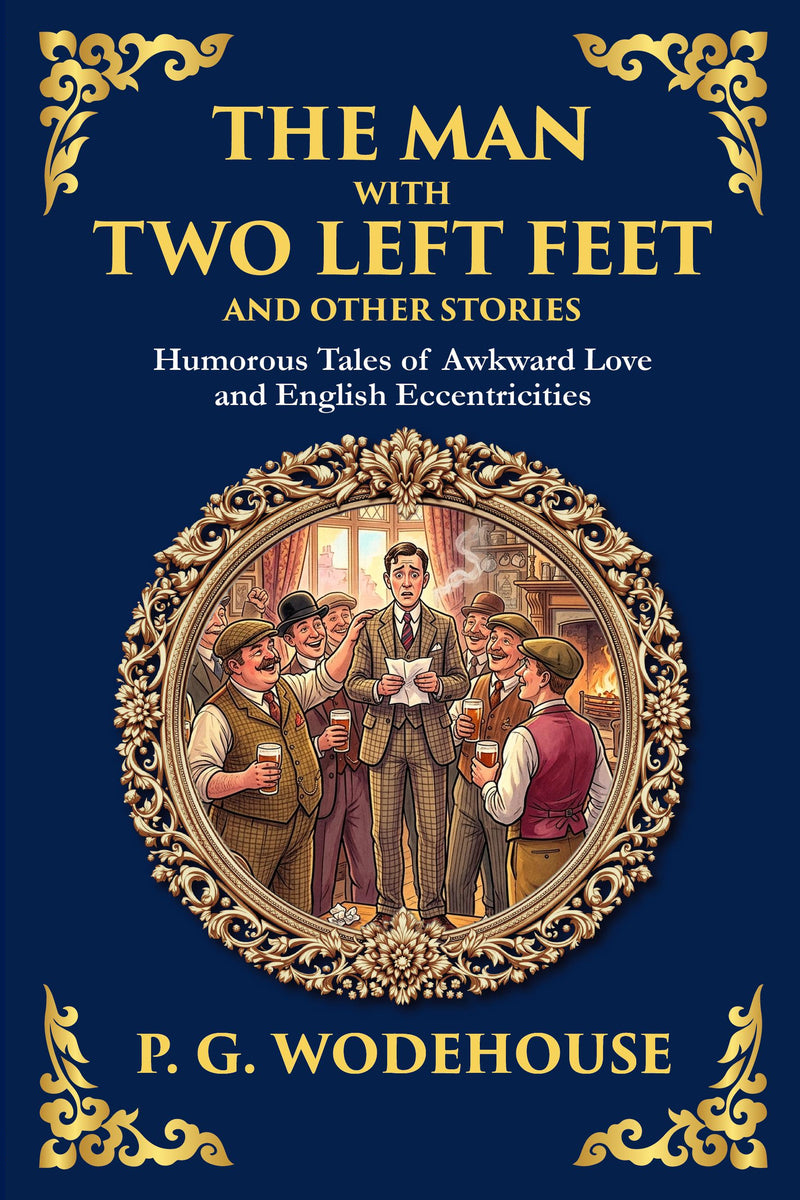
The Man with Two Left Feet, and Other Stories
Witty, warm, and wonderfully absurd, The Man with Two Left Feet, and Other Stories is a delightful collection of tales by P. G. Wodehouse—master of English comedy.
or free app
10,000+ hrs library
30-day guarantee
The complete The Man with Two Left Feet, and Other Stories appears in modern English through Library of Alexandria Press, available online with audiobook narration included for members.
Have you ever wondered why love can make the most sensible person act like an absolute fool? In The Man with Two Left Feet, and Other Stories, P. G. Wodehouse presents a parade of quirky characters whose romantic endeavors are as endearing as they are ill-fated. Known for his sparkling prose and unforgettable sense of humor, Wodehouse offers a series of comedic short stories that explore the fragile art of falling in love—and falling flat on your face while doing so.
From timid bachelors to overconfident dancers, these stories paint a vivid portrait of early 20th- century English society, complete with its club-room banter, class peculiarities, and ridiculous misunderstandings. Each tale is short, sharp, and brimming with charm, showcasing Wodehouse’s gift for laughter that’s never cruel, always clever, and endlessly entertaining.
What you’ll discover in this modern edition
- The Title Story: The Man with Two Left Feet – A painfully awkward attempt to impress a wife through ballroom dancing—hilarity and humility ensue.
- Comedic Misadventures of the Heart – From clumsy proposals to mistaken identities, each story reveals love in all its laughable complexity.
- Classic Wodehouse Wit and Timing – Effortless storytelling paired with some of the finest comedic dialogue in English literature.
- A Glimpse into Pre-War English Life – Social clubs, music halls, and English countryside eccentricities make for a nostalgic and amusing backdrop.
- A Collection to Be Dipped Into or Devoured Whole – Perfect for light reading, train rides, or brightening up a dull afternoon. Whether you’re new to P. G.
| Formats | eBook (EPUB + PDF) · Audiobook · Paperback · Hardcover · Large Print |
| Language | English |
| Trim size (print) | 6 × 9 in |
| Binding | Paperback — perfect-bound · Hardcover — casewrap |
| Large Print edition | Same text in a larger, easy-read type — a larger font, not a larger trim |
| Print pricing | Every physical book at our true cost — at-cost, no profit (members) |
| Library | 873 restored titles, always growing |
| Length | 69,560 words · ~4 hr 38 min reading |
| Reading level | Grade 3 · an easy, flowing read (this modern-English edition) |
| Edition | Modern English translation · 2026 |
Member reviews for this edition are collected as readers finish it — be the first. Across the library: 12,000+ books shipped, every plan covered by a 365-day print guarantee.
About this edition
A faithful, unabridged modern-English edition by The Library of Alexandria — carefully rendered for today's reader and verified paragraph-by-paragraph against the public-domain source. Available as eBook, audiobook, paperback, hardcover, and large print.
- Complete & unabridgedVerified paragraph by paragraph against the source — never a scan, never abridged.
- Modern English, faithfulReadable today, with the author’s meaning kept intact. Readable — not simplified.
- Every format, one membershipRead in your browser or the free app, or listen to the full audiobook.
Included free with your membership
Cancel anytime, one click · 30-day money-back guarantee
Edition last updated July 2026
What’s inside
The Man with Two Left Feet, and Other Stories — complete and unabridged: all 5 sections included with membership, plus the full audiobook.
Begin reading The Man with Two Left Feet, and Other Stories
In clear modern English — the complete text is included with membership.
Introduction
There are writers we read for the plot, writers we read for the wisdom, and writers we read simply for the pleasure of watching language behave beautifully. P. G. Wodehouse belongs unmistakably to that last and rarest category. To open one of his books is to enter a world where the sun seems perpetually to be shining on a well-kept English lawn, where the worst catastrophe imaginable is an awkward proposal of marriage, and where every sentence is built with the care of a master cabinetmaker who happens also to possess a sense of humor that refuses to take itself, or anything else, too seriously. The collection you now hold gathers a delightful assortment of his early short fiction, and it offers something that even devoted Wodehouse readers sometimes overlook: the chance to watch a comic genius in the very act of discovering exactly what he was put on this earth to do.
The title piece, along with its companions, dates from a period when Wodehouse was still finding the precise shape of his comic universe. Some of these stories carry the unmistakable fingerprints of the author the world would come to adore — the impeccable timing, the gift for the absurd simile, the affectionate mockery of the English upper classes and their American cousins. Others reach in directions that may surprise readers who know him only through the immortal figures of Jeeves and Wooster or the genteel chaos of Blandings Castle. There is romance here, of course, and a great deal of comedy, but there are also flashes of genuine tenderness, moments of unexpected pathos, and even a tale or two that dip a curious toe into territory altogether stranger and more sentimental than one might expect. To read this collection is to understand that the polished, seemingly effortless Wodehouse of later fame was not handed down from on high but built, story by story, with patience and craft.
What strikes the modern reader first, perhaps, is how alive these tales remain. Wodehouse wrote about a vanished world — a world of dance halls and chorus girls, of impoverished young men in lodging houses and country gentlemen with more pedigree than sense, of theatrical agents and aspiring novelists and the kind of formidable aunts who could freeze a grown man at fifty paces. Yet the human comedy he records has not aged a day. The young man tongue-tied before the woman he adores, the social climber tripped up by his own pretensions, the dreamer whose grand schemes collapse with magnificent timing — these are figures we recognize instantly, because they are us, dressed in slightly older clothes. The genius of Wodehouse was never in the specifics of his settings. It was in his unerring eye for the gap between what people wish to be and what they actually are, and his boundless generosity in forgiving them the difference.
This particular gathering of stories takes as its loose unifying theme the eternal subject of romance, approached almost always from its most undignified angle. The man with two left feet of the title is a comic emblem for the whole collection: the well-meaning soul who longs to glide gracefully through life and love, and who instead stumbles, trips, and treads on toes both literal and metaphorical. Wodehouse understood, better than almost any writer of his century, that there is nothing more universally funny — and nothing more secretly touching — than the spectacle of a person trying very hard to be smooth and failing utterly. His characters want desperately to impress, to woo, to win; and in the gap between their ambitions and their abilities lies the whole rich field of his comedy. We laugh at them, but we never sneer at them, because Wodehouse loved them all, fools and schemers and lovesick clerks alike, and that love radiates from every page.
It is worth saying a word about the variety on offer here, because it is greater than one might assume. A reader who comes expecting a single comic register will find instead a remarkable spread of moods and methods. Some stories are pure farce, engineered like elaborate clockwork toys so that one absurd consequence triggers another until the whole contraption explodes in a satisfying climax. Others are quieter, more observational, content to follow a single character through a single embarrassing afternoon. There are tales set among the bright lights of the theatrical and sporting worlds Wodehouse knew so well, and tales that venture into the green peace of the English countryside. There is at least one piece that steps almost entirely outside the comic mode to deliver something tender and a little melancholy, a reminder that the man who made the world laugh was also a man who understood loneliness, longing, and the quiet ache of the overlooked. Part of the great pleasure of this collection lies in not knowing, as you turn from one story to the next, quite which Wodehouse will greet you.
It is easy, when discussing a writer as purely entertaining as Wodehouse, to treat his work as a kind of frothy confection — pleasant, undemanding, and ultimately weightless. This would be a profound mistake. The apparent effortlessness of his prose was the product of obsessive labor. He revised relentlessly, pinning pages to the walls of his study and refusing to advance a manuscript until each scene reached a height on the wall that satisfied him — a literal measure of quality. He thought in terms of construction, of setup and payoff, of the precise placement of a word for maximum comic detonation. The result is prose that reads as if it simply fell onto the page in a single inspired breath, when in fact every clause was weighed, tested, and frequently rebuilt. To read Wodehouse attentively is to receive a masterclass in the architecture of the English sentence.
Consider his famous similes, of which this collection offers many early and dazzling examples. A Wodehouse comparison does not merely decorate a sentence; it ambushes the reader, yoking together two things so wildly unlike that the shock of their union produces an involuntary laugh. He describes emotions in terms of physical disasters and physical disasters in terms of cosmic events. He compares the human face to objects it could not possibly resemble, and somehow makes the resemblance feel exactly right. This is not accident but design — a comic technique he refined across decades, and which in these stories we can watch him sharpening. There is a particular delight in catching a great writer mid-development, trying out effects that he would later deploy with surgical precision. Some of the jokes in these pages land with the full force of his mature style; others reach for a height not quite achieved, and there is a peculiar pleasure in that too, like hearing the early demos of a song you have loved for years in its finished form.
Then there is the matter of his characters’ speech. Wodehouse possessed an almost supernatural ear for the rhythms of how people actually talked — or rather, for a heightened, perfected version of how they talked, distilled to its comic essence. His young men babble and blunder; his young women, frequently, are the sharper and more sensible of the pair, watching their suitors with a mixture of affection and exasperation. His servants and his masters, his Americans and his Englishmen, all speak in voices instantly distinguishable from one another. The dialogue crackles. People interrupt, misunderstand, and talk hilariously at cross-purposes, and Wodehouse orchestrates these collisions with the precision of a great conductor. Much of the comedy in this collection lives in its conversations, and a reader who slows down to savor the back-and-forth will be richly rewarded.
It must be acknowledged, gently, that the world Wodehouse depicts was a comfortable and privileged one, and that he made no pretense of social reform or moral instruction. He was not a satirist in the angry sense; his mockery of the upper classes was the mockery of a man who genuinely liked them and found their absurdities endearing rather than monstrous. Some readers come to him expecting biting commentary and are surprised to find instead a sunlit, almost prelapsarian world from which real suffering has been largely banished. This was a deliberate choice. Wodehouse once explained that he had decided early on to write a kind of musical comedy without the music — a sealed, sunny universe of his own invention, governed by its own benevolent laws. Within those laws, no harm comes to anyone that cannot be undone by the final page, and even the villains are more ridiculous than wicked. To enter this world is to take a holiday from the heaviness of ordinary life. That is not a limitation of his art; it is its entire purpose, and it is a purpose he fulfilled more completely than almost any writer who ever lived.
A note on the present edition is in order. This volume has been prepared as a modern translation, adapted for the contemporary reader — a phrase that deserves some explanation, since Wodehouse, of course, wrote in English. The aim of such adaptation is not to rewrite or to diminish, but to smooth the small obstacles that a century of linguistic drift inevitably places between an early-twentieth-century author and a twenty-first-century audience. Slang that has faded into obscurity, references to forgotten public figures or vanished customs, turns of phrase that once landed instantly but now require a footnote — these are the gentle frictions that this edition seeks to ease. The intent throughout has been to preserve the irreplaceable flavor of Wodehouse’s voice while ensuring that nothing trips the modern reader out of the dream. The jokes still detonate; the rhythms still dance; the world is still recognizably and gloriously his. What has changed is only that the reader need no longer pause to puzzle over a dated allusion when they could be laughing instead.
Some purists will, understandably, prefer to encounter Wodehouse in his original, unaltered form, and there is much to be said for that experience. But for the reader meeting these stories for the first time, or for the reader who simply wishes to glide through them as smoothly as their author would have wished, this edition offers a welcoming front door. Think of it not as a replacement for the original but as an invitation — a way in. Those who fall in love here, as so many do, will inevitably seek out the rest of the vast Wodehouse library, and they will arrive at it better equipped to appreciate the full range of his accomplishment.
How to Read These Stories, and Why You Should
The best advice for approaching this collection is also the simplest: do not hurry. Wodehouse is not a writer to be devoured at speed, the way one might consume a thriller in a single anxious sitting. He is a writer to be sipped, lingered over, returned to. The plots, such as they are, matter far less than the moment-to-moment texture of the telling. A reader racing to find out what happens will miss the entire point, which is the sheer delight of the journey itself. Read a story before bed, or over a leisurely breakfast, or in a stolen quarter-hour between obligations, and let each sentence work on you fully before moving to the next. The comedy is cumulative; it builds through accretion, through the slow accumulation of absurd detail, until a moment arrives when the whole edifice tips over and you find yourself laughing aloud in a quiet room.
It also helps to surrender, early and completely, to the conventions of his world. Coincidences will pile up to improbable heights. Misunderstandings will multiply with cheerful disregard for plausibility. Characters will behave in ways no real person would behave, propelled by motives that exist purely to generate maximum comic complication. None of this is a flaw. It is the grammar of the form, and the moment you stop resisting it and begin to enjoy it, the stories open up like flowers. Wodehouse asks of his reader only a willing suspension of cynicism — a temporary agreement to believe that the world might be a fundamentally benevolent place where everything works out and love conquers all and the worst that can happen is a moment of exquisite embarrassment. It is an agreement worth making, if only for the hours it lasts.
Cancel anytime, one click · 30-day money-back guarantee
Founding annual rate available now — your price locks for life when you join.
Not ready? Get this free chapter by email — read it anytime.
✓ Sent — check your inbox for The Man with Two Left Feet, and Other Stories.
Questions about The Man with Two Left Feet, and Other Stories
What is The Man with Two Left Feet, and Other Stories about?
Witty, warm, and wonderfully absurd, The Man with Two Left Feet, and Other Stories is a delightful collection of tales by P. G. Wodehouse—master of English comedy. Within these pages, readers will encounter awkward lovers, bumbling suitors, and charmingly eccentric characters trying (and often failing) to navigate the complex dance of romance and social etiquette. From misadventures at the music hall to miscommunications at the dinner table, Wodehouse crafts each story with light-hearted brilliance, impeccable timi
Who wrote The Man with Two Left Feet, and Other Stories?
The Man with Two Left Feet, and Other Stories was written by P. G. Wodehouse. This edition presents the complete work in clear modern English, faithfully rendered from the public-domain original by Library of Alexandria Press.
Is The Man with Two Left Feet, and Other Stories free to read?
The opening chapter is free to read on this page. Members read and listen to the complete work — and the entire library — free, and can order any physical book at our true print cost.
How long is The Man with Two Left Feet, and Other Stories?
5 chapters (~69,560 words) — about 4 hr 38 min of reading in this modern-English edition.
Is this an abridged version of The Man with Two Left Feet, and Other Stories?
No. This is the complete, unabridged The Man with Two Left Feet, and Other Stories, carefully rendered into clear modern English and verified paragraph-by-paragraph against the public-domain source — nothing is cut or summarised.
What formats does The Man with Two Left Feet, and Other Stories come in?
The Man with Two Left Feet, and Other Stories is available as eBook, paperback, hardcover and large print. eBook and audiobook are included with membership; printed editions ship at our true print cost.
Shipping & returns
Billing & membership
More from the library


Explore Humour & Satire
- The Imaginary Invalid · Molière
- My Man Jeeves · P. G. Wodehouse
- Barry Lyndon · William Makepeace Thackeray
- Carry On, Jeeves · P. G. Wodehouse
- The Confidence-Man: His Masquerade · Herman Melville
- Lucian’s True History · Lucian of Samosata
- Penrod · Booth Tarkington
- Status Quo · Mack Reynolds
- Herland · Charlotte Perkins Gilman
- Sartor Resartus: The Life and Opinions of Herr Teufelsdröckh · Thomas Carlyle
- The Satyricon of Petronius Arbiter · Petronius Arbiter
- Three Men in a Boat (To Say Nothing of the Dog) · Jerome K. Jerome
- A Connecticut Yankee in King Arthur’s Court · Mark Twain
- Northanger Abbey · Jane Austen
- Once Aboard the Lugger—The History of George and his Mary · A. S. M. Hutchinson
- Candide · Voltaire
- Gulliver’s Travels into Several Remote Regions of the World · Jonathan Swift
- Emma · Jane Austen
- A Room with a View · E. M. Forster
- The Eyes Have It · Philip K. Dick
- The Wind in the Willows · Kenneth Grahame
- Right Ho, Jeeves · P. G. Wodehouse
- The Mysterious Stranger and Other Stories · Mark Twain
- A Modest Proposal · Jonathan Swift
The Man with Two Left Feet, and Other Stories
The Man with Two Left Feet, and Other Stories
Funny Stories of Clumsy Romance and English Quirks
P. G. Wodehouse
Contents
- Introduction
- Chapter 1
- Chapter 2
- Chapter 3
- Chapter 4
Introduction
There are writers we read for the plot, writers we read for the wisdom, and writers we read simply for the pleasure of watching language behave beautifully. P. G. Wodehouse belongs unmistakably to that last and rarest category. To open one of his books is to enter a world where the sun seems perpetually to be shining on a well-kept English lawn, where the worst catastrophe imaginable is an awkward proposal of marriage, and where every sentence is built with the care of a master cabinetmaker who happens also to possess a sense of humor that refuses to take itself, or anything else, too seriously. The collection you now hold gathers a delightful assortment of his early short fiction, and it offers something that even devoted Wodehouse readers sometimes overlook: the chance to watch a comic genius in the very act of discovering exactly what he was put on this earth to do.
The title piece, along with its companions, dates from a period when Wodehouse was still finding the precise shape of his comic universe. Some of these stories carry the unmistakable fingerprints of the author the world would come to adore — the impeccable timing, the gift for the absurd simile, the affectionate mockery of the English upper classes and their American cousins. Others reach in directions that may surprise readers who know him only through the immortal figures of Jeeves and Wooster or the genteel chaos of Blandings Castle. There is romance here, of course, and a great deal of comedy, but there are also flashes of genuine tenderness, moments of unexpected pathos, and even a tale or two that dip a curious toe into territory altogether stranger and more sentimental than one might expect. To read this collection is to understand that the polished, seemingly effortless Wodehouse of later fame was not handed down from on high but built, story by story, with patience and craft.
What strikes the modern reader first, perhaps, is how alive these tales remain. Wodehouse wrote about a vanished world — a world of dance halls and chorus girls, of impoverished young men in lodging houses and country gentlemen with more pedigree than sense, of theatrical agents and aspiring novelists and the kind of formidable aunts who could freeze a grown man at fifty paces. Yet the human comedy he records has not aged a day. The young man tongue-tied before the woman he adores, the social climber tripped up by his own pretensions, the dreamer whose grand schemes collapse with magnificent timing — these are figures we recognize instantly, because they are us, dressed in slightly older clothes. The genius of Wodehouse was never in the specifics of his settings. It was in his unerring eye for the gap between what people wish to be and what they actually are, and his boundless generosity in forgiving them the difference.
This particular gathering of stories takes as its loose unifying theme the eternal subject of romance, approached almost always from its most undignified angle. The man with two left feet of the title is a comic emblem for the whole collection: the well-meaning soul who longs to glide gracefully through life and love, and who instead stumbles, trips, and treads on toes both literal and metaphorical. Wodehouse understood, better than almost any writer of his century, that there is nothing more universally funny — and nothing more secretly touching — than the spectacle of a person trying very hard to be smooth and failing utterly. His characters want desperately to impress, to woo, to win; and in the gap between their ambitions and their abilities lies the whole rich field of his comedy. We laugh at them, but we never sneer at them, because Wodehouse loved them all, fools and schemers and lovesick clerks alike, and that love radiates from every page.
It is worth saying a word about the variety on offer here, because it is greater than one might assume. A reader who comes expecting a single comic register will find instead a remarkable spread of moods and methods. Some stories are pure farce, engineered like elaborate clockwork toys so that one absurd consequence triggers another until the whole contraption explodes in a satisfying climax. Others are quieter, more observational, content to follow a single character through a single embarrassing afternoon. There are tales set among the bright lights of the theatrical and sporting worlds Wodehouse knew so well, and tales that venture into the green peace of the English countryside. There is at least one piece that steps almost entirely outside the comic mode to deliver something tender and a little melancholy, a reminder that the man who made the world laugh was also a man who understood loneliness, longing, and the quiet ache of the overlooked. Part of the great pleasure of this collection lies in not knowing, as you turn from one story to the next, quite which Wodehouse will greet you.
It is easy, when discussing a writer as purely entertaining as Wodehouse, to treat his work as a kind of frothy confection — pleasant, undemanding, and ultimately weightless. This would be a profound mistake. The apparent effortlessness of his prose was the product of obsessive labor. He revised relentlessly, pinning pages to the walls of his study and refusing to advance a manuscript until each scene reached a height on the wall that satisfied him — a literal measure of quality. He thought in terms of construction, of setup and payoff, of the precise placement of a word for maximum comic detonation. The result is prose that reads as if it simply fell onto the page in a single inspired breath, when in fact every clause was weighed, tested, and frequently rebuilt. To read Wodehouse attentively is to receive a masterclass in the architecture of the English sentence.
Consider his famous similes, of which this collection offers many early and dazzling examples. A Wodehouse comparison does not merely decorate a sentence; it ambushes the reader, yoking together two things so wildly unlike that the shock of their union produces an involuntary laugh. He describes emotions in terms of physical disasters and physical disasters in terms of cosmic events. He compares the human face to objects it could not possibly resemble, and somehow makes the resemblance feel exactly right. This is not accident but design — a comic technique he refined across decades, and which in these stories we can watch him sharpening. There is a particular delight in catching a great writer mid-development, trying out effects that he would later deploy with surgical precision. Some of the jokes in these pages land with the full force of his mature style; others reach for a height not quite achieved, and there is a peculiar pleasure in that too, like hearing the early demos of a song you have loved for years in its finished form.
Then there is the matter of his characters’ speech. Wodehouse possessed an almost supernatural ear for the rhythms of how people actually talked — or rather, for a heightened, perfected version of how they talked, distilled to its comic essence. His young men babble and blunder; his young women, frequently, are the sharper and more sensible of the pair, watching their suitors with a mixture of affection and exasperation. His servants and his masters, his Americans and his Englishmen, all speak in voices instantly distinguishable from one another. The dialogue crackles. People interrupt, misunderstand, and talk hilariously at cross-purposes, and Wodehouse orchestrates these collisions with the precision of a great conductor. Much of the comedy in this collection lives in its conversations, and a reader who slows down to savor the back-and-forth will be richly rewarded.
It must be acknowledged, gently, that the world Wodehouse depicts was a comfortable and privileged one, and that he made no pretense of social reform or moral instruction. He was not a satirist in the angry sense; his mockery of the upper classes was the mockery of a man who genuinely liked them and found their absurdities endearing rather than monstrous. Some readers come to him expecting biting commentary and are surprised to find instead a sunlit, almost prelapsarian world from which real suffering has been largely banished. This was a deliberate choice. Wodehouse once explained that he had decided early on to write a kind of musical comedy without the music — a sealed, sunny universe of his own invention, governed by its own benevolent laws. Within those laws, no harm comes to anyone that cannot be undone by the final page, and even the villains are more ridiculous than wicked. To enter this world is to take a holiday from the heaviness of ordinary life. That is not a limitation of his art; it is its entire purpose, and it is a purpose he fulfilled more completely than almost any writer who ever lived.
A note on the present edition is in order. This volume has been prepared as a modern translation, adapted for the contemporary reader — a phrase that deserves some explanation, since Wodehouse, of course, wrote in English. The aim of such adaptation is not to rewrite or to diminish, but to smooth the small obstacles that a century of linguistic drift inevitably places between an early-twentieth-century author and a twenty-first-century audience. Slang that has faded into obscurity, references to forgotten public figures or vanished customs, turns of phrase that once landed instantly but now require a footnote — these are the gentle frictions that this edition seeks to ease. The intent throughout has been to preserve the irreplaceable flavor of Wodehouse’s voice while ensuring that nothing trips the modern reader out of the dream. The jokes still detonate; the rhythms still dance; the world is still recognizably and gloriously his. What has changed is only that the reader need no longer pause to puzzle over a dated allusion when they could be laughing instead.
Some purists will, understandably, prefer to encounter Wodehouse in his original, unaltered form, and there is much to be said for that experience. But for the reader meeting these stories for the first time, or for the reader who simply wishes to glide through them as smoothly as their author would have wished, this edition offers a welcoming front door. Think of it not as a replacement for the original but as an invitation — a way in. Those who fall in love here, as so many do, will inevitably seek out the rest of the vast Wodehouse library, and they will arrive at it better equipped to appreciate the full range of his accomplishment.
How to Read These Stories, and Why You Should
The best advice for approaching this collection is also the simplest: do not hurry. Wodehouse is not a writer to be devoured at speed, the way one might consume a thriller in a single anxious sitting. He is a writer to be sipped, lingered over, returned to. The plots, such as they are, matter far less than the moment-to-moment texture of the telling. A reader racing to find out what happens will miss the entire point, which is the sheer delight of the journey itself. Read a story before bed, or over a leisurely breakfast, or in a stolen quarter-hour between obligations, and let each sentence work on you fully before moving to the next. The comedy is cumulative; it builds through accretion, through the slow accumulation of absurd detail, until a moment arrives when the whole edifice tips over and you find yourself laughing aloud in a quiet room.
It also helps to surrender, early and completely, to the conventions of his world. Coincidences will pile up to improbable heights. Misunderstandings will multiply with cheerful disregard for plausibility. Characters will behave in ways no real person would behave, propelled by motives that exist purely to generate maximum comic complication. None of this is a flaw. It is the grammar of the form, and the moment you stop resisting it and begin to enjoy it, the stories open up like flowers. Wodehouse asks of his reader only a willing suspension of cynicism — a temporary agreement to believe that the world might be a fundamentally benevolent place where everything works out and love conquers all and the worst that can happen is a moment of exquisite embarrassment. It is an agreement worth making, if only for the hours it lasts.
There is a divine power that determines our fates. Take the example of Henry Pifield Rice, a detective.
I need to explain Henry’s situation early on so you aren’t disappointed. If I just called him a detective and left it at that, I would be misleading you. He was only a sort of detective, a kind of investigator. At Stafford’s International Investigation Bureau on the Strand, where he worked, they didn’t ask him to solve the kind of mysteries that stumped the police. He had never measured a footprint in his life, and his knowledge of bloodstains was practically nonexistent. The kind of work they gave Henry involved standing outside a restaurant in the rain to note exactly when someone left. In short, I am not presenting you with a thrilling tale like “Pifield Rice, Investigator No. 1: The Adventure of the Maharajah’s Ruby,” but rather the boring life of an ordinary young man. His coworkers at the bureau called him things like “Fathead,” “That guy—what’s-his-name,” or simply, “Hey, you!”
Henry lived in a boarding house on Guildford Street. One day, a new girl moved in and sat next to Henry during meals. Her name was Alice Weston. She was small, quiet, and quite pretty. They got along great. At first, they only talked about the weather and the movies, but they quickly became closer. Henry was surprised to learn that she was a chorus girl in the theater. Other chorus girls who had lived at the boarding house were usually more flashy—nice enough, but loud and fond of wearing fake beauty marks. Alice Weston was different.
“I’m rehearsing right now,” she said. “I’m going on tour next month in ‘The Girl From Brighton.’ What do you do for a living, Mr. Rice?”
End of the free sample
Keep reading, free
Members read and listen to the complete book — and the entire library. Cancel anytime, one click · 30-day money-back guarantee.