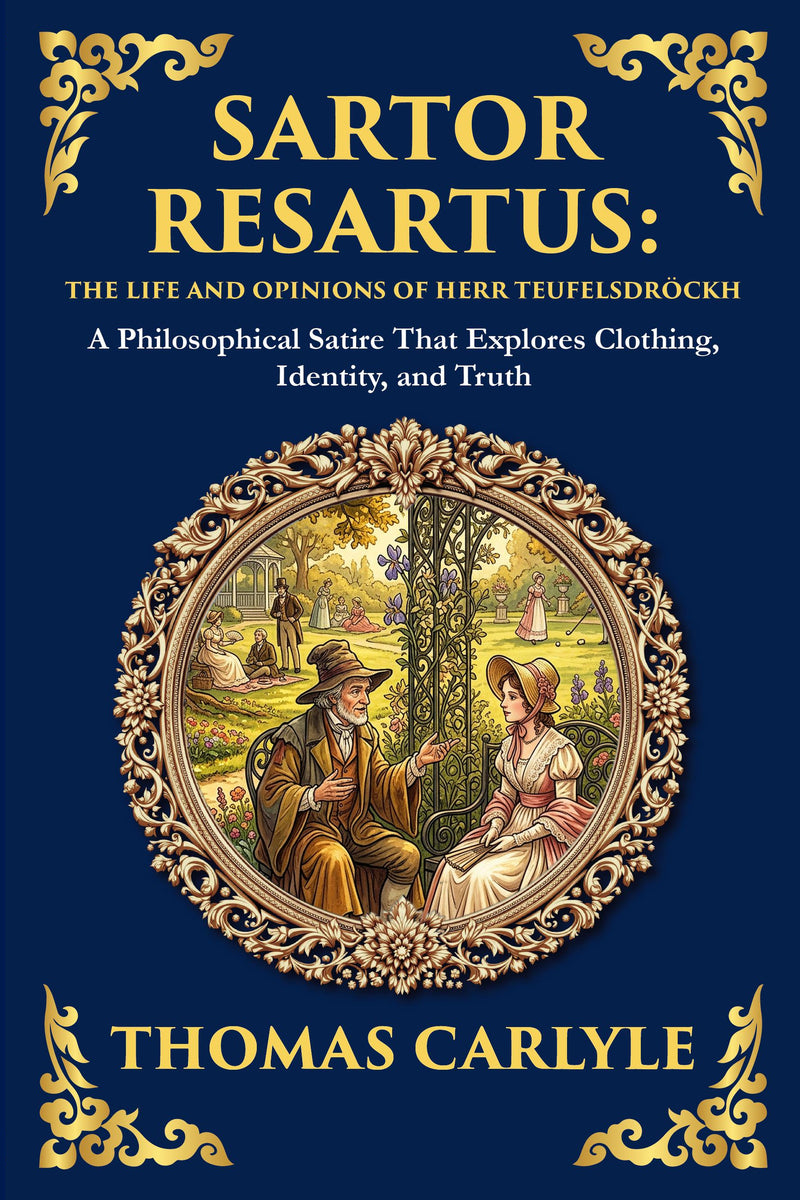
Sartor Resartus: The Life and Opinions of Herr Teufelsdröckh
At once a parody, a profound philosophical reflection, and a sharp commentary on society, Sartor Resartus defies classification.
or free app
10,000+ hrs library
30-day guarantee
The complete Sartor Resartus: The Life and Opinions of Herr Teufelsdröckh appears in modern English through Library of Alexandria Press, available online with audiobook narration included for members.
Have you ever wondered why we hide behind the very things that are meant to reveal who we are? In Sartor Resartus: The Life and Opinions of Herr Teufelsdröckh, Thomas Carlyle fuses philosophy, satire, and literature to create one of the most unique and influential works of the 19th century. Framed as the editor’s commentary on the rambling treatise of a fictional German philosopher, this daring and often humorous narrative peels back the layers of social convention, institutional authority, and individual identity.
The "Philosophy of Clothes" is more than an inquiry into fashion—it is a metaphor for the outer forms of existence, from religion and education to status and nationalism. Through the enigmatic and often contradictory reflections of Herr Teufelsdröckh, Carlyle challenges us to question everything: the masks we wear, the structures we serve, and the truths we overlook in our pursuit of meaning. While the narrative veers into the absurd, its insights are profound.
Beneath its satirical surface lies a spiritual odyssey—from skepticism to faith, from despair to illumination. Carlyle anticipates modern existentialism, standing alongside thinkers like Nietzsche, Kierkegaard, and Dostoevsky in his pursuit of authenticity in a disenchanted world.
What you’ll discover in this modern edition
- A Groundbreaking Satire on Modern Society – Question the roles of institutions, fashion, and convention in shaping human behavior.
- A Deep Philosophical Reflection on Identity – Explore the symbolic nature of clothing and how we define our inner selves.
- Wit, Irony, and Literary Brilliance – Encounter Carlyle’s sharp prose and inventive narrative style.
- A Bridge Between Romanticism and Existentialism – Discover a work that helped redefine philosophy and literature in the modern age.
- A Fresh, Accessible Modern Translation – Designed to preserve Carlyle’s eccentric genius while making his ideas clear for today’s reader.
| Formats | eBook (EPUB + PDF) · Audiobook · Paperback · Hardcover · Large Print |
| Language | English |
| Trim size (print) | 6 × 9 in |
| Binding | Paperback — perfect-bound · Hardcover — casewrap |
| Large Print edition | Same text in a larger, easy-read type — a larger font, not a larger trim |
| Print pricing | Every physical book at our true cost — at-cost, no profit (members) |
| Library | 873 restored titles, always growing |
| Length | 79,634 words · ~5 hr 19 min reading |
| Reading level | Grade 11 · a confident, adult read (this modern-English edition) |
| Edition | Modern English translation · 2026 |
Member reviews for this edition are collected as readers finish it — be the first. Across the library: 12,000+ books shipped, every plan covered by a 365-day print guarantee.
About this edition
A faithful, unabridged modern-English edition by The Library of Alexandria — carefully rendered for today's reader and verified paragraph-by-paragraph against the public-domain source. Available as eBook, audiobook, paperback, hardcover, and large print.
- Complete & unabridgedVerified paragraph by paragraph against the source — never a scan, never abridged.
- Modern English, faithfulReadable today, with the author’s meaning kept intact. Readable — not simplified.
- Every format, one membershipRead in your browser or the free app, or listen to the full audiobook.
Included free with your membership
Cancel anytime, one click · 30-day money-back guarantee
Edition last updated July 2026
What’s inside
Sartor Resartus: The Life and Opinions of Herr Teufelsdröckh — complete and unabridged: all 16 sections included with membership, plus the full audiobook.
Begin reading Sartor Resartus: The Life and Opinions of Herr Teufelsdröckh
In clear modern English — the complete text is included with membership.
Introduction
There are books that ask to be read, and then there are books that demand to be wrestled with—works so strange in their construction, so audacious in their ambition, and so original in their voice that they refuse to sit quietly on the shelf. Sartor Resartus belongs unmistakably to the second category. First serialized in Fraser’s Magazine between 1833 and 1834, this peculiar masterpiece by the Scottish thinker Thomas Carlyle was nearly impenetrable to its earliest readers, who could not decide whether they held in their hands a work of philosophy, a novel, a hoax, an autobiography, or some bewildering hybrid of all four. The confusion was, in many ways, the point. Carlyle had set out to write something unlike anything that had come before it, and in this he succeeded so thoroughly that readers nearly two centuries later still find themselves delighted, baffled, and ultimately transformed by the experience.
The modern edition you now hold has been carefully adapted for the contemporary reader, smoothing some of the more forbidding tangles of nineteenth-century syntax and clarifying allusions that would otherwise require a scholar’s footnotes to decode. But let there be no misunderstanding: the essential spirit of the original remains gloriously intact. The wit, the thunder, the sudden plunges into despair and the equally sudden soaring into joy—all of this survives, because all of this is inseparable from what makes the book worth reading in the first place. What follows is not a watered-down summary but a faithful companion designed to let you experience Carlyle’s vision with the immediacy and force he intended, free from the barriers that time and changing fashions in prose have erected between the author and his audience.
The first thing any reader must understand about Sartor Resartus is its remarkable structure, because the structure is not merely a container for the ideas—it is one of the ideas. The title itself is a clue, a small joke planted at the very threshold. Translated from Latin, Sartor Resartus means “The Tailor Re-Tailored” or “The Patched Tailor Re-Patched.” This is a book about clothing, but it is also a book that wears clothing of its own, dressing itself up in elaborate disguises that the reader is invited to see through.
The conceit is this: Carlyle presents himself not as the author of a philosophy but as the humble English editor of the works of a fictional German professor named Diogenes Teufelsdröckh. The professor’s name alone tells you that Carlyle is having enormous fun at our expense—it is a comic mouthful that combines the noble ancient philosopher Diogenes with a surname that, in German, translates to something distinctly less dignified, suggesting “devil’s dung.” Teufelsdröckh, we are told, holds the imposing and entirely invented chair of “Things in General” at the equally invented University of Weissnichtwo, a German word meaning “Know-not-where.” Already, before we have learned anything of substance, Carlyle has signaled that we are entering a realm where the absurd and the profound will be braided so tightly together that we may never quite be able to separate them.
The professor has, according to the framing story, produced an enormous and impossibly disorganized treatise titled Clothes: Their Origin and Influence. The “Editor”—Carlyle’s mischievous mask—has taken it upon himself to introduce this German philosopher’s strange genius to a British public he assumes will be both fascinated and scandalized. He labors to translate the great work, to summarize its arguments, to defend its excesses, and frequently to throw up his hands in exasperation at the chaos of materials he has been given. Adding to the comedy, the Editor explains that much of the biographical information about Teufelsdröckh arrived from Germany stuffed haphazardly into six paper bags, each labeled with a sign of the zodiac, their contents a jumble of fragments, anecdotes, scribbled notes, and unfinished thoughts. The Editor must reconstruct the professor’s life and philosophy from this hopeless muddle, and we watch him do it, watching him struggle, complain, and occasionally lose his way.
This layered approach—an author pretending to be an editor presenting the work of an invented philosopher whose papers are in disarray—was a stroke of genius that allowed Carlyle an extraordinary freedom. He could say outrageous things and then, through the voice of the bewildered Editor, distance himself from them. He could be earnest and then immediately undercut his earnestness with self-mockery. He could deliver passages of sublime spiritual intensity and then have the Editor confess that he is not entirely sure what the professor meant. This is not mere cleverness for its own sake. The disguise serves a deeper purpose, for the central argument of the book concerns precisely this question of disguise: what is real and what is merely the garment that clothes the real? By making the very form of his book a riddle of appearances and hidden meanings, Carlyle ensures that the reader is forced to participate in the philosophical inquiry rather than passively receiving it.
For the modern reader, this structure may at first feel disorienting, and it is worth knowing in advance that the disorientation is intentional. You are not meant to glide smoothly through this book as you might through a conventional novel. You are meant to stumble, to pause, to wonder whether you are being instructed or teased. Trust that Carlyle knows exactly what he is doing. The apparent chaos is a carefully constructed chaos, and the rewards for staying with it are immense.
The Philosophy of Clothes and the Search for What Is Real
At the heart of Teufelsdröckh’s great treatise lies what he grandly calls the “Philosophy of Clothes,” and it is here that we encounter the genuine intellectual engine of the book. On the surface, the idea seems almost trivial, even ridiculous—a learned professor writing volume after volume about garments, about coats and trousers and the history of tailoring. But Carlyle uses clothing as a vast and flexible metaphor, one that expands until it encompasses nearly everything in human experience.
The core insight runs something like this: everything we perceive in the world is a kind of clothing, an outer garment that both conceals and reveals an inner reality. Our actual clothes are only the most literal example. Beyond them, our bodies themselves are garments clothing the soul. Language is a garment for thought. Institutions—the church, the state, the law, all the structures of society—are garments that humanity has woven to clothe certain spiritual realities. Customs, traditions, titles, ceremonies, even the symbols by which we organize our collective life: all of these are clothes. And clothes, by their nature, wear out. They become threadbare, fall out of fashion, no longer fit the body they were meant to cover. When this happens, they must be cast off and new garments woven in their place.
This is the radical and even revolutionary thrust of the philosophy. If all our institutions and beliefs are merely clothing, then they are not eternal and unchangeable but provisional, made by human hands and subject to decay. A society can find itself dressed in rags that no longer correspond to any living reality, clinging to forms long after the spirit has fled them. Carlyle, writing in an age of profound social transformation—the upheavals of industrialization, the aftershocks of the French Revolution, the crumbling of old certainties—saw a civilization wearing clothes that had grown rotten. His philosophy of clothes is, among other things, a diagnosis of his own troubled times and a call for renewal.
But the metaphor cuts deeper still, into the most personal questions of identity and meaning. If everything visible is mere clothing, then what is the body beneath? What is the self that wears all these garments? Here Carlyle gestures toward something he calls the “Natural Supernaturalism”—the idea that the everyday world, properly understood, is shot through with mystery and the divine. We grow so accustomed to the garments of habit that we cease to see the wonder underneath. We treat the universe as a dead machine because we have wrapped it in the dull clothing of routine perception. The task of the philosopher, and indeed of every awakened person, is to learn to see through the clothes to the living reality beneath—to recover a sense of awe at existence itself.
This is heady material, and Carlyle does not present it in the orderly, step-by-step fashion of a systematic philosopher. Instead it emerges in flashes, in metaphors piled upon metaphors, in passages of soaring rhetoric that read more like prophecy or poetry than argument. Some readers find this frustrating; far more find it exhilarating. Carlyle believed that the deepest truths could not be captured in tidy propositions, that they had to be conveyed through images, through the rhythms of impassioned prose, through a kind of intellectual music that worked on the reader’s whole being rather than merely the rational intellect. To read him is to be swept along by a current of language, and the experience is closer to listening to a great sermon or a symphony than to following a lecture.
It is worth noting how strikingly modern many of these ideas feel. The notion that our social roles are performances, that identity is something constructed and worn rather than fixed and given, that institutions are human inventions rather than natural facts—these are concerns that would preoccupy thinkers for the next two centuries and remain very much alive in our own moment. Carlyle anticipated much of this, and he did so with an energy and originality that still startle. When you read about the philosophy of clothes, you are not reading a quaint Victorian curiosity. You are reading something that speaks directly to questions you yourself have surely asked about appearance and reality, about the masks we wear, about what lies beneath the surface of the lives we lead.
A Soul's Journey Through Darkness and Into Light
If the philosophy of clothes is the intellectual spine of the book, its beating heart is the story of Teufelsdröckh himself—the man whose life the bewildered Editor pieces together from those six chaotic paper bags. And here we arrive at what is perhaps the most powerful and enduring portion of the entire work, the section that has moved readers to tears and inspired generations long after the more abstract philosophical passages have faded from memory.
The professor’s life story is, beneath its eccentric trappings, a profoundly serious account of a spiritual crisis and its resolution. It traces the journey of a sensitive and questioning soul from childhood through a period of devastating doubt and despair and finally toward a hard-won affirmation of life and purpose. This portion of the book is widely understood to be intensely autobiographical—Carlyle himself had passed through his own crisis of faith and meaning, and he poured that experience into the figure of his German professor, transmuting his private struggles into something universal.
The crisis is described in terms that have lost none of their force. Teufelsdröckh finds himself adrift in a universe that seems to have become cold, mechanical, and indifferent—a vast engine grinding on without purpose, in which he is a mere speck of no consequence. He has lost the faith that once gave his existence meaning, and he can find nothing to replace it. The world appears to him as a wasteland, and he is consumed by a state of paralyzing dread and emptiness. Carlyle gives memorable names to the stages of this passage of the soul, and these phrases have entered the language of anyone who has ever struggled with such darkness.
Without revealing the precise contours of how the professor moves through and beyond this crisis—for the unfolding of that journey is one of the great pleasures the book holds in store—it is enough to say that what follows is among the most stirring accounts of spiritual recovery in all of literature. It is a story of defiance, of refusing to be crushed by a meaningless universe, of discovering that meaning is not something handed to us from outside but something we must forge through action, through work, through love, and through a renewed reverence for the wonder of being alive. Carlyle’s vision is not one of easy comfort. He offers no soothing reassurances. What he offers instead is something more bracing and ultimately more sustaining: a summons to courage, to engagement, to the active embrace of life and duty even in the face of doubt.
Cancel anytime, one click · 30-day money-back guarantee
Founding annual rate available now — your price locks for life when you join.
Not ready? Get this free chapter by email — read it anytime.
✓ Sent — check your inbox for Sartor Resartus: The Life and Opinions of Herr Teufelsdröckh.
Questions about Sartor Resartus: The Life and Opinions of Herr Teufelsdröckh
What is Sartor Resartus: The Life and Opinions of Herr Teufelsdröckh about?
At once a parody, a profound philosophical reflection, and a sharp commentary on society, Sartor Resartus defies classification. Thomas Carlyle presents the eccentric musings of the fictional Professor Teufelsdröckh as he unveils his "Philosophy of Clothes"—an elaborate metaphor for the outer forms of life, culture, and religion that both reveal and conceal the truth of the human soul. Witty, bewildering, and revelatory, this groundbreaking work questions what it means to exist, to believe, and to wear the garments
Who wrote Sartor Resartus: The Life and Opinions of Herr Teufelsdröckh?
Sartor Resartus: The Life and Opinions of Herr Teufelsdröckh was written by Thomas Carlyle. This edition presents the complete work in clear modern English, faithfully rendered from the public-domain original by Library of Alexandria Press.
Is Sartor Resartus: The Life and Opinions of Herr Teufelsdröckh free to read?
The opening chapter is free to read on this page. Members read and listen to the complete work — and the entire library — free, and can order any physical book at our true print cost.
How long is Sartor Resartus: The Life and Opinions of Herr Teufelsdröckh?
16 chapters (~79,634 words) — about 5 hr 19 min of reading in this modern-English edition.
Is this an abridged version of Sartor Resartus: The Life and Opinions of Herr Teufelsdröckh?
No. This is the complete, unabridged Sartor Resartus: The Life and Opinions of Herr Teufelsdröckh, carefully rendered into clear modern English and verified paragraph-by-paragraph against the public-domain source — nothing is cut or summarised.
What formats does Sartor Resartus: The Life and Opinions of Herr Teufelsdröckh come in?
Sartor Resartus: The Life and Opinions of Herr Teufelsdröckh is available as eBook, paperback, hardcover and large print. eBook and audiobook are included with membership; printed editions ship at our true print cost.
Shipping & returns
Billing & membership
More from the library


Explore Humour & Satire
- The Imaginary Invalid · Molière
- My Man Jeeves · P. G. Wodehouse
- Barry Lyndon · William Makepeace Thackeray
- The Man with Two Left Feet, and Other Stories · P. G. Wodehouse
- Carry On, Jeeves · P. G. Wodehouse
- The Confidence-Man: His Masquerade · Herman Melville
- Lucian’s True History · Lucian of Samosata
- Penrod · Booth Tarkington
- Status Quo · Mack Reynolds
- Herland · Charlotte Perkins Gilman
- The Satyricon of Petronius Arbiter · Petronius Arbiter
- Three Men in a Boat (To Say Nothing of the Dog) · Jerome K. Jerome
- A Connecticut Yankee in King Arthur’s Court · Mark Twain
- Northanger Abbey · Jane Austen
- Once Aboard the Lugger—The History of George and his Mary · A. S. M. Hutchinson
- Candide · Voltaire
- Gulliver’s Travels into Several Remote Regions of the World · Jonathan Swift
- Emma · Jane Austen
- A Room with a View · E. M. Forster
- The Eyes Have It · Philip K. Dick
- The Wind in the Willows · Kenneth Grahame
- Right Ho, Jeeves · P. G. Wodehouse
- The Mysterious Stranger and Other Stories · Mark Twain
- A Modest Proposal · Jonathan Swift
Sartor Resartus: The Life and Opinions of Herr Teufelsdröckh
Sartor Resartus: The Life and Opinions of Herr Teufelsdröckh
A Philosophical Satire Exploring Clothing, Identity, and Truth
Thomas Carlyle
Contents
- Introduction
- Book 1
- Chapter 1
- Chapter 2
- Chapter 3
- Chapter 4
- Chapter 5
- Chapter 6
- Chapter 7
- Chapter 8
- Chapter 9
- Chapter 10
- Chapter 11
- Book 2
- Book 3
- Chapter 12
Introduction
There are books that ask to be read, and then there are books that demand to be wrestled with—works so strange in their construction, so audacious in their ambition, and so original in their voice that they refuse to sit quietly on the shelf. Sartor Resartus belongs unmistakably to the second category. First serialized in Fraser’s Magazine between 1833 and 1834, this peculiar masterpiece by the Scottish thinker Thomas Carlyle was nearly impenetrable to its earliest readers, who could not decide whether they held in their hands a work of philosophy, a novel, a hoax, an autobiography, or some bewildering hybrid of all four. The confusion was, in many ways, the point. Carlyle had set out to write something unlike anything that had come before it, and in this he succeeded so thoroughly that readers nearly two centuries later still find themselves delighted, baffled, and ultimately transformed by the experience.
The modern edition you now hold has been carefully adapted for the contemporary reader, smoothing some of the more forbidding tangles of nineteenth-century syntax and clarifying allusions that would otherwise require a scholar’s footnotes to decode. But let there be no misunderstanding: the essential spirit of the original remains gloriously intact. The wit, the thunder, the sudden plunges into despair and the equally sudden soaring into joy—all of this survives, because all of this is inseparable from what makes the book worth reading in the first place. What follows is not a watered-down summary but a faithful companion designed to let you experience Carlyle’s vision with the immediacy and force he intended, free from the barriers that time and changing fashions in prose have erected between the author and his audience.
The first thing any reader must understand about Sartor Resartus is its remarkable structure, because the structure is not merely a container for the ideas—it is one of the ideas. The title itself is a clue, a small joke planted at the very threshold. Translated from Latin, Sartor Resartus means “The Tailor Re-Tailored” or “The Patched Tailor Re-Patched.” This is a book about clothing, but it is also a book that wears clothing of its own, dressing itself up in elaborate disguises that the reader is invited to see through.
The conceit is this: Carlyle presents himself not as the author of a philosophy but as the humble English editor of the works of a fictional German professor named Diogenes Teufelsdröckh. The professor’s name alone tells you that Carlyle is having enormous fun at our expense—it is a comic mouthful that combines the noble ancient philosopher Diogenes with a surname that, in German, translates to something distinctly less dignified, suggesting “devil’s dung.” Teufelsdröckh, we are told, holds the imposing and entirely invented chair of “Things in General” at the equally invented University of Weissnichtwo, a German word meaning “Know-not-where.” Already, before we have learned anything of substance, Carlyle has signaled that we are entering a realm where the absurd and the profound will be braided so tightly together that we may never quite be able to separate them.
The professor has, according to the framing story, produced an enormous and impossibly disorganized treatise titled Clothes: Their Origin and Influence. The “Editor”—Carlyle’s mischievous mask—has taken it upon himself to introduce this German philosopher’s strange genius to a British public he assumes will be both fascinated and scandalized. He labors to translate the great work, to summarize its arguments, to defend its excesses, and frequently to throw up his hands in exasperation at the chaos of materials he has been given. Adding to the comedy, the Editor explains that much of the biographical information about Teufelsdröckh arrived from Germany stuffed haphazardly into six paper bags, each labeled with a sign of the zodiac, their contents a jumble of fragments, anecdotes, scribbled notes, and unfinished thoughts. The Editor must reconstruct the professor’s life and philosophy from this hopeless muddle, and we watch him do it, watching him struggle, complain, and occasionally lose his way.
This layered approach—an author pretending to be an editor presenting the work of an invented philosopher whose papers are in disarray—was a stroke of genius that allowed Carlyle an extraordinary freedom. He could say outrageous things and then, through the voice of the bewildered Editor, distance himself from them. He could be earnest and then immediately undercut his earnestness with self-mockery. He could deliver passages of sublime spiritual intensity and then have the Editor confess that he is not entirely sure what the professor meant. This is not mere cleverness for its own sake. The disguise serves a deeper purpose, for the central argument of the book concerns precisely this question of disguise: what is real and what is merely the garment that clothes the real? By making the very form of his book a riddle of appearances and hidden meanings, Carlyle ensures that the reader is forced to participate in the philosophical inquiry rather than passively receiving it.
For the modern reader, this structure may at first feel disorienting, and it is worth knowing in advance that the disorientation is intentional. You are not meant to glide smoothly through this book as you might through a conventional novel. You are meant to stumble, to pause, to wonder whether you are being instructed or teased. Trust that Carlyle knows exactly what he is doing. The apparent chaos is a carefully constructed chaos, and the rewards for staying with it are immense.
The Philosophy of Clothes and the Search for What Is Real
At the heart of Teufelsdröckh’s great treatise lies what he grandly calls the “Philosophy of Clothes,” and it is here that we encounter the genuine intellectual engine of the book. On the surface, the idea seems almost trivial, even ridiculous—a learned professor writing volume after volume about garments, about coats and trousers and the history of tailoring. But Carlyle uses clothing as a vast and flexible metaphor, one that expands until it encompasses nearly everything in human experience.
The core insight runs something like this: everything we perceive in the world is a kind of clothing, an outer garment that both conceals and reveals an inner reality. Our actual clothes are only the most literal example. Beyond them, our bodies themselves are garments clothing the soul. Language is a garment for thought. Institutions—the church, the state, the law, all the structures of society—are garments that humanity has woven to clothe certain spiritual realities. Customs, traditions, titles, ceremonies, even the symbols by which we organize our collective life: all of these are clothes. And clothes, by their nature, wear out. They become threadbare, fall out of fashion, no longer fit the body they were meant to cover. When this happens, they must be cast off and new garments woven in their place.
This is the radical and even revolutionary thrust of the philosophy. If all our institutions and beliefs are merely clothing, then they are not eternal and unchangeable but provisional, made by human hands and subject to decay. A society can find itself dressed in rags that no longer correspond to any living reality, clinging to forms long after the spirit has fled them. Carlyle, writing in an age of profound social transformation—the upheavals of industrialization, the aftershocks of the French Revolution, the crumbling of old certainties—saw a civilization wearing clothes that had grown rotten. His philosophy of clothes is, among other things, a diagnosis of his own troubled times and a call for renewal.
But the metaphor cuts deeper still, into the most personal questions of identity and meaning. If everything visible is mere clothing, then what is the body beneath? What is the self that wears all these garments? Here Carlyle gestures toward something he calls the “Natural Supernaturalism”—the idea that the everyday world, properly understood, is shot through with mystery and the divine. We grow so accustomed to the garments of habit that we cease to see the wonder underneath. We treat the universe as a dead machine because we have wrapped it in the dull clothing of routine perception. The task of the philosopher, and indeed of every awakened person, is to learn to see through the clothes to the living reality beneath—to recover a sense of awe at existence itself.
This is heady material, and Carlyle does not present it in the orderly, step-by-step fashion of a systematic philosopher. Instead it emerges in flashes, in metaphors piled upon metaphors, in passages of soaring rhetoric that read more like prophecy or poetry than argument. Some readers find this frustrating; far more find it exhilarating. Carlyle believed that the deepest truths could not be captured in tidy propositions, that they had to be conveyed through images, through the rhythms of impassioned prose, through a kind of intellectual music that worked on the reader’s whole being rather than merely the rational intellect. To read him is to be swept along by a current of language, and the experience is closer to listening to a great sermon or a symphony than to following a lecture.
It is worth noting how strikingly modern many of these ideas feel. The notion that our social roles are performances, that identity is something constructed and worn rather than fixed and given, that institutions are human inventions rather than natural facts—these are concerns that would preoccupy thinkers for the next two centuries and remain very much alive in our own moment. Carlyle anticipated much of this, and he did so with an energy and originality that still startle. When you read about the philosophy of clothes, you are not reading a quaint Victorian curiosity. You are reading something that speaks directly to questions you yourself have surely asked about appearance and reality, about the masks we wear, about what lies beneath the surface of the lives we lead.
A Soul's Journey Through Darkness and Into Light
If the philosophy of clothes is the intellectual spine of the book, its beating heart is the story of Teufelsdröckh himself—the man whose life the bewildered Editor pieces together from those six chaotic paper bags. And here we arrive at what is perhaps the most powerful and enduring portion of the entire work, the section that has moved readers to tears and inspired generations long after the more abstract philosophical passages have faded from memory.
The professor’s life story is, beneath its eccentric trappings, a profoundly serious account of a spiritual crisis and its resolution. It traces the journey of a sensitive and questioning soul from childhood through a period of devastating doubt and despair and finally toward a hard-won affirmation of life and purpose. This portion of the book is widely understood to be intensely autobiographical—Carlyle himself had passed through his own crisis of faith and meaning, and he poured that experience into the figure of his German professor, transmuting his private struggles into something universal.
The crisis is described in terms that have lost none of their force. Teufelsdröckh finds himself adrift in a universe that seems to have become cold, mechanical, and indifferent—a vast engine grinding on without purpose, in which he is a mere speck of no consequence. He has lost the faith that once gave his existence meaning, and he can find nothing to replace it. The world appears to him as a wasteland, and he is consumed by a state of paralyzing dread and emptiness. Carlyle gives memorable names to the stages of this passage of the soul, and these phrases have entered the language of anyone who has ever struggled with such darkness.
Without revealing the precise contours of how the professor moves through and beyond this crisis—for the unfolding of that journey is one of the great pleasures the book holds in store—it is enough to say that what follows is among the most stirring accounts of spiritual recovery in all of literature. It is a story of defiance, of refusing to be crushed by a meaningless universe, of discovering that meaning is not something handed to us from outside but something we must forge through action, through work, through love, and through a renewed reverence for the wonder of being alive. Carlyle’s vision is not one of easy comfort. He offers no soothing reassurances. What he offers instead is something more bracing and ultimately more sustaining: a summons to courage, to engagement, to the active embrace of life and duty even in the face of doubt.
Given our advanced state of culture and the fact that the “Torch of Science” has been carried around—with varying degrees of success—for over five thousand years, it might surprise a thoughtful person that so little of any fundamental importance has been written about clothes. In this modern era, that torch still burns, perhaps more intensely than ever. Countless smaller lights, sparked from it, now shine in every direction, leaving no tiny crack or hole in nature or art unlit. Yet, in the realms of both philosophy and history, the subject of clothing has been almost entirely ignored.
Our theory of gravity is nearly perfect. It is well known that Lagrange proved the planetary system will last forever under this model, and Laplace even suggested it couldn’t have been designed any other way. Because of this, our nautical logs are more accurate and water transport has become more convenient. We know enough about geology and the structure of the earth; thanks to the work of people like Werner and Hutton and the passion of their students, the creation of a world seems no more mysterious to the Royal Society than cooking a dumpling. In fact, some people have found the question of how the apples get into a dumpling to be a real challenge. And why mention our detailed studies on the social contract, standards of taste, or the migration patterns of herring? We have theories on rent and value, and philosophies regarding language, history, pottery, ghosts, and alcohol. Every aspect of human life and environment has been exposed and explained. Hardly a piece of the human soul, body, or possessions has not been probed, dissected, distilled, dried out, and scientifically broken down. Our spiritual faculties have their experts, and every single cell, vessel, and muscle tissue has its own celebrated scientific authority.
End of the free sample
Keep reading, free
Members read and listen to the complete book — and the entire library. Cancel anytime, one click · 30-day money-back guarantee.