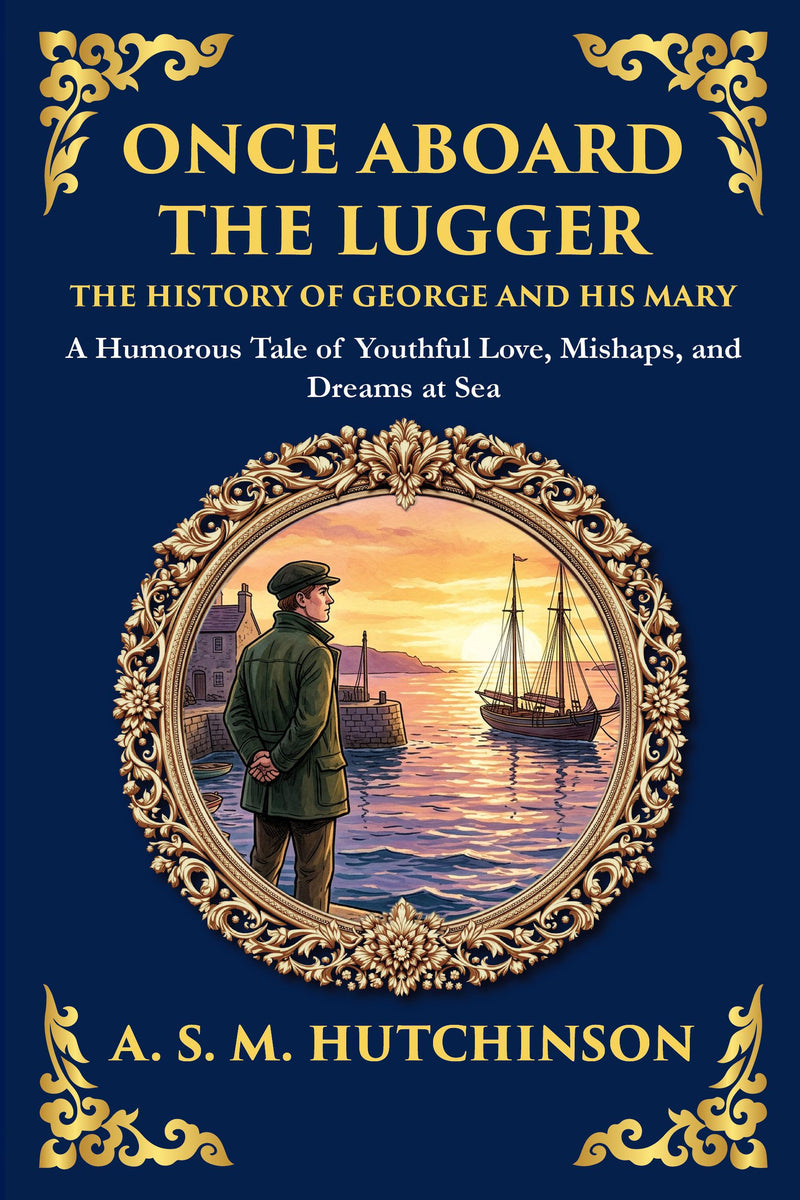
Once Aboard the Lugger—The History of George and his Mary
With charm, wit, and a touch of slapstick, Once Aboard the Lugger tells the tale of George—a headstrong young man determined to win the heart of his beloved Mary.
or free app
10,000+ hrs library
30-day guarantee
The complete Once Aboard the Lugger—The History of George and his Mary appears in modern English through Library of Alexandria Press, available online with audiobook narration included for members.
Have you ever wondered why love makes us do the most foolish things? In Once Aboard the Lugger—The History of George and his Mary, A. S. M. Hutchinson spins a warm-hearted and hilariously chaotic tale of young love, ambition, and class confusion, told through the antics of the ever-determined George. When George—clever but lower in social rank—falls head-over-heels for the charming and refined Mary, he sets out on a scheme to prove himself worthy.
His plan? Escape from school, stage a dramatic escapade at sea, and return a hero. What follows is a series of comical blunders, surprising revelations, and moments of genuine insight about identity, pride, and what it truly means to grow up.
First published in 1908, Hutchinson’s novel remains a masterclass in storytelling, blending farce with sincerity, and poking fun at societal norms while celebrating the innocence and bravery of young hearts.
What you’ll discover in this modern edition
- A Hilarious Coming-of-Age Romance – Follow George’s outrageous attempts to win Mary’s affection through bold (and ill-advised) adventures.
- Witty Commentary on Class and Social Convention – A playful critique of Edwardian society that still rings true today.
- Seaside Escapades and Nautical Mishaps – A dash of maritime adventure adds to the chaos and charm.
- A Gentle Story with Big Laughs and Bigger Heart – Equal parts comedy and soul, perfect for lovers of P.G. Wodehouse, Jerome K. Jerome, or Oscar Wilde.
- A Beautifully Formatted, Accessible Edition – Revived for modern audiences while honoring the original wit and warmth of Hutchinson’s prose.
| Formats | eBook (EPUB + PDF) · Audiobook · Paperback · Hardcover · Large Print |
| Language | English |
| Trim size (print) | 6 × 9 in |
| Binding | Paperback — perfect-bound · Hardcover — casewrap |
| Large Print edition | Same text in a larger, easy-read type — a larger font, not a larger trim |
| Print pricing | Every physical book at our true cost — at-cost, no profit (members) |
| Library | 873 restored titles, always growing |
| Length | 103,908 words · ~6 hr 56 min reading |
| Reading level | Grade 6 · an easy, flowing read (this modern-English edition) |
| Edition | Modern English translation · 2026 |
Member reviews for this edition are collected as readers finish it — be the first. Across the library: 12,000+ books shipped, every plan covered by a 365-day print guarantee.
About this edition
A faithful, unabridged modern-English edition by The Library of Alexandria — carefully rendered for today's reader and verified paragraph-by-paragraph against the public-domain source. Available as eBook, audiobook, paperback, hardcover, and large print.
- Complete & unabridgedVerified paragraph by paragraph against the source — never a scan, never abridged.
- Modern English, faithfulReadable today, with the author’s meaning kept intact. Readable — not simplified.
- Every format, one membershipRead in your browser or the free app, or listen to the full audiobook.
Included free with your membership
Cancel anytime, one click · 30-day money-back guarantee
Edition last updated July 2026
What’s inside
Once Aboard the Lugger—The History of George and his Mary — complete and unabridged: all 18 sections included with membership, plus the full audiobook.
Begin reading Once Aboard the Lugger—The History of George and his Mary
In clear modern English — the complete text is included with membership.
Introduction
There are certain books that announce their intentions from the very first breath, and Once Aboard the Lugger is unmistakably one of them. Its title alone — playful, slightly breathless, carrying that whiff of seafaring adventure crossed with romantic farce — tells you exactly what kind of company you are about to keep. This is a comedy of youthful love, written with the warmth and exuberance of an author who clearly remembered what it felt like to be young, hopelessly smitten, and convinced that the universe was conspiring both for and against you in equal measure. To open these pages is to step into a world where the stakes feel enormous to the people living them, even when — perhaps especially when — those stakes amount to little more than a kiss, a misunderstanding, a meddling relative, or a plan that goes gloriously, comically awry.
A. S. M. Hutchinson, the author of this delightful tale, would later become one of the most widely read novelists of his era, his name attached to bestsellers that sold in the millions and were devoured by readers on both sides of the Atlantic. But before the towering successes that made him a household name, there was this — an earlier, lighter, more impish work, brimming with the energy of a writer flexing his comic muscles and discovering just how much joy he could wring from the misadventures of ordinary people in love. Here you will find none of the heavier social weight that would later characterize his more famous novels. Instead, you are invited to a feast of wit, of affectionate mockery, of the kind of humor that gently teases its characters even as it cherishes them. Hutchinson loves George. He loves Mary. And by the time you have spent a few chapters in their company, you will love them too.
The book belongs to a particular and beloved tradition of English comic fiction — the tradition that delights in the small absurdities of domestic life, in the gap between what people intend and what actually happens, in the gentle chaos that ensues when young hearts collide with the practical world of parents, money, propriety, and circumstance. If you have ever enjoyed the cheerful disasters of P. G. Wodehouse, the warm observational humor of Jerome K. Jerome, or the romantic entanglements of any number of light-hearted Edwardian novels, you will find yourself on familiar and welcoming ground. This is fiction designed not to wound or instruct but to delight — to make you smile, to make you occasionally laugh aloud, and to leave you with that pleasant, glowing sense of having spent time among characters whose company you genuinely enjoyed.
The “history of George and his Mary,” as the subtitle so charmingly puts it, is precisely the kind of story that rewards a reader willing to surrender to its rhythm. George is our hero — though he is the sort of hero who stumbles into heroism more by accident than by design, the sort of young man whose grand romantic intentions are perpetually undercut by his own clumsiness, by the world’s stubborn refusal to cooperate, and by the simple fact that being young and in love is one of the most dangerous, ridiculous, and wonderful conditions a person can experience. Mary, his beloved, is no mere object of his affections; she possesses her own spirit, her own opinions, and her own role to play in the elaborate dance of courtship that unfolds across these pages. Together they form the beating heart of a narrative that finds endless comedy in the universal experience of two people trying, against all the obstacles the world can throw at them, to be together.
What makes Hutchinson’s treatment of this familiar material so engaging is his narrative voice — chatty, intimate, conspiratorial, forever leaning in to share an observation or a confidence with the reader. He writes as though he were telling you the story aloud, pausing to comment, to digress, to wink at the absurdity of it all. This is a storyteller who trusts you to be in on the joke, who assumes you understand human nature well enough to recognize the foibles he so lovingly catalogues. The result is a reading experience that feels less like watching a play from a distance and more like sitting beside a brilliantly funny friend who happens to be recounting the most entertaining episode he knows. You are not merely a spectator; you are a confidant.
This edition presents Once Aboard the Lugger as a modern translation, carefully adapted for the contemporary reader. A word about what that means — and what it does not mean — will help you settle into the experience with the right expectations and the fullest possible enjoyment.
When this novel first appeared, the English language carried a slightly different cadence than it does today. Sentences ran longer, certain words and idioms have since faded from common use, and the conventions of punctuation, phrasing, and reference belonged to a world now more than a century distant. For some readers, these qualities are a charm in themselves; for many others, they can become a barrier — a low but persistent fence between the reader and the pleasure the author intended. The purpose of this adaptation is to lower that fence without trampling the garden behind it. The aim has been to preserve everything that makes Hutchinson’s writing a delight — his humor, his warmth, his distinctive narrative personality, the rhythm of his comic timing — while gently easing the moments where archaic phrasing or dated convention might otherwise interrupt the flow of your reading.
This is a delicate art, and it has been undertaken with great care and respect. The goal is not to modernize the story — George and Mary remain firmly rooted in their own era, with all the social customs, expectations, and assumptions that shaped their world. To strip away that historical texture would be to gut the comedy of its context; half the fun, after all, lies in watching young people navigate the elaborate rules of a society very different from our own. Rather, the goal is to make the language more immediately accessible, so that the wit lands as crisply for you as it did for readers in Hutchinson’s own day. Where a turn of phrase has grown obscure, it has been clarified. Where a sentence’s structure obscured its meaning, it has been gently reshaped. Where a reference might leave a modern reader puzzled, the path has been smoothed. The voice you hear, however, remains unmistakably Hutchinson’s — playful, affectionate, and forever delighting in the comedy of the human heart.
It is worth saying plainly: the spirit of the original has been treated as sacred. Comedy is among the most fragile things in all of literature, because so much of it depends on precise timing, on the exact placement of a word, on the rhythm of a build-up and the snap of a punchline. A clumsy modernization could easily flatten what makes this book funny. The intention throughout has been to honor the comic architecture of the original — to let the jokes breathe, to preserve the build and release of each humorous situation, and to ensure that Hutchinson’s affectionate teasing of his characters comes through with all its original sparkle. If anything, the hope is that by removing the small frictions of dated language, this edition allows the humor to shine even more brightly for the contemporary reader than it might otherwise have done.
You may also notice, as you read, certain attitudes, social arrangements, and assumptions that reflect the period in which the book was written. The relationship between young men and women, the role of family in matters of courtship, the questions of money and class and propriety that swirl around the central romance — all of these belong to a particular moment in history. Rather than view these as obstacles, you are invited to read them as part of the pleasure. There is a special delight in observing how the eternal business of falling in love played out under such different rules, and in recognizing, beneath those unfamiliar customs, the perfectly familiar truths of the human heart. Young people in love have always been ridiculous, always been brave, always been at the mercy of forces larger than themselves. Hutchinson knew this, and he found it endlessly amusing — and so, I suspect, will you.
For the modern reader, then, this edition offers the best of both worlds: a story that retains its full historical flavor and comic charm, told in language that flows smoothly and naturally, without the stumbling blocks that can sometimes make older fiction feel like work. It is meant to be read for pleasure, easily and happily, the way a good comic novel ought to be read — perhaps in a comfortable chair on a quiet afternoon, perhaps on a long journey, perhaps in those stolen moments before sleep when you want nothing more than to be carried away into the gentle chaos of other people’s lives. However you choose to read it, the aim has been to make the experience as effortless and as enjoyable as possible.
Part of the particular charm of a novel like this lies in its modesty of scale. Once Aboard the Lugger does not set out to change the world or to deliver weighty pronouncements on the human condition. It aims, instead, at something both smaller and more difficult: to make you genuinely happy for a few hours. This is no easy feat, and authors who can achieve it deserve more credit than they often receive. To craft a comedy that holds together, that keeps its characters consistent and lovable, that times its jokes well and never wears out its welcome — this requires a craftsman of real skill. Hutchinson was such a craftsman, and the lightness of his touch here should not be mistaken for slightness of talent. There is genuine artistry in making something look this easy.
What you can expect, as you turn these pages, is a story rich in incident. The “mishaps” promised in the subtitle are not idle advertisement; this is a book in which things go wrong with delightful regularity, in which the best-laid plans collapse, in which misunderstandings multiply, in which our young lovers are forever finding themselves in situations more complicated than they bargained for. And yet — and this is the secret of all the best comic fiction — the chaos never tips into cruelty. Hutchinson’s world is fundamentally a kind one. His characters may suffer embarrassment, frustration, and the occasional heartbreak, but they do so within a story that holds them gently, that wishes them well, that promises, even in its darkest comic moments, that things will come right in the end. There is a reassuring warmth at the core of this book, a sense that the author is on the side of love and laughter, and that good humor will ultimately prevail.
The “dreams at sea” hinted at in the subtitle add another layer of pleasure to the proceedings. There is something inherently romantic about the sea, about the idea of escape, of voyages, of horizons that promise both freedom and danger. The nautical motif that runs through the book lends it a flavor of adventure that lifts it above the merely domestic. The lugger of the title — a type of small sailing vessel — becomes, in Hutchinson’s hands, both a literal object and a kind of symbol: a vessel for hopes and schemes, for the longing of young people to break free of their circumstances and chart their own course. Without revealing where the story goes, it is fair to say that this combination of seaside romance and youthful ambition gives the novel a buoyancy — quite appropriately — that keeps it sailing briskly along from one chapter to the next.
The cast of characters surrounding George and Mary deserves special mention, for it is one of the great joys of the book. Comic fiction lives or dies by its supporting players, and Hutchinson populates his story with a gallery of memorable figures — parents and elders with their own fixed ideas, friends and rivals, well-meaning meddlers and unwitting obstacles, each drawn with affectionate precision. These are the people who complicate George’s romantic ambitions, who throw obstacles in his path, who offer advice he does not want and assistance he cannot use. They are the texture of his world, and through them Hutchinson paints a vivid picture of a particular kind of English society — its preoccupations, its proprieties, its endless capacity for getting in the way of young love. You will likely find yourself with favorites among them, and you may find that some of the most quotable, most entertaining moments in the book come not from the central pair but from the rich array of personalities orbiting them.
Cancel anytime, one click · 30-day money-back guarantee
Founding annual rate available now — your price locks for life when you join.
Not ready? Get this free chapter by email — read it anytime.
✓ Sent — check your inbox for Once Aboard the Lugger—The History of George and his Mary.
Questions about Once Aboard the Lugger—The History of George and his Mary
What is Once Aboard the Lugger—The History of George and his Mary about?
With charm, wit, and a touch of slapstick, Once Aboard the Lugger tells the tale of George—a headstrong young man determined to win the heart of his beloved Mary. The problem? Mary belongs to a world far above his own, and George’s scheme to impress her involves a schoolboy prank gone outrageously sideways.
Who wrote Once Aboard the Lugger—The History of George and his Mary?
Once Aboard the Lugger—The History of George and his Mary was written by A. S. M. Hutchinson. This edition presents the complete work in clear modern English, faithfully rendered from the public-domain original by Library of Alexandria Press.
Is Once Aboard the Lugger—The History of George and his Mary free to read?
The opening chapter is free to read on this page. Members read and listen to the complete work — and the entire library — free, and can order any physical book at our true print cost.
How long is Once Aboard the Lugger—The History of George and his Mary?
18 chapters (~103,908 words) — about 6 hr 56 min of reading in this modern-English edition.
Is this an abridged version of Once Aboard the Lugger—The History of George and his Mary?
No. This is the complete, unabridged Once Aboard the Lugger—The History of George and his Mary, carefully rendered into clear modern English and verified paragraph-by-paragraph against the public-domain source — nothing is cut or summarised.
What formats does Once Aboard the Lugger—The History of George and his Mary come in?
Once Aboard the Lugger—The History of George and his Mary is available as eBook, paperback, hardcover and large print. eBook and audiobook are included with membership; printed editions ship at our true print cost.
Shipping & returns
Billing & membership
More from the library


Explore Humour & Satire
- The Imaginary Invalid · Molière
- My Man Jeeves · P. G. Wodehouse
- Barry Lyndon · William Makepeace Thackeray
- The Man with Two Left Feet, and Other Stories · P. G. Wodehouse
- Carry On, Jeeves · P. G. Wodehouse
- The Confidence-Man: His Masquerade · Herman Melville
- Lucian’s True History · Lucian of Samosata
- Penrod · Booth Tarkington
- Status Quo · Mack Reynolds
- Herland · Charlotte Perkins Gilman
- Sartor Resartus: The Life and Opinions of Herr Teufelsdröckh · Thomas Carlyle
- The Satyricon of Petronius Arbiter · Petronius Arbiter
- Three Men in a Boat (To Say Nothing of the Dog) · Jerome K. Jerome
- A Connecticut Yankee in King Arthur’s Court · Mark Twain
- Northanger Abbey · Jane Austen
- Candide · Voltaire
- Gulliver’s Travels into Several Remote Regions of the World · Jonathan Swift
- Emma · Jane Austen
- A Room with a View · E. M. Forster
- The Eyes Have It · Philip K. Dick
- The Wind in the Willows · Kenneth Grahame
- Right Ho, Jeeves · P. G. Wodehouse
- The Mysterious Stranger and Other Stories · Mark Twain
- A Modest Proposal · Jonathan Swift
Once Aboard the Lugger—The History of George and his Mary
Once Aboard the Lugger—The History of George and his Mary
A Humorous Tale of Youthful Love, Mishaps, and Dreams at Sea
A. S. M. Hutchinson
Contents
- Introduction
- The Author's Introduction
- Book 1
- Chapter 1
- Chapter 2
- Chapter 3
- Chapter 4
- Chapter 5
- Chapter 6
- Chapter 7
- Chapter 8
- Book 2
- Book 3
- Book 4
- Book 5
- Chapter 9
- Book 6
- Chapter 10
Introduction
There are certain books that announce their intentions from the very first breath, and Once Aboard the Lugger is unmistakably one of them. Its title alone — playful, slightly breathless, carrying that whiff of seafaring adventure crossed with romantic farce — tells you exactly what kind of company you are about to keep. This is a comedy of youthful love, written with the warmth and exuberance of an author who clearly remembered what it felt like to be young, hopelessly smitten, and convinced that the universe was conspiring both for and against you in equal measure. To open these pages is to step into a world where the stakes feel enormous to the people living them, even when — perhaps especially when — those stakes amount to little more than a kiss, a misunderstanding, a meddling relative, or a plan that goes gloriously, comically awry.
A. S. M. Hutchinson, the author of this delightful tale, would later become one of the most widely read novelists of his era, his name attached to bestsellers that sold in the millions and were devoured by readers on both sides of the Atlantic. But before the towering successes that made him a household name, there was this — an earlier, lighter, more impish work, brimming with the energy of a writer flexing his comic muscles and discovering just how much joy he could wring from the misadventures of ordinary people in love. Here you will find none of the heavier social weight that would later characterize his more famous novels. Instead, you are invited to a feast of wit, of affectionate mockery, of the kind of humor that gently teases its characters even as it cherishes them. Hutchinson loves George. He loves Mary. And by the time you have spent a few chapters in their company, you will love them too.
The book belongs to a particular and beloved tradition of English comic fiction — the tradition that delights in the small absurdities of domestic life, in the gap between what people intend and what actually happens, in the gentle chaos that ensues when young hearts collide with the practical world of parents, money, propriety, and circumstance. If you have ever enjoyed the cheerful disasters of P. G. Wodehouse, the warm observational humor of Jerome K. Jerome, or the romantic entanglements of any number of light-hearted Edwardian novels, you will find yourself on familiar and welcoming ground. This is fiction designed not to wound or instruct but to delight — to make you smile, to make you occasionally laugh aloud, and to leave you with that pleasant, glowing sense of having spent time among characters whose company you genuinely enjoyed.
The “history of George and his Mary,” as the subtitle so charmingly puts it, is precisely the kind of story that rewards a reader willing to surrender to its rhythm. George is our hero — though he is the sort of hero who stumbles into heroism more by accident than by design, the sort of young man whose grand romantic intentions are perpetually undercut by his own clumsiness, by the world’s stubborn refusal to cooperate, and by the simple fact that being young and in love is one of the most dangerous, ridiculous, and wonderful conditions a person can experience. Mary, his beloved, is no mere object of his affections; she possesses her own spirit, her own opinions, and her own role to play in the elaborate dance of courtship that unfolds across these pages. Together they form the beating heart of a narrative that finds endless comedy in the universal experience of two people trying, against all the obstacles the world can throw at them, to be together.
What makes Hutchinson’s treatment of this familiar material so engaging is his narrative voice — chatty, intimate, conspiratorial, forever leaning in to share an observation or a confidence with the reader. He writes as though he were telling you the story aloud, pausing to comment, to digress, to wink at the absurdity of it all. This is a storyteller who trusts you to be in on the joke, who assumes you understand human nature well enough to recognize the foibles he so lovingly catalogues. The result is a reading experience that feels less like watching a play from a distance and more like sitting beside a brilliantly funny friend who happens to be recounting the most entertaining episode he knows. You are not merely a spectator; you are a confidant.
This edition presents Once Aboard the Lugger as a modern translation, carefully adapted for the contemporary reader. A word about what that means — and what it does not mean — will help you settle into the experience with the right expectations and the fullest possible enjoyment.
When this novel first appeared, the English language carried a slightly different cadence than it does today. Sentences ran longer, certain words and idioms have since faded from common use, and the conventions of punctuation, phrasing, and reference belonged to a world now more than a century distant. For some readers, these qualities are a charm in themselves; for many others, they can become a barrier — a low but persistent fence between the reader and the pleasure the author intended. The purpose of this adaptation is to lower that fence without trampling the garden behind it. The aim has been to preserve everything that makes Hutchinson’s writing a delight — his humor, his warmth, his distinctive narrative personality, the rhythm of his comic timing — while gently easing the moments where archaic phrasing or dated convention might otherwise interrupt the flow of your reading.
This is a delicate art, and it has been undertaken with great care and respect. The goal is not to modernize the story — George and Mary remain firmly rooted in their own era, with all the social customs, expectations, and assumptions that shaped their world. To strip away that historical texture would be to gut the comedy of its context; half the fun, after all, lies in watching young people navigate the elaborate rules of a society very different from our own. Rather, the goal is to make the language more immediately accessible, so that the wit lands as crisply for you as it did for readers in Hutchinson’s own day. Where a turn of phrase has grown obscure, it has been clarified. Where a sentence’s structure obscured its meaning, it has been gently reshaped. Where a reference might leave a modern reader puzzled, the path has been smoothed. The voice you hear, however, remains unmistakably Hutchinson’s — playful, affectionate, and forever delighting in the comedy of the human heart.
It is worth saying plainly: the spirit of the original has been treated as sacred. Comedy is among the most fragile things in all of literature, because so much of it depends on precise timing, on the exact placement of a word, on the rhythm of a build-up and the snap of a punchline. A clumsy modernization could easily flatten what makes this book funny. The intention throughout has been to honor the comic architecture of the original — to let the jokes breathe, to preserve the build and release of each humorous situation, and to ensure that Hutchinson’s affectionate teasing of his characters comes through with all its original sparkle. If anything, the hope is that by removing the small frictions of dated language, this edition allows the humor to shine even more brightly for the contemporary reader than it might otherwise have done.
You may also notice, as you read, certain attitudes, social arrangements, and assumptions that reflect the period in which the book was written. The relationship between young men and women, the role of family in matters of courtship, the questions of money and class and propriety that swirl around the central romance — all of these belong to a particular moment in history. Rather than view these as obstacles, you are invited to read them as part of the pleasure. There is a special delight in observing how the eternal business of falling in love played out under such different rules, and in recognizing, beneath those unfamiliar customs, the perfectly familiar truths of the human heart. Young people in love have always been ridiculous, always been brave, always been at the mercy of forces larger than themselves. Hutchinson knew this, and he found it endlessly amusing — and so, I suspect, will you.
For the modern reader, then, this edition offers the best of both worlds: a story that retains its full historical flavor and comic charm, told in language that flows smoothly and naturally, without the stumbling blocks that can sometimes make older fiction feel like work. It is meant to be read for pleasure, easily and happily, the way a good comic novel ought to be read — perhaps in a comfortable chair on a quiet afternoon, perhaps on a long journey, perhaps in those stolen moments before sleep when you want nothing more than to be carried away into the gentle chaos of other people’s lives. However you choose to read it, the aim has been to make the experience as effortless and as enjoyable as possible.
Part of the particular charm of a novel like this lies in its modesty of scale. Once Aboard the Lugger does not set out to change the world or to deliver weighty pronouncements on the human condition. It aims, instead, at something both smaller and more difficult: to make you genuinely happy for a few hours. This is no easy feat, and authors who can achieve it deserve more credit than they often receive. To craft a comedy that holds together, that keeps its characters consistent and lovable, that times its jokes well and never wears out its welcome — this requires a craftsman of real skill. Hutchinson was such a craftsman, and the lightness of his touch here should not be mistaken for slightness of talent. There is genuine artistry in making something look this easy.
What you can expect, as you turn these pages, is a story rich in incident. The “mishaps” promised in the subtitle are not idle advertisement; this is a book in which things go wrong with delightful regularity, in which the best-laid plans collapse, in which misunderstandings multiply, in which our young lovers are forever finding themselves in situations more complicated than they bargained for. And yet — and this is the secret of all the best comic fiction — the chaos never tips into cruelty. Hutchinson’s world is fundamentally a kind one. His characters may suffer embarrassment, frustration, and the occasional heartbreak, but they do so within a story that holds them gently, that wishes them well, that promises, even in its darkest comic moments, that things will come right in the end. There is a reassuring warmth at the core of this book, a sense that the author is on the side of love and laughter, and that good humor will ultimately prevail.
The “dreams at sea” hinted at in the subtitle add another layer of pleasure to the proceedings. There is something inherently romantic about the sea, about the idea of escape, of voyages, of horizons that promise both freedom and danger. The nautical motif that runs through the book lends it a flavor of adventure that lifts it above the merely domestic. The lugger of the title — a type of small sailing vessel — becomes, in Hutchinson’s hands, both a literal object and a kind of symbol: a vessel for hopes and schemes, for the longing of young people to break free of their circumstances and chart their own course. Without revealing where the story goes, it is fair to say that this combination of seaside romance and youthful ambition gives the novel a buoyancy — quite appropriately — that keeps it sailing briskly along from one chapter to the next.
The cast of characters surrounding George and Mary deserves special mention, for it is one of the great joys of the book. Comic fiction lives or dies by its supporting players, and Hutchinson populates his story with a gallery of memorable figures — parents and elders with their own fixed ideas, friends and rivals, well-meaning meddlers and unwitting obstacles, each drawn with affectionate precision. These are the people who complicate George’s romantic ambitions, who throw obstacles in his path, who offer advice he does not want and assistance he cannot use. They are the texture of his world, and through them Hutchinson paints a vivid picture of a particular kind of English society — its preoccupations, its proprieties, its endless capacity for getting in the way of young love. You will likely find yourself with favorites among them, and you may find that some of the most quotable, most entertaining moments in the book come not from the central pair but from the rich array of personalities orbiting them.
This book takes its title from the bold sentiment, “Once aboard the lugger and the girl is mine!” It isn’t for readers who want stories filled with brilliant or wealthy characters, people of noble birth, or exceptionally admirable spirits. You won’t find those here. In writing this story, we followed one strict rule: a novelist should only write about people they know well. Therefore, our characters are ordinary folks. We only know ordinary people, because ordinary people are the only ones who would bother knowing us.
There are no scandalous problems in this story, nor will the reader be shocked by any breaches of proper behavior. This book is safe to keep on any shelf. While you will be invited to spend a bit of a night in a lady’s bedroom, the scene is handled with discretion and speed. There is nothing to blush about.
In this introduction, we want to be very clear about the nature of this novel. That way, if you find this style distressing, you can save your time and skip reading even a single chapter. Because of that, I should mention something about the writing style.
To start, I don’t see why the reader or listener should be the only one allowed to fidget, come and go as they please, or interrupt whenever they like. The narrator should share some of those privileges, and in this story, I’ve taken them. You may swing your legs or let your mind wander as you read; but I must also be allowed to relax and drift off into topics that interest me, even if they are only indirectly related to the plot. Life isn’t made up entirely of action. No one can rush breathlessly from one hour to the next. Since a novel aims to mimic life, the reader—if the author is successful—shouldn’t be rushing breathlessly from page to page. I can at least guarantee that won’t happen here.
End of the free sample
Keep reading, free
Members read and listen to the complete book — and the entire library. Cancel anytime, one click · 30-day money-back guarantee.