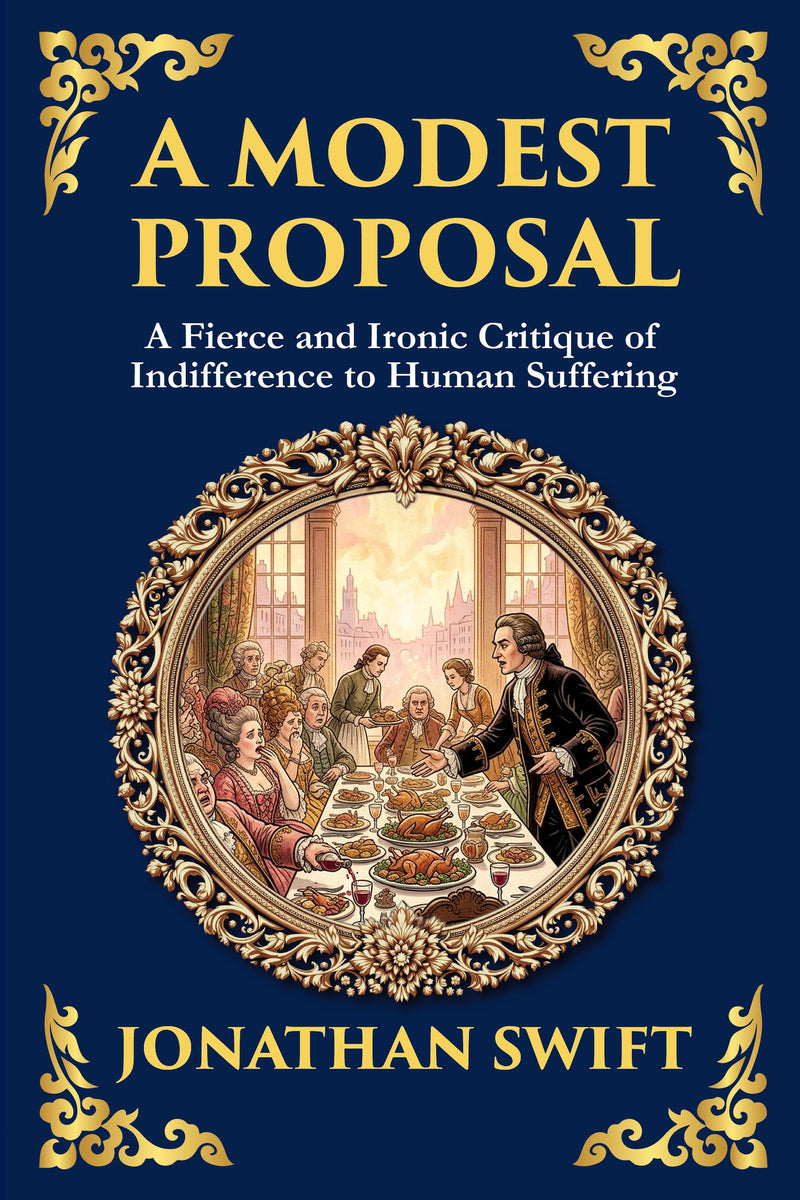
A Modest Proposal
With biting irony and ruthless logic, Jonathan Swift delivers one of the most shocking and brilliant works of satire ever written.
or free app
10,000+ hrs library
30-day guarantee
The complete A Modest Proposal appears in modern English through Library of Alexandria Press, available online with audiobook narration included for members.
Have you ever wondered why the most outrageous ideas sometimes reveal the deepest truths? Jonathan Swift’s A Modest Proposal is not just a satirical essay—it is a searing indictment of society’s neglect of its most vulnerable members. With masterful wit, Swift presents a shocking proposal to “solve” poverty and overpopulation, forcing readers to confront the callousness of the ruling classes toward human suffering.
This modern edition brings new clarity to Swift’s timeless work, making its message accessible and impactful for contemporary readers. More than a historical curiosity, A Modest Proposal remains one of the most important social commentaries in literature.
What you’ll discover in this modern edition
- A Masterpiece of Satire – Explore Swift’s unmatched skill in using irony and shock to challenge social and political norms.
- A Scathing Critique of Indifference – Confront the hypocrisy and cruelty of societies that ignore the suffering of the poor.
- A Work That Still Resonates – Discover why Swift’s “proposal” continues to provoke thought about inequality, exploitation, and morality.
- A Glimpse into 18th-Century Ireland – Understand the historical context of famine, poverty, and oppression that inspired Swift’s writing.
- A Lesson in Persuasion and Irony – Learn how satire can wield more power than straightforward argument.
| Formats | eBook (EPUB + PDF) · Audiobook · Paperback · Hardcover · Large Print |
| Language | English |
| Trim size (print) | 6 × 9 in |
| Binding | Paperback — perfect-bound · Hardcover — casewrap |
| Large Print edition | Same text in a larger, easy-read type — a larger font, not a larger trim |
| Print pricing | Every physical book at our true cost — at-cost, no profit (members) |
| Library | 873 restored titles, always growing |
| Length | 6,742 words · ~27 min reading |
| Reading level | Grade 13 · a demanding, literary read (this modern-English edition) |
| Edition | Modern English translation · 2026 |
Member reviews for this edition are collected as readers finish it — be the first. Across the library: 12,000+ books shipped, every plan covered by a 365-day print guarantee.
About this edition
A faithful, unabridged modern-English edition by The Library of Alexandria — carefully rendered for today's reader and verified paragraph-by-paragraph against the public-domain source. Available as eBook, audiobook, paperback, hardcover, and large print.
- Complete & unabridgedVerified paragraph by paragraph against the source — never a scan, never abridged.
- Modern English, faithfulReadable today, with the author’s meaning kept intact. Readable — not simplified.
- Every format, one membershipRead in your browser or the free app, or listen to the full audiobook.
Included free with your membership
Cancel anytime, one click · 30-day money-back guarantee
Edition last updated July 2026
What’s inside
A Modest Proposal — complete and unabridged, included in full with membership, plus the full audiobook.
Begin reading A Modest Proposal
In clear modern English — the complete text is included with membership.
Introduction
There are certain works in the history of literature that detonate quietly. They do not announce themselves with grand declarations or sweeping manifestos. Instead, they arrive disguised, dressed in the borrowed robes of respectability, speaking in measured tones, presenting themselves as nothing more than the reasonable suggestions of a concerned and thoughtful citizen. And then, almost imperceptibly at first, they reveal their true nature, and the reader realizes too late that they have been led into a trap of the author’s exquisite design. The piece you are about to read belongs unmistakably to this rare and dangerous category. Written by one of the sharpest minds the English language has ever produced, it remains, nearly three centuries after its first appearance, one of the most devastating pieces of social commentary ever committed to paper.
What makes this small text so enduring is not its length, for it is brief, nor the complexity of its argument, for on the surface it is almost insultingly simple. What makes it immortal is the audacity of its method and the precision of its aim. The author takes the cold, calculating logic of those who treat human beings as mere economic units, as figures in a ledger, as problems to be managed rather than people to be helped, and he follows that logic to its grotesque and horrifying conclusion. He does this not to endorse such thinking but to expose it, to drag it into the light and force his readers to see the monstrousness that lies hidden beneath the polite language of policy and profit. It is a work of irony so complete, so sustained, and so coldly committed to its disguise that generations of readers have had to learn, sometimes uncomfortably, how to read it correctly.
This modern translation and adaptation has been prepared with a single guiding purpose: to ensure that the full force of the original reaches you, the contemporary reader, without the obstacles of archaic phrasing, eighteenth-century idiom, and references to a political world that has long since faded from common memory. The intention is not to dilute or soften what the author wrote. Quite the opposite. The intention is to remove the dust and distance that time inevitably places between a reader and an old text, so that the original’s savage wit, its moral fury, and its terrible clarity can strike you as powerfully as they struck the first audiences who encountered it. You are meant to feel discomfort. You are meant to be unsettled. You are meant to laugh and then to feel ashamed for having laughed. That experience is the whole point, and this edition has been crafted to deliver it intact.
To understand the explosive nature of this work, it helps to know something about the extraordinary figure who created it, though we shall be careful not to reduce the work to mere biography, for it stands powerfully on its own. The author was a clergyman, a political pamphleteer, a satirist, and an observer of human folly so keen that his name has become synonymous with a particular kind of biting irony. He lived in an age of immense political turbulence and profound social inequality, an age in which the gap between the comfortable and the desperate was not merely wide but yawning, and in which the suffering of the poor was frequently discussed in the abstract, theoretical terms of pamphlets, sermons, and parliamentary debates, while the poor themselves continued to starve in very concrete and unabstract ways.
He was a man of deep contradictions. He could be tender and he could be merciless. He was capable of great affection and capable of withering contempt. Above all, he possessed an almost surgical understanding of how language could be used to conceal cruelty and to dress up indifference as wisdom. He had watched, throughout his life, as men of influence proposed solutions to social problems that revealed far more about their own callousness than about any genuine desire to help. He had seen how easily the language of reason, efficiency, and economic benefit could be deployed to justify the unjustifiable, and how readily a public could be lulled into accepting the abhorrent if only it were presented in sufficiently calm and orderly prose.
It was out of this long observation, this accumulated rage at the moral blindness of his time, that the present work emerged. But the author did not write a furious denunciation. He did not pound his fist or weep openly on the page. He understood that such direct appeals are easily dismissed, easily filed away under the heading of bleeding-heart sentiment and ignored by precisely the people who most need to hear them. Instead, he chose a far more cunning and far more devastating strategy. He decided to speak in the very voice of the men he despised. He decided to become, on the page, the perfect specimen of the heartless, rational planner, the man who looks upon human misery and sees only a logistical challenge to be solved. He would adopt this persona so completely, so convincingly, that the reader would be drawn into its reasoning before realizing the abyss toward which that reasoning leads.
This is what we mean when we call the work ironic, and it is essential that the modern reader grasps the full weight of that word. Irony here does not mean a light sarcasm or a knowing wink. It means a total inversion of meaning, a sustained performance in which every word on the surface says one thing while the entire work, taken together, screams the opposite. The narrator of this piece appears to be entirely sincere. He appears to believe in what he is saying. He marshals statistics, he weighs costs and benefits, he anticipates objections and answers them with the patient confidence of a man who has thought the matter through carefully. And it is precisely this calm sincerity that makes the work so chilling, because the reader gradually understands that the true target is not the narrator’s specific proposal but the entire mindset that could produce such a proposal and present it as reasonable.
The author’s genius lies in his refusal to break character. He never steps out from behind the mask to reassure us. He never pauses to say, “Of course, I do not really mean this.” He forces us to do the moral work ourselves, to feel the growing horror, to recognize the satire for what it is, and in doing so, to confront our own potential complicity in the kinds of thinking the work attacks. This is why the piece has survived. A direct sermon against indifference would have been forgotten within a generation. A perfect imitation of indifference, designed to expose its monstrousness, has lasted for centuries and will last for centuries more.
It is worth dwelling for a moment on the courage this required. To write in the voice of cruelty is to risk being mistaken for cruel. To employ irony this dark is to risk being misunderstood, even reviled, by readers who fail to perceive the gap between the speaker and the author. The author knew this risk and accepted it, because he understood that some truths can only be told slant, that some forms of hypocrisy can only be punctured by being mirrored back with terrible precision. He trusted his readers to rise to the challenge, to be intelligent enough and morally awake enough to recognize what he was doing. That trust is a kind of compliment paid across the centuries, and as you read, you may feel the author extending that same compliment to you.
One of the great pleasures and challenges of this work lies in observing how meticulously it is constructed. This is not an outburst. It is an argument, built brick by brick with the formal apparatus of serious persuasion. The narrator opens by establishing his credentials as a man of compassion, troubled by a genuine social ill that any reader of the time would have recognized and lamented. He describes the problem with what seems like real feeling. He positions himself as someone who has long sought a remedy and who now, after much reflection, believes he has found one. By the time he arrives at his actual proposal, he has already won a measure of the reader’s trust, established himself as reasonable and well-intentioned, and created an atmosphere of sober deliberation.
And then comes the turn. The proposal itself, when finally revealed, is so shocking that the modern reader, like the original reader, may need a moment to be certain they have understood correctly. The full impact depends on this moment of disbelief, this double-take, this rereading of the crucial sentences to confirm that the narrator has truly said what he appears to have said. We will not spoil the precise nature of that proposal here, for to encounter it cold, in the flow of the narrator’s calm reasoning, is part of the work’s enduring power. It is enough to say that the proposal represents the logical endpoint of treating human beings purely as economic resources, and that its monstrousness is matched only by the chilling rationality with which it is defended.
What follows the proposal is, in many ways, even more remarkable than the proposal itself. The narrator does not flinch. He proceeds to elaborate, to calculate, to demonstrate the various practical benefits of his scheme with the enthusiasm of a man who genuinely believes he has solved a vexing problem. He addresses potential objections. He compares his solution favorably to alternatives. He even reflects with apparent modesty on the difficulties of implementation. Throughout, the language remains measured, courteous, and reasonable, which only intensifies the horror. The reader is forced to inhabit, however briefly, a worldview in which the unthinkable has become a matter of routine policy discussion, in which compassion has been so thoroughly displaced by calculation that the most appalling cruelty can be proposed with a straight face.
This is the moment when many first-time readers experience what we might call the satirical jolt. They realize that the author is not endorsing this worldview but exposing it, holding it up for examination, forcing us to see how the dehumanizing logic that produced the proposal was already present, in milder and more respectable forms, in the actual debates and policies of the author’s day. The fictional proposal is monstrous, yes, but the author’s deeper point is that the real proposals, the real attitudes, the real indifference that surrounded him were not so different in kind. They differed only in degree, in the willingness to follow their own premises to the conclusion. By dramatizing that conclusion, the author makes the milder cruelties visible, strips them of their respectability, and reveals them for what they are.
There is a passage near the end of the work, after the narrator has fully laid out his scheme, where the irony reaches an almost unbearable intensity. The narrator lists, with apparent sincerity, a series of genuine and humane reforms that might actually address the problem he has described, and then dismisses them as impractical, as things he refuses even to consider until they have been tried. In this moment, the mask slips just enough for the attentive reader to glimpse the author’s true voice and true purpose. Here, in a list of rejected alternatives, the author quietly smuggles in his actual recommendations, the real reforms he wished his society would adopt, presenting them as too idealistic to bother proposing seriously. It is a moment of breathtaking craft, and it rewards the reader who has been paying attention. We will say no more about it here, except to suggest that you watch for it, and that when you reach it, you slow down and savor the layers of meaning the author has folded into those deceptively simple sentences.
The work’s structure thus mirrors its meaning. It is a piece about the dangers of cold, methodical reasoning divorced from moral feeling, and it is itself a triumph of cold, methodical reasoning deployed in the service of moral feeling. The author beats the heartless planners at their own game, out-reasoning them, out-calculating them, demonstrating with perfect logical rigor where their assumptions lead. There is a kind of righteous fury beneath the calm surface, a controlled and channeled rage that gives the work its tremendous energy. The author is angry, profoundly angry, but he has transmuted that anger into something far more powerful than mere denunciation. He has made his anger into art.
Cancel anytime, one click · 30-day money-back guarantee
Founding annual rate available now — your price locks for life when you join.
Not ready? Get this free chapter by email — read it anytime.
✓ Sent — check your inbox for A Modest Proposal.
Questions about A Modest Proposal
What is A Modest Proposal about?
With biting irony and ruthless logic, Jonathan Swift delivers one of the most shocking and brilliant works of satire ever written. In A Modest Proposal, Swift confronts the indifference of the wealthy and powerful toward the plight of the poor by presenting an outrageous “solution” to hunger and poverty. Beneath its grotesque suggestion lies a powerful critique of social inequality, moral corruption, and political apathy that still resonates today.
Who wrote A Modest Proposal?
A Modest Proposal was written by Jonathan Swift. This edition presents the complete work in clear modern English, faithfully rendered from the public-domain original by Library of Alexandria Press.
Is A Modest Proposal free to read?
The opening chapter is free to read on this page. Members read and listen to the complete work — and the entire library — free, and can order any physical book at our true print cost.
How long is A Modest Proposal?
2 chapters (~6,742 words) — about 27 min of reading in this modern-English edition.
Is this an abridged version of A Modest Proposal?
No. This is the complete, unabridged A Modest Proposal, carefully rendered into clear modern English and verified paragraph-by-paragraph against the public-domain source — nothing is cut or summarised.
What formats does A Modest Proposal come in?
A Modest Proposal is available as eBook, paperback, hardcover and large print. eBook and audiobook are included with membership; printed editions ship at our true print cost.
Shipping & returns
Billing & membership
More from the library


Explore Free eBooks
- Kant's Prolegomena to Any Future Metaphysics · Immanuel Kant
- The Advancement of Learning · Francis Bacon
- The Dawn of Day · Friedrich Nietzsche
- Peter and Wendy · J. M. Barrie
- Meditations · Marcus Aurelius
- The Confessions of St. Augustine · Saint Augustine of Hippo
- Resurrection · Leo Tolstoy
- Dialogues Concerning Natural Religion · David Hume
- As You Like It · William Shakespeare
- Jack and Jill · Louisa May Alcott
- Dream Psychology: Psychoanalysis for Beginners · Sigmund Freud
- The Raven · Edgar Allan Poe
- Considerations on Representative Government · John Stuart Mill
- The Will to Power: An Attempted Transvaluation of All Values. Book III and IV · Friedrich Nietzsche
- Tarzan of the Apes · Edgar Rice Burroughs
- Fundamental Principles of the Metaphysic of Morals · Immanuel Kant
- The Confessions of Jean Jacques Rousseau — Complete · Jean-Jacques Rousseau
- The Merchant of Venice · William Shakespeare
- Democracy in America — Volume 2 · Alexis de Tocqueville
- Ecce Homo · Friedrich Wilhelm Nietzsche
- Second Treatise of Government · John Locke
- The Wonderful Wizard of Oz · L. Frank Baum
- The Prince · Niccolò Machiavelli
- Anne of Green Gables · L. M. Montgomery
- De Profundis · Oscar Wilde
- Thus Spake Zarathustra: A Book for All and None · Friedrich Nietzsche
- Anna Karenina · Leo Tolstoy
- Great Expectations · Charles Dickens
- The Island of Doctor Moreau · H. G. Wells
- A Midsummer Night's Dream · William Shakespeare
A Modest Proposal
A Modest Proposal
A Fierce and Ironic Critique of Indifference to Human Suffering
Jonathan Swift
Contents
- Introduction
- A Modest Proposal
Introduction
There are certain works in the history of literature that detonate quietly. They do not announce themselves with grand declarations or sweeping manifestos. Instead, they arrive disguised, dressed in the borrowed robes of respectability, speaking in measured tones, presenting themselves as nothing more than the reasonable suggestions of a concerned and thoughtful citizen. And then, almost imperceptibly at first, they reveal their true nature, and the reader realizes too late that they have been led into a trap of the author’s exquisite design. The piece you are about to read belongs unmistakably to this rare and dangerous category. Written by one of the sharpest minds the English language has ever produced, it remains, nearly three centuries after its first appearance, one of the most devastating pieces of social commentary ever committed to paper.
What makes this small text so enduring is not its length, for it is brief, nor the complexity of its argument, for on the surface it is almost insultingly simple. What makes it immortal is the audacity of its method and the precision of its aim. The author takes the cold, calculating logic of those who treat human beings as mere economic units, as figures in a ledger, as problems to be managed rather than people to be helped, and he follows that logic to its grotesque and horrifying conclusion. He does this not to endorse such thinking but to expose it, to drag it into the light and force his readers to see the monstrousness that lies hidden beneath the polite language of policy and profit. It is a work of irony so complete, so sustained, and so coldly committed to its disguise that generations of readers have had to learn, sometimes uncomfortably, how to read it correctly.
This modern translation and adaptation has been prepared with a single guiding purpose: to ensure that the full force of the original reaches you, the contemporary reader, without the obstacles of archaic phrasing, eighteenth-century idiom, and references to a political world that has long since faded from common memory. The intention is not to dilute or soften what the author wrote. Quite the opposite. The intention is to remove the dust and distance that time inevitably places between a reader and an old text, so that the original’s savage wit, its moral fury, and its terrible clarity can strike you as powerfully as they struck the first audiences who encountered it. You are meant to feel discomfort. You are meant to be unsettled. You are meant to laugh and then to feel ashamed for having laughed. That experience is the whole point, and this edition has been crafted to deliver it intact.
To understand the explosive nature of this work, it helps to know something about the extraordinary figure who created it, though we shall be careful not to reduce the work to mere biography, for it stands powerfully on its own. The author was a clergyman, a political pamphleteer, a satirist, and an observer of human folly so keen that his name has become synonymous with a particular kind of biting irony. He lived in an age of immense political turbulence and profound social inequality, an age in which the gap between the comfortable and the desperate was not merely wide but yawning, and in which the suffering of the poor was frequently discussed in the abstract, theoretical terms of pamphlets, sermons, and parliamentary debates, while the poor themselves continued to starve in very concrete and unabstract ways.
He was a man of deep contradictions. He could be tender and he could be merciless. He was capable of great affection and capable of withering contempt. Above all, he possessed an almost surgical understanding of how language could be used to conceal cruelty and to dress up indifference as wisdom. He had watched, throughout his life, as men of influence proposed solutions to social problems that revealed far more about their own callousness than about any genuine desire to help. He had seen how easily the language of reason, efficiency, and economic benefit could be deployed to justify the unjustifiable, and how readily a public could be lulled into accepting the abhorrent if only it were presented in sufficiently calm and orderly prose.
It was out of this long observation, this accumulated rage at the moral blindness of his time, that the present work emerged. But the author did not write a furious denunciation. He did not pound his fist or weep openly on the page. He understood that such direct appeals are easily dismissed, easily filed away under the heading of bleeding-heart sentiment and ignored by precisely the people who most need to hear them. Instead, he chose a far more cunning and far more devastating strategy. He decided to speak in the very voice of the men he despised. He decided to become, on the page, the perfect specimen of the heartless, rational planner, the man who looks upon human misery and sees only a logistical challenge to be solved. He would adopt this persona so completely, so convincingly, that the reader would be drawn into its reasoning before realizing the abyss toward which that reasoning leads.
This is what we mean when we call the work ironic, and it is essential that the modern reader grasps the full weight of that word. Irony here does not mean a light sarcasm or a knowing wink. It means a total inversion of meaning, a sustained performance in which every word on the surface says one thing while the entire work, taken together, screams the opposite. The narrator of this piece appears to be entirely sincere. He appears to believe in what he is saying. He marshals statistics, he weighs costs and benefits, he anticipates objections and answers them with the patient confidence of a man who has thought the matter through carefully. And it is precisely this calm sincerity that makes the work so chilling, because the reader gradually understands that the true target is not the narrator’s specific proposal but the entire mindset that could produce such a proposal and present it as reasonable.
The author’s genius lies in his refusal to break character. He never steps out from behind the mask to reassure us. He never pauses to say, “Of course, I do not really mean this.” He forces us to do the moral work ourselves, to feel the growing horror, to recognize the satire for what it is, and in doing so, to confront our own potential complicity in the kinds of thinking the work attacks. This is why the piece has survived. A direct sermon against indifference would have been forgotten within a generation. A perfect imitation of indifference, designed to expose its monstrousness, has lasted for centuries and will last for centuries more.
It is worth dwelling for a moment on the courage this required. To write in the voice of cruelty is to risk being mistaken for cruel. To employ irony this dark is to risk being misunderstood, even reviled, by readers who fail to perceive the gap between the speaker and the author. The author knew this risk and accepted it, because he understood that some truths can only be told slant, that some forms of hypocrisy can only be punctured by being mirrored back with terrible precision. He trusted his readers to rise to the challenge, to be intelligent enough and morally awake enough to recognize what he was doing. That trust is a kind of compliment paid across the centuries, and as you read, you may feel the author extending that same compliment to you.
One of the great pleasures and challenges of this work lies in observing how meticulously it is constructed. This is not an outburst. It is an argument, built brick by brick with the formal apparatus of serious persuasion. The narrator opens by establishing his credentials as a man of compassion, troubled by a genuine social ill that any reader of the time would have recognized and lamented. He describes the problem with what seems like real feeling. He positions himself as someone who has long sought a remedy and who now, after much reflection, believes he has found one. By the time he arrives at his actual proposal, he has already won a measure of the reader’s trust, established himself as reasonable and well-intentioned, and created an atmosphere of sober deliberation.
And then comes the turn. The proposal itself, when finally revealed, is so shocking that the modern reader, like the original reader, may need a moment to be certain they have understood correctly. The full impact depends on this moment of disbelief, this double-take, this rereading of the crucial sentences to confirm that the narrator has truly said what he appears to have said. We will not spoil the precise nature of that proposal here, for to encounter it cold, in the flow of the narrator’s calm reasoning, is part of the work’s enduring power. It is enough to say that the proposal represents the logical endpoint of treating human beings purely as economic resources, and that its monstrousness is matched only by the chilling rationality with which it is defended.
What follows the proposal is, in many ways, even more remarkable than the proposal itself. The narrator does not flinch. He proceeds to elaborate, to calculate, to demonstrate the various practical benefits of his scheme with the enthusiasm of a man who genuinely believes he has solved a vexing problem. He addresses potential objections. He compares his solution favorably to alternatives. He even reflects with apparent modesty on the difficulties of implementation. Throughout, the language remains measured, courteous, and reasonable, which only intensifies the horror. The reader is forced to inhabit, however briefly, a worldview in which the unthinkable has become a matter of routine policy discussion, in which compassion has been so thoroughly displaced by calculation that the most appalling cruelty can be proposed with a straight face.
This is the moment when many first-time readers experience what we might call the satirical jolt. They realize that the author is not endorsing this worldview but exposing it, holding it up for examination, forcing us to see how the dehumanizing logic that produced the proposal was already present, in milder and more respectable forms, in the actual debates and policies of the author’s day. The fictional proposal is monstrous, yes, but the author’s deeper point is that the real proposals, the real attitudes, the real indifference that surrounded him were not so different in kind. They differed only in degree, in the willingness to follow their own premises to the conclusion. By dramatizing that conclusion, the author makes the milder cruelties visible, strips them of their respectability, and reveals them for what they are.
There is a passage near the end of the work, after the narrator has fully laid out his scheme, where the irony reaches an almost unbearable intensity. The narrator lists, with apparent sincerity, a series of genuine and humane reforms that might actually address the problem he has described, and then dismisses them as impractical, as things he refuses even to consider until they have been tried. In this moment, the mask slips just enough for the attentive reader to glimpse the author’s true voice and true purpose. Here, in a list of rejected alternatives, the author quietly smuggles in his actual recommendations, the real reforms he wished his society would adopt, presenting them as too idealistic to bother proposing seriously. It is a moment of breathtaking craft, and it rewards the reader who has been paying attention. We will say no more about it here, except to suggest that you watch for it, and that when you reach it, you slow down and savor the layers of meaning the author has folded into those deceptively simple sentences.
The work’s structure thus mirrors its meaning. It is a piece about the dangers of cold, methodical reasoning divorced from moral feeling, and it is itself a triumph of cold, methodical reasoning deployed in the service of moral feeling. The author beats the heartless planners at their own game, out-reasoning them, out-calculating them, demonstrating with perfect logical rigor where their assumptions lead. There is a kind of righteous fury beneath the calm surface, a controlled and channeled rage that gives the work its tremendous energy. The author is angry, profoundly angry, but he has transmuted that anger into something far more powerful than mere denunciation. He has made his anger into art.
It is a depressing sight for anyone walking through this great city or traveling through the countryside to see the streets, roads, and cottage doors crowded with female beggars. They are followed by three, four, or six children, all dressed in rags, begging every passerby for a coin. Instead of being able to work for an honest living, these mothers must spend all their time wandering and begging for food for their helpless infants. As these children grow up, they either become thieves because there is no work, or they leave their home country to fight for the Pretender in Spain or sell themselves into slavery in Barbados.
I believe everyone agrees that this huge number of children—carried in their mothers’ arms, on their backs, or trailing behind them and their fathers—is a massive additional burden given the kingdom’s current miserable state. Therefore, anyone who could find a fair, cheap, and easy way to make these children healthy and useful members of society would deserve such public gratitude that a statue should be erected in their honor as a savior of the nation.
However, my goal is not limited to providing only for the children of professional beggars. My plan is much broader; it will include all infants of a certain age born to parents who are just as unable to support them as those who beg for charity in the streets.
As for myself, I have spent many years thinking about this important issue and carefully weighing the various plans proposed by others. I have always found their calculations to be completely wrong. It is true that a newborn baby can be supported by its mother’s milk for a year with very little other nourishment—at most, something worth two shillings, which the mother can certainly earn, or get in food scraps, through her legal occupation of begging. It is exactly at one year old that I propose to provide for them. Instead of being a financial burden on their parents or the parish, or spending their lives lacking food and clothing, they will instead help feed and clothe many thousands of others.
End of the free sample
Keep reading, free
Members read and listen to the complete book — and the entire library. Cancel anytime, one click · 30-day money-back guarantee.