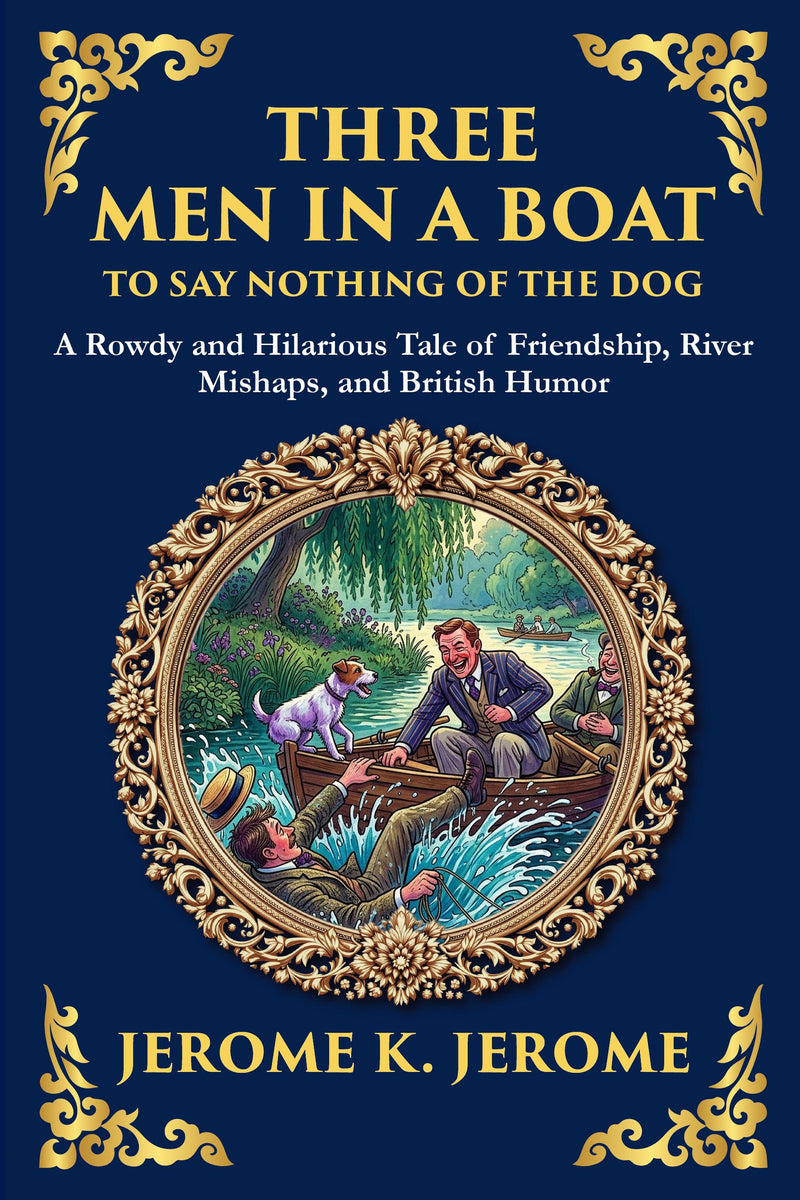
Three Men in a Boat (To Say Nothing of the Dog)
Grab an oar—and your sense of humor—and set out on one of the most delightfully absurd journeys in English literature. Three Men in a Boat (To Say Nothing of the Dog) is a brilliantly comical and unexpectedly touching account of three friends (and a dog) on a boating holiday along the River Thames.
or free app
10,000+ hrs library
30-day guarantee
The complete Three Men in a Boat (To Say Nothing of the Dog) appears in modern English through Library of Alexandria Press, available online with audiobook narration included for members.
Have you ever wondered why the best travel stories are the ones where everything goes hilariously wrong? Three Men in a Boat (To Say Nothing of the Dog) is a comic masterpiece of British literature, blending dry wit, heartfelt friendship, and uproarious absurdity into a journey that is as timeless as it is side-splitting. Meet J., George, Harris, and Montmorency—their dog—as they set out to escape the stresses of urban life by boating up the River Thames.
What follows is not an epic adventure, but a chaotic parade of overpacked luggage, incompetent navigation, disastrous weather, and endless tangents that will leave you laughing out loud. What makes this book so enduring is not just its humor, but its honesty. Jerome’s observations on human nature, health paranoia, and social expectations are as relevant now as they were in the 19th century.
Whether he’s waxing philosophical about the inconvenience of work or chronicling a slapstick struggle with a teapot, Jerome crafts a world where small things matter— and where friendship, laughter, and the occasional disaster make for the best memories.
What you’ll discover in this modern edition
- A Timeless Comedy of Errors – A disastrous river journey that somehow goes right, full of unforgettable blunders.
- Quintessential British Humor – Dry, self-deprecating, and relentlessly funny— Jerome’s voice is pitch-perfect.
- A Touching Portrait of Friendship – Three men and a dog navigating life, laughter, and a leaky boat together.
- Surprisingly Insightful Reflections – On idleness, anxiety, and the quiet beauty of riverbank mornings.
- A Cultural Snapshot of Victorian England – From pubs and picnics to public baths and polite panic.
| Formats | eBook (EPUB + PDF) · Audiobook · Paperback · Hardcover · Large Print |
| Language | English |
| Trim size (print) | 6 × 9 in |
| Binding | Paperback — perfect-bound · Hardcover — casewrap |
| Large Print edition | Same text in a larger, easy-read type — a larger font, not a larger trim |
| Print pricing | Every physical book at our true cost — at-cost, no profit (members) |
| Library | 873 restored titles, always growing |
| Length | 63,628 words · ~4 hr 15 min reading |
| Reading level | Grade 8 · an easy, flowing read (this modern-English edition) |
| Edition | Modern English translation · 2026 |
Member reviews for this edition are collected as readers finish it — be the first. Across the library: 12,000+ books shipped, every plan covered by a 365-day print guarantee.
About this edition
A faithful, unabridged modern-English edition by The Library of Alexandria — carefully rendered for today's reader and verified paragraph-by-paragraph against the public-domain source. Available as eBook, audiobook, paperback, hardcover, and large print.
- Complete & unabridgedVerified paragraph by paragraph against the source — never a scan, never abridged.
- Modern English, faithfulReadable today, with the author’s meaning kept intact. Readable — not simplified.
- Every format, one membershipRead in your browser or the free app, or listen to the full audiobook.
Included free with your membership
Cancel anytime, one click · 30-day money-back guarantee
Edition last updated July 2026
What’s inside
Three Men in a Boat (To Say Nothing of the Dog) — complete and unabridged: all 21 sections included with membership, plus the full audiobook.
Begin reading Three Men in a Boat (To Say Nothing of the Dog)
In clear modern English — the complete text is included with membership.
Introduction
There are books that announce their seriousness from the very first page, and there are books that grin at you, nudge you with an elbow, and dare you not to laugh. Three Men in a Boat (To Say Nothing of the Dog) belongs firmly and gloriously to the second category. Published in 1889 by Jerome Klapka Jerome, an Englishman of restless energy and uneven fortunes, it has somehow managed the remarkable feat of remaining genuinely, helplessly funny for well over a century — a span of time during which fashions in comedy have come and gone, empires have risen and fallen, and the very technologies that frame our laughter have been reinvented several times over. And yet here it still is, making readers snort, chuckle, and read passages aloud to whoever happens to be in the room, exactly as it did when Queen Victoria sat on the throne.
What you hold in your hands is a modern translation of that beloved classic, gently adapted for the contemporary reader. Before you raise an eyebrow at the idea of “translating” a book that was written in English, let me reassure you and explain. The work that follows is not a rewriting of Jerome’s wit, nor a smoothing-out of his personality, nor a sanitizing of his charming absurdities. The humor remains his. The voice remains his. The ridiculous misadventures, the digressions, the mock-heroic descriptions of perfectly ordinary disasters — all of it is preserved with affection and care. What has been adjusted are the small obstacles that the passage of a hundred and thirty-odd years inevitably places between an original text and a present-day reader: archaic turns of phrase, references that have faded into obscurity, sentence structures that the Victorian ear found elegant but that the modern ear finds slow. The goal has been to clear the path so that you can arrive at the laughter unimpeded, experiencing the comedy with the same freshness and immediacy that Jerome’s first readers enjoyed when the book landed, unexpectedly, like a thunderclap of giggles upon late-Victorian England.
For that is precisely what it did. The story of how this book came to be is itself a delightful piece of comic irony, and worth knowing before you set off. Jerome had originally intended to write something quite different. He had recently returned from his honeymoon — a boating trip on the River Thames — and he set out to compose a sober, dignified travel guide. It was to be called The Story of the Thames, and it would be packed with historical anecdotes, scenic descriptions, and the kind of improving information that respectable Victorians expected from their reading. The river had a glorious past, after all: kings had sailed upon it, abbeys had crumbled along its banks, battles had been fought in its meadows. Jerome dutifully began to weave in all this lofty material. But something kept happening. Whenever he sat down to write about the noble history of a riverside town, his mind drifted irresistibly back to the comic mishaps of his own journey — the tangled tow-lines, the uncooperative camping equipment, the catastrophic attempts at cooking, the small daily humiliations of three friends and a dog trying to navigate a small boat down a busy waterway.
The “humorous relief,” as he called it, kept elbowing the serious history aside. His editor, with the instinct of a man who knows comedy gold when he reads it, encouraged him to lean into the jokes. By the time the book was finished, the solemn historical passages had been pruned back to a handful of charming purple patches — which Jerome himself learned to mock even as he wrote them — and the comedy had taken over the entire vessel. The travel guide had mutinied and become a comic masterpiece. The original title was quietly abandoned, and the book emerged into the world under the irresistible heading it carries to this day, complete with that wonderful parenthetical afterthought about the dog, which tells you everything you need to know about the spirit of the thing before you even open it.
The result was a phenomenon. The book sold in enormous numbers, was pirated mercilessly (especially in America, where copyright protection was lax and Jerome saw little of the profits), and was translated into a great many languages. Critics of the time, it must be said, were often sniffy. There was a whole school of Victorian literary opinion that distrusted laughter as a vulgar, lower-class indulgence, and that found Jerome’s cheerful, conversational, slangy style beneath the dignity of true literature. They sneered at his “New Humour.” They complained about his lack of refinement. They were, of course, completely wrong, and history has rendered its verdict with magnificent clarity: the critics are forgotten, and the book they disdained is still being read, still being loved, still being quoted at dinner tables and around campfires. There is a lesson in that somewhere, and it is one of the warmest lessons literature has to teach — that joy, honestly rendered, outlasts almost everything.
What Makes It Funny, and Why It Still Works
It is one thing to say that a book is funny. It is quite another to understand why it is funny, and why its particular brand of comedy has proven so resistant to the erosions of time. Much Victorian humor has dated badly. The puns have grown stale, the social satire requires footnotes, the comic stereotypes have curdled into something we would rather not laugh at. So why does Jerome survive when so many of his contemporaries have vanished into the dusty back rooms of literary history?
The answer lies in the nature of the comedy itself. Jerome’s humor is not built on topical references or clever wordplay that requires you to know the politics of 1889. It is built on something far more durable: human nature. And human nature, mercifully and exasperatingly, does not change. The comedy of this book springs from situations and personality traits that are as recognizable today as they were then. The man who is convinced he is suffering from every disease he reads about in a medical reference. The friend who volunteers to do a difficult task and then somehow contrives to supervise everyone else doing it while accomplishing nothing himself. The three companions who all agree that somebody should pack the hamper, and who then watch the process descend into chaos. The universal human tendency to remember our own past competence with rosy, exaggerated fondness while observing the present incompetence of others with merciless clarity. These are not Victorian jokes. These are eternal jokes, the comedy of being a flawed and self-important creature in a world that refuses to cooperate.
The book’s most famous comic engine is its narrator, a man simply called J., who is a thinly disguised version of Jerome himself, traveling down the Thames with his two real-life friends, here named George and Harris, and accompanied by Montmorency, a fox terrier of magnificent self-importance and questionable judgment. (The dog, it is worth noting, was the one fictional addition to an otherwise autobiographical crew — Jerome invented him for comic purposes, and Montmorency has been stealing scenes ever since.) The genius of J. as a narrator is his complete and serene lack of self-awareness. He is exquisitely sensitive to the laziness, vanity, and incompetence of his companions, and entirely blind to his own. He delivers withering judgments on the failings of others in the same breath that he reveals, quite unconsciously, that he suffers from exactly the same failings, often to a greater degree. This gap between what the narrator believes about himself and what the reader can plainly see is one of the oldest and richest sources of comedy there is, and Jerome works it to perfection.
Then there is the digression — Jerome’s true comic art form. The plot of this book, such as it is, could be summarized in a single sentence: three friends and a dog take a boating holiday up the river and then come back. But the plot is almost beside the point. The real pleasure lies in the way the narrative is constantly interrupted by reminiscences, tangents, philosophical musings, and elaborately constructed anecdotes that spiral outward from some tiny trigger in the present moment. A mention of cheese launches a hilarious extended tale about transporting some particularly pungent specimens by train. A reference to packing summons up a comic set-piece about a friend’s disastrous attempts to organize a suitcase. The river itself is forever prompting the narrator into reflections, some of them genuinely beautiful and almost wistful, others purely absurd. This structure — the loose, associative, conversational meander — was part of what scandalized the more rigid critics of the day, but it is precisely what makes the book feel so alive and so modern. Reading it is like spending an evening with an enormously entertaining friend who cannot tell a story in a straight line, but whose detours are so much fun that you never want him to get to the point.
It is worth dwelling for a moment on those moments of unexpected beauty, because they are part of what elevates this book above mere joke-telling. Every so often, in the middle of all the buffoonery, Jerome will pause and write something genuinely lyrical — a passage about the river at dawn, about the weight of history in an old church, about the quiet meaning of friendship, about the fleeting nature of summer days. These passages are sincere, and they are lovely, and the modern adaptation has taken particular care to preserve their gentle music. They give the comedy its emotional ballast. Without them, the book would be merely amusing. With them, it becomes something richer: a portrait of how three ordinary men, muddling through a slightly farcical adventure, are nonetheless living through moments of real contentment, real beauty, and real companionship. Jerome understood, perhaps better than his critics did, that the deepest comedy and the deepest tenderness are close neighbors, and that a story which makes you laugh out loud can also, almost without your noticing, make your throat tighten with something like affection for the whole absurd, beautiful business of being alive.
This is also a book about friendship, and that is no small part of its enduring appeal. J., George, and Harris bicker constantly. They blame each other for every mishap. They each privately consider themselves the only competent member of the trio. They are, in short, exactly like a real group of old friends — and the warmth beneath the bickering is unmistakable. They have known each other a long time. They know each other’s weaknesses and forgive them, mostly, while reserving the right to mock them mercilessly. There is no plot of betrayal or reconciliation, no dramatic falling-out and tearful reunion. There is simply the steady, comfortable, slightly irritable affection of people who have chosen to spend their leisure time in each other’s company despite finding each other thoroughly aggravating. In an age that often portrays friendship in grand, sentimental terms, there is something refreshing and true about Jerome’s deflationary version: friendship as the willingness to share a small boat with someone whose snoring you cannot stand and whose cooking you would not feed to an enemy.
The Thames itself deserves to be named as a character in its own right. The river that Jerome and his friends rowed up in the 1880s was a place of genuine national affection — a playground for the burgeoning middle class, who had recently discovered the joys of recreational boating and who descended upon the waterway in droves every summer weekend. The towns and locks and meadows that the three men pass are all real, and many of them can still be visited today, though they have changed in the intervening century and more. There is a particular pleasure for the modern reader in following the journey on a map and discovering that these places exist, that the river still flows where Jerome said it flowed, that the camping holiday he described was a real holiday taken by real people in a real summer that is now long gone. The book is, among its many other qualities, a kind of accidental time capsule: it preserves, in amber, a vanished world of leisure and landscape, a particular moment in English social history when the river was the great democratic escape from the smoke and noise of the city. You will catch glimpses, through the comedy, of how people of that era ate and dressed and traveled and amused themselves, and these glimpses are all the more vivid for being delivered so casually, woven into the fabric of the jokes rather than presented as solemn information.
Cancel anytime, one click · 30-day money-back guarantee
Founding annual rate available now — your price locks for life when you join.
Not ready? Get this free chapter by email — read it anytime.
✓ Sent — check your inbox for Three Men in a Boat (To Say Nothing of the Dog).
Questions about Three Men in a Boat (To Say Nothing of the Dog)
What is Three Men in a Boat (To Say Nothing of the Dog) about?
Grab an oar—and your sense of humor—and set out on one of the most delightfully absurd journeys in English literature. Three Men in a Boat (To Say Nothing of the Dog) is a brilliantly comical and unexpectedly touching account of three friends (and a dog) on a boating holiday along the River Thames. What begins as a simple escape from the stresses of modern life quickly devolves into a series of ridiculous misadventures, misunderstandings, and musings on everything from weather forecasts to the perils of canned pine
Who wrote Three Men in a Boat (To Say Nothing of the Dog)?
Three Men in a Boat (To Say Nothing of the Dog) was written by Jerome K. Jerome. This edition presents the complete work in clear modern English, faithfully rendered from the public-domain original by Library of Alexandria Press.
Is Three Men in a Boat (To Say Nothing of the Dog) free to read?
The opening chapter is free to read on this page. Members read and listen to the complete work — and the entire library — free, and can order any physical book at our true print cost.
How long is Three Men in a Boat (To Say Nothing of the Dog)?
21 chapters (~63,628 words) — about 4 hr 15 min of reading in this modern-English edition.
Is this an abridged version of Three Men in a Boat (To Say Nothing of the Dog)?
No. This is the complete, unabridged Three Men in a Boat (To Say Nothing of the Dog), carefully rendered into clear modern English and verified paragraph-by-paragraph against the public-domain source — nothing is cut or summarised.
What formats does Three Men in a Boat (To Say Nothing of the Dog) come in?
Three Men in a Boat (To Say Nothing of the Dog) is available as eBook, paperback, hardcover and large print. eBook and audiobook are included with membership; printed editions ship at our true print cost.
Shipping & returns
Billing & membership
More from the library


Explore Humour & Satire
- The Imaginary Invalid · Molière
- My Man Jeeves · P. G. Wodehouse
- Barry Lyndon · William Makepeace Thackeray
- The Man with Two Left Feet, and Other Stories · P. G. Wodehouse
- Carry On, Jeeves · P. G. Wodehouse
- The Confidence-Man: His Masquerade · Herman Melville
- Lucian’s True History · Lucian of Samosata
- Penrod · Booth Tarkington
- Status Quo · Mack Reynolds
- Herland · Charlotte Perkins Gilman
- Sartor Resartus: The Life and Opinions of Herr Teufelsdröckh · Thomas Carlyle
- The Satyricon of Petronius Arbiter · Petronius Arbiter
- A Connecticut Yankee in King Arthur’s Court · Mark Twain
- Northanger Abbey · Jane Austen
- Once Aboard the Lugger—The History of George and his Mary · A. S. M. Hutchinson
- Candide · Voltaire
- Gulliver’s Travels into Several Remote Regions of the World · Jonathan Swift
- Emma · Jane Austen
- A Room with a View · E. M. Forster
- The Eyes Have It · Philip K. Dick
- The Wind in the Willows · Kenneth Grahame
- Right Ho, Jeeves · P. G. Wodehouse
- The Mysterious Stranger and Other Stories · Mark Twain
- A Modest Proposal · Jonathan Swift
Three Men in a Boat (To Say Nothing of the Dog)
Three Men in a Boat (To Say Nothing of the Dog)
A Rowdy and Hilarious Tale of Friendship, River Mishaps, and British Humor
Jerome K. Jerome
Contents
- Introduction
- Preface by the Author
- Chapter 1
- Chapter 2
- Chapter 3
- Chapter 4
- Chapter 5
- Chapter 6
- Chapter 7
- Chapter 8
- Chapter 9
- Chapter 10
- Chapter 11
- Chapter 12
- Chapter 13
- Chapter 14
- Chapter 15
- Chapter 16
- Chapter 17
- Chapter 18
- Chapter 19
Introduction
There are books that announce their seriousness from the very first page, and there are books that grin at you, nudge you with an elbow, and dare you not to laugh. Three Men in a Boat (To Say Nothing of the Dog) belongs firmly and gloriously to the second category. Published in 1889 by Jerome Klapka Jerome, an Englishman of restless energy and uneven fortunes, it has somehow managed the remarkable feat of remaining genuinely, helplessly funny for well over a century — a span of time during which fashions in comedy have come and gone, empires have risen and fallen, and the very technologies that frame our laughter have been reinvented several times over. And yet here it still is, making readers snort, chuckle, and read passages aloud to whoever happens to be in the room, exactly as it did when Queen Victoria sat on the throne.
What you hold in your hands is a modern translation of that beloved classic, gently adapted for the contemporary reader. Before you raise an eyebrow at the idea of “translating” a book that was written in English, let me reassure you and explain. The work that follows is not a rewriting of Jerome’s wit, nor a smoothing-out of his personality, nor a sanitizing of his charming absurdities. The humor remains his. The voice remains his. The ridiculous misadventures, the digressions, the mock-heroic descriptions of perfectly ordinary disasters — all of it is preserved with affection and care. What has been adjusted are the small obstacles that the passage of a hundred and thirty-odd years inevitably places between an original text and a present-day reader: archaic turns of phrase, references that have faded into obscurity, sentence structures that the Victorian ear found elegant but that the modern ear finds slow. The goal has been to clear the path so that you can arrive at the laughter unimpeded, experiencing the comedy with the same freshness and immediacy that Jerome’s first readers enjoyed when the book landed, unexpectedly, like a thunderclap of giggles upon late-Victorian England.
For that is precisely what it did. The story of how this book came to be is itself a delightful piece of comic irony, and worth knowing before you set off. Jerome had originally intended to write something quite different. He had recently returned from his honeymoon — a boating trip on the River Thames — and he set out to compose a sober, dignified travel guide. It was to be called The Story of the Thames, and it would be packed with historical anecdotes, scenic descriptions, and the kind of improving information that respectable Victorians expected from their reading. The river had a glorious past, after all: kings had sailed upon it, abbeys had crumbled along its banks, battles had been fought in its meadows. Jerome dutifully began to weave in all this lofty material. But something kept happening. Whenever he sat down to write about the noble history of a riverside town, his mind drifted irresistibly back to the comic mishaps of his own journey — the tangled tow-lines, the uncooperative camping equipment, the catastrophic attempts at cooking, the small daily humiliations of three friends and a dog trying to navigate a small boat down a busy waterway.
The “humorous relief,” as he called it, kept elbowing the serious history aside. His editor, with the instinct of a man who knows comedy gold when he reads it, encouraged him to lean into the jokes. By the time the book was finished, the solemn historical passages had been pruned back to a handful of charming purple patches — which Jerome himself learned to mock even as he wrote them — and the comedy had taken over the entire vessel. The travel guide had mutinied and become a comic masterpiece. The original title was quietly abandoned, and the book emerged into the world under the irresistible heading it carries to this day, complete with that wonderful parenthetical afterthought about the dog, which tells you everything you need to know about the spirit of the thing before you even open it.
The result was a phenomenon. The book sold in enormous numbers, was pirated mercilessly (especially in America, where copyright protection was lax and Jerome saw little of the profits), and was translated into a great many languages. Critics of the time, it must be said, were often sniffy. There was a whole school of Victorian literary opinion that distrusted laughter as a vulgar, lower-class indulgence, and that found Jerome’s cheerful, conversational, slangy style beneath the dignity of true literature. They sneered at his “New Humour.” They complained about his lack of refinement. They were, of course, completely wrong, and history has rendered its verdict with magnificent clarity: the critics are forgotten, and the book they disdained is still being read, still being loved, still being quoted at dinner tables and around campfires. There is a lesson in that somewhere, and it is one of the warmest lessons literature has to teach — that joy, honestly rendered, outlasts almost everything.
What Makes It Funny, and Why It Still Works
It is one thing to say that a book is funny. It is quite another to understand why it is funny, and why its particular brand of comedy has proven so resistant to the erosions of time. Much Victorian humor has dated badly. The puns have grown stale, the social satire requires footnotes, the comic stereotypes have curdled into something we would rather not laugh at. So why does Jerome survive when so many of his contemporaries have vanished into the dusty back rooms of literary history?
The answer lies in the nature of the comedy itself. Jerome’s humor is not built on topical references or clever wordplay that requires you to know the politics of 1889. It is built on something far more durable: human nature. And human nature, mercifully and exasperatingly, does not change. The comedy of this book springs from situations and personality traits that are as recognizable today as they were then. The man who is convinced he is suffering from every disease he reads about in a medical reference. The friend who volunteers to do a difficult task and then somehow contrives to supervise everyone else doing it while accomplishing nothing himself. The three companions who all agree that somebody should pack the hamper, and who then watch the process descend into chaos. The universal human tendency to remember our own past competence with rosy, exaggerated fondness while observing the present incompetence of others with merciless clarity. These are not Victorian jokes. These are eternal jokes, the comedy of being a flawed and self-important creature in a world that refuses to cooperate.
The book’s most famous comic engine is its narrator, a man simply called J., who is a thinly disguised version of Jerome himself, traveling down the Thames with his two real-life friends, here named George and Harris, and accompanied by Montmorency, a fox terrier of magnificent self-importance and questionable judgment. (The dog, it is worth noting, was the one fictional addition to an otherwise autobiographical crew — Jerome invented him for comic purposes, and Montmorency has been stealing scenes ever since.) The genius of J. as a narrator is his complete and serene lack of self-awareness. He is exquisitely sensitive to the laziness, vanity, and incompetence of his companions, and entirely blind to his own. He delivers withering judgments on the failings of others in the same breath that he reveals, quite unconsciously, that he suffers from exactly the same failings, often to a greater degree. This gap between what the narrator believes about himself and what the reader can plainly see is one of the oldest and richest sources of comedy there is, and Jerome works it to perfection.
Then there is the digression — Jerome’s true comic art form. The plot of this book, such as it is, could be summarized in a single sentence: three friends and a dog take a boating holiday up the river and then come back. But the plot is almost beside the point. The real pleasure lies in the way the narrative is constantly interrupted by reminiscences, tangents, philosophical musings, and elaborately constructed anecdotes that spiral outward from some tiny trigger in the present moment. A mention of cheese launches a hilarious extended tale about transporting some particularly pungent specimens by train. A reference to packing summons up a comic set-piece about a friend’s disastrous attempts to organize a suitcase. The river itself is forever prompting the narrator into reflections, some of them genuinely beautiful and almost wistful, others purely absurd. This structure — the loose, associative, conversational meander — was part of what scandalized the more rigid critics of the day, but it is precisely what makes the book feel so alive and so modern. Reading it is like spending an evening with an enormously entertaining friend who cannot tell a story in a straight line, but whose detours are so much fun that you never want him to get to the point.
It is worth dwelling for a moment on those moments of unexpected beauty, because they are part of what elevates this book above mere joke-telling. Every so often, in the middle of all the buffoonery, Jerome will pause and write something genuinely lyrical — a passage about the river at dawn, about the weight of history in an old church, about the quiet meaning of friendship, about the fleeting nature of summer days. These passages are sincere, and they are lovely, and the modern adaptation has taken particular care to preserve their gentle music. They give the comedy its emotional ballast. Without them, the book would be merely amusing. With them, it becomes something richer: a portrait of how three ordinary men, muddling through a slightly farcical adventure, are nonetheless living through moments of real contentment, real beauty, and real companionship. Jerome understood, perhaps better than his critics did, that the deepest comedy and the deepest tenderness are close neighbors, and that a story which makes you laugh out loud can also, almost without your noticing, make your throat tighten with something like affection for the whole absurd, beautiful business of being alive.
This is also a book about friendship, and that is no small part of its enduring appeal. J., George, and Harris bicker constantly. They blame each other for every mishap. They each privately consider themselves the only competent member of the trio. They are, in short, exactly like a real group of old friends — and the warmth beneath the bickering is unmistakable. They have known each other a long time. They know each other’s weaknesses and forgive them, mostly, while reserving the right to mock them mercilessly. There is no plot of betrayal or reconciliation, no dramatic falling-out and tearful reunion. There is simply the steady, comfortable, slightly irritable affection of people who have chosen to spend their leisure time in each other’s company despite finding each other thoroughly aggravating. In an age that often portrays friendship in grand, sentimental terms, there is something refreshing and true about Jerome’s deflationary version: friendship as the willingness to share a small boat with someone whose snoring you cannot stand and whose cooking you would not feed to an enemy.
The Thames itself deserves to be named as a character in its own right. The river that Jerome and his friends rowed up in the 1880s was a place of genuine national affection — a playground for the burgeoning middle class, who had recently discovered the joys of recreational boating and who descended upon the waterway in droves every summer weekend. The towns and locks and meadows that the three men pass are all real, and many of them can still be visited today, though they have changed in the intervening century and more. There is a particular pleasure for the modern reader in following the journey on a map and discovering that these places exist, that the river still flows where Jerome said it flowed, that the camping holiday he described was a real holiday taken by real people in a real summer that is now long gone. The book is, among its many other qualities, a kind of accidental time capsule: it preserves, in amber, a vanished world of leisure and landscape, a particular moment in English social history when the river was the great democratic escape from the smoke and noise of the city. You will catch glimpses, through the comedy, of how people of that era ate and dressed and traveled and amused themselves, and these glimpses are all the more vivid for being delivered so casually, woven into the fabric of the jokes rather than presented as solemn information.
Three invalids.—The sufferings of George and Harris.—A victim of 107 fatal diseases.—Useful prescriptions.—A cure for liver problems in children.—We agree that we’re overworked and need a break.—A week at sea?—George suggests the river.—Montmorency objects.—The original motion passes three to one.
There were four of us: George, William Samuel Harris, myself, and Montmorency. We were sitting in my room, smoking and talking about how sick we were—medically speaking, of course.
We all felt run down, and we were starting to get anxious about it. Harris said he occasionally had such strange dizzy spells that he barely knew what he was doing; then George said he had dizzy spells too, and also barely knew what he was doing. As for me, my liver was the problem. I knew it was my liver because I had just read a pamphlet for a patent liver pill that listed all the symptoms of a bad liver. I had every single one of them.
It’s a strange thing, but whenever I read an ad for a patent medicine, I’m convinced I’m suffering from that specific disease in its most severe form. In every case, the diagnosis seems to match exactly how I’ve been feeling.
I remember going to the British Museum one day to research the treatment for a minor ailment I had—hay fever, I think. I found the book and read what I needed. Then, without thinking, I started idling through the pages and began casually studying diseases in general. I forget which one I looked at first—some terrifying, devastating plague—and before I was even halfway through the list of “early symptoms,” I realized I definitely had it.
I sat there for a while, frozen in horror. Then, feeling hopeless and numb, I kept turning the pages. I came to typhoid fever, read the symptoms, and discovered I had it—and must have had it for months without knowing. I wondered what else I had. I looked up St. Vitus’s Dance and found, as expected, that I had that too. I started getting interested in my own case and decided to get to the bottom of it, so I started from the beginning of the alphabet. I read about ague and learned I was developing it, and that the acute stage would start in about two weeks. I was relieved to find I only had a mild case of Bright’s disease, so I could probably live for years. I had cholera with severe complications, and it seemed I was born with diphtheria. I worked my way conscientiously through all twenty-six letters, and the only thing I could conclude I didn’t have was housemaid’s knee.
End of the free sample
Keep reading, free
Members read and listen to the complete book — and the entire library. Cancel anytime, one click · 30-day money-back guarantee.