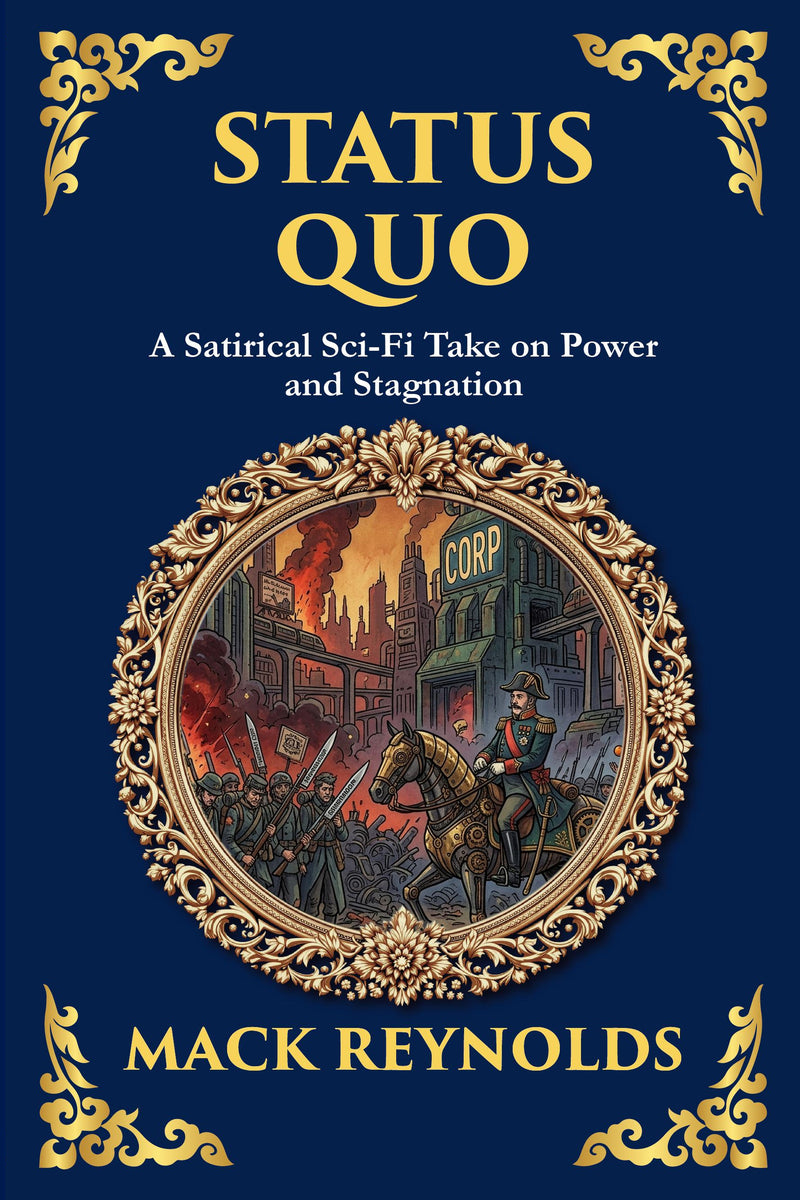
Status Quo
In Status Quo, Mack Reynolds imagines a future where utopia has arrived—at the cost of progress. Citizens are content. The government is efficient.
or free app
10,000+ hrs library
30-day guarantee
The complete Status Quo appears in modern English through Library of Alexandria Press, available online with audiobook narration included for members.
Have you ever wondered why the greatest threat to progress might be the illusion that everything is already perfect? In Status Quo, Mack Reynolds delivers a brilliantly satirical science fiction tale that questions the very foundations of comfort, control, and political equilibrium. Set in a future society where every need is met and every system is “working,” this novella reveals the hidden rot behind a government that thrives not through fear—but through overwhelming contentment.
Meet Rafferty, a political outlier who commits the most dangerous act imaginable: asking “why not change?” In a world allergic to disruption, his questions are met not with violence—but with veiled suppression, false reassurances, and psychological manipulation. As he digs deeper into the machinery of the so-called perfect state, he discovers a sinister logic at its core: stability at the cost of human spirit.
What you’ll discover in this modern edition
- A Chilling Vision of Bureaucratic Utopia – Enter a society that appears ideal, yet is trapped in existential stagnation.
| Formats | eBook (EPUB + PDF) · Audiobook · Paperback · Hardcover · Large Print |
| Language | English |
| Trim size (print) | 6 × 9 in |
| Binding | Paperback — perfect-bound · Hardcover — casewrap |
| Large Print edition | Same text in a larger, easy-read type — a larger font, not a larger trim |
| Print pricing | Every physical book at our true cost — at-cost, no profit (members) |
| Library | 873 restored titles, always growing |
| Length | 28,984 words · ~1 hr 56 min reading |
| Reading level | Grade 3 · an easy, flowing read (this modern-English edition) |
| Edition | Modern English translation · 2026 |
Member reviews for this edition are collected as readers finish it — be the first. Across the library: 12,000+ books shipped, every plan covered by a 365-day print guarantee.
About this edition
A faithful, unabridged modern-English edition by The Library of Alexandria — carefully rendered for today's reader and verified paragraph-by-paragraph against the public-domain source. Available as eBook, audiobook, paperback, hardcover, and large print.
- Complete & unabridgedVerified paragraph by paragraph against the source — never a scan, never abridged.
- Modern English, faithfulReadable today, with the author’s meaning kept intact. Readable — not simplified.
- Every format, one membershipRead in your browser or the free app, or listen to the full audiobook.
Included free with your membership
Cancel anytime, one click · 30-day money-back guarantee
Edition last updated July 2026
What’s inside
Status Quo — complete and unabridged, included in full with membership, plus the full audiobook.
Begin reading Status Quo
In clear modern English — the complete text is included with membership.
Introduction
There is a particular kind of pleasure in discovering a writer who refuses to take the future for granted. So much of science fiction, especially the kind that filled the magazines of the mid-twentieth century, busied itself with the machinery of tomorrow—rockets, ray guns, robots, the gleaming hardware of an imagined age. Mack Reynolds, whose work has too often been filed away under the general heading of “pulp,” was after something more slippery and far more durable. He wanted to know what people would do with the future once they had it. He suspected, with a kind of wry and clear-eyed certainty, that they would do exactly what people have always done: protect their advantages, resist inconvenient change, and quietly arrange the world so that things stay more or less as they are. The very title of the story you are about to read announces that theme without apology. It is a phrase from law and politics, a Latin shorthand for the existing state of affairs, and Reynolds wields it like a scalpel.
To read Reynolds well, it helps to understand what sort of mind produced him, because his fiction is not the work of a daydreamer inventing gadgets in a back room. It is the work of a man who had seen a great deal of the world and thought hard about how its various systems actually function. The story that follows belongs to a tradition of social satire that runs back through Jonathan Swift and forward through writers who used the imagined future as a mirror for the present. What distinguishes Reynolds is that he brought to this tradition a genuine, almost journalistic curiosity about economics, governance, and the slow inertia of institutions. He was less interested in the question “What if we had this technology?” than in the far more uncomfortable question “What if we had this technology and nothing important changed at all?”
Dallas McCord Reynolds was born in 1917 in California into a family already steeped in dissent. His father was a committed socialist and a figure of some prominence in radical political circles, and young Mack grew up in a household where the assumptions most Americans absorbed without thinking—about property, about work, about who gets what and why—were treated as open questions to be debated rather than settled truths to be obeyed. This upbringing left a permanent mark. Throughout his life and his enormous body of work, Reynolds returned again and again to the basic puzzle of how human societies organize themselves, and to the suspicion that the arrangements we treat as natural and eternal are in fact contingent, accidental, and very often rigged.
He did not, however, become a humorless ideologue. Quite the opposite. The most remarkable thing about Reynolds as a thinker is that he subjected every political and economic system to the same skeptical scrutiny—capitalism, communism, technocracy, the welfare state, the utopias of both left and right. He had been a member of the Socialist Labor Party, but he was the kind of socialist who could not resist poking holes in socialism’s own complacencies. He understood that any system, no matter how nobly conceived, hardens over time into a structure that primarily serves the people who already hold power within it. This insight—that revolutions calcify, that reformers become the new establishment, that the machinery built to liberate eventually exists mainly to perpetuate itself—is the beating heart of his best work, and you will find it pulsing throughout the pages ahead.
Before he became a full-time writer, Reynolds led an unusually mobile and observant life. He worked as a journalist and as a foreign correspondent, traveling extensively across Europe, North Africa, the Middle East, the Soviet Union, and Latin America at a time when most Americans rarely ventured beyond their own borders. He lived for years abroad, settling for long stretches in places like Mexico and North Africa, and he made a point of studying how different cultures and economies actually operated on the ground rather than how they were described in textbooks or propaganda. This firsthand exposure to the staggering variety of human social arrangements gave his fiction a texture that purely armchair speculators could never match. When Reynolds writes about a society, you sense that he has stood in its marketplaces, argued with its officials, and noticed who is comfortable and who is not.
During the 1950s and especially the 1960s, Reynolds became one of the most prolific and popular contributors to the science fiction magazines, particularly Analog under the editorship of John W. Campbell, and later Galaxy and If under Frederik Pohl. Campbell, a famously opinionated editor, prized stories that wrestled with ideas, and Reynolds supplied them in abundance. Reader polls of the era repeatedly ranked him among the most beloved authors in the field—a fact that has been somewhat obscured by later critical fashions, which favored stylistic experimentation over the kind of clear, idea-driven storytelling at which Reynolds excelled. But the readers of his day knew exactly what they were getting: stories that entertained on the surface while quietly subverting the assumptions of the reader who came merely to be entertained.
It is worth dwelling on that popularity for a moment, because it tells us something important about the work. Reynolds was not writing obscure manifestos for a coterie of intellectuals. He was writing for a mass audience of ordinary readers, many of them young, and he was smuggling genuinely radical questions into stories that moved briskly, featured competent and engaging protagonists, and delivered the satisfactions of plot. This is satire of a very particular and effective kind. It does not lecture. It seduces. It invites you in with the promise of an adventure and then, somewhere along the way, makes you realize you have been thinking about your own world all along.
Power, Stagnation, and the Comfort of Things as They Are
The story before you takes as its subject one of the most underexamined forces in human affairs: not tyranny, not revolution, not war, but inertia. We are accustomed to thinking of power as something dramatic—the dictator’s iron fist, the general’s army, the tycoon’s empire. But Reynolds understood that the most enduring form of power is the quiet, almost invisible power to keep things from changing. The status quo does not need to win arguments. It does not need to persuade anyone. It only needs to wait, to absorb, to outlast. Every challenge to it can be co-opted, defused, redirected, or simply ignored until the challenger grows tired or old or dies. There is something profoundly unsettling in this recognition, and Reynolds, with his characteristic blend of humor and cold realism, brings it vividly to life.
Consider how rare this theme actually is in the literature of the imagined future. The default mode of science fiction is change—accelerating, transformative, often catastrophic change. We are shown worlds remade by technology, societies overturned by contact with the alien, civilizations rising and falling at dizzying speed. Reynolds, by contrast, dares to imagine a future in which the most powerful institutions have figured out how to prevent meaningful change, to harness the very forces that ought to disrupt them and turn those forces to the service of permanence. This is a darker and more sophisticated vision than the usual fare, precisely because it rings so true. Look around at the institutions that have shaped your own life—governments, corporations, bureaucracies, professions—and ask yourself how many of them have any genuine interest in transforming the conditions that gave them power. The honest answer is sobering, and it is exactly the answer Reynolds wants you to arrive at on your own.
What makes the satire bite is that the defenders of stagnation in Reynolds’s fiction are rarely cartoonish villains. They are reasonable people, often quite likable, who have persuaded themselves that what is good for them is good for everyone, that stability is the highest political value, that the current arrangement—whatever it happens to be—represents not merely one possibility among many but the natural and proper order of things. This is the great psychological insight at the core of the story: the most effective guardians of the status quo are not those who consciously defend it but those who cannot imagine any alternative. They have so thoroughly internalized the existing order that to question it strikes them as not merely wrong but almost unintelligible, a kind of madness or naïveté to be gently corrected.
Reynolds was writing during the Cold War, an era defined by a global standoff between two enormous systems, each of which claimed to represent the future and each of which had, in its own way, settled into a defensive crouch dedicated above all to its own preservation. He observed how both superpowers, for all their revolutionary rhetoric, had become deeply conservative in the most literal sense—obsessed with conserving their own existence, their own elites, their own way of doing things. The arms race, the espionage, the proxy wars, the endless ideological posturing: to Reynolds these often looked less like a clash of competing futures than like an elaborate machinery for ensuring that nothing fundamental ever shifted. Two giant status quos, locked in a frozen embrace, each preventing the other from changing and both preventing the world from moving forward. You will hear echoes of this historical moment throughout the story, but you need not be a student of Cold War history to feel their force, because the underlying pattern is permanent. There will always be a status quo. There will always be those who benefit from it. And there will always be the question of whether anything can be done about it.
The story also engages, with considerable wit, the perennial fantasy of the reformer—the individual or small group who sees clearly what is wrong and sets out to fix it. Reynolds is deeply sympathetic to such figures; one senses that he counted himself among them. But he is also ruthlessly honest about the obstacles they face, and not merely the obvious obstacles of opposition and repression. The subtler difficulty is that the would-be reformer is operating inside the very system he wishes to change, dependent on its resources, constrained by its rules, vulnerable to its rewards and punishments. The system has a remarkable capacity to absorb its critics, to give them titles and offices and salaries, to channel their energies into committees and studies and proposals that go nowhere. The most dangerous thing the status quo can do to a rebel is not to crush him but to promote him. Reynolds knew this, and the knowledge gives his treatment of reform a melancholy depth beneath its comic surface.
I want to be careful here not to reveal the particular turns this story takes, because much of its pleasure lies in watching Reynolds work out his ideas through character and incident, in seeing how the abstract themes I have been describing take concrete and often surprising shape on the page. What I can promise is that you will find here the qualities that made Reynolds a favorite of his era’s most discerning readers: a clean, propulsive narrative; protagonists who are intelligent and resourceful without being superhuman; a future that feels lived-in and plausible rather than merely decorative; and, threaded through it all, a steady stream of genuine ideas that will keep working on your mind long after the last page. Reynolds respected his readers. He did not believe that entertainment and thought were opposed. He believed, rightly, that the best entertainment makes you think and that the best thinking can be enormously entertaining.
There is also a particular quality of dry humor in Reynolds that deserves mention, because it is easy to miss if you read too quickly. He rarely goes for the broad laugh. His comedy is the comedy of recognition—the moment when you see a character behaving exactly as people in such circumstances always do, defending the indefensible with perfect sincerity, mistaking habit for wisdom and self-interest for principle. It is the humor of a man who has watched a great many institutions operate and has noticed how predictably absurd they become. This kind of satire ages remarkably well, because human nature does not change as fast as technology, and the follies Reynolds catalogues are the same follies we commit today, merely dressed in different costumes.
Cancel anytime, one click · 30-day money-back guarantee
Founding annual rate available now — your price locks for life when you join.
Not ready? Get this free chapter by email — read it anytime.
✓ Sent — check your inbox for Status Quo.
Questions about Status Quo
What is Status Quo about?
In Status Quo, Mack Reynolds imagines a future where utopia has arrived—at the cost of progress. Citizens are content. The government is efficient.
Who wrote Status Quo?
Status Quo was written by Mack Reynolds. This edition presents the complete work in clear modern English, faithfully rendered from the public-domain original by Library of Alexandria Press.
Is Status Quo free to read?
The opening chapter is free to read on this page. Members read and listen to the complete work — and the entire library — free, and can order any physical book at our true print cost.
How long is Status Quo?
2 chapters (~28,984 words) — about 1 hr 56 min of reading in this modern-English edition.
Is this an abridged version of Status Quo?
No. This is the complete, unabridged Status Quo, carefully rendered into clear modern English and verified paragraph-by-paragraph against the public-domain source — nothing is cut or summarised.
What formats does Status Quo come in?
Status Quo is available as eBook, paperback, hardcover and large print. eBook and audiobook are included with membership; printed editions ship at our true print cost.
Shipping & returns
Billing & membership
More from the library


Explore Free eBooks
- Kant's Prolegomena to Any Future Metaphysics · Immanuel Kant
- The Advancement of Learning · Francis Bacon
- The Dawn of Day · Friedrich Nietzsche
- Meditations · Marcus Aurelius
- The Confessions of St. Augustine · Saint Augustine of Hippo
- Resurrection · Leo Tolstoy
- Dialogues Concerning Natural Religion · David Hume
- As You Like It · William Shakespeare
- Jack and Jill · Louisa May Alcott
- Dream Psychology: Psychoanalysis for Beginners · Sigmund Freud
- The Raven · Edgar Allan Poe
- Considerations on Representative Government · John Stuart Mill
- The Will to Power: An Attempted Transvaluation of All Values. Book III and IV · Friedrich Nietzsche
- Tarzan of the Apes · Edgar Rice Burroughs
- Fundamental Principles of the Metaphysic of Morals · Immanuel Kant
- The Confessions of Jean Jacques Rousseau — Complete · Jean-Jacques Rousseau
- The Merchant of Venice · William Shakespeare
- Democracy in America — Volume 2 · Alexis de Tocqueville
- Ecce Homo · Friedrich Wilhelm Nietzsche
- Second Treatise of Government · John Locke
- The Wonderful Wizard of Oz · L. Frank Baum
- The Prince · Niccolò Machiavelli
- Anne of Green Gables · L. M. Montgomery
- De Profundis · Oscar Wilde
- Thus Spake Zarathustra: A Book for All and None · Friedrich Nietzsche
- Anna Karenina · Leo Tolstoy
- Great Expectations · Charles Dickens
- The Island of Doctor Moreau · H. G. Wells
- A Midsummer Night's Dream · William Shakespeare
- The Strange Case of Dr. Jekyll and Mr. Hyde · Robert Louis Stevenson
Status Quo
Status Quo
A Satirical Sci-Fi Story About Power and Stagnation
Mack Reynolds
Contents
- Introduction
- Status Quo
Introduction
There is a particular kind of pleasure in discovering a writer who refuses to take the future for granted. So much of science fiction, especially the kind that filled the magazines of the mid-twentieth century, busied itself with the machinery of tomorrow—rockets, ray guns, robots, the gleaming hardware of an imagined age. Mack Reynolds, whose work has too often been filed away under the general heading of “pulp,” was after something more slippery and far more durable. He wanted to know what people would do with the future once they had it. He suspected, with a kind of wry and clear-eyed certainty, that they would do exactly what people have always done: protect their advantages, resist inconvenient change, and quietly arrange the world so that things stay more or less as they are. The very title of the story you are about to read announces that theme without apology. It is a phrase from law and politics, a Latin shorthand for the existing state of affairs, and Reynolds wields it like a scalpel.
To read Reynolds well, it helps to understand what sort of mind produced him, because his fiction is not the work of a daydreamer inventing gadgets in a back room. It is the work of a man who had seen a great deal of the world and thought hard about how its various systems actually function. The story that follows belongs to a tradition of social satire that runs back through Jonathan Swift and forward through writers who used the imagined future as a mirror for the present. What distinguishes Reynolds is that he brought to this tradition a genuine, almost journalistic curiosity about economics, governance, and the slow inertia of institutions. He was less interested in the question “What if we had this technology?” than in the far more uncomfortable question “What if we had this technology and nothing important changed at all?”
Dallas McCord Reynolds was born in 1917 in California into a family already steeped in dissent. His father was a committed socialist and a figure of some prominence in radical political circles, and young Mack grew up in a household where the assumptions most Americans absorbed without thinking—about property, about work, about who gets what and why—were treated as open questions to be debated rather than settled truths to be obeyed. This upbringing left a permanent mark. Throughout his life and his enormous body of work, Reynolds returned again and again to the basic puzzle of how human societies organize themselves, and to the suspicion that the arrangements we treat as natural and eternal are in fact contingent, accidental, and very often rigged.
He did not, however, become a humorless ideologue. Quite the opposite. The most remarkable thing about Reynolds as a thinker is that he subjected every political and economic system to the same skeptical scrutiny—capitalism, communism, technocracy, the welfare state, the utopias of both left and right. He had been a member of the Socialist Labor Party, but he was the kind of socialist who could not resist poking holes in socialism’s own complacencies. He understood that any system, no matter how nobly conceived, hardens over time into a structure that primarily serves the people who already hold power within it. This insight—that revolutions calcify, that reformers become the new establishment, that the machinery built to liberate eventually exists mainly to perpetuate itself—is the beating heart of his best work, and you will find it pulsing throughout the pages ahead.
Before he became a full-time writer, Reynolds led an unusually mobile and observant life. He worked as a journalist and as a foreign correspondent, traveling extensively across Europe, North Africa, the Middle East, the Soviet Union, and Latin America at a time when most Americans rarely ventured beyond their own borders. He lived for years abroad, settling for long stretches in places like Mexico and North Africa, and he made a point of studying how different cultures and economies actually operated on the ground rather than how they were described in textbooks or propaganda. This firsthand exposure to the staggering variety of human social arrangements gave his fiction a texture that purely armchair speculators could never match. When Reynolds writes about a society, you sense that he has stood in its marketplaces, argued with its officials, and noticed who is comfortable and who is not.
During the 1950s and especially the 1960s, Reynolds became one of the most prolific and popular contributors to the science fiction magazines, particularly Analog under the editorship of John W. Campbell, and later Galaxy and If under Frederik Pohl. Campbell, a famously opinionated editor, prized stories that wrestled with ideas, and Reynolds supplied them in abundance. Reader polls of the era repeatedly ranked him among the most beloved authors in the field—a fact that has been somewhat obscured by later critical fashions, which favored stylistic experimentation over the kind of clear, idea-driven storytelling at which Reynolds excelled. But the readers of his day knew exactly what they were getting: stories that entertained on the surface while quietly subverting the assumptions of the reader who came merely to be entertained.
It is worth dwelling on that popularity for a moment, because it tells us something important about the work. Reynolds was not writing obscure manifestos for a coterie of intellectuals. He was writing for a mass audience of ordinary readers, many of them young, and he was smuggling genuinely radical questions into stories that moved briskly, featured competent and engaging protagonists, and delivered the satisfactions of plot. This is satire of a very particular and effective kind. It does not lecture. It seduces. It invites you in with the promise of an adventure and then, somewhere along the way, makes you realize you have been thinking about your own world all along.
Power, Stagnation, and the Comfort of Things as They Are
The story before you takes as its subject one of the most underexamined forces in human affairs: not tyranny, not revolution, not war, but inertia. We are accustomed to thinking of power as something dramatic—the dictator’s iron fist, the general’s army, the tycoon’s empire. But Reynolds understood that the most enduring form of power is the quiet, almost invisible power to keep things from changing. The status quo does not need to win arguments. It does not need to persuade anyone. It only needs to wait, to absorb, to outlast. Every challenge to it can be co-opted, defused, redirected, or simply ignored until the challenger grows tired or old or dies. There is something profoundly unsettling in this recognition, and Reynolds, with his characteristic blend of humor and cold realism, brings it vividly to life.
Consider how rare this theme actually is in the literature of the imagined future. The default mode of science fiction is change—accelerating, transformative, often catastrophic change. We are shown worlds remade by technology, societies overturned by contact with the alien, civilizations rising and falling at dizzying speed. Reynolds, by contrast, dares to imagine a future in which the most powerful institutions have figured out how to prevent meaningful change, to harness the very forces that ought to disrupt them and turn those forces to the service of permanence. This is a darker and more sophisticated vision than the usual fare, precisely because it rings so true. Look around at the institutions that have shaped your own life—governments, corporations, bureaucracies, professions—and ask yourself how many of them have any genuine interest in transforming the conditions that gave them power. The honest answer is sobering, and it is exactly the answer Reynolds wants you to arrive at on your own.
What makes the satire bite is that the defenders of stagnation in Reynolds’s fiction are rarely cartoonish villains. They are reasonable people, often quite likable, who have persuaded themselves that what is good for them is good for everyone, that stability is the highest political value, that the current arrangement—whatever it happens to be—represents not merely one possibility among many but the natural and proper order of things. This is the great psychological insight at the core of the story: the most effective guardians of the status quo are not those who consciously defend it but those who cannot imagine any alternative. They have so thoroughly internalized the existing order that to question it strikes them as not merely wrong but almost unintelligible, a kind of madness or naïveté to be gently corrected.
Reynolds was writing during the Cold War, an era defined by a global standoff between two enormous systems, each of which claimed to represent the future and each of which had, in its own way, settled into a defensive crouch dedicated above all to its own preservation. He observed how both superpowers, for all their revolutionary rhetoric, had become deeply conservative in the most literal sense—obsessed with conserving their own existence, their own elites, their own way of doing things. The arms race, the espionage, the proxy wars, the endless ideological posturing: to Reynolds these often looked less like a clash of competing futures than like an elaborate machinery for ensuring that nothing fundamental ever shifted. Two giant status quos, locked in a frozen embrace, each preventing the other from changing and both preventing the world from moving forward. You will hear echoes of this historical moment throughout the story, but you need not be a student of Cold War history to feel their force, because the underlying pattern is permanent. There will always be a status quo. There will always be those who benefit from it. And there will always be the question of whether anything can be done about it.
The story also engages, with considerable wit, the perennial fantasy of the reformer—the individual or small group who sees clearly what is wrong and sets out to fix it. Reynolds is deeply sympathetic to such figures; one senses that he counted himself among them. But he is also ruthlessly honest about the obstacles they face, and not merely the obvious obstacles of opposition and repression. The subtler difficulty is that the would-be reformer is operating inside the very system he wishes to change, dependent on its resources, constrained by its rules, vulnerable to its rewards and punishments. The system has a remarkable capacity to absorb its critics, to give them titles and offices and salaries, to channel their energies into committees and studies and proposals that go nowhere. The most dangerous thing the status quo can do to a rebel is not to crush him but to promote him. Reynolds knew this, and the knowledge gives his treatment of reform a melancholy depth beneath its comic surface.
I want to be careful here not to reveal the particular turns this story takes, because much of its pleasure lies in watching Reynolds work out his ideas through character and incident, in seeing how the abstract themes I have been describing take concrete and often surprising shape on the page. What I can promise is that you will find here the qualities that made Reynolds a favorite of his era’s most discerning readers: a clean, propulsive narrative; protagonists who are intelligent and resourceful without being superhuman; a future that feels lived-in and plausible rather than merely decorative; and, threaded through it all, a steady stream of genuine ideas that will keep working on your mind long after the last page. Reynolds respected his readers. He did not believe that entertainment and thought were opposed. He believed, rightly, that the best entertainment makes you think and that the best thinking can be enormously entertaining.
There is also a particular quality of dry humor in Reynolds that deserves mention, because it is easy to miss if you read too quickly. He rarely goes for the broad laugh. His comedy is the comedy of recognition—the moment when you see a character behaving exactly as people in such circumstances always do, defending the indefensible with perfect sincerity, mistaking habit for wisdom and self-interest for principle. It is the humor of a man who has watched a great many institutions operate and has noticed how predictably absurd they become. This kind of satire ages remarkably well, because human nature does not change as fast as technology, and the follies Reynolds catalogues are the same follies we commit today, merely dressed in different costumes.
For men in his income bracket and in his neighborhood, government employees between twenty-five and thirty-five were all wearing tweed. Tweed was the current trend. Not wearing it was considered socially inferior.
Lawrence Woolford wore tweed. His suit, which he was wearing this morning, had been crafted on a hand loom in Donegal. It was tailored by a Swede who was popular among the ambitious young professionals in Woolford’s social class; English tailors were currently out of style, and Italian ones were completely unknown.
Woolford strolled down the path in front of his auto-bungalow, frowning at the sports car parked at the curb—it was the wrong year and the wrong brand. He would have to trade it in for a newer model. In a way, it was a pity because he actually liked the car. However, he didn’t want to be seen as an oddball by his friends and coworkers. What had Senator Carey MacArthur said recently? “Show me an oddball, and I’ll show you someone who has taken the first step toward becoming a Communist.”
Woolford slid behind the wheel, pulled the lift lever, gently pressed the accelerator, and drove toward downtown Greater Washington. Technically, he still had four days of vacation left. He wondered what the Boss wanted. That was the problem with being one of the Boss’s favorite problem-solvers; whenever trouble started, you ended up right in the middle of it. Lawrence Woolford had reached the point where he wanted to stop doing field work and get a desk job, which would mean a higher rank and better pay.
He handed his car over to an attendant at the departmental parking lot and entered through the door used by mid-level officials. He told himself that in another year, he would be using the other entrance.
End of the free sample
Keep reading, free
Members read and listen to the complete book — and the entire library. Cancel anytime, one click · 30-day money-back guarantee.