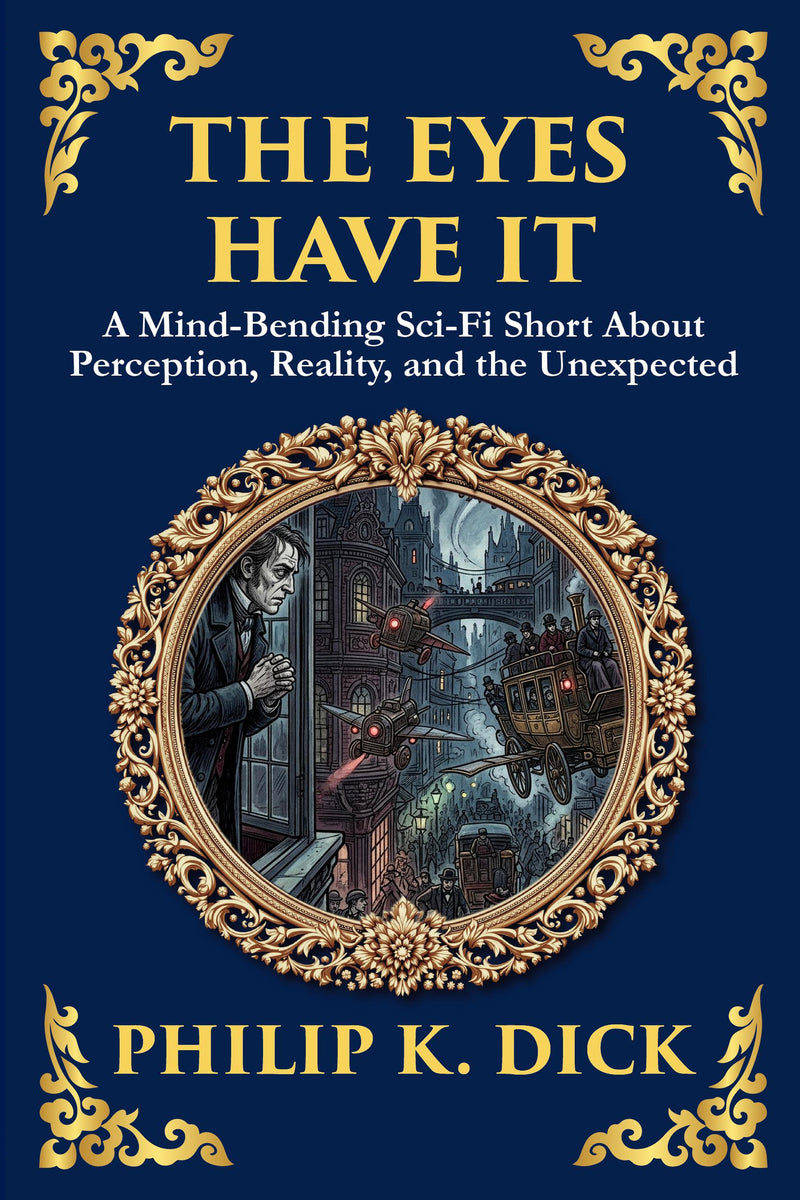
The Eyes Have It
When a man reads a seemingly ordinary science fiction story, something strange begins to happen. The more he reads, the more convinced he becomes that the world around him isn’t what it seems.
or free app
10,000+ hrs library
30-day guarantee
The complete The Eyes Have It appears in modern English through Library of Alexandria Press, available online with audiobook narration included for members.
Have you ever wondered why the truth is sometimes hidden in plain sight? The Eyes Have It is a sharp, humorous, and surreal short story from legendary sci-fi author Philip K. Dick—an author known for blurring the lines between illusion and reality. In this brief but brilliant narrative, a man’s innocent reading session spirals into something deeply strange when he begins to misinterpret the language in a science fiction novel.
As metaphors become literal and descriptions turn bizarre, his mind takes him on a paranoid journey into a world that no longer makes sense. Eyes being removed. Limbs being taken off.
People “giving each other the eye.” What is going on—and is it the book that’s strange, or the reader’s perception? This story is a playful critique of over-analysis, a satire of science fiction tropes, and a metaphysical puzzle disguised as comedy. A bite-sized piece of speculative brilliance, The Eyes Have It delivers exactly what Philip K. Dick fans love: existential tension, unreliable reality, and a twist that flips everything on its head.
What you’ll discover in this modern edition
- A Compact, Clever Story with Big Ideas – Even at just a few pages, this tale explores the psychology of perception and paranoia.
- One of Philip K. Dick’s Most Surprising Pieces – Unlike his more serious dystopias, this story blends sci-fi with absurdist humor.
- A Satirical Gem for Modern Readers – Perfect for fans of irony, language play, and stories that subvert expectations.
- A Gateway into the Mind of a Sci-Fi Visionary – A great introduction to the themes Dick would expand on in Do Androids Dream of Electric Sheep and Ubik.
- An Accessible Read with Philosophical Depth – Easy to read, hard to forget, and open to multiple interpretations. Whether you’re a long-time fan of Philip K.
| Formats | eBook (EPUB + PDF) · Audiobook · Paperback · Hardcover · Large Print |
| Language | English |
| Trim size (print) | 6 × 9 in |
| Binding | Paperback — perfect-bound · Hardcover — casewrap |
| Large Print edition | Same text in a larger, easy-read type — a larger font, not a larger trim |
| Print pricing | Every physical book at our true cost — at-cost, no profit (members) |
| Library | 873 restored titles, always growing |
| Length | 4,723 words · ~19 min reading |
| Reading level | Grade 11 · a confident, adult read (this modern-English edition) |
| Edition | Modern English translation · 2026 |
Member reviews for this edition are collected as readers finish it — be the first. Across the library: 12,000+ books shipped, every plan covered by a 365-day print guarantee.
About this edition
A faithful, unabridged modern-English edition by The Library of Alexandria — carefully rendered for today's reader and verified paragraph-by-paragraph against the public-domain source. Available as eBook, audiobook, paperback, hardcover, and large print.
- Complete & unabridgedVerified paragraph by paragraph against the source — never a scan, never abridged.
- Modern English, faithfulReadable today, with the author’s meaning kept intact. Readable — not simplified.
- Every format, one membershipRead in your browser or the free app, or listen to the full audiobook.
Included free with your membership
Cancel anytime, one click · 30-day money-back guarantee
Edition last updated July 2026
What’s inside
The Eyes Have It — complete and unabridged, included in full with membership, plus the full audiobook.
Begin reading The Eyes Have It
In clear modern English — the complete text is included with membership.
Introduction
There are writers who entertain us, and there are writers who unsettle us, and then there is Philip K. Dick, who does something far rarer and more dangerous: he makes us doubt the very ground beneath our feet. To read Dick is to feel the floor of certainty quietly dissolve, to discover that the most ordinary assumptions about what is real, what is solid, and what can be trusted are not nearly as stable as we had imagined. The short story you are about to read is one of his most playful and accessible works, a brief and brilliant comic gem that nonetheless carries within it the seeds of every great question Dick would spend his entire career wrestling with. It is funny, it is clever, and it is over almost before you realize what has happened to you. But like so much of his work, it leaves behind a faint and persistent aftertaste—the sense that perhaps you have been let in on a cosmic joke whose punchline keeps expanding the longer you think about it.
This piece occupies a special place in the vast and frequently turbulent body of work that Philip K. Dick produced across his lifetime. Where many of his stories and novels plunge the reader into states of paranoia, dread, and metaphysical vertigo, this one approaches the same fundamental concerns from a completely different angle. It is light where so much of his work is dark. It is comic where so much of his work is anguished. And yet it is built upon precisely the same foundation: the conviction that perception is not a reliable window onto reality, that the mind is constantly engaged in the act of interpretation, and that the interpretations we arrive at can be spectacularly, hilariously, and sometimes terrifyingly wrong. To begin your reading with this story is to encounter Dick at his most welcoming, his most disarming, and—in a sly and sideways manner—his most characteristic.
What follows in these introductory pages is meant to prepare you for the experience of reading without spoiling the pleasures that await. I will say nothing here that gives away the central conceit or the turns the narrative takes, because to do so would be to rob you of the very thing that makes this story sparkle. Instead, I want to offer you something more valuable: a sense of the man who wrote it, the era that produced it, the ideas that animate it, and the particular way of reading that will allow you to receive its full delight. Consider this a doorway rather than a map. The territory beyond is best discovered on your own.
Philip Kindred Dick was born in Chicago in 1928, one half of a pair of twins; his sister Jane died only weeks after their birth, and that early loss haunted him throughout his life, surfacing again and again in the doubled and divided characters who populate his fiction. He grew up largely in California, a state whose sprawling suburbs, sun-bleached strip malls, and atmosphere of restless reinvention would become the natural habitat of his imagination. Dick was a voracious reader, a brilliant and troubled mind, and a man who struggled throughout his life with poverty, anxiety, failed marriages, and periods of profound mental and spiritual turmoil. He wrote at a furious pace, often fueled by amphetamines, producing an enormous quantity of work in a relatively short span of years. He died in 1982, at the age of fifty-three, just as Hollywood was beginning to discover that his strange and visionary ideas might translate into spectacular cinema.
It is one of the great ironies of literary history that Dick spent most of his career in obscurity and financial hardship, dismissed by many in the literary establishment as a mere pulp science fiction writer, churning out stories for magazines that paid by the word and were read by a relatively narrow audience of genre enthusiasts. He never lived to see the full flowering of his reputation. Today, he is recognized as one of the most important and influential American writers of the twentieth century, a figure whose ideas have penetrated so deeply into our culture that we scarcely notice them anymore. The questions he asked—about whether we can trust our perceptions, about what it means to be human in a world of machines and simulations, about the fragility of the consensus we call reality—have become the defining questions of our digital age. Films, television, music, philosophy, and the everyday vocabulary we use to describe our increasingly mediated lives all bear his fingerprints.
But to understand the story before you, it helps to understand the period in which it was written. This piece belongs to the early phase of Dick’s career, the years when he was primarily a writer of short fiction, publishing prolifically in the science fiction magazines of the era. These magazines, with their lurid covers and breathless titles, were the proving ground for an entire generation of writers. They demanded economy, ingenuity, and above all a hook—a twist, a reversal, a clever idea that could be deployed in a few thousand words and leave the reader satisfied. Dick mastered this form even as he transcended it. He learned to pack enormous conceptual weight into compact narratives, to set up a premise with deceptive simplicity and then detonate it with a single revelatory stroke.
What distinguished Dick from his contemporaries, even in these early years, was the peculiar quality of his imagination. While many science fiction writers of the period were concerned with the hardware of the future—the rockets, the robots, the gleaming machinery of technological progress—Dick was concerned with something far more intimate and far more unsettling. He was interested in the inner experience of consciousness, in the way the mind constructs its model of the world, and in what happens when that model breaks down. His stories are full of ordinary people, often small and harried and overwhelmed, who suddenly find that the reality they took for granted has become strange, slippery, and possibly false. He had a genius for taking the most mundane circumstances and infusing them with a creeping sense of wrongness, for finding the uncanny lurking just beneath the surface of the everyday.
This particular story showcases another, less frequently celebrated dimension of Dick’s talent: his sense of humor. For all the darkness and anxiety that pervades so much of his work, Dick possessed a sharp and irrepressible wit, a comic sensibility that delighted in absurdity, wordplay, and the comedy of misunderstanding. He understood that the same mechanisms of perception and interpretation that can produce terror can also produce farce. When the mind leaps to a conclusion based on insufficient evidence, the result might be paranoia and dread—or it might be the purest comedy. In this story, Dick chooses comedy, and he plays the game with a gleeful, almost mischievous lightness of touch. The result is a piece that demonstrates how versatile his central preoccupations could be, how the same fundamental insight about the unreliability of perception could be turned to laughter as easily as to fear.
It is worth pausing to appreciate just how unusual this is. The themes that Dick explored most often—the dissolution of reality, the failure of perception, the question of what is genuine and what is illusory—are themes that lend themselves naturally to horror and existential dread. It takes a particular kind of imaginative agility to recognize that these same themes can be the engine of a joke, and to construct that joke with such precision that it works perfectly while also illuminating something true about the way our minds operate. This story is, in a sense, a magic trick performed in broad daylight. You can watch every move, and yet the effect still lands.
Perception, Reality, and the Comedy of Misreading
At the heart of nearly everything Philip K. Dick ever wrote lies a single, deceptively simple question: How do we know what is real? It is a question that philosophers have wrestled with for thousands of years, from the ancient skeptics who doubted whether we could trust our senses, to Descartes imagining an evil demon who might be deceiving him about the entire external world, to the modern thinkers who wonder whether we might be living inside a simulation. Dick took this venerable philosophical question and made it visceral, immediate, and personal. He dramatized it. He gave it characters and plots and emotional stakes. He turned epistemology—the study of knowledge and how we acquire it—into a form of entertainment that could grip a reader by the throat.
The particular insight that animates the story you are about to read is that reality, as we experience it, is not simply given to us. It is constructed. Our minds are not passive recorders of an objective world; they are active interpreters, constantly taking in fragments of sensory data and assembling them into a coherent picture. We do not see the world directly. We see our brain’s best guess about the world, a model built from incomplete information, prior expectations, and inherited assumptions. Most of the time, this process works smoothly and invisibly, and we have no awareness that it is happening at all. The model and the reality line up well enough that we never notice the gap between them.
But what happens when the process goes wrong? What happens when the mind, working from limited evidence, constructs a model that is utterly mistaken—and then proceeds to act upon that model with complete confidence? This is the territory Dick loved to explore, and it is the territory this story inhabits with such impish delight. The story turns on an act of interpretation, on the way a mind can take a set of facts and arrange them into a picture that is internally consistent, emotionally compelling, and entirely, gloriously incorrect. And because we, as readers, are positioned to see both the mistaken interpretation and the truth behind it, we are invited into a kind of delicious dramatic irony, watching a misunderstanding unfold with a clarity that the character involved utterly lacks.
This is the source of the story’s comedy, but it is also the source of its depth. Because once you have laughed at the misreading at the center of this tale, you may find yourself wondering: How often do I do this? How often does my own mind take a handful of observations and leap to a confident conclusion that has no basis in reality? How many of my certainties are merely interpretations that happen to feel certain? The story is light and brief, but the door it opens onto these questions is genuine. Dick has a way of slipping his most serious ideas in through the side entrance, dressed up as a joke, so that you have swallowed them before you realize what they are.
There is something especially resonant about these concerns in our own moment. We live in an age saturated with information, much of it fragmentary, decontextualized, and ambiguous. We are constantly engaged in the act of interpretation, drawing conclusions from headlines, from images, from snippets of conversation, from the curated fragments that flow endlessly across our screens. And we are constantly, demonstrably, getting it wrong—mistaking the part for the whole, reading meanings into things that are not there, constructing elaborate narratives from insufficient evidence and then defending them with the fervor of true believers. Dick saw all of this coming, in a sense. He understood that the gap between perception and reality is the great vulnerability of the human mind, the place where error and delusion and manipulation all enter. This little comic story is, in its modest way, a fable about that vulnerability, and it speaks to our condition with surprising directness.
The genius of the story lies in how unforced all of this is. Dick is not lecturing. He is not delivering a treatise on epistemology. He is telling a funny story, and the funny story happens to be built on a profound truth about how minds work. This is the mark of a real artist: the ability to embed ideas so seamlessly within the texture of narrative that the reader experiences them as pleasure rather than instruction. You can read this story purely for the laugh, and you will be rewarded. You can read it for the ideas, and you will be rewarded again, more deeply. And you can read it as a window into the entire body of Dick’s work, a single bright thread that, when you follow it, leads into the vast and shadowed labyrinth of his larger imagination.
Cancel anytime, one click · 30-day money-back guarantee
Founding annual rate available now — your price locks for life when you join.
Not ready? Get this free chapter by email — read it anytime.
✓ Sent — check your inbox for The Eyes Have It.
Questions about The Eyes Have It
What is The Eyes Have It about?
When a man reads a seemingly ordinary science fiction story, something strange begins to happen. The more he reads, the more convinced he becomes that the world around him isn’t what it seems. But what if the problem isn’t the story—what if it’s how he's seeing the world?
Who wrote The Eyes Have It?
The Eyes Have It was written by Philip K. Dick. This edition presents the complete work in clear modern English, faithfully rendered from the public-domain original by Library of Alexandria Press.
Is The Eyes Have It free to read?
The opening chapter is free to read on this page. Members read and listen to the complete work — and the entire library — free, and can order any physical book at our true print cost.
How long is The Eyes Have It?
2 chapters (~4,723 words) — about 19 min of reading in this modern-English edition.
Is this an abridged version of The Eyes Have It?
No. This is the complete, unabridged The Eyes Have It, carefully rendered into clear modern English and verified paragraph-by-paragraph against the public-domain source — nothing is cut or summarised.
What formats does The Eyes Have It come in?
The Eyes Have It is available as eBook, paperback and large print. eBook and audiobook are included with membership; printed editions ship at our true print cost.
Shipping & returns
Billing & membership
More from the library


Explore Humour & Satire
- The Imaginary Invalid · Molière
- My Man Jeeves · P. G. Wodehouse
- Barry Lyndon · William Makepeace Thackeray
- The Man with Two Left Feet, and Other Stories · P. G. Wodehouse
- Carry On, Jeeves · P. G. Wodehouse
- The Confidence-Man: His Masquerade · Herman Melville
- Lucian’s True History · Lucian of Samosata
- Penrod · Booth Tarkington
- Status Quo · Mack Reynolds
- Herland · Charlotte Perkins Gilman
- Sartor Resartus: The Life and Opinions of Herr Teufelsdröckh · Thomas Carlyle
- The Satyricon of Petronius Arbiter · Petronius Arbiter
- Three Men in a Boat (To Say Nothing of the Dog) · Jerome K. Jerome
- A Connecticut Yankee in King Arthur’s Court · Mark Twain
- Northanger Abbey · Jane Austen
- Once Aboard the Lugger—The History of George and his Mary · A. S. M. Hutchinson
- Candide · Voltaire
- Gulliver’s Travels into Several Remote Regions of the World · Jonathan Swift
- Emma · Jane Austen
- A Room with a View · E. M. Forster
- The Wind in the Willows · Kenneth Grahame
- Right Ho, Jeeves · P. G. Wodehouse
- The Mysterious Stranger and Other Stories · Mark Twain
- A Modest Proposal · Jonathan Swift
The Eyes Have It
The Eyes Have It
A Mind-Bending Sci-Fi Short About Perception, Reality, and the Unexpected
Philip K. Dick
Contents
- Introduction
- The Eyes Have It
Introduction
There are writers who entertain us, and there are writers who unsettle us, and then there is Philip K. Dick, who does something far rarer and more dangerous: he makes us doubt the very ground beneath our feet. To read Dick is to feel the floor of certainty quietly dissolve, to discover that the most ordinary assumptions about what is real, what is solid, and what can be trusted are not nearly as stable as we had imagined. The short story you are about to read is one of his most playful and accessible works, a brief and brilliant comic gem that nonetheless carries within it the seeds of every great question Dick would spend his entire career wrestling with. It is funny, it is clever, and it is over almost before you realize what has happened to you. But like so much of his work, it leaves behind a faint and persistent aftertaste—the sense that perhaps you have been let in on a cosmic joke whose punchline keeps expanding the longer you think about it.
This piece occupies a special place in the vast and frequently turbulent body of work that Philip K. Dick produced across his lifetime. Where many of his stories and novels plunge the reader into states of paranoia, dread, and metaphysical vertigo, this one approaches the same fundamental concerns from a completely different angle. It is light where so much of his work is dark. It is comic where so much of his work is anguished. And yet it is built upon precisely the same foundation: the conviction that perception is not a reliable window onto reality, that the mind is constantly engaged in the act of interpretation, and that the interpretations we arrive at can be spectacularly, hilariously, and sometimes terrifyingly wrong. To begin your reading with this story is to encounter Dick at his most welcoming, his most disarming, and—in a sly and sideways manner—his most characteristic.
What follows in these introductory pages is meant to prepare you for the experience of reading without spoiling the pleasures that await. I will say nothing here that gives away the central conceit or the turns the narrative takes, because to do so would be to rob you of the very thing that makes this story sparkle. Instead, I want to offer you something more valuable: a sense of the man who wrote it, the era that produced it, the ideas that animate it, and the particular way of reading that will allow you to receive its full delight. Consider this a doorway rather than a map. The territory beyond is best discovered on your own.
Philip Kindred Dick was born in Chicago in 1928, one half of a pair of twins; his sister Jane died only weeks after their birth, and that early loss haunted him throughout his life, surfacing again and again in the doubled and divided characters who populate his fiction. He grew up largely in California, a state whose sprawling suburbs, sun-bleached strip malls, and atmosphere of restless reinvention would become the natural habitat of his imagination. Dick was a voracious reader, a brilliant and troubled mind, and a man who struggled throughout his life with poverty, anxiety, failed marriages, and periods of profound mental and spiritual turmoil. He wrote at a furious pace, often fueled by amphetamines, producing an enormous quantity of work in a relatively short span of years. He died in 1982, at the age of fifty-three, just as Hollywood was beginning to discover that his strange and visionary ideas might translate into spectacular cinema.
It is one of the great ironies of literary history that Dick spent most of his career in obscurity and financial hardship, dismissed by many in the literary establishment as a mere pulp science fiction writer, churning out stories for magazines that paid by the word and were read by a relatively narrow audience of genre enthusiasts. He never lived to see the full flowering of his reputation. Today, he is recognized as one of the most important and influential American writers of the twentieth century, a figure whose ideas have penetrated so deeply into our culture that we scarcely notice them anymore. The questions he asked—about whether we can trust our perceptions, about what it means to be human in a world of machines and simulations, about the fragility of the consensus we call reality—have become the defining questions of our digital age. Films, television, music, philosophy, and the everyday vocabulary we use to describe our increasingly mediated lives all bear his fingerprints.
But to understand the story before you, it helps to understand the period in which it was written. This piece belongs to the early phase of Dick’s career, the years when he was primarily a writer of short fiction, publishing prolifically in the science fiction magazines of the era. These magazines, with their lurid covers and breathless titles, were the proving ground for an entire generation of writers. They demanded economy, ingenuity, and above all a hook—a twist, a reversal, a clever idea that could be deployed in a few thousand words and leave the reader satisfied. Dick mastered this form even as he transcended it. He learned to pack enormous conceptual weight into compact narratives, to set up a premise with deceptive simplicity and then detonate it with a single revelatory stroke.
What distinguished Dick from his contemporaries, even in these early years, was the peculiar quality of his imagination. While many science fiction writers of the period were concerned with the hardware of the future—the rockets, the robots, the gleaming machinery of technological progress—Dick was concerned with something far more intimate and far more unsettling. He was interested in the inner experience of consciousness, in the way the mind constructs its model of the world, and in what happens when that model breaks down. His stories are full of ordinary people, often small and harried and overwhelmed, who suddenly find that the reality they took for granted has become strange, slippery, and possibly false. He had a genius for taking the most mundane circumstances and infusing them with a creeping sense of wrongness, for finding the uncanny lurking just beneath the surface of the everyday.
This particular story showcases another, less frequently celebrated dimension of Dick’s talent: his sense of humor. For all the darkness and anxiety that pervades so much of his work, Dick possessed a sharp and irrepressible wit, a comic sensibility that delighted in absurdity, wordplay, and the comedy of misunderstanding. He understood that the same mechanisms of perception and interpretation that can produce terror can also produce farce. When the mind leaps to a conclusion based on insufficient evidence, the result might be paranoia and dread—or it might be the purest comedy. In this story, Dick chooses comedy, and he plays the game with a gleeful, almost mischievous lightness of touch. The result is a piece that demonstrates how versatile his central preoccupations could be, how the same fundamental insight about the unreliability of perception could be turned to laughter as easily as to fear.
It is worth pausing to appreciate just how unusual this is. The themes that Dick explored most often—the dissolution of reality, the failure of perception, the question of what is genuine and what is illusory—are themes that lend themselves naturally to horror and existential dread. It takes a particular kind of imaginative agility to recognize that these same themes can be the engine of a joke, and to construct that joke with such precision that it works perfectly while also illuminating something true about the way our minds operate. This story is, in a sense, a magic trick performed in broad daylight. You can watch every move, and yet the effect still lands.
Perception, Reality, and the Comedy of Misreading
At the heart of nearly everything Philip K. Dick ever wrote lies a single, deceptively simple question: How do we know what is real? It is a question that philosophers have wrestled with for thousands of years, from the ancient skeptics who doubted whether we could trust our senses, to Descartes imagining an evil demon who might be deceiving him about the entire external world, to the modern thinkers who wonder whether we might be living inside a simulation. Dick took this venerable philosophical question and made it visceral, immediate, and personal. He dramatized it. He gave it characters and plots and emotional stakes. He turned epistemology—the study of knowledge and how we acquire it—into a form of entertainment that could grip a reader by the throat.
The particular insight that animates the story you are about to read is that reality, as we experience it, is not simply given to us. It is constructed. Our minds are not passive recorders of an objective world; they are active interpreters, constantly taking in fragments of sensory data and assembling them into a coherent picture. We do not see the world directly. We see our brain’s best guess about the world, a model built from incomplete information, prior expectations, and inherited assumptions. Most of the time, this process works smoothly and invisibly, and we have no awareness that it is happening at all. The model and the reality line up well enough that we never notice the gap between them.
But what happens when the process goes wrong? What happens when the mind, working from limited evidence, constructs a model that is utterly mistaken—and then proceeds to act upon that model with complete confidence? This is the territory Dick loved to explore, and it is the territory this story inhabits with such impish delight. The story turns on an act of interpretation, on the way a mind can take a set of facts and arrange them into a picture that is internally consistent, emotionally compelling, and entirely, gloriously incorrect. And because we, as readers, are positioned to see both the mistaken interpretation and the truth behind it, we are invited into a kind of delicious dramatic irony, watching a misunderstanding unfold with a clarity that the character involved utterly lacks.
This is the source of the story’s comedy, but it is also the source of its depth. Because once you have laughed at the misreading at the center of this tale, you may find yourself wondering: How often do I do this? How often does my own mind take a handful of observations and leap to a confident conclusion that has no basis in reality? How many of my certainties are merely interpretations that happen to feel certain? The story is light and brief, but the door it opens onto these questions is genuine. Dick has a way of slipping his most serious ideas in through the side entrance, dressed up as a joke, so that you have swallowed them before you realize what they are.
There is something especially resonant about these concerns in our own moment. We live in an age saturated with information, much of it fragmentary, decontextualized, and ambiguous. We are constantly engaged in the act of interpretation, drawing conclusions from headlines, from images, from snippets of conversation, from the curated fragments that flow endlessly across our screens. And we are constantly, demonstrably, getting it wrong—mistaking the part for the whole, reading meanings into things that are not there, constructing elaborate narratives from insufficient evidence and then defending them with the fervor of true believers. Dick saw all of this coming, in a sense. He understood that the gap between perception and reality is the great vulnerability of the human mind, the place where error and delusion and manipulation all enter. This little comic story is, in its modest way, a fable about that vulnerability, and it speaks to our condition with surprising directness.
The genius of the story lies in how unforced all of this is. Dick is not lecturing. He is not delivering a treatise on epistemology. He is telling a funny story, and the funny story happens to be built on a profound truth about how minds work. This is the mark of a real artist: the ability to embed ideas so seamlessly within the texture of narrative that the reader experiences them as pleasure rather than instruction. You can read this story purely for the laugh, and you will be rewarded. You can read it for the ideas, and you will be rewarded again, more deeply. And you can read it as a window into the entire body of Dick’s work, a single bright thread that, when you follow it, leads into the vast and shadowed labyrinth of his larger imagination.
I discovered this incredible alien invasion of Earth completely by accident. I haven’t done anything about it yet because I can’t think of what to do. I wrote to the government, but they just sent me a brochure on how to maintain a frame house. Anyway, the secret is out; I’m not the only one who’s noticed. Maybe it’s already under control.
I was sitting in my easy chair, flipping through a paperback someone had left on the bus, when I found the reference that first put me on the trail. For a moment, I didn’t react. It took a while for the full meaning to sink in. Once I understood, it seemed strange that I hadn’t noticed it immediately.
The text was clearly referring to a non-human species with incredible abilities that didn’t originate on Earth. I should mention that this species usually pretends to be ordinary humans. However, their disguise became obvious based on the author’s observations. It was clear the author knew everything—and he was totally casual about it. The line (which still makes me shudder) read:
I felt a sudden chill. I tried to imagine the eyes. Did they roll like coins? The passage suggested not; they seemed to move through the air rather than across a surface. They moved quite quickly, apparently. No one in the story was surprised, which is what tipped me off. There was no sign of shock at such an outrageous thing. Later, the point was made even clearer.
That was it in a nutshell. The eyes had clearly detached from the rest of his body and were moving on their own. My heart pounded and I could barely breathe. I had stumbled upon a casual mention of a completely unknown race—obviously not from Earth. Yet, to the characters in the book, it was perfectly normal, which suggested they belonged to the same species.
End of the free sample
Keep reading, free
Members read and listen to the complete book — and the entire library. Cancel anytime, one click · 30-day money-back guarantee.